REVIEW 3 major objections 5 minor 39 references
The paper claims that positioning an intelligent reflecting surface in the near field of a sparse-array base station, at a specific geometric location, can make user channels nearly orthogonal, enabling spatial multiplexing with simple prec
Reviewed by Pith at T0; open to challenge. T0 means a machine referee read the full paper against a public rubric. the ladder, T0–T4 →
T0 review · deepseek-v4-flash
2026-08-03 11:08 UTC pith:U6TZTCAI
load-bearing objection The paper's headline bound g_jk < 2/M is false—the proof reverses an inequality—and the correct residual is O(1/√N), independent of M; the deployment criterion is still worth attention, but the main quantitative claim doesn't survive. the 3 major comments →
Engineering Favorable Propagation: Near-Field IRS Deployment for Spatial Multiplexing
The pith
A machine-rendered reading of the paper's core claim, the machinery that carries it, and where it could break.
Core claim
The central discovery is a deterministic deployment criterion: for a symmetric IRS placement with equal y- and z-direction cosines, and with the fundamental phase increment Δ = πλ ζ_BS ζ_IRS μ_x μ_y / (2l) set equal to qπ/M (q even, gcd(q/2,M)=1, and M > N_u+N_v−2), the squared Dirichlet kernel that governs inter-user correlation is sampled exactly at its nulls. As a result, all cross-user correlation terms vanish except the zero-lag term, and the favorable-propagation metric g_jk is strictly less than 2/M. This converts a far-field rank-one channel into a near-field full-rank set of sub-channels, restoring spatial multiplexing without requiring instantaneous CSI at the transmitter.
What carries the argument
The machinery is the array factor of the sparse base station array, expressed as a squared Dirichlet kernel f_M(x) = (sin(Mx/2)/sin(x/2))^2. The deployment criterion places the inter-element phase differences Δ_{s,t} — which grow with array sparsity factors and shrink with IRS distance — exactly on the kernel's nulls, so that only the zero-lag term survives in the variance of the user-channel inner product. This null-sampling trick is what turns random favorable statistics into a deterministic decorrelation guarantee.
Load-bearing premise
The paper proves the correlation bound for an average over random IRS phase shifts, but the deployed system uses one optimized phase configuration; it is not proven that the realized inner products under that single configuration satisfy the same bound.
What would settle it
Take the optimized phase solution from Algorithm 1, fix it, and compute g_jk from (21) (or directly from channel realizations) without averaging over phases. If the result is not bounded by 2/M, the deployment criterion does not suffice to guarantee favorable propagation for the deployed configuration.
If this is right
- If the criterion holds, a base station with M antennas can serve up to M/2 users with near-orthogonal channels, even in pure line-of-sight.
- The low-complexity MRT precoder, which just matches the channel, becomes near-optimal because inter-user interference is already suppressed by geometry.
- Only statistical (long-term) CSI is needed for the joint phase-shift and power-allocation design, dramatically reducing channel estimation overhead.
- The result gives a concrete physical design rule: choose IRS location, array sparsity, and number of elements so that Δ = qπ/M with the stated parity and coprimality conditions.
Where Pith is reading between the lines
- The deployment criterion may be extendable to more general IRS placements (non-symmetric, or with unequal y/z direction cosines) by generalizing the null-sampling condition to two-dimensional kernel sampling; the paper only treats the symmetric case.
- Because the guarantee is derived by averaging over random IRS phase shifts, a natural test is whether optimized phases preserve the decorrelation; if they do, the statistical argument could be replaced by a deterministic one.
- The same null-sampling idea might be applied to other passive arrays (e.g., reconfigurable intelligent surfaces used as relays) to engineer orthogonal channels for non-MIMO applications like integrated sensing and communication.
- In practice, the criterion requires knowing the IRS's direction cosines relative to the BS; small positional errors would shift Δ and could degrade the bound, suggesting a robustness analysis as a next step.
Editorial analysis
A structured set of objections, weighed in public.
Referee Report
Summary. The paper proposes a deterministic deployment strategy for IRS-assisted sparse MIMO systems operating in the near field. The BS–IRS link is modeled with a second-order spherical-wavefront approximation and the IRS–user links as far-field paths. The authors show that in the far-field regime the cascaded channel is rank-one and user correlation is 1, whereas in the near field the spherical wavefront, accentuated by sparse array spacings, can decorrelate user channels. Under an i.i.d. random-IRS-phase model, Lemma 1 derives the variance of the cascaded inner product, Theorem 1 expresses the favorable-propagation metric g_jk in terms of a squared Dirichlet kernel, and Proposition 2 gives a null-placement deployment criterion Δ = qπ/M. Corollary 1 then claims the bound g_jk < 2/M. Based on these favorable statistics, the paper formulates an ergodic sum-rate maximization with MRT precoding and alternating optimization of IRS phases and power allocation using statistical CSI, and validates the approach by simulation.
Significance. The paper's central idea is appealing and potentially significant: if a simple geometric condition can make cascaded LoS channels favorable for spatial multiplexing, it would provide a low-complexity alternative to instantaneous-CSI interference management in IRS-aided systems. The derivation is largely self-contained: Lemma 1 is a correct application of random-phase averaging, the Dirichlet-kernel structure in Theorem 1 is a clean and useful observation, and the exact closed form in Proposition 2/Corollary 1 (before the final inequality) is verifiable. The simulations validate the analytical metric in (21) and show that the deployment criterion improves EDoF and sum-rate. However, the paper's headline quantitative guarantee (Corollary 1) is false as stated, and the theoretical guarantee is for the random-phase ensemble rather than for the deterministic optimized phase vector used in the proposed algorithm. These issues affect load-bearing claims, but the underlying geometric insight and the exact computation are salvageable.
major comments (3)
- [§III-C, Corollary 1 and Eq. (35)] The chain in Eq. (35) contains a reversed inequality. From the stated condition M > 2√N − 2 one obtains 2/M < 1/(√N − 1), not 1/(√N − 1) < 2/M. Thus the step labeled (b) is invalid. Concretely, for the simulation parameters N=1600 and M=128 (which satisfy M>2√N−2), g_jk = (2N+1)/(3N^{3/2}) = 3201/192000 ≈ 0.01667, while 2/M = 0.015625, so the claimed bound fails in the paper's own setup. The correct simplification, g_jk ≈ 2/(3√N), is independent of M. This is not a cosmetic typo: the theorem that 'deployment alone bounds g_jk by 2/M' is false, and the accompanying narrative that the BS antenna count M governs spatial separability (Proposition 1) must be reconciled with the fact that the exact post-deployment metric does not depend on M. The exact formula (34) is correct, so the issue is fixable, but the statement of Corollary 1 and the discussion following it need substantive revision.
- [§III-B to §IV (random-phase vs. optimized-phase transfer)] The favorable-propagation metric g_jk in (19)–(21) is defined as a variance with respect to i.i.d. U[0,2π) IRS phase shifts, and Theorem 1, Proposition 2, and Corollary 1 bound this averaged quantity. In contrast, the system in Section IV uses a single deterministic phase vector θ produced by Algorithm 1. The paper does not prove that the realized inner products under this optimized θ inherit the small averaged correlation. The deployment criterion alone therefore does not justify the claim that the actual MRT precoding operates in a favorable-propagation channel. This is a conceptual gap between the theoretical analysis and the algorithmic/performance claims. The authors should either extend the analysis to the optimized phase configuration (e.g., a high-probability or worst-case bound) or explicitly reframe the theoretical contribution as characterizing the random-phase propagation env
- [§III-C, Proposition 1 vs. Corollary 1] There is an apparent tension in the scaling story that should be resolved. Proposition 1 states that for fixed M, increasing N alone cannot drive g_jk to zero. Yet under the deployment criterion, the exact expression (34) tends to zero as N grows, with no M dependence. The resolution is that the deployment condition M > 2√N − 2 forces M to grow with N, but this is not stated clearly. After correcting Corollary 1, the paper should state explicitly that under the deployment rule the residual correlation scales as O(1/√N) and is driven by the IRS dimension N, while M serves only to satisfy the null-placement condition. Currently the text leaves the impression that the bound improves with M, which is not correct.
minor comments (5)
- [Eq. (35)] Inequality (a) divides by √N − 1; for N=1 this is undefined. Restrict the statement to N>1 or handle the case separately.
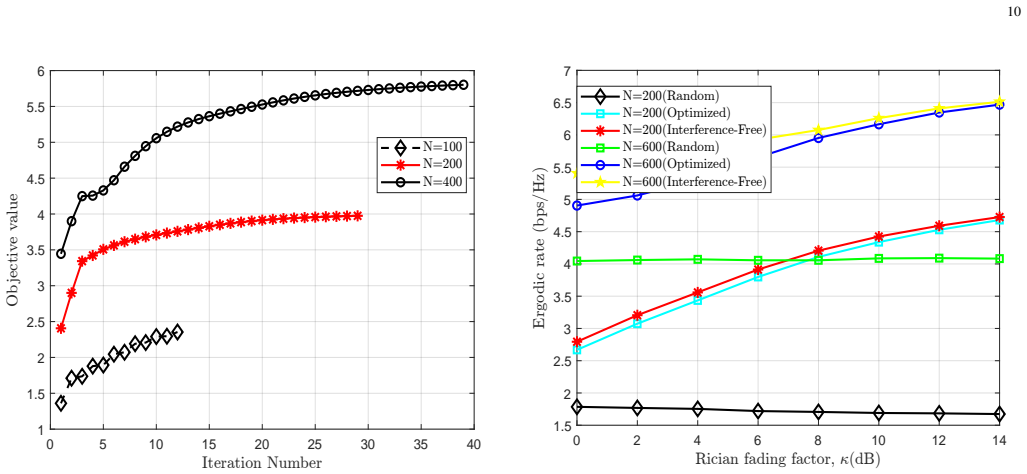
- [Fig. 2 and Fig. 4 captions] The legends use '1BS=1; 1IRS=1' and '2BS=1; 2IRS=1'; these should read ζ_BS and ζ_IRS to be consistent with the notation in Section II.
- [§IV-A, MRT precoding and statistical CSI] The precoding vector w_k = √p_k h_k in (40) requires instantaneous cascaded CSI, but the abstract and problem formulation emphasize that the optimization uses only long-term statistical CSI. Clarify that only the phase/power optimization is statistical while the MRT beamformer itself uses instantaneous h_k, or adjust the wording to avoid apparent inconsistency.
- [§IV, convergence statement] The statement 'The alternating optimization structure guarantees the algorithm's convergence to a stationary point' is made without proof or citation. Since the phase subproblem is non-convex even after relaxation, a convergence argument or a reference to a standard block-coordinate-descent result should be provided.
- [§III-B, proof of Proposition 1] The proof is sketchy, relying on an informal Riemann-integral approximation. It would strengthen the paper to give a precise asymptotic statement or move the detailed argument to an appendix.
Circularity Check
No significant circularity: the deployment criterion is derived self-consistently from the channel model; self-citations are background only.
full rationale
The paper's central chain is self-contained. Lemma 1 derives var{h_j^H h_k} for i.i.d. uniform IRS phases directly from the definition of the favorable-propagation metric (19). Theorem 1 substitutes the second-order distance expansion (14) into the Gram-matrix elements and obtains the Dirichlet-kernel expression (21). Proposition 2 imposes the explicit null-alignment condition Δ = qπ/M and computes the surviving k=0 term, with no parameter fitted to any data set and no assumption that already contains the target bound. Corollary 1 is an intended mathematical consequence of (30), although its inequality appears to reverse direction; that is a correctness issue, not a circularity. The self-citations ([18], [27], [28], [29]) are used only as background on IRS deployment and channel customization; none is invoked as a uniqueness theorem or as the load-bearing justification for the favorable-propagation result. The main weakness is the transfer from random-phase statistics (Theorem 1/Proposition 2) to the deterministic optimized phase vector in Section IV, since the paper does not prove that realized inner products inherit the same variance bound. That is an unproven premise/gap, not an equivalence-by-construction, and the numerical section validates the same model rather than an external benchmark. Accordingly, no circular step is exhibited.
Axiom & Free-Parameter Ledger
free parameters (3)
- q (integer in deployment criterion) =
2 in reported simulations (even, gcd(q/2,M)=1)
- Array sparsity factors ζ_BS, ζ_IRS =
3 and 6 in the default simulation
- IRS center position r_IRS =
[-0.72, 0.51, 0.51] m in the default simulation
axioms (6)
- domain assumption Second-order Taylor expansion of the BS–IRS distance (Eq. 14) is valid for the considered sparse apertures and distances.
- domain assumption The BS–IRS channel is pure LoS free-space with identical amplitude for all element pairs (Eq. 1).
- domain assumption IRS–user channels are in the far field with planar-wave array responses (Eq. 3).
- ad hoc to paper IRS phase shifts are modeled as i.i.d. U[0,2π) random variables in the theoretical analysis (Section III-B).
- standard math Far-field array response vectors have unit-modulus entries, so |[g_k]_n|=1 for all n.
- domain assumption IRS–user links follow a Rician fading model with independent complex Gaussian NLoS components (Eq. 36).
Cite this review
Pith. "Pith review of Engineering Favorable Propagation: Near-Field IRS Deployment for Spatial Multiplexing." pith.science (2026). https://pith.science/paper/U6TZTCAI
@misc{pith2026260107317,
  author       = {Pith},
  title        = {Pith review of: Engineering Favorable Propagation: Near-Field IRS Deployment for Spatial Multiplexing},
  year         = {2026},
  howpublished = {\url{https://pith.science/paper/U6TZTCAI}},
  note         = {Machine review of arXiv:2601.07317}
}
read the original abstract
In intelligent reflecting surface IRS assisted multiple input multiple output MIMO systems, a strong line of sight LoS link is required to compensate for the severe cascaded path loss. However, such a link renders the effective channel highly rank deficient and fundamentally limits spatial multiplexing. To overcome this limitation, this paper leverages the large aperture of sparse arrays to harness near field spherical wavefronts, and establishes a deterministic deployment criterion that strategically positions the IRS in the near field of a base station BS. This placement exploits the spherical wavefronts of the BS IRS link to engineer decorrelated channels, thereby fundamentally overcoming the rank deficiency issue in far field cascaded channels. Based on a physical channel model for the sparse BS array and the IRS, we characterize the rank properties and inter user correlation of the cascaded BS IRS user channel. We further derive a closed form favorable propagation metric that reveals how the sparse array geometry and the IRS position can be tuned to reduce inter user channel correlation. The resulting geometry driven deployment rule provides a simple guideline for creating a favorable propagation environment with enhanced effective degrees of freedom. The favorable channel statistics induced by our deployment criterion enable a low complexity maximum ratio transmission MRT precoding scheme. This serves as the foundation for an efficient algorithm that jointly optimizes the IRS phase shifts and power allocation based solely on long term statistical channel state information CSI. Simulation results validate the effectiveness of our deployment criterion and demonstrate that our optimization framework achieves significant performance gains over benchmark schemes.
Figures



Reference graph
Works this paper leans on
-
[1]
On the road to 6G: Visions, requirements, key technologies, and testbeds,
C.-X. Wang, X. You, X. Gao, X. Zhu, Z. Li, C. Zhang, H. Wang, Y . Huang, Y . Chen, H. Haas, J. S. Thompson, E. G. Larsson, M. D. Renzo, W. Tong, P. Zhu, X. Shen, H. V . Poor, and L. Hanzo, “On the road to 6G: Visions, requirements, key technologies, and testbeds,”IEEE Commun. Surveys Tuts., vol. 25, no. 2, pp. 905–974, Feb. 2023
2023
-
[2]
A tutorial on extremely large-scale MIMO for 6g: Fundamentals, signal processing, and applications,
Z. Wang, J. Zhang, H. Du, D. Niyato, S. Cui, B. Ai, M. Debbah, K. B. Letaief, and H. V . Poor, “A tutorial on extremely large-scale MIMO for 6g: Fundamentals, signal processing, and applications,”IEEE Commun. Surveys Tuts., vol. 26, no. 3, pp. 1560–1605, Jan. 2024
2024
-
[3]
Near-field mimo communica- tions for 6g: Fundamentals, challenges, potentials, and future directions,
M. Cui, Z. Wu, Y . Lu, X. Wei, and L. Dai, “Near-field mimo communica- tions for 6g: Fundamentals, challenges, potentials, and future directions,” IEEE Commun. Mag., vol. 61, no. 1, pp. 40–46, Sep. 2023
2023
-
[4]
6g wireless communications: From far-field beam steering to near-field beam focusing,
H. Zhang, N. Shlezinger, F. Guidi, D. Dardari, and Y . C. Eldar, “6g wireless communications: From far-field beam steering to near-field beam focusing,”IEEE Commun. Mag., vol. 61, no. 4, pp. 72–77, Mar. 2023
2023
-
[5]
Multi-user modular xl-mimo communications: Near-field beam focusing pattern and user grouping,
X. Li, Z. Dong, Y . Zeng, S. Jin, and R. Zhang, “Multi-user modular xl-mimo communications: Near-field beam focusing pattern and user grouping,”IEEE Trans. Wireless Commun., vol. 23, no. 10, pp. 13 766– 13 781, May 2024
2024
-
[6]
A tutorial on near-field XL-MIMO communications toward 6g,
H. Lu, Y . Zeng, C. You, Y . Han, J. Zhang, Z. Wang, Z. Dong, S. Jin, C.-X. Wang, T. Jiang, X. You, and R. Zhang, “A tutorial on near-field XL-MIMO communications toward 6g,”IEEE Commun. Surveys Tuts., vol. 26, no. 4, pp. 2213–2257, Apr. 2024
2024
-
[7]
Effective dof- oriented optimal antenna spacing in near-field XL-MIMO systems,
X. Chen, H. Ren, C. Pan, Z. Peng, and J. Wang, “Effective dof- oriented optimal antenna spacing in near-field XL-MIMO systems,” arXiv preprint arXiv:2501.07062, 2025
Pith/arXiv arXiv 2025
-
[8]
Near-field modeling and performance analysis for multi-user extremely large-scale MIMO communication,
H. Lu and Y . Zeng, “Near-field modeling and performance analysis for multi-user extremely large-scale MIMO communication,”IEEE Communications Letters, vol. 26, no. 2, pp. 277–281, Nov. 2022
2022
-
[9]
Near-field communica- tions: What will be different?
Y . Liu, J. Xu, Z. Wang, X. Mu, and L. Hanzo, “Near-field communica- tions: What will be different?”IEEE Wireless Communications, vol. 32, no. 2, pp. 262–270, Mar. 2025
2025
-
[10]
H. Wang, C. Feng, Y . Zeng, S. Jin, C. Yuen, B. Clerckx, and R. Zhang, “Enhancing spatial multiplexing and interference suppression for near- and far-field communications with sparse MIMO,”arXiv preprint arXiv:2408.01956, 2024
Pith/arXiv arXiv 2024
-
[11]
Sparse array design via integer linear programming,
Y . Zhuang, X. Zhang, Z. He, M. S. Greco, and F. Gini, “Sparse array design via integer linear programming,”IEEE Trans. Signal Process., vol. 72, pp. 4812–4826, Sep. 2024
2024
-
[12]
Sparse mimo for isac: New opportunities and challenges,
X. Li, H. Min, Y . Zeng, S. Jin, L. Dai, Y . Yuan, and R. Zhang, “Sparse mimo for isac: New opportunities and challenges,”IEEE Wireless Commun., vol. 32, no. 4, pp. 170–178, Mar. 2025
2025
-
[13]
Sparse array enabled near-field communications: Beam pattern analysis and hybrid beamforming design,
C. Zhou, C. You, H. Zhang, L. Chen, and S. Shi, “Sparse array enabled near-field communications: Beam pattern analysis and hybrid beamforming design,”arXiv preprint arXiv:2401.05690, 2024
arXiv 2024
-
[14]
Near-field multiuser communications based on sparse arrays,
K. Chen, C. Qi, G. Y . Li, and O. A. Dobre, “Near-field multiuser communications based on sparse arrays,”IEEE J. Sel. Topics Signal Process, vol. 18, no. 4, pp. 619–632, Jun. 2024
2024
-
[15]
Near-field commu- nications for extremely large-scale MIMO: A beamspace perspective,
K. Chen, C. Qi, J. Huang, O. A. Dobre, and G. Y . Li, “Near-field commu- nications for extremely large-scale MIMO: A beamspace perspective,” IEEE Commun. Mag., vol. 63, no. 5, pp. 166–172, Jan. 2025
2025
-
[16]
Communicating with large intelligent surfaces: Fundamen- tal limits and models,
D. Dardari, “Communicating with large intelligent surfaces: Fundamen- tal limits and models,”IEEE J. Sel. Areas Commun., vol. 38, no. 11, pp. 2526–2537, Jul. 2020
2020
-
[17]
Weighted sum-rate of intelligent reflecting surface aided multiuser downlink trans- mission with statistical csi,
Q. Tao, S. Zhang, C. Zhong, W. Xu, H. Lin, and Z. Zhang, “Weighted sum-rate of intelligent reflecting surface aided multiuser downlink trans- mission with statistical csi,”IEEE Trans. Wireless Commun., vol. 21, no. 7, pp. 4925–4937, Jul. 2022
2022
-
[18]
Q. Wu, Y . Zhu, Q. Peng, W. Hao, Y . Hou, F. Yang, W. Yan, G. Wang, W. Chen, and C. Qiu, “Intelligent reflecting surfaces for THz commu- nications: Fundamentals, key solutions, and system prototyping,”arXiv preprint arXiv:2506.17200, 2025
Pith/arXiv arXiv 2025
-
[19]
Reconfigurable intelligent surface deployment for wideband millimeter wave systems,
X. Mo, L. Gui, K. Ying, X. Sang, and X. Diao, “Reconfigurable intelligent surface deployment for wideband millimeter wave systems,” IEEE Trans. Commun., vol. 72, no. 5, pp. 2989–3004, Jan. 2024
2024
-
[20]
RIS-aided wireless communications: Extra degrees of freedom via rotation and location optimization,
Y . Cheng, W. Peng, C. Huang, G. C. Alexandropoulos, C. Yuen, and M. Debbah, “RIS-aided wireless communications: Extra degrees of freedom via rotation and location optimization,”IEEE Trans. Wireless Commun., vol. 21, no. 8, pp. 6656–6671, Mar. 2022
2022
-
[21]
Intelligent reflecting surface aided green communication with deployment optimization,
J. Bai, Q. Yan, H.-M. Wang, and Y . Liu, “Intelligent reflecting surface aided green communication with deployment optimization,”IEEE Trans. Commun., vol. 72, no. 8, pp. 5130–5144, Mar. 2024
2024
-
[22]
Reconfigurable intelligent surfaces for energy efficiency in wireless communication,
C. Huang, A. Zappone, G. C. Alexandropoulos, M. Debbah, and C. Yuen, “Reconfigurable intelligent surfaces for energy efficiency in wireless communication,”IEEE Trans. Wireless Commun., vol. 18, no. 8, pp. 4157–4170, Jun. 2019
2019
-
[23]
Inter- ference leakage minimization in RIS-assisted MIMO interference chan- nels,
I. Santamaria, M. Soleymani, E. Jorswieck, and J. Gutiérrez, “Inter- ference leakage minimization in RIS-assisted MIMO interference chan- nels,” inProc. IEEE Int. Conf. Acoust., Speech Signal Process.(ICASSP), Jun. 2023, pp. 1–5
2023
-
[24]
RIS- aided interference subspace alignment for k -user MIMO interference networks,
W. Liu, A. Li, Y . Xu, Z. Zhang, Y . Zhang, and B. Jiang, “RIS- aided interference subspace alignment for k -user MIMO interference networks,”IEEE Commun. Lett., vol. 28, no. 8, pp. 1919–1923, Jun. 2024
1919
-
[25]
RIS-assisted multi-user MISO communications exploiting statistical csi,
X. Gan, C. Zhong, C. Huang, and Z. Zhang, “RIS-assisted multi-user MISO communications exploiting statistical csi,”IEEE Trans. Commun., vol. 69, no. 10, pp. 6781–6792, Jul. 2021
2021
-
[26]
Power scaling law analysis and phase shift optimization of RIS-aided massive mimo systems with statistical csi,
K. Zhi, C. Pan, H. Ren, and K. Wang, “Power scaling law analysis and phase shift optimization of RIS-aided massive mimo systems with statistical csi,”IEEE Trans. Commun., vol. 70, no. 5, pp. 3558–3574, Mar. 2022
2022
-
[27]
Intelligent reflecting surfaces for wireless networks: Deployment architectures, key solutions, and field trials,
Q. Wu, G. Chen, Q. Peng, W. Chen, Y . Yuan, Z. Cheng, J. Dou, Z. Zhao, and P. Li, “Intelligent reflecting surfaces for wireless networks: Deployment architectures, key solutions, and field trials,”IEEE Wireless Commun., pp. 1–9, May 2025
2025
-
[28]
Spatial multiplexing oriented channel reconfiguration in multi-IRS aided MIMO systems,
Y . Chen, Q. Wu, G. Chen, and W. Chen, “Spatial multiplexing oriented channel reconfiguration in multi-IRS aided MIMO systems,”IEEE Trans. Veh. Technol., vol. 74, no. 6, pp. 9840–9845, Feb. 2025
2025
-
[29]
Channel customization for joint Tx-RISs-Rx design in hybrid mmWave systems,
W. Chen, C.-K. Wen, X. Li, and S. Jin, “Channel customization for joint Tx-RISs-Rx design in hybrid mmWave systems,”IEEE Trans. Wireless Commun., vol. 22, no. 11, pp. 8304–8319, Nov. 2023
2023
-
[30]
X. Cui, K.-H. Park, and M.-S. Alouini, “Channel capacity saturation point and beamforming acceleration for near-field XL-MIMO multiuser communications,”arXiv preprint arXiv:2503.18118, 2025
Pith/arXiv arXiv 2025
-
[31]
Analytical framework for effective degrees of freedom in near-field XL-MIMO,
Z. Wang, J. Zhang, W. Yi, H. Xiao, H. Du, D. Niyato, B. Ai, and D. W. K. Ng, “Analytical framework for effective degrees of freedom in near-field XL-MIMO,”IEEE Trans. Wireless Commun., vol. 24, no. 4, pp. 3465–3482, Jan. 2025
2025
-
[32]
Extremely large-scale MIMO: Fundamentals, challenges, solutions, and future directions,
Z. Wang, J. Zhang, H. Du, W. E. I. Sha, B. Ai, D. Niyato, and M. Debbah, “Extremely large-scale MIMO: Fundamentals, challenges, solutions, and future directions,”IEEE Wireless Commun., vol. 31, no. 3, pp. 117–124, Apr. 2024
2024
-
[33]
Near-field wideband beamforming for extremely large antenna arrays,
M. Cui and L. Dai, “Near-field wideband beamforming for extremely large antenna arrays,”IEEE Trans. Commun., vol. 23, no. 10, pp. 13 110– 13 124, Oct. 2024
2024
-
[34]
How to differentiate between near field and far field: Revisiting the rayleigh distance,
S. Sun, R. Li, C. Han, X. Liu, L. Xue, and M. Tao, “How to differentiate between near field and far field: Revisiting the rayleigh distance,”IEEE Commun. Mag., vol. 63, no. 1, pp. 22–28, Jan. 2025
2025
-
[35]
Approaching massive MIMO performance with reconfigurable intelli- gent surfaces: We do not need many antennas,
G. Interdonato, F. Di Murro, C. D’Andrea, G. Di Gennaro, and S. Buzzi, “Approaching massive MIMO performance with reconfigurable intelli- gent surfaces: We do not need many antennas,”IEEE Trans. Commun., vol. 73, no. 6, pp. 4000–4016, Nov. 2024
2024
-
[36]
Active-passive IRS aided wireless communication: New hybrid architecture and elements allocation opti- mization,
Z. Kang, C. You, and R. Zhang, “Active-passive IRS aided wireless communication: New hybrid architecture and elements allocation opti- mization,”IEEE Trans. Wireless Commun., vol. 23, no. 4, pp. 3450– 3464, Apr. 2024. 13
2024
-
[37]
Fractional programming for communication systems—part i: Power control and beamforming,
K. Shen and W. Yu, “Fractional programming for communication systems—part i: Power control and beamforming,”IEEE Trans. Signal Process., vol. 66, no. 10, pp. 2616–2630, May 2018
2018
-
[38]
Fractional programming for communication systems—part ii: Uplink scheduling via matching,
K. Shen and W. Yu, “Fractional programming for communication systems—part ii: Uplink scheduling via matching,”IEEE Trans. Signal Process., vol. 66, no. 10, pp. 2631–2644, May 2018
2018
-
[39]
Cvx: Matlab software for disciplined convex programming, version 1.21,
M. Grant, “Cvx: Matlab software for disciplined convex programming, version 1.21,”http://cvxr. com/cvx, 2011
2011
discussion (0)
Sign in with ORCID, Apple, or X to comment. Anyone can read and Pith papers without signing in.