REVIEW 4 major objections 5 minor 88 references
UWB Radar-based Heart Rate Monitoring: A Transfer Learning Approach
T0 review · 4 major / 5 minor · reviewed 2026-08-06 · deepseek-v4-flash
Pith's one-line read Heart-rate features learned on 60 GHz FMCW radar transfer to 8 GHz IR-UWB radar, cutting UWB error from 5.4 to 4.1 bpm after fine-tuning.
desk verdict First FMCW-to-IR-UWB transfer result for heart rate is worth knowing about, but the 25% gain is not a clean estimate of transfer benefit because the baseline and transfer conditions differ by more than pretraining. read the letter →
The pith
A machine-rendered reading of the paper's core claim, the machinery that carries it, and where it could break.
The reading
What carries the argument
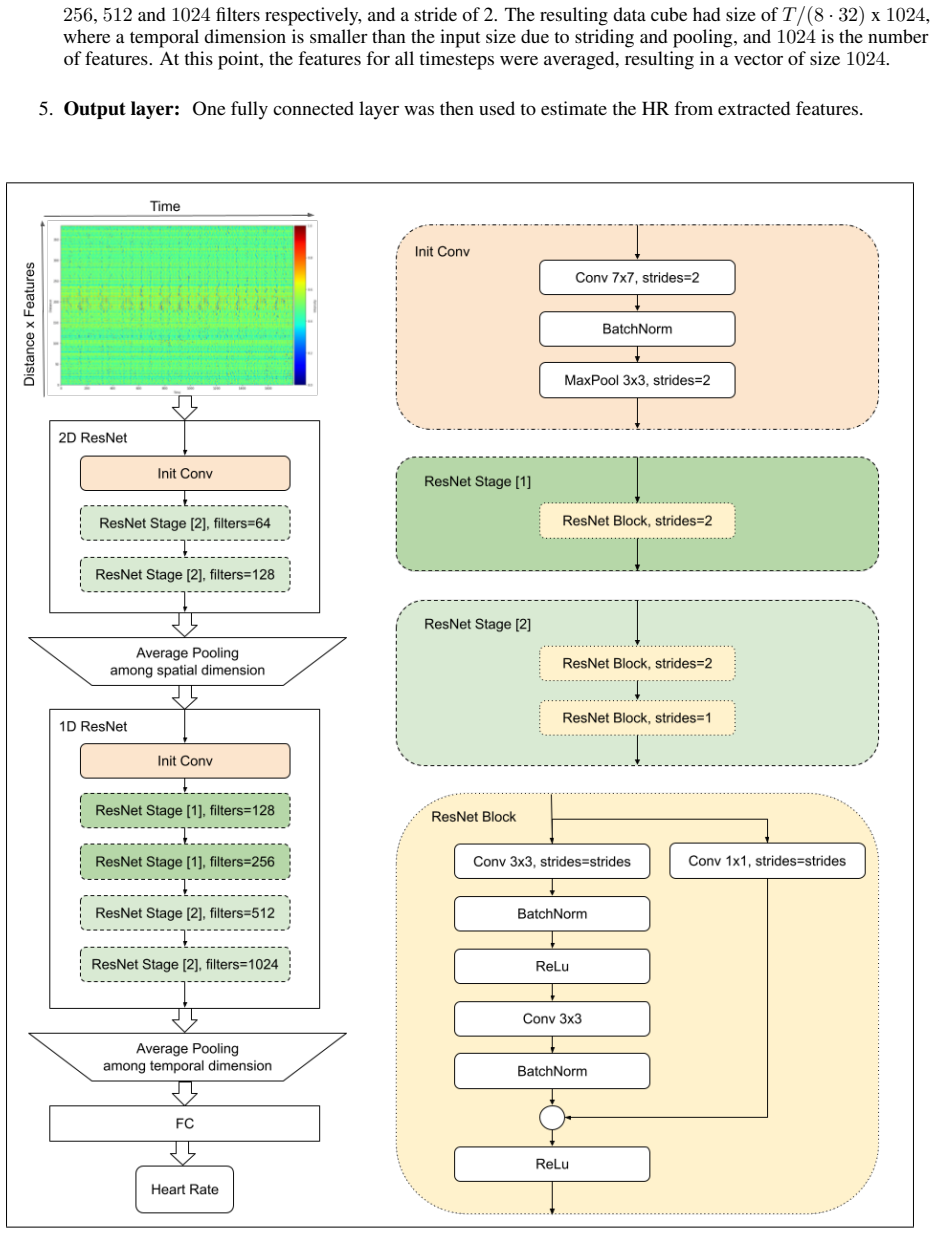
The load-bearing machinery is a 2D+1D ResNet operating on the magnitude and unwrapped angle of the complex radar range profile at the detected range bin. A first 2D ResNet processes the time-by-spatial-feature input to capture local spatio-temporal chest micromotion, the spatial dimension is then averaged away, and a 1D ResNet refines temporal features before a fully connected layer regresses heart rate. To make FMCW features transferable, the authors reduce FMCW data to one range bin and one receiving antenna, add Gaussian noise augmentation, and use an adaptive filter derived from the respiratory rate to remove breathing and its harmonics before the features enter the network.
What would settle it
Repeat the transfer with the pretraining FMCW data reduced by averaging ten range bins into one instead of selecting a single range bin, and check whether the fine-tuned IR-UWB MAE rises from 4.1 bpm toward the 5.4 bpm from-scratch baseline; if it does, the transfer gain depends on the single-bin approximation rather than on genuinely transferable cardiac features.
Extended reading notes
Core claim
On its own terms, the paper's central discovery is that transfer learning between radar modalities works for vital-sign measurement: features learned from the complex range profile of a 60 GHz FMCW radar remain useful when fine-tuned on an 8 GHz IR-UWB radar, even though the UWB radar has roughly ten times coarser range resolution and uses short pulses rather than chirps. The transferred model reaches a test MAE of 4.1 bpm and MAPE of 6.3% on IR-UWB data, compared with 5.4 bpm and 8.4% for the same architecture trained from scratch on IR-UWB data alone; the fine-tuned model also keeps a 97.5% recall. The paper further claims this meets the 5 bpm MAE / 10% MAPE accuracy standard for consumer heart-rate devices, and that the underlying 2D+1D ResNet architecture improves FMCW heart-rate accuracy to 0.85 bpm MAE, halving the previous reported error on that dataset. The authors present this as the first demonstration of transfer learning between FMCW and IR-UWB radar for heart-rate monitoring.
Load-bearing premise
The transfer works only if the cardiac micromotion seen by a single range bin and a single antenna of a 60 GHz FMCW radar is similar enough to what an 8 GHz IR-UWB radar sees, despite a tenfold coarser range resolution and different radar physics.
Editorial extensions
If this is right
- A UWB chip already present in phones could measure heart rate contactlessly with an accuracy acceptable for consumer wellness devices, without collecting a large new labeled dataset for each phone's radar configuration.
- New radar systems or hardware revisions could inherit heart-rate capability by fine-tuning an FMCW-pretrained model on a small dataset; the paper's ablation suggests the first 40% of the training set delivers most of the gain.
- Combining unwrapped phase with magnitude matters for both radar types, and the 2D+1D structure reaches the same accuracy as a much larger 1D ResNet with roughly 15 times fewer parameters.
- The transfer result is specific to the tested radar pair and configurations, so accuracy on other UWB integrations would need to be measured again.
Reading between the lines
- I would expect the same single-range-bin, magnitude-plus-unwrapped-angle recipe to transfer heart-rate features between other radar pairs that share the complex range-profile representation, such as different FMCW bands or a UWB radar with a different bandwidth, though the paper only demonstrates one pair.
- The fine-tuning curve saturating near 40% of the IR-UWB data suggests that data collection for a new radar could be substantially shorter than the 2-minute-per-position protocol used here, which is a testable consequence.
- If the transferable representation really is the phase and magnitude of chest-wall micromotion, the same pretrained backbone may support heart-rate variability or pseudo-ECG/PPG reconstruction, directions the paper mentions as future work but does not test.
Editorial analysis
A structured set of objections, weighed in public.
Referee Report
Summary. The paper proposes a 2D+1D ResNet architecture for radar-based heart rate estimation and investigates transfer learning between 60 GHz mm-wave FMCW radar and 8 GHz IR-UWB radar. On a large overnight FMCW dataset the model achieves a test MAE of 0.85 bpm and MAPE of 1.42%, halving the previously reported MAE of 1.69 bpm. For IR-UWB, the authors fine-tune a variant of the FMCW model after reducing both modalities to a single antenna and single range bin and applying Gaussian noise augmentation; the fine-tuned model reaches a test MAE of 4.1 bpm and MAPE of 6.3%, a 25% improvement over a from-scratch IR-UWB baseline at MAE 5.4 bpm. The paper includes extensive ablations on architecture, feature choice, antenna configuration, range-bin count, augmentation, and training-set size, with bootstrap confidence intervals.
Significance. If the transfer-learning effect is causal, this is a practically important result: it would show that a large FMCW radar dataset can reduce the data collection burden for a new radar modality, and it would support the feasibility of heart rate monitoring on UWB-enabled consumer devices. The paper's strengths are its large participant cohorts (119 participants for FMCW, 376 for IR-UWB), the use of held-out test sets with bootstrap confidence intervals, and the unusually thorough ablation program documented in the supplementary material. The main limitation is that the headline 25% improvement is not attributable to pretraining alone, because the transfer and baseline conditions differ in several simultaneous ways.
major comments (4)
- [§3.5.3, §3.5.4, Table 5] The central claim that FMCW pretraining causes the 25% MAE reduction is not established, because the transfer and baseline conditions differ by more than pretraining. The transfer pipeline uses a single antenna, swaps the order of magnitude and unwrapped-angle channels, and applies Gaussian noise augmentation during fine-tuning, whereas the from-scratch baseline is trained on antennas split into separate examples and no augmentation is described. Supplementary Table S10 shows that the feature flip plus Gaussian noise improves the fine-tuned model's validation MAE from 3.7 bpm to 3.2 bpm, so these choices have a measurable effect. A controlled comparison is needed that keeps preprocessing and augmentation identical for the transfer and from-scratch conditions, e.g., a from-scratch model trained with single-antenna input, feature swap, and Gaussian noise, or a transfer model fine-tuned without those augmentations. Without this, the reported 5.4-to-4.1 bpm improvement may be partially or entirely attributable to input configuration and augmentation rather than to knowledge transferred from FMCW pretraining.
- [§3.1.2, Tables 5–11] The IR-UWB test set excludes the upper-arm radar position, which was collected but removed from validation and test sets because the authors judged it out-of-distribution relative to FMCW data. Because the paper's headline IR-UWB accuracy is computed only on the two retained positions, this post-hoc exclusion materially narrows the claim. The manuscript should report performance including the upper-arm position, state whether the exclusion was decided before model selection, and justify why a deployment-relevant position should be omitted from evaluation.
- [§4.1, §3.1.1, Tables 2–4] The claimed halving of the previous FMCW state of the art (MAE 1.69 to 0.85 bpm) should be qualified with the evaluation protocol. The prior work reports performance under a detection-based protocol with a different recall level, and the present paper evaluates only on segments where presence detection succeeded (98.9% recall). The comparison would be cleaner if the paper reported the FMCW MAE under the same segment-inclusion and recall criteria as the prior work, or explicitly stated the protocol difference as a caveat. In addition, the high-HR range is nearly absent in the FMCW sleep dataset and sparsely represented in the IR-UWB dataset, so the subgroup MAEs for HR above 90 bpm should not be over-interpreted; the Discussion already acknowledges this, but the abstract-level 'maintained performance under 5 MAE/10% MAPE across heart rate ranges' should be tempered.
- [§3.5.3, §3.5.4, Supplementary Tables S7–S10] The design choices for the transfer pipeline (single antenna, single range bin, Gaussian noise parameters, feature-order swap, fine-tuning schedule) were selected based on validation-set performance on the IR-UWB target dataset. This validation-based selection tunes the method to the target distribution, which is legitimate but should be reported as such; the test set remains independent, but the reported confidence intervals do not account for the model-selection process. An additional concern is that the transfer premise—that a single FMCW range bin and a single IR-UWB range bin carry sufficiently similar cardiac micromotion information despite a 10x difference in range resolution—is supported only indirectly by the final accuracy. A direct analysis of feature similarity or a cross-modality sanity check would strengthen the claim that the transfer mechanism is the single-range-bin representation rather than a dataset-size or augmentation artifact.
minor comments (5)
- [§4.1] The text states 'total N=199 valid sessions' for the FMCW dataset, while §3.1.1 says 119 valid sessions and the abstract says N=119 participants; this numerical discrepancy should be corrected.
- [§3.5.4, §4.2] The baseline model is described as achieving an MAE of 2.450 bpm in §3.5.4 and 5.4 bpm on the test set in §4.2; the manuscript should state explicitly which number is the validation MAE and which is the test MAE to avoid confusion.
- [Supplementary Table S12] The final model's MAE on IR-UWB is reported as 3.8 bpm in the architecture ablation, while Table 5 reports a test MAE of 4.1 bpm; the supplementary table should clarify that the 3.8 bpm value is a validation-set result, not a test-set result.
- [§B.2.3, Supplementary Tables S9–S10] The feature-order swap is described as random during FMCW training in §B.2.3 but as a fixed swap during fine-tuning in §3.5.4; the manuscript should state precisely whether the fine-tuning augmentation swaps the order randomly per sample or always swaps it.
- [References] Reference [25] is incomplete ('The present and future of uwb'), and the supplementary material contains a typo, 'Gausian noise', which should be corrected.
Circularity Check
No significant circularity: the transfer result is an empirical benchmark with independent test-set ground truth; the augmentation/feature-swap confound is an experimental validity issue, not a circular reduction.
full rationale
The central claims—FMCW MAE 0.85 bpm and transfer-learned IR-UWB MAE 4.1 bpm versus a from-scratch baseline of 5.4 bpm—are evaluated on held-out test segments against ECG/PPG ground truth, not derived from the model inputs or from a fitted parameter. The pretrained and baseline models share the same 2D+1D ResNet architecture, and the comparison is a direct empirical benchmark. Self-citations appear ([19] provides the FMCW dataset and prior SOTA; [31] supplies the adaptive respiratory filter), but neither is load-bearing for the transfer conclusion: the dataset is external and the filter is applied to both radar conditions. The main methodological weakness is that the transfer pipeline includes single-antenna selection, feature-order swapping, and Gaussian-noise augmentation that the from-scratch baseline does not receive; Supplementary Table S10 shows augmentations alone reduce validation MAE from 3.7 to 3.2 bpm for the fine-tuned model. This is a confounding-variable threat to the causal attribution of the gain to FMCW pretraining, not a circularity: no equation or prediction reduces by construction to its own input, and the reported test numbers are not statistically forced by the design choices. Hence no circular step is identified.
Assumptions & free parameters
free parameters (5)
- Feature-order swap during fine-tuning =
enabled
- Gaussian noise augmentation parameters =
std=0.0005, probability 0.7 pretraining / 0.6 fine-tuning
- Single range bin selection =
1
- Antenna selection =
FMCW antenna #2, UWB antenna #0
- Fine-tuning hyperparameters =
lr=0.0003, decay=0.1, batch=2048, 2.7k steps
assumptions (4)
- domain assumption Radar range-profile magnitude and unwrapped phase at a selected range bin encode cardiac chest-wall micromotion after clutter removal and adaptive respiratory filtering.
- ad hoc to paper The cardiac micromotion signal in a single FMCW range bin and a single IR-UWB range bin is similar enough for feature transfer despite 10x range-resolution difference.
- domain assumption The CFAR detector with threshold 1.5 identifies the correct range bin containing the participant.
- domain assumption ECG- or PPG-derived ground-truth heart rates are accurate for kept segments after R-peak noise rejection.
Cite this review
Pith. "Pith review of UWB Radar-based Heart Rate Monitoring: A Transfer Learning Approach." pith.science (2026). https://pith.science/paper/U6UQQG4L
@misc{pith2026250714195,
  author       = {Pith},
  title        = {Pith review of: UWB Radar-based Heart Rate Monitoring: A Transfer Learning Approach},
  year         = {2026},
  howpublished = {\url{https://pith.science/paper/U6UQQG4L}},
  note         = {Machine review of arXiv:2507.14195}
}
read the original abstract
Radar technology presents untapped potential for continuous, contactless, and passive heart rate monitoring via consumer electronics like mobile phones. However the variety of available radar systems and lack of standardization means that a large new paired dataset collection is required for each radar system. This study demonstrates transfer learning between frequency-modulated continuous wave (FMCW) and impulse-radio ultra-wideband (IR-UWB) radar systems, both increasingly integrated into consumer devices. FMCW radar utilizes a continuous chirp, while IR-UWB radar employs short pulses. Our mm-wave FMCW radar operated at 60 GHz with a 5.5 GHz bandwidth (2.7 cm resolution, 3 receiving antennas [Rx]), and our IR-UWB radar at 8 GHz with a 500 MHz bandwidth (30 cm resolution, 2 Rx). Using a novel 2D+1D ResNet architecture we achieved a mean absolute error (MAE) of 0.85 bpm and a mean absolute percentage error (MAPE) of 1.42% for heart rate monitoring with FMCW radar (N=119 participants, an average of 8 hours per participant). This model maintained performance (under 5 MAE/10% MAPE) across various body positions and heart rate ranges, with a 98.9% recall. We then fine-tuned a variant of this model, trained on single-antenna and single-range bin FMCW data, using a small (N=376, avg 6 minutes per participant) IR-UWB dataset. This transfer learning approach yielded a model with MAE 4.1 bpm and MAPE 6.3% (97.5% recall), a 25% MAE reduction over the IR-UWB baseline. This demonstration of transfer learning between radar systems for heart rate monitoring has the potential to accelerate its introduction into existing consumer devices.
Figures


Figures from the paper (6 more)


Reference graph
Works this paper leans on
-
[37]
Emad Arasteh, Esther S Veldhoen, Xi Long, Maartje van Poppel, Marjolein van der Linden, Thomas Alderliesten, Joppe Nijman, Robbin de Goederen, and Jeroen Dudink. Ultra-wideband radar for simultaneous and unobtrusive monitoring of respiratory and heart rates in early childhood: A deep transfer learning approach. Sensors, 23(18):7665, 2023
work page 2023
-
[1]
Importance of resting heart rate.Trends in Cardiovascular Medicine, 33(8):502–515, 2023
Brian Olshansky, Fabrizio Ricci, and Artur Fedorowski. Importance of resting heart rate.Trends in Cardiovascular Medicine, 33(8):502–515, 2023
2023
-
[2]
Association between heart rate and mortality in patients with septic shock: an analysis revealed by time series data
Yi-Le Ning, Wen-Jia Li, Xiang Lu, Yu Zhang, Jun-Wei Zhang, and Ji-Hong Zhou. Association between heart rate and mortality in patients with septic shock: an analysis revealed by time series data. BMC Infectious Diseases, 24(1):1088, 2024
2024
-
[3]
Rest heart rate and life expectancy
Herbert J Levine et al. Rest heart rate and life expectancy. Journal of the American College of Cardiology , 30(4):1104–1106, 1997
1997
-
[4]
Thyrotoxicosis
Brannon L Inman and Brit Long. Thyrotoxicosis. Emergency medicine clinics of North America, 41(4):759–774, 2023
2023
-
[5]
Pathophysiology of heart failure
Robert HG Schwinger. Pathophysiology of heart failure. Cardiovascular diagnosis and therapy, 11(1):263, 2021
2021
-
[6]
Central circuitries for body temperature regulation and fever.American journal of Physiology- Regulatory, integrative and comparative Physiology, 301(5):R1207–R1228, 2011
Kazuhiro Nakamura. Central circuitries for body temperature regulation and fever.American journal of Physiology- Regulatory, integrative and comparative Physiology, 301(5):R1207–R1228, 2011
2011
-
[7]
Sinus tachycardia: a multidisciplinary expert focused review
Kenneth A Mayuga, Artur Fedorowski, Fabrizio Ricci, Rakesh Gopinathannair, Jonathan Walter Dukes, Christo- pher Gibbons, Peter Hanna, Dan Sorajja, Mina Chung, David Benditt, et al. Sinus tachycardia: a multidisciplinary expert focused review. Circulation: Arrhythmia and Electrophysiology, 15(9):e007960, 2022
2022
Show all 88 references
-
[8]
Use and limitations of clinical and radiologic diagnosis of pneumonia
Matthew Mabie and Richard G Wunderink. Use and limitations of clinical and radiologic diagnosis of pneumonia. In Seminars in respiratory infections, volume 18, pages 72–79. [Orlando, Fla.]: Grune & Stratton, c1986-2003., 2003
2003
-
[9]
Predictors of pneumonia in lower respiratory tract infections: 3c prospective cough complication cohort study
Michael Moore, Beth Stuart, Paul Little, Sue Smith, Matthew J Thompson, Kyle Knox, Anne van den Bruel, Mark Lown, and David Mant. Predictors of pneumonia in lower respiratory tract infections: 3c prospective cough complication cohort study. European respiratory journal, 50(5), 2017
2017
-
[10]
Water as an essential nutrient: the physiological basis of hydration
Eric Jéquier and Florence Constant. Water as an essential nutrient: the physiological basis of hydration. European journal of clinical nutrition, 64(2):115–123, 2010
2010
-
[11]
Detecting sleep outside the clinic using wearable heart rate devices
Ignacio Perez-Pozuelo, Marius Posa, Dimitris Spathis, Kate Westgate, Nicholas Wareham, Cecilia Mascolo, Søren Brage, and Joao Palotti. Detecting sleep outside the clinic using wearable heart rate devices. Scientific Reports, 12(1):7956, 2022
2022
-
[12]
An examination and critique of current methods to determine exercise intensity
Nicholas A Jamnick, Robert W Pettitt, Cesare Granata, David B Pyne, and David J Bishop. An examination and critique of current methods to determine exercise intensity. Sports Medicine, 50(10):1729–1756, 2020
2020
-
[13]
Assessment of ownership of smart devices and the acceptability of digital health data sharing
Md Mobashir Hasan Shandhi, Karnika Singh, Natasha Janson, Perisa Ashar, Geetika Singh, Baiying Lu, D Sun- shine Hillygus, Jennifer M Maddocks, and Jessilyn P Dunn. Assessment of ownership of smart devices and the acceptability of digital health data sharing. NPJ digital medici...
2024
-
[14]
A validation of six wearable devices for estimating sleep, heart rate and heart rate variability in healthy adults
Dean J Miller, Charli Sargent, and Gregory D Roach. A validation of six wearable devices for estimating sleep, heart rate and heart rate variability in healthy adults. Sensors, 22(16):6317, 2022
2022
-
[15]
Real-time through-wall imaging using an ultrawideband multiple-input multiple-output (mimo) phased array radar system
Tyler S Ralston, Gregory L Charvat, and John E Peabody. Real-time through-wall imaging using an ultrawideband multiple-input multiple-output (mimo) phased array radar system. In 2010 IEEE international symposium on phased array systems and technology, pages 551–558. IEEE, 2010
2010
-
[16]
Non-contact heart rate monitoring based on millimeter wave radar
Zongquan Ling, Weinan Zhou, Yuhao Ren, Jiping Wang, and Liquan Guo. Non-contact heart rate monitoring based on millimeter wave radar. IEEE Access, 10:74033–74044, 2022
2022
-
[17]
Vital sign monitoring using fmcw radar in various sleeping scenarios
Emmi Turppa, Juha M Kortelainen, Oleg Antropov, and Tero Kiuru. Vital sign monitoring using fmcw radar in various sleeping scenarios. Sensors, 20(22):6505, 2020
2020
-
[18]
Non-contact vital signs monitoring for multiple subjects using a millimeter wave fmcw automotive radar
Shekh MM Islam, Naoyuki Motoyama, Sergio Pacheco, and Victor M Lubecke. Non-contact vital signs monitoring for multiple subjects using a millimeter wave fmcw automotive radar. In 2020 IEEE/MTT-S International Microwave Symposium (IMS), pages 783–786. IEEE, 2020
2020
-
[19]
Soli-enabled noncontact heart rate detection for sleep and meditation tracking
Luzhou Xu, Jaime Lien, Haiguang Li, Nicholas Gillian, Rajeev Nongpiur, Jihan Li, Qian Zhang, Jian Cui, David Jorgensen, Adam Bernstein, et al. Soli-enabled noncontact heart rate detection for sleep and meditation tracking. Scientific Reports, 13(1):18008, 2023. 17
2023
-
[20]
Ecg monitoring system integrated with ir-uwb radar based on cnn
Wenfeng Yin, Xiuzhu Yang, Lin Zhang, and Eiji Oki. Ecg monitoring system integrated with ir-uwb radar based on cnn. IEEE Access, 4:6344–6351, 2016
2016
-
[21]
A uwb radar-based approach of detecting vital signals
Qimeng Li, Jikui Liu, Raffaele Gravina, Ye Li, and Giancarlo Fortino. A uwb radar-based approach of detecting vital signals. In 2021 IEEE 17th International Conference on Wearable and Implantable Body Sensor Networks (BSN), pages 1–4. IEEE, 2021
2021
-
[22]
A novel non-contact heart rate monitor using impulse-radio ultra-wideband (ir-uwb) radar technology
Yonggu Lee, Jun-Young Park, Yeon-Woo Choi, Hyun-Kyung Park, Seok-Hyun Cho, Sung Ho Cho, and Young- Hyo Lim. A novel non-contact heart rate monitor using impulse-radio ultra-wideband (ir-uwb) radar technology. Scientific reports, 8(1):13053, 2018
2018
-
[23]
A comprehensive overview on uwb radar: Applications, standards, signal processing techniques, datasets, radio chips, trends and future research directions
Mohammad Cheraghinia, Adnan Shahid, Stijn Luchie, Gert-Jan Gordebeke, Olivier Caytan, Jaron Fontaine, Ben Van Herbruggen, Sam Lemey, and Eli De Poorter. A comprehensive overview on uwb radar: Applications, standards, signal processing techniques, datasets, radio chips, trends ...
2024
-
[24]
Unleashing the potential of uwb: Regulatory considerations
FiRa Consortium. Unleashing the potential of uwb: Regulatory considerations. White paper, FiRa Consortium, August 2022. Accessed on 2025-06-24
2022
-
[25]
The present and future of uwb
-
[26]
Localization via ultra-wideband radios: a look at positioning aspects for future sensor networks
Sinan Gezici, Zhi Tian, Georgios B Giannakis, Hisashi Kobayashi, Andreas F Molisch, H Vincent Poor, and Zafer Sahinoglu. Localization via ultra-wideband radios: a look at positioning aspects for future sensor networks. IEEE signal processing magazine, 22(4):70–84, 2005
2005
-
[27]
Surface chest motion decomposition for cardiovascular monitoring
Ghufran Shafiq and Kalyana C Veluvolu. Surface chest motion decomposition for cardiovascular monitoring. Scientific reports, 4(1):5093, 2014
2014
-
[28]
Ir-uwb radar-based robust heart rate detection using a deep learning technique intended for vehicular applications
Faheem Khan, Stéphane Azou, Roua Youssef, Pascal Morel, and Emanuel Radoi. Ir-uwb radar-based robust heart rate detection using a deep learning technique intended for vehicular applications. Electronics, 11(16):2505, 2022
2022
-
[29]
Heart rate variability monitoring based on doppler radar using deep learning
Sha Yuan, Shaocan Fan, Zhenmiao Deng, and Pingping Pan. Heart rate variability monitoring based on doppler radar using deep learning. Sensors, 24(7):2026, 2024
2026
-
[30]
Non-contact heart rate detection technology based on deep learning
Hongfei Li, Yunxue Liu, Min Zhou, Zhen Cao, Xiao Zhai, and Yan Zhang. Non-contact heart rate detection technology based on deep learning. In 2023 International Seminar on Computer Science and Engineering Technology (SCSET), pages 272–277. IEEE, 2023
2023
-
[31]
Uwb radar cardiac activity sensing: Novel arctangent demodulator for direct-rf receivers
Sharanya Srinivas, Yu Rong, and Daniel W Bliss. Uwb radar cardiac activity sensing: Novel arctangent demodulator for direct-rf receivers. In 2020 IEEE International Radar Conference (RADAR), pages 984–989. IEEE, 2020
2020
-
[32]
Heart rate sensing with a robot mounted mmwave radar
Peijun Zhao, Chris Xiaoxuan Lu, Bing Wang, Changhao Chen, Linhai Xie, Mengyu Wang, Niki Trigoni, and Andrew Markham. Heart rate sensing with a robot mounted mmwave radar. In2020 IEEE International Conference on Robotics and Automation (ICRA), pages 2812–2818. IEEE, 2020
2020
-
[33]
Precise heart rate measurement using non-contact doppler radar assisted by machine-learning-based sleep posture estimation
Kotaro Higashi, Guanghao Sun, and Koichiro Ishibashi. Precise heart rate measurement using non-contact doppler radar assisted by machine-learning-based sleep posture estimation. In 2019 41st Annual International Conference of the IEEE Engineering in Medicine and Biology Societ...
2019
-
[34]
A novel heart rate detection algorithm with small observing window using millimeter-wave radar
Jiacheng Wu, Han Cui, and Naim Dahnoun. A novel heart rate detection algorithm with small observing window using millimeter-wave radar. In 2022 11th Mediterranean Conference on Embedded Computing (MECO), pages 1–4. IEEE, 2022
2022
-
[35]
Millimeter wave radar calibration for heart rate estimation using bayesian neural networks
Felipe Parralejo, José A Paredes, Fernando J Aranda, Fernando J Álvarez, and África Vicario. Millimeter wave radar calibration for heart rate estimation using bayesian neural networks. In 2023 IEEE International Conference on Omni-layer Intelligent Systems (COINS), pages 1–6. ...
2023
-
[36]
Development of predictive cnn based model for vital signs alerts
RF Gibadullin and NS Marushkai. Development of predictive cnn based model for vital signs alerts. In 2021 International Conference on Industrial Engineering, Applications and Manufacturing (ICIEAM), pages 404–409. IEEE, 2021
2021
-
[38]
Exercise vital signs detection employing fmcw radar and artificial neural networks
King Leong Li, Shih-Hsuan Lai, Kyle Cheng, Lindor Henrickson, Irwin Chen, Vincent Wu, and Jyehong Chen. Exercise vital signs detection employing fmcw radar and artificial neural networks. InCLEO: QELS_Fundamental Science, pages JW1A–149. Optica Publishing Group, 2021. 18
2021
-
[39]
Convolutional neural networks for the real-time monitoring of vital signs based on impulse radio ultrawide-band radar during sleep
Sang Ho Choi and Heenam Yoon. Convolutional neural networks for the real-time monitoring of vital signs based on impulse radio ultrawide-band radar during sleep. Sensors, 23(6):3116, 2023
2023
-
[40]
Heartbeatnet: Enhancing fast and accurate heart rate estimation with fmcw radar and lightweight deep learning
Dongryul Kim, Jaeyoung Choi, Joonseok Yoon, Sungpil Cheon, and Byungkwan Kim. Heartbeatnet: Enhancing fast and accurate heart rate estimation with fmcw radar and lightweight deep learning. IEEE Sensors Letters, 2024
2024
-
[41]
Physical activity monitoring for heart rate (ansi/cta-2065)
JA Consumer Technology Association et al. Physical activity monitoring for heart rate (ansi/cta-2065). American National Standards, 2018
2018
-
[42]
Standard, Association for the Advancement of Medical Instrumentation, Arlington, Virginia, USA, 2016
Medical electrical equipment - Part 2-27: Particular requirements for the basic safety and essential perfor- mance of electrocardiographic monitoring equipment. Standard, Association for the Advancement of Medical Instrumentation, Arlington, Virginia, USA, 2016
2016
-
[43]
Standard, Association for the Advancement of Medical Instrumentation, Arlington, Virginia, USA, 2002
Cardiac Monitors, Heart Rate Meters, and Alarms. Standard, Association for the Advancement of Medical Instrumentation, Arlington, Virginia, USA, 2002
2002
-
[44]
Monitoring long-term cardiac activity with contactless radio frequency signals
Bin-Bin Zhang, Dongheng Zhang, Yadong Li, Zhi Lu, Jinbo Chen, Haoyu Wang, Fang Zhou, Yu Pu, Yang Hu, Li-Kun Ma, et al. Monitoring long-term cardiac activity with contactless radio frequency signals. Nature Communications, 15(1):1–11, 2024
2024
-
[45]
Local pulse wave detection using continuous wave radar systems.IEEE Journal of Electromagnetics, RF and Microwaves in Medicine and Biology, 1(2):81–89, 2017
Christoph Will, Kilin Shi, Sven Schellenberger, Tobias Steigleder, Fabian Michler, Robert Weigel, Christoph Ostgathe, and Alexander Koelpin. Local pulse wave detection using continuous wave radar systems.IEEE Journal of Electromagnetics, RF and Microwaves in Medicine and Biolo...
2017
-
[46]
Cuffless blood pressure estimation from the carotid pulse arrival time using continuous wave radar
Dilpreet Buxi, Jean-Michel Redouté, and Mehmet Rasit Yuce. Cuffless blood pressure estimation from the carotid pulse arrival time using continuous wave radar. In 2015 37th Annual International Conference of the IEEE Engineering in Medicine and Biology Society (EMBC), pages 570...
2015
-
[47]
Ecg signal reconstruction using fmcw radar and a convolutional neural network for contactless vital-sign sensing
Daiki Toda, Ren Anzai, Koichi Ichige, Ryo Saito, and Daichi Ueki. Ecg signal reconstruction using fmcw radar and a convolutional neural network for contactless vital-sign sensing. IEICE Transactions on Communications, 106(1):65–73, 2023
2023
-
[48]
Contactless electrocardiogram monitoring with millimeter wave radar
Jinbo Chen, Dongheng Zhang, Zhi Wu, Fang Zhou, Qibin Sun, and Yan Chen. Contactless electrocardiogram monitoring with millimeter wave radar. IEEE Transactions on Mobile Computing, 23(1):270–285, 2022
2022
-
[49]
Machine learning in radar-based physiological signals sensing: a scoping review of the models, datasets and metrics
Antonio Nocera, Linda Senigagliesi, Michela Raimondi, Gianluca Ciattaglia, and Ennio Gambi. Machine learning in radar-based physiological signals sensing: a scoping review of the models, datasets and metrics. IEEE Access, 2024
2024
-
[50]
Dl-aided nomp: A deep learning-based vital sign estimating scheme using fmcw radar
Hsin-Yuan Chang, Chia-Hung Lin, Yu-Chien Lin, Wei-Ho Chung, and Ta-Sung Lee. Dl-aided nomp: A deep learning-based vital sign estimating scheme using fmcw radar. In 2020 IEEE 91st vehicular technology conference (VTC2020-Spring), pages 1–7. IEEE, 2020
2020
-
[51]
Here: Heartbeat signal reconstruction for low-power millimeter-wave radar based on deep learning
Haili Wang, Fuchuan Du, Hao Zhu, Zhuangzhuang Zhang, Yizhao Wang, Qixin Cao, and Xiaoxiao Zhu. Here: Heartbeat signal reconstruction for low-power millimeter-wave radar based on deep learning. IEEE Transactions on Instrumentation and Measurement, 72:1–15, 2023
2023
-
[52]
Fast acquisition and accurate vital sign estima- tion with deep learning-aided weighted scheme using fmcw radar
Hsin-Yuan Chang, Chih-Hsuan Hsu, and Wei-Ho Chung. Fast acquisition and accurate vital sign estima- tion with deep learning-aided weighted scheme using fmcw radar. In 2022 IEEE 95th Vehicular Technology Conference:(VTC2022-Spring), pages 1–6. IEEE, 2022
2022
-
[53]
Interference motion removal for doppler radar vital sign detection using variational encoder-decoder neural network
Mikolaj Czerkawski, Christos Ilioudis, Carmine Clemente, Craig Michie, Ivan Andonovic, and Christos Tachtatzis. Interference motion removal for doppler radar vital sign detection using variational encoder-decoder neural network. In 2021 IEEE Radar Conference (RadarConf21), pag...
2021
-
[54]
Spectral viterbi algorithm for contactless wide-range heart rate estimation with deep clustering
Chen Ye and Tomoaki Ohtsuki. Spectral viterbi algorithm for contactless wide-range heart rate estimation with deep clustering. IEEE Transactions on Microwave Theory and Techniques, 69(5):2629–2641, 2021
2021
-
[55]
Rf vital sign sensing under free body movement
Jian Gong, Xinyu Zhang, Kaixin Lin, Ju Ren, Yaoxue Zhang, and Wenxun Qiu. Rf vital sign sensing under free body movement. Proceedings of the ACM on Interactive, Mobile, Wearable and Ubiquitous Technologies, 5(3):1–22, 2021
2021
-
[56]
An efficient heart rate measurement system using medical radar and lstm neural network
Thanh Han-Trong and Hoang Nguyen Viet. An efficient heart rate measurement system using medical radar and lstm neural network. Journal of Electrical and Computer Engineering, 2022(1):4696163, 2022
2022
-
[57]
A non-contact heart rate measurement system based on lstm neural network
Thanh Han Trong and Hoang Nguyen Viet. A non-contact heart rate measurement system based on lstm neural network. In 2022 7th National Scientific Conference on Applying New Technology in Green Buildings (ATiGB), pages 205–210. IEEE, 2022
2022
-
[58]
Fedradar: Federated multi-task transfer learning for radar-based internet of medical things
Xikang Jiang, Jinhui Zhang, and Lin Zhang. Fedradar: Federated multi-task transfer learning for radar-based internet of medical things. IEEE Transactions on Network and Service Management, 20(2):1459–1469, 2023. 19
2023
-
[59]
High accuracy respiration and heart rate detection based on artificial neural network regression
Yu-Chiao Tsai, Shih-Hsuan Lai, Ching-Ju Ho, Fang-Ming Wu, Lindor Henrickson, Chia-Chien Wei, Irwin Chen, Vincent Wu, and Jyehong Chen. High accuracy respiration and heart rate detection based on artificial neural network regression. In 2020 42nd Annual International Conference...
2020
-
[60]
Indoor activity and vital sign monitoring for moving people with multiple radar data fusion
Xiuzhu Yang, Xinyue Zhang, Yi Ding, and Lin Zhang. Indoor activity and vital sign monitoring for moving people with multiple radar data fusion. Remote Sensing, 13(18):3791, 2021
2021
-
[61]
Contactless heart and respiration rates estimation and classification of driver physiological states using cw radar and temporal neural networks
Amal El Abbaoui, David Sodoyer, and Fouzia Elbahhar. Contactless heart and respiration rates estimation and classification of driver physiological states using cw radar and temporal neural networks. Sensors, 23(23):9457, 2023
2023
-
[62]
Mae-based self-supervised pretraining algorithm for heart rate estimation of radar signals
Yashan Xiang, Jian Guo, Ming Chen, Zheyu Wang, and Chong Han. Mae-based self-supervised pretraining algorithm for heart rate estimation of radar signals. Sensors, 23(18):7869, 2023
2023
-
[63]
Heartbeat information prediction based on transformer model using millimetre-wave radar
Bojun Hu, Biao Jin, Hao Xue, Zhenkai Zhang, Zhaoyang Xu, and Xiaohua Zhu. Heartbeat information prediction based on transformer model using millimetre-wave radar. IET Biometrics, 12(4):235–243, 2023
2023
-
[64]
Contactless radar heart rate variability monitoring via deep spatio-temporal modeling
Haoyu Wang, Jinbo Chen, Dongheng Zhang, Zhi Lu, Changwei Wu, Yang Hu, Qibin Sun, and Yan Chen. Contactless radar heart rate variability monitoring via deep spatio-temporal modeling. In ICASSP 2024-2024 IEEE International Conference on Acoustics, Speech and Signal Processing (I...
2024
-
[65]
A closer look at spatiotemporal convolutions for action recognition
Du Tran, Heng Wang, Lorenzo Torresani, Jamie Ray, Yann LeCun, and Manohar Paluri. A closer look at spatiotemporal convolutions for action recognition. In Proceedings of the IEEE conference on Computer Vision and Pattern Recognition, pages 6450–6459, 2018
2018
-
[66]
Digit recognition using fmcw and uwb radar sensors: A transfer learning approach
Jaehoon Jung, Sohee Lim, Jihye Kim, and Seong-Cheol Kim. Digit recognition using fmcw and uwb radar sensors: A transfer learning approach. IEEE Sensors Journal, 23(16):18776–18784, 2023
2023
-
[67]
Ultra-wideband data as input of a combined efficientnet and lstm architecture for human activity recognition
Alexandre Beaulieu, Florentin Thullier, Kévin Bouchard, Julien Maître, and Sébastien Gaboury. Ultra-wideband data as input of a combined efficientnet and lstm architecture for human activity recognition. Journal of Ambient Intelligence and Smart Environments, 14(3):157–172, 2022
2022
-
[68]
Micro-doppler based classification of human aquatic activities via transfer learning of convolutional neural networks
Jinhee Park, Rios Jesus Javier, Taesup Moon, and Youngwook Kim. Micro-doppler based classification of human aquatic activities via transfer learning of convolutional neural networks. Sensors, 16(12):1990, 2016
1990
-
[69]
Supervised domain adaptation for few-shot radar-based human activity recognition
Xinyu Li, Yuan He, J Andrew Zhang, and Xiaojun Jing. Supervised domain adaptation for few-shot radar-based human activity recognition. IEEE Sensors Journal, 21(22):25880–25890, 2021
2021
-
[70]
Unsupervised domain adaptation for micro-doppler human motion classification via feature fusion
Yue Lang, Qing Wang, Yang Yang, Chunping Hou, Danyang Huang, and Wei Xiang. Unsupervised domain adaptation for micro-doppler human motion classification via feature fusion. IEEE Geoscience and Remote Sensing Letters, 16(3):392–396, 2018
2018
-
[71]
mm-wave radar-based vital signs monitoring and arrhythmia detection using machine learning
Srikrishna Iyer, Leo Zhao, Manoj Prabhakar Mohan, Joe Jimeno, Mohammed Yakoob Siyal, Arokiaswami Alphones, and Muhammad Faeyz Karim. mm-wave radar-based vital signs monitoring and arrhythmia detection using machine learning. Sensors, 22(9):3106, 2022
2022
-
[72]
A supervised machine learning algorithm for heart-rate detection using doppler motion-sensing radar
Justin Saluja, Joaquin Casanova, and Jenshan Lin. A supervised machine learning algorithm for heart-rate detection using doppler motion-sensing radar. IEEE Journal of Electromagnetics, RF and Microwaves in Medicine and Biology, 4(1):45–51, 2019
2019
-
[73]
Noncontact heart rate measurement based on an improved convolutional sparse coding method using ir-uwb radar
Pengfei Wang, Fugui Qi, Miao Liu, Fulai Liang, Huijun Xue, Yang Zhang, Hao Lv, and Jianqi Wang. Noncontact heart rate measurement based on an improved convolutional sparse coding method using ir-uwb radar. IEEE Access, 7:158492–158502, 2019
2019
-
[74]
Accurate heart rate and respiration rate detection based on a higher-order harmonics peak selection method using radar non-contact sensors
Hongqiang Xu, Malikeh P Ebrahim, Kareeb Hasan, Fatemeh Heydari, Paul Howley, and Mehmet Rasit Yuce. Accurate heart rate and respiration rate detection based on a higher-order harmonics peak selection method using radar non-contact sensors. Sensors, 22(1):83, 2021
2021
-
[75]
Fundamentals of radar signal processing, volume 1
Mark A Richards et al. Fundamentals of radar signal processing, volume 1. Mcgraw-hill New York, 2005
2005
-
[76]
Experimental comparison of ir-uwb radar and fmcw radar for vital signs
Dingyang Wang, Sungwon Yoo, and Sung Ho Cho. Experimental comparison of ir-uwb radar and fmcw radar for vital signs. Sensors, 20(22):6695, 2020
2020
-
[77]
Decoupled weight decay regularization
Ilya Loshchilov and Frank Hutter. Decoupled weight decay regularization. arXiv preprint arXiv:1711.05101, 2017
2017 arXiv
-
[78]
Understanding bland altman analysis
Davide Giavarina. Understanding bland altman analysis. Biochemia medica, 25(2):141–151, 2015
2015
-
[79]
Association between arterial stiffness and blood pressure progression with incident hypertension: a systematic review and meta-analysis
Alicia Saz-Lara, Rosa María Bruno, Iván Cavero-Redondo, Celia Álvarez-Bueno, Blanca Notario-Pacheco, and Vicente Martínez-Vizcaíno. Association between arterial stiffness and blood pressure progression with incident hypertension: a systematic review and meta-analysis. Frontier...
2022
-
[80]
Developing technologies to assess vascular ageing: a roadmap from vascagenet
Serena Zanelli, Davide Agnoletti, Jordi Alastruey, John Allen, Elisabetta Bianchini, Vasiliki Bikia, Pierre Boutouyrie, Rosa Maria Bruno, Rachel Climie, Djammaleddine Djeldjli, et al. Developing technologies to assess vascular ageing: a roadmap from vascagenet. Physiological M...
2024
-
[81]
Association of arterial stiffness and neuropathy in diabetes: a systematic review and meta-analysis
Angela Beros, John Sluyter, and Robert Keith Rhodes Scragg. Association of arterial stiffness and neuropathy in diabetes: a systematic review and meta-analysis. BMJ Open Diabetes Research and Care, 11(1):e003140, 2023
2023
-
[82]
Performance of triage systems in emergency care: a systematic review and meta-analysis
Joany M Zachariasse, Vera van der Hagen, Nienke Seiger, Kevin Mackway-Jones, Mirjam van Veen, and Henriette A Moll. Performance of triage systems in emergency care: a systematic review and meta-analysis. BMJ open, 9(5):e026471, 2019
2019
-
[83]
Vital sign assessment
Amit Sapra, Ahmad Malik, and Priyanka Bhandari. Vital sign assessment. In StatPearls [internet]. StatPearls Publishing, 2023
2023
-
[84]
Physiologic predictors of severe injury: systematic review
Annette Marie Totten, Tamara P Cheney, Maya E O’Neil, Craig D Newgard, Mohamud Daya, Rongwei Fu, Ngoc Wasson, Erica L Hart, and Roger Chou. Physiologic predictors of severe injury: systematic review. 2019
2019
-
[85]
Emergency department triage
Charles C Yancey and Maria C O’Rourke. Emergency department triage. 2020
2020
-
[86]
Diagnostic value of clinical features at presentation to identify serious infection in children in developed countries: a systematic review
Ann Van den Bruel, Tanya Haj-Hassan, Matthew Thompson, Frank Buntinx, and David Mant. Diagnostic value of clinical features at presentation to identify serious infection in children in developed countries: a systematic review. The Lancet, 375(9717):834–845, 2010
2010
-
[87]
Improving the prioritization of children at the emergency department: Updating the manchester triage system using vital signs
Joany M Zachariasse, Ian K Maconochie, Ruud G Nijman, Susanne Greber-Platzer, Frank J Smit, Daan Nieboer, Johan van der Lei, Claudio F Alves, and Henriette A Moll. Improving the prioritization of children at the emergency department: Updating the manchester triage system using...
2021
-
[88]
Normal ranges of heart rate and respiratory rate in children from birth to 18 years of age: a systematic review of observational studies
Susannah Fleming, Matthew Thompson, Richard Stevens, Carl Heneghan, Annette Plüddemann, Ian Maconochie, Lionel Tarassenko, and David Mant. Normal ranges of heart rate and respiratory rate in children from birth to 18 years of age: a systematic review of observational studies. ...
2011
Reviewed August 6, 2026 · model on record in the stance chip above.
Discussion (0). Sign in to comment.