REVIEW 3 major objections 5 minor 1 cited by
Adding one phase-tailored microwave segment to a standard readout pulse empties the superconducting readout cavity in about 50 ns, roughly six times faster than passive decay, without extra qubit backaction.
Reviewed by Pith at T0; open to challenge. T0 means a machine referee read the full paper against a public rubric. the ladder, T0–T4 →
2026-08-03 17:39 UTC pith:U6VGNXAZ
load-bearing objection Solid experimental reset result with a real scaling law, but the 'arbitrarily fast' claim outruns the data. the 3 major comments →
Single-Step Phase-Engineered Pulse for Active Readout Cavity Reset in Superconducting Circuits
The pith
A machine-rendered reading of the paper's core claim, the machinery that carries it, and where it could break.
Core claim
The central claim is that, in the linear-response regime, for any fixed readout amplitude and duration there exists a single pair of reset parameters—amplitude εr and phase φr—such that the cavity field returns exactly to the vacuum at the end of the reset interval for both qubit states. The experiment verifies this by measuring the residual photon number after the pulse and by time-resolved photon dynamics. When the readout amplitude is rescaled by a factor βn, the optimal reset amplitude rescales proportionally while the optimal reset phase remains fixed; this scaling law reduces calibration to one measurement per device. Fitted reset rates are about 10.97 MHz (|0>) and 11.62 MHz (|1>), ro
What carries the argument
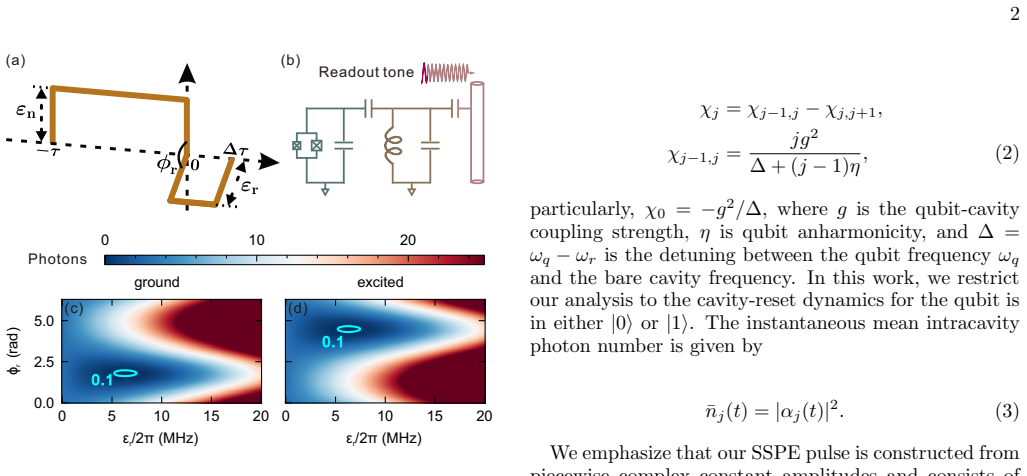
The mechanism is a two-segment pulse: a standard square readout segment of duration τ, followed by a reset segment of duration Δτ with complex amplitude εr e^{iφr}. The cavity field is governed by the input–output equation dα_j/dt = -i ε_d(t) - i(Δ_r + χ_j)α_j - (κ/2)α_j, whose piecewise-constant solution yields an analytic expression for α_j(t) during both segments. The reset parameters are chosen so that |α_j(Δτ)|^2 = 0 simultaneously for j=0 and j=1. The practical key is the scaling law: optimal ε_r is proportional to the readout amplitude, while optimal φ_r is invariant, so calibration is a one-time measurement. For weakly nonlinear operation, the model is extended with a Kerr term K_c|α
Load-bearing premise
The protocol assumes that a single (εr, φr) pair optimized in the linear input–output model (with constant decay rate and dispersive shift) continues to cancel the cavity field at the experimentally used drive amplitudes and within the 50 ns reset window; if nonlinearities or state-dependent effects shift the field away from this trajectory, residual photons remain.
What would settle it
Measure the residual photon number immediately after the SSPE pulse for a reset duration of, say, 20 ns (shorter than the demonstrated 50 ns) at the same readout amplitude; the model predicts the optimized (εr, φr) still cancels the field exactly. If any nonzero residual appears, the 'arbitrarily fast' assertion and the linear-cancellation picture are wrong.
If this is right
- SSPE empties the readout cavity to near-zero photon population in 50 ns for both qubit states across a wide range of readout amplitudes, while a square pulse leaves a residual population that grows with drive amplitude.
- Because the reset trajectory avoids photon overshoot, the protocol does not experience the transient backaction seen in CLEAR; measured excitation and relaxation rates are the lowest of the three protocols.
- The amplitude-linear, phase-invariant scaling law means that after a one-time phase calibration, reset parameters for any readout amplitude are obtained by proportional scaling, greatly simplifying use in multiplexed systems.
- The ultimate reset speed is limited by available drive amplitude and analog bandwidth, not by the model; the paper states that arbitrarily fast, overshoot-free depletion is achievable in principle.
Where Pith is reading between the lines
- The same scaling law suggests that qubit-state-independent reset could be achieved by selecting a phase that cancels the field for both |0> and |1>; the paper leaves this as future work, but the fixed-phase property makes it a natural next test.
- The 'arbitrarily fast' claim rests on the linear model; a short-window test (e.g., Δτ = 20–30 ns) would verify whether optimized (εr, φr) still cancels the field and would locate the real bandwidth limit.
- The Kerr-corrected model should predict a maximum usable reset amplitude before nonlinearity spoils cancellation; sweeping εr at fixed phase and comparing residual photons would test this directly, and might even provide a way to measure K_c more precisely.
Editorial analysis
A structured set of objections, weighed in public.
Referee Report
Summary. The manuscript reports an experimental implementation of a single-step phase-engineered pulse (SSPE) for resetting a superconducting readout cavity. A reset segment with optimized amplitude and phase is appended to a square readout pulse, and the coherent field amplitude is returned to zero at the end of the segment according to the linear input-output model. The authors claim the reset amplitude scales linearly with readout amplitude while the phase is invariant, simplifying calibration. They demonstrate residual photon numbers near zero at a reset duration of 50 ns, with effective decay rates approximately six times faster than passive free decay on qubit Q1, and they characterize measurement-induced backaction, reporting lower excitation and relaxation rates than Square or CLEAR pulses. The method is also tested on a second qubit in an appendix. The central claims are that SSPE enables arbitrarily fast, overshoot-free depletion and that it introduces no additional non-QND errors beyond those of free decay.
Significance. If the claims hold, the SSPE scheme is a simple, hardware-efficient pulse-level approach to cavity reset that could be valuable for mid-circuit measurement and fast feedback in circuit QED. The linear-scaling calibration rule (amplitude proportional, phase invariant) is a useful practical simplification, and the comparison with CLEAR addresses a known transient overshoot issue. The work combines standard input-output theory, Ramsey/ac-Stark photon-number measurement, and backaction characterization. The manuscript includes a two-qubit test and a nonlinear (Kerr) model fit, which are positive features. However, the strongest claim—'arbitrarily fast' reset—is an extrapolation from a single reset duration, and the quantitative comparisons lack error bars, so the significance of the reported speedups and backaction advantages is not yet fully established.
major comments (3)
- [Section II, Eq. (5); Section III, Fig. 3] The abstract and conclusion claim 'arbitrarily fast, overshoot-free depletion,' but the experiment only tests a single reset duration Δτ = 50 ns. In Eq. (5), the reset amplitude required to satisfy |α_j(Δτ)|^2 = 0 grows as ε_r ∝ 1/Δτ for Δτ → 0, since the denominator 1 − exp(−C_j Δτ/2) is linear in Δτ. At shorter Δτ, the larger drive amplitude will enter the nonlinear regime where Eq. (B.1) with Kc/2π = −11 kHz applies, and drive-induced qubit transitions (discussed in Section III) may become non-negligible. No data or bound is provided showing that the residual photon number remains below the 0.1-photon contour or that backaction rates stay low when Δτ is reduced. Please either soften the 'arbitrarily fast' claim to what is demonstrated, or provide measurements at additional Δτ values (e.g., 25 ns and 10 ns) with the nonlinear model and backaction characterization.
- [Section III, Figs. 2–4] The central quantitative comparisons—residual photon population, decay rates (κ_SSPE vs κ_free), and backaction probabilities—are presented without error bars or statistical uncertainty. For example, Fig. 3(d,e) reports κ_SSPE/2π = 10.968 and 11.618 MHz with no confidence intervals, and Fig. 4(b,c) reports excitation and relaxation rates (0.05%, 7.22%, 9.54%) without uncertainty. The claim that SSPE yields the lowest backaction among the three protocols depends on the significance of these differences. Please add error bars, repeat counts, or confidence intervals for all quantitative claims, especially the factor-of-six speedup and the ordering of backaction rates.
- [Section III, Fig. 3(d,e)] The decay rates for SSPE are obtained by exponential fits, but the SSPE reset process is a driven coherent trajectory, not an exponential decay. It is not clear over which time window the fit is performed and whether the fitted rate is a well-defined physical quantity or merely an empirical descriptor. Please specify the fitting range, the functional form used for the driven segment, and the goodness-of-fit. Without this, the comparison 'six times faster' is ambiguous.
minor comments (5)
- [Abstract] Typo: 'Thses' should be 'These'.
- [Section III, Fig. 2] The text says 'residual photon population ... measured either at a delay of Δτ = 50 ns following the end of a Square pulse or immediately after the SSPE pulse.' It would be clearer to specify whether the SSPE residual is measured exactly at t = Δτ or at a later fixed delay; the caption should also state the number of experimental repetitions used for each point.
- [Appendix B, Fig. 5] The term 'π-pusle' appears twice; should be 'π-pulse'.
- [Appendix C] The Kerr coefficient Kc/2π = −11 kHz is reported without uncertainty. A confidence interval and the fit range would help assess the validity of the nonlinear model at the drive amplitudes used in the reset segment.
- [General] The manuscript would benefit from a table summarizing the measured residual photon numbers, decay rates, and backaction rates for Q1 and Q2, with uncertainties, to make the cross-qubit comparison easier.
Circularity Check
No significant circularity: reset parameters are computed from the input-output model and independently verified; the only self-citation is a non-load-bearing hardware reference.
full rationale
The central derivation chain is: input-output theory (Eq. 1) → piecewise solution (Eq. 5) → numerical optimization of (ε_r, φ_r) to satisfy the reset condition |α_j(Δτ)|²=0 (Eq. 6) → independent experimental measurement of residual photon number and time-resolved cavity dynamics. The reset parameters are design targets from the model, not fit parameters extracted from the same data used to validate them; the measured zero/low residual and the ~6× faster exponential depletion rates are genuine experimental confirmations, not forced by construction. The scaling law (β_r = β_n, phase invariant) is a direct linearity consequence of Eq. 5 and is presented as such, and the backaction rates are post-hoc phenomenological fits (Eq. 8), not predictions. The 'arbitrarily fast' claim is an untested linear-model extrapolation, explicitly qualified by the hardware drive-amplitude limit, and only Δτ = 50 ns is demonstrated; this is an overreach/correctness concern, not circularity. The only self-citation is Ref. [53] (the authors' own IMPA amplifier), used solely to describe measurement hardware and not load-bearing for the reset derivation. No self-cited uniqueness theorem, no ansatz smuggled via self-citation, and no fitted parameter renamed as a prediction were found. Score 2 reflects the single non-load-bearing self-citation rather than any circular step.
Axiom & Free-Parameter Ledger
free parameters (3)
- Kerr coefficient Kc =
-11 kHz
- Optimal reset amplitude εr and phase ϕr =
not stated in text; reported as scaling factors βr, βϕr
- Backaction transition rates γo, γb =
e.g., SSPE excitation 0.05%, relaxation 7.22%
axioms (4)
- domain assumption Linear input-output dynamics of a coherent cavity field, Eq. (1), with constant κ and dispersive shift χj
- domain assumption Dispersive approximation and rotating-wave approximation in circuit QED
- standard math Markovian exponential decay of the cavity field
- domain assumption Phenomenological two-state Markov model for repeated measurements, Eq. (8)
Cite this review
Pith. "Pith review of Single-Step Phase-Engineered Pulse for Active Readout Cavity Reset in Superconducting Circuits." pith.science (2026). https://pith.science/paper/U6VGNXAZ
@misc{pith2026251208393,
  author       = {Pith},
  title        = {Pith review of: Single-Step Phase-Engineered Pulse for Active Readout Cavity Reset in Superconducting Circuits},
  year         = {2026},
  howpublished = {\url{https://pith.science/paper/U6VGNXAZ}},
  note         = {Machine review of arXiv:2512.08393}
}
read the original abstract
In a circuit QED architecture, we experimentally demonstrate a hardware-efficient and qubit-state-dependent Single-Step Phase-Engineered (SSPE) pulse scheme for actively depopulating a readout cavity. The protocol appends a reset segment with tailored amplitude and phase to a standard square readout pulse. Within the linear-response regime, the optimal reset amplitude scales proportionally with the readout amplitude, while the optimal reset phase remains invariant, significantly simplifying the experimental calibration procedure. Time-resolved measurements of the cavity photon number dynamics demonstrate that the SSPE scheme significantly outperforms the CLEAR protocol in terms of reset speed. Crucially, this approach enables arbitrarily fast, overshoot-free depletion of the cavity photon population, with the ultimate reset rate constrained by the finite analog bandwidth of the measurement chain. Furthermore, a comprehensive evaluation of the QND nature demonstrates that the SSPE scheme introduces no additional non-QND measurement errors. It exhibits non-QNDness comparable to both the free-decay and CLEAR protocols, with residual errors predominantly governed by state switching induced by qubit relaxation during the readout process. Thses results establish the SSPE scheme as a practical and scalable approach for achieving rapid and smooth cavity reset in superconducting quantum circuits.
Figures


Forward citations
Cited by 1 Pith paper
-
Fast, High-Fidelity Erasure Detection of Dual-Rail Qubits with Symmetrically Coupled Readout
Symmetrically coupled dispersive readout achieves 384 ns single-shot erasure detection on dual-rail qubits with 6.0(2)×10^{-4} residual error per check and enables parallel erasure checks during single-qubit gates wit...
Reference graph
Works this paper leans on
-
[1]
Blais, A
A. Blais, A. L. Grimsmo, S. M. Girvin, and A. Wallraff, Circuit quantum electrodynamics, Rev. Mod. Phys. 93, 025005 (2021)
2021
-
[2]
Blais, R.-S
A. Blais, R.-S. Huang, A. Wallraff, S. M. Girvin, and R. J. Schoelkopf, Cavity quantum electrodynamics for superconducting electrical circuits: An architecture for quantum computation, Phys. Rev. A 69, 062320 (2004)
2004
-
[3]
Blais, J
A. Blais, J. Gambetta, A. Wallraff, D. I. Schuster, S. M. Girvin, M. H. Devoret, and R. J. Schoelkopf, Quantum- information processing with circuit quantum electrody- namics, Phys. Rev. A 75, 032329 (2007)
2007
-
[4]
Krantz, M
P. Krantz, M. Kjaergaard, F. Yan, T. P. Orlando, S. Gus- tavsson, and W. D. Oliver, A quantum engineer’s guide to superconducting qubits, Applied Physics Reviews 6, 021318 (2019)
2019
-
[5]
R. Li, K. Kubo, Y. Ho, Z. Yan, Y. Nakamura, and H. Goto, Realization of high-fidelity cz gate based on a double-transmon coupler, Phys. Rev. X 14, 041050 (2024)
2024
-
[6]
F. Marxer, J. Mro˙ zek, J. Andersson, L. Abdurakhi- mov, J. Adam, V. Bergholm, R. Beriwal, C. F. Chan, S. Dahl, S. R. Das, F. Deppe, O. Fedorets, et al., Above 99.9fidelity single-qubit gates, two-qubit gates, and read- out in a single superconducting quantum device (2025), arXiv:2508.16437 [quant-ph]
Pith/arXiv arXiv 2025
-
[7]
Chen, H.-X
L. Chen, H.-X. Li, Y. Lu, C. W. Warren, C. J. Kriˇ zan, S. Kosen, M. Rommel, S. Ahmed, A. Osman, J. Bizn´ arov´ a, A. Fadavi Roudsari, B. Lienhard, M. Ca- puto, K. Grigoras, L. Gr¨ onberg, J. Govenius, A. F. Kockum, P. Delsing, J. Bylander, and G. Tancredi, 8 Transmon qubit readout fidelity at the threshold for quantum error correction without a quantum-l...
2023
-
[8]
F. m. c. Swiadek, R. Shillito, P. Magnard, A. Remm, C. Hellings, N. Lacroix, Q. Ficheux, D. C. Zanuz, G. J. Norris, A. Blais, S. Krinner, and A. Wallraff, Enhanc- ing dispersive readout of superconducting qubits through dynamic control of the dispersive shift: Experiment and theory, PRX Quantum 5, 040326 (2024)
2024
-
[9]
P. A. Spring, L. Milanovic, Y. Sunada, S. Wang, A. F. van Loo, S. Tamate, and Y. Nakamura, Fast multiplexed superconducting-qubit readout with intrinsic purcell fil- tering using a multiconductor transmission line, PRX Quantum 6, 020345 (2025)
2025
-
[10]
Wang, F.-M
C. Wang, F.-M. Liu, H. Chen, Y.-F. Du, C. Ying, J.-W. Wang, Y.-H. Huo, C.-Z. Peng, X. Zhu, M.-C. Chen, C.- Y. Lu, and J.-W. Pan, Longitudinal and nonlinear cou- pling for high-fidelity readout of a superconducting qubit, Phys. Rev. Lett. 135, 060803 (2025)
2025
-
[11]
Y. Xiong, Z. Wang, J. Zhang, X. Sun, Z. Zhang, P. Huang, Y. Liang, J. Jiang, J. Qiu, Y. Zhou, X. Lin- peng, W. Huang, J. Niu, Y. Zhong, J. Chu, S. Liu, and D. Yu, High-performance multiplexed readout of super- conducting qubits with a tunable broadband purcell filter (2025), arXiv:2509.11822 [quant-ph]
arXiv 2025
-
[12]
Google Quantum AI, Suppressing quantum errors by scaling a surface code logical qubit, Nature 614, 676 (2023)
2023
-
[13]
Google Quantum AI and Collaborators, Quantum error correction below the surface code threshold, Nature 638, 920 (2025)
2025
-
[14]
Lacroix, A
N. Lacroix, A. Bourassa, F. J. H. Heras, L. M. Zhang, J. Bausch, A. W. Senior, T. Edlich, N. Shutty, V. Sivak, A. Bengtsson, M. McEwen, O. Higgott, D. Kafri, et al., Scaling and logic in the colour code on a superconducting quantum processor, Nature 645, 614 (2025)
2025
-
[15]
A. Eickbusch, M. McEwen, V. Sivak, A. Bourassa, J. Atalaya, J. Claes, D. Kafri, C. Gidney, C. W. Warren, et al., Demonstration of dynamic surface codes, Nature Physics 10.1038/s41567-025-03070-w (2025)
-
[16]
Z. Ni, S. Li, X. Deng, Y. Cai, L. Zhang, W. Wang, Z.- B. Yang, H. Yu, F. Yan, S. Liu, C.-L. Zou, L. Sun, S.- B. Zheng, Y. Xu, and D. Yu, Beating the break-even point with a discrete-variable-encoded logical qubit, Na- ture 616, 56 (2023)
2023
-
[17]
V. V. Sivak, A. Eickbusch, B. Royer, S. Singh, I. Tsiout- sios, S. Ganjam, A. Miano, B. L. Brock, A. Z. Ding, L. Frunzio, S. M. Girvin, R. J. Schoelkopf, and M. H. De- voret, Real-time quantum error correction beyond break- even, Nature 616, 50 (2023)
2023
-
[18]
W. P. Livingston, M. S. Blok, E. Flurin, J. Dressel, A. N. Jordan, and I. Siddiqi, Experimental demonstration of continuous quantum error correction, Nature Communi- cations 13, 2307 (2022)
2022
-
[19]
Rist` e, M
D. Rist` e, M. Dukalski, C. A. Watson, G. de Lange, M. J. Tiggelman, Y. M. Blanter, K. W. Lehnert, R. N. Schouten, and L. DiCarlo, Deterministic entanglement of superconducting qubits by parity measurement and feed- back, Nature 502, 350 (2013)
2013
-
[20]
B¨ aumer, V
E. B¨ aumer, V. Tripathi, D. S. Wang, P. Rall, E. H. Chen, S. Majumder, A. Seif, and Z. K. Minev, Efficient long- range entanglement using dynamic circuits, PRX Quan- tum 5, 030339 (2024)
2024
-
[21]
Battistel, B
F. Battistel, B. Varbanov, and B. Terhal, Hardware- efficient leakage-reduction scheme for quantum error cor- rection with superconducting transmon qubits, PRX Quantum 2, 030314 (2021)
2021
-
[22]
Magnard, P
P. Magnard, P. Kurpiers, B. Royer, T. Walter, J.-C. Besse, S. Gasparinetti, M. Pechal, J. Heinsoo, S. Storz, A. Blais, and A. Wallraff, Fast and unconditional all- microwave reset of a superconducting qubit, Phys. Rev. Lett. 121, 060502 (2018)
2018
-
[23]
Zeytino˘ glu, M
S. Zeytino˘ glu, M. Pechal, S. Berger, A. A. Abduma- likov, A. Wallraff, and S. Filipp, Microwave-induced amplitude- and phase-tunable qubit-resonator coupling in circuit quantum electrodynamics, Phys. Rev. A 91, 043846 (2015)
2015
-
[24]
Egger, M
D. Egger, M. Werninghaus, M. Ganzhorn, G. Salis, A. Fuhrer, P. M¨ uller, and S. Filipp, Pulsed reset pro- tocol for fixed-frequency superconducting qubits, Phys. Rev. Appl. 10, 044030 (2018)
2018
-
[25]
Heinsoo, C
J. Heinsoo, C. K. Andersen, A. Remm, S. Krinner, T. Walter, Y. Salath´ e, S. Gasparinetti, J.-C. Besse, A. Potoˇ cnik, A. Wallraff, and C. Eichler, Rapid high- fidelity multiplexed readout of superconducting qubits, Phys. Rev. Appl. 10, 034040 (2018)
2018
-
[26]
Jeffrey, D
E. Jeffrey, D. Sank, J. Y. Mutus, T. C. White, J. Kelly, R. Barends, Y. Chen, Z. Chen, B. Chiaro, A. Dunsworth, A. Megrant, P. J. J. O’Malley, C. Neill, P. Roushan, A. Vainsencher, J. Wenner, A. N. Cleland, and J. M. Martinis, Fast accurate state measurement with super- conducting qubits, Phys. Rev. Lett. 112, 190504 (2014)
2014
-
[27]
M. D. Reed, B. R. Johnson, A. A. Houck, L. DiCarlo, J. M. Chow, D. I. Schuster, L. Frunzio, and R. J. Schoelkopf, Fast reset and suppressing spontaneous emis- sion of a superconducting qubit, Applied Physics Letters 96, 203110 (2010)
2010
-
[28]
Boutin, C
S. Boutin, C. K. Andersen, J. Venkatraman, A. J. Ferris, and A. Blais, Resonator reset in circuit qed by optimal control for large open quantum systems, Phys. Rev. A 96, 042315 (2017)
2017
-
[29]
D. T. McClure, H. Paik, L. S. Bishop, M. Steffen, J. M. Chow, and J. M. Gambetta, Rapid driven reset of a qubit readout resonator, Phys. Rev. Appl. 5, 011001 (2016)
2016
-
[30]
G¨ oppl, A
M. G¨ oppl, A. Fragner, M. Baur, R. Bianchetti, S. Filipp, J. M. Fink, P. J. Leek, G. Puebla, L. Steffen, and A. Wall- raff, Coplanar waveguide resonators for circuit quantum electrodynamics, Journal of Applied Physics 104, 113904 (2008)
2008
-
[31]
M. J. Collett and C. W. Gardiner, Squeezing of intracav- ity and traveling-wave light fields produced in parametric amplification, Phys. Rev. A 30, 1386 (1984)
1984
-
[32]
C. W. Gardiner and M. J. Collett, Input and output in damped quantum systems: Quantum stochastic differen- tial equations and the master equation, Phys. Rev. A 31, 3761 (1985)
1985
-
[33]
Yurke and J
B. Yurke and J. S. Denker, Quantum network theory, Phys. Rev. A 29, 1419 (1984)
1984
-
[34]
Gambetta, A
J. Gambetta, A. Blais, D. I. Schuster, A. Wallraff, L. Frunzio, J. Majer, M. H. Devoret, S. M. Girvin, and R. J. Schoelkopf, Qubit-photon interactions in a cavity: Measurement-induced dephasing and number splitting, Phys. Rev. A 74, 042318 (2006)
2006
-
[35]
J. Koch, T. M. Yu, J. Gambetta, A. A. Houck, D. I. Schuster, J. Majer, A. Blais, M. H. Devoret, S. M. Girvin, and R. J. Schoelkopf, Charge-insensitive qubit design de- rived from the cooper pair box, Phys. Rev. A 76, 042319 9 (2007)
2007
-
[36]
Boissonneault, J
M. Boissonneault, J. M. Gambetta, and A. Blais, Non- linear dispersive regime of cavity qed: The dressed de- phasing model, Phys. Rev. A 77, 060305 (2008)
2008
-
[37]
Boissonneault, J
M. Boissonneault, J. M. Gambetta, and A. Blais, Im- proved superconducting qubit readout by qubit-induced nonlinearities, Phys. Rev. Lett. 105, 100504 (2010)
2010
-
[38]
M. D. Reed, L. DiCarlo, B. R. Johnson, L. Sun, D. I. Schuster, L. Frunzio, and R. J. Schoelkopf, High-fidelity readout in circuit quantum electrodynamics using the jaynes-cummings nonlinearity, Phys. Rev. Lett. 105, 173601 (2010)
2010
-
[39]
D. I. Schuster, A. Wallraff, A. Blais, L. Frunzio, R.-S. Huang, J. Majer, S. M. Girvin, and R. J. Schoelkopf, ac stark shift and dephasing of a superconducting qubit strongly coupled to a cavity field, Phys. Rev. Lett. 94, 123602 (2005)
2005
-
[40]
D. Sank, Z. Chen, M. Khezri, J. Kelly, R. Barends, B. Campbell, Y. Chen, B. Chiaro, A. Dunsworth, A. Fowler, E. Jeffrey, E. Lucero, A. Megrant, J. Mu- tus, M. Neeley, C. Neill, P. J. J. O’Malley, C. Quin- tana, P. Roushan, A. Vainsencher, T. White, J. Wen- ner, A. N. Korotkov, and J. M. Martinis, Measurement- induced state transitions in a superconducting...
2016
-
[41]
Khezri, A
M. Khezri, A. Opremcak, Z. Chen, K. C. Miao, M. McEwen, A. Bengtsson, T. White, O. Naaman, D. Sank, A. N. Korotkov, Y. Chen, and V. Smelyan- skiy, Measurement-induced state transitions in a super- conducting qubit: Within the rotating-wave approxima- tion, Phys. Rev. Appl. 20, 054008 (2023)
2023
-
[42]
M. F. Dumas, B. Groleau-Par´ e, A. McDonald, M. H. Mu˜ noz Arias, C. Lled´ o, B. D’Anjou, and A. Blais, Measurement-induced transmon ionization, Phys. Rev. X 14, 041023 (2024)
2024
-
[43]
Shillito, A
R. Shillito, A. Petrescu, J. Cohen, J. Beall, M. Hauru, M. Ganahl, A. G. Lewis, G. Vidal, and A. Blais, Dynam- ics of transmon ionization, Phys. Rev. Appl. 18, 034031 (2022)
2022
-
[44]
K. N. Nesterov and I. V. Pechenezhskiy, Measurement- induced state transitions in dispersive qubit-readout schemes, Phys. Rev. Appl. 22, 064038 (2024)
2024
-
[45]
T. Connolly, P. D. Kurilovich, V. D. Kurilovich, C. G. L. Bøttcher, S. Hazra, W. Dai, A. Z. Ding, V. R. Joshi, H. Nho, S. Diamond, D. K. Weiss, V. Fatemi, L. Frunzio, L. I. Glazman, and M. H. Devoret, Full characterization of measurement-induced transitions of a superconducting qubit (2025), arXiv:2506.05306 [quant-ph]
Pith/arXiv arXiv 2025
-
[46]
W. Dai, S. Hazra, D. K. Weiss, P. D. Kurilovich, T. Connolly, H. K. Babla, S. Singh, V. R. Joshi, A. Z. Ding, P. D. Parakh, J. Venkatraman, X. Xiao, L. Frun- zio, and M. H. Devoret, Spectroscopy of drive-induced unwanted state transitions in superconducting circuits (2025), arXiv:2506.24070 [quant-ph]
arXiv 2025
-
[47]
Thorbeck, Z
T. Thorbeck, Z. Xiao, A. Kamal, and L. C. G. Govia, Readout-induced suppression and enhancement of super- conducting qubit lifetimes, Phys. Rev. Lett. 132, 090602 (2024)
2024
-
[48]
Malekakhlagh, A
M. Malekakhlagh, A. Petrescu, and H. E. T¨ ureci, Life- time renormalization of weakly anharmonic supercon- ducting qubits. i. role of number nonconserving terms, Phys. Rev. B 101, 134509 (2020)
2020
-
[49]
Petrescu, M
A. Petrescu, M. Malekakhlagh, and H. E. T¨ ureci, Life- time renormalization of driven weakly anharmonic super- conducting qubits. ii. the readout problem, Phys. Rev. B 101, 134510 (2020)
2020
-
[50]
Z. Chen, J. Kelly, C. Quintana, R. Barends, B. Camp- bell, Y. Chen, B. Chiaro, A. Dunsworth, A. G. Fowler, E. Lucero, E. Jeffrey, A. Megrant, J. Mutus, M. Nee- ley, C. Neill, P. J. J. O’Malley, P. Roushan, D. Sank, A. Vainsencher, J. Wenner, T. C. White, A. N. Korotkov, and J. M. Martinis, Measuring and suppressing quan- tum state leakage in a superconduc...
2016
-
[51]
Wang, M.-C
C. Wang, M.-C. Chen, C.-Y. Lu, and J.-W. Pan, Optimal readout of superconducting qubits exploiting high-level states, Fundamental Research 1, 16 (2021)
2021
-
[52]
Z. Wang, B. D’Anjou, P. Gigon, A. Blais, and M. S. Blok, Probing excited-state dynamics of transmon ionization (2025), arXiv:2505.00639 [quant-ph]
Pith/arXiv arXiv 2025
-
[53]
P. Duan, Z. Jia, C. Zhang, L. Du, H. Tao, X. Yang, L. Guo, Y. Chen, H. Zhang, Z. Peng, W. Kong, H.- O. Li, G. Cao, and G.-P. Guo, Broadband flux-pumped josephson parametric amplifier with an on-chip coplanar waveguide impedance transformer, Applied Physics Ex- press 14, 042011 (2021)
2021
This paper was first reviewed by deepseek-v4-flash on August 3, 2026.
discussion (0)
Sign in with ORCID, Apple, or X to comment. Anyone can read and Pith papers without signing in.