REVIEW 3 major objections
Affirmative AI agent coverage with multi-billion limits is achievable by 2030, but only if insurers jointly build a full eight-component stack that prices, monitors, and contains the risk.
Reviewed by Pith at T0; open to challenge. T0 means a machine referee read the full paper against a public rubric. the ladder, T0–T4 →
T0 review · grok-4.5
2026-07-15 08:35 UTC pith:U7KULTZJ
load-bearing objection Solid institutional blueprint for AI insurance; the 2030 billion-tower claim is aspirational and rests on untested transfer of slower historical templates. the 3 major comments →
Underwriting the Agent Economy: The Blueprint for an AI Insurance Stack
The pith
A machine-rendered reading of the paper's core claim, the machinery that carries it, and where it could break.
Core claim
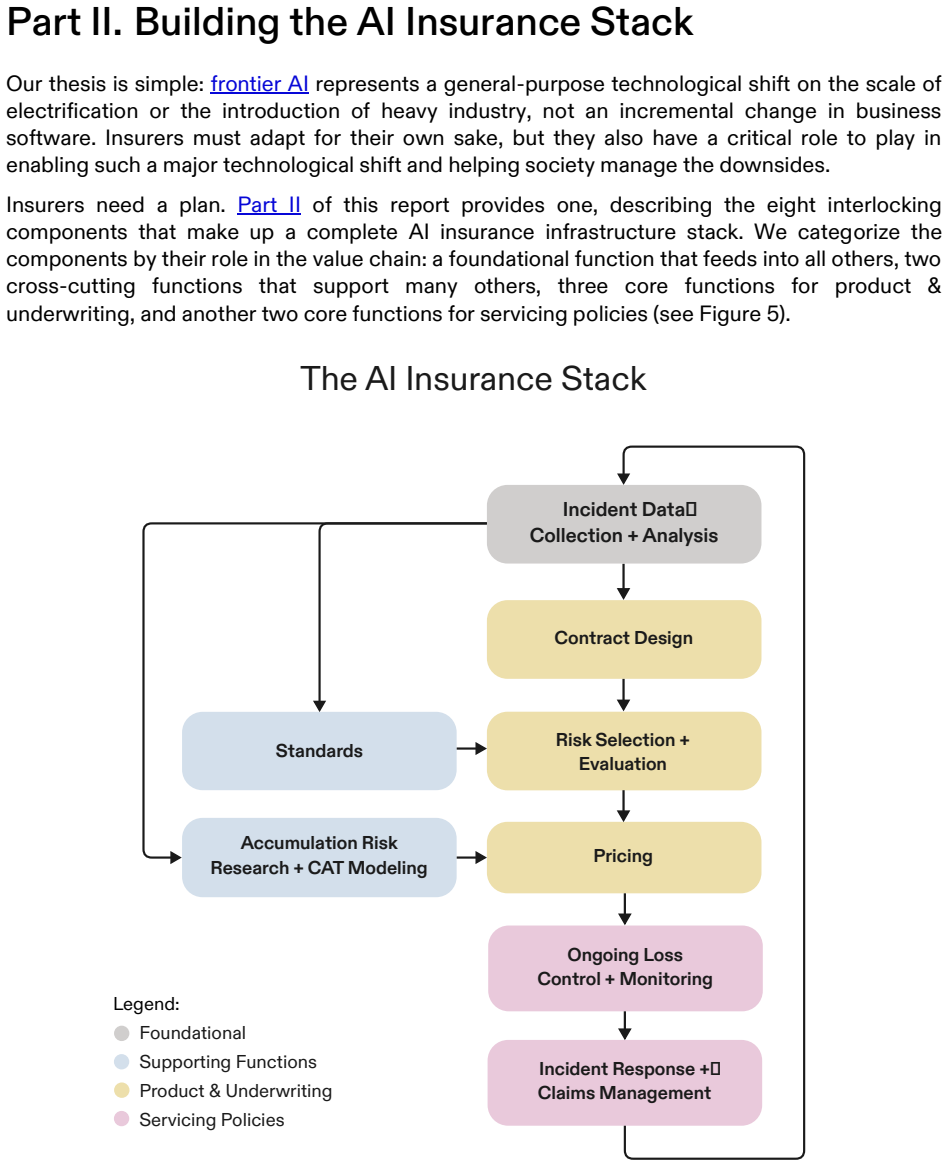
The paper’s central claim is that affirmative, high-limit AI agent insurance is commercially achievable by 2030 if and only if the industry builds and coordinates an eight-component infrastructure stack—incident data collection, accumulation-risk research and CAT modeling, standard setting, contract design, technical risk selection, pricing that uses performance evaluations, ongoing monitoring, and incident-response and claims management—rather than relying on silent coverage, low limits, or blanket exclusions.
What carries the argument
The eight-component AI insurance stack: a layered system of shared incident data, catastrophe modeling, standards, contracts, risk selection, pricing, monitoring, and claims that together convert a fast-moving, correlated, and still-immature risk into something that can be underwritten, differentiated, and continuously controlled.
Load-bearing premise
That lessons from past technologies whose risks changed slowly—electricity, cars, nuclear power, medical malpractice—will transfer to frontier AI agents whose capabilities and failure modes shift every few months and concentrate in a handful of model providers.
What would settle it
If, by the early 2030s, the industry has built the described stack yet still cannot profitably write affirmative AI coverage with multi-hundred-million or billion-dollar towers at premiums enterprises will pay—because tails remain unmanageable or coordination never materializes—the central claim fails.
Editorial analysis
A structured set of objections, weighed in public.
Referee Report
Summary. The manuscript argues that affirmative AI-agent insurance with enterprise towers reaching the billions is achievable by 2030, but only if the industry coordinates to build an eight-component stack (incident data collection, accumulation/CAT modeling, standards, contract design, risk selection, pricing, ongoing monitoring/loss control, and claims/incident response). It documents silent coverage and growing exclusions, rising severity and concentration risk, and the limits of actuarial methods for a technology whose autonomous task length doubles roughly every four months. Drawing on UL, the Closed Claims Project, IIHS/IBHS, nuclear mutuals, and cyber’s mixed record, it supplies component-level recommendations for carriers, reinsurers, modelers, and governments, and sketches purpose-built instruments for societal-scale “AI CAT.” An appendix constructs a public-data incident-to-usage index with leave-one-out sensitivity.
Significance. If the institutional diagnosis and stack design are roughly right, the paper is a high-value blueprint for a market that is currently unpriced and potentially destabilizing. It usefully reframes insurance as both risk transfer and private governance for a general-purpose technology, and the component-by-component recommendations (shared incident databases, model policy language, performance-evaluation-based pricing, CSP/foundation-model telemetry partnerships, AI-literate claims forensics) are concrete enough to guide industry and policy work. The appendix’s sensitivity-tested index and the explicit separation of ordinary accumulation risk from societal-scale AI CAT are strengths. The contribution is institutional and agenda-setting rather than a new theorem or calibrated capital model; its value is as a coordination document for cs.CY, insurance, and AI-governance audiences.
major comments (3)
- Central claim (Key Takeaways; Extended Summary; §I.2–I.3): “affirmative AI coverage with limits in the billions… by 2030” is load-bearing but rests on untested transfer of UL, Closed Claims, IIHS, and nuclear mutuals. The paper itself documents the mismatch—task-length doubling ~every four months (§I.3.D), reliability lagging capability (§I.3.B), and >80% concentration on three foundation-model providers—yet offers no pilot, loss-ratio simulation, capital model, or staged capacity path showing that quarterly evaluations and claims-to-underwriting loops (§§II.5–II.8) can stabilize severity and accumulation loading fast enough for primary carriers and reinsurers to write billion-scale towers at premiums buyers will pay. Either supply a falsifiable intermediate roadmap (e.g., 2027–28 limit/loss-ratio milestones) or restate the claim as a conditional institutional hypothesis rather than a da
- §II.6 pricing formula and §II.2 accumulation/CAT modeling: expected-loss pricing is said to lean on performance evaluations and red-teaming as “quasi-actuarial” inputs, with accumulation loading added later. No worked numerical example, attachment/PML sketch, or sensitivity of capital requirements to SPOF or multi-agent scenarios is given. Without even a stylized calculation, it remains unclear whether the proposed stack can move the market beyond low limits and exclusions—the very outcome the paper warns against. A minimal illustrative pricing or capital example would make the claim checkable.
- §II.3.D / Table 3 and related recommendations: AIUC-1 is presented as one of four standards and is repeatedly favored for prescriptiveness and performance-based certification. Three authors are affiliated with the Artificial Intelligence Underwriting Company that develops AIUC-1; the disclaimer is noted but does not fully neutralize the appearance that the stack’s “standards” layer is partly product advocacy. Either expand independent comparison criteria and third-party evidence of loss reduction, or clearly separate the general case for any robust, frequently revised standard from endorsement of a particular commercial standard.
Circularity Check
No circular derivation chain; the paper is a historical-institutional blueprint whose achievability claim rests on transferable precedents and coordination, not on self-defining equations or fitted inputs renamed as predictions.
full rationale
This is a policy and infrastructure blueprint, not a mathematical derivation paper. The central claim (affirmative AI coverage with billion-scale towers by 2030 conditional on building an eight-component stack) is supported by historical analogies (UL 1894, Closed Claims Project, nuclear mutuals/INPO, cyber lessons) and institutional recommendations, not by equations that reduce to their own inputs. Appendix 1 constructs composite incident and usage indices from public sources, reports an ~80% decline in the ratio with leave-one-out/leave-two-out sensitivity bands, and explicitly flags noise, short coverage, and construct-validity limits; the indices do not define the target quantity in terms of themselves, nor is any fitted parameter later called a prediction of a closely related quantity. Self-references to the Artificial Intelligence Underwriting Company’s $200 B GDP estimate and to AIUC-1 are disclosed (including a conflict-of-interest note in §II.3.D) and function as illustrative estimates or one standard among several (ISO 42001, NIST AI RMF, STAR for AI); they are not load-bearing uniqueness theorems or the sole justification for the stack. No uniqueness result is imported from prior author work to forbid alternatives, no ansatz is smuggled via self-citation, and no known empirical pattern is merely renamed. The argument is therefore self-contained against its own stated historical and institutional benchmarks; any weakness lies in the transferability assumption (capability doubling, concentration, tail thickening), which is a correctness/risk issue, not circularity.
Axiom & Free-Parameter Ledger
free parameters (3)
- US GDP swing from institutional readiness =
~$200 billion
- incident-to-usage ratio decline =
~80 % decline
- autonomous task-length doubling time =
~4 months
axioms (4)
- domain assumption Agentic AI is a general-purpose technology comparable in scope to electricity, so a common insurance infrastructure can advance insurability across nearly all use cases simultaneously.
- domain assumption Historical insurance successes (UL 1894, Closed Claims Project, nuclear mutuals, IIHS) supply transferable templates for AI despite differences in speed and correlation structure.
- domain assumption Industry-wide coordination on public-good components (data pools, standards, model language) is feasible and will expand rather than shrink individual carriers’ addressable market.
- domain assumption Capability gains will continue to outpace reliability gains, producing thickening tails that conventional actuarial methods cannot price.
invented entities (2)
-
eight-component AI insurance stack
no independent evidence
-
AI CAT (societal-scale frontier AI catastrophe)
no independent evidence
read the original abstract
From maritime trade to commercial nuclear power, insurance has been the enabler of major economic and technological developments by pricing risk, limiting downside, and spreading best practices. The emerging AI agent economy, projected to handle trillions of dollars in transactions by 2030, looks to be the next such development. Yet insurers' exposure to AI agent risk currently sits largely unpriced across existing insurance lines; between this silent coverage and growing exclusions, coverage is not fit for purpose. Furthermore, insurability is trending the wrong way: AI agent capabilities appear to be outpacing reliability, leading to rising incident severity; concentration among a few foundation model providers threatens correlated losses; and traditional actuarial modeling will struggle to keep pace with a technology evolving as rapidly as frontier AI. This report argues that affirmative AI coverage with limits in the billions is achievable by 2030, but only with industry-wide coordination. Drawing on successful historical precedents such as Underwriters Laboratories, the Closed Claims Project, and others, we lay out an eight-component AI insurance stack spanning incident data collection, catastrophe modeling, standards, contract design, risk selection, pricing, monitoring, and claims management. Building out this infrastructure is what will enable insurers to cover and manage AI agent risk sustainably and at scale. Finally, we discuss coverage for catastrophic risk from frontier AI ("AI CAT"), including CBRN, critical infrastructure collapse, and loss of control scenarios. Addressing these tail risks will require purpose-built instruments, potentially including a frontier model developer mutual, catastrophe bonds, bespoke liability regimes, and government backstops.
Figures




discussion (0)
Sign in with ORCID, Apple, or X to comment. Anyone can read and Pith papers without signing in.