Searching for single production of a vector-like Y quark decaying into bW at the FCC-eh
Pith reviewed 2026-07-03 09:55 UTC · model grok-4.3
The pith
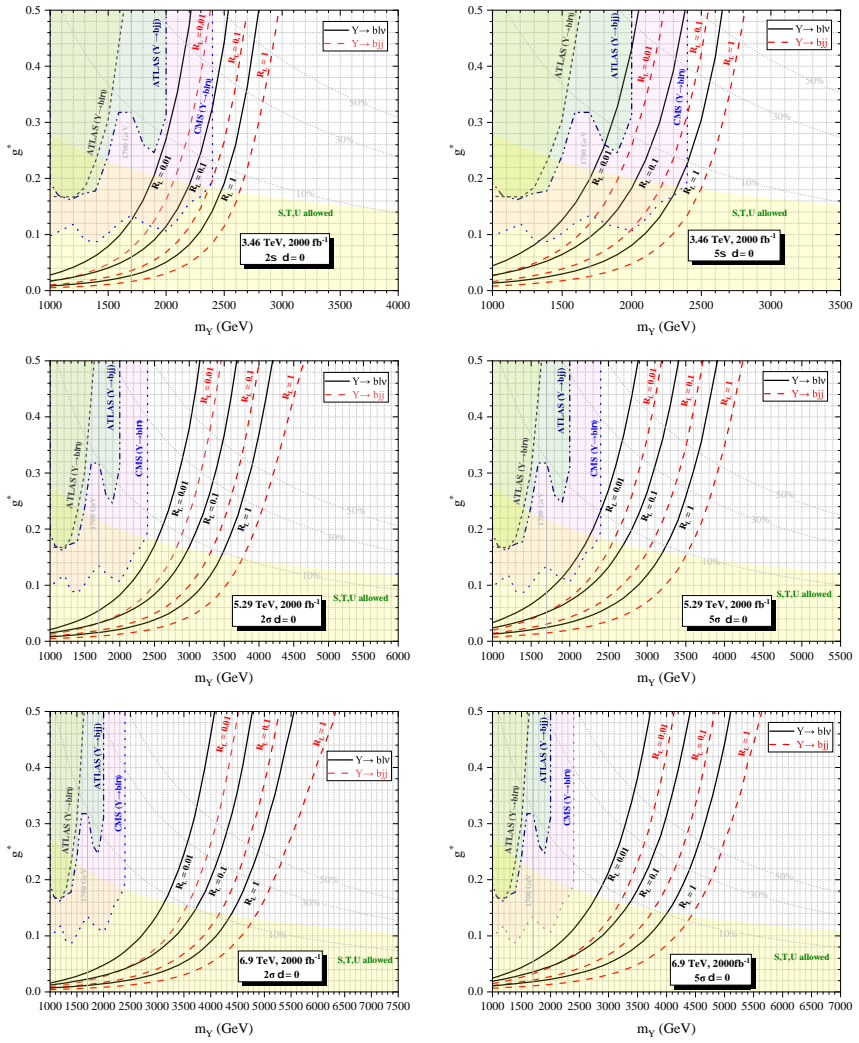
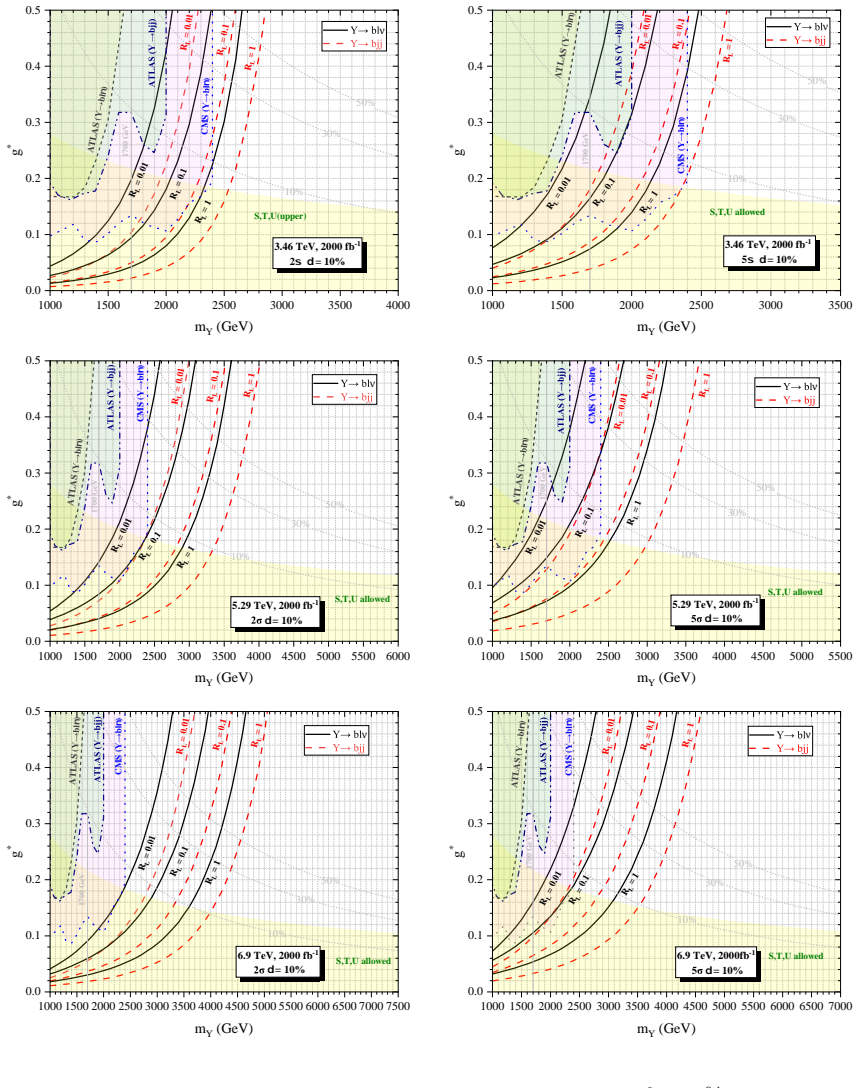
The hadronic W decay channel yields stronger 2σ exclusion and 5σ discovery reach for single-produced vector-like Y quarks at the FCC-eh than the leptonic channel.
A machine-rendered reading of the paper's core claim, the machinery that carries it, and where it could break.
Core claim
By performing detailed detector simulations of single Y production followed by Y → bW, the analysis shows that the hadronic channel, where the W is reconstructed as a W-jet, delivers stronger 2σ exclusion limits and 5σ discovery reaches in the g*–m_Y plane than the leptonic channel; both reaches improve with increasing √s from 3.46 TeV to 6.9 TeV at 80% electron polarization.
What carries the argument
Reconstruction of boosted W bosons as single W-jets together with kinematic observables that suppress Standard Model backgrounds in the hadronic decay channel.
If this is right
- The hadronic channel provides stronger exclusion and discovery sensitivities than the leptonic channel.
- Sensitivities improve with increasing √s at the FCC-eh.
- Limits apply to Y couplings to both first- and third-generation down-type quarks.
- Electron-beam polarization of -80% is incorporated throughout the reach estimates.
Where Pith is reading between the lines
- The same W-jet reconstruction technique could be applied to other vector-like quark searches at future electron-hadron facilities.
- If the Y quark is discovered, its measured coupling strength would directly constrain mixing angles with the Standard Model down sector.
- Higher energies beyond 6.9 TeV would further extend the mass reach for small couplings.
Load-bearing premise
The detailed detector simulations and background suppression via kinematic observables in the hadronic channel accurately model real detector response and SM backgrounds at the proposed FCC-eh energies.
What would settle it
A null result in the hadronic W-jet channel at 6.9 TeV that fails to exclude the predicted signal cross-section for any g* above the quoted 2σ contour would falsify the claimed sensitivity improvement.
Figures
read the original abstract
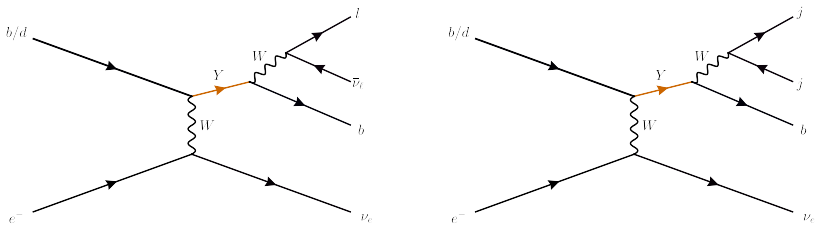
We investigate the exclusion and discovery potential for single production of a vector-like $Y$ quark with electric charge $Q=-4/3$, followed by the decay $Y\to bW$, at the FCC-eh. The $Y$ quark is allowed to couple to both first- and third-generation down-type quarks. The analysis is performed for an electron-beam polarization of $P_e=-80\%$ at $\sqrt{s}=3.46$, $5.29$, and $6.9~\mathrm{TeV}$. Both leptonic and hadronic $W$-boson decay channels are considered. In the hadronic channel, the boosted $W$-boson is reconstructed as a $W$-jet, and kinematic observables are used to suppress the Standard Model (SM) backgrounds. By performing a detailed detector simulations and event analysis, we present the $2\sigma$ exclusion limits and $5\sigma$ discovery reaches in the $g^*$--$m_Y$ plane, where $g^*$ is $Y$ coupling strength to the SM quarks. We find that the hadronic channel can provide stronger exclusion and discovery sensitivities, which are improved with increasing $\sqrt{s}$ at the FCC-eh.
Editorial analysis
A structured set of objections, weighed in public.
Referee Report
Summary. The manuscript investigates the potential for discovering or excluding single production of a vector-like Y quark (Q = -4/3) decaying to bW at the FCC-eh collider. It considers electron beam polarization of -80% at three energies (3.46, 5.29, 6.9 TeV), analyzes both leptonic and hadronic W decay modes using detailed detector simulations, and presents 2σ exclusion and 5σ discovery reaches in the g*–m_Y plane, concluding that the hadronic channel provides stronger sensitivities that improve with increasing center-of-mass energy.
Significance. If the simulation-based projections hold, the work would provide concrete guidance for BSM searches at future ep facilities by showing the advantage of hadronic W reconstruction for boosted topologies and the scaling of reach with √s. The forward-simulation approach against external SM backgrounds is standard for such studies.
major comments (2)
- [Event analysis and W-jet reconstruction] Event analysis and W-jet reconstruction section: The claim that the hadronic channel yields stronger 2σ exclusion and 5σ discovery reaches (and improves with √s) rests entirely on the Delphes-style detector simulation correctly predicting boosted W-jet tagging efficiencies, kinematic variable distributions, and residual SM background rates after cuts. Because FCC-eh does not exist, these predictions rely on an unvalidated Monte Carlo model at 3.5–6.9 TeV; no cross-checks against data, alternative generators, or variations in jet energy resolution/pile-up are reported. A modest shift in assumed tagging efficiency or background normalization would reverse the hadronic-vs-leptonic ranking, making this load-bearing for the central result.
- [Results (g*–m_Y plane figures)] Results (g*–m_Y plane figures): The quoted reaches are presented without systematic uncertainty bands arising from the simulation assumptions (tagging efficiencies, background normalizations). This omission directly affects the quantitative comparison between channels and energies.
minor comments (1)
- [Abstract] Abstract: The phrase 'detailed detector simulations' should specify the tool and card used (e.g., Delphes with FCC configuration) for reproducibility.
Simulated Author's Rebuttal
We thank the referee for their thorough review and constructive comments on our manuscript investigating single production of a vector-like Y quark at the FCC-eh. We address each major comment point by point below.
read point-by-point responses
-
Referee: Event analysis and W-jet reconstruction section: The claim that the hadronic channel yields stronger 2σ exclusion and 5σ discovery reaches (and improves with √s) rests entirely on the Delphes-style detector simulation correctly predicting boosted W-jet tagging efficiencies, kinematic variable distributions, and residual SM background rates after cuts. Because FCC-eh does not exist, these predictions rely on an unvalidated Monte Carlo model at 3.5–6.9 TeV; no cross-checks against data, alternative generators, or variations in jet energy resolution/pile-up are reported. A modest shift in assumed tagging efficiency or background normalization would reverse the hadronic-vs-leptonic ranking, making this load-bearing for the central result.
Authors: We acknowledge that our results depend on the modeling in the detector simulation, and that direct experimental validation is not feasible for a future collider. The Delphes simulation is a widely used tool calibrated on current LHC data, and our W-jet tagging efficiencies are based on established boosted jet algorithms from ATLAS and CMS. We did not include explicit variations in the original analysis, but we will revise the manuscript to add a robustness study showing the impact of ±10% variations in tagging efficiency and ±30% in background rates. This will demonstrate that the hadronic channel's advantage holds under these variations. We therefore make a partial revision by adding this discussion. revision: partial
-
Referee: Results (g*–m_Y plane figures): The quoted reaches are presented without systematic uncertainty bands arising from the simulation assumptions (tagging efficiencies, background normalizations). This omission directly affects the quantitative comparison between channels and energies.
Authors: We agree with the referee that systematic uncertainty bands would improve the figures. In the revised manuscript, we will incorporate estimated systematic uncertainty bands on the 2σ exclusion and 5σ discovery contours in the g*–m_Y plane. These will be based on the variations in tagging efficiencies and background normalizations as discussed in response to the first comment. This revision will be made. revision: yes
- Validation of the Monte Carlo model against data at 3.5-6.9 TeV, since the FCC-eh does not exist.
Circularity Check
No circularity: forward Monte Carlo simulation of collider reach
full rationale
The paper generates signal and background events via standard Monte Carlo tools, applies kinematic cuts and W-jet tagging in a detector simulation, then extracts 2σ/5σ contours in the g*–m_Y plane. None of these steps reduces a claimed prediction to a fitted input by construction, invokes a self-citation as a uniqueness theorem, or renames an empirical pattern. The hadronic-channel superiority is an output of the simulation chain, not an input; external SM cross-sections and detector response models are independent of the paper’s results. This is the normal, non-circular case for a phenomenological sensitivity study.
Axiom & Free-Parameter Ledger
free parameters (2)
- g*
- m_Y
axioms (2)
- domain assumption Standard Model backgrounds and parton distributions are known and correctly modeled at FCC-eh energies.
- domain assumption Detector response and jet reconstruction efficiencies at proposed FCC-eh energies match the simulation.
invented entities (1)
-
vector-like Y quark with Q=-4/3
no independent evidence
Reference graph
Works this paper leans on
-
[1]
School of Physics, Henan Normal University, Xinxiang 453007, PR China
-
[2]
School of Physics & Astronomy, University of Southampton, Highfield, Southampton SO17 1BJ, UK
-
[3]
Searching for single production of a vector-like $Y$ quark decaying into $bW$ at the FCC-eh
Department of Physics & Astronomy, Uppsala University, Box 516, 751 20 Uppsala, Sweden Abstract We investigate the exclusion and discovery potential for single production of a vector-likeYquark with electric chargeQ=−4/3, followed by the decayY→bW, at the FCC-eh. TheYquark is allowed to couple to both first- and third-generation down-type quarks. The anal...
work page internal anchor Pith review Pith/arXiv arXiv 2026
-
[4]
Aad et al
G. Aad et al. (ATLAS Collaboration), Phys. Lett. B716, 1 (2012)
2012
-
[5]
Chatrchyan et al
S. Chatrchyan et al. (CMS Collaboration), Phys. Lett. B716, 30 (2012)
2012
-
[6]
N. Arkani-Hamed, C. Figueiredo, L. J. Hall, and C. A. Manzari (2026), arXiv:2602.17754 [hep-ph]
-
[7]
Burdman, Z
G. Burdman, Z. Chacko, R. Harnik, L. de Lima, and C. B. Verhaaren, Phys. Rev. D91, 055007 (2015)
2015
-
[8]
H.-J. He, N. Polonsky, and S.-f. Su, Phys. Rev. D64, 053004 (2001)
2001
-
[9]
G. D. Kribs, T. Plehn, M. Spannowsky, and T. M. P. Tait, Phys. Rev. D76, 075016 (2007)
2007
-
[10]
Lenz, Adv
A. Lenz, Adv. High Energy Phys.2013, 910275 (2013)
2013
-
[11]
Electroweak Model and Constraints on New Physics
J. Erler and P. Langacker (2004), arXiv:hep-ph/0407097
work page internal anchor Pith review Pith/arXiv arXiv 2004
-
[12]
Shang, Y
L. Shang, Y . Yan, S. Moretti, and B. Yang, Phys. Rev. D109, 115016 (2024)
2024
-
[13]
J. A. Aguilar-Saavedra, R. Benbrik, S. Heinemeyer, and M. P ´erez-Victoria, Phys. Rev. D88, 094010 (2013). 22
2013
-
[14]
J. A. Aguilar-Saavedra, EPJ Web Conf.60, 16012 (2013)
2013
- [15]
-
[16]
Han, Y .-B
J.-Z. Han, Y .-B. Liu, and S. Moretti, Phys. Rev. D112, 035016 (2025)
2025
-
[17]
Cetinkaya, A
V . Cetinkaya, A. Ozansoy, V . Ari, O. Ozsimsek, and O. Cakir, Nucl. Phys. B973, 115580 (2021)
2021
-
[18]
Branco and L
G. Branco and L. Lavoura, Nucl. Phys. B278, 738 (1986)
1986
-
[19]
Del Aguila and M
F. Del Aguila and M. Bowick, Nucl. Phys. B224, 107 (1983)
1983
-
[20]
F. J. Botella, G. C. Branco, M. Nebot, M. N. Rebelo, and J. I. Silva-Marcos, Eur. Phys. J. C77, 408 (2017)
2017
-
[21]
Aad et al
G. Aad et al. (ATLAS Collaboration), Phys. Lett. B854, 138743 (2024)
2024
-
[22]
A. M. Sirunyan et al. (CMS Collaboration), Phys. Lett. B779, 82 (2018)
2018
-
[23]
Aaboud et al
M. Aaboud et al. (ATLAS Collaboration), JHEP05, 164 (2019)
2019
-
[24]
Aad et al
G. Aad et al. (ATLAS Collaboration), JHEP02, 075 (2025)
2025
-
[25]
A. Hayrapetyan et al. (CMS Collaboration) (2026), arXiv:2604.17564 [hep-ex]
work page internal anchor Pith review Pith/arXiv arXiv 2026
-
[26]
Abada et al
A. Abada et al. (FCC Collaboration), Eur. Phys. J. C79, 474 (2019)
2019
-
[27]
Agostini et al
P. Agostini et al. (LHeC, FCC-he Study Group), J. Phys. G48, 110501 (2021)
2021
-
[28]
J. L. Abelleira Fernandez et al. (LHeC Study Group), J. Phys. G39, 075001 (2012)
2012
-
[29]
Y . C. Acar, A. N. Akay, S. Beser, A. C. Canbay, H. Karadeniz, U. Kaya, B. B. Oner, and S. Sultan- soy, Nucl. Instrum. Meth. A871, 47 (2017)
2017
-
[30]
Curtin, K
D. Curtin, K. Deshpande, O. Fischer, et al., JHEP07, 024 (2018)
2018
-
[31]
Machine Parameters and Projected Luminosity Performance of Proposed Future Colliders at CERN
F. Bordry, M. Benedikt, O. Br¨uning, J. Jowett, L. Rossi, D. Schulte, S. Stapnes, and F. Zimmermann (2018), arXiv:1810.13022 [physics.acc-ph]
work page internal anchor Pith review Pith/arXiv arXiv 2018
-
[33]
Buchkremer, G
M. Buchkremer, G. Cacciapaglia, A. Deandrea, and L. Panizzi, Nucl. Phys. B876, 376 (2013)
2013
-
[34]
Q.-H. Cao, B. Yan, J.-H. Yu, and C. Zhang, Chin. Phys. C41, 063101 (2017)
2017
-
[35]
Cetinkaya, A
V . Cetinkaya, A. Ozansoy, V . Ari, O. M. Ozsimsek, and O. Cakir, Nucl. Phys. B973, 115580 (2021)
2021
-
[36]
J. Cao, L. Meng, L. Shang, S. Wang, and B. Yang, Phys. Rev. D106, 055042 (2022)
2022
-
[38]
Deandrea, Phys
A. Deandrea, Phys. Lett. B409, 277 (1997). 23
1997
-
[39]
Arcadi, M
G. Arcadi, M. Lindner, J. Martins, and F. S. Queiroz, Nucl. Phys. B959, 115158 (2020)
2020
-
[40]
Moretti, L
S. Moretti, L. Panizzi, and L. Shang, JHEP06, 132 (2025)
2025
-
[41]
Navas et al
S. Navas et al. (Particle Data Group Collaboration), Phys. Rev. D110, 030001 (2024)
2024
-
[42]
Shang, C
L. Shang, C. Chen, S. Wang, and B. Yang, Nucl. Phys. B984, 115977 (2022)
2022
-
[43]
Y . J. Zhang, Y . T. Zhu, and L. Han, Eur. Phys. J. C84, 1184 (2024)
2024
-
[44]
B. Yang, Z. Li, X. Jia, et al., Eur. Phys. J. C84, 1124 (2024)
2024
-
[45]
Y .-B. Liu, B. Hu, and C.-Z. Li, Nucl. Phys. B1007, 116667 (2024)
2024
-
[46]
J. Han, L. Shang, and B. Yang, Eur. Phys. J. C83, 846 (2023)
2023
-
[47]
L. Han, J. F. Shen, and Y . B. Liu, Eur. Phys. J. C82, 637 (2022)
2022
-
[48]
Alwall, M
J. Alwall, M. Herquet, F. Maltoni, O. Mattelaer, and T. Stelzer, JHEP06, 128 (2011)
2011
-
[49]
R. D. Ball et al. (NNPDF Collaboration), Eur. Phys. J. C77, 663 (2017)
2017
-
[50]
Sj ¨ostrand, S
T. Sj ¨ostrand, S. Ask, J. R. Christiansen, R. Corke, N. Desai, P. Ilten, S. Mrenna, S. Prestel, C. O. Rasmussen, and P. Z. Skands, Comput. Phys. Commun.191, 159 (2015)
2015
-
[51]
de Favereau, C
The DELPHES 3 collaboration, J. de Favereau, C. Delaere, et al., JHEP02, 057 (2014)
2014
-
[52]
Cacciari and G
M. Cacciari and G. P. Salam, Phys. Lett. B641, 57 (2006)
2006
-
[53]
Cacciari, G
M. Cacciari, G. P. Salam, and G. Soyez, Eur. Phys. J. C72, 1896 (2012)
2012
-
[54]
Y . L. Dokshitzer, G. D. Leder, S. Moretti, and B. R. Webber, JHEP08, 001 (1997)
1997
-
[55]
Hadronization Corrections to Jet Cross Sections in Deep-Inelastic Scattering
M. Wobisch and T. Wengler, inWorkshop on Monte Carlo Generators for HERA Physics (Plenary Starting Meeting)(1998), pp. 270–279, arXiv:hep-ph/9907280
work page internal anchor Pith review Pith/arXiv arXiv 1998
-
[56]
Conte, B
E. Conte, B. Fuks, and G. Serret, Comput. Phys. Commun.184, 222 (2013)
2013
-
[57]
Shang and Y
L. Shang and Y . Zhang, Comput. Phys. Commun.296, 109027 (2024)
2024
-
[58]
Br ¨uning, A
O. Br ¨uning, A. Seryi, and S. Verd´u-Andr´es, Front. Phys.10(2022)
2022
-
[59]
Cowan, K
G. Cowan, K. Cranmer, E. Gross, and O. Vitells, Eur. Phys. J. C71, 1554 (2011), [Erratum: Eur.Phys.J.C 73, 2501 (2013)]
2011
-
[60]
Kumar and S
N. Kumar and S. P. Martin, Phys. Rev. D92, 115018 (2015)
2015
-
[61]
Moretti, D
S. Moretti, D. O’Brien, L. Panizzi, and H. Prager, Phys. Rev. D96, 075035 (2017)
2017
-
[62]
Carvalho, S
A. Carvalho, S. Moretti, D. O’Brien, L. Panizzi, and H. Prager, Phys. Rev. D98, 015029 (2018)
2018
-
[63]
Deandrea, T
A. Deandrea, T. Flacke, B. Fuks, L. Panizzi, and H.-S. Shao, JHEP08, 107 (2021). 24
2021
discussion (0)
Sign in with ORCID, Apple, or X to comment. Anyone can read and Pith papers without signing in.