Thermodynamics of polymerized vacuum regular black holes in anti-de Sitter spacetime
Pith reviewed 2026-06-27 06:25 UTC · model grok-4.3
The pith
Regular black holes in anti-de Sitter space undergo Hawking-Page transitions set by how each core deforms the outer horizon.
A machine-rendered reading of the paper's core claim, the machinery that carries it, and where it could break.
Core claim
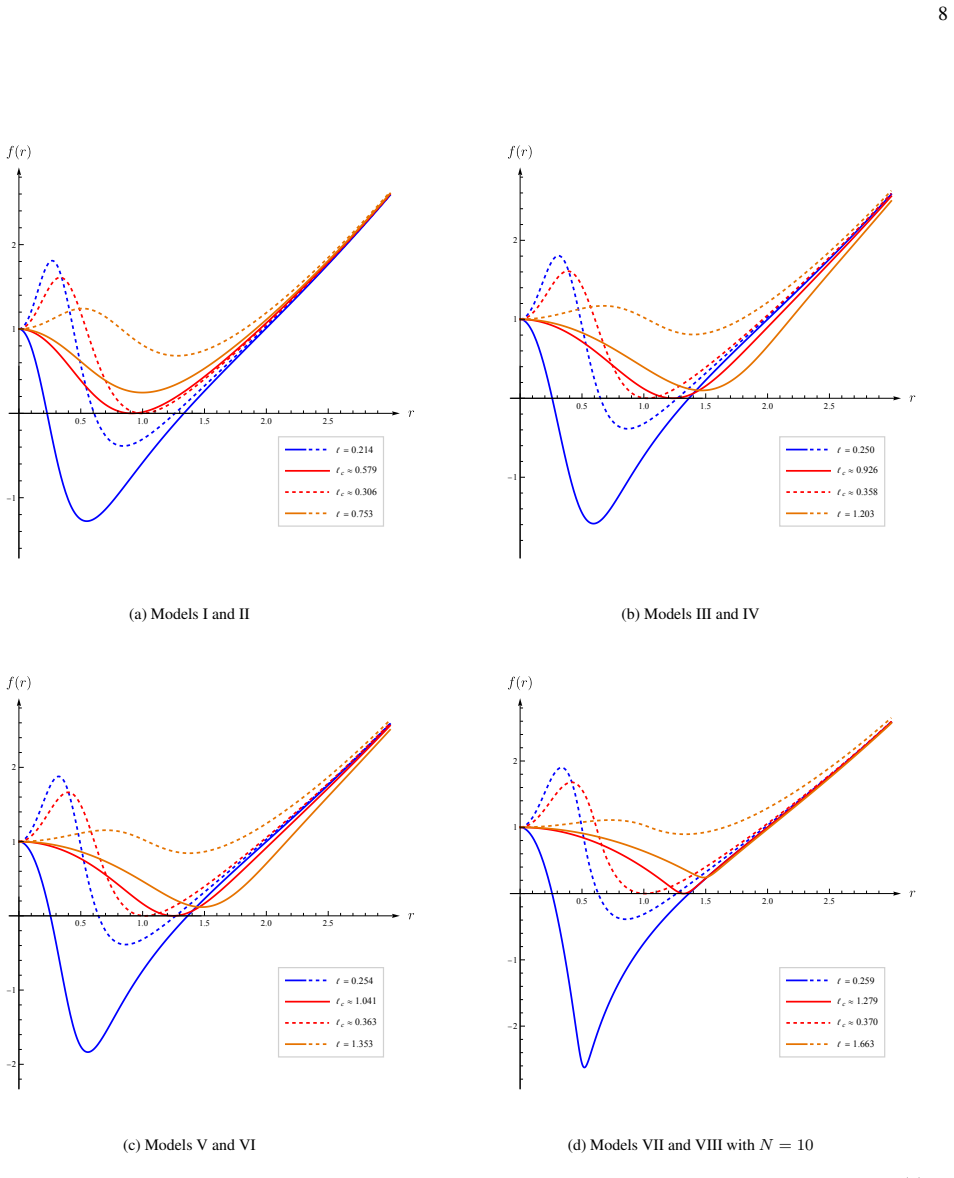
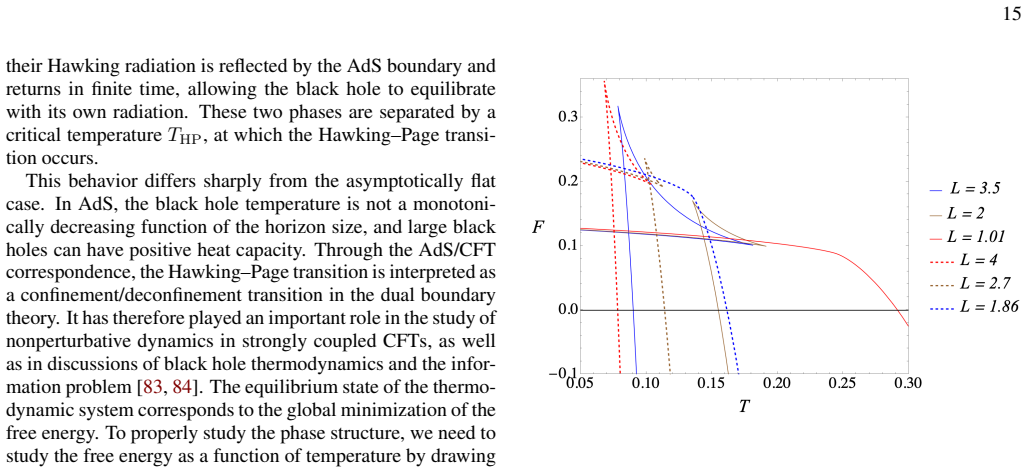
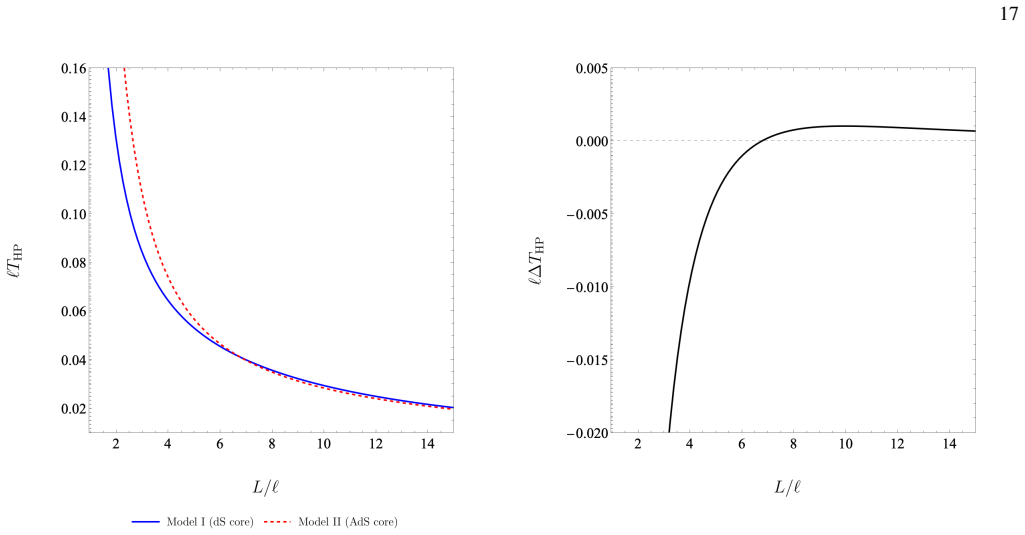
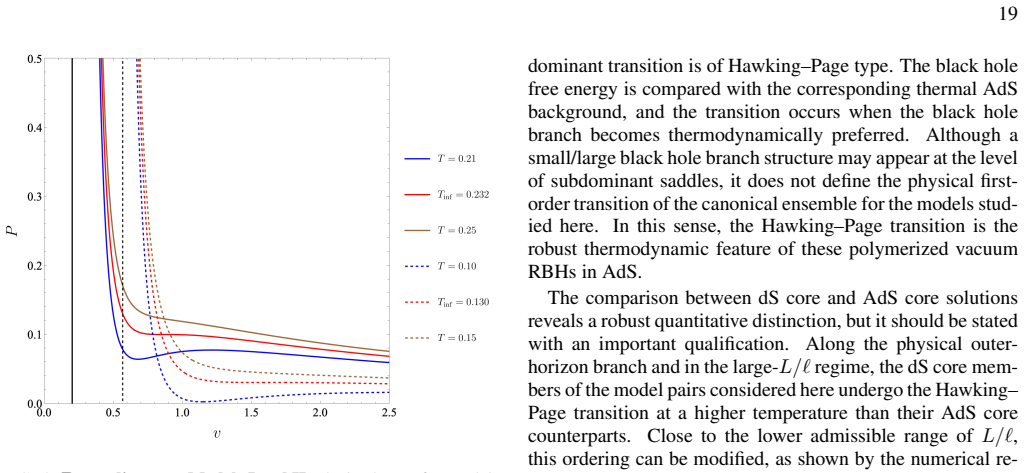
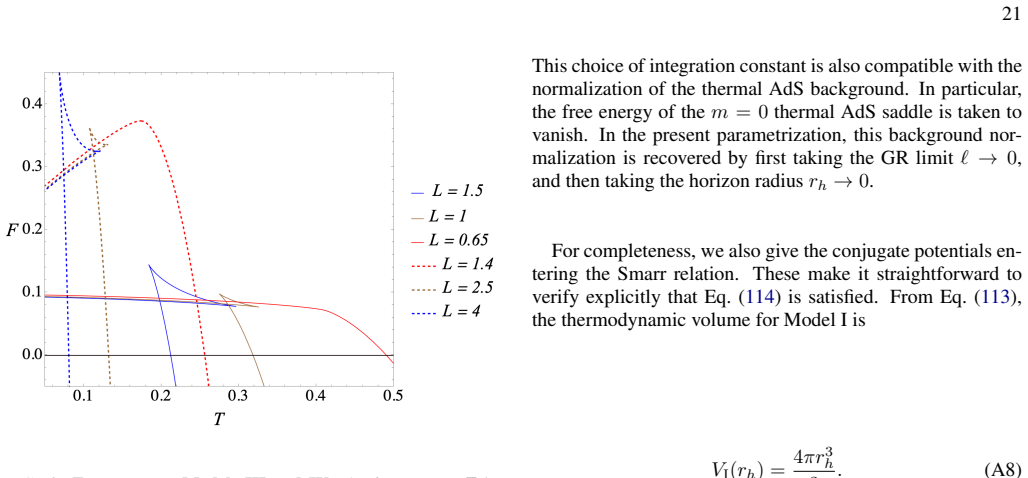
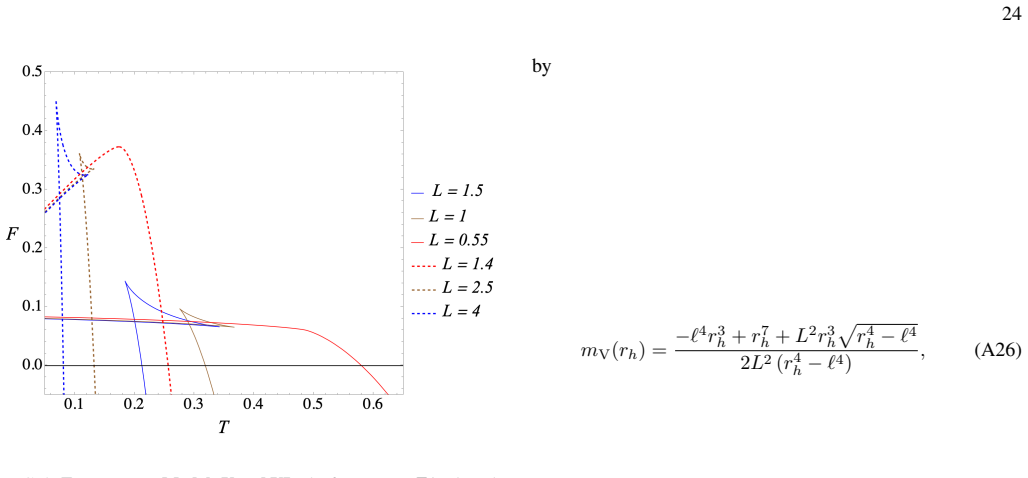
Within the deparameterized formulation the dynamics factorizes across radial shells, yielding a Birkhoff-type uniqueness theorem: for fixed reconstruction function and cosmological constant the static solution is determined solely by its mass. Several explicit regular geometries are constructed, some possessing de Sitter cores and others anti-de Sitter cores. Their extended-phase-space thermodynamics are computed, revealing that the dominant phase transition occurs when the black-hole free energy equals the free energy of the thermal anti-de Sitter background. The regularization modifies the quantitative value of this transition temperature through its effect on the outer-horizon branch and
What carries the argument
The factorized shell Hamiltonian arising from the deparameterized dynamics, which enforces a Birkhoff-type uniqueness property for the static geometry given fixed reconstruction function and cosmological constant.
If this is right
- The Hawking-Page transition remains the dominant transition for all models in the class.
- The transition temperature is shifted quantitatively by the core-induced deformation of the outer-horizon branch.
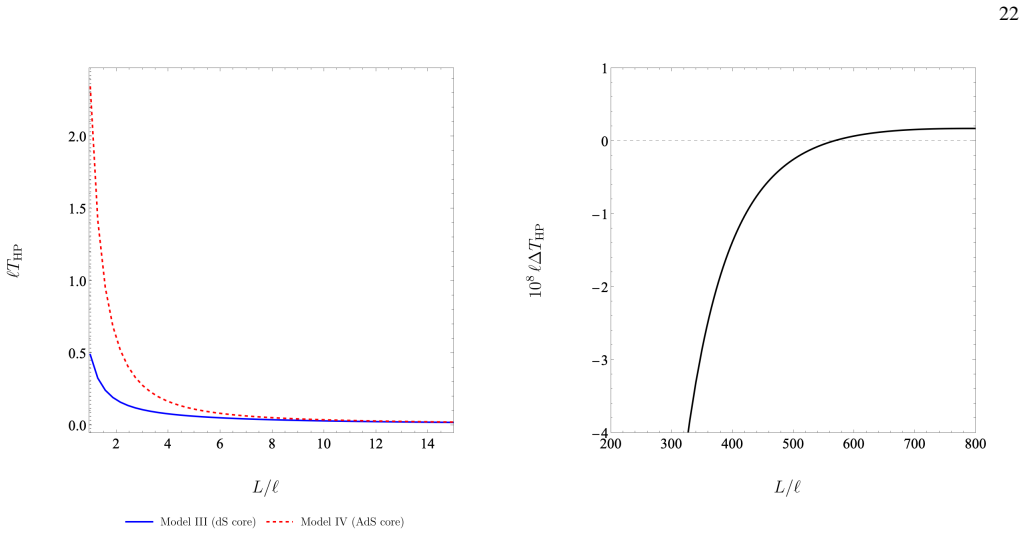
- In the large anti-de Sitter radius regime, de Sitter-core solutions reach the transition at higher temperature than anti-de Sitter-core solutions.
- The relative ordering of the two classes can reverse when the anti-de Sitter radius approaches its lower admissible value.
Where Pith is reading between the lines
- Thermodynamic observables may distinguish different choices of regularization function through their effect on horizon-branch endpoints.
- The same core-deformation mechanism could be examined in asymptotically flat or de Sitter settings to test whether the Hawking-Page dominance persists.
- Comparison of free-energy curves across multiple reconstruction functions would map how internal structure controls global thermodynamic behavior.
Load-bearing premise
The auxiliary dust field is used exclusively to define an internal time coordinate and does not contribute any stress-energy to the spacetime.
What would settle it
A direct computation for one of the explicit models in which the black-hole free energy never crosses the thermal anti-de Sitter free energy would falsify the claim that the dominant transition is of Hawking-Page type.
Figures
read the original abstract
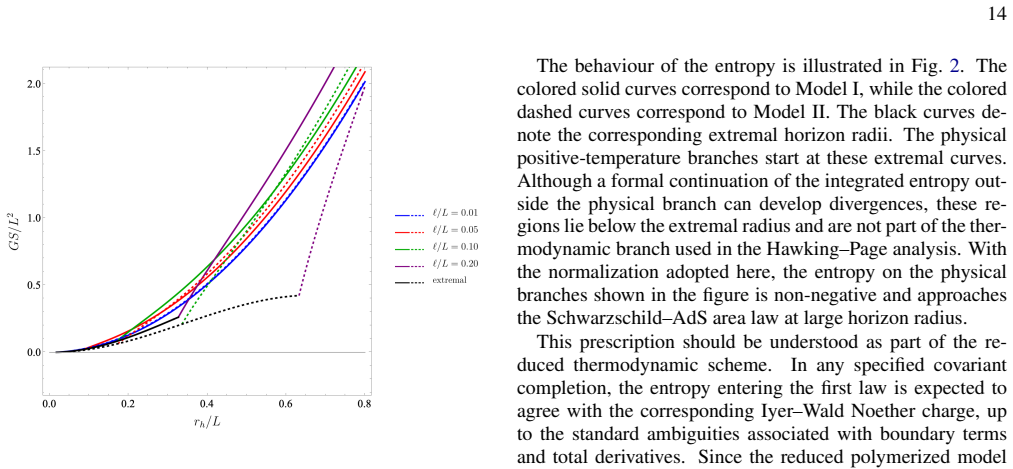
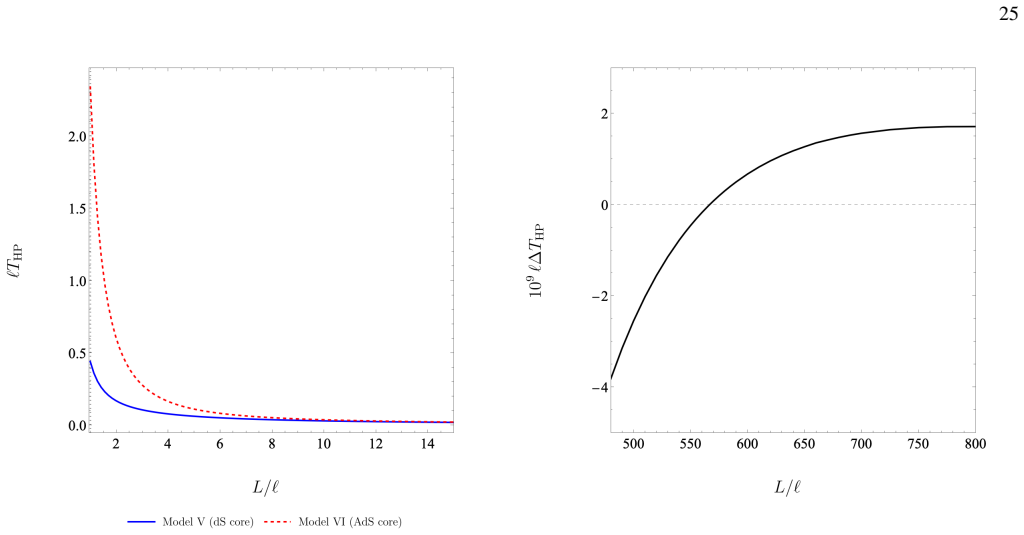
We derive a class of vacuum regular black holes inspired by effective loop quantum gravity dynamics and extend the construction to asymptotically anti-de Sitter spacetimes. The derivation is based on a deparameterized Lema\^itre--Tolman--Bondi formulation, where an auxiliary dust field is introduced only to define an internal time and does not act as a matter source. In spherical symmetry, the dynamics reduces to a set of independent radial shells, giving rise to a factorized shell Hamiltonian and to a Birkhoff-type property: for a fixed reconstruction function and cosmological constant, the static geometry is uniquely determined by the mass. Within this framework, we construct several regular black hole models with de Sitter cores and corresponding models with anti-de Sitter cores. We then study their thermodynamics in the extended phase space, with particular emphasis on the Hawking--Page transition. For the class of models considered, the dominant transition is of Hawking--Page type, determined by the crossing of the black hole free energy with the corresponding thermal-AdS background. The regularization affects the quantitative transition temperature by deforming the physical outer-horizon branch, including its endpoint structure. In the large anti-de Sitter radius regime, the de Sitter core solutions exhibit a higher Hawking--Page temperature than their anti-de Sitter-core counterparts, while the ordering can be modified close to the lower admissible range of the AdS scale. Thus, the thermodynamic differences between the two classes are not a consequence of regularity alone, but arise from how the core deformation modifies the horizon branch relative to the thermal-AdS reference background.
Editorial analysis
A structured set of objections, weighed in public.
Referee Report
Summary. The manuscript derives a class of vacuum regular black holes in asymptotically anti-de Sitter spacetime from a deparameterized Lemaître-Tolman-Bondi formulation in which an auxiliary dust field defines an internal time but is asserted not to source stress-energy. In spherical symmetry the dynamics factorizes into independent radial shells, yielding a Birkhoff-type uniqueness property: for fixed reconstruction function and cosmological constant the static geometry is uniquely fixed by the mass. Several explicit models with de Sitter and anti-de Sitter cores are constructed and their thermodynamics are studied in the extended phase space, with the conclusion that the dominant transition is of Hawking-Page type set by the crossing of black-hole and thermal-AdS free energies; quantitative differences between the two core classes arise from how the core deformation modifies the outer-horizon branch rather than from regularity alone.
Significance. If the vacuum property and Birkhoff uniqueness hold, the construction supplies a controlled, parameter-light framework for comparing the thermodynamics of regular black holes with qualitatively different cores against a common thermal-AdS reference. The explicit factorization into shells and the ability to vary the core while preserving the vacuum character are genuine strengths that permit falsifiable statements about how horizon-branch deformations shift the Hawking-Page temperature.
major comments (2)
- [Deparameterized LTB formulation and Hamiltonian reduction] The central claim that the solutions remain vacuum (and therefore obey the stated Birkhoff-type uniqueness) rests on the auxiliary dust contributing identically zero stress-energy after deparameterization and shell factorization. The abstract asserts this, yet the load-bearing step—whether the Hamiltonian reduction and conjugate-momentum constraints enforce T_{\mu\nu}^{dust}=0 identically—requires an explicit derivation; without it the vacuum character, the uniqueness property, and the controlled comparison to thermal AdS are not secured.
- [Thermodynamic analysis] § on thermodynamic analysis: the assertion that the dominant transition is Hawking-Page type for the entire class, together with the ordering of transition temperatures in the large-AdS-radius regime, is stated without reported error estimates, convergence checks against the Schwarzschild-AdS limit, or tabulated free-energy crossings; these omissions make the quantitative claims difficult to assess.
minor comments (1)
- Notation for the reconstruction function and the auxiliary dust momentum should be introduced once with a clear table of symbols; repeated redefinitions in different sections hinder readability.
Simulated Author's Rebuttal
We thank the referee for the positive assessment of the framework's strengths and for the constructive major comments. We address each point below, indicating where the manuscript will be revised to strengthen the presentation.
read point-by-point responses
-
Referee: [Deparameterized LTB formulation and Hamiltonian reduction] The central claim that the solutions remain vacuum (and therefore obey the stated Birkhoff-type uniqueness) rests on the auxiliary dust contributing identically zero stress-energy after deparameterization and shell factorization. The abstract asserts this, yet the load-bearing step—whether the Hamiltonian reduction and conjugate-momentum constraints enforce T_{\mu\nu}^{dust}=0 identically—requires an explicit derivation; without it the vacuum character, the uniqueness property, and the controlled comparison to thermal AdS are not secured.
Authors: We agree that an explicit derivation of T_{\mu\nu}^{dust}=0 from the Hamiltonian reduction and constraints is necessary to secure the vacuum character and Birkhoff-type uniqueness. While the deparameterized LTB setup and shell factorization are presented in the manuscript, the step showing that the dust stress-energy vanishes identically under the conjugate-momentum constraints is not derived in sufficient detail. We will add a dedicated subsection in the revised manuscript that carries out this derivation from the reduced Hamiltonian and constraints, thereby making the vacuum property fully explicit. revision: yes
-
Referee: [Thermodynamic analysis] § on thermodynamic analysis: the assertion that the dominant transition is Hawking-Page type for the entire class, together with the ordering of transition temperatures in the large-AdS-radius regime, is stated without reported error estimates, convergence checks against the Schwarzschild-AdS limit, or tabulated free-energy crossings; these omissions make the quantitative claims difficult to assess.
Authors: We accept that the thermodynamic claims would be strengthened by the inclusion of error estimates, convergence checks against the Schwarzschild-AdS limit, and tabulated free-energy crossings. The manuscript currently presents the free-energy comparisons and transition temperatures through analytic expressions and representative plots, but does not report numerical error estimates or explicit tables of crossings. In the revision we will add these elements: (i) tabulated values of the free-energy crossing points for representative parameter choices, (ii) convergence checks of the outer-horizon branch and transition temperatures as the regularization parameter approaches the Schwarzschild-AdS limit, and (iii) brief error estimates on the numerically located transition temperatures. revision: yes
Circularity Check
No significant circularity; derivation uses external mass/Λ inputs and computes transitions from geometry
full rationale
The paper's chain starts from the deparameterized LTB setup with the auxiliary dust introduced by assumption (explicitly stated not to source stress-energy), reduces to shell Hamiltonians, obtains the Birkhoff-type uniqueness as a derived consequence for fixed reconstruction function and Λ, then constructs explicit regular models and computes free energies and Hawking-Page crossings directly from the resulting horizon radii. Mass and cosmological constant enter as external parameters; transition temperatures are obtained by comparing on-shell actions rather than by fitting any output to itself. No self-citation is invoked for load-bearing uniqueness, no ansatz is smuggled, and no prediction is renamed from a fit. The derivation remains self-contained against the stated assumptions.
Axiom & Free-Parameter Ledger
free parameters (2)
- reconstruction function
- cosmological constant
axioms (2)
- domain assumption Auxiliary dust field defines internal time but carries no stress-energy
- standard math Spherical symmetry and factorized shell Hamiltonian
Forward citations
Cited by 1 Pith paper
-
Null geodesic defocusing in dynamical black-hole-to-white-hole transitions
Dynamical black-hole-to-white-hole transitions require a violation of the null convergence condition for the trapped region to disappear and the anti-trapped region to form.
Reference graph
Works this paper leans on
-
[1]
The branch continuously connected to the Schwarzschild– AdS regime is the monotonic segment0< y <1/3
The AdS-core region therefore lies beyond the zero of ˜fII, 18 and is not itself part of the positive horizon branch determined by ˜fII(uh) = 1/r2 h >0. The branch continuously connected to the Schwarzschild– AdS regime is the monotonic segment0< y <1/3. Indeed, d dy y(1−y) (1 +y) 2 = 1−3y (1 +y) 3 ,(137) so this branch ends at the maximumy end = 1/3, whe...
-
[2]
S. W. Hawking, Breakdown of predictability in gravitational collapse, Phys. Rev. D14, 2460 (1976)
1976
-
[3]
Cardoso and P
V . Cardoso and P. Pani, Testing the nature of dark compact ob- jects: a status report, Living Rev. Relativ.22, 4 (2019)
2019
-
[4]
Barack, V
L. Barack, V . Cardoso, S. Nissanke, and T. P. Sotiriou (eds.), Black holes, gravitational waves and fundamental physics: a roadmap, Class. Quantum Gravity36, 143001 (2019)
2019
-
[5]
Murk, Nomen non est omen: Why it is too soon to identify ultra-compact objects as black holes, Int
S. Murk, Nomen non est omen: Why it is too soon to identify ultra-compact objects as black holes, Int. J. Mod. Phys. D32, 2342012 (2023)
2023
-
[6]
Pellicer and R
R. Pellicer and R. J. Torrence, Nonlinear Electrodynamics and General Relativity, J. Math. Phys.10, 1718 (1969)
1969
-
[7]
K. A. Bronnikov, V . N. Melnikov, G. N. Shikin, and K. P. Sta- niukovich, Scalar, electromagnetic, and gravitational fields in- 26 teraction: Particlelike solutions, Ann. Phys.118, 84 (1979)
1979
-
[8]
Ay ´on-Beato and E
E. Ay ´on-Beato and E. Garc ´ıa, Regular Black Hole in General Relativity Coupled to Nonlinear Electrodynamics, Phys. Rev. Lett.80, 5056 (1998)
1998
-
[9]
Ay ´on-Beato and E
E. Ay ´on-Beato and E. Garc ´ıa, Non-Singular Charged Black Hole Solution for Non-Linear Source, Gen. Relativ. Gravit.31, 629 (1999)
1999
-
[10]
Ay ´on-Beato and E
E. Ay ´on-Beato and E. Garc´ıa, New regular black hole solution from nonlinear electrodynamics, Phys. Lett. B464, 25 (1999)
1999
-
[11]
Regular Black Hole in General Relativity Coupled to Nonlinear Electrodynamics
K. A. Bronnikov, Comment on “Regular Black Hole in General Relativity Coupled to Nonlinear Electrodynamics”, Phys. Rev. Lett.85, 4641 (2000)
2000
-
[12]
K. A. Bronnikov, Regular magnetic black holes and monopoles from nonlinear electrodynamics, Phys. Rev. D63, 044005 (2001)
2001
-
[13]
Burinskii and S
A. Burinskii and S. R. Hildebrandt, New type of regular black holes and particlelike solutions from nonlinear electrodynam- ics, Phys. Rev. D65, 104017 (2002)
2002
-
[14]
Dymnikova, Regular electrically charged vacuum structures with de Sitter centre in nonlinear electrodynamics coupled to general relativity, Class
I. Dymnikova, Regular electrically charged vacuum structures with de Sitter centre in nonlinear electrodynamics coupled to general relativity, Class. Quantum Gravity21, 4417 (2004)
2004
-
[15]
Balart and E
L. Balart and E. C. Vagenas, Regular black holes with a nonlin- ear electrodynamics source, Phys. Rev. D90, 124045 (2014)
2014
-
[16]
Fan and X
Z.-Y . Fan and X. Wang, Construction of regular black holes in general relativity, Phys. Rev. D94, 124027 (2016)
2016
-
[17]
Construction of regular black holes in general relativity
K. A. Bronnikov, Comment on “Construction of regular black holes in general relativity”, Phys. Rev. D96, 128501 (2017)
2017
-
[18]
Construction of regular black holes in general relativity
B. Toshmatov, Z. Stuchl ´ık, and B. Ahmedov, Comment on “Construction of regular black holes in general relativity”, Phys. Rev. D98, 028501 (2018)
2018
-
[19]
K. A. Bronnikov, Regular Black Holes Sourced by Nonlinear Electrodynamics, in C. Bambi (ed.) Regular Black Holes: To- wards a New Paradigm of Gravitational Collapse (Springer Sin- gapore, 2023)
2023
-
[20]
Bueno, P
P. Bueno, P. A. Cano, and R. A. Hennigar, Regular black holes from pure gravity, Phys. Lett. B861, 139 (2025)
2025
-
[21]
Bueno, P
P. Bueno, P. A. Cano, R. A. Hennigar, and ´A. J. Murcia Regular black holes from thin-shell collapse, Phys. Rev. D111, 104009 (2025)
2025
-
[22]
Bueno, P
P. Bueno, P. A. Cano, R. A. Hennigar, and ´A. J. Murcia Dy- namical Formation of Regular Black Holes, Phys. Rev. Lett. 134, 181401 (2025)
2025
-
[23]
Bueno, P
P. Bueno, P. A. Cano, R. A. Hennigar, ´A. J. Murcia, and A. Vincente-Cano, Regular black holes from Oppenheimer-Snyder collapse, Phys. Rev. D112, 064039 (2025)
2025
-
[24]
R. A. Hennigar, D. Kubiz ˇn´ak, S. Murk, and I. Soranidis, Ther- modynamics of regular black holes in anti-de Sitter space, J. High Energ. Phys. 2025, 121 (2025)
2025
-
[25]
V . P. Frolov, A. Koek, J. P. Soto, and A. Zelnikov, Regular black holes inspired by quasitopological gravity, Phys. Rev. D111, 044034 (2025)
2025
-
[26]
J. Borissova and R. Carballo-Rubio, Regular black holes from pure gravity in four dimensions, arXiv: 2602.16773 [gr-qc] (2026)
Pith/arXiv arXiv 2026
-
[27]
Ben Achour, F
J. Ben Achour, F. Lamy, H. Liu, and K. Noui, Polymer Schwarzschild black hole: An effective metric, Europhysics let- ters123, 20006 (2018)
2018
-
[28]
Han and H
M. Han and H. Liu, Improved effective dynamics of quantum- gravity black hole and Nariai limit, Classical Quantum Gravity 39, 035011 (2022)
2022
-
[29]
Han and H
M. Han and H. Liu, Covariantµ¯-scheme effective dynam- ics, mimetic gravity, and nonsingular black holes: Applications to spherically symmetric quantum gravity, Phys. Rev. D109, 084033 (2024)
2024
-
[30]
P. G. S. Fernandes, Singularity resolution and inflation from an infinite tower of regularized curvature corrections, Phys. Rev. D112, 084028 (2025)
2025
-
[31]
Bueno, P
P. Bueno, P. A. Cano, R. A. Hennigar, and ´A. J. Murcia, Reg- ular black hole formation in four-dimensional nonpolynomial gravities, Phys. Rev. D113, 024019 (2026)
2026
-
[32]
Giesel, H
K. Giesel, H. Liu, E. Rullit, P. Singh, and S. A. Weigl, Em- bedding generalized Lema ˆıtre-Tolman-Bondi models in poly- merized spherically symmetric spacetimes, Phys. Rev. D110, 104017 (2025)
2025
-
[33]
K.Giesel, H. Liu, P. Singh, and S. A. Weigl, Regular black holes and their relationship to polymerized models and mimetic grav- ity, Phys. Rev. D111, 064064 (2025)
2025
-
[34]
K. Giesel and H. Liu, From Principles to Effective Models: A Constructive Framework for Effective Covariant Actions with a Unique Vacuum Solution, arXiv: 2512.24960 (2025)
arXiv 2025
-
[35]
H. Liu and I. Soranidis, Regular ultracompact objects with anti-de Sitter cores as polymerized vacuum solutions, arXiv: 2604.27880 [gr-qc] (2026)
Pith/arXiv arXiv 2026
-
[36]
A. H. Chamseddine and V . Mukhanov, Resolving Cosmological Singularities, JCAP03(2017), 009
2017
-
[37]
Langlois, H
D. Langlois, H. Liu, K. Noui and E. Wilson-Ewing, Effective loop quantum cosmology as a higher-derivative scalar-tensor theory, Class. Quant. Grav.34(2017) no.22, 225004
2017
-
[38]
Ben Achour, F
J. Ben Achour, F. Lamy, H. Liu and K. Noui, Non-singular black holes and the Limiting Curvature Mechanism: A Hamil- tonian perspective, JCAP05(2018), 072
2018
-
[39]
H. Liu and I. Soranidis, Probing mass inflation in polymer- ized vacuum regular black holes via colliding null shells, arXiv: 2604.27897 (2026)
Pith/arXiv arXiv 2026
-
[40]
J. M. Maldacena, The Large-N Limit of Superconformal Field Theories and Supergravity, Int. J. Theor. Phys.38, 1113 (1999)
1999
-
[41]
Kubiz ˇn´ak and F
D. Kubiz ˇn´ak and F. Simovic, Thermodynamics of horizons: de Sitter black holes and reentrant phase transitions, Classical Quantum Gravity33, 245001 (2016)
2016
-
[42]
Simovic and R
F. Simovic and R. B Mann, Critical phenomena of charged de Sitter black holes in cavities, Classical Quantum Gravity36, 014002 (2018)
2018
-
[43]
Simovic and R
F. Simovic and R. B Mann, Critical phenomena of Born-Infeld- de Sitter black holes in cavities, J. High Energy Phys. 05 (2019) 136
2019
-
[44]
Haroon, R
S. Haroon, R. A. Hennigar, R. B. Mann, and F. Simovic, Ther- modynamics of Gauss–Bonnet–de Sitter black holes, Phys. Rev. D101, 084051 (2020)
2020
-
[45]
Simovic, D
F. Simovic, D. Fusco, and R. B. Mann, Critical phenomena of Born-Infeld-de Sitter black holes in cavities, J. High Energy Phys. 02 (2021) 219
2021
-
[46]
Simovic, Black holes, equilibrium and cosmology, Int
F. Simovic, Black holes, equilibrium and cosmology, Int. J. Mod. Phys. D32, 2342023 (2023)
2023
-
[47]
Simovic and I
F. Simovic and I. Soranidis, Euclidean and Hamiltonian ther- modynamics for regular black holes, Phys. Rev. D109, 044029 (2024)
2024
-
[48]
Soranidis, Euclidean methods and phase transitions for the strongest deformations compatible with Schwarzschild asymp- totics, Phys
I. Soranidis, Euclidean methods and phase transitions for the strongest deformations compatible with Schwarzschild asymp- totics, Phys. Rev. D109, 044041 (2024)
2024
-
[49]
Kubiz ˇn´ak, R
D. Kubiz ˇn´ak, R. B. Mann, and M. Teo, Black hole chemistry: thermodynamics with Lambda, Classical Quantum Gravity34, 063001 (2017)
2017
-
[50]
Arrechea, S
J. Arrechea, S. Liberati, H. Neshat, and V . Vellucci, From de Sitter to anti–de Sitter singularity regularization: Theory and phenomenology, Phys. Rev. D112, 124029 (2025)
2025
-
[51]
P. Lasky, A. Lun, and R. Burston, Initial value formalism for dust collapse, arXiv: gr-qc/0606003 (2007)
Pith/arXiv arXiv 2007
-
[52]
RovelliQuantum Gravity(Cambridge University Press, 27 2010)
C. RovelliQuantum Gravity(Cambridge University Press, 27 2010)
2010
-
[53]
Rovelli and F
C. Rovelli and F. Vidotto,Covariant Loop Quantum Gravity: An Elementary Introduction to Quantum Gravity and Spinfoam Theory(Cambridge University Press, 2015)
2015
-
[54]
Thiemann,Modern Canonical Quantum General Relativity (Cambridge University Press, 2010)
T. Thiemann,Modern Canonical Quantum General Relativity (Cambridge University Press, 2010)
2010
-
[55]
J. M. Bardeen Non-singular general relativistic gravitational collapse,Proceedings of the International Conference GR5 (Tbilisi University Press, Tbilisi, 1968)
1968
-
[56]
S. A. Hayward, Formation and Evaporation of Nonsingular Black Holes, Phys. Rev. Lett.96, 031103 (2006)
2006
-
[57]
Dymnikova, Vacuum nonsingular black hole, Gen
I. Dymnikova, Vacuum nonsingular black hole, Gen. Relativ. Gravit.24, 235 (1992)
1992
-
[58]
Bambi (ed.),Regular Black Holes: Towards a New Paradigm of Gravitational Collapse(Springer Singapore, 2023)
C. Bambi (ed.),Regular Black Holes: Towards a New Paradigm of Gravitational Collapse(Springer Singapore, 2023)
2023
-
[59]
H. A. Buchdahl, General Relativistic Fluid Spheres, Phys. Rev. 116, 1027 (1959)
1959
-
[60]
Arrechea, C
J. Arrechea, C. Barcel ´o, R. Carballo-Rubio, and L. J. Garay, Semiclassical relativistic stars, Sci. Rep.12, 15958 (2022)
2022
-
[61]
Arrechea, C
J. Arrechea, C. Barcel ´o, R. Carballo-Rubio, and L. J. Garay, Ultracompact horizonless objects in order-reduced semiclassi- cal gravity, Phys. Rev. D109, 104056 (2024)
2024
-
[62]
I. A. Reyes and G. M. Tomaselli, Quantum field theory on com- pact stars near the Buchdahl limit, Phys. Rev. D108, 065006 (2023)
2023
-
[63]
I. A. Reyes, Trace anomaly and compact stars, arXiv: 2308.07363 (2023)
arXiv 2023
-
[64]
Frolov, Notes on nonsingular models of black holes, Phys
V . Frolov, Notes on nonsingular models of black holes, Phys. Rev. D94, 104056 (2016)
2016
-
[65]
Cadoni, M
M. Cadoni, M. Oi, and A. P. Sanna, Effective models of nonsin- gular quantum black holes, Phys. Rev. D106, 024030 (2022)
2022
-
[66]
Cadoni, M
M. Cadoni, M. De Laurentis, I. De Martino, R. D. Monica, M. Oi and A. P. Sanna, Are nonsingular black holes with super- Planckian hair ruled out by S2 star data?, Phys. Rev. D107, 044038 (2023)
2023
-
[67]
Barcel ´o, V
C. Barcel ´o, V . Boyanov, R. Carballo-Rubio and L. J. Garay, Black hole inner horizon evaporation in semiclassical gravity, Class. Quantum Grav.38125003 (2021)
2021
-
[68]
Barcel ´o, V
C. Barcel ´o, V . Boyanov, R. Carballo-Rubio and L. J. Garay, Classical mass inflation versus semiclassical inner horizon in- flation, Phys. Rev. D106, 124006 (2022)
2022
-
[69]
R. Carballo-Rubio, F. Di Filippo, S. Liberati and M. Visser, Singularity-free gravitational collapse: From regular black holes to horizonless objects, arXiv:2302.00028 [gr-qc] (2023)
arXiv 2023
-
[70]
Murk and I
S. Murk and I. Soranidis, Light rings and causality for nonsin- gular ultracompact objects sourced by nonlinear electrodynam- ics, Phys. Rev. D110, 044064 (2024)
2024
-
[71]
Iyer and R
V . Iyer and R. M. Wald, Some properties of the Noether charge and a proposal for dynamical black hole entropy, Phys. Rev. D 50, 846 (1994)
1994
-
[72]
G. W. Gibbons and S. W. Hawking, Cosmological event hori- zons, thermodynamics, and particle creation, Phys. Rev. D15, 2738 (1977)
1977
-
[73]
Susskind and J
L. Susskind and J. Uglum, Black hole entropy in canonical quantum gravity and superstring theory, Phys. Rev. D 50, 2700 (1994)
1994
-
[74]
S. N. Solodukhin, Entanglement Entropy of Black Holes, Liv- ing Rev. Relativ.14, 8 (2011)
2011
-
[75]
Carlip, Black Hole Entropy from Conformal Field Theory in Any Dimension, Phys
S. Carlip, Black Hole Entropy from Conformal Field Theory in Any Dimension, Phys. Rev. Lett.82, 2828 (1999)
1999
-
[76]
Li ˇska, R
M. Li ˇska, R. A. Hennigar and D. Kubiz ˇn´ak, No logarithmic corrections to entropy in shift-symmetric Gauss-Bonnet gravity, J. High Energ. Phys.11(2023) 195
2023
- [77]
-
[79]
Smarr, Mass Formula for Kerr Black Holes, Phys
L. Smarr, Mass Formula for Kerr Black Holes, Phys. Rev. Lett. 30, 71 (1973)
1973
-
[80]
Kastor, S
D. Kastor, S. Ray and J. Traschen, Mass and Free Energy of Lovelock Black Holes, Classical Quantum Gravity28, 195022 (2011)
2011
-
[81]
R. A. Hennigar, W. G. Brenna and R. B. Mann, P–v criticality in quasitopological gravity, J. High Energy Phys.07(2015) 077
2015
discussion (0)
Sign in with ORCID, Apple, or X to comment. Anyone can read and Pith papers without signing in.