REVIEW 5 major objections 7 minor 29 references
Learning Efficient Robotic Garment Manipulation with Standardization
T0 review · 5 major / 7 minor · reviewed 2026-08-06 · deepseek-v4-flash
Pith's one-line read A dual-arm robot policy that alternates flinging and pick-and-place unfolds crumpled garments into standardized poses, improving downstream folding.
desk verdict A plausible system with a genuinely new combination of ideas, but the real-world evidence for the headline claim is statistically underpowered. read the letter →
The pith
A machine-rendered reading of the paper's core claim, the machinery that carries it, and where it could break.
The reading
What carries the argument
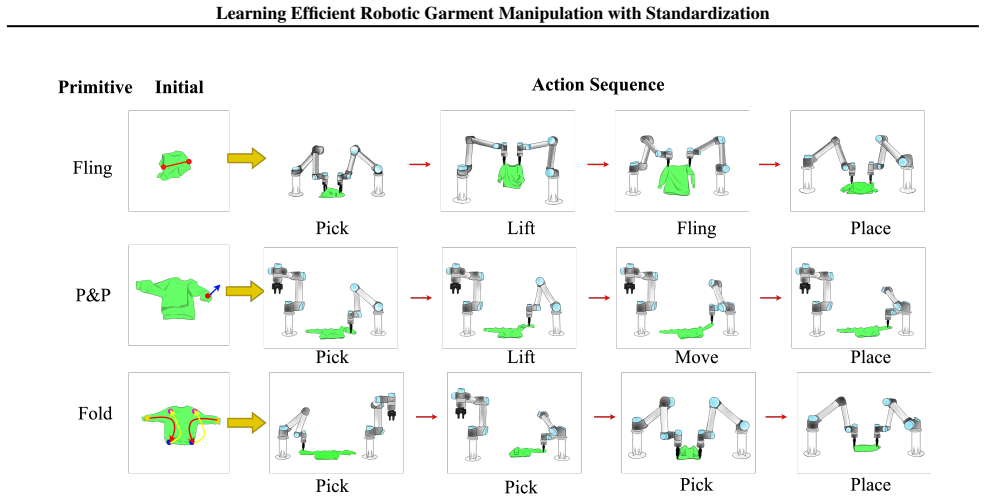
The central machinery is the spatial action map: for each observation, APS-Net computes desirability values at every pixel for each action primitive across 80 rotated and scaled views, and the action executed is the one containing the highest peak value. What makes the output standardized rather than merely flat is the factorized reward $R_{CIK}=\alpha R_C+\beta R_I+(1-\alpha-\beta)R_K$, where $R_C$ is coverage, $R_I$ is intersection-over-union with a target garment template, and $R_K$ is negative keypoint distance; the policy is trained on the delta of this reward before and after each action. The spatial action mask (intersection of a workspace mask and a garment mask per primitive) removes infeasible grasps, and the action-optimized module redirects fling grasps to shoulder keypoints within a 5-pixel threshold. Together these pieces make primitive selection and grasp-point choice optimize for a canonical, folding-ready configuration.
What would settle it
Run the simulation-trained APS-Net on a real dual-arm system for 50 trials per garment type, scoring both standardized-state IoU and downstream folding success against Cloth Funnels; the central claim fails if real-world folding success does not exceed the baseline or if standardization degrades across trials. A cheaper check: ablate the IoU and keypoint reward terms and see whether downstream folding success drops; if folding succeeds equally well without standardization terms, standardization is not the active ingredient.
Extended reading notes
Core claim
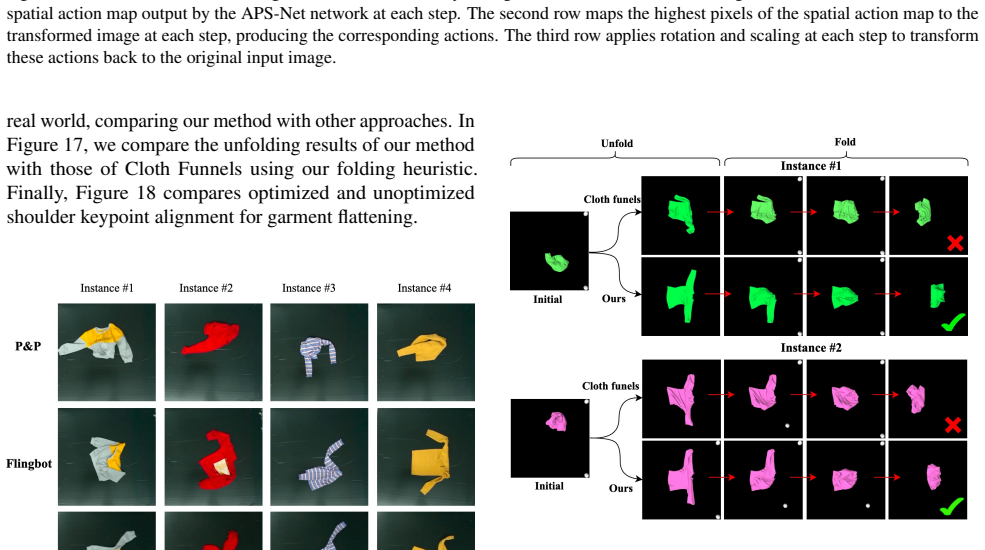
APS-Net's central claim is that an unfolding policy can be trained to produce standardized garments directly, by rewarding not just flatness but alignment. The network consumes rotated and scaled crops of an overhead RGB-D image and outputs a spatial desirability map for each action primitive; it executes the fling or pick-and-place whose peak value is highest, with the grasp parameters read off from the winning transformed view. A factorized reward ($R_{CIK}=\alpha R_C+\beta R_I+(1-\alpha-\beta)R_K$) scores each transition on coverage, IoU against a canonical template, and keypoint distance, so the policy learns that a good action is one that leaves the garment flat, correctly oriented, and with its shoulder and waist keypoints close to their target positions. An action-optimized module nudges fling grasp points toward shoulder keypoints when they are within a threshold, and a spatial action mask suppresses actions that would fall outside the garment or beyond arm reach. The paper shows this pipeline unfolding arbitrarily crumpled long-sleeve garments to standardized configurations in simulation and on a dual-UR5 setup, and reports that the standardized states feed directly into a keypoint-based folding heuristic with 12/15 real-world success.
Load-bearing premise
The load-bearing premise is that a policy trained in a particle-based cloth simulator transfers to a real dual-UR5 system through RGB-D input, varied mass and stiffness, and procedural wrinkles, with no additional training; the real-world evidence for this transfer is only 15 trials per condition.
Editorial extensions
If this is right
- Because unfolded garments preserve visible, well-positioned keypoints, a single hand-coded folding heuristic succeeds across long sleeves, pants, and skirts without per-garment retraining.
- Coverage-only unfolding methods leave the garment in a pose that requires extra correction before folding; with standardization, the number of manipulation steps to a foldable state drops.
- The same standardized state that helps folding should also simplify ironing, packing, and other downstream manipulations that assume a known shape and orientation.
- A policy trained in simulation with varied mass, stiffness, and procedural wrinkles transfers to a real dual-UR5 system using only RGB-D input, so the sim-to-real gap is claimed to be manageable without target-domain training.
- On the categories tested, the reported real-world folding success is 12/15 for long sleeves, 14/15 for pants, and 11/15 for skirts, suggesting the standardization benefit is not specific to one garment type.
Reading between the lines
- A testable extension: run the same factorized reward on non-garment cloth like towels, where canonical keypoints do not exist, replacing $R_K$ with template IoU, to see whether standardization transfers.
- The spatial action mask is written in terms of geometric workspace constraints, so swapping masks should let the same learned network move to a different dual-arm robot without retraining, a consequence the paper does not test.
- The learned primitive selector could be compared with a hand-coded fling-then-pick schedule; if the schedule matches APS-Net, the contribution is the standardization reward rather than the switching policy.
- Coverage-only metrics may understate progress in garment manipulation; orientation and keypoint alignment should become standard evaluation axes if the standardization thesis holds.
Editorial analysis
A structured set of objections, weighed in public.
Referee Report
Summary. The paper proposes APS-Net, a dual-arm garment manipulation policy that learns to select between dynamic fling and pick-and-place actions in order to unfold crumpled garments into standardized configurations, as defined by high coverage, alignment (IoU), and small keypoint distance to a target. The method introduces a factorized reward, a spatial action mask, and an action-optimizing module that refines fling grasp points toward shoulder keypoints. The authors report simulation results on long-sleeve shirts where APS-Net outperforms Cloth Funnels and other baselines on coverage, IoU, and keypoint distance, plus real-world unfolding and folding experiments on a dual-UR5 system, including folding success rates for long sleeves, pants, and skirts. The claimed contribution is that standardization simplifies downstream folding, and this is the central hypothesis of the paper.
Significance. If the results hold, the paper makes a useful contribution to deformable-object manipulation by explicitly combining unfolding with standardization and by demonstrating, both in simulation and on a real system, that a policy trained on multiple action primitives can achieve high coverage and alignment. The design of the factorized reward and the spatial action mask are reasonable and reproducible in principle, and the simulation results show consistent improvements over strong baselines. The paper also provides a real-world validation with a dual-arm setup, which is valuable. However, the load-bearing evidence for the downstream benefit (standardization improving folding) is notably thin: the real-world folding comparison is underpowered, and the real-world unfolding evaluation omits the keypoint-distance metric that defines standardization. This limits the strength of the conclusions that can currently be drawn.
major comments (5)
- [§4.5, Table 6] The central claim that standardization improves downstream folding rests primarily on the real-world folding success rates: APS-Net 12/15 versus Cloth Funnels 10/15. With n=15 per condition, this two-trial difference is not statistically significant (Fisher exact test gives p≈0.68), and no significance test or confidence interval is reported. Since Figure 9 in the simulation section is qualitative and no quantitative simulation folding success is reported, Table 6 is the only numeric evidence for the headline downstream benefit. The authors should either report a significance test, provide more real-world trials, or include quantitative simulation folding success rates with statistical comparison to support the claim.
- [§4.5, Table 5] The real-world unfolding evaluation reports IoU and coverage but omits the keypoint distance (KD) metric that the paper uses in simulation to define standardization. The text states that the method preserves 'the standardization of garment' (Section 4.5), but without a direct measurement of alignment to a canonical target (e.g., KD or an orientation error), the real-world standardization claim is not directly supported. Please add a quantitative alignment metric to Table 5, or justify why IoU and coverage alone are sufficient to conclude that standardization was achieved.
- [§3.3, Appendix A, §4.1] The target standardized mask and the target keypoint configuration used in the IoU and KD rewards are never defined. The paper refers to a 'target mask' and 'target configuration' but does not explain how these are generated for each garment type, whether they are instance-specific or a canonical flattened mesh projection, or how the target keypoints are obtained. This detail is essential for reproducibility and interpretation, and it directly affects whether the reward measures standardization to a meaningful canonical form or merely self-matching. Please specify how the target mask and target keypoints are constructed.
- [§4.3, Tables 1–4] All simulation results are reported as point estimates from 50 trials per condition with no standard deviations, standard errors, confidence intervals, or statistical significance tests. For example, Table 1 reports coverage 91.1% versus 87.2% for Cloth Funnels, but without variance measures the reader cannot assess whether these differences are reliable or within noise. The authors should report variance and, where appropriate, statistical tests for the main comparisons, especially because the number of trials is relatively modest.
- [§4.3, Figure 9] The simulation section contains no numerical folding success rates; the claim of 'superior folding performance' is supported only by a qualitative figure. Since the paper's title and central thesis emphasize that standardization improves downstream tasks, the authors should provide quantitative folding success rates in simulation (using the same success definition as in the real world) for APS-Net and the baselines, along with statistical comparison.
minor comments (7)
- [Abstract and §2.2] The acronym is inconsistent: 'ASP-Net' appears in the abstract and in Section 2.2, while the correct name 'APS-Net' is used elsewhere. Please unify.
- [Table 1] The baseline name 'CLOTH FUNNELS' is misspelled in the table header; it should be 'CLOTH FUNNELS'.
- [Appendix B, Eq. (19)] Equation (19) uses 'formula (9)' to refer to a previous equation, but the reference is ambiguous. Also, the symbol w is used both for the table width in Eq. (19) and for the grasp width in Eq. (10); this notational collision should be resolved for clarity.
- [Appendix B, Eq. (19)] The variable D in Eq. (19) is not defined at that point. Please define it (rendered image dimension) before use.
- [§4.1] The real-world folding success criterion uses IoU > 0.8 against a human demonstrator, but no information is given about how many demonstrators were used or whether the reference fold was consistent across trials. Please clarify the evaluation protocol.
- [§3.1 and §3.3] The method is described as self-supervised, but the reward uses target masks and target keypoints. Clarify in what sense the learning is self-supervised (e.g., labels come from simulator state rather than human demonstrations) and avoid potential confusion with fully unsupervised approaches.
- [§3.6] The threshold δ=5 in the Action Optimized Module is given without units or justification. Please state the units (pixels? centimeters?) and explain how this value was chosen.
Circularity Check
No circular derivation: the reward and evaluation metrics are the same objective by design, not a fitted prediction, and the self-citations are contextual rather than load-bearing.
full rationale
I walked the paper's claimed derivation chain. The agent's objective is the factorized reward R_CIK = alpha * R_C + beta * R_I + (1 - alpha - beta) * R_K (Eq. 12), with components defined in Appendix A as coverage, overlap with the target mask, and negative keypoint error. Section 4.1 evaluates the same three quantities. This overlap is not a circular reduction: in reinforcement learning the reward is the objective being optimized, and reporting the objective's components is a direct evaluation of that objective, not a fitted parameter renamed as a prediction. Nothing in the paper claims to derive the test-set numbers from the reward formula; the policy is trained and then measured on unseen initial configurations. The only self-citations (Zhou et al. 2025a, 2025b) appear in background sentences about deformable-object dynamics and RL models; they are not used to justify APS-Net's architecture, the standardization reward, or the claim that standardization improves folding. The keypoint detector is trained partly on unfold replay-buffer images (Appendix D), which is a bootstrapping choice, but the paper does not use that detector as the sole support for the central claim: real-world folding success is measured against a human-demonstrator IoU threshold (Section 4.1), and APS-Net is compared with external baselines in simulation (Table 1) and on the robot (Tables 5-6). The main weaknesses of the paper, including only 15 real trials per condition, the absence of a reported real-world keypoint-distance metric, and reliance on sim-to-real transfer without additional training, are evidentiary and statistical concerns rather than circularity. Accordingly, no step in the derivation reduces by construction to its own inputs.
Assumptions & free parameters
free parameters (4)
- alpha (coverage reward weight) =
0.2
- beta (IoU reward weight) =
0.4
- delta (AOM replacement threshold) =
5
- fling trajectory parameters =
unspecified
assumptions (4)
- domain assumption Particle-based PyFleX cloth simulation with sampled mass and stiffness is a faithful model for sim-to-real transfer.
- domain assumption The predefined fling and pick-and-place primitives, along with the standardized template target, are sufficient to unfold all tested garment types from arbitrary crumpled states.
- domain assumption Keypoints (shoulders, waist, hem) are sufficient to define a successful folding heuristic.
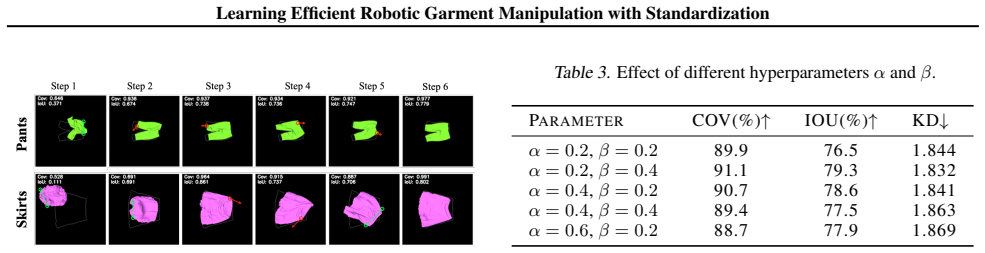
- ad hoc to paper The reward weights chosen in Table 3 generalize across garment types and to the real world.
Cite this review
Pith. "Pith review of Learning Efficient Robotic Garment Manipulation with Standardization." pith.science (2026). https://pith.science/paper/UARKWY6O
@misc{pith2026250622769,
  author       = {Pith},
  title        = {Pith review of: Learning Efficient Robotic Garment Manipulation with Standardization},
  year         = {2026},
  howpublished = {\url{https://pith.science/paper/UARKWY6O}},
  note         = {Machine review of arXiv:2506.22769}
}
read the original abstract
Garment manipulation is a significant challenge for robots due to the complex dynamics and potential self-occlusion of garments. Most existing methods of efficient garment unfolding overlook the crucial role of standardization of flattened garments, which could significantly simplify downstream tasks like folding, ironing, and packing. This paper presents APS-Net, a novel approach to garment manipulation that combines unfolding and standardization in a unified framework. APS-Net employs a dual-arm, multi-primitive policy with dynamic fling to quickly unfold crumpled garments and pick-and-place (p and p) for precise alignment. The purpose of garment standardization during unfolding involves not only maximizing surface coverage but also aligning the garment's shape and orientation to predefined requirements. To guide effective robot learning, we introduce a novel factorized reward function for standardization, which incorporates garment coverage (Cov), keypoint distance (KD), and intersection-over-union (IoU) metrics. Additionally, we introduce a spatial action mask and an Action Optimized Module to improve unfolding efficiency by selecting actions and operation points effectively. In simulation, APS-Net outperforms state-of-the-art methods for long sleeves, achieving 3.9 percent better coverage, 5.2 percent higher IoU, and a 0.14 decrease in KD (7.09 percent relative reduction). Real-world folding tasks further demonstrate that standardization simplifies the folding process. Project page: see https://hellohaia.github.io/APS/
Figures


Figures from the paper (14 more)





Reference graph
Works this paper leans on
-
[5]
K., Chin, L., Choi, J., Zhang, A., and Rus, D
Chen, V . K., Chin, L., Choi, J., Zhang, A., and Rus, D. Real-time grocery packing by integrating vision, tactile sensing, and soft fingers. In 2024 IEEE 7th International Conference on Soft Robotics (RoboSoft) , pp. 392–399. IEEE,
work page 2024
-
[7]
Gu, N., He, R., and and, L. Y . Defnet: deconstructed strategy for multi-step fabric folding tasks. The Journal of The Textile Institute, 0(0):1–9, 2024a. doi: 10.1080/ 00405000.2024.2400633. URL https://doi.org/ 10.1080/00405000.2024.2400633. Gu, N., He, R., and Yu, L. Learning to unfold garment effectively into oriented direction. IEEE Robotics and Auto...
-
[9]
C., Nalmpantis, C., Dwivedi-Yu, J., Zhuravinskyi, M., Hambro, E., Sukhbaatar, S., and Raileanu, R
Havrilla, A., Du, Y ., Raparthy, S. C., Nalmpantis, C., Dwivedi-Yu, J., Zhuravinskyi, M., Hambro, E., Sukhbaatar, S., and Raileanu, R. Teaching large language models to reason with reinforcement learning. arXiv preprint arXiv:2403.04642,
- [10]
-
[11]
Learning to fold real garments with one arm: A case study in cloud-based robotics research
Hoque, R., Shivakumar, K., Aeron, S., Deza, G., Ganapathi, A., Wong, A., Lee, J., Zeng, A., Vanhoucke, V ., and Goldberg, K. Learning to fold real garments with one arm: A case study in cloud-based robotics research. In 10 Learning Efficient Robotic Garment Manipulation with Standardization 2022 IEEE/RSJ International Conference on Intelligent Robots and ...
work page 2022
-
[12]
Huang, Z., Lin, X., and Held, D
doi: 10.1109/IROS47612.2022.9981253. Huang, Z., Lin, X., and Held, D. Mesh-based dynamics with occlusion reasoning for cloth manipulation. arXiv preprint arXiv:2206.02881,
arXiv 2022
-
[13]
doi: 10.1109/TPAMI. 2024.3411045. Li, Y ., Wu, J., Tedrake, R., Tenenbaum, J. B., and Torralba, A. Learning particle dynamics for manipulating rigid bodies, deformable objects, and fluids. arXiv preprint arXiv:1810.01566,
arXiv 2024
-
[14]
Grounding dino: Marrying dino with grounded pre-training for open-set object detection
Liu, S., Zeng, Z., Ren, T., Li, F., Zhang, H., Yang, J., Li, C., Yang, J., Su, H., Zhu, J., et al. Grounding dino: Marrying dino with grounded pre-training for open-set object detection. arXiv preprint arXiv:2303.05499,
Show all 29 references
-
[15]
Ma, X., Patidar, S., Haughton, I., and James, S
URL https://arxiv.org/abs/2209.08285. Ma, X., Patidar, S., Haughton, I., and James, S. Hierarchical diffusion policy for kinematics-aware multi-task robotic manipulation. In Proceedings of the IEEE/CVF Confer- ence on Computer Vision and Pattern Recognition , pp. 18081–18090,
-
[16]
Cloth grasp point detection based on multiple- view geometric cues with application to robotic towel folding
Maitin-Shepard, J., Cusumano-Towner, M., Lei, J., and Abbeel, P. Cloth grasp point detection based on multiple- view geometric cues with application to robotic towel folding. In 2010 IEEE International Conference on Robotics and Automation, pp. 2308–2315. IEEE,
2010
-
[17]
Cloth region segmentation for robust grasp selection
Qian, J., Weng, T., Zhang, L., Okorn, B., and Held, D. Cloth region segmentation for robust grasp selection. In 2020 IEEE/RSJ International Conference on Intelligent Robots and Systems (IROS), pp. 9553–9560. IEEE,
2020
-
[18]
Gpt-fabric: Folding and smoothing fabric by lever- aging pre-trained foundation models
Raval, V ., Zhao, E., Zhang, H., Nikolaidis, S., and Seita, D. Gpt-fabric: Folding and smoothing fabric by lever- aging pre-trained foundation models. arXiv preprint arXiv:2406.09640,
-
[19]
Learning robot manipulation from cross-morphology demonstra- tion
Salhotra, G., Liu, I., Arthur, C., and Sukhatme, G. Learning robot manipulation from cross-morphology demonstra- tion. arXiv preprint arXiv:2304.03833,
-
[21]
Garment perception and its folding using a dual-arm robot
11 Learning Efficient Robotic Garment Manipulation with Standardization Stria, J., Pr˚uˇsa, D., Hlav´aˇc, V ., Wagner, L., Petrik, V ., Krsek, P., and Smutn`y, V . Garment perception and its folding using a dual-arm robot. In 2014 IEEE/RSJ International Conference on Intellige...
2014
-
[23]
Unifolding: Towards sample-efficient, scalable, and generalizable robotic garment folding
Xue, H., Li, Y ., Xu, W., Li, H., Zheng, D., and Lu, C. Unifolding: Towards sample-efficient, scalable, and generalizable robotic garment folding. arXiv preprint arXiv:2311.01267,
-
[24]
Equivact: Sim (3)-equivariant visuomotor poli- cies beyond rigid object manipulation
Yang, J., Deng, C., Wu, J., Antonova, R., Guibas, L., and Bohg, J. Equivact: Sim (3)-equivariant visuomotor poli- cies beyond rigid object manipulation. In 2024 IEEE international conference on robotics and automation (ICRA), pp. 9249–9255. IEEE, 2024a. Yang, L., Li, Y ., and ...
2024 arXiv
-
[25]
Dual-arm robotic fabric ma- nipulation with quasi-static and dynamic primitives for rapid garment flattening
Zhou, C., Jiang, R., Luan, F., Meng, S., Wang, Z., Dong, Y ., Zhou, Y ., and He, B. Dual-arm robotic fabric ma- nipulation with quasi-static and dynamic primitives for rapid garment flattening. IEEE/ASME Transactions on Mechatronics, pp. 1–11, 2025a. doi: 10.1109/TMECH. 2025.3...
-
[26]
Zhu, X., Wang, X., Freer, J., Chang, H
doi: 10.1109/TII.2023.3342895. Zhu, X., Wang, X., Freer, J., Chang, H. J., and Gao, Y . Clothes grasping and unfolding based on rgb-d semantic segmentation. In 2023 IEEE International conference on robotics and automation (ICRA), pp. 9471–9477. IEEE,
2023
-
[28]
This approach allows the simulation-trained model to be effectively adapted for real-world use without requiring additional training. D. Data Collection In the simulation environment, we collected two datasets, one for training garment unfolding and another for training garmen...
2020
-
[29]
ize the cloth states, we randomly sample from a subset of CLOTH3D, which provides a curated collection of garment meshes
Real-world Setup. ize the cloth states, we randomly sample from a subset of CLOTH3D, which provides a curated collection of garment meshes. For the garment unfolding dataset, the initial configuration was created by randomly rotating the garment, selecting a random point on th...
2000
-
[2014]
Sun, L., Aragon-Camarasa, G., Cockshott, P., Rogers, S., and Siebert, J. P. A heuristic-based approach for flatten- ing wrinkled clothes. In Towards Autonomous Robotic Systems: 14th Annual Conference, TAROS 2013, Oxford, UK, August 28–30, 2013, Revised Selected Papers 14, pp. ...
2013
-
[2016]
Cloth funnels: Canonicalized- alignment for multi-purpose garment manipulation
Canberk, A., Chi, C., Ha, H., Burchfiel, B., Cousineau, E., Feng, S., and Song, S. Cloth funnels: Canonicalized- alignment for multi-purpose garment manipulation. In 2023 IEEE International Conference on Robotics and Automation (ICRA), pp. 5872–5879. IEEE,
2023
-
[2017]
URL https://arxiv.org/abs/ 1706.05587. Chen, L. Y ., Huang, H., Novoseller, E., Seita, D., Ichnowski, J., Laskey, M., Cheng, R., Kollar, T., and Goldberg, K. Efficiently learning single-arm fling motions to smooth garments. In The International Symposium of Robotics Research, ...
-
[2018]
The robot gripper is modeled as a spherical picker that can move freely in 3D space and can be activated to attach to the nearest particle
bindings to Nvidia FleX, inte- grated with SoftGym(Lin et al., 2021), to develop a rein- forcement learning environment called Cloth Action Gym, which supports loading arbitrary cloth meshes, such as T- shirts, pants, and skirts, through a Python API. The robot gripper is mode...
2021
-
[2020]
Llava steering: Visual instruction tun- ing with 500x fewer parameters through modality linear representation-steering, 2025a
Bi, J., Wang, Y ., Chen, H., Xiao, X., Hecker, A., Tresp, V ., and Ma, Y . Llava steering: Visual instruction tun- ing with 500x fewer parameters through modality linear representation-steering, 2025a. URL https://arxiv. org/abs/2412.12359. Bi, J., Wang, Y ., Yan, D., Xiao, X....
-
[2022]
Speedfolding: Learning efficient bimanual fold- ing of garments
Avigal, Y ., Berscheid, L., Asfour, T., Kr¨oger, T., and Gold- berg, K. Speedfolding: Learning efficient bimanual fold- ing of garments. In 2022 IEEE/RSJ International Confer- ence on Intelligent Robots and Systems (IROS), pp. 1–8. IEEE,
2022
-
[2023]
K., Balakrishna, A., Thananjeyan, B., Ich- nowski, J., Jamali, N., et al
Seita, D., Ganapathi, A., Hoque, R., Hwang, M., Cen, E., Tanwani, A. K., Balakrishna, A., Thananjeyan, B., Ich- nowski, J., Jamali, N., et al. Deep imitation learning of sequential fabric smoothing from an algorithmic super- visor. In 2020 IEEE/RSJ International Conference on ...
2020
-
[2024]
Learning to grasp clothing structural regions for garment manipula- tion tasks
Chen, W., Lee, D., Chappell, D., and Rojas, N. Learning to grasp clothing structural regions for garment manipula- tion tasks. In 2023 IEEE/RSJ International Conference on Intelligent Robots and Systems (IROS), pp. 4889–4895. IEEE,
2023
-
[2025]
Jing, P., Cui, K., Guan, W., Nie, L., and Su, Y
URL https://arxiv.org/abs/ 2502.14744. Jing, P., Cui, K., Guan, W., Nie, L., and Su, Y . Category- aware multimodal attention network for fashion compati- bility modeling. IEEE Transactions on Multimedia, 25: 9120–9131,
Reviewed August 6, 2026 · model on record in the stance chip above.
Discussion (0). Sign in to comment.