REVIEW 3 major objections 5 minor 1 cited by
Stacked intelligent metasurfaces can perform MIMO precoding, direction-of-arrival estimation, and logic operations directly in the electromagnetic wave domain, without digital baseband processing.
Reviewed by Pith at T0; open to challenge. T0 means a machine referee read the full paper against a public rubric. the ladder, T0–T4 →
A review of stacked intelligent metasurfaces as a wave-domain signal-processing platform, covering theory, prototypes, training methods, and communications/sensing/computing applications.
T0 review reviewed 2026-08-03 challenge →
load-bearing objection Useful, well-organized survey of SIMs, but the central wave-domain 'neural network' claim rests on a linear feed-forward assumption that the paper's own cited literature shows is not yet secure. the 3 major comments →
Stacked Intelligent Metasurface-Aided Wave-Domain Signal Processing: From Communications to Sensing and Computing
The pith
A machine-rendered reading of the paper's core claim, the machinery that carries it, and where it could break.
The reading
Core claim
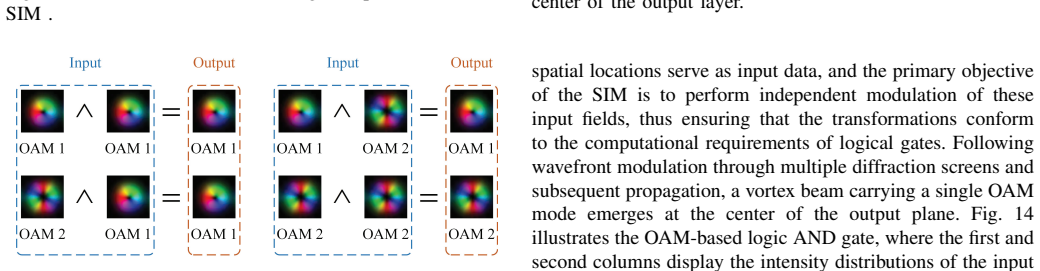
According to the paper, a SIM is a feed-forward diffractive neural network realized in hardware: each programmable metasurface acts as a layer, each meta-atom acts as a neuron with a learnable complex transmission coefficient, and inter-layer connections are set by free-space diffraction, modeled by the Rayleigh–Sommerfeld integral. Once the coefficients are trained—either in simulation or in situ—an incoming electromagnetic wave undergoes the desired transformation as it propagates through the stack. The paper presents experimental evidence spanning image classification, DOA estimation with angular resolution down to 1 degree, holographic pattern generation, and logic operations including A
What carries the argument
The stacked intelligent metasurface (SIM): a device made of multiple electronically programmable transmissive metasurfaces stacked like neural-network layers. Each meta-atom is a tunable phase/amplitude element, and inter-layer coupling is governed by diffraction, captured by the Rayleigh–Sommerfeld propagation coefficient. Anti-reflective coatings suppress back-reflections and non-adjacent coupling, making the SIM an effectively feed-forward linear diffractive network. Training configures the transmission coefficients so that the desired operation—beamforming, a transform, or classification—is executed as waves pass through.
Load-bearing premise
The load-bearing assumption is that the Rayleigh–Sommerfeld diffraction coefficient in Eq. (1) accurately captures all significant inter-layer propagation, and that anti-reflective coatings suppress back-reflections and non-adjacent coupling, so the SIM behaves as a feed-forward linear network—yet the paper itself notes that Eq. (1) holds only when inter-layer spacing is not too small, and that the SIM has no inherent nonlinearity except the receiving detector.
What would settle it
Train a SIM in simulation for a concrete task such as digit classification, then fabricate it with sub-wavelength inter-layer spacing (below the threshold where the amplitude of Eq. (1) exceeds one) and measure the energy leaking to non-adjacent layers and the back-reflected power; if the leakage is significant or the deployed classification accuracy collapses relative to simulation, the feed-forward linear model underpinning the paper's central claim is falsified.
If this is right
- MIMO transceivers could eliminate digital precoding and combining, cutting RF chains, DAC/ADC resolution requirements, and processing latency.
- DOA estimation and target detection could happen at light speed, enabling low-latency sensing for autonomous vehicles and high-speed rail.
- Object classification could be performed all-optically, with accuracy improving as the number of metasurface layers grows.
- Logic operations in the wave domain could enable over-the-air encryption and bit-level electromagnetic information processing.
- A single SIM could integrate communication, sensing, and computing functions, reducing hardware footprint and energy use in next-generation networks.
Where Pith is reading between the lines
- If the feed-forward linear model is taken literally, a SIM without internal nonlinearity is limited to linear or affine transformations, so tasks requiring nonlinear feature extraction would need an external detector or a hybrid electronic network—an extension the paper itself flags as a future direction.
- The Rayleigh–Sommerfeld model may understate coupling when inter-layer spacing shrinks toward the sub-wavelength regime; a testable consequence is that simulated performance gains from deeper stacks could partly erode in densely packed physical devices.
- If in situ training is adopted, the paper's distinction between simulation and hardware calibration suggests a trade-off: training on the physical device absorbs fabrication errors but adds real-time feedback overhead when the SIM is remote.
- The 'multiple functions in one device' claim depends on the ability to reconfigure the SIM on timescales comparable to task switching; for fast-varying environments, reconfiguration speed may become the bottleneck.
Editorial analysis
A structured set of objections, weighed in public.
Referee Report
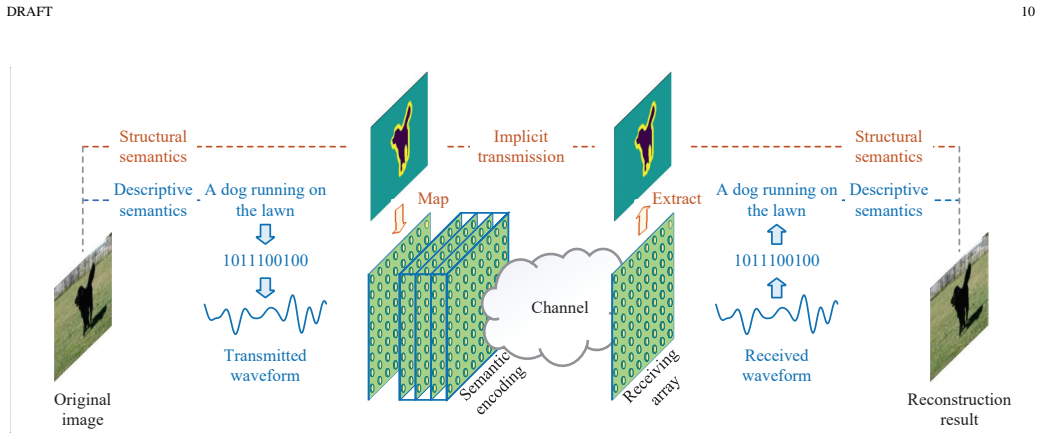
Summary. The paper surveys stacked intelligent metasurface (SIM) technology, positioning it as a wave-domain analog processor that combines the architecture of neural networks, electromagnetic computing, and programmable metasurfaces. It presents Eq. (1) as the inter-layer Rayleigh–Sommerfeld propagation model, describes a SIM as a feed-forward diffractive network with trainable meta-atom transmission coefficients, and then reviews SIM prototypes and training methods. The applications covered include wave-domain MIMO precoding, semantic communication, DOA estimation, object recognition, pattern generation, logic operations, and ISAC. The paper closes with a list of technical challenges—channel estimation, antenna selection, propagation calibration, physical modeling, energy efficiency—and future research directions.
Significance. If the SIM concept survives physically rigorous modeling, it could offer a genuinely different front-end architecture for low-latency, low-power processing in wireless systems. The survey is well organized and useful as a catalogue: Tables I–VI provide a compact comparison of prototypes, optimization formulations, and channel estimators, and the paper is candid about several key limitations, including the restricted validity of Eq. (1), the absence of inherent nonlinearity in Sec. IX.C, and calibration challenges in Sec. VIII.C. Its main contribution is synthesis rather than new technical results. The central weakness is that the survey's strongest claims—universal wave-domain processing, 'light-speed' inference, and low-power operation—are built on an ideal feed-forward linear model whose regime of validity is not quantified, and are asserted without measured energy or latency comparisons.
major comments (3)
- [Sec. II, Eq. (1); Sec. VIII.D; Table I] The central model—Eq. (1) plus the assertion in Sec. II that anti-reflective coatings suppress back-reflections and non-adjacent coupling—is load-bearing for nearly every performance claim in Secs. IV–VI, including the 'interference-free' MIMO channels of Fig. 7, the DOA resolutions of Sec. V.B, and the logic operations of Sec. VI.B. The paper footnotes that Eq. (1) requires the inter-layer distance not to be too small and cites [24], and Sec. VIII.D itself cites [114] and [115] showing that physically consistent SIM models must include element coupling and non-diagonal phase matrices. However, the paper does not state whether the geometries in Table I satisfy the required condition, nor does it compare Eq. (1) with full-wave or multiport models for those geometries. As written, a reader cannot tell which surveyed results are robust and which are artifacts of the ideal feed-forward appro
- [Secs. I, III–VI vs. Sec. IX.C; Sec. IX.B] Throughout Secs. I, III, IV–VI, a SIM is described as an 'electromagnetic neural network' with meta-atoms as 'neurons' and with the 'representation capabilities' of an ANN. Section IX.C correctly concedes that a SIM has no inherent nonlinearity except the receiving detector. A cascade of elementwise diagonal transmission matrices and fixed diffraction matrices is a linear operator, not a DNN in the usual sense; the classification results in the surveyed applications therefore rely on detector nonlinearity or output-plane energy partitioning. The paper should explicitly define the achievable transformation class and restrict the 'neural network' language accordingly. Relatedly, the claim in Sec. IX.B that 'a SIM can approximate any universal linear transformations' is unsupported as stated; the cited work [15] does not provide a theorem for the constrained class of diagonal-plus-fixed-dif
- [Abstract and Secs. II, IV; Table I] The 'green' claim—low-power, light-speed, massively parallel processing—is repeated in the Abstract and Sec. II, and Sec. IV.A argues that removing digital precoding reduces hardware and energy. However, the survey contains no measured power, latency, or energy data, and no comparison with conventional DSP baselines, for the prototypes in Table I; accuracy and resolution numbers are given, but not energy efficiency or end-to-end delay including configuration/training overhead. Since energy efficiency is one of the three pillars of Fig. 3, this is more than a presentational gap. The authors should either include available measured comparisons from the cited experimental papers or explicitly present these benefits as potential, not yet demonstrated, advantages.
minor comments (5)
- [Footnote 1, Sec. II] The rule of thumb that 'the amplitude of (1) is less than one' should be stated as an explicit inequality in terms of A, d, λ, and the incidence angle, and then applied to the geometries in Table I. This would make the validity regime concrete for the reader.
- [Table II] The complexity entry O(1) for SIM-based MIMO is misleading unless defined: it refers to the online digital-domain complexity only, not to the cost of training or configuring the SIM. The OFDM entry O(NStream log NSC) should also indicate which operations are included (e.g., FFT/IFFT), otherwise the comparison is not apples-to-apples.
- [Eq. (2)] Equation (2) counts ordered antenna-to-user assignments, which is correct for the described pairing problem. If the authors intend unordered antenna subsets, a factor of 1/K! would be needed. Please clarify the wording 'number of possible combinations'.
- [Table I and Table III] The nonstandard table symbols (♯, ♭, ⊛, etc.) make the tables hard to read and should be replaced with conventional column headings or a clear legend. Some entries, such as 'Linet al.' for [15], also need typographical cleanup.
- [Sec. IX.B] The statement that 'the dimensionality of the space for linear transformations ... is linearly proportional to the number of metasurface layers' is not formal. The set of achievable transformations is not a linear subspace, and 'dimensionality' should be defined or the claim rephrased.
Circularity Check
No circularity found: the paper is a survey whose central claims are anchored by external prototypes and literature; self-citations are historical and not definitional.
full rationale
This is a survey/tutorial, not a derivation paper. There is no claimed chain in which an output quantity is constructed from inputs that already contain it. The only quantitative model, Eq. (1), is the standard Rayleigh–Sommerfeld diffraction coefficient imported from external DNN optics literature ([15], [23]) with an explicit validity caveat in the footnote. The SIM-as-feed-forward-network claim rests on anti-reflective coatings (cited to external [17]) and the linear propagation model, which the paper itself flags as restrictive in Section VIII.D (citing [114] and [115]) and Section IX.C (noting no inherent nonlinearity except the detector). These are assumptions and limitations, not circular reductions. The survey's favorable assessment does lean on the authors' own SIM papers ([20], [21], [31], [36], [37]), but the central existence claims are anchored by external experimental prototypes from independent groups ([15], [16], [17], [19], [26]–[30]) and by published work from other groups (e.g., [29], [43], [114], [115]). No fitted parameter is relabeled as a prediction, no uniqueness theorem is imported from self-citation, and no known empirical result is merely renamed. Hence no circular step is present.
Axiom & Free-Parameter Ledger
axioms (4)
- domain assumption Rayleigh–Sommerfeld diffraction (Eq. 1) models all significant inter-layer propagation in a SIM
- domain assumption Anti-reflective coatings make the SIM a feed-forward network by suppressing back-reflections and non-adjacent coupling
- domain assumption Each meta-atom's transmission coefficient is independently programmable and quantized
- domain assumption A SIM can approximate any universal linear transformation with arbitrarily small error
Cite this review
Pith. "Pith review of Stacked Intelligent Metasurface-Aided Wave-Domain Signal Processing: From Communications to Sensing and Computing." pith.science (2026). https://pith.science/paper/UAZCOXZR
@misc{pith2026260116030,
  author       = {Pith},
  title        = {Pith review of: Stacked Intelligent Metasurface-Aided Wave-Domain Signal Processing: From Communications to Sensing and Computing},
  year         = {2026},
  howpublished = {\url{https://pith.science/paper/UAZCOXZR}},
  note         = {Machine review of arXiv:2601.16030}
}
read the original abstract
Artificial neural networks possess remarkable capabilities for abstract feature extraction, while electromagnetic computing leverages wave propagation to execute complex mathematical operations. Concurrently, metasurfaces engineered from subwavelength meta-atoms offer unprecedented control over electromagnetic wavefronts. Synthesizing these three cutting-edge fields has sparked significant interest in developing electromagnetic neural networks via stacked intelligent metasurface (SIM) technology, which aims to execute diverse signal processing tasks directly within the wave domain. By enabling direct processing of information-carrying electromagnetic waves, SIMs offer a promising paradigm for high-speed, massively parallel, and low-power signal processing. This article provides a comprehensive overview of SIM technology, beginning with its evolutionary trajectory. We then delve into its theoretical foundations and examine state-of-the-art SIM hardware prototypes. Furthermore, we analyze the optimization and training strategies devised to configure SIM functionalities from two distinct perspectives. Additionally, the diverse applications of SIM technology across the communication, sensing, and computing domains are explored, supported by experimental evidence that highlights its ability to sustain multiple functions within a single device. Finally, we outline critical technical challenges to deploying SIMs in next-generation wireless networks and chart promising research directions to fully unlock their transformative potential.
Figures






Forward citations
Cited by 1 Pith paper
-
Fundamental Theorems on Controllability in Wave-domain Processing for Holographic MIMO
Necessary and sufficient conditions for controllability of generic reconfigurable EM devices are derived as a function of geometry and mutual coupling between elements.
Reference graph
Works this paper leans on
-
[1]
Deep learning,
Y . LeCun, Y . Bengio, and G. Hinton, “Deep learning,”Nature, vol. 521, no. 7553, pp. 436–444, May 2015
2015
-
[2]
Rethink- ing the inception architecture for computer vision,
C. Szegedy, V . Vanhoucke, S. Ioffe, J. Shlens, and Z. Wojna, “Rethink- ing the inception architecture for computer vision,” inProc. IEEE Conf. Computer Vision, Pattern Recognition (CVPR), 2016, pp. 2818–2826
2016
-
[3]
Deep neural networks for acoustic modeling in speech recognition: The shared views of four research groups,
G. Hinton, L. Deng, D. Yu, G. E. Dahl, A.-r. Mohamed, N. Jaitly, A. Senior, V . Vanhoucke, P. Nguyen, T. N. Sainath, and B. Kingsbury, “Deep neural networks for acoustic modeling in speech recognition: The shared views of four research groups,”IEEE Signal Process. Mag., vol. 29, no. 6, pp. 82–97, Nov. 2012
2012
-
[4]
A survey of the usages of deep learning for natural language processing,
D. W. Otter, J. R. Medina, and J. K. Kalita, “A survey of the usages of deep learning for natural language processing,”IEEE Trans. Neural Netw. Learning Systems, vol. 32, no. 2, pp. 604–624, Feb. 2021
2021
-
[5]
Efficient processing of deep neural networks: A tutorial and survey,
V . Sze, Y .-H. Chen, T.-J. Yang, and J. S. Emer, “Efficient processing of deep neural networks: A tutorial and survey,”Proc. IEEE, vol. 105, no. 12, pp. 2295–2329, Dec. 2017
2017
-
[6]
Performing mathematical operations with metamaterials,
A. Silva, F. Monticone, G. Castaldi, V . Galdi, A. Al `u, and N. Engheta, “Performing mathematical operations with metamaterials,”Science, vol. 343, no. 6167, pp. 160–163, Jan. 2014
2014
-
[7]
Programmable wave- based analog computing machine: a metastructure that designs metas- tructures,
D. C. Tzarouchis, B. Edwards, and N. Engheta, “Programmable wave- based analog computing machine: a metastructure that designs metas- tructures,”Nature Commun., vol. 16, no. 1, p. 908, Jan. 2025
2025
-
[8]
Coding metamaterials, digital metamaterials and programmable metamaterials,
T. J. Cui, M. Q. Qi, X. Wan, J. Zhao, and Q. Cheng, “Coding metamaterials, digital metamaterials and programmable metamaterials,” Light: Science & Applications, vol. 3, no. 10, pp. e218–e218, Oct. 2014
2014
-
[9]
Reconfigurable intelligent surfaces: Simplified-architecture transmitters—from theory to implementations,
Q. Cheng, L. Zhang, J. Y . Dai, W. Tang, J. C. Ke, S. Liu, J. C. Liang, S. Jin, and T. J. Cui, “Reconfigurable intelligent surfaces: Simplified-architecture transmitters—from theory to implementations,” Proc. IEEE, vol. 110, no. 9, pp. 1266–1289, Sep. 2022
2022
-
[10]
Flexible intelligent metasurfaces for downlink multiuser MISO com- munications,
J. An, C. Yuen, M. D. Renzo, M. Debbah, H. V . Poor, and L. Hanzo, “Flexible intelligent metasurfaces for downlink multiuser MISO com- munications,”IEEE Trans. Wireless Commun., vol. 24, no. 4, pp. 2940– 2955, Apr. 2025
2025
-
[11]
Communication models for reconfigurable intelligent surfaces: From surface electro- magnetics to wireless networks optimization,
M. Di Renzo, F. H. Danufane, and S. Tretyakov, “Communication models for reconfigurable intelligent surfaces: From surface electro- magnetics to wireless networks optimization,”Proc. IEEE, vol. 110, no. 9, pp. 1164–1209, Sep. 2022
2022
-
[12]
Smart radio environments empowered by reconfigurable intelligent surfaces: How it works, state of research, and the road ahead,
M. Di Renzo, A. Zappone, M. Debbah, M.-S. Alouini, C. Yuen, J. de Rosny, and S. Tretyakov, “Smart radio environments empowered by reconfigurable intelligent surfaces: How it works, state of research, and the road ahead,”IEEE J. Sel. Areas Commun., vol. 38, no. 11, pp. 2450–2525, Nov. 2020
2020
-
[13]
Pervasive machine learning for smart radio environments enabled by reconfigurable intelligent surfaces,
G. C. Alexandropoulos, K. Stylianopoulos, C. Huang, C. Yuen, M. Ben- nis, and M. Debbah, “Pervasive machine learning for smart radio environments enabled by reconfigurable intelligent surfaces,”Proc. IEEE, vol. 110, no. 9, pp. 1494–1525, Sep. 2022
2022
-
[14]
Emerging technologies in intelligent metasurfaces: Shaping the future of wireless communications,
J. An, M. Debbah, T. J. Cui, Z. N. Chen, and C. Yuen, “Emerging technologies in intelligent metasurfaces: Shaping the future of wireless communications,” pp. 1–16, 2025, Early Access
2025
-
[15]
All-optical machine learning using diffractive deep neural networks,
X. Lin, Y . Rivenson, N. T. Yardimci, M. Veli, Y . Luo, M. Jarrahi, and A. Ozcan, “All-optical machine learning using diffractive deep neural networks,”Science, vol. 361, no. 6406, pp. 1004–1008, Jul. 2018
2018
-
[16]
Spectrally encoded single-pixel machine vision using diffractive networks,
J. Li, D. Mengu, N. T. Yardimci, Y . Luo, X. Li, M. Veli, Y . Rivenson, M. Jarrahi, and A. Ozcan, “Spectrally encoded single-pixel machine vision using diffractive networks,”Science Advances, vol. 7, no. 13, p. eabd7690, Mar. 2021
2021
-
[17]
Metasurface-enabled on-chip multiplexed diffractive neural networks in the visible,
X. Luo, Y . Hu, X. Ou, X. Li, J. Lai, N. Liu, X. Cheng, A. Pan, and H. Duan, “Metasurface-enabled on-chip multiplexed diffractive neural networks in the visible,”Light: Science & Applications, vol. 11, no. 1, p. 158, May 2022
2022
-
[18]
Diffrac- tive deep neural networks: Theories, optimization, and applications,
H. Chen, S. Lou, Q. Wang, P. Huang, H. Duan, and Y . Hu, “Diffrac- tive deep neural networks: Theories, optimization, and applications,” Applied Physics Reviews, vol. 11, no. 2, Jun. 2024
2024
-
[19]
A programmable diffractive deep neural network based on a digital-coding metasurface array,
C. Liu, Q. Ma, Z. J. Luo, Q. R. Hong, Q. Xiao, H. C. Zhang, L. Miao, W. M. Yu, Q. Cheng, L. Liet al., “A programmable diffractive deep neural network based on a digital-coding metasurface array,”Nature Electronics, vol. 5, no. 2, pp. 113–122, Feb. 2022
2022
-
[20]
Stacked intelligent metasurfaces for efficient holo- graphic MIMO communications in 6G,
J. An, C. Xu, D. W. K. Ng, G. C. Alexandropoulos, C. Huang, C. Yuen, and L. Hanzo, “Stacked intelligent metasurfaces for efficient holo- graphic MIMO communications in 6G,”IEEE J. Sel. Areas Commun., vol. 41, no. 8, pp. 2380–2396, Aug. 2023
2023
-
[21]
Stacked intelligent metasurface-aided MIMO transceiver design,
J. An, C. Yuen, C. Xu, H. Li, D. W. K. Ng, M. Di Renzo, M. Deb- bah, and L. Hanzo, “Stacked intelligent metasurface-aided MIMO transceiver design,”IEEE Wireless Commun., vol. 31, no. 4, pp. 123– 131, Aug. 2024
2024
-
[22]
Stacked intelligent metasurfaces for wireless communications: Applications and challenges,
H. Liu, J. An, X. Jia, L. Gan, G. K. Karagiannidis, B. Clerckx, M. Ben- nis, M. Debbah, and T. J. Cui, “Stacked intelligent metasurfaces for wireless communications: Applications and challenges,”IEEE Wireless Commun., vol. 32, no. 4, pp. 46–53, Aug. 2025
2025
-
[23]
Born and E
M. Born and E. Wolf,Principles of optics: electromagnetic theory of propagation, interference and diffraction of light. Elsevier, 2013. DRAFT 20
2013
-
[24]
Is the rayleigh-sommerfeld diffrac- tion always an exact reference for high speed diffraction algorithms?
S. Mehrabkhani and T. Schneider, “Is the rayleigh-sommerfeld diffrac- tion always an exact reference for high speed diffraction algorithms?” Optics Express, vol. 25, no. 24, pp. 30 229–30 240, Nov. 2017
2017
-
[25]
State of the art on stacked intelligent metasurfaces communication, sensing and computing in the wave domain,
M. Di Renzo, “State of the art on stacked intelligent metasurfaces communication, sensing and computing in the wave domain,” in2025 19th European Conf. Antennas, Propag. (EuCAP), 2025, pp. 1–3
2025
-
[26]
Performing optical logic operations by a diffractive neural network,
C. Qian, X. Lin, X. Lin, J. Xu, Y . Sun, E. Li, B. Zhang, and H. Chen, “Performing optical logic operations by a diffractive neural network,” Light: Science & Applications, vol. 9, no. 1, p. 59, Apr. 2020
2020
-
[27]
Classification of metal handwritten digits based on microwave diffractive deep neural network,
Z. Gu, Q. Ma, X. Gao, J. W. You, and T. J. Cui, “Classification of metal handwritten digits based on microwave diffractive deep neural network,”Advanced Optical Materials, vol. 12, no. 7, p. 2301938, Oct. 2024
2024
-
[28]
Multi-user ISAC through stacked intelligent metasur- faces: New algorithms and experiments,
Z. Wang, H. Liu, J. Zhang, R. Xiong, K. Wan, X. Qian, M. Di Renzo, and R. C. Qiu, “Multi-user ISAC through stacked intelligent metasur- faces: New algorithms and experiments,”Proc. IEEE Global Commun. Conf. (GLOBECOM), pp. 4442–4447, 2024
2024
-
[29]
Super-resolution diffractive neural network for all-optical direction of arrival estimation beyond diffraction limits,
S. Gao, H. Chen, Y . Wang, Z. Duan, H. Zhang, Z. Sun, Y . Shen, and X. Lin, “Super-resolution diffractive neural network for all-optical direction of arrival estimation beyond diffraction limits,”Light: Science & Applications, vol. 13, no. 1, p. 161, Jul. 2024
2024
-
[30]
Polarization-selective unidirectional and bidirectional diffractive neural networks for information security and sharing,
Z. Guo, Z. Tan, X. Zang, T. Zhang, G. Wang, H. Li, Y . Wang, Y . Zhu, F. Ding, and S. Zhuang, “Polarization-selective unidirectional and bidirectional diffractive neural networks for information security and sharing,”Nature Commun., vol. 16, no. 1, p. 4492, May 2025
2025
-
[31]
Two-dimensional direction-of-arrival estimation using stacked intelligent metasurfaces,
J. An, C. Yuen, Y . L. Guan, M. D. Renzo, M. Debbah, H. V . Poor, and L. Hanzo, “Two-dimensional direction-of-arrival estimation using stacked intelligent metasurfaces,”IEEE J. Sel. Areas Commun., vol. 42, no. 10, pp. 2786–2802, Oct. 2024
2024
-
[32]
In situ optical backpropagation training of diffractive optical neural networks,
T. Zhou, L. Fang, T. Yan, J. Wu, Y . Li, J. Fan, H. Wu, X. Lin, and Q. Dai, “In situ optical backpropagation training of diffractive optical neural networks,”Photonics Research, vol. 8, no. 6, pp. 940–953, 2020
2020
-
[33]
Dual adaptive training of photonic neural networks,
Z. Zheng, Z. Duan, H. Chen, R. Yang, S. Gao, H. Zhang, H. Xiong, and X. Lin, “Dual adaptive training of photonic neural networks,”Nature Machine Intelligence, vol. 5, no. 10, pp. 1119–1129, Sep. 2023
2023
-
[34]
Training of physical neural networks,
A. Momeni, B. Rahmani, B. Scellier, L. G. Wright, P. L. McMahon, C. C. Wanjura, Y . Li, A. Skalli, N. G. Berloff, T. Onoderaet al., “Training of physical neural networks,”Nature, vol. 645, no. 8079, pp. 53–61, Sep. 2025
2025
-
[35]
Tse and P
D. Tse and P. Viswanath,Fundamentals of wireless communication. Cambridge university press, 2005
2005
-
[36]
Stacked intelligent metasurfaces for multiuser beamforming in the wave domain,
J. An, M. Di Renzo, M. Debbah, and C. Yuen, “Stacked intelligent metasurfaces for multiuser beamforming in the wave domain,” inProc. IEEE Int. Conf. Commun. (ICC), 2023, pp. 2834–2839
2023
-
[37]
Stacked intelligent metasurfaces for multiuser downlink beamforming in the wave domain,
J. An, M. Di Renzo, M. Debbah, H. Vincent Poor, and C. Yuen, “Stacked intelligent metasurfaces for multiuser downlink beamforming in the wave domain,”IEEE Trans. Wireless Commun., vol. 24, no. 7, pp. 5525–5538, Jul. 2025
2025
-
[38]
Capacity limits of MIMO channels,
A. Goldsmith, S. Jafar, N. Jindal, and S. Vishwanath, “Capacity limits of MIMO channels,”IEEE J. Sel. Areas Commun., vol. 21, no. 5, pp. 684–702, Jun. 2003
2003
-
[39]
Zero-forcing methods for downlink spatial multiplexing in multiuser MIMO channels,
Q. Spencer, A. Swindlehurst, and M. Haardt, “Zero-forcing methods for downlink spatial multiplexing in multiuser MIMO channels,”IEEE Trans. Signal Process., vol. 52, no. 2, pp. 461–471, Feb. 2004
2004
-
[40]
Cell-free massive MIMO versus small cells,
H. Q. Ngo, A. Ashikhmin, H. Yang, E. G. Larsson, and T. L. Marzetta, “Cell-free massive MIMO versus small cells,”IEEE Trans. Wireless Commun., vol. 16, no. 3, pp. 1834–1850, Mar. 2017
2017
-
[41]
Uplink perfor- mance of stacked intelligent metasurface-enhanced cell-free massive MIMO systems,
E. Shi, J. Zhang, Y . Zhu, J. An, C. Yuen, and B. Ai, “Uplink perfor- mance of stacked intelligent metasurface-enhanced cell-free massive MIMO systems,”IEEE Trans. Wireless Commun., vol. 24, no. 5, pp. 3731–3746, 2025, Early Access
2025
-
[42]
On the capacity of OFDM- based spatial multiplexing systems,
H. Bolcskei, D. Gesbert, and A. Paulraj, “On the capacity of OFDM- based spatial multiplexing systems,”IEEE Trans. Commun., vol. 50, no. 2, pp. 225–234, Feb. 2002
2002
-
[43]
Stacked intelligent metasurfaces-enhanced MIMO OFDM wideband communication systems,
Z. Li, J. An, and C. Yuen, “Stacked intelligent metasurfaces-enhanced MIMO OFDM wideband communication systems,”IEEE Trans. Wire- less Commun., pp. 1–16, 2025, Early Access
2025
-
[44]
Scaling achievable rates in SIM-aided MIMO systems with metasurface layers: A hybrid optimization framework,
E. E. Bahingayi, N. Stefan Perovi ´c, and L.-N. Tran, “Scaling achievable rates in SIM-aided MIMO systems with metasurface layers: A hybrid optimization framework,” pp. 2773–2777, Sep. 2025
2025
-
[45]
Achievable rate optimization for stacked intelli- gent metasurface-assisted holographic MIMO communications,
A. Papazafeiropoulos, J. An, P. Kourtessis, T. Ratnarajah, and S. Chatzinotas, “Achievable rate optimization for stacked intelli- gent metasurface-assisted holographic MIMO communications,”IEEE Trans. Wireless Commun., vol. 23, no. 10, pp. 13 173–13 186, Oct. 2024
2024
-
[46]
Mutual information optimization for SIM-based holographic MIMO systems,
N. Stefan Perovi ´c and L.-N. Tran, “Mutual information optimization for SIM-based holographic MIMO systems,”IEEE Commun. Lett., vol. 28, no. 11, pp. 2583–2587, 2024
2024
-
[47]
Multi-user MISO with stacked intelligent metasurfaces: A DRL-based sum-rate optimization approach,
H. Liu, J. An, G. C. Alexandropoulos, D. W. K. Ng, C. Yuen, and L. Gan, “Multi-user MISO with stacked intelligent metasurfaces: A DRL-based sum-rate optimization approach,”IEEE Trans. Cog. Commun. Netw., pp. 1–16, 2025, Early Access
2025
-
[48]
Joint SIM configuration and power allocation for stacked intelligent metasurface-assisted MU-MISO systems with TD3,
X. Yang, J. Zhang, E. Shi, Z. Liu, J. Liu, K. Zheng, and B. Ai, “Joint SIM configuration and power allocation for stacked intelligent metasurface-assisted MU-MISO systems with TD3,” inProc. IEEE Global Commun. Conf. (GLOBECOM), 2024, pp. 3255–3260
2024
-
[49]
Achievable rate optimization for large stacked intel- ligent metasurfaces based on statistical CSI,
A. Papazafeiropoulos, P. Kourtessis, S. Chatzinotas, D. I. Kaklamani, and I. S. Venieris, “Achievable rate optimization for large stacked intel- ligent metasurfaces based on statistical CSI,”IEEE Wireless Commun. Lett., vol. 13, no. 9, pp. 2337–2341, Sep. 2024
2024
-
[50]
Design of stacked intelligent metasurfaces with reconfigurable amplitude and phase for multiuser downlink beamforming,
D. Darsena, F. Verde, I. Iudice, and V . Galdi, “Design of stacked intelligent metasurfaces with reconfigurable amplitude and phase for multiuser downlink beamforming,”IEEE Open J. Commun. Society, vol. 6, no. 1, pp. 531–550, Jan. 2025
2025
-
[51]
Meta reinforcement learning empowered orchestration of SIM and RIS for downlink multiuser communications,
A. Mohammadzadeh, H. Zarini, M. R. Mili, M. J. Siavoshani, A. Movaghar, J. An, and N. Al-Dhahir, “Meta reinforcement learning empowered orchestration of SIM and RIS for downlink multiuser communications,”arXiv preprint, 2024
2024
-
[52]
Interplay of STAR-RIS and SIM: Joint computing and communication for full-space coverage,
H. Zarini, J. An, M. Sookhak, and E. Basar, “Interplay of STAR-RIS and SIM: Joint computing and communication for full-space coverage,” arXiv preprint, 2024
2024
-
[53]
Stacked intelligent metasurface assisted multiuser communications: From a rate fairness perspective,
J. Fang, C. Zhang, J. An, H. Yu, Q. Wu, M. Debbah, and C. Yuen, “Stacked intelligent metasurface assisted multiuser communications: From a rate fairness perspective,”IEEE Trans. Commun., pp. 1–16, 2025, Early Access
2025
-
[54]
QoE-driven resource allocation for stacked intelligent metasurface systems,
H. Zarini, S. M. Kazemi, J. An, A. Movaghar, S. Hessabi, and M. Sookhak, “QoE-driven resource allocation for stacked intelligent metasurface systems,”arXiv, 2024
2024
-
[55]
On the application of active RIS to stacked intelligent metasur- face systems,
——, “On the application of active RIS to stacked intelligent metasur- face systems,”arXiv, 2024
2024
-
[56]
Performance of double-stacked intelligent metasurface-assisted multiuser massive MIMO communications in the wave domain,
A. Papazafeiropoulos, P. Kourtessis, S. Chatzinotas, D. I. Kakla- mani, and I. S. Venieris, “Performance of double-stacked intelligent metasurface-assisted multiuser massive MIMO communications in the wave domain,”IEEE Trans. Wireless Commun., vol. 24, no. 5, pp. 4205–4218, May 2025
2025
-
[57]
On the orchestration of SIM and UA V,
H. Zarini, S. M. Kazemi, J. An, M. Sookhak, and J. Choi, “On the orchestration of SIM and UA V,” inProc. IEEE Int. Conf. Commun. (ICC), 2025, pp. 2913–2918
2025
-
[58]
Digital twin- based SIM communication and flight control for advanced air mobility,
K. Xiong, Z. Chen, J. Xie, Y . Qin, S. Leng, and C. Yuen, “Digital twin- based SIM communication and flight control for advanced air mobility,” IEEE Trans. Netw. Science Engineer., vol. 13, no. 1, pp. 728–744, Jan. 2026
2026
-
[59]
On the efficient design of stacked intelligent metasurfaces for secure SISO transmission,
H. Niu, X. Lei, J. An, L. Zhang, and C. Yuen, “On the efficient design of stacked intelligent metasurfaces for secure SISO transmission,”IEEE Trans. Inf. Forensics Security, vol. 20, pp. 60–70, Nov. 2025
2025
-
[60]
A refined alternating optimization for sum rate maximization in SIM- aided multiuser MISO systems,
E. E. Bahingayi, S. Lin, M. Uysal, M. Di Renzo, and L.-N. Tran, “A refined alternating optimization for sum rate maximization in SIM- aided multiuser MISO systems,”IEEE Wireless Commun. Lett., vol. 15, no. 1, pp. 1250–1254, Dec. 2026
2026
-
[61]
Near- field communications: Research advances, potential, and challenges,
J. An, C. Yuen, L. Dai, M. Di Renzo, M. Debbah, and L. Hanzo, “Near- field communications: Research advances, potential, and challenges,” IEEE Wireless Commun., vol. 31, no. 3, pp. 100–107, Jun. 2024
2024
-
[62]
Stacked intelligent metasurface-based transceiver design for near-field wideband systems,
Q. Li, M. El-Hajjar, C. Xu, J. An, C. Yuen, and L. Hanzo, “Stacked intelligent metasurface-based transceiver design for near-field wideband systems,”IEEE Trans. Commun., vol. 73, no. 9, pp. 8125–8139, Sep. 2025
2025
-
[63]
Stacked intelligent metasurface enabled near-field multiuser beamfocusing in the wave domain,
X. Jia, J. An, H. Liu, L. Gan, M. Di Renzo, M. Debbah, and C. Yuen, “Stacked intelligent metasurface enabled near-field multiuser beamfocusing in the wave domain,” inProc. IEEE 99th Veh. Technol. Conf. (VTC2024-Spring), 2024, pp. 1–5
2024
-
[64]
Near-field beamforming for stacked intelligent metasurfaces-assisted MIMO networks,
A. Papazafeiropoulos, P. Kourtessis, S. Chatzinotas, D. I. Kaklamani, and I. S. Venieris, “Near-field beamforming for stacked intelligent metasurfaces-assisted MIMO networks,”IEEE Wireless Commun. Lett., vol. 13, no. 11, pp. 3035–3039, Nov. 2024
2024
-
[65]
Dynamic subarrays for hybrid precoding in wideband mmwave MIMO systems,
S. Park, A. Alkhateeb, and R. W. Heath, “Dynamic subarrays for hybrid precoding in wideband mmwave MIMO systems,”IEEE Trans. Wireless Commun., vol. 16, no. 5, pp. 2907–2920, May 2017
2017
-
[66]
Flexible intelligent metasurface for mitigating beam squint in wideband com- munications,
A. Ming, J. An, L. Gan, A. Nallanathan, and N. Al-Dhahir, “Flexible intelligent metasurface for mitigating beam squint in wideband com- munications,”IEEE Trans. Veh. Technol., pp. 1–6, 2025, Early Access. DRAFT 21
2025
-
[67]
Stacked intelligent metasurface- enhanced wideband multiuser MIMO OFDM-IM communications,
Z. Li, J. An, and C. Yuen, “Stacked intelligent metasurface- enhanced wideband multiuser MIMO OFDM-IM communications,” arXiv preprint arXiv:2509.22327, 2025
Pith/arXiv arXiv 2025
-
[68]
RIS-aided cell-free massive MIMO systems for 6G: Fundamentals, system design, and applications,
E. Shi, J. Zhang, H. Du, B. Ai, C. Yuen, D. Niyato, K. B. Letaief, and X. Shen, “RIS-aided cell-free massive MIMO systems for 6G: Fundamentals, system design, and applications,”Proc. IEEE, vol. 112, no. 4, pp. 331–364, Sep. 2024
2024
-
[69]
Joint beamforming and power allocation design for stacked intelligent metasurfaces-aided cell-free massive MIMO systems,
Y . Hu, J. Zhang, E. Shi, Y . Lu, J. An, C. Yuen, and B. Ai, “Joint beamforming and power allocation design for stacked intelligent metasurfaces-aided cell-free massive MIMO systems,”IEEE Trans. Veh. Technol., vol. 74, no. 3, pp. 5235–5240, Mar. 2025
2025
-
[70]
Uplink performance and beamforming design of sim-enhanced cell- free massive MIMO systems,
E. Shi, J. Zhang, Y . Zhu, Z. Liu, J. An, C. Yuen, and B. Ai, “Uplink performance and beamforming design of sim-enhanced cell- free massive MIMO systems,” inProc. IEEE VTS Asia Pacific Wireless Commun. Symposium (APWCS), 2024, pp. 01–05
2024
-
[71]
Stacked intelligent metasurfaces for holographic MIMO-aided cell-free net- works,
Q. Li, M. El-Hajjar, C. Xu, J. An, C. Yuen, and L. Hanzo, “Stacked intelligent metasurfaces for holographic MIMO-aided cell-free net- works,”IEEE Trans. Commun., vol. 72, no. 11, pp. 7139–7151, Nov. 2024
2024
-
[72]
SIM- enabled hybrid digital-wave beamforming for fronthaul-constrained cell-free massive MIMO systems,
E. Park, S.-H. Park, O. Simeone, M. D. Renzo, and S. Shamai, “SIM- enabled hybrid digital-wave beamforming for fronthaul-constrained cell-free massive MIMO systems,”IEEE Trans. Wireless Commun., pp. 1–16, 2025, Early Access
2025
-
[73]
DRL-based orchestration of multi-user MISO systems with stacked intelligent metasurfaces,
H. Liu, J. An, D. W. K. Ng, G. C. Alexandropoulos, and L. Gan, “DRL-based orchestration of multi-user MISO systems with stacked intelligent metasurfaces,” inProc. IEEE Int. Conf. Commun. (ICC), 2024, pp. 4991–4996
2024
-
[74]
Secure multiuser communications with stacked intelligent metasurfaces using quantum reinforcement learning,
L.-H. Hoang, M.-H. Pham, Q.-T. Luu, and V .-D. Nguyen, “Secure multiuser communications with stacked intelligent metasurfaces using quantum reinforcement learning,” inProc. Int. Conf. Advanced Technol. Commun. (ATC), 2025, pp. 1–6
2025
-
[75]
Low-complexity phase shift and power optimization for stacked intelligent metasurface communications with meta-learning,
X. Yang, J. Zhang, E. Shi, C. Yuen, and B. Ai, “Low-complexity phase shift and power optimization for stacked intelligent metasurface communications with meta-learning,”IEEE Trans. Veh. Technol., pp. 1–6, 2025, Early Access
2025
-
[76]
Sum rate maximization for reconfigurable intelligent surface-aided SIM-RSMA system,
C. Liu, K. Qiao, R. Jiang, and W. Yuan, “Sum rate maximization for reconfigurable intelligent surface-aided SIM-RSMA system,”IEEE Commun. Lett., pp. 1–5, 2025, Early Access
2025
-
[77]
Dual-polarized stacked metasurface transceiver design with rate splitting for next-generation wireless net- works,
Y . Sun, K. An, M. Yu, Y . Hu, Y . Zhu, Z. Lin, M. Xiao, N. Al- Dhahir, D. Niyato, and J. Wang, “Dual-polarized stacked metasurface transceiver design with rate splitting for next-generation wireless net- works,”IEEE J. Sel. Areas Commun., vol. 43, no. 3, pp. 811–833, Mar. 2025
2025
-
[78]
Enhancing physical layer security for siso systems using stacked intelligent metasurfaces,
H. Niu, J. An, L. Zhang, X. Lei, and C. Yuen, “Enhancing physical layer security for siso systems using stacked intelligent metasurfaces,” inProc. IEEE VTS Asia Pacific Wireless Commun. Symposium (AP- WCS), 2024, pp. 1–5
2024
-
[79]
Energy efficient design for SIM-NOMA enabled satellite beam-hopping system,
K. Yu, J. Xie, Q. Cui, X. Lv, B. Chen, P. Wang, Y . Wang, and X. Tao, “Energy efficient design for SIM-NOMA enabled satellite beam-hopping system,”IEEE Trans. Aerospace Electro. Systems, pp. 1–10, 2025, Early Access
2025
-
[80]
Stacked intelligent metasurface for simultaneous wireless information and power transfer,
M. Amiri, S. Javadi, H. Zarini, M. R. Mili, J. An, M. Sookhak, and I. Krikidis, “Stacked intelligent metasurface for simultaneous wireless information and power transfer,” inProc. IEEE Int. Conf. Commun. (ICC), 2025, pp. 4583–4588
2025
This paper was first reviewed by deepseek-v4-flash on August 3, 2026.
discussion (0)
Sign in with ORCID, Apple, or X to comment. Anyone can read and Pith papers without signing in.