REVIEW 5 major objections 7 minor 3 cited by
Federated Continual Learning for Edge-AI: A Comprehensive Survey
T0 review · 5 major / 7 minor · reviewed 2026-08-12 · deepseek-v4-flash
Pith's one-line read This survey claims that federated continual learning for Edge-AI can be organized by three task characteristics—new classes, drifting domains, and known task identities—and that each demands its own family of anti-forgetting methods.
desk verdict A useful newcomer's map of federated continual learning, organized by three task scenarios, though the taxonomy overlaps and the 'first' claim needs rewording. read the letter →
The pith
A machine-rendered reading of the paper's core claim, the machinery that carries it, and where it could break.
The reading
What carries the argument
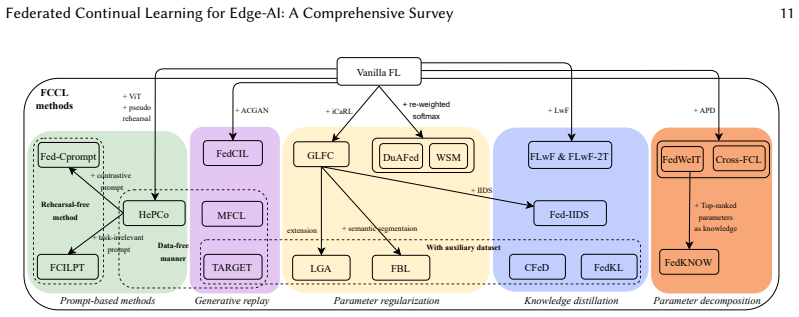
The central object is the three-way task-characteristic taxonomy: federated class continual learning (task identity withheld, new classes appear), federated domain continual learning (class set fixed, distributions drift), and federated task continual learning (task identity supplied). This taxonomy does the organizing work of the survey: it determines which forgetting problems are central in a given scenario and which solution families are even available, since methods that rely on task-specific components are natural only when task identity is known. Secondary organizing devices include the tri-level division into data-centric, model-centric, and algorithmic approaches for the class scenario, and the four domain-focused strategy groups of data supplementation, knowledge learning, model enhancement, and weight aggregation.
What would settle it
Run a coverage test over the surveyed corpus: assign each method to exactly one of federated class, domain, or task continual learning; if methods such as CFeD must be placed in more than one category, or if newly published FCL methods fall outside all three, then the taxonomy's partition claim fails.
Extended reading notes
Core claim
The survey's central claim is a map: federated continual learning for Edge-AI is best understood through three task characteristics, distinguished by what changes over time and whether task identity is available at test time. In federated class continual learning, clients encounter new classes and task identity is withheld, so the failure modes are intra-task forgetting, where the global model loses knowledge contributed by a client that did not participate in a round, and inter-task forgetting, where new tasks degrade performance on old ones. In federated domain continual learning, the class set stays fixed while local and global data distributions drift, and the model must generalize across client-specific and unknown domains while adapting to known domain drift. In federated task continual learning, task identity is provided, which makes task-specific components and task-aware methods available. The paper then subdivides each scenario into concrete strategy families, reviews representative methods within the families, and argues that these families cover the current state of the art in FCL for Edge-AI.
Load-bearing premise
The taxonomy works only if every federated continual learning method can be assigned to exactly one of the three task scenarios, and the survey does not justify that the categories are exhaustive or non-overlapping.
Editorial extensions
If this is right
- Federated class continual learning can be attacked at the data, model, or algorithm level, and method choice should follow from whether intra-task or inter-task forgetting dominates.
- Because task identity is absent in class and domain scenarios, methods that need task-specific parameter components are less natural there; task identity supplied in advance is what makes architecture-based and task-aware replay methods viable.
- Domain-drift solutions sit on a privacy-generalization spectrum: data supplementation risks leakage, knowledge distillation adds computational cost, model enhancement may not transfer, and weight aggregation mainly improves known domains.
- The nine application areas share the same three task characteristics, so the taxonomy gives practitioners a common language for choosing and comparing FCL approaches across domains.
- The open directions identified by the survey—benchmarks, explainability, algorithm-hardware co-design, and foundation models—are where the taxonomy and its coverage assumptions will be tested next.
Reading between the lines
- If the taxonomy is read as a design guide rather than a strict partition, it suggests a testable rule: a method built for one scenario should be re-evaluated when task-identity availability or the type of drift changes, for instance when a prompt-based class-continual method is moved to a domain-drift setting.
- The survey's own placement of CFeD under both class and domain continual learning hints that scenario boundaries are not sharp; a matrix of 'what changes by how the method prevents forgetting' might represent the literature more faithfully than three disjoint buckets.
- The benchmark discussion's emphasis on blurry task boundaries implies that real deployments mix class and domain drift, so extending the taxonomy to explicitly cover mixed-drift tasks would be a natural next step.
- FCL with foundation models could make the class/domain distinction less central: when a frozen pretrained backbone is combined with prompts or adapters, what is forgotten is task-specific parameterization, not the shared representation.
Signed reviews
Editorial analysis
A structured set of objections, weighed in public.
Referee Report
Summary. This manuscript surveys federated continual learning (FCL) in the context of Edge-AI. It proposes a three-way taxonomy based on task characteristics: federated class continual learning (FCCL), federated domain continual learning (FDCL), and federated task continual learning (FTCL). For each category, it reviews representative methods (generative replay, parameter regularization, parameter decomposition, prompting, knowledge distillation for FCCL; data supplementation, knowledge learning, model enhancement, weight aggregation for FDCL; regularization, architecture, replay, meta-learning, and unsupervised methods for FTCL), summarizes them in tables, and then reviews applications (transportation, medical, IoT, UAVs, energy, digital twins, auditing, robotics) and future directions (benchmarks, explainability, algorithm-hardware co-design, foundation models). The paper claims to be the first comprehensive survey of FCL for Edge-AI.
Significance. If the central claims hold, the survey would be a useful entry point for researchers entering FCL, particularly because it brings together a large and recent body of work and organizes it by the type of continual-learning scenario, with summary tables that allow quick comparison of methods. The collection of application areas and the discussion of open challenges, especially algorithm-hardware co-design and foundation-model integration, are valuable and generally accurate in their individual descriptions of cited works. However, the value of the survey depends critically on the taxonomy being a reliable navigation map. The manuscript itself contains duplicate assignments of methods to different taxonomy categories, and the formal definitions contain notation errors. These issues undermine the claimed organizational contribution and the 'first comprehensive survey' claim, so the manuscript needs substantive revision before the central claims can be accepted.
major comments (5)
- [§2.3 and §4.2] Cross-FCL [41] is reviewed as an FCCL parameter-decomposition method in Section 2.3 and again as an FTCL architecture-based method in Section 4.2. This is not merely a presentation redundancy: the survey defines FCCL by the absence of task identity during testing (Section 2) and FTCL by the explicit provision of task identity during learning and testing (Section 4). One method cannot satisfy both conditions, so either one review is misassigned or the taxonomy's decision rule is not actually being applied. The authors should state a clear assignment rule and remove or justify each duplicate placement.
- [§2.5, Table 1, §3.2, Table 2] CFeD [15] is listed under FCCL knowledge distillation (Table 1, Section 2.5) and under FDCL domain knowledge learning (Table 2, Section 3.2). The survey presents FCCL and FDCL as distinct scenarios but never gives a rule for methods that address both new classes and domain drift, nor does it discuss mixed scenarios. This makes the taxonomy non-exhaustive for real methods and potentially misleading for a newcomer who uses the taxonomy to locate all relevant work. The authors should either justify a mixed-category treatment or choose a single primary assignment for each method.
- [§3 (FDCL formalization)] The problem formalization for FDCL contains notation errors that make the definition unusable as written. The displayed definition D^t_k = {(x^t_i, y^t_i)}^{|K|}_{i=1} uses |K| as the upper bound of the sample index i, although i should index samples in client k and the number of samples is client-specific; the text later uses D^t_g = {D^t_1, ..., D^t_K}, which conflates the number of clients (K) with the sample-count bound. Please correct the indexing and clearly distinguish the number of clients from the number of samples per client.
- [§1.2, §1.1, §7] The paper claims in Section 1.2 and Section 7 to be 'the first comprehensive survey of federated continual learning for Edge-AI,' but Section 1.1 states that 'Yang et al. [24] conducted a survey of FCL.' As written, the claims are internally inconsistent. The authors should either temper the novelty claim or explicitly delineate the Edge-AI-specific scope, inclusion criteria, and how the present survey differs from [24] in a way that justifies the word 'first.'
- [§1 (no methodology section)] A survey whose central contribution is comprehensiveness should state its literature search protocol: databases searched, time window, keywords, inclusion/exclusion criteria, and how representative methods were selected. The manuscript does not describe any such protocol, so the 'comprehensive' claim cannot be independently verified or updated. Adding a short methodology subsection would substantially strengthen the paper.
minor comments (7)
- [§4.5] The sentence 'Paul et al. [87] extend FedWeIT [41]' cites the wrong reference: FedWeIT is Yoon et al. [40], while [41] is Cross-FCL. Please correct the citation.
- [§6 (intro)] The introduction to Section 6 says 'we highlight and discuss three future directions,' but the section contains four subsections (6.1 FCL Benchmark, 6.2 Explainable FCL, 6.3 Algorithm-Hardware Co-design, 6.4 FCL with Foundation Models). Please adjust the count or the section structure.
- [§5.4] The heading 'UA Vs' should read 'UAVs.'
- [§4.6] The phrase 'regulation-based approaches' should be 'regularization-based approaches' to match the terminology used elsewhere in the paper.
- [§6.3] The phrase 'Spare matrix multiplication' should be 'Sparse matrix multiplication.'
- [§6.1] The dataset name 'SHVN' appears to be a typo for 'SVHN.'
- [§7] In the conclusion, 'applications empowered by federated continual learning In addition' is missing a period before 'In addition.'
Circularity Check
No significant circularity: the survey organizes existing FCL literature and makes no derivation or fitted prediction that reduces to its own inputs.
full rationale
This is a survey paper. It does not derive equations from fitted parameters, make predictions that are forced by construction, or invoke a uniqueness theorem from the authors' prior work. The organizing claim is a taxonomy of FCL methods by task characteristics, and the summaries of individual methods rest on citations to the original papers, not on this survey's own definitions. The noted double-placement of Cross-FCL in Sections 2.3 and 4.2 and CFeD in Sections 2.5 and 3.2 is a possible organizational inconsistency, but it is not circular reasoning: the survey does not use those placements to prove the taxonomy's correctness, and no prediction or derived result is defined in terms of itself. The 'first comprehensive survey' statement is a novelty claim rather than a derivation. No self-citation chain is load-bearing, and no fitted parameter is relabeled as a prediction. Accordingly, the circularity score is 0.
Assumptions & free parameters
assumptions (2)
- domain assumption The cited papers are accurately represented by the summaries in Sections 2 through 5.
- ad hoc to paper Each FCL method belongs to exactly one of the three categories (FCCL, FDCL, FTCL).
Cite this review
Pith. "Pith review of Federated Continual Learning for Edge-AI: A Comprehensive Survey." pith.science (2026). https://pith.science/paper/UB4LFBBM
@misc{pith2026241113740,
  author       = {Pith},
  title        = {Pith review of: Federated Continual Learning for Edge-AI: A Comprehensive Survey},
  year         = {2026},
  howpublished = {\url{https://pith.science/paper/UB4LFBBM}},
  note         = {Machine review of arXiv:2411.13740}
}
read the original abstract
Edge-AI, the convergence of edge computing and artificial intelligence (AI), has become a promising paradigm that enables the deployment of advanced AI models at the network edge, close to users. In Edge-AI, federated continual learning (FCL) has emerged as an imperative framework, which fuses knowledge from different clients while preserving data privacy and retaining knowledge from previous tasks as it learns new ones. By so doing, FCL aims to ensure stable and reliable performance of learning models in dynamic and distributed environments. In this survey, we thoroughly review the state-of-the-art research and present the first comprehensive survey of FCL for Edge-AI. We categorize FCL methods based on three task characteristics: federated class continual learning, federated domain continual learning, and federated task continual learning. For each category, an in-depth investigation and review of the representative methods are provided, covering background, challenges, problem formalisation, solutions, and limitations. Besides, existing real-world applications empowered by FCL are reviewed, indicating the current progress and potential of FCL in diverse application domains. Furthermore, we discuss and highlight several prospective research directions of FCL such as algorithm-hardware co-design for FCL and FCL with foundation models, which could provide insights into the future development and practical deployment of FCL in the era of Edge-AI.
Figures


Figures from the paper (1 more)

Forward citations
Cited by 3 Pith papers
-
FedTeddi: Temporal Drift and Divergence Aware Scheduling for Timely Federated Edge Learning
A temporal-drift and collective-divergence aware greedy client scheduler plus bandwidth allocator accelerates convergence in federated edge learning with streaming, non-i.i.d. data.
-
Unleashing the Power of Continual Learning on Non-Centralized Devices: A Survey
A review of non-centralized continual learning that taxonomizes data-, model-, and device-level methods and benchmarks twelve federated continual learning methods on six datasets.
-
Federated Continual Learning: Concepts, Challenges, and Solutions
A literature review that categorizes challenges and solutions in federated continual learning and adds an experimental comparison of aggregation strategies.
Reference graph
Works this paper leans on
-
[24]
Federated Continual Learning via Knowledge Fusion: A Survey
Xin Yang, Hao Yu, Xin Gao, Hao Wang, Junbo Zhang, and Tianrui Li. Federated continual learning via knowledge fusion: A survey. arXiv preprint arXiv:2312.16475, 2023
work page Pith review arXiv 2023
-
[41]
Cross-fcl: Toward a cross-edge federated continual learning framework in mobile edge computing systems
Zhouyangzi Zhang, Bin Guo, Wen Sun, Yan Liu, and Zhiwen Yu. Cross-fcl: Toward a cross-edge federated continual learning framework in mobile edge computing systems. IEEE Transactions on Mobile Computing , 2022
2022
-
[15]
Continual federated learning based on knowledge distillation
Yuhang Ma, Zhongle Xie, Jue Wang, Ke Chen, and Lidan Shou. Continual federated learning based on knowledge distillation. In IJCAI, pages 2182–2188, 2022
2022
-
[1]
A survey on deep learning and its applications
Shi Dong, Ping Wang, and Khushnood Abbas. A survey on deep learning and its applications. Computer Science Review, 40:100379, 2021. ACM Comput. Surv., Vol. 1, No. 1, Article . Publication date: November 2024. 28 Wang et al
2021
-
[2]
A survey of blockchain and artificial intelligence for 6g wireless communications
Yiping Zuo, Jiajia Guo, Ning Gao, Yongxu Zhu, Shi Jin, and Xiao Li. A survey of blockchain and artificial intelligence for 6g wireless communications. IEEE Communications Surveys & Tutorials , 2023
2023
-
[3]
Deep learning-enabled medical computer vision
Andre Esteva, Katherine Chou, Serena Yeung, Nikhil Naik, Ali Madani, Ali Mottaghi, Yun Liu, Eric Topol, Jeff Dean, and Richard Socher. Deep learning-enabled medical computer vision. NPJ digital medicine, 4(1):5, 2021
2021
-
[4]
A survey of deep learning applications to autonomous vehicle control
Sampo Kuutti, Richard Bowden, Yaochu Jin, Phil Barber, and Saber Fallah. A survey of deep learning applications to autonomous vehicle control. IEEE Transactions on Intelligent Transportation Systems , 22(2):712–733, 2020
2020
-
[5]
Current progress and open challenges for applying deep learning across the biosciences
Nicolae Sapoval, Amirali Aghazadeh, Michael G Nute, Dinler A Antunes, Advait Balaji, Richard Baraniuk, CJ Barberan, Ruth Dannenfelser, Chen Dun, Mohammadamin Edrisi, et al. Current progress and open challenges for applying deep learning across the biosciences. Nature Communications, 13(1):1728, 2022
2022
Show all 170 references
-
[6]
Communication-efficient learning of deep networks from decentralized data
Brendan McMahan, Eider Moore, Daniel Ramage, Seth Hampson, and Blaise Aguera y Arcas. Communication-efficient learning of deep networks from decentralized data. In Artificial intelligence and statistics, pages 1273–1282. PMLR, 2017
2017
-
[7]
A survey on federated learning
Chen Zhang, Yu Xie, Hang Bai, Bin Yu, Weihong Li, and Yuan Gao. A survey on federated learning. Knowledge-Based Systems, 216:106775, 2021
2021
-
[8]
The future of digital health with federated learning
Nicola Rieke, Jonny Hancox, Wenqi Li, Fausto Milletari, Holger R Roth, Shadi Albarqouni, Spyridon Bakas, Mathieu N Galtier, Bennett A Landman, Klaus Maier-Hein, et al. The future of digital health with federated learning. NPJ digital medicine, 3(1):1–7, 2020
2020
-
[9]
Federated learning on non-iid data: A survey
Hangyu Zhu, Jinjin Xu, Shiqing Liu, and Yaochu Jin. Federated learning on non-iid data: A survey. Neurocomputing, 465:371–390, 2021
2021
-
[10]
Model aggregation techniques in federated learning: A comprehensive survey
Pian Qi, Diletta Chiaro, Antonella Guzzo, Michele Ianni, Giancarlo Fortino, and Francesco Piccialli. Model aggregation techniques in federated learning: A comprehensive survey. Future Generation Computer Systems , 2023
2023
-
[11]
A survey on security and privacy of federated learning
Viraaji Mothukuri, Reza M Parizi, Seyedamin Pouriyeh, Yan Huang, Ali Dehghantanha, and Gautam Srivastava. A survey on security and privacy of federated learning. Future Generation Computer Systems , 115:619–640, 2021
2021
-
[12]
Federated learning for edge networks: Resource optimization and incentive mechanism
Latif U Khan, Shashi Raj Pandey, Nguyen H Tran, Walid Saad, Zhu Han, Minh NH Nguyen, and Choong Seon Hong. Federated learning for edge networks: Resource optimization and incentive mechanism. IEEE Communications Magazine, 58(10):88–93, 2020
2020
-
[13]
A comprehensive survey of continual learning: Theory, method and application
Liyuan Wang, Xingxing Zhang, Hang Su, and Jun Zhu. A comprehensive survey of continual learning: Theory, method and application. IEEE Transactions on Pattern Analysis and Machine Intelligence , 2024
2024
-
[14]
Non-iid data and continual learning processes in federated learning: A long road ahead
Marcos F Criado, Fernando E Casado, Roberto Iglesias, Carlos V Regueiro, and Senén Barro. Non-iid data and continual learning processes in federated learning: A long road ahead. Information Fusion, 88:263–280, 2022
2022
-
[16]
Federated class-incremental learning
Jiahua Dong, Lixu Wang, Zhen Fang, Gan Sun, Shichao Xu, Xiao Wang, and Qi Zhu. Federated class-incremental learning. In Proceedings of the IEEE/CVF conference on computer vision and pattern recognition , pages 10164–10173, 2022
2022
-
[17]
Target: Federated class-continual learning via exemplar- free distillation
Jie Zhang, Chen Chen, Weiming Zhuang, and Lingjuan Lyu. Target: Federated class-continual learning via exemplar- free distillation. In Proceedings of the IEEE/CVF International Conference on Computer Vision , pages 4782–4793, 2023
2023
-
[18]
Asynchronous federated continual learning
Donald Shenaj, Marco Toldo, Alberto Rigon, and Pietro Zanuttigh. Asynchronous federated continual learning. In Proceedings of the IEEE/CVF Conference on Computer Vision and Pattern Recognition , pages 5054–5062, 2023
2023
-
[19]
Federated learning for the internet of things: Applications, challenges, and opportunities
Tuo Zhang, Lei Gao, Chaoyang He, Mi Zhang, Bhaskar Krishnamachari, and A Salman Avestimehr. Federated learning for the internet of things: Applications, challenges, and opportunities. IEEE Internet of Things Magazine , 5(1):24–29, 2022
2022
-
[20]
Heterogeneous federated learning: State-of-the-art and research challenges
Mang Ye, Xiuwen Fang, Bo Du, Pong C Yuen, and Dacheng Tao. Heterogeneous federated learning: State-of-the-art and research challenges. ACM Computing Surveys, 56(3):1–44, 2023
2023
-
[21]
Three types of incremental learning
Gido M van de Ven, Tinne Tuytelaars, and Andreas S Tolias. Three types of incremental learning. Nature Machine Intelligence, 4(12):1185–1197, 2022
2022
-
[22]
A continual learning survey: Defying forgetting in classification tasks
Matthias De Lange, Rahaf Aljundi, Marc Masana, Sarah Parisot, Xu Jia, Aleš Leonardis, Gregory Slabaugh, and Tinne Tuytelaars. A continual learning survey: Defying forgetting in classification tasks. IEEE transactions on pattern analysis and machine intelligence , 44(7):3366–3385, 2021
2021
-
[23]
Class-incremental learning: survey and performance evaluation on image classification
Marc Masana, Xialei Liu, Bartłomiej Twardowski, Mikel Menta, Andrew D Bagdanov, and Joost Van De Weijer. Class-incremental learning: survey and performance evaluation on image classification. IEEE Transactions on Pattern Analysis and Machine Intelligence, 45(5):5513–5533, 2022
2022
-
[25]
Deep class-incremental learning: A survey, February 2023
Da-Wei Zhou, Qi-Wei Wang, Zhi-Hong Qi, Han-Jia Ye, De-Chuan Zhan, and Ziwei Liu. Deep class-incremental learning: A survey, February 2023. ACM Comput. Surv., Vol. 1, No. 1, Article . Publication date: November 2024. Federated Continual Learning for Edge-AI: A Comprehensive Survey 29
2023
-
[26]
Federated Learning for Data Streams
Othmane Marfoq, Giovanni Neglia, Laetitia Kameni, and Richard Vidal. Federated Learning for Data Streams. In Proceedings of The 26th International Conference on Artificial Intelligence and Statistics , pages 8889–8924. PMLR, April 2023
2023
-
[27]
Hendryx, Dharma Raj KC, Bradley Walls, and Clayton T
Sean M. Hendryx, Dharma Raj KC, Bradley Walls, and Clayton T. Morrison. Federated Reconnaissance: Efficient, Distributed, Class-Incremental Learning, August 2021
2021
-
[28]
Goodfellow, Jean Pouget-Abadie, Mehdi Mirza, Bing Xu, David Warde-Farley, Sherjil Ozair, Aaron Courville, and Yoshua Bengio
Ian J. Goodfellow, Jean Pouget-Abadie, Mehdi Mirza, Bing Xu, David Warde-Farley, Sherjil Ozair, Aaron Courville, and Yoshua Bengio. Generative Adversarial Networks, June 2014
2014
-
[29]
Better generative replay for continual federated learning
Daiqing Qi, Handong Zhao, and Sheng Li. Better generative replay for continual federated learning. In The Eleventh International Conference on Learning Representations , 2022
2022
-
[30]
Don’t memorize; mimic the past: Federated class incremental learning without episodic memory
Sara Babakniya, Zalan Fabian, Chaoyang He, Mahdi Soltanolkotabi, and Salman Avestimehr. Don’t memorize; mimic the past: Federated class incremental learning without episodic memory. In Federated Learning and Analytics in Practice: Algorithms, Systems, Applications, and Opportu...
2023
-
[31]
A data-free approach to mitigate catastrophic forgetting in federated class incremental learning for vision tasks
Sara Babakniya, Zalan Fabian, Chaoyang He, Mahdi Soltanolkotabi, and Salman Avestimehr. A data-free approach to mitigate catastrophic forgetting in federated class incremental learning for vision tasks. In Thirty-seventh Conference on Neural Information Processing Systems , 2023
2023
-
[32]
No one left behind: Real-world federated class-incremental learning
Jiahua Dong, Yang Cong, Gan Sun, Yulun Zhang, Bernt Schiele, and Dengxin Dai. No one left behind: Real-world federated class-incremental learning. arXiv preprint arXiv:2302.00903, 2023
2023 arXiv
-
[33]
Federated incremental semantic segmentation
Jiahua Dong, Duzhen Zhang, Yang Cong, Wei Cong, Henghui Ding, and Dengxin Dai. Federated incremental semantic segmentation. In Proceedings of the IEEE/CVF Conference on Computer Vision and Pattern Recognition , pages 3934–3943, 2023
2023
-
[34]
Re-weighted softmax cross-entropy to control forgetting in federated learning
Gwen Legate, Lucas Caccia, and Eugene Belilovsky. Re-weighted softmax cross-entropy to control forgetting in federated learning. arXiv preprint arXiv:2304.05260, 2023
2023 arXiv
-
[35]
A federated incremental learning algorithm based on dual attention mechanism
Kai Hu, Meixia Lu, Yaogen Li, Sheng Gong, Jiasheng Wu, Fenghua Zhou, Shanshan Jiang, and Yi Yang. A federated incremental learning algorithm based on dual attention mechanism. Applied Sciences, 12(19):10025, 2022
2022
-
[36]
Sylvestre-Alvise Rebuffi, Alexander Kolesnikov, Georg Sperl, and Christoph H. Lampert. ICaRL: Incremental classifier and representation learning. In 2017 IEEE Conference on Computer Vision and Pattern Recognition (CVPR) , pages 5533–5542, Honolulu, HI, July 2017. IEEE
2017
-
[37]
Continual local training for better initialization of federated models
Xin Yao and Lifeng Sun. Continual local training for better initialization of federated models. In2020 IEEE International Conference on Image Processing (ICIP) , pages 1736–1740. IEEE, 2020
2020
-
[38]
Rusu, Kieran Milan, John Quan, Tiago Ramalho, Agnieszka Grabska-Barwinska, Demis Hassabis, Claudia Clopath, Dharshan Kumaran, and Raia Hadsell
James Kirkpatrick, Razvan Pascanu, Neil Rabinowitz, Joel Veness, Guillaume Desjardins, Andrei A. Rusu, Kieran Milan, John Quan, Tiago Ramalho, Agnieszka Grabska-Barwinska, Demis Hassabis, Claudia Clopath, Dharshan Kumaran, and Raia Hadsell. Overcoming catastrophic forgetting i...
2017
-
[39]
Scalable and order-robust continual learning with additive parameter decomposition
Jaehong Yoon, Saehoon Kim, Eunho Yang, and Sung Ju Hwang. Scalable and order-robust continual learning with additive parameter decomposition. In International Conference on Learning Representations , 2019
2019
-
[40]
Federated continual learning with weighted inter-client transfer
Jaehong Yoon, Wonyong Jeong, Giwoong Lee, Eunho Yang, and Sung Ju Hwang. Federated continual learning with weighted inter-client transfer. In International Conference on Machine Learning , pages 12073–12086. PMLR, 2021
2021
-
[42]
Fedknow: Federated continual learning with signature task knowledge integration at edge
Yaxin Luopan, Rui Han, Qinglong Zhang, Chi Harold Liu, Guoren Wang, and Lydia Y Chen. Fedknow: Federated continual learning with signature task knowledge integration at edge. In 2023 IEEE 39th International Conference on Data Engineering (ICDE), pages 341–354. IEEE, 2023
2023
-
[43]
Hepco: Data-free heterogeneous prompt consolidation for continual federated learning
Shaunak Halbe, James Seale Smith, Junjiao Tian, and Zsolt Kira. Hepco: Data-free heterogeneous prompt consolidation for continual federated learning. arXiv preprint arXiv:2306.09970, 2023
2023 arXiv
-
[44]
Fed-CPrompt: Contrastive Prompt for Rehearsal-Free Federated Continual Learning, September 2023
Gaurav Bagwe, Xiaoyong Yuan, Miao Pan, and Lan Zhang. Fed-CPrompt: Contrastive Prompt for Rehearsal-Free Federated Continual Learning, September 2023
2023
-
[45]
Federated class-incremental learning with prompting
Jiale Liu, Yu-Wei Zhan, Chong-Yu Zhang, Xin Luo, Zhen-Duo Chen, Yinwei Wei, and Xin-Shun Xu. Federated class-incremental learning with prompting. arXiv preprint arXiv:2310.08948, 2023
2023 arXiv
-
[46]
Distilling the Knowledge in a Neural Network, March 2015
Geoffrey Hinton, Oriol Vinyals, and Jeff Dean. Distilling the Knowledge in a Neural Network, March 2015
2015
-
[47]
Learning without Forgetting
Zhizhong Li and Derek Hoiem. Learning without Forgetting. IEEE Transactions on Pattern Analysis and Machine Intelligence, 40(12):2935–2947, December 2018
2018
-
[48]
Federated continual learning through distillation in pervasive computing
Anastasiia Usmanova, François Portet, Philippe Lalanda, and German Vega. Federated continual learning through distillation in pervasive computing. In 2022 IEEE International Conference on Smart Computing (SMARTCOMP) , pages 86–91. IEEE, 2022
2022
-
[49]
A distillation-based approach integrating continual learning and federated learning for pervasive services
Anastasiia Usmanova, François Portet, Philippe Lalanda, and German Vega. A distillation-based approach integrating continual learning and federated learning for pervasive services. arXiv preprint arXiv:2109.04197, 2021. ACM Comput. Surv., Vol. 1, No. 1, Article . Publication d...
2021 arXiv
-
[50]
Knowledge lock: Overcoming catastrophic forgetting in federated learning
Guoyizhe Wei and Xiu Li. Knowledge lock: Overcoming catastrophic forgetting in federated learning. In Pacific-Asia Conference on Knowledge Discovery and Data Mining , pages 601–612. Springer, 2022
2022
-
[51]
Fl-iids: A novel federated learning-based incremental intrusion detection system
Zhigang Jin, Junyi Zhou, Bing Li, Xiaodong Wu, and Chenxu Duan. Fl-iids: A novel federated learning-based incremental intrusion detection system. Future Generation Computer Systems , 151:57–70, 2024
2024
-
[52]
Fedet: a communication-efficient federated class- incremental learning framework based on enhanced transformer
Chenghao Liu, Xiaoyang Qu, Jianzong Wang, and Jing Xiao. Fedet: a communication-efficient federated class- incremental learning framework based on enhanced transformer. In Proceedings of the Thirty-Second International Joint Conference on Artificial Intelligence , pages 3984–3...
2023
-
[53]
Feddg: Federated domain generalization on medical image segmentation via episodic learning in continuous frequency space
Quande Liu, Cheng Chen, Jing Qin, Qi Dou, and Pheng-Ann Heng. Feddg: Federated domain generalization on medical image segmentation via episodic learning in continuous frequency space. In Proceedings of the IEEE/CVF Conference on Computer Vision and Pattern Recognition , pages ...
2021
-
[54]
Overcoming forgetting in local adaptation of federated learning model
Shunjian Liu, Xinxin Feng, and Haifeng Zheng. Overcoming forgetting in local adaptation of federated learning model. In Pacific-Asia Conference on Knowledge Discovery and Data Mining , pages 613–625. Springer, 2022
2022
-
[55]
Tackling dynamics in federated incremental learning with variational embedding rehearsal
Tae Jin Park, Kenichi Kumatani, and Dimitrios Dimitriadis. Tackling dynamics in federated incremental learning with variational embedding rehearsal. arXiv preprint arXiv:2110.09695, 2021
2021 arXiv
-
[56]
Federated and continual learning for classification tasks in a society of devices
Fernando E Casado, Dylan Lema, Roberto Iglesias, Carlos V Regueiro, and Senén Barro. Federated and continual learning for classification tasks in a society of devices. arXiv preprint arXiv:2006.07129, 2020
2006 arXiv
-
[57]
Concept drift detection and adaptation for federated and continual learning
Fernando E Casado, Dylan Lema, Marcos F Criado, Roberto Iglesias, Carlos V Regueiro, and Senén Barro. Concept drift detection and adaptation for federated and continual learning. Multimedia Tools and Applications, pages 1–23, 2022
2022
-
[58]
Ensemble and continual federated learning for classification tasks
Fernando E Casado, Dylan Lema, Roberto Iglesias, Carlos V Regueiro, and Senén Barro. Ensemble and continual federated learning for classification tasks. Machine Learning, pages 1–41, 2023
2023
-
[59]
Spatial-temporal federated learning for lifelong person re- identification on distributed edges
Lei Zhang, Guanyu Gao, and Huaizheng Zhang. Spatial-temporal federated learning for lifelong person re- identification on distributed edges. IEEE Transactions on Circuits and Systems for Video Technology , 2023
2023
-
[60]
Learn from others and be yourself in heterogeneous federated learning
Wenke Huang, Mang Ye, and Bo Du. Learn from others and be yourself in heterogeneous federated learning. In Proceedings of the IEEE/CVF Conference on Computer Vision and Pattern Recognition , pages 10143–10153, 2022
2022
-
[61]
Multi-granularity fusion resource allocation algorithm based on dual- attention deep reinforcement learning and lifelong learning architecture in heterogeneous iiot
Ying Wang, Fengjun Shang, and Jianjun Lei. Multi-granularity fusion resource allocation algorithm based on dual- attention deep reinforcement learning and lifelong learning architecture in heterogeneous iiot. Information Fusion, page 101871, 2023
2023
-
[62]
Towards federated learning on time-evolving heterogeneous data
Yongxin Guo, Tao Lin, and Xiaoying Tang. Towards federated learning on time-evolving heterogeneous data. arXiv preprint arXiv:2112.13246, 2021
2021 arXiv
-
[63]
Incremental unsupervised adversarial domain adaptation for federated learning in iot networks
Yan Huang, Mengxuan Du, Haifeng Zheng, and Xinxin Feng. Incremental unsupervised adversarial domain adaptation for federated learning in iot networks. In 2022 18th International Conference on Mobility, Sensing and Networking (MSN), pages 186–190. IEEE, 2022
2022
-
[64]
Learning domain-heterogeneous speaker recognition systems with personalized continual federated learning
Zhiyong Chen and Shugong Xu. Learning domain-heterogeneous speaker recognition systems with personalized continual federated learning. EURASIP Journal on Audio, Speech, and Music Processing , 2023(1):33, 2023
2023
-
[65]
Continual adaptation of federated reservoirs in pervasive environments
Valerio De Caro, Claudio Gallicchio, and Davide Bacciu. Continual adaptation of federated reservoirs in pervasive environments. Neurocomputing, 556:126638, 2023
2023
-
[66]
Communication-efficient federated continual learning for distributed learning system with non-iid data
Zhao Zhang, Yong Zhang, Da Guo, Shuang Zhao, and Xiaolin Zhu. Communication-efficient federated continual learning for distributed learning system with non-iid data. Science China Information Sciences , 66(2):122102, 2023
2023
-
[67]
Differentially private federated continual learning with heterogeneous cohort privacy
Ajesh Koyatan Chathoth, Clark P Necciai, Abhyuday Jagannatha, and Stephen Lee. Differentially private federated continual learning with heterogeneous cohort privacy. In 2022 IEEE International Conference on Big Data (Big Data) , pages 5682–5691. IEEE, 2022
2022
-
[68]
Efl: Elastic federated learning on non-iid data
Zichen Ma, Yu Lu, Wenye Li, and Shuguang Cui. Efl: Elastic federated learning on non-iid data. In Conference on Lifelong Learning Agents, pages 92–115. PMLR, 2022
2022
-
[69]
Continual learning of dynamical systems with competitive federated reservoir computing
Leonard Bereska and Efstratios Gavves. Continual learning of dynamical systems with competitive federated reservoir computing. In Conference on Lifelong Learning Agents , pages 335–350. PMLR, 2022
2022
-
[70]
Continual horizontal federated learning for heterogeneous data
Junki Mori, Isamu Teranishi, and Ryo Furukawa. Continual horizontal federated learning for heterogeneous data. In 2022 International Joint Conference on Neural Networks (IJCNN) , pages 1–8. IEEE, 2022
2022
-
[71]
Federated continuous learning with broad network architecture
Junqing Le, Xinyu Lei, Nankun Mu, Hengrun Zhang, Kai Zeng, and Xiaofeng Liao. Federated continuous learning with broad network architecture. IEEE Transactions on Cybernetics , 51(8):3874–3888, 2021
2021
-
[72]
Attention-based federated incremental learning for traffic classification in the internet of things
Meng-yuan Zhu, Zhuo Chen, Ke-fan Chen, Na Lv, and Yun Zhong. Attention-based federated incremental learning for traffic classification in the internet of things. Computer Communications, 185:168–175, 2022
2022
-
[73]
Lightweight privacy-preserving federated incremental decision trees
Zhaoyang Han, Chunpeng Ge, Bingzhe Wu, and Zhe Liu. Lightweight privacy-preserving federated incremental decision trees. IEEE Transactions on Services Computing , 2022
2022
-
[74]
Federated domain generalization with generalization adjustment
Ruipeng Zhang, Qinwei Xu, Jiangchao Yao, Ya Zhang, Qi Tian, and Yanfeng Wang. Federated domain generalization with generalization adjustment. In Proceedings of the IEEE/CVF Conference on Computer Vision and Pattern Recognition , pages 3954–3963, 2023. ACM Comput. Surv., Vol. 1...
2023
-
[75]
Learnings from federated learning in the real world
Christophe Dupuy, Tanya G Roosta, Leo Long, Clement Chung, Rahul Gupta, and Salman Avestimehr. Learnings from federated learning in the real world. In ICASSP 2022-2022 IEEE International Conference on Acoustics, Speech and Signal Processing (ICASSP), pages 8767–8771. IEEE, 2022
2022
-
[76]
Secure and efficient parameters aggregation protocol for federated incremental learning and its applications
Xiaoying Wang, Zhiwei Liang, Arthur Sandor Voundi Koe, Qingwu Wu, Xiaodong Zhang, Haitao Li, and Qintai Yang. Secure and efficient parameters aggregation protocol for federated incremental learning and its applications. International Journal of Intelligent Systems , 37(8):4471...
2022
-
[77]
Semi-supervised federated learning on evolving data streams
Cobbinah B Mawuli, Jay Kumar, Ebenezer Nanor, Shangxuan Fu, Liangxu Pan, Qinli Yang, Wei Zhang, and Junming Shao. Semi-supervised federated learning on evolving data streams. Information Sciences, page 119235, 2023
2023
-
[78]
Finding trustworthy neighbors: Graph aided federated learning for few-shot industrial fault diagnosis with data heterogeneity
Zoujing Yao, Pengyu Song, and Chunhui Zhao. Finding trustworthy neighbors: Graph aided federated learning for few-shot industrial fault diagnosis with data heterogeneity. Journal of Process Control , 129:103038, 2023
2023
-
[79]
Federated orthogonal training: Mitigating global catastrophic forgetting in continual federated learning
Yavuz Faruk Bakman, Duygu Nur Yaldiz, Yahya H Ezzeldin, and Salman Avestimehr. Federated orthogonal training: Mitigating global catastrophic forgetting in continual federated learning. arXiv preprint arXiv:2309.01289, 2023
2023 arXiv
-
[80]
A peer-to-peer federated continual learning network for improving ct imaging from multiple institutions
Hao Wang, Ruihong He, Xiaoyu Zhang, Zhaoying Bian, Dong Zeng, and Jianhua Ma. A peer-to-peer federated continual learning network for improving ct imaging from multiple institutions. arXiv preprint arXiv:2306.02037, 2023
2023 arXiv
-
[81]
Federated continual learning for text classification via selective inter-client transfer
Yatin Chaudhary, Pranav Rai, Matthias Schubert, Hinrich Schütze, and Pankaj Gupta. Federated continual learning for text classification via selective inter-client transfer. arXiv preprint arXiv:2210.06101, 2022
2022 arXiv
-
[82]
Federated continual learning with differentially private data sharing
Giulio Zizzo, Ambrish Rawat, Naoise Holohan, and Seshu Tirupathi. Federated continual learning with differentially private data sharing. In Workshop on Federated Learning: Recent Advances and New Challenges (in Conjunction with NeurIPS 2022), 2022
2022
-
[83]
Federated probability memory recall for federated continual learning
Zhe Wang, Yu Zhang, Xinlei Xu, Zhiling Fu, Hai Yang, and Wenli Du. Federated probability memory recall for federated continual learning. Information Sciences, 629:551–565, 2023
2023
-
[84]
Xiaojiang Zuo, Yaxin Luopan, Rui Han, Qinglong Zhang, Chi Harold Liu, Guoren Wang, and Lydia Y. Chen. FedViT: Federated continual learning of vision transformer at edge. Future Generation Computer Systems , 154:1–15, May 2024
2024
-
[85]
Lifelong bandit optimization: no prior and no regret
Felix Schur, Parnian Kassraie, Jonas Rothfuss, and Andreas Krause. Lifelong bandit optimization: no prior and no regret. In Uncertainty in Artificial Intelligence, pages 1847–1857. PMLR, 2023
2023
-
[86]
Personalized federated continual learning for task-incremental biometrics
Dongdong Li, Nan Huang, Zhe Wang, and Hai Yang. Personalized federated continual learning for task-incremental biometrics. IEEE Internet of Things Journal , 2023
2023
-
[87]
Masked autoencoders are efuficient continual federated learners
Subarnaduti Paul, Lars-Joel Frey, Roshni Kamath, Kristian Kersting, and Martin Mundt. Masked autoencoders are efuficient continual federated learners. arXiv preprint arXiv:2306.03542, 2023
2023 arXiv
-
[88]
A deep learning-based smart service model for context-aware intelligent transportation system
K Hemant Kumar Reddy, Rajat Shubhra Goswami, and Diptendu Sinha Roy. A deep learning-based smart service model for context-aware intelligent transportation system. The Journal of Supercomputing , pages 1–23, 2023
2023
-
[89]
Decentralized federated learning for extended sensing in 6g connected vehicles
Luca Barbieri, Stefano Savazzi, Mattia Brambilla, and Monica Nicoli. Decentralized federated learning for extended sensing in 6g connected vehicles. Vehicular Communications, 33:100396, 2022
2022
-
[90]
Peer-to-peer federated continual learning for naturalistic driving action recognition
Liangqi Yuan, Yunsheng Ma, Lu Su, and Ziran Wang. Peer-to-peer federated continual learning for naturalistic driving action recognition. In Proceedings of the IEEE/CVF Conference on Computer Vision and Pattern Recognition , pages 5249–5258, 2023
2023
-
[91]
Icmfed: An incremental and cost-efficient mechanism of federated meta-learning for driver distraction detection
Zihan Guo, Linlin You, Sheng Liu, Junshu He, and Bingran Zuo. Icmfed: An incremental and cost-efficient mechanism of federated meta-learning for driver distraction detection. Mathematics, 11(8):1867, 2023
2023
-
[92]
A federated learning and blockchain framework for physiological signal classification based on continual learning
Le Sun, Jin Wu, Yang Xu, and Yanchun Zhang. A federated learning and blockchain framework for physiological signal classification based on continual learning. Information Sciences, 630:586–598, 2023
2023
-
[93]
Continual learning for peer-to-peer federated learning: A study on automated brain metastasis identification
Yixing Huang, Christoph Bert, Stefan Fischer, Manuel Schmidt, Arnd Dörfler, Andreas Maier, Rainer Fietkau, and Florian Putz. Continual learning for peer-to-peer federated learning: A study on automated brain metastasis identification. arXiv preprint arXiv:2204.13591, 2022
2022 arXiv
-
[94]
Federated learning empowered real-time medical data processing method for smart healthcare
Kehua Guo, Tianyu Chen, Sheng Ren, Nan Li, Min Hu, and Jian Kang. Federated learning empowered real-time medical data processing method for smart healthcare. IEEE/ACM Transactions on Computational Biology and Bioinformatics , 2022
2022
-
[95]
Federated incremental learning based evolvable intrusion detection system for zero-day attacks
Dong Jin, Shuangwu Chen, Huasen He, Xiaofeng Jiang, Siyu Cheng, and Jian Yang. Federated incremental learning based evolvable intrusion detection system for zero-day attacks. IEEE Network, 37(1):125–132, 2023
2023
-
[96]
Surveilnet: A lightweight anomaly detection system for cooperative iot surveillance networks
Martins O Osifeko, Gerhard P Hancke, and Adnan M Abu-Mahfouz. Surveilnet: A lightweight anomaly detection system for cooperative iot surveillance networks. IEEE Sensors Journal, 21(22):25293–25306, 2021
2021
-
[97]
Collaborative and incremental learning for modulation classification with heterogeneous local dataset in cognitive iot
Peihan Qi, Xiaoyu Zhou, Yuanlei Ding, Shilian Zheng, Tao Jiang, and Zan Li. Collaborative and incremental learning for modulation classification with heterogeneous local dataset in cognitive iot. IEEE Transactions on Green Communications and Networking, 2022
2022
-
[98]
Asynchronous semi-supervised federated learning with provable convergence in edge computing
Nan Yang, Dong Yuan, Yuning Zhang, Yongkun Deng, and Wei Bao. Asynchronous semi-supervised federated learning with provable convergence in edge computing. IEEE Network, 36(5):136–143, 2022
2022
-
[99]
Federated continuous learning based on stacked broad learning system assisted by digital twin networks: An incremental learning approach for ACM Comput
Xiaoqiang He, Qianbin Chen, Lun Tang, Weili Wang, Tong Liu, Li Li, Qinghai Liu, et al. Federated continuous learning based on stacked broad learning system assisted by digital twin networks: An incremental learning approach for ACM Comput. Surv., Vol. 1, No. 1, Article . Publi...
2024
-
[100]
Failure-sentient composition for swarm-based drone services
Balsam Alkouz, Athman Bouguettaya, and Abdallah Lakhdari. Failure-sentient composition for swarm-based drone services. arXiv preprint arXiv:2305.13892, 2023
2023 arXiv
-
[101]
An incremental photovoltaic power prediction method considering concept drift and privacy protection
Le Zhang, Jizhong Zhu, Di Zhang, and Yun Liu. An incremental photovoltaic power prediction method considering concept drift and privacy protection. Applied Energy, 351:121919, 2023
2023
-
[102]
Online fault line detection in small-sample and streaming data environments
Le Zhang, Jizhong Zhu, Shenglin Li, Alberto Borghetti, and Di Zhang. Online fault line detection in small-sample and streaming data environments. IEEE Transactions on Instrumentation and Measurement , 2023
2023
-
[103]
Blockchain based decentralized learning for security in digital twins
Zhihan Lv, Chen Cheng, and Haibin Lv. Blockchain based decentralized learning for security in digital twins. IEEE Internet of Things Journal , 2023
2023
-
[104]
Federated continual learning to detect accounting anomalies in financial auditing
Marco Schreyer, Hamed Hemati, Damian Borth, and Miklos A Vasarhelyi. Federated continual learning to detect accounting anomalies in financial auditing. arXiv preprint arXiv:2210.15051, 2022
2022 arXiv
-
[105]
Towards lifelong federated learning in autonomous mobile robots with continuous sim-to-real transfer
Xianjia Yu, Jorge Pena Queralta, and Tomi Westerlund. Towards lifelong federated learning in autonomous mobile robots with continuous sim-to-real transfer. Procedia Computer Science, 210:86–93, 2022
2022
-
[106]
Federated continual learning for socially aware robotics
Luke Guerdan and Hatice Gunes. Federated continual learning for socially aware robotics. In 2023 32nd IEEE International Conference on Robot and Human Interactive Communication (RO-MAN) , pages 1522–1529. IEEE, 2023
2023
-
[107]
Brendan McMahan, Virginia Smith, and Ameet Talwalkar
Sebastian Caldas, Sai Meher Karthik Duddu, Peter Wu, Tian Li, Jakub Konečný, H. Brendan McMahan, Virginia Smith, and Ameet Talwalkar. LEAF: A Benchmark for Federated Settings, December 2019
2019
-
[108]
FedMultimodal: A Benchmark for Multimodal Federated Learning
Tiantian Feng, Digbalay Bose, Tuo Zhang, Rajat Hebbar, Anil Ramakrishna, Rahul Gupta, Mi Zhang, Salman Aves- timehr, and Shrikanth Narayanan. FedMultimodal: A Benchmark for Multimodal Federated Learning. In Proceedings of the 29th ACM SIGKDD Conference on Knowledge Discovery a...
2023
-
[109]
Yu, Yu Rong, Peilin Zhao, Junzhou Huang, Murali Annavaram, and Salman Avestimehr
Chaoyang He, Keshav Balasubramanian, Emir Ceyani, Carl Yang, Han Xie, Lichao Sun, Lifang He, Liangwei Yang, Philip S. Yu, Yu Rong, Peilin Zhao, Junzhou Huang, Murali Annavaram, and Salman Avestimehr. FedGraphNN: A Federated Learning System and Benchmark for Graph Neural Networ...
2021
-
[110]
CORe50: A New Dataset and Benchmark for Continuous Object Recognition
Vincenzo Lomonaco and Davide Maltoni. CORe50: A New Dataset and Benchmark for Continuous Object Recognition. In Proceedings of the 1st Annual Conference on Robot Learning , pages 17–26. PMLR, October 2017
2017
-
[111]
Yuval Netzer, Tao Wang, Adam Coates, Alessandro Bissacco, Bo Wu, and Andrew Y. Ng. Reading digits in natural images with unsupervised feature learning. NIPS Workshop on Deep Learning and Unsupervised Feature Learning , 2011
2011
-
[112]
Hayes, Hitesh Vaidya, and Christopher Kanan
Ryne Roady, Tyler L. Hayes, Hitesh Vaidya, and Christopher Kanan. Stream-51: Streaming Classification and Novelty Detection From Videos. In Proceedings of the IEEE/CVF Conference on Computer Vision and Pattern Recognition Workshops, pages 228–229, 2020
2020
-
[113]
The Caltech-UCSD Birds-200-2011 Dataset
Catherine Wah, Steve Branson, Peter Welinder, Pietro Perona, and Serge Belongie. The Caltech-UCSD Birds-200-2011 Dataset
2011
-
[114]
The CLEAR Benchmark: Continual LEArning on Real-World Imagery
Zhiqiu Lin, Jia Shi, Deepak Pathak, and Deva Ramanan. The CLEAR Benchmark: Continual LEArning on Real-World Imagery
-
[115]
Defining Benchmarks for Continual Few-Shot Learning, April 2020
Antreas Antoniou, Massimiliano Patacchiola, Mateusz Ochal, and Amos Storkey. Defining Benchmarks for Continual Few-Shot Learning, April 2020
2020
-
[116]
The mnist database of handwritten digit images for machine learning research
Li Deng. The mnist database of handwritten digit images for machine learning research. IEEE Signal Processing Magazine, 29(6):141–142, 2012
2012
-
[117]
Learning multiple layers of features from tiny images
Alex Krizhevsky and Geoffrey Hinton. Learning multiple layers of features from tiny images. 2009
2009
-
[118]
Imagenet: A large-scale hierarchical image database
Jia Deng, Wei Dong, Richard Socher, Li-Jia Li, Kai Li, and Li Fei-Fei. Imagenet: A large-scale hierarchical image database. In 2009 IEEE conference on computer vision and pattern recognition , pages 248–255. Ieee, 2009
2009
-
[119]
Rainbow memory: Continual learning with a memory of diverse samples
Jihwan Bang, Heesu Kim, YoungJoon Yoo, Jung-Woo Ha, and Jonghyun Choi. Rainbow memory: Continual learning with a memory of diverse samples. In Proceedings of the IEEE/CVF Conference on Computer Vision and Pattern Recognition, pages 8218–8227, 2021
2021
-
[120]
Online Class-Incremental Learning for Real-World Food Image Classification
Siddeshwar Raghavan, Jiangpeng He, and Fengqing Zhu. Online Class-Incremental Learning for Real-World Food Image Classification. In Proceedings of the IEEE/CVF Winter Conference on Applications of Computer Vision , pages 8195–8204, 2024
2024
-
[121]
Gradient based sample selection for online continual learning
Rahaf Aljundi, Min Lin, Baptiste Goujaud, and Yoshua Bengio. Gradient based sample selection for online continual learning. In Advances in Neural Information Processing Systems , volume 32. Curran Associates, Inc., 2019
2019
-
[122]
Online Continual Learning on Class Incremental Blurry Task Configuration with Anytime Inference
Hyunseo Koh, Dahyun Kim, Jung-Woo Ha, and Jonghyun Choi. Online Continual Learning on Class Incremental Blurry Task Configuration with Anytime Inference. In International Conference on Learning Representations , October 2021
2021
-
[123]
Ameya Prabhu, Philip H. S. Torr, and Puneet K. Dokania. GDumb: A Simple Approach that Questions Our Progress in Continual Learning. In Andrea Vedaldi, Horst Bischof, Thomas Brox, and Jan-Michael Frahm, editors, Computer Vision – ECCV 2020 , volume 12347, pages 524–540. Springe...
2020
-
[124]
Is Class-Incremental Enough for Continual Learning? Frontiers in Artificial Intelligence, 5, 2022
Andrea Cossu, Gabriele Graffieti, Lorenzo Pellegrini, Davide Maltoni, Davide Bacciu, Antonio Carta, and Vincenzo Lomonaco. Is Class-Incremental Enough for Continual Learning? Frontiers in Artificial Intelligence, 5, 2022
2022
-
[125]
Class-incremental learning with repetition
Hamed Hemati, Andrea Cossu, Antonio Carta, Julio Hurtado, Lorenzo Pellegrini, Davide Bacciu, Vincenzo Lomonaco, and Damian Borth. Class-incremental learning with repetition. In Conference on Lifelong Learning Agents , pages 437–455. PMLR, 2023
2023
-
[126]
FATE: An Industrial Grade Platform for Collaborative Learning With Data Protection
Yang Liu, Tao Fan, Tianjian Chen, Qian Xu, and Qiang Yang. FATE: An Industrial Grade Platform for Collaborative Learning With Data Protection
-
[127]
PySyft: A Library for Easy Federated Learning
Alexander Ziller, Andrew Trask, Antonio Lopardo, Benjamin Szymkow, Bobby Wagner, Emma Bluemke, Jean-Mickael Nounahon, Jonathan Passerat-Palmbach, Kritika Prakash, Nick Rose, Théo Ryffel, Zarreen Naowal Reza, and Georgios Kaissis. PySyft: A Library for Easy Federated Learning. ...
2021
-
[128]
https://www.tensorflow.org/federated
TensorFlow Federated. https://www.tensorflow.org/federated
-
[129]
Beutel, Taner Topal, Akhil Mathur, Xinchi Qiu, Javier Fernandez-Marques, Yan Gao, Lorenzo Sani, Kwing Hei Li, Titouan Parcollet, Pedro Porto Buarque de Gusmão, and Nicholas D
Daniel J. Beutel, Taner Topal, Akhil Mathur, Xinchi Qiu, Javier Fernandez-Marques, Yan Gao, Lorenzo Sani, Kwing Hei Li, Titouan Parcollet, Pedro Porto Buarque de Gusmão, and Nicholas D. Lane. Flower: A Friendly Federated Learning Research Framework, March 2022
2022
-
[130]
FedML: A Research Library and Benchmark for Federated Machine Learning, November 2020
Chaoyang He, Songze Li, Jinhyun So, Xiao Zeng, Mi Zhang, Hongyi Wang, Xiaoyang Wang, Praneeth Vepakomma, Abhishek Singh, Hang Qiu, Xinghua Zhu, Jianzong Wang, Li Shen, Peilin Zhao, Yan Kang, Yang Liu, Ramesh Raskar, Qiang Yang, Murali Annavaram, and Salman Avestimehr. FedML: A...
2020
-
[131]
FederatedScope: A Flexible Federated Learning Platform for Heterogeneity, November 2022
Yuexiang Xie, Zhen Wang, Dawei Gao, Daoyuan Chen, Liuyi Yao, Weirui Kuang, Yaliang Li, Bolin Ding, and Jingren Zhou. FederatedScope: A Flexible Federated Learning Platform for Heterogeneity, November 2022
2022
-
[132]
Hayes, Matthias De Lange, Marc Masana, Jary Pomponi, Gido M
Vincenzo Lomonaco, Lorenzo Pellegrini, Andrea Cossu, Antonio Carta, Gabriele Graffieti, Tyler L. Hayes, Matthias De Lange, Marc Masana, Jary Pomponi, Gido M. van de Ven, Martin Mundt, Qi She, Keiland Cooper, Jeremy Forest, Eden Belouadah, Simone Calderara, German I. Parisi, Fa...
2021
-
[133]
Ramya, S
P. Ramya, S. Venkatesh Babu, and G. Venkatesan. Advancing cybersecurity with explainable artificial intelligence: A review of the latest research. In 2023 5th International Conference on Inventive Research in Computing Applications (ICIRCA), pages 1351–1357, 2023
2023
-
[134]
Explainable federated learning: A lifecycle dashboard for industrial settings
Michael Ungersböck, Thomas Hiessl, Daniel Schall, and Florian Michahelles. Explainable federated learning: A lifecycle dashboard for industrial settings. IEEE Pervasive Computing, 22(1):19–28, 2023
2023
-
[135]
Federated learning-based explainable anomaly detection for industrial control systems
Truong Thu Huong, Ta Phuong Bac, Kieu Ngan Ha, Nguyen Viet Hoang, Nguyen Xuan Hoang, Nguyen Tai Hung, and Kim Phuc Tran. Federated learning-based explainable anomaly detection for industrial control systems. IEEE Access, 10:53854–53872, 2022
2022
-
[136]
Evfl: An explainable vertical federated learning for data-oriented artificial intelligence systems
Peng Chen, Xin Du, Zhihui Lu, Jie Wu, and Patrick CK Hung. Evfl: An explainable vertical federated learning for data-oriented artificial intelligence systems. Journal of Systems Architecture, 126:102474, 2022
2022
-
[137]
Enabling federated learning of explainable ai models within beyond-5g/6g networks
José Luis Corcuera Bárcena, Pietro Ducange, Francesco Marcelloni, Giovanni Nardini, Alessandro Noferi, Alessandro Renda, Fabrizio Ruffini, Alessio Schiavo, Giovanni Stea, and Antonio Virdis. Enabling federated learning of explainable ai models within beyond-5g/6g networks. Com...
2023
-
[138]
Human-in-the-loop integration with domain-knowledge graphs for explainable federated deep learning
Andreas Holzinger, Anna Saranti, Anne-Christin Hauschild, Jacqueline Beinecke, Dominik Heider, Richard Roettger, Heimo Mueller, Jan Baumbach, and Bastian Pfeifer. Human-in-the-loop integration with domain-knowledge graphs for explainable federated deep learning. InInternationa...
2023
-
[139]
Design, interpretability, and explainability of models in the framework of granular computing and federated learning
Witold Pedrycz. Design, interpretability, and explainability of models in the framework of granular computing and federated learning. In 2021 IEEE Conference on Norbert Wiener in the 21st Century (21CW) , pages 1–6. IEEE, 2021
2021
-
[140]
Icicle: Interpretable class incremental continual learning
Dawid Rymarczyk, Joost van de Weijer, Bartosz Zieliński, and Bartlomiej Twardowski. Icicle: Interpretable class incremental continual learning. In Proceedings of the IEEE/CVF International Conference on Computer Vision , pages 1887–1898, 2023
2023
-
[141]
Fpga-based hardware accelerator of homomorphic encryption for efficient federated learning
Zhaoxiong Yang, Shuihai Hu, and Kai Chen. Fpga-based hardware accelerator of homomorphic encryption for efficient federated learning. arXiv preprint arXiv:2007.10560, 2020
2007 arXiv
-
[142]
In20th USENIX Symposium on Networked Systems Design and Implementation (NSDI 23) , pages 1057–1079, 2023
Junxue Zhang, Xiaodian Cheng, Wei Wang, Liu Yang, Jinbin Hu, and Kai Chen.{FLASH}: Towards a high-performance hardware acceleration architecture for cross-silo federated learning. In20th USENIX Symposium on Networked Systems Design and Implementation (NSDI 23) , pages 1057–1079, 2023
2023
-
[143]
Pipefl: Hardware/software co-design of an fpga accelerator for federated learning
Zixiao Wang, Biyao Che, Liang Guo, Yang Du, Ying Chen, Jizhuang Zhao, and Wei He. Pipefl: Hardware/software co-design of an fpga accelerator for federated learning. IEEE Access, 10:98649–98661, 2022. ACM Comput. Surv., Vol. 1, No. 1, Article . Publication date: November 2024. ...
2022
-
[144]
Flairs: Fpga-accelerated inference- resistant & secure federated learning
Huimin Li, Phillip Rieger, Shaza Zeitouni, Stjepan Picek, and Ahmad-Reza Sadeghi. Flairs: Fpga-accelerated inference- resistant & secure federated learning. In 2023 33rd International Conference on Field-Programmable Logic and Applica- tions (FPL), pages 271–276. IEEE, 2023
2023
-
[145]
Unifl: Accelerating federated learning using heterogeneous hardware under a unified framework
Biyao Che, Zixiao Wang, Ying Chen, Liang Guo, Yuan Liu, Yuan Tian, and Jizhuang Zhao. Unifl: Accelerating federated learning using heterogeneous hardware under a unified framework. IEEE Access, 2023
2023
-
[146]
Bio-inspired techniques in a fully digital approach for lifelong learning
Stefano Bianchi, Irene Muñoz-Martin, and Daniele Ielmini. Bio-inspired techniques in a fully digital approach for lifelong learning. Frontiers in Neuroscience, 14:379, 2020
2020
-
[147]
Dynamically growing neural network architecture for lifelong deep learning on the edge
Duvindu Piyasena, Miyuru Thathsara, Sathursan Kanagarajah, Siew Kei Lam, and Meiqing Wu. Dynamically growing neural network architecture for lifelong deep learning on the edge. In 2020 30th International Conference on Field-Programmable Logic and Applications (FPL) , pages 262...
2020
-
[148]
Accelerating continual learning on edge fpga
Duvindu Piyasena, Siew-Kei Lam, and Meiqing Wu. Accelerating continual learning on edge fpga. In 2021 31st International Conference on Field-Programmable Logic and Applications (FPL) , pages 294–300. IEEE, 2021
2021
-
[149]
In-memory realization of in-situ few-shot continual learning with a dynamically evolving explicit memory
Geethan Karunaratne, Michael Hersche, J Langeneager, Giovanni Cherubini, Manuel Le Gallo, Urs Egger, Kevin Brew, Sam Choi, Injo Ok, Claire Silvestre, et al. In-memory realization of in-situ few-shot continual learning with a dynamically evolving explicit memory. In ESSCIRC 202...
2022
-
[150]
Evolutionary fpga-based spiking neural networks for continual learning
Andrés Otero, Guillermo Sanllorente, Eduardo de la Torre, and Jose Nunez-Yanez. Evolutionary fpga-based spiking neural networks for continual learning. In International Symposium on Applied Reconfigurable Computing , pages 260–274. Springer, 2023
2023
-
[151]
Chameleon: Dual memory replay for online continual learning on edge devices
Shivam Aggarwal, Kuluhan Binici, and Tulika Mitra. Chameleon: Dual memory replay for online continual learning on edge devices. In 2023 Design, Automation & Test in Europe Conference & Exhibition (DATE) , pages 1–6. IEEE, 2023
2023
-
[152]
Design principles for lifelong learning ai accelerators
Dhireesha Kudithipudi, Anurag Daram, Abdullah M Zyarah, Fatima Tuz Zohora, James B Aimone, Angel Yanguas-Gil, Nicholas Soures, Emre Neftci, Matthew Mattina, Vincenzo Lomonaco, et al. Design principles for lifelong learning ai accelerators. Nature Electronics, pages 1–16, 2023
2023
-
[153]
Sparsity in deep learning: Pruning and growth for efficient inference and training in neural networks
Torsten Hoefler, Dan Alistarh, Tal Ben-Nun, Nikoli Dryden, and Alexandra Peste. Sparsity in deep learning: Pruning and growth for efficient inference and training in neural networks. The Journal of Machine Learning Research , 22(1):10882–11005, 2021
2021
-
[154]
On-device training under 256kb memory
Ji Lin, Ligeng Zhu, Wei-Ming Chen, Wei-Chen Wang, Chuang Gan, and Song Han. On-device training under 256kb memory. Advances in Neural Information Processing Systems , 35:22941–22954, 2022
2022
-
[155]
Fednas: Federated deep learning via neural architecture search
Chaoyang He, Erum Mushtaq, Jie Ding, and Salman Avestimehr. Fednas: Federated deep learning via neural architecture search. 2021
2021
-
[156]
Real-time federated evolutionary neural architecture search
Hangyu Zhu and Yaochu Jin. Real-time federated evolutionary neural architecture search. IEEE transactions on evolutionary computation, 26(2):364–378, 2021
2021
-
[157]
Heterogeneous reconfigurable accelerators: Trends and perspectives
Wayne Luk. Heterogeneous reconfigurable accelerators: Trends and perspectives. In 2023 60th ACM/IEEE Design Automation Conference (DAC), pages 1–2. IEEE, 2023
2023
-
[158]
Language models are few-shot learners
Tom Brown, Benjamin Mann, Nick Ryder, Melanie Subbiah, Jared D Kaplan, Prafulla Dhariwal, Arvind Neelakantan, Pranav Shyam, Girish Sastry, Amanda Askell, et al. Language models are few-shot learners. Advances in neural information processing systems, 33:1877–1901, 2020
1901
-
[159]
Bert: Pre-training of deep bidirectional transformers for language understanding
Jacob Devlin, Ming-Wei Chang, Kenton Lee, and Kristina Toutanova. Bert: Pre-training of deep bidirectional transformers for language understanding. arXiv preprint arXiv:1810.04805, 2018
2018 arXiv
-
[160]
Learning transferable visual models from natural language supervision
Alec Radford, Jong Wook Kim, Chris Hallacy, Aditya Ramesh, Gabriel Goh, Sandhini Agarwal, Girish Sastry, Amanda Askell, Pamela Mishkin, Jack Clark, et al. Learning transferable visual models from natural language supervision. In International conference on machine learning , p...
2021
-
[161]
Rethinking architecture design for tackling data heterogeneity in federated learning
Liangqiong Qu, Yuyin Zhou, Paul Pu Liang, Yingda Xia, Feifei Wang, Ehsan Adeli, Li Fei-Fei, and Daniel Rubin. Rethinking architecture design for tackling data heterogeneity in federated learning. In Proceedings of the IEEE/CVF conference on computer vision and pattern recognit...
2022
-
[162]
Fedbert: When federated learning meets pre-training
Yuanyishu Tian, Yao Wan, Lingjuan Lyu, Dezhong Yao, Hai Jin, and Lichao Sun. Fedbert: When federated learning meets pre-training. ACM Transactions on Intelligent Systems and Technology (TIST) , 13(4):1–26, 2022
2022
-
[163]
Parameter-efficient transfer learning for nlp
Neil Houlsby, Andrei Giurgiu, Stanislaw Jastrzebski, Bruna Morrone, Quentin De Laroussilhe, Andrea Gesmundo, Mona Attariyan, and Sylvain Gelly. Parameter-efficient transfer learning for nlp. In International Conference on Machine Learning, pages 2790–2799. PMLR, 2019
2019
-
[164]
The power of scale for parameter-efficient prompt tuning
Brian Lester, Rami Al-Rfou, and Noah Constant. The power of scale for parameter-efficient prompt tuning. arXiv preprint arXiv:2104.08691, 2021
2021 arXiv
-
[165]
Lora: Low-rank adaptation of large language models
Edward J Hu, Yelong Shen, Phillip Wallis, Zeyuan Allen-Zhu, Yuanzhi Li, Shean Wang, Lu Wang, and Weizhu Chen. Lora: Low-rank adaptation of large language models. arXiv preprint arXiv:2106.09685, 2021
2021 arXiv
-
[166]
Slora: Federated parameter efficient fine-tuning of language models
Sara Babakniya, Ahmed Roushdy Elkordy, Yahya H Ezzeldin, Qingfeng Liu, Kee-Bong Song, Mostafa El-Khamy, and Salman Avestimehr. Slora: Federated parameter efficient fine-tuning of language models. arXiv preprint ACM Comput. Surv., Vol. 1, No. 1, Article . Publication date: Nove...
2024 arXiv
-
[167]
Fedlora: Model-heterogeneous personalized federated learning with lora tuning
Liping Yi, Han Yu, Gang Wang, and Xiaoguang Liu. Fedlora: Model-heterogeneous personalized federated learning with lora tuning. arXiv preprint arXiv:2310.13283, 2023
2023 arXiv
-
[168]
Fedra: A random allocation strategy for federated tuning to unleash the power of heterogeneous clients
Shangchao Su, Bin Li, and Xiangyang Xue. Fedra: A random allocation strategy for federated tuning to unleash the power of heterogeneous clients. arXiv preprint arXiv:2311.11227, 2023
2023 arXiv
-
[169]
Fedyolo: Augmenting federated learning with pretrained transformers
Xuechen Zhang, Mingchen Li, Xiangyu Chang, Jiasi Chen, Amit K Roy-Chowdhury, Ananda Theertha Suresh, and Samet Oymak. Fedyolo: Augmenting federated learning with pretrained transformers. arXiv preprint arXiv:2307.04905, 2023
2023 arXiv
-
[170]
Multi-task federated learning medical analysis algorithm integrated into adapter
Yuyuan Zhao, Tian Zhao, Peng Xiang, Qingshan Li, and Zhong Chen. Multi-task federated learning medical analysis algorithm integrated into adapter. In 2023 IEEE 8th International Conference on Big Data Analytics (ICBDA) , pages 24–30. IEEE, 2023. ACM Comput. Surv., Vol. 1, No. ...
2023
Reviewed August 12, 2026 · model on record in the stance chip above.
Discussion (0). Continue with ORCID to comment.