REVIEW 2 major objections 5 minor 45 references
Diffusion models under low-noise regime
T0 review · 2 major / 5 minor · reviewed 2026-08-07 · deepseek-v4-flash
Pith's one-line read Diffusion models trained on disjoint data agree at high noise but diverge near the data manifold, where small-perturbation denoising also fails.
desk verdict Useful low-noise probe and attractor test, but the causal claim about disjoint training data needs a same-data control before it is supported. read the letter →
The pith
A machine-rendered reading of the paper's core claim, the machinery that carries it, and where it could break.
The reading
What carries the argument
The load-bearing device is the 'local probe': instead of initializing denoisers from pure random noise, the procedure starts both models from identical images corrupted by Gaussian noise with decreasing variance $\sigma \in \{0.001, 0.01, 0.05, 0.1, 0.2, 1.0\}$ and compares their denoising trajectories through the L2 distance between outputs and the cosine similarity of predicted denoising directions. A companion 're-denoising' procedure adds noise, denoises, and repeats, testing whether trajectories return to the same samples (discrete attractors) or wander continuously. For the synthetic benchmarks, analytic score functions of Gaussian mixtures provide a ground truth against which the learned score fields are measured in L2 error. Together these tools convert 'local consistency' from a qualitative idea into quantitative measurements across noise scales.
What would settle it
Train Model A and Model B on the identical 100k-image subset using only different random seeds, and run the local probe at $\sigma = 0.001$. If the same-data pair also shows a cosine similarity of denoising directions near 0.55, the claim that disjoint training data causes the divergence is refuted; if the same-data pair stays well above the disjoint-pair value, the data-disjointness explanation survives.
Extended reading notes
Core claim
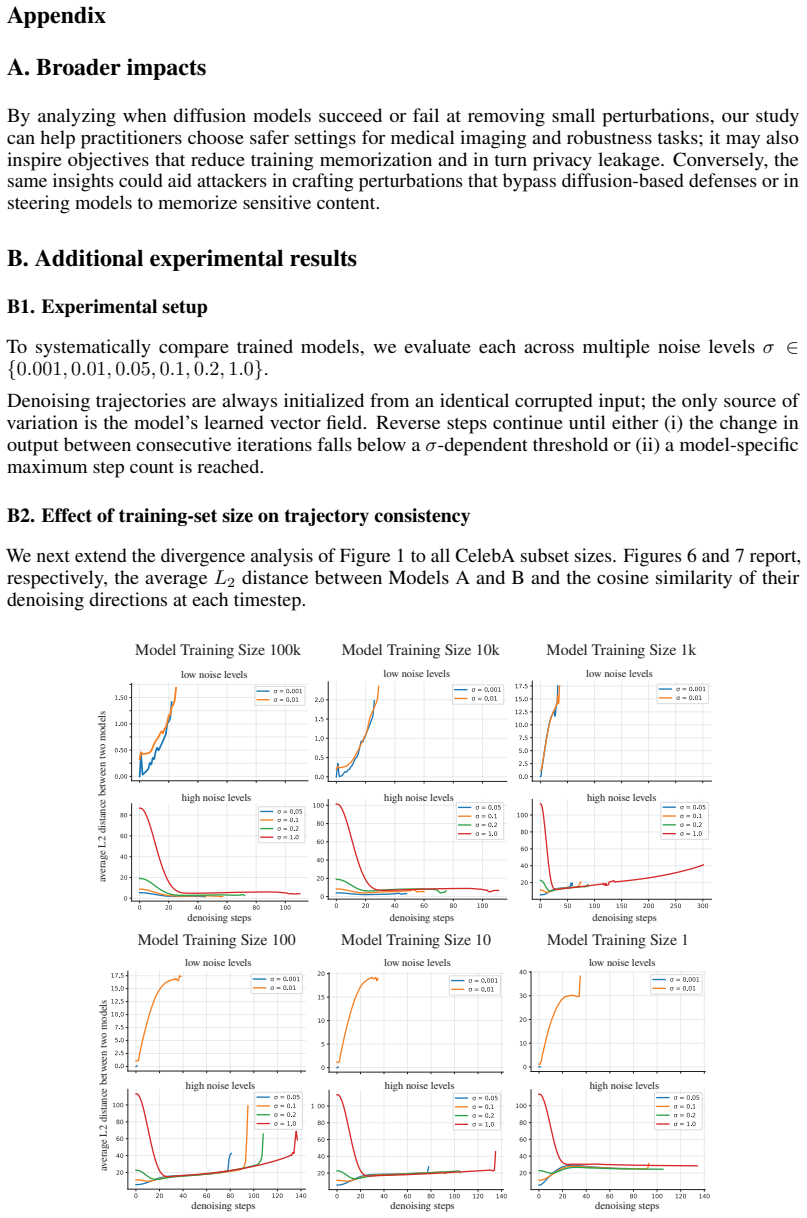
The paper's central discovery is that the generalization documented in the high-noise regime does not extend to the low-noise regime. Using a 'local probe' that initializes denoisers near clean images, the authors show that two models trained on disjoint subsets of 100k images converge at high noise but diverge near the manifold: the L2 distance between their trajectories grows over denoising steps at $\sigma = 0.001$, and the cosine similarity of their denoising directions drops to roughly 0.55, versus near-perfect agreement at $\sigma = 1.0$. The same instability limits denoising: at $\sigma = 0.05$ and below the denoised output moves away from the clean image rather than toward it. A second finding is that a model trained on ten images returns to the same training images under repeated perturbation, indicating discrete-attractor dynamics, whereas a 100k-image model does not, behaving more like a continuous attractor. On analytic Gaussian mixtures where the true score is known, all three model objectives (UNet reconstruction, NCSN, and sliced score matching) learn trajectories that head directly to density centers and miss curved or strongly anisotropic structure, showing a systematic bias in how diffusion models learn local geometry.
Load-bearing premise
The argument rests on the assumption that the observed low-noise divergence is caused by the two models seeing different training data; because the experiments never train two models on the same data with different random seeds, the divergence could instead be an artifact of optimization stochasticity or architecture sensitivity rather than data content.
Editorial extensions
If this is right
- The memorization-versus-generalization dichotomy does not settle local behavior: even a 100k-image model that generalizes globally is an inconsistent denoiser within 0.001-scale perturbations of the manifold.
- Diffusion-based adversarial purification has a floor: at $\sigma = 0.05$ and below, denoising drifts away from the clean image, so small adversarial perturbations near that scale cannot be stripped reliably.
- Small training sets convert the denoiser into a lookup of discrete attractors, with repeated perturbation returning to the same training image, while large sets interpolate continuously between training images.
- Explicit score-matching objectives (NCSN, sliced score matching) track low-density tails of anisotropic mixtures better than reconstruction-based UNets and slightly reduce low-noise divergence, but do not remove it.
- Trajectories that cut straight to density centers on the spiral mixture indicate a systematic bias in learned score fields that would only be stronger for high-dimensional natural images.
Reading between the lines
- The data-disjointness attribution is not yet isolated: a same-data, different-seed control is missing, so optimization stochasticity or architecture sensitivity remains a viable alternative explanation for low-noise divergence.
- A direct test would train two models on the same subset with different random seeds and repeat the local probe at $\sigma = 0.001$; a comparable cosine drop would move the explanation from data content to inherent low-noise instability.
- If the straight-line-to-center bias persists in latent-space and video diffusion models, near-manifold edits and inverse problems built on those models inherit the same curvature error; the paper explicitly lists latent-space models as open territory.
- A practical noise-floor corollary: in applications that rely on near-manifold denoising, such as image editing, MRI reconstruction, and purification, the learned score field's local inconsistency means improvements below roughly $\sigma = 0.05$ should not be expected to track the true clean image.
Editorial analysis
A structured set of objections, weighed in public.
Referee Report
Summary. The paper investigates the low-noise behavior of diffusion models. It trains UNet denoisers, noise-conditional score networks (NCSN), and sliced-score-matching (SSM) models on disjoint CelebA subsets of varying sizes, as well as on analytic Gaussian mixture benchmarks. The main empirical claim is that models trained on disjoint data produce similar outputs in the high-noise regime but diverge near the data manifold: at sigma = 0.001 the cosine similarity of denoising directions between two 100k-subset models is reported to be about 0.55, versus near-perfect agreement at sigma = 1.0. The paper also reports that denoising performance degrades for very small perturbations, that small models exhibit discrete-attractor re-denoising dynamics, and that all tested models learn curved or anisotropic score geometry poorly. It introduces a re-denoising probe and uses analytic Gaussian-mixture scores as ground truth.
Significance. If the central claim is supported, the paper identifies a practically relevant limitation of diffusion denoisers: the learned local score field is not uniquely determined even with large training sets, which has implications for robustness, adversarial purification, and fine-grained generation control. The use of analytic Gaussian-mixture scores as ground truth is a strength, as is the proposed re-denoising attractor test. The paper also ships a clear experimental framework and promises public code. However, the causal interpretation of the main result currently rests on a missing control, and the quantitative evidence lacks multi-run uncertainty estimates. The core phenomenon is worth publishing only after these gaps are addressed.
major comments (2)
- [§4.1, Fig. 1; Appendix B1] The central claim—that models trained on disjoint data diverge near the data manifold—is not established, because the experiments compare only two models trained on disjoint subsets and never train two models on the same subset with different random seeds. The observed divergence at sigma = 0.001 could equally arise from random initialization, batch ordering, or other optimization stochasticity. The statement in Appendix B1 that 'the only source of variation is the model's learned vector field' assumes this source away. Please add a same-data control with at least two seeds and report the same L2 and cosine metrics; if same-data pairs show comparable divergence, the causal wording in the abstract, §4.1, and Discussion must be revised.
- [§4.1, Figs. 1b,c and Appendix B2] The quantitative support for the main result lacks error bars, confidence intervals, or significance tests. The text states that metrics are averaged over 200 image samples, but with one trained pair per condition this captures only image-level variability, not model-training variability. Please report multiple training seeds and show the spread of the L2 and cosine metrics; this is necessary to confirm that the gap between sigma = 1.0 and sigma = 0.001 (e.g., cosine similarity falling to about 0.55) is robust rather than an artifact of one run.
minor comments (5)
- [§4.1] The sentence 'quantification of the differences of the two below reveal divergence at low-noise' is grammatically awkward and should be revised.
- [§4.2] There is a typo: 'celebA susbet' should read 'CelebA subset'.
- [Appendix B3] The phrase 'soL2 distances remain highest' is missing a space and should read 'so L2 distances remain highest'.
- [Figure 7 caption] The caption repeats 'cosine similarity' many times and is hard to read; consider a cleaner layout with concise labels.
- [§3.2] The NCSN objective is written without explicitly stating the distribution of sigma over which the expectation is taken; please specify the noise schedule or refer to [20] for the exact weighting.
Circularity Check
No significant circularity: the empirical measurements and analytic ground truth are independent of the conclusions; the main caveat is a missing same-data control, which is a validity issue rather than a circular reduction.
full rationale
The paper is an empirical study rather than a derivation chain. The central claim—that models trained on disjoint subsets diverge at low noise despite converging at high noise—is supported by direct measurements of L2 trajectory distance and cosine similarity between two independently trained models; these metrics are not fitted parameters renamed as predictions, and no equation defines one target quantity in terms of another. The synthetic Gaussian mixture experiments use analytic score functions as external ground truth, so the score-error results do not reduce to the model's own outputs. The paper contains no self-citations; the cited generalization framework of Kadkhodaie et al. is external prior work whose high-noise agreement is explicitly replicated, not assumed by construction. The only notable concern is experimental: Section 4.1 lacks a same-data/different-seed control, and Appendix B1 states that 'the only source of variation is the model’s learned vector field,' implicitly assuming training stochasticity is negligible. This weakens the causal attribution of low-noise divergence to disjointness of the training data, but it does not make the measured divergence equivalent to the paper's inputs by definition. Accordingly, there is no significant circularity; the score reflects the minor control caveat rather than a circular step.
Assumptions & free parameters
free parameters (3)
- Perturbation noise level for re-denoising attractor test =
0.1
- Low-noise denoising threshold =
0.05
- Reverse diffusion stopping threshold =
1e-2
assumptions (4)
- standard math Denoising score matching correctly estimates the score function of the perturbed data distribution.
- domain assumption The analytic score of the Gaussian mixture ground truth is exact and used as an external benchmark.
- domain assumption The reverse integration procedure (Euler steps with schedule ht/gamma_t) faithfully follows the learned score field, with stochastic noise controlled.
- domain assumption 80x80 grayscale CelebA retains the manifold structure relevant to the conclusions.
Cite this review
Pith. "Pith review of Diffusion models under low-noise regime." pith.science (2026). https://pith.science/paper/UB6RBKEG
@misc{pith2026250607841,
  author       = {Pith},
  title        = {Pith review of: Diffusion models under low-noise regime},
  year         = {2026},
  howpublished = {\url{https://pith.science/paper/UB6RBKEG}},
  note         = {Machine review of arXiv:2506.07841}
}
read the original abstract
Recent work on diffusion models proposed that they operate in two regimes: memorization, in which models reproduce their training data, and generalization, in which they generate novel samples. While this has been tested in high-noise settings, the behavior of diffusion models as effective denoisers when the corruption level is small remains unclear. To address this gap, we systematically investigated the behavior of diffusion models under low-noise diffusion dynamics, with implications for model robustness and interpretability. Using (i) CelebA subsets of varying sample sizes and (ii) analytic Gaussian mixture benchmarks, we reveal that models trained on disjoint data diverge near the data manifold even when their high-noise outputs converge. We quantify how training set size, data geometry, and model objective choice shape denoising trajectories and affect score accuracy, providing insights into how these models actually learn representations of data distributions. This work starts to address gaps in our understanding of generative model reliability in practical applications where small perturbations are common.
Figures


Figures from the paper (7 more)




Reference graph
Works this paper leans on
-
[1]
Denoising diffusion probabilistic models
Jonathan Ho, Ajay Jain, and Pieter Abbeel. Denoising diffusion probabilistic models. In Proceedings of the 34th International Conference on Neural Information Processing Systems, NIPS ’20, Red Hook, NY , USA, 2020. Curran Associates Inc
work page 2020
-
[2]
Improved denoising diffusion probabilistic models
Alexander Quinn Nichol and Prafulla Dhariwal. Improved denoising diffusion probabilistic models. In Marina Meila and Tong Zhang, editors, Proceedings of the 38th International Conference on Machine Learning, volume 139 of Proceedings of Machine Learning Research, pages 8162–8171. PMLR, 18–24 Jul 2021
work page 2021
-
[3]
High- resolution image synthesis with latent diffusion models
Robin Rombach, Andreas Blattmann, Dominik Lorenz, Patrick Esser, and Björn Ommer. High- resolution image synthesis with latent diffusion models. In Proceedings of the IEEE/CVF conference on computer vision and pattern recognition, pages 10684–10695, 2022
2022
-
[4]
Sara Mahdavi, Rapha Gontijo Lopes, Tim Salimans, Jonathan Ho, David J Fleet, and Mohammad Norouzi
Chitwan Saharia, William Chan, Saurabh Saxena, Lala Li, Jay Whang, Emily Denton, Seyed Kamyar Seyed Ghasemipour, Burcu Karagol Ayan, S. Sara Mahdavi, Rapha Gontijo Lopes, Tim Salimans, Jonathan Ho, David J Fleet, and Mohammad Norouzi. Photorealistic text-to-image diffusion models with deep language understanding, 2022
2022
-
[5]
Video diffusion models
Jonathan Ho, Tim Salimans, Alexey Gritsenko, William Chan, Mohammad Norouzi, and David J Fleet. Video diffusion models. Advances in Neural Information Processing Systems, 35:8633–8646, 2022
2022
-
[6]
Make-a-video: Text-to-video generation without text-video data, 2022
Uriel Singer, Adam Polyak, Thomas Hayes, Xi Yin, Jie An, Songyang Zhang, Qiyuan Hu, Harry Yang, Oron Ashual, Oran Gafni, Devi Parikh, Sonal Gupta, and Yaniv Taigman. Make-a-video: Text-to-video generation without text-video data, 2022
2022
-
[7]
Kingma, Abhishek Kumar, Stefano Ermon, and Ben Poole
Yang Song, Jascha Sohl-Dickstein, Diederik P. Kingma, Abhishek Kumar, Stefano Ermon, and Ben Poole. Score-based generative modeling through stochastic differential equations, 2021
2021
-
[8]
Deep unsuper- vised learning using nonequilibrium thermodynamics
Jascha Sohl-Dickstein, Eric Weiss, Niru Maheswaranathan, and Surya Ganguli. Deep unsuper- vised learning using nonequilibrium thermodynamics. In International conference on machine learning, pages 2256–2265. pmlr, 2015
work page 2015
Show all 45 references
-
[9]
Extracting training data from diffusion models
Nicolas Carlini, Jamie Hayes, Milad Nasr, Matthew Jagielski, Vikash Sehwag, Florian Tramer, Borja Balle, Daphne Ippolito, and Eric Wallace. Extracting training data from diffusion models. In 32nd USENIX Security Symposium (USENIX Security 23), pages 5253–5270, 2023
2023
-
[10]
Diffu- sion art or digital forgery? investigating data replication in diffusion models
Gowthami Somepalli, Vasu Singla, Micah Goldblum, Jonas Geiping, and Tom Goldstein. Diffu- sion art or digital forgery? investigating data replication in diffusion models. In Proceedings of the IEEE/CVF conference on computer vision and pattern recognition, pages 6048–6058, 2023
2023
-
[11]
Generalization in diffusion models arises from geometry-adaptive harmonic representations
Zahra Kadkhodaie, Florentin Guth, Eero P Simoncelli, and Stéphane Mallat. Generalization in diffusion models arises from geometry-adaptive harmonic representations. arXiv preprint arXiv:2310.02557, 2023
2023 arXiv
-
[12]
From memorization to generalization: a theoretical framework for diffusion- based generative models
Indranil Halder. From memorization to generalization: a theoretical framework for diffusion- based generative models. arXiv preprint arXiv:2411.17807, 2024
2024 arXiv
-
[13]
No-new-denoiser: A critical analysis of diffusion models for medical image denoising
Laura Pfaff, Fabian Wagner, Nastassia Vysotskaya, Mareike Thies, Noah Maul, Siyuan Mei, Tobias Wuerfl, and Andreas Maier. No-new-denoiser: A critical analysis of diffusion models for medical image denoising. In Medical Image Computing and Computer Assisted Intervention – MICCA...
2024
-
[14]
Denoising diffusion probabilistic models for 3d medical image generation
Firas Khader, Gustav Müller-Franzes, Soroosh Tayebi Arasteh, Tianyu Han, Christoph Haar- burger, Maximilian Schulze-Hagen, Philipp Schad, Sandy Engelhardt, Bettina Baeßler, Sebas- tian Foersch, et al. Denoising diffusion probabilistic models for 3d medical image generation. Sc...
2023
-
[15]
Denoising diffusion probabilistic models for magnetic resonance fingerprinting
Perla Mayo, Carolin M Pirkl, Alin Achim, Bjoern H Menze, and Mohammad Golbabaee. Denoising diffusion probabilistic models for magnetic resonance fingerprinting. arXiv preprint arXiv:2410.23318, 2024. 10
2024 arXiv
-
[16]
Diffusion models in medical imaging: A comprehensive survey
Amirhossein Kazerouni, Ehsan Khodapanah Aghdam, Moein Heidari, Reza Azad, Mohsen Fayyaz, Ilker Hacihaliloglu, and Dorit Merhof. Diffusion models in medical imaging: A comprehensive survey. Medical Image Analysis, 88:102846, 2023
2023
-
[17]
Diffusion models for adversarial purification
Weili Nie, Brandon Guo, Yujia Huang, Chaowei Xiao, Arash Vahdat, and Anima Anandkumar. Diffusion models for adversarial purification. arXiv preprint arXiv:2205.07460, 2022
2022 arXiv
-
[18]
Robust evaluation of diffusion-based adversarial purification
Minjong Lee and Dongwoo Kim. Robust evaluation of diffusion-based adversarial purification. In Proceedings of the IEEE/CVF International Conference on Computer Vision, pages 134–144, 2023
2023
-
[19]
Adding conditional control to text-to-image diffusion models
Lvmin Zhang, Anyi Rao, and Maneesh Agrawala. Adding conditional control to text-to-image diffusion models. In Proceedings of the IEEE/CVF international conference on computer vision, pages 3836–3847, 2023
2023
-
[20]
Generative modeling by estimating gradients of the data distribution
Yang Song and Stefano Ermon. Generative modeling by estimating gradients of the data distribution. Advances in neural information processing systems, 32, 2019
2019
-
[21]
Repli- cation in visual diffusion models: A survey and outlook
Wenhao Wang, Yifan Sun, Zongxin Yang, Zhengdong Hu, Zhentao Tan, and Yi Yang. Repli- cation in visual diffusion models: A survey and outlook. arXiv preprint arXiv:2408.00001, 2024
2024 arXiv
-
[22]
Understanding generalizability of diffusion models requires rethinking the hidden gaussian structure
Xiang Li, Yixiang Dai, and Qing Qu. Understanding generalizability of diffusion models requires rethinking the hidden gaussian structure. Advances in neural information processing systems, 37:57499–57538, 2024
2024
-
[23]
On memorization in diffusion models
Xiangming Gu, Chao Du, Tianyu Pang, Chongxuan Li, Min Lin, and Ye Wang. On memorization in diffusion models. arXiv preprint arXiv:2310.02664, 2023
2023 arXiv
-
[24]
A geometric framework for understanding memorization in generative models
Brendan Leigh Ross, Hamidreza Kamkari, Tongzi Wu, Rasa Hosseinzadeh, Zhaoyan Liu, George Stein, Jesse C Cresswell, and Gabriel Loaiza-Ganem. A geometric framework for understanding memorization in generative models. arXiv preprint arXiv:2411.00113, 2024
2024 arXiv
-
[25]
Towards memorization-free diffusion models
Chen Chen, Daochang Liu, and Chang Xu. Towards memorization-free diffusion models. In Proceedings of the IEEE/CVF Conference on Computer Vision and Pattern Recognition, pages 8425–8434, 2024
2024
-
[26]
Unveiling and mitigating memorization in text-to-image diffusion models through cross attention
Jie Ren, Yaxin Li, Shenglai Zeng, Han Xu, Lingjuan Lyu, Yue Xing, and Jiliang Tang. Unveiling and mitigating memorization in text-to-image diffusion models through cross attention. In European Conference on Computer Vision, pages 340–356. Springer, 2024
2024
-
[27]
Dynamical regimes of diffusion models
Giulio Biroli, Tony Bonnaire, Valentin de Bortoli, and Marc Mézard. Dynamical regimes of diffusion models. Nature Communications, 15(1), November 2024
2024
-
[28]
Denoising diffusion implicit models
Jiaming Song, Chenlin Meng, and Stefano Ermon. Denoising diffusion implicit models. arXiv preprint arXiv:2010.02502, 2020
2010 arXiv
-
[29]
Dpm-solver: A fast ode solver for diffusion probabilistic model sampling in around 10 steps
Cheng Lu, Yuhao Zhou, Fan Bao, Jianfei Chen, Chongxuan LI, and Jun Zhu. Dpm-solver: A fast ode solver for diffusion probabilistic model sampling in around 10 steps. In S. Koyejo, S. Mohamed, A. Agarwal, D. Belgrave, K. Cho, and A. Oh, editors, Advances in Neural Information Pr...
2022
-
[30]
Fast sampling of diffusion models with exponential integrator
Qinsheng Zhang and Yongxin Chen. Fast sampling of diffusion models with exponential integrator. arXiv preprint arXiv:2204.13902, 2022
2022 arXiv
-
[31]
Sampling is as easy as learning the score: theory for diffusion models with minimal data assumptions
Sitan Chen, Sinho Chewi, Jerry Li, Yuanzhi Li, Adil Salim, and Anru R Zhang. Sampling is as easy as learning the score: theory for diffusion models with minimal data assumptions. arXiv preprint arXiv:2209.11215, 2022
2022 arXiv
-
[32]
Convergence for score-based generative modeling with polynomial complexity
Holden Lee, Jianfeng Lu, and Yixin Tan. Convergence for score-based generative modeling with polynomial complexity. Advances in Neural Information Processing Systems, 35:22870–22882, 2022. 11
2022
-
[33]
Score approximation, estimation and distribution recovery of diffusion models on low-dimensional data
Minshuo Chen, Kaixuan Huang, Tuo Zhao, and Mengdi Wang. Score approximation, estimation and distribution recovery of diffusion models on low-dimensional data. In Andreas Krause, Emma Brunskill, Kyunghyun Cho, Barbara Engelhardt, Sivan Sabato, and Jonathan Scarlett, editors, Pr...
2023
-
[34]
Solving linear inverse problems using the prior implicit in a denoiser
Zahra Kadkhodaie and Eero P Simoncelli. Solving linear inverse problems using the prior implicit in a denoiser. arXiv preprint arXiv:2007.13640, 2020
2007 arXiv
-
[35]
Divide-and- conquer posterior sampling for denoising diffusion priors
Yazid Janati, Badr Moufad, Alain Durmus, Eric Moulines, and Jimmy Olsson. Divide-and- conquer posterior sampling for denoising diffusion priors. Advances in Neural Information Processing Systems, 37:97408–97444, 2024
2024
-
[36]
Investigating data memorization in 3d latent diffusion models for medical image synthesis
Salman Ul Hassan Dar, Arman Ghanaat, Jannik Kahmann, Isabelle Ayx, Theano Papavassiliu, Stefan O Schoenberg, and Sandy Engelhardt. Investigating data memorization in 3d latent diffusion models for medical image synthesis. In International Conference on Medical Image Computing ...
2023
-
[37]
A tour of modern image filtering: New insights and methods, both practical and theoretical
Peyman Milanfar. A tour of modern image filtering: New insights and methods, both practical and theoretical. IEEE Signal Processing Magazine, 30(1):106–128, 2013
2013
-
[38]
The little engine that could: Regularization by denoising (red)
Yaniv Romano, Michael Elad, and Peyman Milanfar. The little engine that could: Regularization by denoising (red). SIAM Journal on Imaging Sciences, 10(4):1804–1844, 2017
2017
-
[39]
T2i-adapter: Learning adapters to dig out more controllable ability for text-to-image diffusion models
Chong Mou, Xintao Wang, Liangbin Xie, Yanze Wu, Jian Zhang, Zhongang Qi, and Ying Shan. T2i-adapter: Learning adapters to dig out more controllable ability for text-to-image diffusion models. In Proceedings of the AAAI conference on artificial intelligence, volume 38, pages 42...
2024
-
[40]
Intriguing properties of neural networks
Christian Szegedy, Wojciech Zaremba, Ilya Sutskever, Joan Bruna, Dumitru Erhan, Ian Goodfel- low, and Rob Fergus. Intriguing properties of neural networks. arXiv preprint arXiv:1312.6199, 2013
2013 arXiv
-
[41]
Neural networks and physical systems with emergent collective computational abilities
J J Hopfield. Neural networks and physical systems with emergent collective computational abilities. Proceedings of the National Academy of Sciences, 79(8):2554–2558, 1982
1982
-
[42]
Deep learning face attributes in the wild
Ziwei Liu, Ping Luo, Xiaogang Wang, and Xiaoou Tang. Deep learning face attributes in the wild. In Proceedings of International Conference on Computer Vision (ICCV), December 2015. 12 Appendix A. Broader impacts By analyzing when diffusion models succeed or fail at removing sm...
2015
-
[43]
The dataset was introduced by Liu et al
CelebA Dataset: We used the CelebA dataset as described in Section 3.1. The dataset was introduced by Liu et al. [ 42] and is available at http://mmlab.ie.cuhk.edu.hk/ projects/CelebA.html under a non-commercial research license. The dataset is available for non-commercial res...
-
[44]
[11] available at https://github.com/LabForComputationalVision/ memorization_generalization_in_diffusion_models under the MIT License
UNet Denoiser Implementation: This model follows the architecture described in Kad- khodaie et al. [11] available at https://github.com/LabForComputationalVision/ memorization_generalization_in_diffusion_models under the MIT License
-
[45]
[ 20] available at https://github.com/ermongroup/ncsn under the GPL-3.0 License
NCSN and SSM Implementation : Both of these models follow the implementation described by Song et al. [ 20] available at https://github.com/ermongroup/ncsn under the GPL-3.0 License. E. Code and data availability All code and experiment configurations used in this work are mad...
Reviewed August 7, 2026 · model on record in the stance chip above.
Discussion (0). Sign in to comment.