REVIEW 1 major objections 5 minor 3 cited by
Ultralight axions from thermally excited 57Fe nuclei in stars would make a 14.4 keV X-ray line; NuSTAR observations of M87 and M82 show none, setting the strongest limit yet on the combined axion-nucleon and axion-photon couplings for axion
Reviewed by Pith at T0; open to challenge. T0 means a machine referee read the full paper against a public rubric. the ladder, T0–T4 →
No 14.4 keV axion line from 57Fe de-excitations is seen by NuSTAR toward M87, M82, M31, or the Galactic Center, yielding |g_ann x g_aγγ| < 1.1e-22 GeV^-1 for m_a < 1e-10 eV.
T0 review reviewed 2026-08-05 challenge →
load-bearing objection Solid new search channel with a leading bound; the headline limit carries a stated but unquantified nuclear-rate systematic that a referee should ask to have bracketed. the 1 major comments →
Axion lines from nuclear de-excitations in galactic stellar populations
The pith
A machine-rendered reading of the paper's core claim, the machinery that carries it, and where it could break.
The reading
Core claim
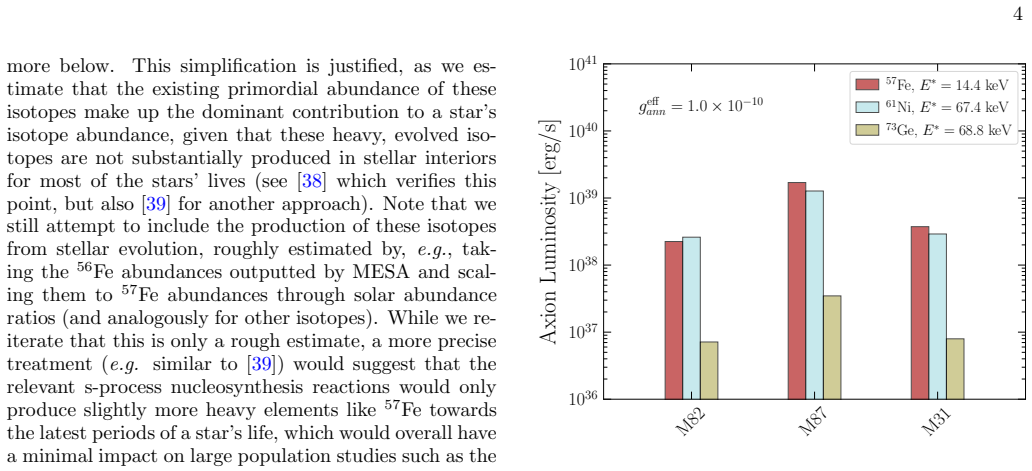
On the paper's own terms: axions coupled to nucleons are produced in abundance by magnetic-dipole nuclear de-excitations in the stellar populations of normal galaxies, with the 57Fe transition at 14.4 keV the most promising line. For ultralight axions, these mono-energetic axions convert coherently to X-rays in galactic magnetic fields, so a line search in NuSTAR data directly tests the product of the axion-nucleon and axion-photon couplings. No line appears, yielding the quoted limits. The paper also identifies 61Ni at 67.4 keV and 73Ge at 68.8 keV as the next most promising lines, reports constraints from them, and notes that the results disfavor the axion explanation of the M7 neutron-sta
What carries the argument
The engine is the thermally excited 57Fe M1 transition at E* = 14.4 keV, whose axion-to-photon branching ratio Γa/Γγ ≈ 1.83 (g_eff_ann)^2 sets how many mono-energetic axions each star emits when core temperatures approach the excitation energy. The axion luminosity is summed over a modeled stellar population from stellar evolution simulations, then converted to X-rays using per-galaxy axion-to-photon conversion probabilities in the galaxies' magnetic fields; NuSTAR data around 14.4 keV are fit with a signal-plus-power-law-background likelihood.
Load-bearing premise
The headline limit assumes the adopted 57Fe nuclear branching ratio Γa/Γγ ≈ 1.83 (g_eff_ann)^2; if the true nuclear rate is lower, the bound weakens by the same factor, and the paper acknowledges the rate may be even lower than assumed.
What would settle it
Take a NuSTAR exposure of M87 or M82 with higher sensitivity at 14.4 keV, or recalculate the 57Fe axion branching ratio from a shell-model calculation pinned to the measured M1 lifetime: a detected 14.4 keV line at the predicted flux would confirm the mechanism, while a measured Γa/Γγ a factor of two below the adopted value would pull the quoted upper limit up by the same factor.
If this is right
- The 57Fe search from M87 improves the CAST bound on geff_ann x gaγγ by roughly six orders of magnitude for axion masses below about 10^-10 eV.
- The M7 neutron-star hard X-ray excess cannot be explained by ultralight axions below about 10^-10 eV; if axions explain it, their mass must be higher.
- In models with tree-level axion-quark couplings (Cann = Caγγ), the M87 and M82 limits on gaγγ alone surpass prior low-mass searches.
- The 61Ni and 73Ge lines provide complementary next-best constraints, with 61Ni most competitive in starburst environments like M82.
- The same nuclear-de-excitation technique could be extended to higher-energy transitions with future MeV telescopes.
Where Pith is reading between the lines
- The quoted limit scales linearly with the assumed 57Fe axion branching ratio, so a future shell-model calculation that lowers Γa/Γγ would weaken the headline bound by the same factor; the paper itself states it cannot rule out an even lower rate.
- Using median rather than deliberately conservative magnetic-field conversion probabilities would strengthen the low-mass limits by factors of 1.4-1.7, meaning the remaining uncertainty is dominated by magnetic-field modeling rather than counting statistics.
- A natural extension is to search the same nuclear lines in additional galaxies with strong magnetic fields, or to exploit the unpaired-proton isotopes catalogued in the survey to separate gapp from gann.
Editorial analysis
A structured set of objections, weighed in public.
Referee Report
Summary. This paper proposes that ultralight axions with both nucleon and photon couplings are emitted as monoenergetic lines from thermally excited nuclear states in the stellar populations of nearby galaxies. It focuses on the 14.4 keV 57Fe M1 transition, with supplementary searches using 61Ni and 73Ge, and models target stellar populations for M82, M87, M31, and the Galactic Center using MESA simulations and the magnetic-field/conversion framework of earlier works. Analyzing archival NuSTAR data with native energy bins, OFF-subtracted spectra, profile likelihoods, and conservative conversion probabilities, the authors find no signal. They report 95% upper limits, the strongest being |g_ann × g_aγγ| < 1.1e-22 GeV^-1 for m_a ≲ 1e-10 eV from M87 (3.1e-22 GeV^-1 from M82) under the assumption gann = gapp, and claim an improvement of about six orders of magnitude over the CAST 57Fe search. The paper also catalogs other potentially relevant isotopes and recasts the result against the M7 neutron-star X-ray excess interpretation.
Significance. If the result holds, this is a significant advance in ultralight axion searches: it directly probes the product g_ann × g_aγγ at masses below about 1e-10 eV, a region where the product is otherwise constrained only by combining separate g_aγγ and g_ann bounds. The data analysis is careful: counts are kept in native NuSTAR channels, background parameters are profiled, the OFF-subtracted spectra are shown for the key targets, and the magnetic-field conversion probabilities are deliberately chosen conservatively with containment bands. The no-evidence conclusion itself is robust. The main limitation is that the conversion from line-flux upper limits to coupling limits scales inversely with the assumed 57Fe nuclear de-excitation rate, and this rate enters with an explicitly admitted but unquantified one-sided uncertainty. If quantified and propagated, the paper would make a strong contribution; as written, the headline number carries a systematic uncertainty that is acknowledged but not bounded.
major comments (1)
- [Sec. II, Eqs. (7)-(8); Table I] The central 95% upper limits scale as [Γ_a/Γγ]^{-1/2}. The paper adopts Γ_a/Γγ ≈ 1.83 (g_eff_ann)^2 using β = -1.19, η = 0.8, whereas Refs. [36,37] give 2.42 (g_eff_ann)^2. Importantly, Sec. II explicitly states: 'we cannot rule out the possibility that Γ_a/Γγ is, in reality, even lower than we assume.' No lower bound on the true rate is provided nor is this one-sided systematic propagated into the reported limits. If the true rate is lower by a factor f, all quoted limits in Table I and Fig. 1 weaken by sqrt(f). This is load-bearing for the headline limit of 1.1e-22 GeV^-1. Please quantify this systematic, e.g., by quoting limits as a function of Γ_a/Γγ, by providing a conservative lower bound from nuclear shell-model calculations, or by adding a systematic band to Fig. 1.
minor comments (5)
- [Abstract and Sec. I] The quoted |g_ann × g_aγγ| numbers assume gann = gapp (an effective coupling geff_ann ≈ 1.19 gann is actually constrained). This assumption should be stated explicitly in the abstract, since the product limit is not directly what is measured for arbitrary gann/gapp ratios.
- [Table I and Eq. (11)] It would be useful to report the line-flux or signal-count upper limit separately from the coupling limit. This would separate the statistical result from the nuclear-model normalization and make the dependence of the bound on Γ_a/Γγ and on stellar-abundance assumptions more transparent.
- [Sec. IV / Table I] The paper reports discovery TS values from multiple search channels (up to ~2.5 in Table I) without discussing trials/look-elsewhere considerations. A sentence explaining why no trials correction is needed, or why the null result is robust despite the multiplicity of lines and targets, would be helpful.
- [Sec. III / Fig. 17] The M82 Fe abundance is set to the average of the observed 0.23-0.55 solar range. This affects the M82 limit by roughly 30%, but the range is not propagated into the quoted M82 bound. Please either propagate this uncertainty or state explicitly that it is subdominant to the Γ_a/Γγ uncertainty.
- [General] Minor consistency issues: the main text gives E* = 68.8 keV for 73Ge while Table III lists 68.7 keV; Fig. 1's M7 band should be defined in the caption; Eq. (8) defines geff_ann with a sign that makes the numerator in Eq. (6) negative for the adopted β, which may confuse readers — it is worth stating that only the square enters the rate.
Circularity Check
No significant circularity: the central result is an experimental upper limit from NuSTAR non-observation; all load-bearing inputs are external/prior frameworks or explicitly conservative choices, with no equation reducing the derived limit to an input by construction.
full rationale
The paper's central claim is a 95% upper limit on |g_ann × g_aγγ| set by the absence of a 14.4 keV line in NuSTAR data toward M87 (and M82). This is an experimental null result, not a fitted prediction. The derivation chain is: axion EFT (Eqs. 1-4) defines independent coupling coefficients; the nuclear emission rate (Eqs. 5-8) adopts the standard Haxton-Lee formalism with shell-model parameters from Ref. [27]. The paper explicitly compares to the alternative parameter set of Refs. [36,37], which gives Γ_a/Γγ ≈ 2.42(g_eff_ann)^2 rather than 1.83(g_eff_ann)^2, and states it chooses the smaller value 'because it leads to more conservative results.' It then flags the residual possibility: 'we cannot rule out the possibility that Γ_a/Γγ is, in reality, even lower than we assume.' That is an unquantified nuclear-structure systematic, but it is an input uncertainty, not a circularity: no equation in the paper defines the target coupling in terms of the adopted rate, and the rate is not fitted to the NuSTAR data. The stellar population models and axion-to-photon conversion probabilities are taken from the authors' prior works [23,24], but those are published, externally benchmarked analyses based on MESA stellar simulations and IllustrisTNG magnetohydrodynamic simulations, with stated assumptions and conservative fiducial choices (e.g., 'our choice of fiducial model is the conservative one that minimizes the expected sensitivity'). They are not defined in terms of the 57Fe line result and are not fitted to the present data. The likelihood analysis profiles only background nuisance parameters and the signal amplitude, which is the constrained quantity itself. No self-definitional step, renamed-parameter prediction, uniqueness import, or ansatz-smuggling-via-citation is present. A conservative handling of the nuclear rate uncertainty would be a correctness/systems concern, not evidence of circularity.
Axiom & Free-Parameter Ledger
free parameters (7)
- beta (57Fe shell-model mixing parameter) =
-1.19 (adopted); alternative -1.3065 from [36,37]
- eta (57Fe shell-model parameter) =
0.8 (adopted); alternative 1.2054 from [36,37]
- gapp/gann ratio =
1 (fiducial assumption)
- M82 iron abundance multiplier =
0.38 times solar
- Ntot, M87 stellar population =
1e12 stars
- Ntot, M82 stellar population =
1e10 stars
- Fiducial conversion probability selection =
lowest 1-sigma among IllustrisTNG ensemble / weakest parametric model for GC
axioms (6)
- domain assumption Standard axion EFT with derivative couplings to nucleons and photon coupling (Eqs. 1-2)
- domain assumption M1 nuclear transition axion emission formula of Haxton-Lee (Eqs. 5-6)
- domain assumption MESA stellar models and IMF/SFH prescriptions describe M82, M87, M31, and GC stellar populations
- domain assumption IllustrisTNG TNG50/TNG300 simulated galaxies approximate the magnetic fields and free-electron densities of the targets
- domain assumption Isotope abundances are mostly primordial and close to solar
- standard math Gaussian likelihood on OFF-subtracted NuSTAR counts is valid
Cite this review
Pith. "Pith review of Axion lines from nuclear de-excitations in galactic stellar populations." pith.science (2026). https://pith.science/paper/UB7WWXRZ
@misc{pith2026250903569,
  author       = {Pith},
  title        = {Pith review of: Axion lines from nuclear de-excitations in galactic stellar populations},
  year         = {2026},
  howpublished = {\url{https://pith.science/paper/UB7WWXRZ}},
  note         = {Machine review of arXiv:2509.03569}
}
read the original abstract
We show that mono-energetic axions are produced in abundance through nuclear de-excitations in nearby galaxies such as M87, which is the central galaxy of the Virgo cluster, and the starburst galaxy M82. If the axion couples to both nucleons and photons and is ultralight, then monochromatic hard X-ray signatures are induced by the subsequent axion-to-photon conversion in the magnetic fields permeating these systems. We search for evidence of such signals using NuSTAR data, focusing specifically on the $^{57}$Fe de-excitation line at 14.4 keV, and we catalog other potentially relevant nuclear lines. We find no evidence for axions from M87 or M82 and set leading constraints on the combined axion-nucleon and axion-photon coupling at the level of $|g_{ann} \times g_{a\gamma \gamma}| \lesssim 1.1 \times 10^{-22}$ GeV$^{-1}$ in the limit $m_a \lesssim 10^{-10}$ eV, at 95% confidence.
Figures



Forward citations
Cited by 3 Pith papers
-
Revisiting Turner Window Axions: The Untapped Potential of NaI Dark Matter Detectors
Revised supernova opacity modeling reopens the Turner window for hadronically coupled axions, enabling resonant absorption searches in NaI detectors for couplings |g_app| between 10^{-6.5} and 10^{-2}.
-
Axion-photon conversion in transient compact stars: Systematics, constraints, and opportunities
Analytical expressions for ALP-photon conversion in transient compact stars yield an updated bound g_aγ < 5×10^{-12} GeV^{-1} for m_a ≲ 10^{-9} eV from SN 1987A, plus sensitivity forecasts for future Galactic SN and N...
-
NuSTAR as an Axion Helioscope: probing axion-nucleon and axion-electron couplings
NuSTAR solar minimum data sets g_ae · g_aγ ≲ 1.1×10^{-24} GeV^{-1} and g_aN^eff · g_aγ ≲ 2.3×10^{-19} GeV^{-1} at 95% CL for m_a ≲ 10^{-6} eV.
Reference graph
Works this paper leans on
-
[1]
R. D. Peccei and H. R. Quinn, CP Conservation in the Presence of Instantons, Phys. Rev. Lett. 38, 1440 (1977)
1977
-
[2]
R. D. Peccei and H. R. Quinn, Constraints Imposed by CP Conservation in the Presence of Instantons, Phys. Rev. D16, 1791 (1977)
1977
-
[3]
Weinberg, A New Light Boson?, Phys
S. Weinberg, A New Light Boson?, Phys. Rev. Lett. 40, 223 (1978)
1978
-
[4]
Wilczek, Problem of Strong p and t Invariance in the Presence of Instantons, Phys
F. Wilczek, Problem of Strong p and t Invariance in the Presence of Instantons, Phys. Rev. Lett. 40, 279 (1978)
1978
-
[5]
Preskill, M
J. Preskill, M. B. Wise, and F. Wilczek, Cosmology of the Invisible Axion, Phys. Lett. 120B, 127 (1983)
1983
-
[6]
L. F. Abbott and P. Sikivie, A Cosmological Bound on the Invisible Axion, Phys. Lett. 120B, 133 (1983)
1983
-
[7]
Dine and W
M. Dine and W. Fischler, The Not So Harmless Axion, Phys. Lett. 120B, 137 (1983)
1983
-
[8]
Witten, Some Properties of O(32) Superstrings, Phys
E. Witten, Some Properties of O(32) Superstrings, Phys. Lett. B 149, 351 (1984)
1984
-
[9]
Choi and J
K. Choi and J. E. Kim, Harmful Axions in Super- string Models, Phys. Lett. B 154, 393 (1985), [Erratum: Phys.Lett.B 156, 452 (1985)]
1985
-
[10]
S. M. Barr, Harmless Axions in Superstring Theories, Phys. Lett. B 158, 397 (1985)
work page 1985
-
[11]
P. Svrcek and E. Witten, Axions In String Theory, JHEP 06, 051, arXiv:hep-th/0605206 [hep-th]
-
[12]
A. Arvanitaki, S. Dimopoulos, S. Dubovsky, N. Kaloper, and J. March-Russell, String Axiverse, Phys. Rev. D81, 123530 (2010), arXiv:0905.4720 [hep-th]
Pith/arXiv arXiv 2010
-
[13]
M. Demirtas, C. Long, L. McAllister, and M. Still- man, The Kreuzer-Skarke Axiverse, JHEP 04, 138, arXiv:1808.01282 [hep-th]
-
[14]
J. Halverson, C. Long, B. Nelson, and G. Salinas, To- wards string theory expectations for photon couplings to axionlike particles, Phys. Rev. D 100, 106010 (2019), arXiv:1909.05257 [hep-th]
Pith/arXiv arXiv 2019
-
[15]
V. M. Mehta, M. Demirtas, C. Long, D. J. E. Marsh, L. McAllister, and M. J. Stott, Superradiance in string theory, JCAP 07, 033, arXiv:2103.06812 [hep-th]
-
[16]
N. Gendler, D. J. E. Marsh, L. McAllister, and J. Moritz, Glimmers from the Axiverse, (2023), arXiv:2309.13145 [hep-th]
Pith/arXiv arXiv 2023
-
[17]
J. N. Benabou, K. Fraser, M. Reig, and B. R. Safdi, String Theory and Grand Unification Suggest a Sub- Microelectronvolt QCD Axion, (2025), arXiv:2505.15884 [hep-ph]
Pith/arXiv arXiv 2025
-
[18]
Hook, Solving the Hierarchy Problem Discretely, Phys
A. Hook, Solving the Hierarchy Problem Discretely, Phys. Rev. Lett. 120, 261802 (2018), arXiv:1802.10093 [hep-ph]
Pith/arXiv arXiv 2018
-
[19]
A. Hook, TASI Lectures on the Strong CP Problem and Axions, PoS T ASI2018, 004 (2019), arXiv:1812.02669 [hep-ph]
Pith/arXiv arXiv 2019
-
[20]
L. Di Luzio, M. Giannotti, E. Nardi, and L. Visinelli, The landscape of QCD axion models, Phys. Rept. 870, 1 (2020), arXiv:2003.01100 [hep-ph]
Pith/arXiv arXiv 2020
-
[21]
B. R. Safdi, TASI Lectures on the Particle Physics and Astrophysics of Dark Matter, (2022), arXiv:2303.02169 [hep-ph]
work page internal anchor Pith review Pith/arXiv arXiv 2022
-
[22]
C. A. J. O’Hare, Cosmology of axion dark matter, PoS COSMICWISPers, 040 (2024), arXiv:2403.17697 [hep- ph]
Pith/arXiv arXiv 2024
-
[23]
O. Ning and B. R. Safdi, Leading Axion-Photon Sensitiv- ity with NuSTAR Observations of M82 and M87, Phys. Rev. Lett. 134, 171003 (2025), arXiv:2404.14476 [hep- ph]
Pith/arXiv arXiv 2025
-
[24]
O. Ning and B. R. Safdi, Probing the Axion-Electron Coupling with NuSTAR Observations of Galaxies, (2025), arXiv:2503.09682 [hep-ph]
Pith/arXiv arXiv 2025
-
[25]
C. Dessert, J. W. Foster, and B. R. Safdi, Hard X-ray Excess from the Magnificent Seven Neutron Stars, Astro- phys. J. 904, 42 (2020), arXiv:1910.02956 [astro-ph.HE]
Pith/arXiv arXiv 2020
-
[26]
M. Buschmann, R. T. Co, C. Dessert, and B. R. Safdi, Axion Emission Can Explain a New Hard X-Ray Excess from Nearby Isolated Neutron Stars, Phys. Rev. Lett. 126, 021102 (2021), arXiv:1910.04164 [hep-ph]
Pith/arXiv arXiv 2021
-
[27]
W. C. Haxton and K. Y. Lee, Red-giant evolution, metal- licity, and new bounds on hadronic axions, Phys. Rev. Lett. 66, 2557 (1991)
work page 1991
-
[28]
Moriyama, A Proposal to search for a monochromatic component of solar axions using Fe-57, Phys
S. Moriyama, A Proposal to search for a monochromatic component of solar axions using Fe-57, Phys. Rev. Lett. 75, 3222 (1995), arXiv:hep-ph/9504318
Pith/arXiv arXiv 1995
-
[29]
M. Krcmar, Z. Krecak, M. Stipcevic, A. Ljubicic, and D. A. Bradley, Search for invisible axions using Fe-57, Phys. Lett. B 442, 38 (1998), arXiv:nucl-ex/9801005
Pith/arXiv arXiv 1998
-
[30]
Namba, Results of a search for monochromatic solar axions using Fe-57, Phys
T. Namba, Results of a search for monochromatic solar axions using Fe-57, Phys. Lett. B 645, 398 (2007)
work page 2007
-
[31]
S. Andriamonje et al. (CAST), Search for 14.4-keV solar axions emitted in the M1-transition of Fe-57 nuclei with CAST, JCAP 12, 002, arXiv:0906.4488 [hep-ex]
-
[32]
A. V. Derbin, V. N. Muratova, D. A. Semenov, and E. V. Unzhakov, New limit on the mass of 14.4-keV solar axions emitted in an M1 transition in Fe-57 nuclei, Phys. Atom. Nucl. 74, 596 (2011)
work page 2011
-
[33]
F. Alessandria et al.(CUORE), Search for 14.4 keV solar axions from M1 transition of Fe-57 with CUORE crystals, JCAP 05, 007, arXiv:1209.2800 [hep-ex]
-
[34]
Axion searches with the EDELWEISS-II experiment
E. Armengaud et al. , Axion searches with the EDEL WEISS-II experiment, JCAP 11, 067, arXiv:1307.1488 [astro-ph.CO]
work page internal anchor Pith review Pith/arXiv arXiv
-
[35]
N. Abgrall et al. (Majorana), New limits on Bosonic Dark Matter, Solar Axions, Pauli Exclusion Princi- ple Violation, and Electron Decay from the Majorana Demonstrator, Phys. Rev. Lett. 118, 161801 (2017), arXiv:1612.00886 [nucl-ex]
Pith/arXiv arXiv 2017
-
[36]
F. T. Avignone, R. J. Creswick, J. D. Vergados, P. Piri- nen, P. C. Srivastava, and J. Suhonen, Estimating the flux of the 14.4 keV solar axions, JCAP 01, 021, arXiv:1711.06979 [hep-ph]
work page internal anchor Pith review Pith/arXiv arXiv
-
[37]
L. Di Luzio et al., Probing the axion–nucleon coupling with the next generation of axion helioscopes, Eur. Phys. J. C 82, 120 (2022), arXiv:2111.06407 [hep-ph]
Pith/arXiv arXiv 2022
-
[38]
L. Fleury, I. Caiazzo, and J. Heyl, Constraining ax- ions with ZTF J1901+1458, Phys. Rev. D 107, L101303 (2023), arXiv:2208.00405 [astro-ph.HE]
Pith/arXiv arXiv 2023
-
[39]
F. R. Cand´ on, P. Casaseca, M. Giannotti, M. Kaltschmidt, J. Ruz, and J. K. Vogel, Probing the Axion-Nucleon Coupling with Supergiant Stars, (2025), arXiv:2504.21107 [hep-ph]
arXiv 2025
-
[40]
Y. M. Gavrilyuk et al., First result of the experimental search for the 9.4 keV solar axion reactions with 83Kr in the copper proportional counter, Phys. Part. Nucl. 46, 152 (2015), arXiv:1405.1271 [nucl-ex]
Pith/arXiv arXiv 2015
- [41]
-
[42]
A. V. Derbin, A. I. Egorov, I. A. Mitropolskii, V. N. Mu- ratova, S. V. Bakhlanov, and L. M. Tukhkonen, Search for the invisible axion emitted in the M1 transition in Te-125m, JETP Lett. 65, 605 (1997)
work page 1997
- [43]
-
[44]
F. T. Avignone III, C. Baktash, W. C. Barker, F. P. Calaprice, R. W. Dunford, W. C. Haxton, D. Kahana, R. T. Kouzes, H. S. Miley, and D. M. Moltz, Search for axions from the 1115-kev transition of 65Cu, Phys. Rev. D 37, 618 (1988)
work page 1988
-
[45]
C. S. Reynolds, M. C. D. Marsh, H. R. Russell, A. C. Fabian, R. Smith, F. Tombesi, and S. Veilleux, As- trophysical limits on very light axion-like particles from Chandra grating spectroscopy of NGC 1275 10.3847/1538-4357/ab6a0c (2019), arXiv:1907.05475 [hep-ph]
Pith/arXiv arXiv 2019
-
[46]
M. C. D. Marsh, H. R. Russell, A. C. Fabian, B. P. Mc- Namara, P. Nulsen, and C. S. Reynolds, A New Bound on Axion-Like Particles, JCAP12, 036, arXiv:1703.07354 [hep-ph]
-
[47]
J. P. Conlon, F. Day, N. Jennings, S. Krippendorf, and M. Rummel, Constraints on Axion-Like Particles from Non-Observation of Spectral Modulations for X-ray Point Sources, JCAP 07, 005, arXiv:1704.05256 [astro-ph.HE]
work page internal anchor Pith review Pith/arXiv arXiv
-
[48]
J. S. Reyn´ es, J. H. Matthews, C. S. Reynolds, H. R. Rus- sell, R. N. Smith, and M. C. D. Marsh, New constraints on light axion-like particles using Chandra transmis- sion grating spectroscopy of the powerful cluster-hosted quasar H1821+643, Mon. Not. Roy. Astron. Soc. 510, 1264 (2021), arXiv:2109.03261 [astro-ph.HE]
Pith/arXiv arXiv 2021
- [49]
-
[50]
J. A. Grifols, E. Masso, and R. Toldra, Gamma-rays from SN1987A due to pseudoscalar conversion, Phys. Rev. Lett. 77, 2372 (1996), arXiv:astro-ph/9606028
Pith/arXiv arXiv 1996
-
[51]
A. Payez, C. Evoli, T. Fischer, M. Giannotti, A. Mirizzi, and A. Ringwald, Revisiting the SN1987A gamma-ray limit on ultralight axion-like particles, JCAP 02, 006, arXiv:1410.3747 [astro-ph.HE]
-
[52]
S. Hoof and L. Schulz, Updated constraints on axion-like particles from temporal information in su- pernova SN1987A gamma-ray data, JCAP 03, 054, arXiv:2212.09764 [hep-ph]
-
[53]
C. A. Manzari, Y. Park, B. R. Safdi, and I. Savoray, Supernova Axions Convert to Gamma Rays in Magnetic Fields of Progenitor Stars, Phys. Rev. Lett. 133, 211002 (2024), arXiv:2405.19393 [hep-ph]
arXiv 2024
-
[54]
J. N. Benabou, C. Dessert, K. C. Patra, T. G. Brink, W. Zheng, A. V. Filippenko, and B. R. Safdi, Search for Axions in Magnetic White Dwarf Polarization at Lick and Keck Observatories, (2025), arXiv:2504.12377 [hep- ph]
Pith/arXiv arXiv 2025
-
[55]
C. Dessert, D. Dunsky, and B. R. Safdi, Upper limit on the axion-photon coupling from magnetic white dwarf polarization, Phys. Rev. D 105, 103034 (2022), arXiv:2203.04319 [hep-ph]
Pith/arXiv arXiv 2022
-
[56]
C. Dessert, A. J. Long, and B. R. Safdi, No Evidence for Axions from Chandra Observation of the Magnetic White Dwarf RE J0317-853, Phys. Rev. Lett. 128, 071102 (2022), arXiv:2104.12772 [hep-ph]
Pith/arXiv arXiv 2022
-
[57]
O. Ning, C. Dessert, V. Hong, and B. R. Safdi, Search for Axions from Magnetic White Dwarfs with Chandra, (2024), arXiv:2411.05041 [astro-ph.HE]
work page internal anchor Pith review Pith/arXiv arXiv 2024
-
[58]
M. Buschmann, C. Dessert, J. W. Foster, A. J. Long, and B. R. Safdi, Upper Limit on the QCD Axion Mass from Isolated Neutron Star Cooling, Phys. Rev. Lett. 128, 091102 (2022), arXiv:2111.09892 [hep-ph]
Pith/arXiv arXiv 2022
-
[59]
G. G. Raffelt, Astrophysical axion bounds, Lect. Notes Phys. 741, 51 (2008), arXiv:hep-ph/0611350
Pith/arXiv arXiv 2008
-
[60]
T. Fischer, S. Chakraborty, M. Giannotti, A. Mirizzi, A. Payez, and A. Ringwald, Probing axions with the neu- trino signal from the next galactic supernova, Phys. Rev. D 94, 085012 (2016), arXiv:1605.08780 [astro-ph.HE]
Pith/arXiv arXiv 2016
-
[61]
J. H. Chang, R. Essig, and S. D. McDermott, Super- nova 1987A Constraints on Sub-GeV Dark Sectors, Mil- licharged Particles, the QCD Axion, and an Axion-like Particle, JHEP 09, 051, arXiv:1803.00993 [hep-ph]
-
[62]
P. Carenza, T. Fischer, M. Giannotti, G. Guo, G. Mart ´ ınez-Pinedo, and A. Mirizzi, Improved ax- ion emissivity from a supernova via nucleon-nucleon bremsstrahlung, JCAP 10 (10), 016, [Erratum: JCAP 05, E01 (2020)], arXiv:1906.11844 [hep-ph]
Pith/arXiv arXiv 2020
-
[63]
P. Carenza, B. Fore, M. Giannotti, A. Mirizzi, and S. Reddy, Enhanced Supernova Axion Emission and its Implications, Phys. Rev. Lett. 126, 071102 (2021), arXiv:2010.02943 [hep-ph]
Pith/arXiv arXiv 2021
-
[64]
G. Grilli di Cortona, E. Hardy, J. Pardo Vega, and G. Villadoro, The QCD axion, precisely, JHEP 01, 034, arXiv:1511.02867 [hep-ph]
-
[65]
C. Patrignani et al. (Particle Data Group), Review of Particle Physics, Chin. Phys. C 40, 100001 (2016)
work page 2016
-
[66]
N. N. D. Center, Nudat 3.0 database (n.d.), brookhaven National Laboratory, https://www.nndc.bnl.gov/ nudat3/
-
[67]
B. Paxton, L. Bildsten, A. Dotter, F. Herwig, P. Lesaf- fre, and F. Timmes, Modules for Experiments in Stellar Astrophysics (MESA), ApJS 192, 3 (2011), arXiv:1009.1622 [astro-ph.SR]
Pith/arXiv arXiv 2011
-
[68]
B. Paxton, M. Cantiello, P. Arras, L. Bildsten, E. F. Brown, A. Dotter, C. Mankovich, M. H. Montgomery, D. Stello, F. X. Timmes, and R. Townsend, Modules for Experiments in Stellar Astrophysics (MESA): Planets, Oscillations, Rotation, and Massive Stars, ApJS 208, 4 (2013), arXiv:1301.0319 [astro-ph.SR]
Pith/arXiv arXiv 2013
-
[70]
Stellar and gaseous abundances in M82
L. Origlia, P. Ranalli, A. Comastri, and R. Maiolino, Stel- lar and gaseous abundances in m82, Astrophys. J. 606, 862–868 (2004), arXiv:astro-ph/0401361
work page internal anchor Pith review Pith/arXiv arXiv 2004
-
[71]
F. R. Cand´ on, D. F. G. Fiorillo, G. Lucente, E. Vitagliano, and J. K. Vogel, NuSTAR bounds on radiatively decaying particles from M82, (2024), arXiv:2412.03660 [hep-ph]
Pith/arXiv arXiv 2024
-
[72]
K. Abd El Dayem et al. (GRA VITY), Improving con- straints on the extended mass distribution in the Galactic center with stellar orbits, Astron. Astrophys. 692, A242 (2024), arXiv:2409.12261 [astro-ph.GA]
Pith/arXiv arXiv 2024
-
[73]
A. Pillepich et al., First results from the TNG50 simula- tion: the evolution of stellar and gaseous discs across cos- mic time, Mon. Not. Roy. Astron. Soc. 490, 3196 (2019), 17 arXiv:1902.05553 [astro-ph.GA]
Pith/arXiv arXiv 2019
-
[74]
D. Nelson, A. Pillepich, V. Springel, R. Pakmor, R. Wein- berger, S. Genel, P. Torrey, M. Vogelsberger, F. Mari- nacci, and L. Hernquist, First Results from the TNG50 Simulation: Galactic outflows driven by supernovae and black hole feedback, Mon. Not. Roy. Astron. Soc. 490, 3234 (2019), arXiv:1902.05554 [astro-ph.GA]
Pith/arXiv arXiv 2019
-
[75]
M. Unger and G. R. Farrar, The Coherent Magnetic Field of the Milky Way, Astrophys. J. 970, 95 (2024), arXiv:2311.12120 [astro-ph.GA]
Pith/arXiv arXiv 2024
-
[76]
R. Jansson and G. R. Farrar, A New Model of the Galac- tic Magnetic Field, ApJ 757, 14 (2012), arXiv:1204.3662 [astro-ph.GA]
Pith/arXiv arXiv 2012
-
[77]
J. M. Cordes and T. J. W. Lazio, NE2001. 1. A New model for the galactic distribution of free electrons and its fluctuations, (2002), arXiv:astro-ph/0207156
Pith/arXiv arXiv 2002
-
[78]
Nasa High Energy Astrophysics Science Archive Re- search Center (Heasarc), HEAsoft: Unified Release of FTOOLS and XANADU, Astrophysics Source Code Li- brary, record ascl:1408.004 (2014), ascl:1408.004
work page 2014
-
[79]
G. Cowan, K. Cranmer, E. Gross, and O. Vitells, Asymp- totic formulae for likelihood-based tests of new physics, Eur. Phys. J. C 71, 1554 (2011), [Erratum: Eur.Phys.J.C 73, 2501 (2013)], arXiv:1007.1727 [physics.data-an]
Pith/arXiv arXiv 2011
-
[80]
G. Cowan, K. Cranmer, E. Gross, and O. Vitells, Power-Constrained Limits, (2011), arXiv:1105.3166 [physics.data-an]
Pith/arXiv arXiv 2011
-
[81]
D. R. Wik, A. Hornstrup, S. Molendi, G. Made- jski, F. A. Harrison, A. Zoglauer, B. W. Grefenstette, F. Gastaldello, K. K. Madsen, N. J. Westergaard, D. D. M. Ferreira, T. Kitaguchi, K. Pedersen, S. E. Boggs, F. E. Christensen, W. W. Craig, C. J. Hailey, D. Stern, and W. W. Zhang, Nustar observations of the bullet cluster: Constraints on inverse compton e...
Pith/arXiv arXiv 2014
This paper was first reviewed by deepseek-v4-flash on August 5, 2026.
discussion (0)
Sign in with ORCID, Apple, or X to comment. Anyone can read and Pith papers without signing in.