Dissipation-Induced Deviations from Kibble-Zurek Scaling in Non-Hermitian Quantum Annealing
Pith reviewed 2026-06-26 04:57 UTC · model grok-4.3
The pith
Dissipation strength in non-Hermitian quantum annealing determines whether defect density follows standard Kibble-Zurek scaling, anti-Kibble-Zurek behavior, or faster suppression.
A machine-rendered reading of the paper's core claim, the machinery that carries it, and where it could break.
Core claim
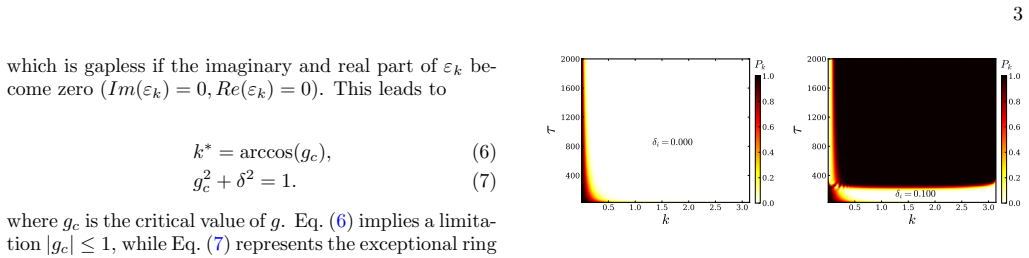
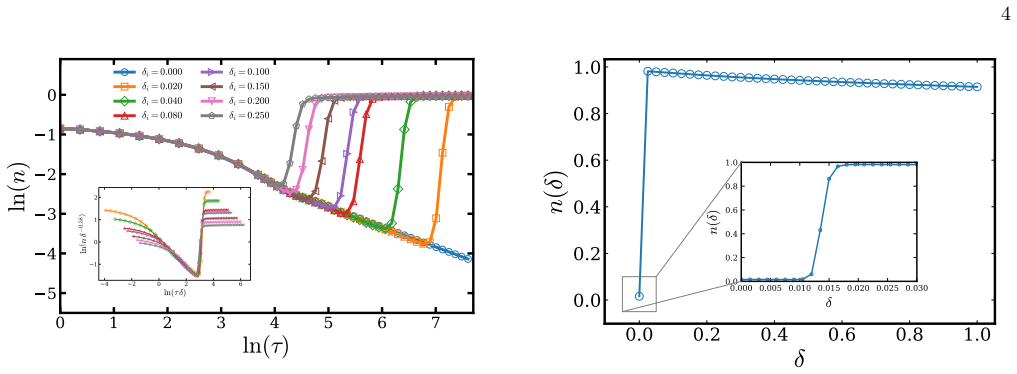
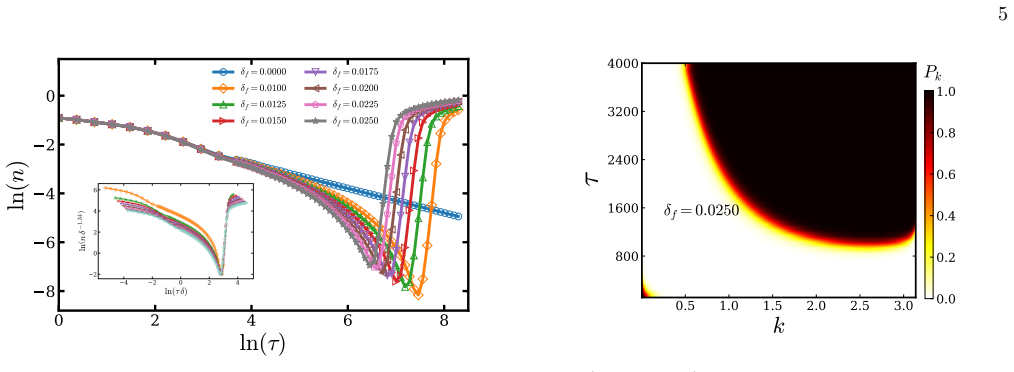
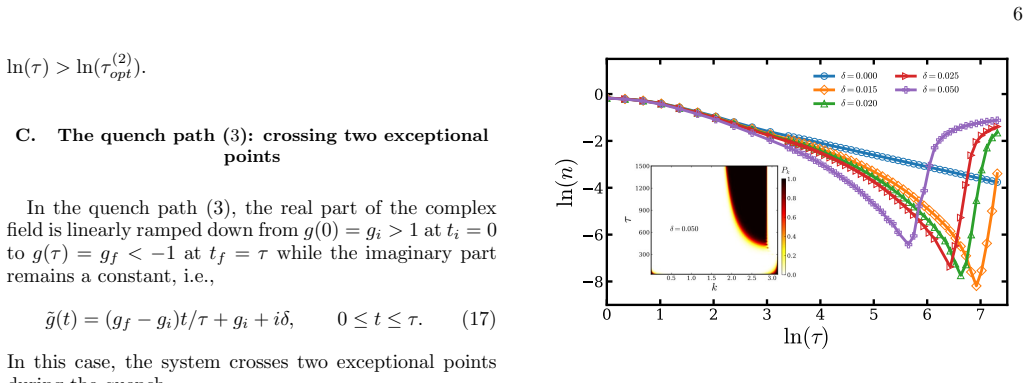
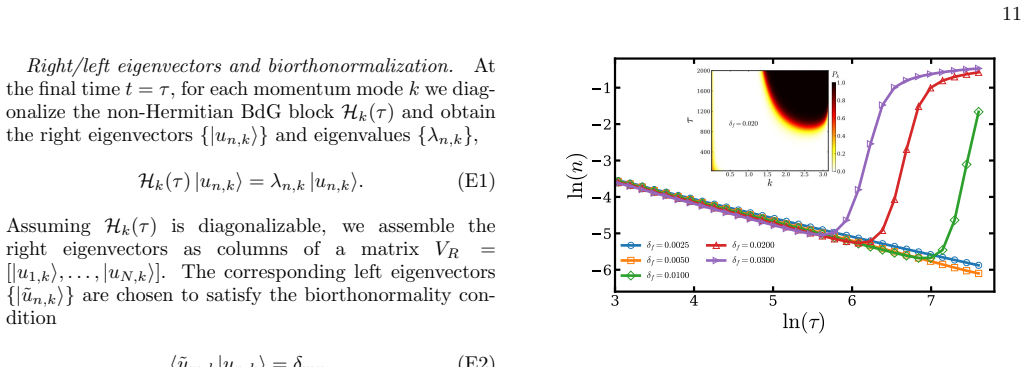
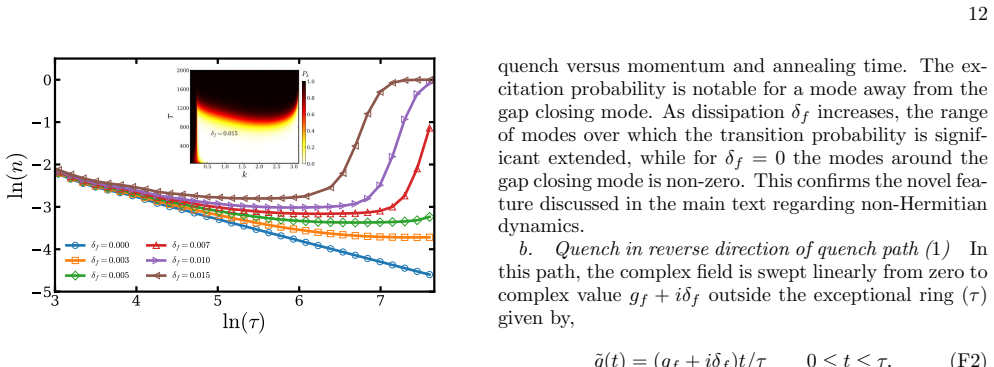
In the non-Hermitian transverse-field Ising model the intrinsic transition probabilities involve significant contributions from broad momentum sectors rather than only near the gap-closing point. Depending on dissipation strength the resulting defect density exhibits standard Kibble-Zurek scaling, anti-Kibble-Zurek behavior, or suppression faster than the Kibble-Zurek prediction. The fast decay originates from a vanishing excitation probability that spans a range of annealing times across all allowed modes, while the anti-Kibble-Zurek behavior arises from supplementary excitations facilitated by dissipation over a broad range of modes away from the gap-closing region.
What carries the argument
The excitation probabilities across all momentum modes, which determine the defect density through the non-Hermitian dynamics.
If this is right
- Defect density can exhibit anti-Kibble-Zurek scaling when dissipation adds excitations over a wide momentum range.
- Faster-than-Kibble-Zurek suppression occurs when excitation probability vanishes across all modes for a range of annealing times.
- The deviations are tied directly to the momentum dependence of the intrinsic transition probabilities rather than to the gap-closing region alone.
- Standard Kibble-Zurek scaling is recovered only in the limit of weak dissipation where broad-sector contributions remain small.
Where Pith is reading between the lines
- The same broad-momentum mechanism could be tested in other non-Hermitian models by varying the dissipation operator while keeping the annealing schedule fixed.
- If confirmed, the result would imply that open-system annealing protocols can deliberately tune defect production by choosing dissipation strength to enter the faster-suppression regime.
- The analysis suggests checking whether similar deviations appear when the annealing path passes near other types of critical points in non-Hermitian systems.
- Numerical checks for finite-size chains could quantify how the width of the momentum sectors that contribute changes with system size.
Load-bearing premise
The non-Hermitian transverse-field Ising model together with the chosen form of dissipation correctly captures the physical system and that the derived transition probabilities accurately reflect the broad momentum contributions driving the scaling deviations.
What would settle it
A plot of defect density versus annealing time for several fixed values of dissipation strength that shows the three distinct regimes, including anti-Kibble-Zurek growth and faster-than-Kibble-Zurek suppression.
Figures
read the original abstract
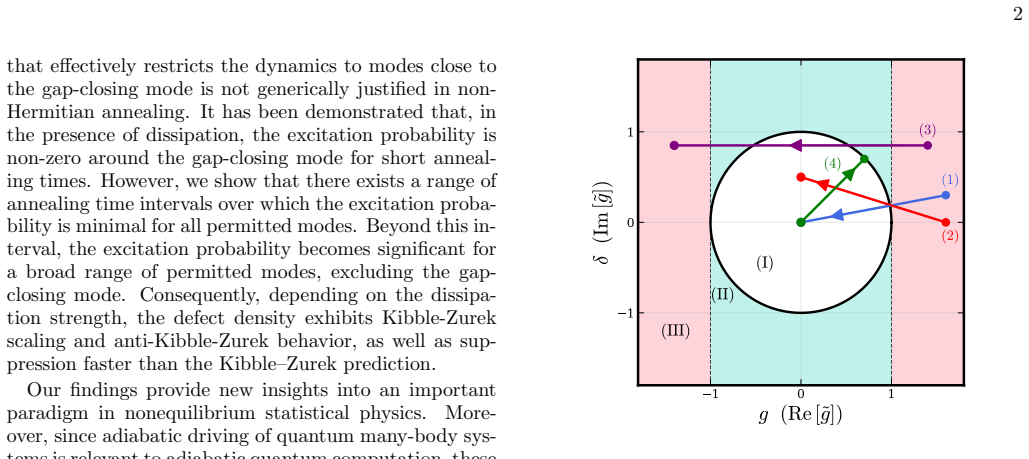
We revisit the quantum annealing problem in the non-Hermitian transverse-field Ising model. We determine, both analytically and numerically, the intrinsic transition probabilities and the resulting defect density. Our results reveal that, unlike the Hermitian case where defect production is dominated by modes near the gap-closing point, the non-Hermitian dynamics involve significant contributions from broad momentum sectors. We find that, depending on the dissipation strength, the defect density exhibits standard Kibble-Zurek scaling, anti-Kibble-Zurek behavior, and a suppression faster than the Kibble-Zurek prediction. We demonstrate that these deviations from the standard Kibble-Zurek scaling can be understood in terms of the underlying excitation probabilities. Specifically, the fast decay of the defect density originates from a vanishing excitation probability spanning a range of annealing times across all allowed modes, even at the gap-closing points. In contrast, the anti-Kibble-Zurek behavior arises from supplementary excitations facilitated by dissipation over a broad range of allowed modes, particularly those situated away from the gap-closing region.
Editorial analysis
A structured set of objections, weighed in public.
Referee Report
Summary. The paper studies quantum annealing in the non-Hermitian transverse-field Ising model. It determines transition probabilities and defect density both analytically and numerically, showing that non-Hermitian dynamics allow significant contributions from broad momentum sectors (unlike the Hermitian case, which is dominated by modes near the gap-closing point). Depending on dissipation strength, the defect density exhibits standard Kibble-Zurek scaling, anti-Kibble-Zurek behavior, or suppression faster than the KZ prediction; these regimes are tied to the functional form of the excitation probabilities, including vanishing probabilities across modes for fast suppression and supplementary excitations away from the gap-closing region for anti-KZ scaling.
Significance. If the analytical derivations and numerical results hold, the work provides a concrete mechanism by which dissipation modifies the Kibble-Zurek scaling in non-Hermitian systems, identifying three distinct regimes directly linked to excitation probabilities. The explicit contrast with the Hermitian case and the focus on broad-momentum contributions constitute a clear advance in understanding defect production in open quantum annealing protocols.
minor comments (2)
- The abstract states that results are obtained 'both analytically and numerically,' but the main text should include explicit error bars, convergence checks, and system-size scaling for the numerical data to substantiate the reported scaling exponents.
- Notation for the dissipation strength and the momentum sectors should be defined once at first use and used consistently; occasional redefinition of symbols can obscure the connection between the excitation probability expressions and the three scaling regimes.
Simulated Author's Rebuttal
We thank the referee for their positive summary and recommendation of minor revision. The report identifies no specific major comments requiring point-by-point response.
Circularity Check
No significant circularity detected
full rationale
The paper derives transition probabilities and defect densities analytically and numerically from the non-Hermitian transverse-field Ising model dynamics. The reported scalings (standard KZ, anti-KZ, faster suppression) are presented as direct consequences of the functional form of excitation probabilities across momentum sectors, with no reduction to fitted parameters, self-definitions, or load-bearing self-citations. The central claims rest on explicit model calculations rather than renaming or circular invocation of prior results by the same authors.
Axiom & Free-Parameter Ledger
Reference graph
Works this paper leans on
-
[1]
P. C. Hohenberg and B. I. Halperin, Theory of dynamic critical phenomena, Rev. Mod. Phys.49, 435 (1977)
1977
-
[2]
T. Chou, K. Mallick, and R. K. P. Zia, Non-equilibrium statistical mechanics: from a paradigmatic model to bi- ological transport, Reports on Progress in Physics74, 116601 (2011)
2011
-
[3]
Grabarits, G
A. Grabarits, G. Sammartino, and A. del Campo, An- nealing dynamics of regular rotor networks: Universality and its breakdown, Phys. Rev. Res.7, 013123 (2025)
2025
-
[4]
Subires, F
D. Subires, F. J. G´ omez-Ruiz, A. Ruiz-Garc´ ıa, D. Alonso, and A. del Campo, Benchmarking quantum annealing dynamics: The spin-vector langevin model, Phys. Rev. Res.4, 023104 (2022)
2022
-
[5]
Bando, Y
Y. Bando, Y. Susa, H. Oshiyama, N. Shibata, M. Ohzeki, F. J. G´ omez-Ruiz, D. A. Lidar, S. Suzuki, A. del Campo, and H. Nishimori, Probing the universality of topolog- ical defect formation in a quantum annealer: Kibble- zurek mechanism and beyond, Phys. Rev. Res.2, 033369 (2020)
2020
-
[6]
C.-W. Liu, A. Polkovnikov, and A. W. Sandvik, Quantum versus classical annealing: Insights from scaling theory and results for spin glasses on 3-regular graphs, Phys. Rev. Lett.114, 147203 (2015)
2015
-
[7]
Suzuki, Quench dynamics of quantum and classi- cal ising chains: From the viewpoint of the kibble– zurek mechanism, inQuantum Quenching, Annealing and Computation, edited by A
S. Suzuki, Quench dynamics of quantum and classi- cal ising chains: From the viewpoint of the kibble– zurek mechanism, inQuantum Quenching, Annealing and Computation, edited by A. K. Chandra, A. Das, and B. K. Chakrabarti (Springer Berlin Heidelberg, Berlin, Heidelberg, 2010) pp. 115–143
2010
-
[8]
E. Farhi, J. Goldstone, S. Gutmann, and M. Sipser, Quantum computation by adiabatic evolution (2000), arXiv:quant-ph/0001106 [quant-ph]
Pith/arXiv arXiv 2000
-
[9]
Albash and D
T. Albash and D. A. Lidar, Adiabatic quantum compu- tation, Rev. Mod. Phys.90, 015002 (2018)
2018
-
[10]
Dziarmaga, Dynamics of a quantum phase transition: Exact solution of the quantum ising model, Phys
J. Dziarmaga, Dynamics of a quantum phase transition: Exact solution of the quantum ising model, Phys. Rev. Lett.95, 245701 (2005)
2005
-
[11]
Polkovnikov, K
A. Polkovnikov, K. Sengupta, A. Silva, and M. Vengalat- tore, Colloquium: Nonequilibrium dynamics of closed in- teracting quantum systems, Rev. Mod. Phys.83, 863 (2011)
2011
-
[12]
Grabarits, F
A. Grabarits, F. Balducci, and A. del Campo, Driving a quantum phase transition at an arbitrary rate: Exact solution of the transverse-field ising model, Phys. Rev. A 111, 042207 (2025)
2025
-
[13]
D. Sen, K. Sengupta, and S. Mondal, Defect produc- tion in nonlinear quench across a quantum critical point, Phys. Rev. Lett.101, 016806 (2008)
2008
-
[14]
Kolodrubetz, B
M. Kolodrubetz, B. K. Clark, and D. A. Huse, Nonequi- librium dynamic critical scaling of the quantum ising chain, Phys. Rev. Lett.109, 015701 (2012)
2012
-
[15]
Mondal, K
S. Mondal, K. Sengupta, and D. Sen, Theory of defect production in nonlinear quench across a quantum critical point, Phys. Rev. B79, 045128 (2009). 13
2009
-
[16]
T. W. B. Kibble, Topology of cosmic domains and strings, Journal of Physics A: Mathematical and General9, 1387 (1976)
1976
-
[17]
W. H. Zurek, Cosmological experiments in superfluid he- lium?, Nature317, 505 (1985)
1985
-
[18]
De Grandi, A
C. De Grandi, A. Polkovnikov, and A. W. Sandvik, Uni- versal nonequilibrium quantum dynamics in imaginary time, Phys. Rev. B84, 224303 (2011)
2011
-
[19]
Patan` e, A
D. Patan` e, A. Silva, L. Amico, R. Fazio, and G. E. San- toro, Adiabatic dynamics in open quantum critical many- body systems, Phys. Rev. Lett.101, 175701 (2008)
2008
-
[20]
Patan` e, L
D. Patan` e, L. Amico, A. Silva, R. Fazio, and G. E. San- toro, Adiabatic dynamics of a quantum critical system coupled to an environment: Scaling and kinetic equation approaches, Phys. Rev. B80, 024302 (2009)
2009
-
[21]
S. M. Griffin, M. Lilienblum, K. T. Delaney, Y. Kuma- gai, M. Fiebig, and N. A. Spaldin, Scaling behavior and beyond equilibrium in the hexagonal manganites, Phys. Rev. X2, 041022 (2012)
2012
-
[22]
Nigmatullin, A
R. Nigmatullin, A. del Campo, G. De Chiara, G. Morigi, M. B. Plenio, and A. Retzker, Formation of helical ion chains, Phys. Rev. B93, 014106 (2016)
2016
-
[23]
Dutta, A
A. Dutta, A. Rahmani, and A. del Campo, Anti-kibble- zurek behavior in crossing the quantum critical point of a thermally isolated system driven by a noisy control field, Phys. Rev. Lett.117, 080402 (2016)
2016
-
[24]
Puebla, A
R. Puebla, A. Smirne, S. F. Huelga, and M. B. Plenio, Universal anti-kibble-zurek scaling in fully connected sys- tems, Phys. Rev. Lett.124, 230602 (2020)
2020
-
[25]
Sadeghizade, R
S. Sadeghizade, R. Jafari, and A. Langari, Anti-kibble- zurek behavior in the quantum xy spin- 1 2 chain driven by correlated noisy magnetic field and anisotropy, Phys. Rev. B111, 104310 (2025)
2025
-
[26]
Balducci, M
F. Balducci, M. Beau, J. Yang, A. Gambassi, and A. del Campo, Large deviations beyond the kibble-zurek mech- anism, Phys. Rev. Lett.131, 230401 (2023)
2023
-
[27]
Singh and S
M. Singh and S. Gangadharaiah, Driven quantum spin chain in the presence of noise: Anti-kibble-zurek behav- ior, Phys. Rev. B104, 064313 (2021)
2021
-
[28]
Bermudez, D
A. Bermudez, D. Patan` e, L. Amico, and M. A. Martin- Delgado, Topology-induced anomalous defect production by crossing a quantum critical point, Phys. Rev. Lett. 102, 135702 (2009)
2009
-
[29]
Singh, S
M. Singh, S. Dhara, and S. Gangadharaiah, Driven one- dimensional noisy kitaev chain, Phys. Rev. B107, 014303 (2023)
2023
-
[30]
Gao, D.-W
Z.-P. Gao, D.-W. Zhang, Y. Yu, and S.-L. Zhu, Anti- kibble-zurek behavior of a noisy transverse-field XY chain and its quantum simulation with two-level systems, Phys. Rev. B95, 224303 (2017)
2017
-
[31]
Separation of the Kibble-Zurek Mechanism from Quantum Criticality
R. Jafari and A. Akbari, Separation of the kibble-zurek mechanism from quantum criticality, arXiv preprint arXiv:2602.19865 https://doi.org/10.48550/arXiv.:2602.19865 (2026)
work page internal anchor Pith review Pith/arXiv arXiv doi:10.48550/arxiv.:2602.19865 2026
-
[32]
R. Jafari, H. Johannesson, and S. Eggert, Topological defects from quantum reset dynamics, arXiv preprint arXiv:2602.00230 (2026)
Pith/arXiv arXiv 2026
-
[33]
Breuer and F
H.-P. Breuer and F. Petruccione,The Theory of Open Quantum Systems(Oxford University Press, Oxford, 2002)
2002
-
[34]
Rivas and S
´A. Rivas and S. F. Huelga,Open Quantum Systems: An Introduction, SpringerBriefs in Physics (Springer, Heidel- berg, 2012)
2012
-
[35]
Ashida, Z
Y. Ashida, Z. Gong, and M. Ueda, Non-hermitian physics, Advances in Physics69, 249 (2020)
2020
-
[36]
E. J. Bergholtz, J. C. Budich, and F. K. Kunst, Ex- ceptional topology of non-hermitian systems, Rev. Mod. Phys.93, 015005 (2021)
2021
-
[37]
Qiu, T.-S
X. Qiu, T.-S. Deng, Y. Hu, P. Xue, and W. Yi, Non- hermitian dynamical quantum phase transitions, iScience 20, 392 (2019)
2019
-
[38]
D´ ora, M
B. D´ ora, M. Heyl, and R. Moessner, The kibble-zurek mechanism at exceptional points, Nature communica- tions10, 2254 (2019)
2019
-
[39]
Jing, J.-J
Y. Jing, J.-J. Dong, Y.-Y. Zhang, and Z.-X. Hu, Non- hermitian dynamical scaling in quantum critical systems, Phys. Rev. Lett.132, 220402 (2024)
2024
-
[40]
Zhou, Q.-h
L. Zhou, Q.-h. Wang, H. Wang, and J. Gong, Non- hermitian criticality and dynamical quantum phase tran- sitions, Phys. Rev. A98, 022129 (2018)
2018
-
[41]
Zhou and Q
L. Zhou and Q. Du, Floquet non-hermitian criticality and universal dynamics, New J. Phys.23, 063041 (2021)
2021
-
[42]
Nehra and D
R. Nehra and D. Roy, Non-hermitian quantum critical dynamics in driven systems, Phys. Rev. B109, 094311 (2024)
2024
-
[43]
A. I. Nesterov, A. L. Zepeda, and G. P. Berman, Non- hermitian quantum annealing in the ferromagnetic ising model, Phys. Rev. A87, 042332 (2013)
2013
-
[44]
D. C. Brody, Biorthogonal quantum mechanics, J. Phys. A: Math. Theor.47, 035305 (2014)
2014
-
[45]
Oshiyama, N
H. Oshiyama, N. Shibata, and S. Suzuki, Kibble–zurek mechanism in a dissipative transverse ising chain, Journal of the Physical Society of Japan89, 104002 (2020)
2020
-
[46]
Doria, T
P. Doria, T. Calarco, and S. Montangero, Optimal control technique for many-body quantum dynamics, Phys. Rev. Lett.106, 190501 (2011)
2011
-
[47]
del Campo, M
A. del Campo, M. M. Rams, and W. H. Zurek, Assisted finite-rate adiabatic passage across a quantum critical point: Exact solution for the quantum ising model, Phys. Rev. Lett.109, 115703 (2012)
2012
-
[48]
Campbell, G
S. Campbell, G. De Chiara, M. Paternostro, G. M. Palma, and R. Fazio, Shortcut to adiabaticity in the lipkin-meshkov-glick model, Phys. Rev. Lett.114, 177206 (2015)
2015
-
[49]
Puebla, S
R. Puebla, S. Deffner, and S. Campbell, Kibble-zurek scaling in quantum speed limits for shortcuts to adia- baticity, Phys. Rev. Res.2, 032020 (2020)
2020
-
[50]
Mathey and A
L. Mathey and A. Polkovnikov, Light cone dynamics and reverse kibble-zurek mechanism in two-dimensional su- perfluids following a quantum quench, Phys. Rev. A81, 033605 (2010)
2010
-
[51]
J. Naji, M. Jafari, R. Jafari, and A. Akbari, Dissipative floquet dynamical quantum phase transition, Phys. Rev. A105, 022220 (2022)
2022
-
[52]
Feshbach, Unified theory of nuclear reactions, Annals of Physics5, 357 (1958)
H. Feshbach, Unified theory of nuclear reactions, Annals of Physics5, 357 (1958)
1958
-
[53]
Feshbach, A unified theory of nuclear reactions
H. Feshbach, A unified theory of nuclear reactions. ii, Annals of Physics19, 287 (1962)
1962
-
[54]
E. Lieb, T. Schultz, and D. Mattis, Two soluble models of an antiferromagnetic chain, Annals of Physics16, 407 (1961)
1961
-
[55]
Pfeuty, The one-dimensional ising model with a trans- verse field, Annals of Physics57, 79 (1970)
P. Pfeuty, The one-dimensional ising model with a trans- verse field, Annals of Physics57, 79 (1970)
1970
-
[56]
Barouch and B
E. Barouch and B. M. McCoy, Statistical mechanics of thexymodel. ii. spin-correlation functions, Phys. Rev. A3, 786 (1971)
1971
-
[57]
Zener, Non-adiabatic crossing of energy levels, Proc
C. Zener, Non-adiabatic crossing of energy levels, Proc. 14 R. Soc. Lond. A137, 696 (1932)
1932
-
[58]
N. V. Vitanov, Transition times in the landau-zener model, Phys. Rev. A59, 988 (1999)
1999
-
[59]
N. V. Vitanov and B. M. Garraway, Landau-zener model: Effects of finite coupling duration, Phys. Rev. A53, 4288 (1996)
1996
-
[60]
M. Deng, W. Li, K. Hu, C. Sun, and F. Li, Nonadiabatic dynamics and universal behaviors in non-hermitian sys- tems under biorthogonal framework, Phys. Rev. B112, L020306 (2025)
2025
-
[61]
J. P. Davis and P. Pechukas, Nonadiabatic transitions induced by a time-dependent hamiltonian in the semi- classical/adiabatic limit: The two-state case, J. Chem. Phys.64, 3129 (1976)
1976
discussion (0)
Sign in with ORCID, Apple, or X to comment. Anyone can read and Pith papers without signing in.