REVIEW 4 major objections 8 minor 60 references
CA-Edit: Causality-Aware Condition Adapter for High-Fidelity Local Facial Attribute Editing
T0 review · 4 major / 8 minor · reviewed 2026-08-11 · deepseek-v4-flash
Pith's one-line read Local facial attribute editing can stay faithful to skin tone and texture while following a text prompt, if the diffusion model gates original-image cues by a per-pixel text-importance score and aligns low-frequency skin transitions at…
desk verdict Solid applied contribution with a genuinely new adapter idea, but the central score mechanism is under-specified and the evaluation is self-referential. read the letter →
The pith
A machine-rendered reading of the paper's core claim, the machinery that carries it, and where it could break.
The reading
What carries the argument
The load-bearing object is the score map produced by CA2, a two-layer MLP with softmax that takes the concatenation of the diffusion latent feature $Z$ and the CLIP text pooling token replicated spatially, and outputs a per-pixel value in $[0,1]$. That score multiplies the visual cross-attention map via $A^s_{vis} = A_{vis} \odot (1 - Score \odot M)$, so it is the mechanism that decides, per location, whether original skin details or the textual edit win. The second mechanism is STFG: it uses the mean and standard deviation of the textual cross-attention maps inside the mask to locate boundary regions, estimates a clean latent one-step prediction, and applies a score-based guidance gradient that reduces the squared low-frequency difference between the generated and original latents only on those pixels.
What would settle it
Compare the predicted score map from Eq. (3) against a ground-truth semantic mask of the attribute being edited (e.g., for "closed eyes," the eyelid/lash region). If the central claim is right, high suppression values should concentrate on that attribute region and low values on adjacent cheek and forehead. A run where the score map instead tracks image contrast or CLIP text attention alone, or where replacing the score with a fixed constant equal to its mean leaves LPIPS and HPSv2 unchanged, would contradict the claim that per-pixel gating carries the causality modeling.
Extended reading notes
Core claim
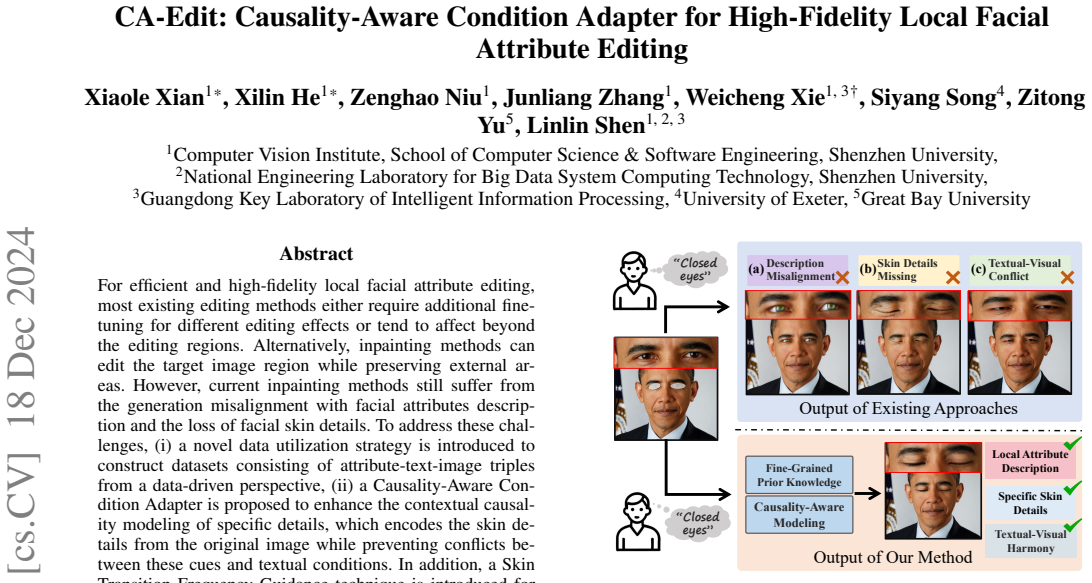
On its own terms, the paper claims that the failure to edit one facial attribute cleanly is not a capacity problem of text-to-image diffusion but a conditioning problem: injecting the original image as a parallel visual prompt (as IP-Adapter-style adapters do) makes the model lean on source details and ignore the text, while dropping the image cue makes it produce a generic face without the person's skin specifics. The proposed Causality-Aware Condition Adapter (CA2) resolves this by computing a score field $Score = S(\mathrm{Concat}(Z, f^s_{txt}))$ from the diffusion latent $Z$ and the CLIP text token, then gating the visual cross-attention map with $1 - Score \odot M$ so pixels with high textual importance receive less original-image influence and pixels outside the edit keep full skin-detail influence. The Skin Transition Frequency Guidance (STFG) then identifies boundary pixels inside the mask where text attention is weak and steers sampling so their low-frequency components match the original image in the Fourier domain. Together these two mechanisms are claimed to yield edits that follow the prompt, preserve skin detail, and avoid boundary artifacts.
Load-bearing premise
The load-bearing premise is that the learned score predictor can correctly judge, pixel by pixel, where the text edit should override the original skin details and where the original image should be preserved.
Editorial extensions
If this is right
- The same trained model can edit any supported facial attribute from its text description alone, with no per-attribute retraining or latent optimization at inference.
- Users can provide rough or dilated masks: STFG compensates for imprecise boundaries, so natural skin transitions no longer require exact segmentation.
- Skin tone, texture, and identity in the unedited and minimally edited regions are carried over from the original image, reducing the identity drift that inversion-based editors show.
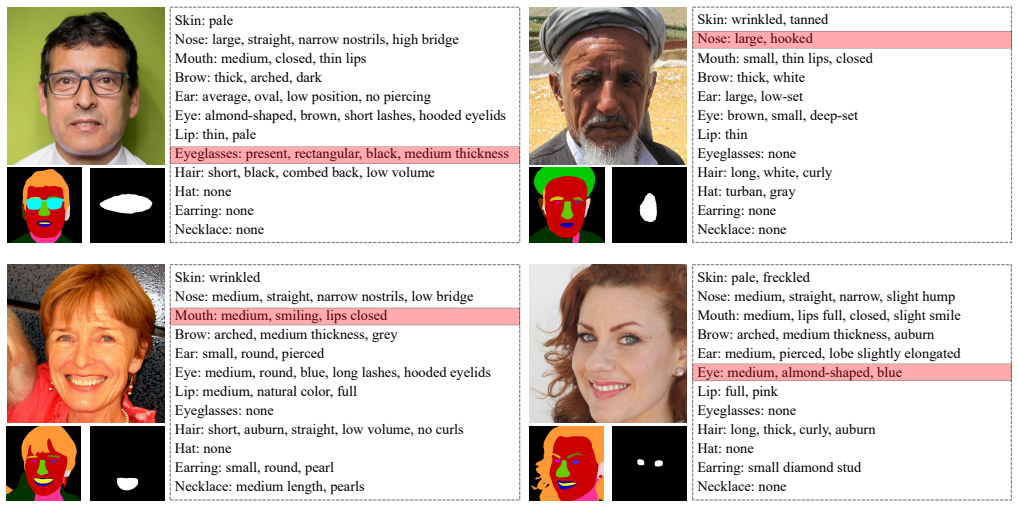
- The LAMask-Caption dataset's attribute-text-mask triples give diffusion inpainting models the local facial captions they lack, which should improve prompt-aligned edits for other face-editing tasks.
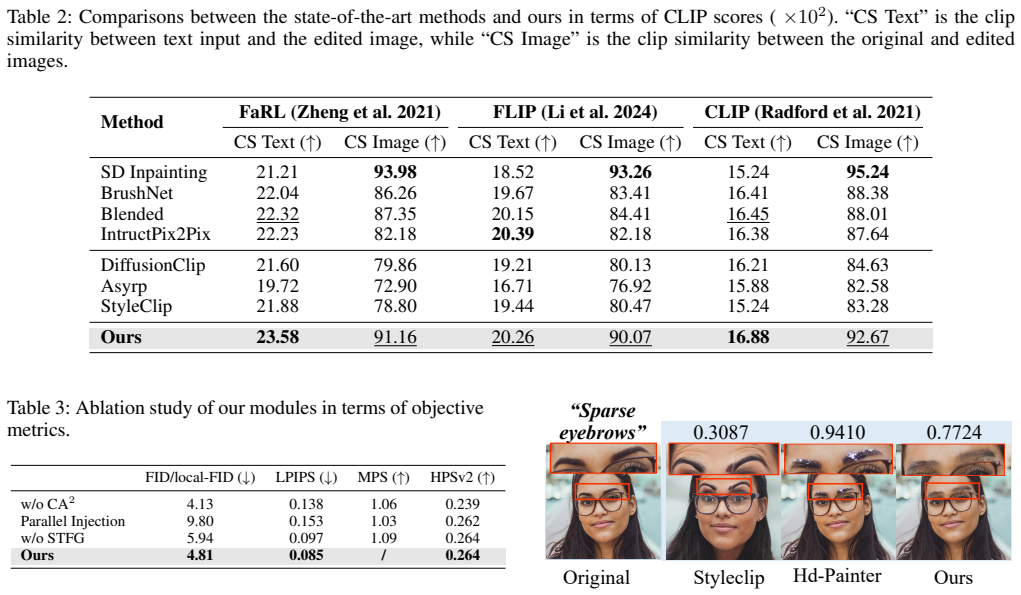
- Text-image alignment metrics (HPSv2, MPS, CLIP text score) and fidelity metrics (LPIPS, ID, user preference) improve together, except FID, which the paper attributes to SD Inpainting's prompt-neglecting fallback.
Reading between the lines
- A testable extension of the score-gating idea is to non-face inpainting: any task where the source image's texture should persist outside an edit (fur, fabric, foliage) could learn a similar per-pixel gate from the diffusion latent, without needing face-specific captions.
- STFG is a test-time regularizer, so it could be bolted onto other mask-based diffusion editors and evaluated purely by boundary artifact rates; a positive result would suggest the low-frequency alignment, not CA2, is doing much of the fidelity work.
- The paper's own ID-similarity discussion implies evaluation of local editing should separate fidelity inside the mask from fidelity outside it; current single-number FID and ID conflate "did not change" with "changed correctly."
- One could directly probe the score predictor by feeding it adversarial text embeddings (e.g., a prompt whose CLIP embedding is far from the visual domain); if the gate then collapses, the model's robustness to unusual prompts would be the limiting factor.
Editorial analysis
A structured set of objections, weighed in public.
Referee Report
Summary. The paper proposes CA-Edit, a text-guided local facial attribute editing method built on stable-diffusion inpainting. It contributes (i) LAMask-Caption, a dataset of face image / local-attribute caption / segmentation-mask triples constructed with MLLM captioning and BiSeNet parsing; (ii) the Causality-Aware Condition Adapter (CA2), which injects original-image skin details through a parallel visual cross-attention branch while using a learned per-pixel score to suppress that visual condition where the text prompt should dominate; and (iii) Skin Transition Frequency Guidance (STFG), a sampling-time low-frequency alignment step applied to boundary regions detected from textual cross-attention maps. The method is evaluated on a self-constructed benchmark, FFLEBench, against several inpainting, editing, and inversion baselines using FID/Local-FID, LPIPS, HPSv2, ID, MPS, CLIP-based scores, and a user study.
Significance. If the central mechanism works as claimed, CA-Edit addresses a genuine limitation of current inpainting models for localized facial editing: simultaneously following a textual attribute description and preserving fine skin details from the original image. The paper ships code and a detailed dataset-construction pipeline, and it reports extensive comparisons, including a user study. The strength of the claim, however, depends critically on the correctness of the learned score map in Eq. (3), on the independence of the evaluation benchmark from the training-data pipeline, and on the statistical stability of the quantitative results. The paper would be a useful contribution to the community if these points are resolved, but in its current form the evidence is not conclusive.
major comments (4)
- [Eq. (3) and Eq. (5)] The score predictor in Eq. (3) uses a softmax activation, but the normalization dimension is not specified. If the softmax is taken over all nz spatial positions of the latent, then for large nz each score is approximately 1/nz, and the modulation term (1 - Score ⊙ M) in Eq. (5) is approximately 1, making the CA2 mechanism nearly inert. If the softmax is over a different dimension (e.g., the channel dimension), the paper must state this explicitly and provide evidence (attention statistics, gradient analysis, or a controlled experiment) that the score map actually varies meaningfully across spatial positions during inference. The current visualization in Fig. 5 is not sufficient to resolve this ambiguity.
- [Analysis of the Score in CA2] The paper provides no quantitative validation that the learned per-pixel score correctly decides where to suppress the visual condition. The predictor in Eq. (3) operates on the textual class token and the noisy diffusion latent Z; it never sees the visual tokens fvis, so it cannot directly detect regions where image detail conflicts with the text. The only evidence is a qualitative score visualization (Fig. 5) and an end-to-end ablation (Tab. 3). This does not rule out simpler alternatives such as a timestep-dependent ramp, a fixed score based on text-attention statistics, or a mask-only schedule. The authors should compare against such baselines or provide a direct metric of score-map correctness, for instance by measuring prompt neglect and content leakage as a function of score thresholding.
- [Experimental Setup and FFLEBench construction] The evaluation benchmark FFLEBench is constructed with the same MLLM captioning and face-parsing pipeline as the training dataset LAMask-Caption, as stated in the Appendix ("Details of our proposed Benchmark FFLEBench"). This introduces a potential circularity: the model is tested on captions and masks generated by the same distribution used for training, which may inflate the reported text-alignment and fidelity numbers. Additionally, the dataset is not released, and Tables 1 and 3 report no error bars, confidence intervals, or significance tests. The authors should provide run-to-run variance, evaluate on an independent benchmark with human-annotated captions, or at least release the benchmark to allow independent verification.
- [Table 3 ablation study] The ablation results in Table 3 are mixed and not fully discussed. Removing CA2 improves FID (4.13 vs 4.81) while worsening LPIPS (0.138 vs 0.085) and HPSv2 (0.239 vs 0.264); removing STFG leaves HPSv2 unchanged (0.264 vs 0.264) and has a relatively small effect on FID (5.94 vs 4.81). The claim that both modules are essential for the reported superiority is not clearly supported by these numbers. The authors should analyze this trade-off explicitly, relate it to the qualitative claims, and ideally provide statistical significance across multiple seeds or edited attributes.
minor comments (8)
- [Notation in Appendix STFG] The main text uses ρt in Eq. (10) for the noise-schedule parameter, while the Appendix uses σt in Eq. (17). Please unify the notation.
- [Contributions bullet] The first contribution bullet contains a typo: "MLMMs" should be "MLLMs".
- [Figure 5 caption] The caption says "The lighter regions indicate the higher values in the maps," but the text explains that higher values mean less injection of image features. Please clarify in the caption that lighter regions correspond to stronger textual suppression, not stronger visual conditioning.
- [Table 1 user study] The user study percentages (Ours vs.) are reported without the number of participants, the number of images per participant, or any measure of inter-rater agreement. Please include these details.
- [Related Work reference] In the Related Work section, BrushNet is cited as "(Brooks, Holynski, and Efros 2023)", but the correct reference is Ju et al. 2024 (arXiv:2403.06976). The paper already cites this reference elsewhere; please fix the in-text citation.
- [Eq. (8) and Algorithm 2] The symbol bzt is used in Eq. (8) and Algorithm 2 without being defined; it appears to denote the predicted or current latent during sampling. Please define it explicitly when it is first introduced.
- [Algorithm 2 line 5] Algorithm 2 computes the guidance on bz′_{t-1}, while the mathematical development in Eq. (16) uses bz′_{t→0}. Please make the notation consistent so the reader can follow the update rule.
- [ID similarity discussion] The discussion of why ID similarity may be an unsuitable metric for this task (Fig. 13) is valuable but appears only in the appendix. Since ID is reported in Table 1, consider moving a condensed version of this discussion to the main text.
Circularity Check
No significant circularity: the CA-Edit derivation is self-contained, and the benchmark-pipeline overlap is an evaluation-validity concern, not a circular argument.
full rationale
The paper's derivation chain is self-contained. The CA2 score predictor (Eq. 3) is a learned MLP, trained through the diffusion objective (Eq. 1), and the visual-attention suppression in Eq. (5) is an explicit design choice rather than an input re-labeled as a prediction. STFG (Eqs. 7-10) is an inference-time guidance that directly uses the original image's low frequencies to preserve skin details, which is the stated purpose of the method rather than a circular reduction. The benchmark FFLEBench is built with the same MLLM captioning and face-parsing mask pipeline as LAMask-Caption, which may make the evaluation distribution easier for the method and is a legitimate benchmark-validity concern, but it does not make any equation equivalent to its inputs, nor is any fitted parameter renamed as a prediction. The paper's self-citations (e.g., FLIP-80M) are used only as evaluation tools or related work and are not load-bearing for the central claim. The appendix's discussion of the ID metric explicitly acknowledges a limitation of that metric, not a circular step. No step in the paper reduces by construction to its own inputs, so the circularity score is 0.
Assumptions & free parameters
free parameters (3)
- guidance strength lambda =
not reported in the main text
- boundary threshold gamma =
mu - sigma of attention inside mask
- low-frequency band =
H/2 < h < 3H/4, W/2 < w < 3W/4
assumptions (4)
- domain assumption Stable Diffusion inpainting weights provide a usable prior for facial editing
- domain assumption CLIP text and image embeddings capture fine-grained facial attribute distinctions
- ad hoc to paper Textual cross-attention maps localize the primary editing region
- domain assumption BiSeNet masks are accurate enough for training captions and masks
Cite this review
Pith. "Pith review of CA-Edit: Causality-Aware Condition Adapter for High-Fidelity Local Facial Attribute Editing." pith.science (2026). https://pith.science/paper/UBNAFIRX
@misc{pith2026241213565,
  author       = {Pith},
  title        = {Pith review of: CA-Edit: Causality-Aware Condition Adapter for High-Fidelity Local Facial Attribute Editing},
  year         = {2026},
  howpublished = {\url{https://pith.science/paper/UBNAFIRX}},
  note         = {Machine review of arXiv:2412.13565}
}
read the original abstract
For efficient and high-fidelity local facial attribute editing, most existing editing methods either require additional fine-tuning for different editing effects or tend to affect beyond the editing regions. Alternatively, inpainting methods can edit the target image region while preserving external areas. However, current inpainting methods still suffer from the generation misalignment with facial attributes description and the loss of facial skin details. To address these challenges, (i) a novel data utilization strategy is introduced to construct datasets consisting of attribute-text-image triples from a data-driven perspective, (ii) a Causality-Aware Condition Adapter is proposed to enhance the contextual causality modeling of specific details, which encodes the skin details from the original image while preventing conflicts between these cues and textual conditions. In addition, a Skin Transition Frequency Guidance technique is introduced for the local modeling of contextual causality via sampling guidance driven by low-frequency alignment. Extensive quantitative and qualitative experiments demonstrate the effectiveness of our method in boosting both fidelity and editability for localized attribute editing. The code is available at https://github.com/connorxian/CA-Edit.
Figures


Figures from the paper (12 more)






Reference graph
Works this paper leans on
-
[1]
Andonian, A.; Osmany, S.; Cui, A.; Park, Y.; Jahanian, A.; Torralba, A.; and Bau, D. 2021. Paint by word. arXiv preprint arXiv:2103.10951
arXiv 2021
-
[2]
Avrahami, O.; Lischinski, D.; and Fried, O. 2022. Blended diffusion for text-driven editing of natural images. In Proceedings of the IEEE/CVF Conference on Computer Vision and Pattern Recognition, 18208--18218
work page 2022
-
[3]
Brooks, T.; Holynski, A.; and Efros, A. A. 2023. Instructpix2pix: Learning to follow image editing instructions. In Proceedings of the IEEE/CVF Conference on Computer Vision and Pattern Recognition, 18392--18402
2023
-
[4]
Chen, L.; Li, J.; Dong, X.; Zhang, P.; He, C.; Wang, J.; Zhao, F.; and Lin, D. 2023. Sharegpt4v: Improving large multi-modal models with better captions. arXiv preprint arXiv:2311.12793
arXiv 2023
-
[5]
Dai, D.; Li, Y.; Liu, Y.; Jia, M.; YuanHui, Z.; and Wang, G. 2024. 15M Multimodal Facial Image-Text Dataset. arXiv preprint arXiv:2407.08515
arXiv 2024
-
[6]
Ding, Z.; Zhang, X.; Xia, Z.; Jebe, L.; Tu, Z.; and Zhang, X. 2023. Diffusionrig: Learning personalized priors for facial appearance editing. In Proceedings of the IEEE/CVF Conference on Computer Vision and Pattern Recognition, 12736--12746
work page 2023
-
[7]
H.; Chechik, G.; and Cohen-Or, D
Gal, R.; Alaluf, Y.; Atzmon, Y.; Patashnik, O.; Bermano, A. H.; Chechik, G.; and Cohen-Or, D. 2022 a . An image is worth one word: Personalizing text-to-image generation using textual inversion. arXiv preprint arXiv:2208.01618
arXiv 2022
-
[8]
H.; Chechik, G.; and Cohen-Or, D
Gal, R.; Patashnik, O.; Maron, H.; Bermano, A. H.; Chechik, G.; and Cohen-Or, D. 2022 b . Stylegan-nada: Clip-guided domain adaptation of image generators. ACM Transactions on Graphics (TOG), 41(4): 1--13
work page 2022
Show all 60 references
-
[9]
Garibi, D.; Patashnik, O.; Voynov, A.; Averbuch-Elor, H.; and Cohen-Or, D. 2024. ReNoise: Real Image Inversion Through Iterative Noising. arXiv:2403.14602
2024 arXiv
-
[10]
Hertz, A.; Mokady, R.; Tenenbaum, J.; Aberman, K.; Pritch, Y.; and Cohen-Or, D. 2022. Prompt-to-prompt image editing with cross attention control. arXiv preprint arXiv:2208.01626
2022 arXiv
-
[11]
Heusel, M.; Ramsauer, H.; Unterthiner, T.; Nessler, B.; and Hochreiter, S. 2017. Gans trained by a two time-scale update rule converge to a local nash equilibrium. Advances in neural information processing systems, 30
2017
-
[12]
Jeong, J.; Kim, J.; Choi, Y.; Lee, G.; and Uh, Y. 2024. Visual Style Prompting with Swapping Self-Attention. arXiv preprint arXiv:2402.12974
2024 arXiv
-
[13]
Jia, H.; Li, Y.; Cui, H.; Xu, D.; Yang, C.; Wang, Y.; and Yu, T. 2023. DisControlFace: Disentangled Control for Personalized Facial Image Editing. arXiv preprint arXiv:2312.06193
2023 arXiv
-
[14]
C.; and Liu, Z
Jiang, Y.; Huang, Z.; Pan, X.; Loy, C. C.; and Liu, Z. 2021. Talk-to-Edit: Fine-Grained Facial Editing via Dialog. In Proceedings of International Conference on Computer Vision (ICCV)
2021
-
[15]
Ju, X.; Liu, X.; Wang, X.; Bian, Y.; Shan, Y.; and Xu, Q. 2024. Brushnet: A plug-and-play image inpainting model with decomposed dual-branch diffusion. arXiv preprint arXiv:2403.06976
2024 arXiv
-
[16]
Karras, T.; Laine, S.; and Aila, T. 2019. A style-based generator architecture for generative adversarial networks. In Proceedings of the IEEE/CVF conference on computer vision and pattern recognition, 4401--4410
2019
-
[17]
Karras, T.; Laine, S.; Aittala, M.; Hellsten, J.; Lehtinen, J.; and Aila, T. 2020. Analyzing and improving the image quality of stylegan. In Proceedings of the IEEE/CVF conference on computer vision and pattern recognition, 8110--8119
2020
-
[18]
Kim, G.; Kwon, T.; and Ye, J. C. 2022. Diffusionclip: Text-guided diffusion models for robust image manipulation. In Proceedings of the IEEE/CVF Conference on Computer Vision and Pattern Recognition, 2426--2435
2022
-
[19]
Kwon, M.; Jeong, J.; and Uh, Y. 2022. Diffusion models already have a semantic latent space. 2210.10960
2022 arXiv
-
[20]
Kwon, M.; Jeong, J.; and Uh, Y. 2023. Diffusion Models Already Have A Semantic Latent Space. In The Eleventh International Conference on Learning Representations, ICLR 2023, Kigali, Rwanda, May 1-5, 2023
2023
-
[21]
Lee, C.-H.; Liu, Z.; Wu, L.; and Luo, P. 2020. MaskGAN: Towards Diverse and Interactive Facial Image Manipulation. In IEEE Conference on Computer Vision and Pattern Recognition (CVPR)
2020
-
[22]
Levin, E.; and Fried, O. 2023. Differential diffusion: Giving each pixel its strength. arXiv preprint arXiv:2306.00950
2023 arXiv
-
[23]
Li, Y.; Hou, X.; Zheng, D.; Shen, L.; and Zhao, Z. 2024. FLIP-80M: 80 Million Visual-Linguistic Pairs for Facial Language-Image Pre-Training. In ACM Multimedia 2024
2024
-
[24]
Li, Y.; Zhang, Y.; Wang, C.; Zhong, Z.; Chen, Y.; Chu, R.; Liu, S.; and Jia, J. 2023. Mini-Gemini: Mining the Potential of Multi-modality Vision Language Models. arXiv:2403.18814
2023 arXiv
-
[25]
Lin, T.-Y.; Maire, M.; Belongie, S.; Hays, J.; Perona, P.; Ramanan, D.; Doll \'a r, P.; and Zitnick, C. L. 2014. Microsoft coco: Common objects in context. In Computer Vision--ECCV 2014: 13th European Conference, Zurich, Switzerland, September 6-12, 2014, Proceedings, Part V 1...
2014
-
[26]
Lugmayr, A.; Danelljan, M.; Romero, A.; Yu, F.; Timofte, R.; and Van Gool, L. 2022. Repaint: Inpainting using denoising diffusion probabilistic models. In Proceedings of the IEEE/CVF conference on computer vision and pattern recognition, 11461--11471
2022
-
[27]
Manukyan, H.; Sargsyan, A.; Atanyan, B.; Wang, Z.; Navasardyan, S.; and Shi, H. 2023. HD-Painter: High-Resolution and Prompt-Faithful Text-Guided Image Inpainting with Diffusion Models. arXiv preprint arXiv:2312.14091
2023 arXiv
-
[28]
Mao, J.; Wang, X.; and Aizawa, K. 2023. Guided image synthesis via initial image editing in diffusion model. In Proceedings of the 31st ACM International Conference on Multimedia, 5321--5329
2023
-
[29]
Mao, Q.; Chen, L.; Gu, Y.; Fang, Z.; and Shou, M. Z. 2023. MAG-Edit: Localized Image Editing in Complex Scenarios via M ask-Based A ttention-Adjusted G uidance. arXiv preprint arXiv:2312.11396
2023 arXiv
-
[30]
Mokady, R.; Hertz, A.; Aberman, K.; Pritch, Y.; and Cohen-Or, D. 2023. Null-text inversion for editing real images using guided diffusion models. In Proceedings of the IEEE/CVF Conference on Computer Vision and Pattern Recognition, 6038--6047
2023
-
[31]
Morelli, D.; Baldrati, A.; Cartella, G.; Cornia, M.; Bertini, M.; and Cucchiara, R. 2023. LaDI-VTON: latent diffusion textual-inversion enhanced virtual try-on. In Proceedings of the 31st ACM International Conference on Multimedia, 8580--8589
2023
-
[32]
Nitzan, Y.; Aberman, K.; He, Q.; Liba, O.; Yarom, M.; Gandelsman, Y.; Mosseri, I.; Pritch, Y.; and Cohen-Or, D. 2022. Mystyle: A personalized generative prior. ACM Transactions on Graphics (TOG), 41(6): 1--10
2022
-
[33]
Patashnik, O.; Wu, Z.; Shechtman, E.; Cohen-Or, D.; and Lischinski, D. 2021. Styleclip: Text-driven manipulation of stylegan imagery. In Proceedings of the IEEE/CVF international conference on computer vision, 2085--2094
2021
-
[34]
Pernu s , M.; S truc, V.; and Dobri s ek, S. 2023. Maskfacegan: High resolution face editing with masked gan latent code optimization. IEEE Transactions on Image Processing
2023
-
[35]
Qi, T.; Fang, S.; Wu, Y.; Xie, H.; Liu, J.; Chen, L.; He, Q.; and Zhang, Y. 2024. DEADiff: An Efficient Stylization Diffusion Model with Disentangled Representations. In Proceedings of the IEEE/CVF Conference on Computer Vision and Pattern Recognition, 8693--8702
2024
-
[36]
W.; Hallacy, C.; Ramesh, A.; Goh, G.; Agarwal, S.; Sastry, G.; Askell, A.; Mishkin, P.; Clark, J.; et al
Radford, A.; Kim, J. W.; Hallacy, C.; Ramesh, A.; Goh, G.; Agarwal, S.; Sastry, G.; Askell, A.; Mishkin, P.; Clark, J.; et al. 2021. Learning transferable visual models from natural language supervision. In International conference on machine learning, 8748--8763. PMLR
2021
-
[37]
Rombach, R.; Blattmann, A.; Lorenz, D.; Esser, P.; and Ommer, B. 2022. High-resolution image synthesis with latent diffusion models. In Proceedings of the IEEE/CVF conference on computer vision and pattern recognition, 10684--10695
2022
-
[38]
Ruiz, N.; Li, Y.; Jampani, V.; Pritch, Y.; Rubinstein, M.; and Aberman, K. 2023. Dreambooth: Fine tuning text-to-image diffusion models for subject-driven generation. In Proceedings of the IEEE/CVF Conference on Computer Vision and Pattern Recognition, 22500--22510
2023
-
[39]
Schuhmann, C.; Beaumont, R.; Vencu, R.; Gordon, C.; Wightman, R.; Cherti, M.; Coombes, T.; Katta, A.; Mullis, C.; Wortsman, M.; et al. 2022. Laion-5b: An open large-scale dataset for training next generation image-text models. Advances in Neural Information Processing Systems,...
2022
-
[40]
Shen, Y.; Yang, C.; Tang, X.; and Zhou, B. 2020. Interfacegan: Interpreting the disentangled face representation learned by gans. IEEE transactions on pattern analysis and machine intelligence, 44(4): 2004--2018
2020
-
[41]
Simsar, E.; Tonioni, A.; Xian, Y.; Hofmann, T.; and Tombari, F. 2023. LIME: Localized Image Editing via Attention Regularization in Diffusion Models. arXiv preprint arXiv:2312.09256
2023 arXiv
-
[42]
Song, J.; Meng, C.; and Ermon, S. 2020. Denoising diffusion implicit models. arXiv preprint arXiv:2010.02502
2020 arXiv
-
[43]
P.; Kumar, A.; Ermon, S.; and Poole, B
Song, Y.; Sohl-Dickstein, J.; Kingma, D. P.; Kumar, A.; Ermon, S.; and Poole, B. 2020. Score-based generative modeling through stochastic differential equations. arXiv preprint arXiv:2011.13456
2020 arXiv
-
[44]
Wang, Q.; Bai, X.; Wang, H.; Qin, Z.; and Chen, A. 2024. Instantid: Zero-shot identity-preserving generation in seconds. arXiv preprint arXiv:2401.07519
2024 arXiv
-
[45]
Wang, T.; Zhang, Y.; Fan, Y.; Wang, J.; and Chen, Q. 2022. High-fidelity gan inversion for image attribute editing. In Proceedings of the IEEE/CVF Conference on Computer Vision and Pattern Recognition, 11379--11388
2022
-
[46]
Wu, X.; Hao, Y.; Sun, K.; Chen, Y.; Zhu, F.; Zhao, R.; and Li, H. 2023. Human preference score v2: A solid benchmark for evaluating human preferences of text-to-image synthesis. arXiv preprint arXiv:2306.09341
2023 arXiv
-
[47]
Xia, W.; Yang, Y.; Xue, J.-H.; and Wu, B. 2021. Tedigan: Text-guided diverse face image generation and manipulation. In Proceedings of the IEEE/CVF conference on computer vision and pattern recognition, 2256--2265
2021
-
[48]
H.; Haene, C.; Bazin, J.-C.; and De la Torre, F
Xu, J.; Motamed, S.; Vaddamanu, P.; Wu, C. H.; Haene, C.; Bazin, J.-C.; and De la Torre, F. 2024. Personalized face inpainting with diffusion models by parallel visual attention. In Proceedings of the IEEE/CVF Winter Conference on Applications of Computer Vision, 5432--5442
2024
-
[49]
Yang, B.; Gu, S.; Zhang, B.; Zhang, T.; Chen, X.; Sun, X.; Chen, D.; and Wen, F. 2023. Paint by example: Exemplar-based image editing with diffusion models. In Proceedings of the IEEE/CVF Conference on Computer Vision and Pattern Recognition, 18381--18391
2023
-
[50]
Yang, H.; Chai, L.; Wen, Q.; Zhao, S.; Sun, Z.; and He, S. 2021. Discovering interpretable latent space directions of gans beyond binary attributes. In Proceedings of the IEEE/CVF Conference on Computer Vision and Pattern Recognition, 12177--12185
2021
-
[51]
Yang, S.; Chen, X.; and Liao, J. 2023. Uni-paint: A unified framework for multimodal image inpainting with pretrained diffusion model. In Proceedings of the 31st ACM International Conference on Multimedia, 3190--3199
2023
-
[52]
Ye, H.; Zhang, J.; Liu, S.; Han, X.; and Yang, W. 2023. Ip-adapter: Text compatible image prompt adapter for text-to-image diffusion models. arXiv preprint arXiv:2308.06721
2023 arXiv
-
[53]
Yu, C.; Wang, J.; Peng, C.; Gao, C.; Yu, G.; and Sang, N. 2018. Bisenet: Bilateral segmentation network for real-time semantic segmentation. In Proceedings of the European conference on computer vision (ECCV), 325--341
2018
-
[54]
Zhang, L.; Rao, A.; and Agrawala, M. 2023. Adding conditional control to text-to-image diffusion models. In Proceedings of the IEEE/CVF International Conference on Computer Vision, 3836--3847
2023
-
[55]
A.; Shechtman, E.; and Wang, O
Zhang, R.; Isola, P.; Efros, A. A.; Shechtman, E.; and Wang, O. 2018. The unreasonable effectiveness of deep features as a perceptual metric. In Proceedings of the IEEE conference on computer vision and pattern recognition, 586--595
2018
-
[56]
Zhang, S.; Wang, B.; Wu, J.; Li, Y.; Gao, T.; Zhang, D.; and Wang, Z. 2024. Learning Multi-Dimensional Human Preference for Text-to-Image Generation. In Proceedings of the IEEE/CVF Conference on Computer Vision and Pattern Recognition (CVPR), 8018--8027
2024
-
[57]
Zheng, Y.; Yang, H.; Zhang, T.; Bao, J.; Chen, D.; Huang, Y.; Yuan, L.; Chen, D.; Zeng, M.; and Wen, F. 2021. General Facial Representation Learning in a Visual-Linguistic Manner. arXiv preprint arXiv:2112.03109
2021 arXiv
-
[58]
Zhong, S.; Huang, Z.; Wen, W.; Qin, J.; and Lin, L. 2023. Sur-adapter: Enhancing text-to-image pre-trained diffusion models with large language models. In Proceedings of the 31st ACM International Conference on Multimedia, 567--578
2023
-
[59]
, " * write output.state after.block = add.period write newline
ENTRY address archivePrefix author booktitle chapter edition editor eid eprint howpublished institution isbn journal key month note number organization pages publisher school series title type volume year label extra.label sort.label short.list INTEGERS output.state before.all...
-
[60]
write newline
" write newline "" before.all 'output.state := FUNCTION n.dashify 't := "" t empty not t #1 #1 substring "-" = t #1 #2 substring "--" = not "--" * t #2 global.max substring 't := t #1 #1 substring "-" = "-" * t #2 global.max substring 't := while if t #1 #1 substring * t #2 gl...
Reviewed August 11, 2026 · model on record in the stance chip above.
Discussion (0). Continue with ORCID to comment.