PatchSTG: Scalable Spatiotemporal Graph Transformers for Traffic Forecasting on Irregular Sensor Networks
Pith reviewed 2026-06-28 11:37 UTC · model grok-4.3
The pith
Patch-based dual attention scales spatiotemporal graph transformers for traffic forecasting on irregular networks to near-linear complexity.
A machine-rendered reading of the paper's core claim, the machinery that carries it, and where it could break.
Core claim
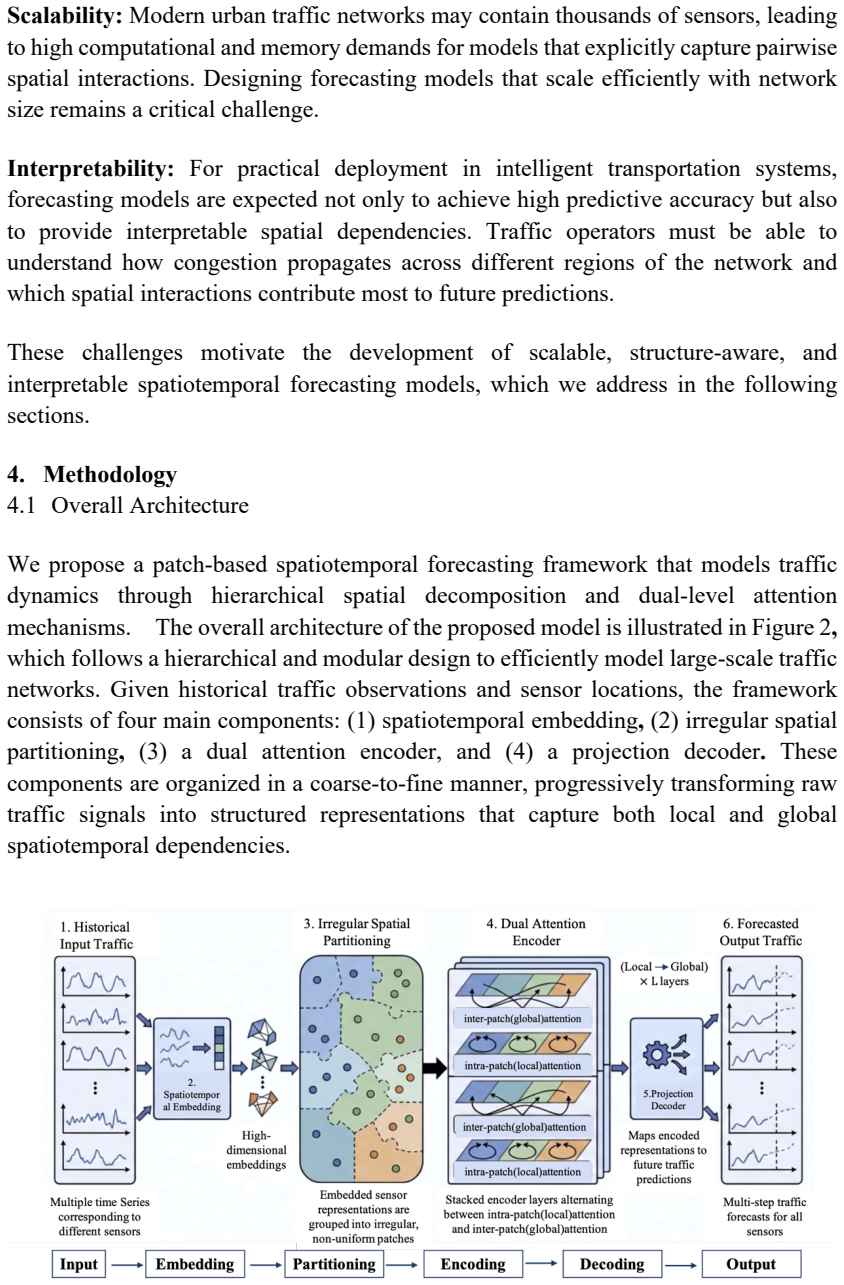
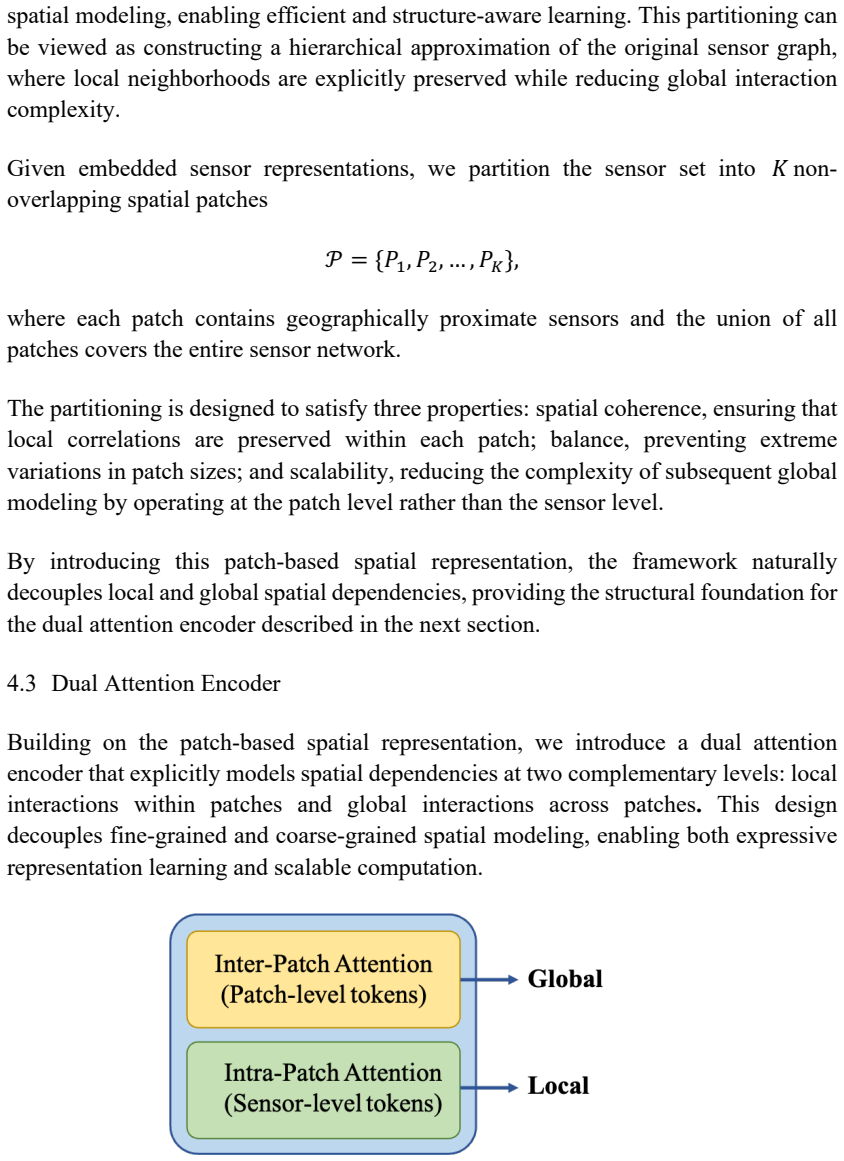
PatchSTG introduces a hierarchical spatial representation by partitioning sensors into balanced, locality-preserving patches using geographic information. A dual attention encoder then alternates intra-patch attention for local dependencies and inter-patch attention for global ones, reducing complexity from quadratic to near-linear. Evaluations on Rhode Island and other datasets show competitive forecasting performance with improved efficiency, validating the patch structure and dual attention.
What carries the argument
The dual attention encoder on geographically partitioned patches, which separates local intra-patch and global inter-patch attention to model spatiotemporal dependencies efficiently.
Load-bearing premise
Geographic partitioning into balanced, locality-preserving patches combined with dual attention sufficiently captures all required local and global traffic dependencies on irregular networks without loss of critical information.
What would settle it
A test on an irregular network where important traffic correlations span across proposed patch boundaries in a way that inter-patch attention fails to capture, resulting in lower accuracy than non-patched baselines.
Figures
read the original abstract
Traffic forecasting is a fundamental component of intelligent transportation systems, yet remains challenging in real-world settings due to irregular sensor distributions and the high computational cost of modeling large-scale spatiotemporal dependencies. In practical traffic networks, sensors are unevenly distributed across regions, leading to non-uniform spatial structures that limit the effectiveness and scalability of existing graph-based and attention-based models. To address these challenges, we propose PatchSTG, a patch-based spatiotemporal graph Transformer designed for efficient forecasting on irregular sensor networks. The key idea is to introduce a hierarchical spatial representation that partitions sensors into balanced, locality-preserving patches based on geographic information. On top of this structure, a dual attention encoder alternates between intra-patch attention for capturing local interactions and inter-patch attention for modeling global dependencies, reducing computational complexity from quadratic to near-linear scaling. We evaluate PatchSTG on real-world traffic data from Rhode Island and additional large-scale datasets. Experimental results demonstrate that the proposed model achieves stable and competitive forecasting performance across multiple horizons, while significantly improving computational efficiency. Ablation studies further validate the effectiveness of spatial partitioning and dual attention in capturing both local and long-range traffic dynamics. These results suggest that patch-based spatiotemporal modeling provides a scalable and effective framework for traffic forecasting under irregular spatial settings.
Editorial analysis
A structured set of objections, weighed in public.
Referee Report
Summary. The paper proposes PatchSTG, a patch-based spatiotemporal graph Transformer for traffic forecasting on irregular sensor networks. Sensors are partitioned into balanced, locality-preserving patches using geographic information; a dual attention encoder then alternates intra-patch attention (local interactions) and inter-patch attention (global dependencies) to reduce complexity from quadratic to near-linear. The model is evaluated on Rhode Island traffic data and additional large-scale datasets, with claims of stable competitive forecasting performance across horizons, significant efficiency gains, and ablation support for the partitioning and dual-attention components.
Significance. If the empirical results and the assumption that geographic patches plus dual attention preserve all necessary dependencies hold, the work would offer a practical route to scaling graph-Transformer models to large irregular traffic networks, addressing a common bottleneck in real-world ITS applications. The hierarchical locality-preserving design is a concrete contribution to spatiotemporal modeling under non-uniform sensor distributions.
major comments (2)
- [Spatial partitioning and dual attention encoder] Spatial partitioning subsection: the central claim requires that geographic patches plus intra/inter-patch attention recover all required local and long-range traffic dependencies without loss of critical information. If the underlying graph is constructed from road connectivity (standard in the field) while patches are formed solely from geographic coordinates, road-linked sensors placed in different patches lose direct intra-patch modeling; inter-patch attention operates at a coarser scale and may not restore the severed fine-grained interactions. The manuscript must supply explicit verification (e.g., topology-alignment statistics or an ablation isolating cross-patch road edges) because this assumption is load-bearing for the “without loss of critical information” guarantee.
- [Experiments] Experimental results section: the abstract asserts competitive performance and efficiency gains, yet the provided description contains no quantitative baseline comparisons, error bars, dataset cardinalities, or tabulated ablation outcomes. These omissions prevent verification of the central empirical claim and must be supplied with full tables and statistical detail.
minor comments (1)
- [Abstract] Abstract: the statement that ablation studies “validate the effectiveness” would be strengthened by naming the controls and metrics used.
Simulated Author's Rebuttal
We thank the referee for the constructive feedback. We address each major comment below and indicate the changes planned for the revised manuscript.
read point-by-point responses
-
Referee: [Spatial partitioning and dual attention encoder] Spatial partitioning subsection: the central claim requires that geographic patches plus intra/inter-patch attention recover all required local and long-range traffic dependencies without loss of critical information. If the underlying graph is constructed from road connectivity (standard in the field) while patches are formed solely from geographic coordinates, road-linked sensors placed in different patches lose direct intra-patch modeling; inter-patch attention operates at a coarser scale and may not restore the severed fine-grained interactions. The manuscript must supply explicit verification (e.g., topology-alignment statistics or an ablation isolating cross-patch road edges) because this assumption is load-bearing for the “without loss of critical information” guarantee.
Authors: We agree this verification is necessary. Our patches are formed from geographic coordinates to preserve locality, and the dual-attention mechanism is designed to handle both intra- and inter-patch interactions. To directly address potential cross-patch road edges, the revised manuscript will add topology-alignment statistics (fraction of road edges retained within patches) and an ablation that isolates cross-patch edges by comparing variants with and without them. revision: yes
-
Referee: [Experiments] Experimental results section: the abstract asserts competitive performance and efficiency gains, yet the provided description contains no quantitative baseline comparisons, error bars, dataset cardinalities, or tabulated ablation outcomes. These omissions prevent verification of the central empirical claim and must be supplied with full tables and statistical detail.
Authors: We agree the experimental reporting must be fully quantitative. The manuscript contains the requested elements (baseline tables, error bars from repeated runs, dataset cardinalities for Rhode Island and other sets, and ablation tables). The revision will expand the experimental section to present all tables and statistical details explicitly and prominently. revision: yes
Circularity Check
No significant circularity; architecture proposal is self-contained
full rationale
The provided manuscript text (abstract and description) presents PatchSTG as an empirical architecture proposal: geographic partitioning into patches followed by dual intra/inter-patch attention to achieve near-linear scaling. No equations, derivations, or parameter-fitting steps are shown that reduce a claimed prediction or result to its own inputs by construction. No self-citation chains are invoked to justify uniqueness or load-bearing premises. The central claims rest on experimental results on real-world datasets rather than any definitional or fitted-input reduction. This is the expected outcome for a standard model-design paper without mathematical derivations.
Axiom & Free-Parameter Ledger
Reference graph
Works this paper leans on
-
[1]
CodingFuture (Shanghai) Education Technology Co., Ltd
Portsmouth Abbey School 2. CodingFuture (Shanghai) Education Technology Co., Ltd. E-mail: 568078145@qq.com Abstract Traffic forecasting is a fundamental component of intelligent transportation systems, yet remains challenging in real-world settings due to irregular sensor distributions and the high computational cost of modeling large-scale spatiotemporal...
2024
-
[2]
Literature Review 2.1 Surveys on Traffic Prediction, Wireless Sensor Networks, and Large-Scale Streaming Analytics Survey studies outline systemic challenges in large-scale traffic prediction. Yuan and Li [19] identify persistent gaps—limited real-time scalability, high computational cost, and difficulty modeling heterogeneous spatial structures. In paral...
-
[3]
Spatio-Temporal Graph Convolutional Networks: A Deep Learning Framework for Traffic Forecasting
Wkipedia contributors. (2025, November 24). Claiborne Pell Newport Bridge. Wikipedia. https://en.wikipedia.org/wiki/Claiborne_Pell_Newport_Bridge [16] yler. (2025, June 20). Summer tourist season crashes: Unique challenges on Rhode Island roads. Bottaro Law Firm. https://bottarolaw.com/blog/summer-tourist-season-crashes-unique-challenges-on-rhode-island-r...
work page internal anchor Pith review Pith/arXiv arXiv doi:10.3390/s16020157 2025
discussion (0)
Sign in with ORCID, Apple, or X to comment. Anyone can read and Pith papers without signing in.