REVIEW 3 major objections 5 minor 80 references
Semantic Hypergraphs
T0 review · 3 major / 5 minor · reviewed 2026-08-14 · deepseek-v4-flash
Pith's one-line read Five hypergraph patterns, drawn from a recursive sentence representation, outperform specialized open information extraction systems.
desk verdict The formalism and parser are worth a serious look, but the headline OIE rank is a post-hoc fit to a 57-sentence benchmark, so the empirical claim is unproven. read the letter →
The pith
A machine-rendered reading of the paper's core claim, the machinery that carries it, and where it could break.
The reading
What carries the argument
The load-bearing object is the recursive ordered hyperedge: an ordered list of elements that may themselves be hyperedges, so that statements can contain statements and concepts can be built from concepts. The formal syntax requires the first element of every non-atomic hyperedge to be a connector, and the type-inference rules determine the resulting hyperedge type. Parsing works by repeatedly matching these inference rules as unordered patterns over the sequence of typed atoms, using the heuristic $h$ to resolve competing matches by preferring directly dependency-linked tokens; the same hyperedge syntax then doubles as a pattern-matching language, with variables, wildcards, and replacement rules, which is what makes the five OIE patterns possible.
What would settle it
A decisive test: rerun the OIE benchmark with the grouping heuristic replaced by random selection among pattern matches while keeping token types unchanged. If the five patterns no longer beat the baselines, the dependency-connectivity heuristic carries the benchmark result; if they still do, the representation itself is sufficient.
Extended reading notes
Core claim
The central claim is that sentence meaning can be captured by a recursive ordered hyperedge whose first element is always a connector (predicate, modifier, builder, trigger, or conjunction), with a compact eight-type system and a small set of type-inference rules that close the syntax. Starting from tokens classified into atomic types, a search-tree algorithm applies those inference rules bottom-up, guided by a heuristic that prefers groupings whose tokens are directly linked in the dependency tree. The paper reports that this pipeline yields completely correct hyperedges for 79% of 500 held-out sentences, and that on a public Open Information Extraction benchmark the five most general patterns derived from the 50 most frequent hyperedge patterns rank first with an F1 of 0.365, edging out seven dedicated OIE systems.
Load-bearing premise
The parser's grouping stage assumes that tokens directly linked in the grammatical dependency tree belong together in the same semantic unit, so if grammatical connectivity stops being a reliable guide for longer or more ambiguous sentences, the grouping step fails even when every token is classified correctly.
Editorial extensions
If this is right
- If the central claim holds, a transparent, human-readable representation can match specialized statistical systems on a standard OIE benchmark using only five patterns, so openness does not have to cost competitive performance.
- The reported 79% complete-parse rate across fiction, nonfiction, news, science, and Wikipedia indicates that the representation is not tuned to a single text genre.
- The conjunction decomposition rules and the co-occurrence based coreference method should allow corpus-scale actor-claim-topic analysis, as demonstrated on news headlines.
- Because the type system is designed to cover all grammatical relations in Universal Dependencies, the same hyperedge syntax should transfer to other languages once a small amount of token-classification training data is provided.
Reading between the lines
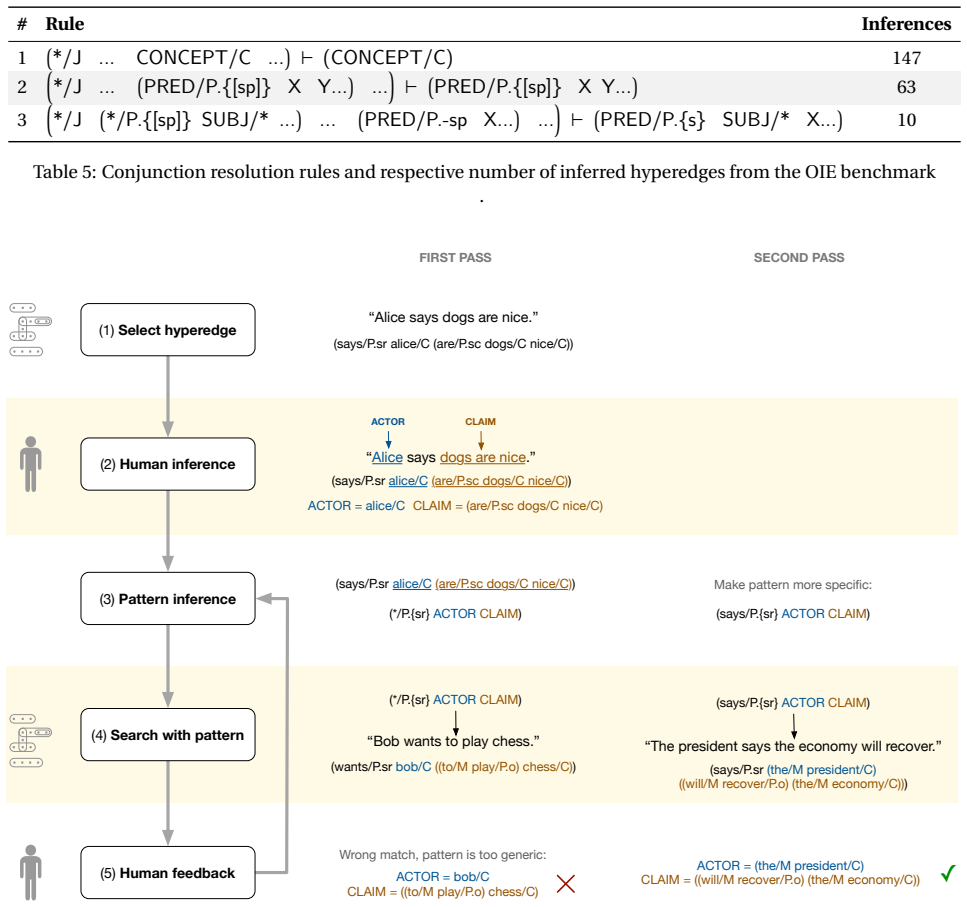
- The pattern-learning loop in Section 5.3 is human-in-the-loop; a direct extension would be to automate the generalization step with a search tree over wildcard substitutions and test whether the same five OIE patterns can be rediscovered without human feedback.
- If the dependency-connectivity heuristic is the real bottleneck behind the 79% figure, replacing it with a learned grouping model could raise complete-parse accuracy while keeping the SH representation intact.
- The Universal Dependencies completeness argument suggests a clean language-transfer experiment: annotate a few hundred sentences in a typologically distant language and check whether the same eight types suffice.
Signed reviews
Editorial analysis
A structured set of objections, weighed in public.
Referee Report
Summary. The paper introduces Semantic Hypergraphs (SH), a recursive, ordered, typed hypergraph representation of natural-language meaning, together with a two-stage parser (an α-stage token-type classifier and a β-stage search-tree structuring algorithm), a pattern language for knowledge inference, and a set of applications including conjunction decomposition, open information extraction, concept taxonomy inference, coreference resolution, and a news-corpus claim/conflict case study. The central empirical claims are that the NL-to-SH parser achieves 79% completely correct parses across five text categories (Section 4.3, Table 4) and that five simple SH hyperedge patterns suffice to rank first on the WiRe57 Open Information Extraction benchmark (Section 5.4, Tables 6 and 7). The paper also emphasizes the open-adaptive nature of the formalism, its human readability, and the availability of the Graphbrain open-source implementation.
Significance. If the empirical claims were properly supported, this would be a valuable demonstration that a small, human-readable symbolic representation can compete with specialized statistical systems on a standard extraction task, and that a knowledge representation of this kind is usable across several downstream text-analysis tasks. The paper is also notable for shipping an open-source implementation (Graphbrain), for defining a concrete type system with explicit inference rules, and for attempting an integrated social-science-oriented application on a large news-title corpus. These strengths make the work of potential interest to the NLP and computational social science communities. However, the significance currently rests on evaluations whose validity needs reinforcement, especially the OIE ranking result, so the contribution is promising rather than fully established.
major comments (3)
- [Section 5.4, Tables 6 and 7] The rank-first OIE claim is a post-hoc fit to the evaluation set, not a held-out result. The five patterns were obtained by taking the 50 most common patterns from a Wikipedia hypergraph, validating 36 of them against the benchmark's annotation guidelines, compressing them to 5, and then ordering them "by decreasing contribution to F1" with the ranks in Table 6 and the final rank in Table 7 all computed on WiRe57 itself. No split, cross-validation, or significance testing is reported. The margin over MinIE is 0.365 vs 0.358 F1, i.e. 0.007 on a 57-sentence benchmark, so a small number of extractions can flip the rank. The paper's disclaimer that it does not claim to be the best OIE system softens the wording but does not repair the inference, because this result is the main external quantitative evidence for the expressiveness of SH. The authors should either evaluate patterns selected on a training portion and tested on held-out sentences, or explicitly reframe the result as a post-hoc descriptive comparison without the rank-first claim.
- [Section 4.3, Table 4] The parser evaluation is based on 500 sentences rated by the authors themselves, with no inter-annotator agreement, no confidence intervals, and no release of the annotated judgments. The categories "completely correct", "defect", and "completely wrong" involve subjective semantic judgments, and the reported 79% complete-correct rate and the per-category rates would be considerably more convincing if at least a second annotator scored a subset and Cohen's kappa or a similar agreement measure were reported. This concern is secondary to the OIE issue, but it directly affects the reliability of the parser's headline accuracy and of every downstream experiment that consumes the parser output.
- [Section 4.2, Algorithm 1] The β-stage heuristic is the load-bearing assumption that grammatical connectivity in the dependency tree correlates with semantic grouping, but the paper does not quantify how often the heuristic selects a suboptimal grouping when the dependency parse is correct, nor how sensitive the final parse quality is to this choice. The statement in Section 4.3 that "a correct α classification and dependency parse tree always lead to the construction of an SH that preserves the meaning" is based on the same 500-sentence author-rated sample and is not supported by a controlled analysis of the heuristic's decisions. A small ablation or error analysis separating α errors, dependency-parse errors, and β heuristic errors would materially strengthen the parser validation.
minor comments (5)
- [Section 2] There is a typo in the related-work discussion: "we sill see how SHs can represent semantic information" should be "we will see".
- [Section 5.4] In the description of patterns 3, 4, and 5, the text says "REL is split into two or thee variables" and later "REL1, REL2 and REL2"; the first should be "three" and the second should likely be "REL1, REL2 and REL3".
- [Section 4.1] The phrase "one of thealpha categories" has a missing space; it should read "one of the α categories".
- [Figure 1] The right panel would benefit from explicit axis labels and error bars or confidence intervals, since the text makes claims about significant differences between text categories.
- [Section 3.2] The definition of the recursive hyperedge set E_V is stated compactly and would be clearer with an explicit base case distinguishing atoms from non-atomic hyperedges; currently the notation is ambiguous about whether atoms are included in E_V by definition or by the V ∪ E_V disjunct.
Circularity Check
OIE '5 patterns rank first' is benchmark-fitted: the patterns were ordered by F1 on WiRe57 and the rank is measured on the same benchmark.
-
fitted input called prediction
[Section 5.4, Table 6 caption and Table 7]
"Open Information Extraction patterns, ordered by decreasing contribution to F1 (presented cumulatively). Ranks correspond to the rank achieved in the benchmark of Table 7 by using patterns up to the given line."
The headline claim says that five simple hyperedge patterns are sufficient to rank first in the WiRe57 OIE benchmark. The table caption states that the patterns are ordered by decreasing contribution to F1 and that the ranks are the benchmark ranks obtained by using patterns up to each line. Thus the pattern set, its cardinality, and its order were all selected by evaluating on WiRe57 itself, and the final rank in Table 7 is computed on that same benchmark. The result is therefore a post-hoc fit to the test set rather than an independent prediction: the F1 values and rank used as the evidence were also the objective used for selection.
full rationale
Most of the paper's derivation chain is self-contained: the SH type system and syntax are defined formally; the α-stage classifier is trained on annotated sentences and tested on random splits; the β-stage is evaluated on 500 held-out sentences; and the concept, coreference, and claim/conflict applications are checked by human inspection or by comparison to the corpus. Self-citations are pointers to the released Graphbrain code, not load-bearing evidence for the formal claims. The one significant circular step is the OIE headline. In Section 5.4 the five patterns are obtained by generalizing common hyperedges, validating candidates against the benchmark's annotation guidelines, compressing the valid ones, and then ordering them 'by decreasing contribution to F1', with Table 6 explicitly tying each rank to the benchmark of Table 7. The same WiRe57 benchmark supplies the final F1 and rank, so the claim that five simple patterns can rank first is a test-set selection result, not a held-out prediction. This OIE comparison is the paper's main external quantitative evidence, so the circularity is load-bearing for that specific claim. Other parts of the paper remain independent, which keeps the overall score at 6 rather than higher.
Assumptions & free parameters
free parameters (4)
- coreference threshold θ =
0.7
- coreference threshold θ′ =
0.05
- OIE pattern set =
5 patterns
- Conjunction decomposition rules =
3 rules
assumptions (5)
- domain assumption Universal Dependencies catalogs all grammatical constructs, and the Appendix A mapping covers each construct in SH.
- domain assumption Dependency-tree connectivity is a reliable guide to semantic grouping in the β-stage heuristic.
- ad hoc to paper The type-inference rules in Table 2 are the correct composition rules for natural-language meaning.
- domain assumption Manual 'correct/defect/wrong' ratings are reliable indicators of semantic equivalence.
- domain assumption spaCy's POS, dependency and NER outputs are accurate enough to support the parser.
invented entities (4)
-
Semantic Hypergraph formalism (recursive ordered typed hyperedges)
-
Special builder atom (+/B)
-
Implicit conjunction connector (:/J)
-
lemma/J connector
Cite this review
Pith. "Pith review of Semantic Hypergraphs." pith.science (2026). https://pith.science/paper/UCFALYYM
@misc{pith2026190810784,
  author       = {Pith},
  title        = {Pith review of: Semantic Hypergraphs},
  year         = {2026},
  howpublished = {\url{https://pith.science/paper/UCFALYYM}},
  note         = {Machine review of arXiv:1908.10784}
}
read the original abstract
Approaches to Natural language processing (NLP) may be classified along a double dichotomy open/opaque - strict/adaptive. The former axis relates to the possibility of inspecting the underlying processing rules, the latter to the use of fixed or adaptive rules. We argue that many techniques fall into either the open-strict or opaque-adaptive categories. Our contribution takes steps in the open-adaptive direction, which we suggest is likely to provide key instruments for interdisciplinary research. The central idea of our approach is the Semantic Hypergraph (SH), a novel knowledge representation model that is intrinsically recursive and accommodates the natural hierarchical richness of natural language. The SH model is hybrid in two senses. First, it attempts to combine the strengths of ML and symbolic approaches. Second, it is a formal language representation that reduces but tolerates ambiguity and structural variability. We will see that SH enables simple yet powerful methods of pattern detection, and features a good compromise for intelligibility both for humans and machines. It also provides a semantically deep starting point (in terms of explicit meaning) for further algorithms to operate and collaborate on. We show how modern NLP ML-based building blocks can be used in combination with a random forest classifier and a simple search tree to parse NL to SH, and that this parser can achieve high precision in a diversity of text categories. We define a pattern language representable in SH itself, and a process to discover knowledge inference rules. We then illustrate the efficiency of the SH framework in a variety of tasks, including conjunction decomposition, open information extraction, concept taxonomy inference and co-reference resolution, and an applied example of claim and conflict analysis in a news corpus.
Figures


Figures from the paper (3 more)


Reference graph
Works this paper leans on
-
[1]
RDFa in XHTML: Syntax and processing
Adida, B., Birbeck, M., McCarron, S., Pemberton, S., 2008. RDFa in XHTML: Syntax and processing. Recommenda- tion, W3C 7
work page 2008
-
[2]
Agirre, E., Soroa, A., 2009. Personalizing pagerank for word sense disambiguation, in: Proceedings of the 12th Conference of the European Chapter of the Association for Computational Linguistics, Association for Computa- tional Linguistics. pp. 33–41
work page 2009
-
[3]
Allen, J.F ., Frisch, A.M., 1982. What’ s in a semantic net- work?, in: Proceedings of the 20th annual meeting on As- sociation for Computational Linguistics, Association for Computational Linguistics. pp. 19–27
work page 1982
-
[4]
Lever- aging linguistic structure for open domain information extraction, in: Proc
Angeli, G., Premkumar, M.J.J., Manning, C.D., 2015. Lever- aging linguistic structure for open domain information extraction, in: Proc. 53rd Annual Meeting of the Associa- tion for Computational Linguistics and 7th Intl. Joint Con- ference on Natural Language Processing, pp. 344–354
work page 2015
-
[5]
Top2vec: Distributed representations of topics
Angelov, D., 2020. Top2vec: Distributed representations of topics. arXiv preprint arXiv:2008.09470
arXiv 2020
-
[6]
Dbpedia: A nucleus for a web of open data, in: The semantic web
Auer, S., Bizer, C., Kobilarov, G., Lehmann, J., Cyganiak, R., Ives, Z., 2007. Dbpedia: A nucleus for a web of open data, in: The semantic web. Springer, pp. 722–735
work page 2007
-
[7]
Abstract meaning representation for sembanking, in: Proc
Banarescu, L., Bonial, C., Cai, S., Georgescu, M., Grif- fitt, K., Hermjakob, U., Knight, K., Koehn, P ., Palmer, M., Schneider, N., 2013. Abstract meaning representation for sembanking, in: Proc. 7th linguistic annotation workshop and interoperability with discourse, pp. 178–186
work page 2013
-
[8]
Networks beyond pairwise interactions: structure and dynamics
Battiston, F ., Cencetti, G., Iacopini, I., Latora, V ., Lucas, M., Patania, A., Young, J.G., Petri, G., 2020. Networks beyond pairwise interactions: structure and dynamics. Physics Reports 874, 1–92
work page 2020
Show all 80 references
-
[9]
Hypergraphs: combinatorics of finite sets
Berge, C., 1984. Hypergraphs: combinatorics of finite sets. volume 45 ofNorth-Holland mathematical library. North- Holland, Amsterdam
1984
-
[10]
Publishing on the se- mantic web
Berners-Lee, T ., Hendler, J., 2001. Publishing on the se- mantic web. Nature 410, 1023–1024
2001
-
[11]
Probabilistic topic models
Blei, D.M., 2012. Probabilistic topic models. Communica- tions of the ACM 55, 77–84
2012
-
[12]
Latent dirichlet allocation
Blei, D.M., Ng, A.Y., Jordan, M.I., 2003. Latent dirichlet allocation. Journal of machine Learning research 3, 993– 1022
2003
-
[13]
Directed recursive labelnode hyper- graphs: A new representation-language
Boley, H., 1977. Directed recursive labelnode hyper- graphs: A new representation-language. Artificial Intel- ligence 9, 49–85
1977
-
[14]
Comet: Commonsense transform- ers for automatic knowledge graph construction
Bosselut, A., Rashkin, H., Sap, M., Malaviya, C., Celikyil- maz, A., Choi, Y., 2019. Comet: Commonsense transform- ers for automatic knowledge graph construction. arXiv 1906.05317
2019 arXiv
-
[15]
Language models are few-shot learners
Brown, T .B., Mann, B., Ryder, N., Subbiah, M., Kaplan, J., Dhariwal, P ., Neelakantan, A., Shyam, P ., Sastry, G., Askell, A., Agarwal, S., Herbert-Voss, A., Krueger, G., Henighan, T ., Child, R., Ramesh, A., Ziegler, D.M., Wu, J., Winter, C., Hesse, C., Chen, M., Sigler, E.,...
2020 arXiv
-
[16]
Net- work properties of folksonomies
Cattuto, C., Schmitz, C., Baldassarri, A., Servedio, V .D., Loreto, V ., Hotho, A., Grahl, M., Stumme, G., 2007. Net- work properties of folksonomies. Ai Communications 20, 245–262
2007
-
[17]
Chavalarias, D., Wallach, J.D., Li, A.H.T ., Ioannidis, J.P .,
-
[18]
It depends: Depen- dency parser comparison using a web-based evaluation tool, in: Proc
Choi, J.D., Tetreault, J., Stent, A., 2015. It depends: Depen- dency parser comparison using a web-based evaluation tool, in: Proc. 53rd Annual Meeting of the Association for Computational Linguistics and 7th Intl. Joint Conference on Natural Language Processing, pp. 387–396
2015
-
[19]
A unified architecture for natural language processing: Deep neural networks with multitask learning, in: Proceedings of the 25th interna- tional conference on Machine learning, pp
Collobert, R., Weston, J., 2008. A unified architecture for natural language processing: Deep neural networks with multitask learning, in: Proceedings of the 25th interna- tional conference on Machine learning, pp. 160–167
2008
-
[20]
Clausie: clause-based open information extraction, in: Proceedings of the 22nd international conference on World Wide Web, pp
Del Corro, L., Gemulla, R., 2013. Clausie: clause-based open information extraction, in: Proceedings of the 22nd international conference on World Wide Web, pp. 355– 366
2013
-
[21]
BERT: Pre-training of deep bidirectional transformers for language understanding, in: Proc
Devlin, J., Chang, M.W ., Lee, K., Toutanova, K., 2019. BERT: Pre-training of deep bidirectional transformers for language understanding, in: Proc. 2019 Conference of the North American Chapter of the Association for Computa- tional Linguistics: Human Language Technologies, AC...
2019
-
[22]
Revealing social structure from texts: Meta-matrix text analysis as a novel method for network text analysis, in: Causal mapping for research in information technology
Diesner, J., Carley, K., 2005. Revealing social structure from texts: Meta-matrix text analysis as a novel method for network text analysis, in: Causal mapping for research in information technology. IGI Global, pp. 81–108
2005
-
[23]
Some properties of ordered hypergraphs
Eslahchi, C., Rahimi, A., 2007. Some properties of ordered hypergraphs. Matematiˇ cki vesnik 59, 9–13. 28
2007
-
[24]
Open information extraction from the web
Etzioni, O., Banko, M., Soderland, S., Weld, D.S., 2008. Open information extraction from the web. Communi- cations of the ACM 51, 68–74
2008
-
[25]
Identifying re- lations for open information extraction, in: Proc
Fader, A., Soderland, S., Etzioni, O., 2011. Identifying re- lations for open information extraction, in: Proc. Conf. on empirical methods in natural language processing, ACL. pp. 1535–1545
2011
-
[26]
Minie: minimizing facts in open information extraction, in: Proc
Gashteovski, K., Gemulla, R., Del Corro, L., 2017. Minie: minimizing facts in open information extraction, in: Proc. of the 2017 Conf. on Empirical Methods in Natural Lan- guage Processing, Association for Computational Linguis- tics. p. 2620–2630
2017
-
[27]
A network approach to topic models
Gerlach, M., Peixoto, T .P ., Altmann, E.G., 2018. A network approach to topic models. Science advances 4, eaaq1360
2018
-
[28]
Patterns, hypergraphs and embod- ied general intelligence, in: IJCNN’06 International Joint Conference on Neural Networks, IEEE
Goertzel, B., 2006. Patterns, hypergraphs and embod- ied general intelligence, in: IJCNN’06 International Joint Conference on Neural Networks, IEEE. pp. 451–458
2006
-
[29]
Text as data: The promise and pitfalls of automatic content analysis meth- ods for political texts
Grimmer, J., Stewart, B.M., 2013. Text as data: The promise and pitfalls of automatic content analysis meth- ods for political texts. Political Analysis 21, 267–297
2013
-
[30]
Opencog: A software frame- work for integrative artificial general intelligence, in: Arti- ficial General Intelligence, IOS Press
Hart, D., Goertzel, B., 2008. Opencog: A software frame- work for integrative artificial general intelligence, in: Arti- ficial General Intelligence, IOS Press. pp. 468–472
2008
-
[31]
An improved non- monotonic transition system for dependency parsing, in: EMNLP’15 Proc
Honnibal, M., Johnson, M., et al., 2015. An improved non- monotonic transition system for dependency parsing, in: EMNLP’15 Proc. of the 2015 Conf, on Empirical Methods in Natural Language Processing, pp. 1373–1378
2015
-
[32]
HyperGraphDB: A generalized graph database, in: Shen, H.T ., Pei, J., Özsu, M.T ., Zou, L., Lu, J., Ling, T .W ., Yu, G., Zhuang, Y., Shao, J
Iordanov, B., 2010. HyperGraphDB: A generalized graph database, in: Shen, H.T ., Pei, J., Özsu, M.T ., Zou, L., Lu, J., Ling, T .W ., Yu, G., Zhuang, Y., Shao, J. (Eds.), Web- Age Information Management, Springer Berlin Heidel- berg, Berlin, Heidelberg. pp. 25–36
2010
-
[33]
Distributed representations of sentences and documents, in: International conference on machine learning, PMLR
Le, Q., Mikolov, T ., 2014. Distributed representations of sentences and documents, in: International conference on machine learning, PMLR. pp. 1188–1196
2014
-
[34]
Wire57 : A fine- grained benchmark for open information extraction, in: Friedrich, A., Zeyrek, D., Hoek, J
Léchelle, W ., Gotti, F ., Langlais, P ., 2019. Wire57 : A fine- grained benchmark for open information extraction, in: Friedrich, A., Zeyrek, D., Hoek, J. (Eds.), Proc. of the 13th Linguistic Annotation Workshop, LAW at ACL 2019, Flo- rence, Italy, August 1, 2019, Association ...
2019
-
[35]
Resources for the open information extraction benchmark WiRe57, com- panion to Léchelle et al., 2019
Léchelle, W ., Gotti, F ., Langlais, P ., 2020. Resources for the open information extraction benchmark WiRe57, com- panion to Léchelle et al., 2019. URL: https://github. com/rali-udem/WiRe57
2020
-
[36]
Cyc: toward programs with common sense
Lenat, D.B., Guha, R.V ., Pittman, K., Pratt, D., Shepherd, M., 1990. Cyc: toward programs with common sense. Communications of the ACM 33, 30–49
1990
-
[37]
Co-word maps and topic modeling: A comparison using small and medium- sized corpora (n < 1,000)
Leydesdorff, L., Nerghes, A., 2017. Co-word maps and topic modeling: A comparison using small and medium- sized corpora (n < 1,000). Journal of the American Society for Information Science and Technology 68, 1024–1035
2017
-
[38]
Argumentation mining: State of the art and emerging trends
Lippi, M., Torroni, P ., 2016. Argumentation mining: State of the art and emerging trends. ACM Transactions on In- ternet Technology (TOIT) 16, 10
2016
-
[39]
Understanding wordscores
Lowe, W ., 2008. Understanding wordscores. Political Anal- ysis 16, 356–371
2008
-
[40]
Mausam, Schmitz, M., Soderland, S., Bart, R., Etzioni, O.,
-
[41]
Open information extraction sys- tems and downstream applications, in: Proceedings of the Twenty-Fifth International Joint Conference on Artificial Intelligence, pp
Mausam, M., 2016. Open information extraction sys- tems and downstream applications, in: Proceedings of the Twenty-Fifth International Joint Conference on Artificial Intelligence, pp. 4074–4077
2016
-
[42]
Recursive functions of symbolic ex- pressions and their computation by machine, part i
McCarthy, J., 1960. Recursive functions of symbolic ex- pressions and their computation by machine, part i. Com- munications of the ACM 3, 184–195
1960
-
[43]
Mihalcea, R., 2005. Unsupervised large-vocabulary word sense disambiguation with graph-based algorithms for sequence data labeling, in: Proceedings of Human Lan- guage Technology Conference and Conference on Empiri- cal Methods in Natural Language Processing, pp. 411–418
2005
-
[44]
Textrank: Bringing order into text, in: EMNLP’04 Proc
Mihalcea, R., Tarau, P ., 2004. Textrank: Bringing order into text, in: EMNLP’04 Proc. 2004 Conf. on Empirical Meth- ods in Natural Language Processing, pp. 404–411
2004
-
[45]
Efficient estimation of word representations in vector space
Mikolov, T ., Chen, K., Corrado, G., Dean, J., 2013. Efficient estimation of word representations in vector space. arXiv preprint arXiv:1301.3781
2013 arXiv
-
[46]
Wordnet: a lexical database for english
Miller, G.A., 1995. Wordnet: a lexical database for english. Communications of the ACM 38, 39–41
1995
-
[47]
Fightin’words: Lexical feature selection and evalua- tion for identifying the content of political conflict
Monroe, B.L., Colaresi, M.P ., Quinn, K.M., 2008. Fightin’words: Lexical feature selection and evalua- tion for identifying the content of political conflict. Political Analysis 16, 372–403
2008
-
[48]
Distant reading
Moretti, F ., 2013. Distant reading. Verso Books
2013
-
[49]
Statement map: reducing web information credibility noise through opinion classification, in: Pro- ceedings of the fourth workshop on Analytics for noisy unstructured text data, ACM
Murakami, K., Nichols, E., Mizuno, J., Watanabe, Y., Ma- suda, S., Goto, H., Ohki, M., Sao, C., Matsuyoshi, S., Inui, K., et al., 2010. Statement map: reducing web information credibility noise through opinion classification, in: Pro- ceedings of the fourth workshop on Analytic...
2010
-
[50]
A survey of named en- tity recognition and classification
Nadeau, D., Sekine, S., 2007. A survey of named en- tity recognition and classification. Lingvisticae Investiga- tiones 30, 3–26
2007
-
[51]
Graph connectivity mea- sures for unsupervised word sense disambiguation., in: IJCAI, pp
Navigli, R., Lapata, M., 2007. Graph connectivity mea- sures for unsupervised word sense disambiguation., in: IJCAI, pp. 1683–1688
2007
-
[52]
Univer- sal dependencies v1: A multilingual treebank collection, in: Proceedings of the Tenth International Conference on 29 Language Resources and Evaluation (LREC’16), pp
Nivre, J., De Marneffe, M.C., Ginter, F ., Goldberg, Y., Ha- jic, J., Manning, C.D., McDonald, R., Petrov, S., Pyysalo, S., Silveira, N., Tsarfaty, R., Zeman, D., 2016. Univer- sal dependencies v1: A multilingual treebank collection, in: Proceedings of the Tenth International ...
2016
-
[53]
The proposi- tion bank: An annotated corpus of semantic roles
Palmer, M., Gildea, D., Kingsbury, P ., 2005. The proposi- tion bank: An annotated corpus of semantic roles. Com- putational linguistics 31, 71–106
2005
-
[54]
Opinion mining and sen- timent analysis
Pang, B., Lee, L., et al., 2008. Opinion mining and sen- timent analysis. Foundations and Trends in Information Retrieval 2, 1–135
2008
-
[55]
Deep contextualized word representations
Peters, M.E., Neumann, M., Iyyer, M., Gardner, M., Clark, C., Lee, K., Zettlemoyer, L., 2018. Deep contextualized word representations. arXiv 1802.05365
2018 arXiv
-
[56]
Transforming de- pendency structures to logical forms for semantic pars- ing
Reddy, S., Täckström, O., Collins, M., Kwiatkowski, T ., Das, D., Steedman, M., Lapata, M., 2016. Transforming de- pendency structures to logical forms for semantic pars- ing. Transactions of the Association for Computational Linguistics 4, 127–140
2016
-
[57]
Ritter, A., Clark, S., Etzioni, O., et al., 2011. Named entity recognition in tweets: an experimental study, in: Proceed- ings of the Conference on Empirical Methods in Natural Language Processing, Association for Computational Lin- guistics. pp. 1524–1534
2011
-
[58]
Socio-semantic frameworks
Roth, C., 2013. Socio-semantic frameworks. Advances in Complex Systems 16, 1350013
2013
-
[59]
Ruiz, P ., Plancq, C., Poibeau, T ., 2016. More than word cooccurrence: Exploring support and opposition in inter- national climate negotiations with semantic parsing, in: LREC: The 10th Language Resources and Evaluation Con- ference, pp. 1902–1907
2016
-
[60]
Term-weighting approaches in automatic text retrieval
Salton, G., Buckley, C., 1988. Term-weighting approaches in automatic text retrieval. Information processing & management 24, 513–523
1988
-
[61]
Atomic: An atlas of machine commonsense for if-then reasoning, in: Proceedings of the AAAI Conference on Ar- tificial Intelligence, pp
Sap, M., Le Bras, R., Allaway, E., Bhagavatula, C., Lourie, N., Rashkin, H., Roof, B., Smith, N.A., Choi, Y., 2019. Atomic: An atlas of machine commonsense for if-then reasoning, in: Proceedings of the AAAI Conference on Ar- tificial Intelligence, pp. 3027–3035
2019
-
[62]
The semantic web revisited
Shadbolt, N., Berners-Lee, T ., Hall, W ., 2006. The semantic web revisited. IEEE intelligent systems 21, 96–101
2006
-
[63]
Mea- suring ideological proportions in political speeches, in: EMLP’13 Proc
Sim, Y., Acree, B.D., Gross, J.H., Smith, N.A., 2013. Mea- suring ideological proportions in political speeches, in: EMLP’13 Proc. 2013 Conf. on Empirical Methods in Nat- ural Language Processing, pp. 91–101
2013
-
[64]
Modern information retrieval: A brief overview
Singhal, A., 2001. Modern information retrieval: A brief overview. IEEE Data Eng. Bull. 24, 35–43
2001
-
[65]
A machine learn- ing approach to coreference resolution of noun phrases
Soon, W .M., Ng, H.T ., Lim, D.C.Y., 2001. A machine learn- ing approach to coreference resolution of noun phrases. Computational linguistics 27, 521–544
2001
-
[66]
Principles of semantic networks: Explo- rations in the representation of knowledge
Sowa, J.F ., 2014. Principles of semantic networks: Explo- rations in the representation of knowledge. Morgan Kauf- mann
2014
-
[67]
Models documentation
spaCy, 2020. Models documentation. URL: https:// spacy.io/models/en
2020
-
[68]
Conceptnet 5.5: An open multilingual graph of general knowledge, in: Pro- ceedings of the AAAI Conference on Artificial Intelligence, pp
Speer, R., Chin, J., Havasi, C., 2017. Conceptnet 5.5: An open multilingual graph of general knowledge, in: Pro- ceedings of the AAAI Conference on Artificial Intelligence, pp. 4444–4451
2017
-
[69]
Text mining: Classifi- cation, clustering, and applications
Srivastava, A.N., Sahami, M., 2009. Text mining: Classifi- cation, clustering, and applications. CRC Press
2009
-
[70]
Handbook on ontologies
Staab, S., Studer, R., 2010. Handbook on ontologies. Springer Science & Business Media
2010
-
[71]
Get- ting more out of syntax with props
Stanovsky, G., Ficler, J., Dagan, I., Goldberg, Y., 2016. Get- ting more out of syntax with props. arXiv 1603.01648
2016 arXiv
-
[72]
Parliamentarization of popular contention in great britain, 1758-1834
Tilly, C., 1997. Parliamentarization of popular contention in great britain, 1758-1834. Theory and Society 26, 245– 273
1997
-
[73]
Parsing, semantic networks, and political authority using syntactic analysis to extract semantic relations from dutch newspaper articles
Van Atteveldt, W ., Kleinnijenhuis, J., Ruigrok, N., 2008. Parsing, semantic networks, and political authority using syntactic analysis to extract semantic relations from dutch newspaper articles. Political Analysis 16, 428–446
2008
-
[74]
Clause analysis: using syntactic information to automatically extract source, subject, and predicate from texts with an application to the 2008–2009 Gaza War
Van Atteveldt, W ., Sheafer, T ., Shenhav, S.R., Fogel-Dror, Y., 2017. Clause analysis: using syntactic information to automatically extract source, subject, and predicate from texts with an application to the 2008–2009 Gaza War. Po- litical Analysis 25, 207–222
2017
-
[75]
Wikidata: A new platform for collab- orative data collection, in: Proceedings of the 21st inter- national conference on World Wide Web, pp
Vrandeˇ ci´ c, D., 2012. Wikidata: A new platform for collab- orative data collection, in: Proceedings of the 21st inter- national conference on World Wide Web, pp. 1063–1064
2012
-
[76]
Wang, H., Can, D., Kazemzadeh, A., Bar, F ., Narayanan, S.,
-
[77]
Large-scale computerized text analysis in political science: Opportunities and chal- lenges
Wilkerson, J., Casas, A., 2017. Large-scale computerized text analysis in political science: Opportunities and chal- lenges. Annual Review of Political Science 20, 529–544. A Mapping Universal Stanford De- pendencies to hyperedges We used the Universal Stanford Dependencies [5...
2017
-
[79]
A system for real-time twitter sentiment analysis of 2012 US presidential election cycle, in: Proceedings of the ACL 2012 System Demonstrations, Association for Com- putational Linguistics. pp. 115–120
2012
-
[2012]
Open language learning for information extraction, in: Proceedings of the 2012 joint conference on empiri- cal methods in natural language processing and compu- tational natural language learning, pp. 523–534
2012
-
[2016]
Jama 315, 1141–1148
Evolution of reporting p values in the biomedical literature, 1990-2015. Jama 315, 1141–1148
1990
Reviewed August 14, 2026 · model on record in the stance chip above.
Discussion (0). Continue with ORCID to comment.