Approximability limits for bounded-degree max-LINSAT and implications for decoded quantum interferometry
Pith reviewed 2026-06-27 06:25 UTC · model grok-4.3
The pith
It is NP-hard to approximate bounded-degree max-Ek-LINSAT over finite fields better than r/q plus order 1/sqrt(D).
A machine-rendered reading of the paper's core claim, the machinery that carries it, and where it could break.
Core claim
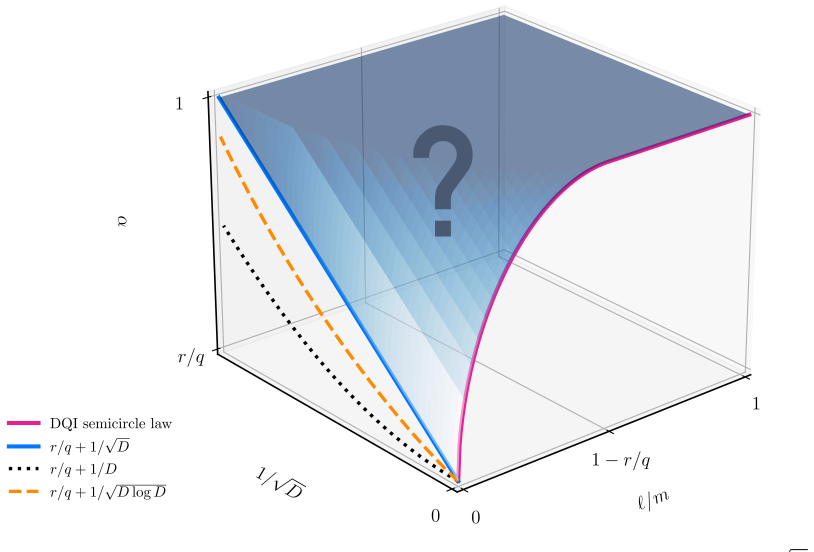
For general max-k-XORSAT with k at least 3, no polynomial-time algorithm can do substantially better than random guessing on worst-case instances unless P equals NP, but with bounded degree D polynomial-time algorithms can beat the random baseline by order 1/sqrt(D). The paper proves this hardness extends to max-Ek-LINSAT(q,r) with bounded degree D over arbitrary finite fields F_q, establishing that it is NP-hard to exceed r/q plus O_{q,r}(1/sqrt(D)). These results benchmark DQI, QAOA and classical heuristics on the targeted bounded-degree instances. On (k,D)-regular instances DQI with classical decoders faces a 1/sqrt(D log D) information-theoretic barrier while DQI with quantum decoders is
What carries the argument
The NP-hardness reduction that preserves both the bounded-degree property D and the precise approximation gap r/q plus O(1/sqrt(D)) for instances over arbitrary finite fields F_q.
If this is right
- Quantum advantage on bounded-degree instances is confined to the constant prefactor.
- DQI with classical decoders cannot match the 1/sqrt(D) hardness scaling due to the extra log D factor in the information-theoretic barrier.
- DQI with quantum decoders can in principle achieve the optimal 1/sqrt(D) scaling on (k,D)-regular instances.
- The benchmark applies equally to QAOA and other heuristics targeting the same bounded-degree instances.
Where Pith is reading between the lines
- Future decoder designs for DQI should prioritize constant-factor improvements to reach the hardness limit.
- The classical-versus-quantum decoder distinction may apply to other hybrid algorithms that combine interferometry with post-processing.
- Explicit construction of (k,D)-regular instances saturating the hardness gap would allow direct numerical tests of whether quantum decoding closes the gap.
- The result leaves open whether the O(1/sqrt(D)) term can be tightened to a specific leading constant for particular q and r.
Load-bearing premise
The reduction establishing hardness for general finite fields preserves both the bounded-degree property and the precise approximation gap.
What would settle it
A polynomial-time algorithm achieving approximation ratio r/q + c/sqrt(D) for some c smaller than the O_{q,r} constant on bounded-degree max-Ek-LINSAT instances over F_q would falsify the hardness claim.
Figures
read the original abstract
For general max-k-XORSAT with $k \geq 3$, no polynomial-time algorithm can do substantially better than random guessing on worst-case instances unless $\mathsf{P} = \mathsf{NP}$: approximating beyond the random-assignment value of $1/2$ is $\mathsf{NP}$-hard. The picture changes when each variable appears in at most $D$ constraints. In that bounded-degree setting, polynomial-time algorithms can provably beat the random baseline by an additive amount of order $1/\sqrt{D}$. For Boolean instances, this scaling is known to be optimal: the matching hardness result is due to Trevisan, while the corresponding algorithmic guarantee was established by Barak et al. Whether the same holds over general finite fields, and what it implies for quantum algorithms, has not been established. We make this connection explicit and extend the hardness to max-E$k$-LINSAT$(q,r)$ with bounded degree $D$ and over arbitrary finite fields $\mathbb{F}_q$, proving that it is $\mathsf{NP}$-hard to exceed $r/q + \mathcal{O}_{q,r}(1/\sqrt{D})$. These results provide the complexity-theoretic benchmark for the bounded-degree instances targeted by decoded quantum interferometry (DQI), QAOA, and classical heuristics. Any quantum advantage on bounded-degree instances is therefore confined to the constant prefactor. We further show that in the context of DQI and on $(k,D)$-regular instances, this prefactor is sensitive to the nature of the decoder: DQI with classical decoders faces an information-theoretic $1/\sqrt{D \log D}$ barrier that prevents it from matching the hardness scaling, while DQI with quantum decoders is compatible with the $1/\sqrt{D}$ scaling -- identifying quantum decoding as the key ingredient for matching the complexity-theoretic scaling with DQI.
Editorial analysis
A structured set of objections, weighed in public.
Referee Report
Summary. The paper proves that approximating max-Ek-LINSAT(q,r) over F_q on instances of maximum degree D is NP-hard beyond the random-assignment value r/q + O_{q,r}(1/sqrt(D)). It positions this as a complexity-theoretic benchmark for decoded quantum interferometry (DQI), QAOA and classical heuristics on bounded-degree instances, and shows that on (k,D)-regular instances DQI with classical decoders is limited by a 1/sqrt(D log D) information-theoretic barrier while quantum decoders remain compatible with the 1/sqrt(D) scaling.
Significance. If the hardness result and the decoder comparison hold, the work supplies a tight classical benchmark that confines any quantum advantage on these instances to constant-factor improvements and identifies quantum decoding as the ingredient needed to match the optimal scaling. The explicit link between bounded-degree CSP hardness and DQI performance models is a useful contribution to the literature on quantum algorithms for constraint satisfaction.
major comments (2)
- [reduction section (likely §3–4)] The central hardness claim rests on a reduction from Boolean bounded-degree max-k-XORSAT (known to have gap 1/2 + Θ(1/sqrt(D))) to max-Ek-LINSAT(q,r) that must simultaneously preserve maximum degree ≤ D and produce an optimum at most r/q + O_{q,r}(1/sqrt(D)). The manuscript must exhibit the explicit construction and verify that neither the degree bound nor the additive gap is degraded by a q-dependent factor or by a weaker exponent.
- [DQI decoder analysis (likely §5)] The information-theoretic barrier statements for classical versus quantum decoders in DQI are stated for (k,D)-regular instances; the derivation of the 1/sqrt(D log D) classical barrier and the compatibility of the quantum decoder with 1/sqrt(D) must be shown to follow from the same gap that the hardness reduction produces, rather than from separate modeling assumptions.
minor comments (2)
- [abstract and introduction] Notation for the O_{q,r}(·) term should be defined explicitly when first introduced, including dependence on the field size and the parameter r.
- [introduction] The manuscript should include a short table or paragraph comparing the new hardness gap with the Boolean case of Trevisan and the algorithmic guarantee of Barak et al. to make the extension clear.
Simulated Author's Rebuttal
We thank the referee for the careful and constructive report. The two major comments identify points where additional explicitness will strengthen the manuscript. We address each below and have revised the relevant sections accordingly.
read point-by-point responses
-
Referee: [reduction section (likely §3–4)] The central hardness claim rests on a reduction from Boolean bounded-degree max-k-XORSAT (known to have gap 1/2 + Θ(1/sqrt(D))) to max-Ek-LINSAT(q,r) that must simultaneously preserve maximum degree ≤ D and produce an optimum at most r/q + O_{q,r}(1/sqrt(D)). The manuscript must exhibit the explicit construction and verify that neither the degree bound nor the additive gap is degraded by a q-dependent factor or by a weaker exponent.
Authors: The reduction is given explicitly in Section 3: each Boolean variable is replaced by a single element of F_q and each Boolean equation is lifted to an equation over F_q whose solution set projects onto the original Boolean solutions. The construction is stated as a linear map that preserves the support of each variable, so the maximum degree remains exactly D. In the proof of Theorem 4.1 we bound the additive gap by O_{q,r}(1/sqrt(D)) with the implicit constant depending only on q and r; the exponent on D is unchanged. A new paragraph has been inserted after the statement of the reduction to make these two verifications explicit. revision: yes
-
Referee: [DQI decoder analysis (likely §5)] The information-theoretic barrier statements for classical versus quantum decoders in DQI are stated for (k,D)-regular instances; the derivation of the 1/sqrt(D log D) classical barrier and the compatibility of the quantum decoder with 1/sqrt(D) must be shown to follow from the same gap that the hardness reduction produces, rather than from separate modeling assumptions.
Authors: Section 5 derives both barriers from the identical gap produced by Theorem 4.2 on (k,D)-regular instances. The classical mutual-information calculation uses the same additive gap r/q + Θ(1/sqrt(D)) to obtain the 1/sqrt(D log D) information-theoretic limit; the quantum decoder analysis shows that the same gap is compatible with a 1/sqrt(D) scaling once the decoder is permitted to act on the full superposition. A new subsection 5.3 has been added that repeats the gap statement from the hardness theorem and then re-derives each barrier directly from it, eliminating any separate modeling assumptions. revision: yes
Circularity Check
No circularity: hardness extends external Trevisan/Barak results; DQI comparison is downstream analysis
full rationale
The paper's central claim is an extension of known Boolean bounded-degree hardness (Trevisan) and algorithmic results (Barak et al.) to general finite fields F_q, with a new reduction establishing the r/q + O(1/sqrt(D)) gap while preserving degree D. These priors are external and not self-citations. No equations or steps in the provided abstract reduce a prediction or uniqueness claim to a fitted parameter or self-citation chain by construction. The DQI decoder comparison (classical vs quantum) is presented as an implication of the hardness benchmark rather than a self-referential derivation. The derivation chain is therefore self-contained against external benchmarks.
Axiom & Free-Parameter Ledger
axioms (1)
- domain assumption P ≠ NP
Reference graph
Works this paper leans on
-
[1]
Opti- mization by decoded quantum interferometry
Stephen P. Jordan, Noah Shutty, Mary Wootters, Adam Zalcman, Alexander Schmid- huber, Robbie King, Sergei V. Isakov, Tanuj Khattar, and Ryan Babbush. “Opti- mization by decoded quantum interferometry”. Nature646, 831–836 (2025)
2025
-
[2]
Some optimal inapproximability results
Johan H˚ astad. “Some optimal inapproximability results”. J. ACM48, 798–859 (2001)
2001
-
[3]
Tight inapproxima- bility of max-linsat and implications for decoded quantum interferometry
Maximilian J Kramer, Carsten Schubert, and Jens Eisert. “Tight inapproxima- bility of max-linsat and implications for decoded quantum interferometry” (2026). arXiv:2603.04540
arXiv 2026
-
[4]
Probabilistic checking of proofs: a new character- ization of NP
Sanjeev Arora and Shmuel Safra. “Probabilistic checking of proofs: a new character- ization of NP”. J. ACM45, 70–122 (1998)
1998
-
[5]
Proof verification and the hardness of approximation problems
Sanjeev Arora, Carsten Lund, Rajeev Motwani, Madhu Sudan, and Mario Szegedy. “Proof verification and the hardness of approximation problems”. J. ACM45, 501–555 (1998)
1998
-
[6]
An in-principle super-polynomial quantum advantage for approximating combina- torial optimization problems via computational learning theory
Niklas Pirnay, Vincent Ulitzsch, Frederik Wilde, Jens Eisert, and Jean-Pierre Seifert. “An in-principle super-polynomial quantum advantage for approximating combina- torial optimization problems via computational learning theory”. Science Adv.10, eadj5170 (2024)
2024
-
[7]
Quantum advantage for combinatorial optimization problems, sim- plified
Mario Szegedy. “Quantum advantage for combinatorial optimization problems, sim- plified” (2022). arXiv:2212.12572
arXiv 2022
-
[8]
Verifiable quantum advantage without struc- ture
Takashi Yamakawa and Mark Zhandry. “Verifiable quantum advantage without struc- ture”. J. ACM71, 1–50 (2024)
2024
-
[9]
Formal framework for quantum advantage
Harry Buhrman, Niklas Galke, and Konstantinos Meichanetzidis. “Formal framework for quantum advantage” (2025). arXiv:2510.01953
arXiv 2025
-
[10]
Quantum advantage from soft de- coders
Andr´ e Chailloux and Jean-Pierre Tillich. “Quantum advantage from soft de- coders” (2024). arXiv:2411.12553. 15
arXiv 2024
-
[11]
Quantum circuit design for decoded quantum interferometry
Natchapol Patamawisut, Naphan Benchasattabuse, Michal Hajduˇ sek, and Rodney Van Meter. “Quantum circuit design for decoded quantum interferometry”. In 2025 IEEE Int.l Conf. Quant. Comp. Eng. (QCE). Page 291–301. IEEE (2025)
2025
-
[12]
Bridging quantum chemistry and MaxCut: Classical performance guarantees and quantum algorithms for the Hartree–Fock method
Alexis Ralli, Tim Weaving, Peter V. Coveney, and Peter J. Love. “Bridging quantum chemistry and MaxCut: Classical performance guarantees and quantum algorithms for the Hartree–Fock method”. J. Chem. Th. Comp.21, 9511–9524 (2025)
2025
-
[13]
Decoded quantum inter- ferometry under noise
Kaifeng Bu, Weichen Gu, Dax Enshan Koh, and Xiang Li. “Decoded quantum inter- ferometry under noise” (2025). arXiv:2508.10725
arXiv 2025
-
[14]
Quantum advantage via solving multivariate polynomials
Pierre Briaud, Itai Dinur, Riddhi Ghosal, Aayush Jain, Paul Lou, and Amit Sahai. “Quantum advantage via solving multivariate polynomials” (2025). arXiv:2509.07276
arXiv 2025
-
[15]
Towards solving industrial integer linear programs with decoded quantum interfer- ometry
Francesc Sabater, Ouns El Harzli, Geert-Jan Besjes, Marvin Erdmann, Johannes Klepsch, Jonas Hiltrop, Jean-Francois Bobier, Yudong Cao, and Carlos A. Riofrio. “Towards solving industrial integer linear programs with decoded quantum interfer- ometry” (2025). arXiv:2509.08328
Pith/arXiv arXiv 2025
-
[16]
On the complexity of decoded quantum interferometry
Kunal Marwaha, Bill Fefferman, Alexandru Gheorghiu, and Vojtech Havlicek. “On the complexity of decoded quantum interferometry” (2025). arXiv:2509.14443
Pith/arXiv arXiv 2025
-
[17]
Decoded quantum inter- ferometry requires structure
Eric R. Anschuetz, David Gamarnik, and Jonathan Z. Lu. “Decoded quantum inter- ferometry requires structure” (2025). arXiv:2509.14509
arXiv 2025
-
[18]
Efficient and optimal quantum state discrimination via quantum belief propagation
Christophe Piveteau and Joseph M. Renes. “Efficient and optimal quantum state discrimination via quantum belief propagation” (2025). arXiv:2509.19441
arXiv 2025
-
[19]
No quantum advantage in decoded quantum interferometry for max- cut
Ojas Parekh. “No quantum advantage in decoded quantum interferometry for max- cut” (2025). arXiv:2509.19966
arXiv 2025
-
[20]
Algebraic geometry codes and decoded quantum interferometry
Andi Gu and Stephen P. Jordan. “Algebraic geometry codes and decoded quantum interferometry” (2025). arXiv:2510.06603
arXiv 2025
-
[21]
No exponential quantum speedup forSIS∞anymore
Robin Kothari, Ryan O’Donnell, and Kewen Wu. “No exponential quantum speedup forSIS∞anymore” (2025). arXiv:2510.07515
arXiv 2025
-
[22]
Hamiltonian decoded quantum interferometry
Alexander Schmidhuber, Jonathan Z. Lu, Noah Shutty, Stephen Jordan, Alexander Poremba, and Yihui Quek. “Hamiltonian decoded quantum interferometry” (2025). arXiv:2510.07913
arXiv 2025
-
[23]
Verifiable quantum advantage via optimized DQI circuits
Tanuj Khattar, Noah Shutty, Craig Gidney, Adam Zalcman, Noureldin Yosri, Dmitri Maslov, Ryan Babbush, and Stephen P. Jordan. “Verifiable quantum advantage via optimized DQI circuits” (2025). arXiv:2510.10967
arXiv 2025
- [24]
-
[25]
Ansis Rosmanis. “A nearly linear-time decoded quantum interferometry algorithm for the optimal polynomial intersection problem” (2026). arXiv:2601.15171
arXiv 2026
-
[26]
Hamiltonian decoded quantum interferom- etry for general Pauli Hamiltonians
Kaifeng Bu, Weichen Gu, and Xiang Li. “Hamiltonian decoded quantum interferom- etry for general Pauli Hamiltonians” (2026). arXiv:2601.18773
arXiv 2026
-
[27]
On worst-case optimal polynomial intersec- tion
Yihang Sun and Mary Wootters. “On worst-case optimal polynomial intersec- tion” (2026). arXiv:2604.09533
Pith/arXiv arXiv 2026
-
[29]
M. Isabel Franco Garrido and Andr´ e Chailloux. “Regev’s reduction as a candidate quantum algorithm for the discrete logarithm problem in finite abelian groups” (2026). arXiv:2605.03972
Pith/arXiv arXiv 2026
-
[30]
From constraint to code: DQI-Kit – A soft- ware framework for decoded quantum interferometry
Simon Thelen and Wolfgang Mauerer. “From constraint to code: DQI-Kit – A soft- ware framework for decoded quantum interferometry” (2026). arXiv:2605.16955. 16
Pith/arXiv arXiv 2026
-
[31]
Decoded quantum interferometry beyond hamming: Rank-metric and translation association schemes
Alexandre Krajenbrink, Colin Krawchuk, Ansis Rosmanis, and Matthias Rosenkranz. “Decoded quantum interferometry beyond hamming: Rank-metric and translation association schemes” (2026). arXiv:2606.04843
Pith/arXiv arXiv 2026
-
[32]
Adiabatic quantum state generation and statistical zero knowledge
Dorit Aharonov and Amnon Ta-Shma. “Adiabatic quantum state generation and statistical zero knowledge”. In Proceedings of the Thirty-Fifth Annual ACM Sympo- sium on Theory of Computing. Page 20–29. STOC ’03 New York, NY, USA (2003). Association for Computing Machinery
2003
-
[33]
Quantum computation and lattice problems
Oded Regev. “Quantum computation and lattice problems”. SIAM J. Comp.33, 738–760 (2004)
2004
-
[34]
Lattice problems in NP∩coNP
Dorit Aharonov and Oded Regev. “Lattice problems in NP∩coNP”. J. ACM52, 749–765 (2005)
2005
-
[35]
On lattices, learning with errors, random linear codes, and cryptogra- phy
Oded Regev. “On lattices, learning with errors, random linear codes, and cryptogra- phy”. J. ACM56(2009)
2009
-
[36]
Mind the gaps: The fraught road to quantum advan- tage
Jens Eisert and John Preskill. “Mind the gaps: The fraught road to quantum advan- tage” (2025). arXiv:2510.19928
Pith/arXiv arXiv 2025
-
[37]
The vast world of quantum advantage
Hsin-Yuan Huang, Soonwon Choi, Jarrod R. McClean, and John Preskill. “The vast world of quantum advantage” (2025). arXiv:2508.05720
arXiv 2025
-
[38]
Challenges and opportunities in quantum optimization
Amira Abbas, Andris Ambainis, Brandon Augustino, Andreas B¨ artschi, Harry Buhrman, Carleton Coffrin, Giorgio Cortiana, Vedran Dunjko, Daniel J. Egger, Bruce G. Elmegreen, Nicola Franco, Filippo Fratini, Bryce Fuller, Julien Gacon, Con- stantin Gonciulea, Sander Gribling, Swati Gupta, Stuart Hadfield, Raoul Heese, Ger- hard Kircher, Thomas Kleinert, Thors...
2024
-
[39]
On bounded occurrence constraint satisfaction
Johan H˚ astad. “On bounded occurrence constraint satisfaction”. Inf. Proc. Lett.74, 1–6 (2000)
2000
-
[40]
A quantum approximate optimization algorithm applied to a bounded occurrence constraint problem
Edward Farhi, Jeffrey Goldstone, and Sam Gutmann. “A quantum approximate optimization algorithm applied to a bounded occurrence constraint problem” (2015). arXiv:1412.6062
Pith/arXiv arXiv 2015
-
[41]
Beating the Random Assignment on Constraint Satisfaction Problems of Bounded Degree
Boaz Barak, Ankur Moitra, Ryan O’Donnell, Prasad Raghavendra, Oded Regev, David Steurer, Luca Trevisan, Aravindan Vijayaraghavan, David Witmer, and John Wright. “Beating the Random Assignment on Constraint Satisfaction Problems of Bounded Degree”. In Naveen Garg, Klaus Jansen, Anup Rao, and Jos´ e D. P. Rolim, editors, Approximation, Randomization, and Co...
2015
-
[42]
A quantum approximate optimization algorithm
Edward Farhi, Jeffrey Goldstone, and Sam Gutmann. “A quantum approximate optimization algorithm” (2014). arXiv:1411.4028
Pith/arXiv arXiv 2014
-
[43]
Non-approximability results for optimization problems on bounded degree instances
Luca Trevisan. “Non-approximability results for optimization problems on bounded degree instances”. In Proceedings of the Thirty-Third Annual ACM Symposium on Theory of Computing. Page 453–461. STOC ’01 New York, NY, USA (2001). Association for Computing Machinery
2001
-
[44]
Approximation resistance from pairwise-independent subgroups
Siu On Chan. “Approximation resistance from pairwise-independent subgroups”. J. ACM63(2016). 17
2016
-
[45]
How many theoreticians does it take to approximate Max 3LIN?
Luca Trevisan. “How many theoreticians does it take to approximate Max 3LIN?”. Blog post,in theory(2015). Accessed May 2026
2015
-
[46]
Improved bounds for bounded occurrence constraint satisfac- tion
Johan H˚ astad. “Improved bounds for bounded occurrence constraint satisfac- tion” (2015). Unpublished manuscript
2015
-
[47]
The use of information sets in decoding cyclic codes
Eugene Prange. “The use of information sets in decoding cyclic codes”. IRE Trans. Inf. Th.8, S5–S9 (1962)
1962
-
[48]
The quantum approximate optimization algorithm at high depth for MaxCut on large-girth regular graphs and the Sherrington-Kirkpatrick model
Joao Basso, Edward Farhi, Kunal Marwaha, Benjamin Villalonga, and Leo Zhou. “The quantum approximate optimization algorithm at high depth for MaxCut on large-girth regular graphs and the Sherrington-Kirkpatrick model”. In Fran¸ cois Le Gall and Tomoyuki Morimae, editors, 17th Conference on the Theory of Quantum Computation, Communication and Cryptography ...
2022
-
[49]
Comment on: Optimization using locally-quantum decoders
Christophe Piveteau. “Comment on: Optimization using locally-quantum decoders”. SciRate comment on arXiv:2604.24633 (2026). Accessed May 2026
Pith/arXiv arXiv 2026
-
[50]
Belief propagation decoding of quantum channels by passing quantum messages
Joseph M. Renes. “Belief propagation decoding of quantum channels by passing quantum messages”. New J. Phys.19, 072001 (2017)
2017
-
[51]
Belief propagation with quan- tum messages for symmetric classical-quantum channels
Sarah Brandsen, Avijit Mandal, and Henry D. Pfister. “Belief propagation with quan- tum messages for symmetric classical-quantum channels” (2022). arXiv:2207.04984
arXiv 2022
-
[52]
Belief propagation with quantum messages for symmetric q-ary pure-state channels
Avijit Mandal and Henry D. Pfister. “Belief propagation with quantum messages for symmetric q-ary pure-state channels” (2026). arXiv:2601.21330
arXiv 2026
-
[53]
Bounds on approximating max-k-xor with quantum and classical local algorithms
Kunal Marwaha and Stuart Hadfield. “Bounds on approximating max-k-xor with quantum and classical local algorithms”. Quantum6, 757 (2022)
2022
-
[54]
A mathematical theory of communication
C. E. Shannon. “A mathematical theory of communication”. The Bell System Tech- nical Journal27, 379–423 (1948)
1948
-
[55]
Elements of information theory
Thomas M. Cover and Joy A. Thomas. “Elements of information theory”. Wiley. Hoboken (2006)
2006
-
[56]
Bounds for the quantity of information transmitted by a quantum communication channel
Alexander S. Holevo. “Bounds for the quantity of information transmitted by a quantum communication channel”. Problemy Peredachi Informatsii9, 3–11 (1973)
1973
-
[57]
Fine-grained unambiguous measure- ments
Quentin Buzet and Andr´ e Chailloux. “Fine-grained unambiguous measure- ments” (2025). arXiv:2510.07298
arXiv 2025
-
[58]
Classical algorithms and quantum limitations for maximum cut on high-girth graphs
Boaz Barak and Kunal Marwaha. “Classical algorithms and quantum limitations for maximum cut on high-girth graphs”. In Mark Braverman, editor, 13th Innovations in Theoretical Computer Science Conference (ITCS 2022). Volume 215 of LIPIcs, pages 14:1–14:21. Dagstuhl, Germany (2022). Schloss Dagstuhl – Leibniz-Zentrum f¨ ur Informatik
2022
-
[59]
Ahmed El Alaoui, Andrea Montanari, and Mark Sellke. “Local algorithms for max- imum cut and minimum bisection on locally treelike regular graphs of large de- gree” (2023). arXiv:2111.06813. 18
arXiv 2023
discussion (0)
Sign in with ORCID, Apple, or X to comment. Anyone can read and Pith papers without signing in.