REVIEW 2 major objections 5 minor 1 cited by
Comparison of variational quantum eigensolvers in light nuclei
T0 review · 2 major / 5 minor · reviewed 2026-08-06 · deepseek-v4-flash
Pith's one-line read Simulating p-shell nuclei without noise, the paper finds ADAPT-VQE cheaper below Hilbert-space dimension 51 and UCC cheaper at 51 and above, because UCC's operator pool saturates at 145 while ADAPT's ansatz keeps growing.
desk verdict A careful, honest UCC-vs-ADAPT benchmark whose crossover is real under its own metric but needs sensitivity testing before becoming a hardware recommendation. read the letter →
The pith
A machine-rendered reading of the paper's core claim, the machinery that carries it, and where it could break.
The reading
What carries the argument
The carrying object is the total-operations metric $N_{\rm op}$. For UCC it counts $N_{\rm op}^{\rm UCC} = f_{\rm calls} \times \Delta$, the number of optimizer function calls times the fixed number of ansatz layers (the operator-pool size); for ADAPT it sums over iterations, $N_{\rm op}^{\rm ADAPT} = \sum_{i=1}^{N_{\rm iter}} f_{{\rm calls},i} \times i$, so that every growth step of the ansatz contributes to the accumulated cost. This metric is what makes a UCC–ADAPT comparison meaningful, and the paper states explicitly that it is approximate: it assumes each layer can be implemented with the same number of quantum gates in both approaches, and it omits ADAPT's gradient-measurement operations, citing Ref. [41] for their being orders of magnitude smaller than the energy-minimization cost. The argument then reduces to a competition between two scaling behaviours: UCC's pool size saturating at $\Delta = 145$ within the $p$ shell, versus ADAPT's ansatz growing nearly linearly with $\dim(\mathcal{H})$, which together produce the crossover at $\dim(\mathcal{H}) = 51$.
What would settle it
Compile both ansätze onto a concrete hardware connectivity graph (for example, a heavy-hexagon qubit grid) for the two nuclei on either side of the crossover, $^{8}$Li ($\dim(\mathcal{H}) = 28$, ADAPT favored) and $^{8}$Be ($\dim(\mathcal{H}) = 51$, UCC favored), and count the physical two-qubit gates after routing and optimization; recomputing the crossover with gate counts in place of layer counts would settle whether the $\dim(\mathcal{H}) = 51$ boundary is a property of the algorithms or an artifact of the metric, since it would fail to reproduce if a UCC layer and an ADAPT layer differ substantially in compiled gate number or if ADAPT's gradient circuits add a comparable number of gates.
Extended reading notes
Core claim
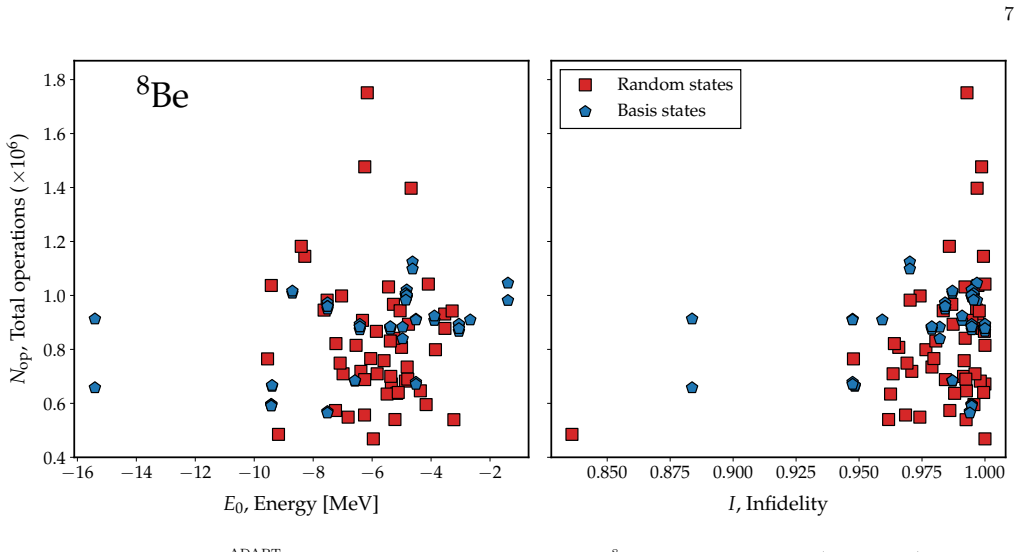
In the noiseless nuclear shell model with the Cohen–Kurath interaction, the authors find that the quantum-resource ranking of the two variational eigensolvers crosses over as a function of the many-body Hilbert-space dimension. For the seven nuclei with $\dim(\mathcal{H}) < 51$ ($^{6}$He, $^{6}$Be, $^{6}$Li, $^{8}$Li, $^{10}$Li, $^{10}$N, $^{8}$B), ADAPT converges to the ground state with fewer total operations than UCC, by more than an order of magnitude for the two-nucleon systems ($\langle N_{\rm op}^{\rm ADAPT}\rangle < 100$ versus $\langle N_{\rm op}^{\rm UCC}\rangle \approx 1000$ at $\dim(\mathcal{H}) = 5$); for the four nuclei with $\dim(\mathcal{H}) \ge 51$ ($^{8}$Be, $^{10}$Be, $^{10}$C, $^{10}$B), UCC is the cheaper method, with the margin reaching a factor of about three at $\dim(\mathcal{H}) = 84$. The origin of the crossover is structural: the UCC operator pool in the $p$ shell saturates at $\Delta = 145$ symmetry-preserving two-body excitations, so the UCC ansatz depth stops growing, whereas the number of ADAPT layers grows approximately linearly with $\dim(\mathcal{H})$, consistent with earlier shell-model ADAPT results. The paper also establishes that UCC's total operations are nearly independent of the reference state, that ADAPT's can vary by up to a factor of two across reference states, and that Slater determinants, not random superpositions, are the dependable reference states for both algorithms.
Load-bearing premise
The load-bearing premise, acknowledged in the paper's own definition of the metric, is that every unitary layer in UCC and ADAPT costs the same number of physical quantum gates and that ADAPT's gradient measurements cost orders of magnitude less than its energy minimizations; if compiled gate counts differ between the two ansätze or gradient overhead becomes comparable on real hardware, the crossover at dimension 51 would move or disappear.
Editorial extensions
If this is right
- In the noiseless limit, ADAPT is the lower-resource algorithm for the near-closed-shell nuclei $^{6}$He, $^{6}$Be, $^{6}$Li, $^{8}$Li, $^{10}$Li, $^{10}$N, and $^{8}$B, while UCC is lower-resource for the mid-shell nuclei $^{8}$Be, $^{10}$Be, $^{10}$C, and $^{10}$B.
- Slater determinants, not random superpositions, are the reference states to use with both algorithms; a random reference state can make ADAPT up to four times more expensive.
- UCC's cost per minimization stops climbing once the operator pool saturates ($\Delta = 145$ in the $p$ shell), so UCC's advantage grows with Hilbert-space dimension from $\dim(\mathcal{H}) = 51$ onward.
- The crossover at $\dim(\mathcal{H}) = 51$ is a concrete quantitative prediction to probe in $sd$- and $pf$-shell model spaces with the same metric, as the authors state they intend to do.
Reading between the lines
- The paper's scaling mechanism extrapolates to larger spaces: in the $sd$ shell the UCC pool will saturate at a larger $\Delta$, while ADAPT's near-linear layer growth continues, so by the paper's own logic the crossover dimension should rise; this is a testable prediction that the paper does not itself make.
- A hardware-level redefinition of cost could move the crossover either way: if compiled ADAPT layers turn out cheaper than compiled UCC layers on a fixed connectivity graph, ADAPT's advantage should extend past $\dim(\mathcal{H}) = 51$; if gradient-measurement circuits dominate ADAPT's cost, UCC could win even below 51.
- ADAPT's factor-of-two reference-state variance suggests an algorithmic tweak worth testing: rank candidate operators by projected energy-lowering per unit gate cost instead of gradient magnitude at the origin, which could reduce the variance and possibly shift some mid-shell nuclei back toward ADAPT.
Editorial analysis
A structured set of objections, weighed in public.
Referee Report
Summary. The paper reports classical noiseless simulations of the ground states of eleven p-shell nuclei (6He to 10B) within the nuclear shell model using the Cohen-Kurath interaction, comparing two variational quantum eigensolvers: UCC (specifically UCCSD with a Trotterized product ansatz) and ADAPT. To compare resource usage, the authors introduce a new metric, the total number of operations N_op, defined as the number of optimizer energy-function calls times the number of ansatz layers (Eqs. (9) and (10)). They average over reference Slater determinants and random references states for ADAPT, and over operator orderings and initial parameter values for UCC, benchmarking convergence against exact Lanczos diagonalization with relative error tolerance 1e-4. The central claim is that ADAPT requires fewer total operations for nuclei with small Hilbert-space dimension (dim(H)<51, near shell closure), while UCC requires fewer for mid-shell nuclei (dim(H)>=51), because the UCC operator-pool size saturates at Delta=145 while ADAPT's ansatz layers grow approximately linearly. They also find that UCC performance is largely independent of the reference state, whereas ADAPT shows a factor-of-two variation, and that Slater determinants are better reference states than random states.
Significance. If the resource ranking is robust, the paper offers a practically useful heuristic for choosing between UCC and ADAPT in nuclear shell-model VQE calculations, and it extends the earlier ADAPT-scaling analysis to a systematic comparison across a range of isotopes. The work is carefully executed in several respects: ground states are benchmarked against independent Lanczos diagonalization, convergence criteria are explicit, the code is made available, and the averaging over reference states and initial conditions is a genuine attempt at method-independent conclusions. The central quantitative crossover at dim(H)=51, however, is derived from the N_op metric, whose two load-bearing assumptions—equal gate count per layer and negligible ADAPT gradient-measurement cost—are stated but not tested. The paper's physical conclusion about shell-closure dependence is interesting, but the quantitative 'ADAPT vs UCC' ranking needs strengthening or reframing if it is to guide hardware decisions.
major comments (2)
- [III C 1, Eq. (10) and Sec. IV B] The central crossover at dim(H)=51 depends on the assumption that each ansatz layer costs the same number of quantum gates for UCC and ADAPT. The paper explicitly states this assumption in Sec. III C 1 and acknowledges it 'may not always be the case,' but it is load-bearing for the comparison in Fig. 4 and for the corresponding conclusions in Sec. V. Under a Jordan-Wigner encoding, two-body excitation exponentials have Pauli weights that depend on the orbital indices, so a 'layer' is not a fixed gate count; a weighted gate-count metric could change the relative costs of UCC and ADAPT for specific nuclei. I request a sensitivity analysis using gate-count-weighted operations, or at least a quantitative estimate of the spread in gate counts across the operator pool, to determine whether the dim(H)=51 crossover survives under a more realistic cost model.
- The ADAPT gradient-measurement cost is excluded from N_ADAPT, with the justification that it is 'orders of magnitude smaller' than energy-minimization operations, citing Ref. [41]. This is a load-bearing assumption for the crossover because ADAPT selects each operator by evaluating gradients of all Delta pool operators (Delta up to 145) against the current i-layer ansatz at every iteration. In a shot-based estimate, this adds circuits proportional to Delta times the number of shots per gradient, with depths that grow with i; for N_iter in the tens and Delta of order 100, this omitted term can be comparable to or larger than the energy-minimization cost, and it would increase N_ADAPT differentially across the nuclei. The cited reference may justify this for that particular implementation, but the present paper does not reproduce or verify the magnitude for the calculations reported here. I recommend including a quantitative estimate of the gradient-measurement cost, or explicitly limiting the conclusions to the function-call-plus-layer metric defined by Eq. (10).
minor comments (5)
- [I] There is a typo in the Introduction: 'developmemts' should be 'developments.'
- [IV A, Fig. 3] The statement that 'results not shown here in the interest of brevity' for UCC with random reference states should be backed by data in the supplementary material or the GitHub repository, since it supports the claim that UCC performance is reference-state independent.
- [Table I] The table lists dim(H) and Delta but does not label the columns fully; please clarify the meaning of the column headers (e.g., 'Nucleus', 'Z', 'N', etc.) and the ordering of the reference states v_alpha.
- [IV B] For UCC, Fig. 4 uses the first Slater determinant as reference state, while ADAPT averages over all reference states; the paper argues this is justified based on Fig. 2, but only three nuclei are shown. I suggest stating explicitly that the other nuclei behave analogously, or including the corresponding plots for all nuclei in an appendix.
- [IV, sample sizes] The number of UCC runs (100, 50, 30) is stated, but there is no discussion of whether these sample sizes are sufficient for the reported standard deviations to be meaningful; a convergence check of the average versus sample size would strengthen the comparison.
Circularity Check
No significant circularity: the UCC/ADAPT comparison is reproduced from direct noiseless simulations against an independent exact-diagonalization benchmark, and the self-citations to Ref. [41] are not load-bearing reductions.
full rationale
The central resource comparison is not circular. The paper obtains ground-state energies by classical Lanczos diagonalization of the Cohen-Kurath Hamiltonian and defines convergence by Eq. (12), so the benchmark is independent of the UCC and ADAPT results. The UCC and ADAPT simulations are performed directly in Sec. IV, with no parameter fitted to the target ranking; the ADAPT layer-count scaling is shown in the paper's own Fig. 4 (right panel) and is only described as 'consistent with Ref. [41]', making that self-citation corroborative rather than load-bearing. The only self-cited quantitative input is the Sec. III C 1 statement that ADAPT gradient-selection operations are 'orders of magnitude smaller' than energy-minimization operations [41]. That is a stated modeling assumption, not a definitional identity, and the authors explicitly flag the related equal-gate-cost assumption ('which may not always be the case'). If those assumptions are wrong, the resource ranking as a hardware-cost prediction would be weakened, but the derivation would still not be equivalent to its inputs by construction. No fitted quantity is renamed as a prediction, no uniqueness theorem is imported, and no ansatz is smuggled in via citation. Accordingly, no circular step is identified.
Assumptions & free parameters
free parameters (2)
- Convergence tolerance ftol =
1e-4
- Number of UCC randomized runs =
100 for dim(H)=5; 50 for dim(H)=10 or 28; 30 for dim(H)=51 or 84
assumptions (6)
- domain assumption The Cohen-Kurath effective interaction in the p shell describes the relevant nuclear structure.
- domain assumption Ground states of the even-nucleon systems studied have M=0, so the many-body space can be restricted to M=0.
- domain assumption One-step Trotter-Suzuki decomposition (n=1) is sufficient for the UCC ansatz.
- domain assumption The L-BFGS-B optimizer with ftol=1e-4 reliably minimizes the variational energy surfaces.
- ad hoc to paper Total operations N_op faithfully ranks quantum computational cost, with equal gate count per layer and negligible ADAPT gradient cost.
- ad hoc to paper Unbiased random coefficient reference states sample generic initial states.
Cite this review
Pith. "Pith review of Comparison of variational quantum eigensolvers in light nuclei." pith.science (2026). https://pith.science/paper/UF3TJNJH
@misc{pith2026250713819,
  author       = {Pith},
  title        = {Pith review of: Comparison of variational quantum eigensolvers in light nuclei},
  year         = {2026},
  howpublished = {\url{https://pith.science/paper/UF3TJNJH}},
  note         = {Machine review of arXiv:2507.13819}
}
abstract
Quantum computing is one of the most promising technologies of the near future, and the simulation of quantum many-body systems is a natural application. In this work, we present classical simulations of the ground states of light atomic nuclei within the $p$ shell, from $^{6}$He to $^{10}$B, calculated within the nuclear shell model. We compare the performance of two leading variational quantum eigensolver algorithms: the Unitary Coupled Cluster (UCC) and the Adaptive Derivative-Assembled Pseudo-Trotter (ADAPT) methods, introducing a new metric to quantify the use of quantum resources in each simulation. We find that Slater determinants are the most useful reference states for both approaches. Our analysis suggests that ADAPT is more efficient for nuclei close to magic numbers, while UCC tends to require fewer resources toward the mid shell. This work lays the groundwork for robust benchmarking of quantum algorithms in nuclear structure studies.
Figures


Figures from the paper (1 more)

Forward citations
Cited by 1 Pith paper
-
Quantum Computing Hadron Fragmentation Functions in Light-Front Chromodynamics
A quantum-simulation framework based on discretized light-front QCD extracts the c→J/ψ fragmentation function from a truncated four-particle Hilbert space, finding rough agreement with the 1993 NRQCD calculation.
Reference graph
Works this paper leans on
- [41]
-
[1]
However, these quanti- ties do not necessarily reflect how many operations the quantum device performs
Total operations Standard metrics to evaluate the efficiency of a VQE based on parameter optimization include the number of iterations of the classical minimizer and the number of energy function evaluations [37]. However, these quanti- ties do not necessarily reflect how many operations the quantum device performs. Due to the iterative growth of the ADAP...
-
[2]
Ram´ on y Cajal
Reference states and initial parameters Some additional aspects need to be addressed before we can directly compare UCC and ADAPT. First, the reference state in Eq. (5) may play an important role in the minimization. Past implementations for nuclear ground states propose Hartree-Fock solutions as refer- ence states [38] or many-body basis states of minima...
-
[3]
R. P. Feynman, Simulating physics with computers, Int. J. Theor. Phys. 21, 467 (1982)
1982
-
[4]
Mukha, E
I. Mukha, E. Roeckl, L. Batist, A. Blazhev, J. D¨ oring, H. Grawe, L. Grigorenko, M. Huyse, Z. Janas, R. Kirch- ner, et al. , Proton–proton correlations observed in two- proton radioactivity of 94ag, Nature 439, 298–302 (2006)
2006
-
[5]
R. Taniuchi, C. Santamaria, P. Doornenbal, A. Obertelli, K. Yoneda, G. Authelet, H. Baba, D. Calvet, F. Chˆ ateau, A. Corsi, et al. , 78ni revealed as a doubly magic stronghold against nuclear deformation, Nature 569, 53–58 (2019)
work page 2019
- [6]
-
[7]
N. Tsunoda, T. Otsuka, K. Takayanagi, N. Shimizu, T. Suzuki, Y. Utsuno, S. Yoshida, and H. Ueno, The impact of nuclear shape on the emergence of the neutron dripline, Nature 587, 66–71 (2020)
work page 2020
Show all 84 references
-
[8]
B. Hu, W. Jiang, T. Miyagi, Z. Sun, A. Ekstr¨ om, C. Forss´ en, G. Hagen, J. D. Holt, T. Papenbrock, S. R. Stroberg, et al. , Ab initio predictions link the neutron skin of 208Pb to nuclear forces, Nature Phys. 18, 1196 (2022)
2022
-
[9]
Kondo, N
Y. Kondo, N. Achouri, H. A. Falou, L. Atar, T. Aumann, H. Baba, K. Boretzky, C. Caesar, D. Calvet, H. Chae, et al. , First observation of 28O, Nature 620, 965 (2023), [Erratum: Nature 623, E13 (2023)]
2023
-
[10]
A. Gade, B. Longfellow, R. V. Janssens, D. D. Dao, F. Nowacki, J. A. Tostevin, A. D. Ayangeakaa, M. J. Basson, C. M. Campbell, M. P. Carpenter, et al. , In- beam spectroscopy reveals competing nuclear shapes in the rare isotope 62Cr, Nature Phys. 21, 37 (2025)
2025
-
[11]
Hinke, M
C. Hinke, M. B¨ ohmer, P. Boutachkov, T. Faestermann, H. Geissel, J. Gerl, R. Gernh¨ auser, M. G´ orska, A. Got- tardo, H. Grawe, et al. , Superallowed Gamow–Teller de- cay of the doubly magic nucleus 100Sn, Nature 486, 341–345 (2012)
2012
-
[12]
Gysbers, G
P. Gysbers, G. Hagen, J. Holt, G. R. Jansen, T. D. Morris, P. Navr´ atil, T. Papenbrock, S. Quaglioni, A. Schwenk, S. Stroberg, et al., Discrepancy between ex- perimental and theoretical β-decay rates resolved from first principles, Nature Phys. 15, 428 (2019)
2019
-
[13]
Robin, M
C. Robin, M. J. Savage, and N. Pillet, Entanglement Re- arrangement in Self-Consistent Nuclear Structure Calcu- lations, Phys. Rev. C 103, 034325 (2021)
2021
-
[14]
C. W. Johnson and O. C. Gorton, Proton-neutron entan- glement in the nuclear shell model, J. Phys. G50, 045110 (2023)
2023
-
[15]
Tichai, S
A. Tichai, S. Knecht, A. T. Kruppa, ¨O. Legeza, C. P. Moca, A. Schwenk, M. A. Werner, and G. Zarand, Com- bining the in-medium similarity renormalization group with the density matrix renormalization group: Shell structure and information entropy, Phys. Lett. B 845, 138139 (2023)
2023
-
[16]
P´ erez-Obiol, S
A. P´ erez-Obiol, S. Masot-Llima, A. M. Romero, J. Men´ endez, A. Rios, A. Garc ´ ıa-S´ aez, and B. Juli´ a- D ´ ıaz, Quantum entanglement patterns in the structure of atomic nuclei within the nuclear shell model, Eur. Phys. J. A 59, 240 (2023)
2023
-
[17]
Br¨ okemeier, S
F. Br¨ okemeier, S. M. Hengstenberg, J. W. T. Keeble, C. E. P. Robin, F. Rocco, and M. J. Savage, Quantum Magic and Multi-Partite Entanglement in the Structure of Nuclei, Phys. Rev. C 111, 034317 (2025)
2025
-
[18]
J. J. Cowan, C. Sneden, J. E. Lawler, A. Aprahamian, M. Wiescher, K. Langanke, G. Mart ´ ınez-Pinedo, and F.- K. Thielemann, Origin of the heaviest elements: The rapid neutron-capture process, Rev. Mod. Phys. 93, 015002 (2021). 11
2021
-
[19]
Aalbers, S
J. Aalbers, S. AbdusSalam, K. Abe, V. Aerne, F. Agos- tini, S. A. Maouloud, D. Akerib, D. Y. Akimov, J. Ak- shat, A. Al Musalhi, et al. , A next-generation liquid xenon observatory for dark matter and neutrino physics, J. Phys. G Nucl. Part. Phys. 50, 013001 (2022)
2022
-
[20]
S. Huth, P. T. Pang, I. Tews, T. Dietrich, A. Le F` evre, A. Schwenk, W. Trautmann, K. Agarwal, M. Bulla, M. W. Coughlin, et al., Constraining Neutron-Star Mat- ter with Microscopic and Macroscopic Collisions, Nature 606, 276 (2022)
2022
-
[21]
Agostini, G
M. Agostini, G. Benato, J. A. Detwiler, J. Men´ endez, and F. Vissani, Toward the discovery of matter creation with neutrinoless ββ decay, Rev. Mod. Phys. 95, 025002 (2023)
2023
-
[22]
Engel, M
J. Engel, M. J. Ramsey-Musolf, and U. van Kolck, Elec- tric dipole moments of nucleons, nuclei, and atoms: The standard model and beyond, Prog. Part. Nucl. Phys. 71, 21 (2013), fundamental Symmetries in the Era of the LHC
2013
-
[23]
M. A. Nielsen and I. L. Chuang, Quantum Computa- tion and Quantum Information: 10th Anniversary Edi- tion (Cambridge University Press, 2010)
2010
-
[24]
D. P. DiVincenzo, The physical implementation of quan- tum computation, Fortschritte der Physik 48, 771–783 (2000)
2000
-
[25]
Preskill, Quantum computing in the NISQ era and beyond, Quantum 2, 79 (2018)
J. Preskill, Quantum computing in the NISQ era and beyond, Quantum 2, 79 (2018)
2018
-
[26]
Bravyi, A
S. Bravyi, A. W. Cross, J. M. Gambetta, D. Maslov, P. Rall, and T. J. Yoder, High-threshold and low- overhead fault-tolerant quantum memory, Nature 627, 778 (2024)
2024
-
[27]
J. M. Hornibrook, J. I. Colless, I. D. Conway Lamb, S. J. Pauka, H. Lu, A. C. Gossard, J. D. Watson, G. C. Gard- ner, S. Fallahi, M. J. Manfra, and D. J. Reilly, Cryogenic control architecture for large-scale quantum computing, Phys. Rev. Appl. 3, 024010 (2015)
2015
-
[28]
Ayral, P
T. Ayral, P. Besserve, D. Lacroix, and E. A. Ruiz- Guzman, Quantum computing with and for many-body physics, Eur. Phys. J. A 59, 227 (2023)
2023
-
[29]
Stetcu, A
I. Stetcu, A. Baroni, and J. Carlson, Projection algorithm for state preparation on quantum computers, Phys. Rev. C 108, L031306 (2023)
2023
-
[30]
A. Li, A. Baroni, I. Stetcu, and T. S. Humble, Deep quan- tum circuit simulations of low-energy nuclear states, Eur. Phys. J. A 60, 106 (2024)
2024
-
[31]
E. Rule, I. Stetcu, and J. Carlson, Simplified projection on total spin zero for state preparation on quantum com- puters, Phys. Rev. C 110, 064003 (2024)
2024
-
[32]
Yoshida, T
S. Yoshida, T. Sato, T. Ogata, T. Naito, and M. Kimura, Accurate and precise quantum computation of valence two-neutron systems, Phys. Rev. C 109, 064305 (2024)
2024
-
[33]
W. Du, J. P. Vary, X. Zhao, and W. Zuo, Ab initio nu- clear structure via quantum adiabatic algorithm (2021), arXiv:2105.08910 [nucl-th]
2021 arXiv
-
[34]
Costa, A
E. Costa, A. Perez-Obiol, J. Menendez, A. Rios, A. Garcia-Saez, and B. Julia-Diaz, A Quantum Anneal- ing Protocol to Solve the Nuclear Shell Model (2024), arXiv:2411.06954 [quant-ph]
2024 arXiv
-
[35]
Peruzzo, J
A. Peruzzo, J. McClean, P. Shadbolt, M.-H. Yung, X.-Q. Zhou, P. J. Love, A. Aspuru-Guzik, and J. L. O’brien, A variational eigenvalue solver on a photonic quantum processor, Nat. Commun. 5, 4213 (2014)
2014
-
[36]
Cerezo, A
M. Cerezo, A. Arrasmith, R. Babbush, S. C. Benjamin, S. Endo, K. Fujii, J. R. McClean, K. Mitarai, X. Yuan, L. Cincio, and P. J. Coles, Variational quantum algo- rithms, Nat. Rev. Phys. 3, 625–644 (2021)
2021
-
[37]
Tilly, H
J. Tilly, H. Chen, S. Cao, D. Picozzi, K. Setia, Y. Li, E. Grant, L. Wossnig, I. Rungger, G. H. Booth, and J. Tennyson, The variational quantum eigensolver: A re- view of methods and best practices, Phys. Rep. 986, 1 (2022)
2022
-
[38]
E. F. Dumitrescu, A. J. McCaskey, G. Hagen, G. R. Jansen, T. D. Morris, T. Papenbrock, R. C. Pooser, D. J. Dean, and P. Lougovski, Cloud quantum computing of an atomic nucleus, Phys. Rev. Lett. 120, 210501 (2018)
2018
-
[39]
O. Kiss, M. Grossi, P. Lougovski, F. Sanchez, S. Val- lecorsa, and T. Papenbrock, Quantum computing of the 6Li nucleus via ordered unitary coupled clusters, Phys. Rev. C 106, 034325 (2022)
2022
-
[40]
Stetcu, A
I. Stetcu, A. Baroni, and J. Carlson, Variational ap- proaches to constructing the many-body nuclear ground state for quantum computing, Phys. Rev. C 105, 064308 (2022)
2022
-
[42]
A. M. Romero, J. Engel, H. L. Tang, and S. E. Economou, Solving nuclear structure problems with the adaptive variational quantum algorithm, Phys. Rev. C 105, 064317 (2022)
2022
-
[43]
P´ erez-Obiol, A
A. P´ erez-Obiol, A. M. Romero, J. Men´ endez, A. Rios, A. Garc ´ ıa-S´ aez, and B. Juli´ a-D ´ ıaz, Nuclear shell-model simulation in digital quantum computers, Sci. Rep. 13, 10.1038/s41598-023-39263-7 (2023)
2023 doi
-
[44]
Zhang, D
J. Zhang, D. Lacroix, and Y. Beaujeault-Taudiere, Neutron-proton pairing correlations described on quan- tum computers, Phys. Rev. C 110, 064320 (2024)
2024
-
[45]
P´ erez-Obiol, S
A. P´ erez-Obiol, S. Masot-Llima, A. M. Romero, J. Men´ endez, A. Rios, A. Garc ´ ıa-S´ aez, and B. Juli´ a- D ´ ıaz, Entropy-driven entanglement forging (2024), arXiv:2409.04510 [quant-ph]
2024 arXiv
-
[46]
Zhang and D
J. Zhang and D. Lacroix, Excited States from ADAPT- VQE convergence path in Many-Body Problems: appli- cation to nuclear pairing problem and H4 molecule dis- sociation (2025), arXiv:2506.22275 [quant-ph]
2025 arXiv
-
[47]
Singh, P
N. Singh, P. Siwach, and P. Arumugam, Advancing quantum simulations of nuclear shell model with noise- resilient protocols (2025), 2504.11689 [quant-ph]
2025 arXiv
-
[48]
Bhoy and P
B. Bhoy and P. Stevenson, Shell-model study of 58ni using quantum computing algorithm, New J. Phys. 26, 075001 (2024)
2024
-
[49]
C. E. P. Robin, Stabilizer-accelerated quantum many- body ground-state estimation (2025), 2505.02923 [quant- ph]
2025
-
[50]
H. R. Grimsley, S. E. Economou, E. Barnes, and N. J. Mayhall, An adaptive variational algorithm for exact molecular simulations on a quantum computer, Nat. Commun. 10 (2019)
2019
-
[51]
M. D. Sapova and A. K. Fedorov, Variational quantum eigensolver techniques for simulating carbon monoxide oxidation, Commun. Phys. 5 (2022)
2022
-
[52]
McArdle, S
S. McArdle, S. Endo, A. Aspuru-Guzik, S. C. Benjamin, and X. Yuan, Quantum computational chemistry, Rev. Mod. Phys. 92, 015003 (2020)
2020
-
[53]
Cervera-Lierta, Exact Ising model simulation on a quantum computer, Quantum 2, 114 (2018)
A. Cervera-Lierta, Exact Ising model simulation on a quantum computer, Quantum 2, 114 (2018). 12
2018
-
[54]
M. J. Cervia, A. B. Balantekin, S. N. Coppersmith, C. W. Johnson, P. J. Love, C. Poole, K. Robbins, and M. Saffman, Lipkin model on a quantum computer, Phys. Rev. C 104, 024305 (2021)
2021
-
[55]
Harsha, T
G. Harsha, T. Shiozaki, and G. E. Scuseria, On the dif- ference between variational and unitary coupled cluster theories, J. Chem. Phys. 148, 044107 (2018)
2018
-
[56]
J. Faba, V. Mart ´ ın, and L. Robledo, Analysis of quantum correlations within the ground state of a three-level lipkin model, Phys. Rev. A 105, 062449 (2022)
2022
-
[57]
C. E. P. Robin and M. J. Savage, Quantum simulations in effective model spaces: Hamiltonian-learning variational quantum eigensolver using digital quantum computers and application to the lipkin-meshkov-glick model, Phys. Rev. C 108, 024313 (2023)
2023
-
[58]
S. Baid, A. S´ aiz, L. Lamata, P. P´ erez-Fern´ andez, A. M. Romero, A. Rios, J. M. Arias, and J. E. Garc ´ ıa-Ramos, Extended Lipkin model: Proposal for implementation in a quantum platform and machine learning analysis of its phase diagram, Phys. Rev. C 110, 044318 (2024)
2024
-
[59]
Lacroix, Symmetry-assisted preparation of entangled many-body states on a quantum computer, Phys
D. Lacroix, Symmetry-assisted preparation of entangled many-body states on a quantum computer, Phys. Rev. Lett. 125, 230502 (2020)
2020
-
[60]
E. A. Ruiz Guzman and D. Lacroix, Accessing ground- state and excited-state energies in a many-body system after symmetry restoration using quantum computers, Phys. Rev. C 105, 024324 (2022)
2022
-
[61]
Anand, P
A. Anand, P. Schleich, S. Alperin-Lea, P. W. K. Jensen, S. Sim, M. D ´ ıaz-Tinoco, J. S. Kottmann, M. Degroote, A. F. Izmaylov, and A. Aspuru-Guzik, A quantum com- puting view on unitary coupled cluster theory, Chem. Soc. Rev. 51, 1659 (2022)
2022
-
[62]
Jordan and E
P. Jordan and E. Wigner, ¨Uber das paulische ¨ aquivalenzverbot, Zeitschrift f¨ ur Physik47, 631 (1928)
1928
-
[63]
M. G. Mayer, On closed shells in nuclei. II, Phys. Rev. 75, 1969 (1949)
1949
-
[64]
magic numbers
O. Haxel, J. H. D. Jensen, and H. E. Suess, On the “magic numbers” in nuclear structure, Phys. Rev. 75, 1766 (1949)
1949
-
[65]
Caurier, G
E. Caurier, G. Mart ´ ınez-Pinedo, F. Nowacki, A. Poves, and A. P. Zuker, The shell model as a unified view of nuclear structure, Rev. Mod. Phys. 77, 427–488 (2005)
2005
-
[66]
Hjorth-Jensen, T
M. Hjorth-Jensen, T. T. Kuo, and E. Osnes, Realistic effective interactions for nuclear systems, Phys. Rep.261, 125 (1995)
1995
-
[67]
S. R. Stroberg, H. Hergert, S. K. Bogner, and J. D. Holt, Nonempirical interactions for the nuclear shell model: An update, Ann. Rev. Nucl. Part. Sci. 69, 307 (2019)
2019
-
[68]
Cohen and D
S. Cohen and D. Kurath, Effective interactions for the 1p shell, Nucl. Phys. 73, 1 (1965)
1965
-
[69]
J. C. Slater, The theory of complex spectra, Phys. Rev. 34, 1293 (1929)
1929
-
[70]
Ritz, ¨Uber eine neue methode zur l¨ osung gewisser variationsprobleme der mathematischen physik., J
W. Ritz, ¨Uber eine neue methode zur l¨ osung gewisser variationsprobleme der mathematischen physik., J. Reine Angew. Math. 135, 1 (1909)
1909
-
[71]
Larocca, P
M. Larocca, P. Czarnik, K. Sharma, G. Muraleedharan, P. J. Coles, and M. Cerezo, Diagnosing Barren Plateaus with Tools from Quantum Optimal Control, Quantum 6, 824 (2022)
2022
-
[72]
A. F. Izmaylov, M. D ´ ıaz-Tinoco, and R. A. Lang, On the order problem in construction of unitary operators for the variational quantum eigensolver, Phys. Chem. Chem. Phys. 22, 12980–12986 (2020)
2020
-
[73]
R. J. Bartlett and M. Musia l, Coupled-cluster theory in quantum chemistry, Rev. Mod. Phys. 79, 291 (2007)
2007
-
[74]
I. O. Sokolov, P. K. Barkoutsos, P. J. Ollitrault, D. Greenberg, J. Rice, M. Pistoia, and I. Taver- nelli, Quantum orbital-optimized unitary coupled cluster methods in the strongly correlated regime: Can quan- tum algorithms outperform their classical equivalents?, J. Chem. Ph...
2020
-
[75]
Romero, R
J. Romero, R. Babbush, J. R. McClean, C. Hempel, P. J. Love, and A. Aspuru-Guzik, Strategies for quantum com- puting molecular energies using the unitary coupled clus- ter ansatz, Quantum Sci. Technol. 4, 014008 (2018)
2018
-
[76]
Suzuki, Generalized Trotter’s formula and systematic approximants of exponential operators and inner deriva- tions with applications to many-body problems, Com- mun
M. Suzuki, Generalized Trotter’s formula and systematic approximants of exponential operators and inner deriva- tions with applications to many-body problems, Com- mun. Math. Phys. 51, 183 (1976)
1976
-
[77]
H. F. Trotter, On the product of semi-groups of opera- tors, Proc. Am. Math. Soc. 10, 545 (1959)
1959
-
[78]
P. K. Barkoutsos, J. F. Gonthier, I. Sokolov, N. Moll, G. Salis, A. Fuhrer, M. Ganzhorn, D. J. Egger, M. Troyer, A. Mezzacapo, S. Filipp, and I. Tavernelli, Quantum al- gorithms for electronic structure calculations: Particle- hole hamiltonian and optimized wave-function expan...
2018
-
[79]
H. R. Grimsley, D. Claudino, S. E. Economou, E. Barnes, and N. J. Mayhall, Is the trotterized uccsd ansatz chem- ically well-defined?, J. Chem. Theory Comput. 16, 1 (2020)
2020
-
[80]
Carrasco Codina, Variational hybrid algorithms for nuclear shell model simulations , Master’s thesis, Univer- sity of Barcelona (2024)
M. Carrasco Codina, Variational hybrid algorithms for nuclear shell model simulations , Master’s thesis, Univer- sity of Barcelona (2024)
2024
-
[81]
C. R. Harris, K. J. Millman, S. J. van der Walt, R. Gom- mers, P. Virtanen, D. Cournapeau, E. Wieser, J. Tay- lor, S. Berg, N. J. Smith, R. Kern, M. Picus, S. Hoyer, M. H. van Kerkwijk, M. Brett, A. Haldane, J. F. del R ´ ıo, M. Wiebe, P. Peterson, P. G´ erard-Marchant, K. She...
2020
-
[82]
Virtanen, R
P. Virtanen, R. Gommers, T. E. Oliphant, M. Haber- land, T. Reddy, D. Cournapeau, E. Burovski, P. Pe- terson, W. Weckesser, J. Bright, S. J. van der Walt, M. Brett, J. Wilson, K. J. Millman, N. Mayorov, A. R. J. Nelson, E. Jones, R. Kern, E. Larson, C. J. Carey, ˙I. Po- lat, Y...
2020
-
[83]
R. H. Byrd, P. Lu, J. Nocedal, and C. Zhu, A limited memory algorithm for bound constrained optimization, SIAM Journal on Scientific Computing 16, 1190 (1995)
1995
-
[84]
Carrasco, Ucc vs adapt p shell, https://github
M. Carrasco, Ucc vs adapt p shell, https://github. com/miquel-carrasco/UCC_vs_ADAPT_p_shell (2024)
2024
Reviewed August 6, 2026 · model on record in the stance chip above.
Discussion (0). Sign in to comment.