REVIEW 4 major objections 6 minor 4 cited by
Self-consistent scenario for jet and stellar explosion in collapsar: General relativistic magnetohydrodynamics simulation with dynamo
T0 review · 4 major / 6 minor · reviewed 2026-08-09 · deepseek-v4-flash
Pith's one-line read A collapsar can build the magnetic field for its own gamma-ray-burst jet, starting from a weak seed.
desk verdict A credible but not yet converged collapsar engine: the dynamo closure does real work, and the jet/no-jet split across resolution keeps the headline result conditional. read the letter →
The pith
A machine-rendered reading of the paper's core claim, the machinery that carries it, and where it could break.
The reading
What carries the argument
The load-bearing object is the phenomenological mean-field $\alpha\Omega$ dynamo, inserted into general-relativistic resistive magnetohydrodynamics as a source term with amplitude $\alpha_d$ and conductivity $\sigma_c$, suppressed by a factor $1-\exp(-\rho/\rho_{\rm cut})$ in low-density regions. It stands in for the turbulent dynamo that a fully resolved three-dimensional magnetorotational-instability simulation would produce, sustaining both field amplification and the turbulent angular-momentum transport that makes the torus 'viscous.' The second essential element is the jet-launch criterion $B^2/8\pi > \rho_{\rm inf}v_{\rm inf}^2$: once magnetic pressure in the polar region beats the ram pressure of infalling matter, a magnetosphere inflates and the Blandford-Znajek mechanism can operate. Because the dynamo reverses field polarity quasi-periodically, reconnection in the magnetosphere limits the extracted energy to roughly $10^{51}$ erg, giving the jet a natural lifetime of order 100 s.
What would settle it
A three-dimensional general-relativistic magnetohydrodynamics simulation of the same progenitor starting from the same weak toroidal seed, with resolution high enough to resolve the magnetorotational instability, would settle the claim: if no $\sim10^{14}$ G poloidal field threads the black hole and no jet appears within about 30 seconds, the dynamo closure is carrying the result.
Extended reading notes
Core claim
The central claim is that a collapsar with only a weak toroidal magnetic seed self-consistently produces both a long-GRB jet and a supernova explosion. Once a massive torus forms, the dynamo amplifies the field toward equipartition, giving $\sim10^{14}$ G near the black hole. At early times the ram pressure of infalling matter swallows magnetic flux into the horizon before a magnetosphere can grow; only when the ram pressure drops does the condition $B^2/8\pi > \rho_{\rm inf}v_{\rm inf}^2$ hold. Then a horizon-threading poloidal field is established, the Blandford-Znajek mechanism extracts black-hole spin energy as a Poynting-flux jet with $L_{BZ}\sim10^{50}$–$10^{51}$ erg/s, and the turbulent torus plus magnetocentrifugal effects drive an explosion with $E_{\rm exp}\sim10^{51}$–$10^{52}$ erg, $M_{\rm ej}\sim1.6$–$4.9\,M_\odot$, and $M_{\rm Ni}\sim0.1$–$1.1\,M_\odot$, matching observed broad-lined type Ic supernovae. The paper also finds that jet activity is required for even a weak $r$-process and that large amounts of zinc are synthesized.
Load-bearing premise
The scenario stands or falls on the assumption that the hand-tuned two-dimensional dynamo term reproduces how real three-dimensional turbulence amplifies magnetic fields in the torus.
Editorial extensions
If this is right
- Long gamma-ray bursts do not require a pre-existing $\sim10^{14}$ G poloidal field; the torus dynamo builds the jet-launching field from a weak seed in roughly 10–20 s.
- The same torus that feeds the jet drives the stellar explosion, so the $E_{\rm exp}$–$M_{\rm ej}$–$M_{\rm Ni}$ correlations of GRB-associated broad-lined type Ic supernovae emerge from a single calculation with no fine-tuning.
- Jet activity is the switch for trans-iron nucleosynthesis: models with jets make modest $r$-process nuclei and sizable zinc masses, while non-jet models make essentially none.
- The jet energy is capped at the order of $10^{51}$ erg because dynamo polarity flips and reconnection erode the magnetosphere, providing a natural timescale of order 100 s for the jet lifetime.
Reading between the lines
- Inference: if the dynamo closure is approximately faithful, the observed scatter in $E_{\rm exp}$ and $M_{\rm ej}$ among type Ic-BL supernovae could be driven as much by dynamo activity as by progenitor angular momentum; varying $\alpha_d$ and $\sigma_c$ in the simulation already produces a spread similar to the observations.
- Inference: the paper's negligible lanthanide and actinide yields imply that red kilonova-like transients associated with long GRBs, such as the reported GRB 230307A event, more likely come from neutron-star mergers; future events with tellurium features can test this.
- Inference: if the local magnetosphere with $|\phi_{\rm AH}|\sim5$ suffices for jet launch, the higher global magnetically arrested disk (MAD) threshold often used in simulations may overstate the field required for GRB jets; this can be checked with higher-resolution runs.
- Inference: because the dynamo's sign, magnitude, and spatial structure are chosen rather than derived, a three-dimensional simulation resolving the magnetorotational instability is the decisive check, and until then the quantitative Poynting luminosity carries a factor-of-a-few uncertainty.
Editorial analysis
A structured set of objections, weighed in public.
Referee Report
Summary. The paper reports fully general-relativistic, axisymmetric, neutrino-radiation resistive MHD simulations of a collapsar, with a phenomenological mean-field alpha-Omega dynamo term added to mimic MRI-driven turbulence. Starting from a spinning 16 solar-mass black hole and infalling stellar matter with a weak toroidal seed magnetic field, the simulations follow 30-50 s of evolution. In several models a turbulent torus develops, poloidal field threading the black hole builds up, and a Blandford-Znajek jet plus a stellar explosion result, with explosion energies 1e51-1e52 erg, ejecta masses 1.6-4.9 solar masses, and 56Ni masses 0.1-1.1 solar masses, in rough agreement with observed broad-lined type Ic supernovae. The authors also report large Zn production and weak r-process nucleosynthesis in jet-launching models, and they explicitly state that the modeling is qualitative/semi-quantitative and that full 3D simulations are needed for quantitative conclusions.
Significance. If correct, the paper would demonstrate a self-consistent path from a weak toroidal seed field to a Blandford-Znajek jet and an Ic-BL-like explosion, removing the need to assume a pre-existing ~1e14 G poloidal field in collapsar models. This is an important step for the collapsar scenario. The paper's strengths include long-duration full-GR simulations with neutrino radiation transport, a systematic multi-model parameter study, transparent reporting of resolution dependence, and post-processing nucleosynthesis with comparisons to observed supernovae and metal-poor stellar abundances. The central mechanism, however, is conditioned on an uncalibrated mean-field dynamo closure and on resolution-dependent jet/no-jet outcomes; the paper itself acknowledges these limitations. The result should therefore be read as a plausible scenario rather than a demonstrated mechanism, and the observational agreement, while encouraging, does not independently validate the dynamo prescription.
major comments (4)
- [Section II, Eq. (2) and Table I] The dynamo closure is load-bearing for the central scenario, yet it is introduced phenomenologically. The coefficients alpha_d, sigma_c, and rho_cut set the growth rate, dissipation, and spatial cutoff of the dynamo, and the results in Table II vary substantially across the small parameter grid (Eexp from 1.33 to 11.6 x 10^51 erg, Mej from 1.56 to 4.90 solar masses, EBZ from 0.22 to 1.59 x 10^51 erg). Because the simulations are axisymmetric, MRI turbulence is not resolved and the closure cannot be validated internally; the references to neutron-star merger simulations (Refs. [30-33]) establish that a dynamo can operate in disks, but not that this specific alpha_d(rho) prescription with fixed positive sign and rho_cut is quantitatively faithful for a collapsar torus. Please provide a sensitivity study of the qualitative conclusions to the sign and spatial structure of alpha_d, or explicitly reframe the central claim as contingent on the closure rather than 'self-consistent'.
- [Section III.C and Table I] The jet/no-jet outcome is not converged for a key model. Model B12.3.8l launches a jet at Delta x = 360 m, while the higher-resolution run B12.3.8l-H at Delta x = 300 m does not launch a jet even though the explosion energy is similar (Table II). The authors state that convergence is 'fair' after turbulence develops and attribute the difference to stochastic polarity of the horizon flux (Sec. III.A), but a binary flip from jet to no-jet with resolution means that the central claim 'a jet is launched' is not established for this model. The paper should show that at least one jet-launching model is robust at higher resolution, or identify a resolution-converged diagnostic (e.g., a threshold in horizon poloidal flux) that determines jet formation.
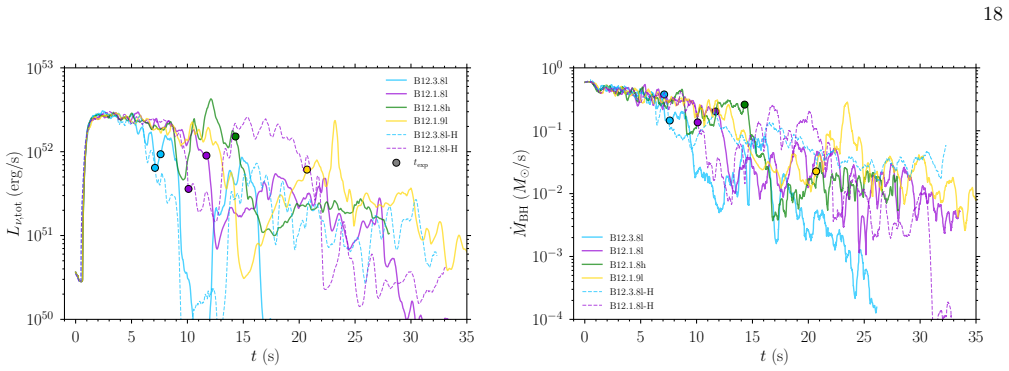
- [Section III.D and Fig. 8] The horizon poloidal flux oscillates with sign reversals, and the Poynting luminosity decays on a timescale of about 10 s after the peak; the authors note that no quasi-steady magnetosphere forms, possibly because of the simple dynamo modeling. Since long GRBs typically last 10-100 s, the paper should discuss whether an intermittent, polarity-flipping BZ jet with LBZ of order 10^50 erg/s for only about 10 s is compatible with the duration and energetics of typical long GRBs, or whether the late-time suppression is an artifact of the closure. This is directly relevant to the abstract's claim that the jet luminosity is 'suitable for explaining typical long gamma-ray bursts.'
- [Section III.E, Fig. 9, and Table III] The nucleosynthesis yields, including the claimed large Zn mass and the weak r-process, depend on low-Ye and high-entropy ejecta components that are not converged. For example, model B12.1.8l ejects no material with Ye less than about 0.35, while the higher-resolution run B12.1.8l-H ejects an appreciable low-Ye component, and the 56Ni mass drops from 1.08 to 0.50 solar masses between these two runs. The authors acknowledge this in the text ('we have to keep in mind that the convergence of the numerical results might be poor for other models as well'), but the abstract and conclusions present the 56Ni, Zn, and r-process results as part of the successful scenario. Please either soften these claims to reflect the resolution sensitivity or demonstrate convergence of the nucleosynthesis-relevant ejecta properties.
minor comments (6)
- [Eq. (8)] In Eq. (8), the sound speed c_s is a velocity, but the denominator in the second factor is written with units of g/cm^3; it should be cm/s (the text preceding the equation gives c_s = 0.1c = 3 x 10^9 cm/s).
- [Section III.A] Typo: 'Poynging flux' should be 'Poynting flux' in the paragraph describing the funnel structure and jet propagation.
- [Section III.D] Typo: 'B12.1.8l abd B12.1.8l-H' should be 'B12.1.8l and B12.1.8l-H' in the first paragraph discussing the Poynting flux evolution.
- [References] Reference [9] and reference [47] are the same paper (Fujibayashi et al., Phys. Rev. D 109, 023031) and should be consolidated.
- [Table I caption] The model-name key '104alpha_d' is ambiguous; it should be written as '10^4 alpha_d' for clarity.
- [Table II caption] The caption says 'Poynting luminosity integrated over simulation time,' but the column EBZ is an energy, not a time-integrated luminosity; consider renaming it 'Poynting energy.'
Circularity Check
No significant circularity: the dynamo closure is an acknowledged modeling assumption, and the predicted explosion and jet quantities are emergent simulation outputs.
full rationale
The paper's central claim is that a weak toroidal seed field, amplified by a prescribed mean-field alpha-Omega dynamo, can build a poloidal field that threads the black hole and launches a Blandford-Znajek jet with an accompanying stellar explosion. The target quantities—explosion energy, ejecta mass, 56Ni mass, and Poynting luminosity—are outputs of the simulations, not inputs. The dynamo parameters (alpha_d, sigma_c, rho_cut) are varied over a small grid (Table I), and the paper explicitly reports that some models do not launch jets (e.g., B12.3.8l-H), so the outcome is not enforced by construction. The dynamo term is taken from the authors' previous work [29], but this is disclosed as a phenomenological model ('we perform axisymmetric resistive magnetohydrodynamics simulations adding a dynamo term'), and plausible parameter values are also supported by external citations [39-41]. The comparison with observed type Ic-BL SNe and with viscous-hydrodynamics simulations is done after the runs, as an external benchmark, not as a fit. The paper also candidly states its limitations, noting that the magnetosphere may be poorly modeled and that a three-dimensional simulation is needed for quantitative results. No step in the derivation reduces, by definition or by parameter fitting, to the inputs. The self-citations are for code, formulation, and initial-data setup, not for the central result itself, and they do not constitute circular justification.
Assumptions & free parameters
free parameters (6)
- alpha_d (dimensionless dynamo coefficient) =
1e-4 or 3e-4
- sigma_c (magnetic conductivity) =
1e7, 1e8, or 1e9 s^-1
- rho_cut (dynamo cutoff density) =
1e6 or 1e8 g/cm3
- Initial maximum magnetic field Bmax =
1e11 or 1e12 G
- Initial black hole mass and spin =
M_BH,0 = 16 Msun, chi_0 = 0.70, envelope mass ~9.5 Msun
- alpha_viscosity in comparison run =
0.03
assumptions (6)
- domain assumption Axisymmetry with equatorial-plane symmetry
- ad hoc to paper Mean-field alpha-Omega dynamo source term
- ad hoc to paper Density cutoff rho_cut suppresses dynamo in low-density regions
- domain assumption Initial data of a spinning BH plus free-falling AD35 envelope
- ad hoc to paper Initial magnetic field is purely toroidal and weak
- domain assumption DD2 tabulated equation of state and approximate neutrino transport are adequate
Cite this review
Pith. "Pith review of Self-consistent scenario for jet and stellar explosion in collapsar: General relativistic magnetohydrodynamics simulation with dynamo." pith.science (2026). https://pith.science/paper/UFTV7I7U
@misc{pith2026250202077,
  author       = {Pith},
  title        = {Pith review of: Self-consistent scenario for jet and stellar explosion in collapsar: General relativistic magnetohydrodynamics simulation with dynamo},
  year         = {2026},
  howpublished = {\url{https://pith.science/paper/UFTV7I7U}},
  note         = {Machine review of arXiv:2502.02077}
}
abstract
A resistive magnetohydrodynamics simulation with a dynamo term is performed for modeling the collapsar in full general relativity. As an initial condition, a spinning black hole and infalling stellar matter are modeled based on a stellar evolution result, superimposing a weak toroidal magnetic field. After the growth of a massive torus around the black hole, the magnetic field is amplified in it, developing poloidal fields via dynamo. In an early stage of the torus growth, magnetic fluxes that fall to the vicinity of the central black hole are swallowed by the black hole and global poloidal magnetic fields that can be the source of the Blandford-Znajek mechanism are not developed. However, in a later stage in which the ram pressure of the infalling matter becomes weak, the magnetic field amplified by the black hole spin via the winding becomes large enough to expel the infalling matter by the magnetic pressure, and subsequently, a global poloidal magnetic field that penetrates the black hole is established, launching a jet along the spin axis by the Blandford-Znajek mechanism with the luminosity suitable for explaining typical long gamma-ray bursts. Together with the jet launch, the effectively viscous effect in the inner region of the torus and the magnetocentrifugal effect drive the stellar explosion with the explosion energy comparable to typical or powerful supernovae. We also find large amounts of synthesized $^{56}$Ni and Zn associated with the stellar explosion. In the presence of jet launching, $r$-process elements are weakly synthesized. The numerical results of the explosion energy, ejecta mass, and $^{56}$Ni mass are in a good agreement with those for observed broad-lined type Ic supernovae. Our result illustrates a self-consistent scenario for the gamma-ray-burst-associated broad-lined type Ic supernovae.
Figures


Figures from the paper (10 more)


Forward citations
Cited by 4 Pith papers
-
Hyperaccreting Magnetised Neutron Stars inside Rotating Massive Envelopes: Low-Power Jets and Precursor Flares
In 2D GRMHD simulations, magnetised neutron stars hyperaccreting inside massive envelopes can halt accretion above B_surf ~2.3e13 G and launch ~1e46 erg/s precursor jets that still cannot unbind the envelope.
-
Accretion Regimes of Neutrino-Cooled Flows onto Black Holes
A 1D relativistic disk model charts the accretion regimes of neutrino-cooled flows and predicts r-process outflows up to black hole masses of about 3000 solar masses.
-
SACRA-2D: New axisymmetric general relativistic hydrodynamics code with fixed mesh refinement
SACRA-2D is a new axisymmetric relativistic hydrodynamics code with the HLLC solver and adaptive mesh refinement, validated by benchmarks showing improved accuracy over the TVDLF solver.
-
Neutrino pair annihilation driven jets from black-hole torus systems
Neutrino pair annihilation in black hole-torus systems launches relativistic fireballs with isotropic energies up to about 10^51 erg and durations around 0.1 s, which can account for faint short GRBs and GRB precursors.
Reference graph
Works this paper leans on
-
[1]
Conditions for nucleosynthesis Before moving onto the nucleosynthesis results, we first review the general trends of physical conditions found in each of our models. Figure 9 shows the distribu- tions of the electron fraction (top) and the entropy per baryon (middle) in the ejecta components which experi- enced the temperature with > 5 GK (here GK= 10 9 K...
-
[2]
We use a nuclear re- action network code rNET [54]
Nucleosynthesis results Based on the thermodynamical histories obtained by the particle tracing method, nucleosynthesis calculations are performed in post-processing. We use a nuclear re- action network code rNET [54]. The network consists of about 6300 nuclear species with atomic number Z = 0– 110, which are connected by relevant reactions. Each nu- cleo...
2000
-
[3]
A. I. MacFadyen and S. E. Woosley, Collapsars: Gamma- Ray Bursts and Explosions in “Failed Supernovae”, As- trophys. J. 524, 262 (1999), arXiv:astro-ph/9810274 [astro-ph]
arXiv 1999
-
[4]
S. E. Woosley, Gamma-Ray Bursts from Stellar Mass Accretion Disks around Black Holes, Astrophys. J. 405, 273 (1993)
1993
-
[5]
Paczy´ nski, Are Gamma-Ray Bursts in Star- Forming Regions?, Astrophys
B. Paczy´ nski, Are Gamma-Ray Bursts in Star- Forming Regions?, Astrophys. J. Lett. 494, L45 (1998), arXiv:astro-ph/9710086 [astro-ph]
arXiv 1998
-
[6]
R. D. Blandford and R. L. Znajek, Electromagnetic ex- traction of energy from Kerr black holes., Mon. Not. R. Astron. Soc. 179, 433 (1977)
work page 1977
-
[7]
T. Piran, The physics of gamma-ray bursts, Reviews of Modern Physics 76, 1143 (2004), arXiv:astro-ph/0405503 [astro-ph]
arXiv 2004
-
[8]
B. Zhang and P. Meszaros, Gamma-ray bursts: Progress, problems & prospects, Int. J. Mod. Phys. A 19, 2385 (2004), arXiv:astro-ph/0311321
arXiv 2004
Show all 84 references
-
[10]
Kohri, R
K. Kohri, R. Narayan, and T. Piran, Neutrino-dominated Accretion and Supernovae, Astrophys. J. 629, 341 (2005), arXiv:astro-ph/0502470 [astro-ph]
2005 arXiv
-
[11]
O. Just, M. A. Aloy, M. Obergaulinger, and S. Na- gataki, r-process Viable Outflows are Suppressed in Global Alpha-viscosity Models of Collapsar Disks, Astro- phys. J. Lett. 934, L30 (2022), arXiv:2205.14158 [astro- ph.HE]
2022 arXiv
-
[12]
S. S. Komissarov, Observations of the Blandford-Znajek and the MHD Penrose processes in computer simulations of black hole magnetospheres, Mon. Not. Roy. Astron. Soc. 359, 801 (2005), arXiv:astro-ph/0501599
2005 arXiv
-
[13]
Dean and R
C. Dean and R. Fern´ andez, Collapsar disk outflows: Vis- cous hydrodynamic evolution in axisymmetry, Phys. Rev. D 109, 083010 (2024), arXiv:2403.08877 [astro-ph.HE]
2024 arXiv
-
[14]
Cano, S.-Q
Z. Cano, S.-Q. Wang, Z.-G. Dai, and X.-F. Wu, The Ob- server’s Guide to the Gamma-Ray Burst Supernova Con- nection, Advances in Astronomy 2017, 8929054 (2017), arXiv:1604.03549 [astro-ph.HE]
2017 arXiv
-
[15]
S. S. Komissarov and M. V. Barkov, Activation of the Blandford-Znajek mechanism in collapsing stars, Mon. Not. Roy. Astron. Soc.397, 1153 (2009), arXiv:0902.2881 [astro-ph.HE]
2009 arXiv
-
[16]
J. C. McKinney, General relativistic magnetohydrody- namic simulations of jet formation and large-scale propa- gation from black hole accretion systems, Mon. Not. Roy. Astron. Soc. 368, 1561 (2006), arXiv:astro-ph/0603045
2006 arXiv
-
[17]
M. V. Barkov and S. S. Komissarov, Stellar explosions powered by the Blandford-Znajek mechanism, Mon. Not. R. Astron. Soc. 385, L28 (2008), arXiv:0710.2654 [astro- ph]
2008 arXiv
-
[18]
Gottlieb, A
O. Gottlieb, A. Lalakos, O. Bromberg, M. Liska, and A. Tchekhovskoy, Black hole to breakout: 3D GRMHD simulations of collapsar jets reveal a wide range of tran- sients, Mon. Not. Roy. Astron. Soc. 510, 4962 (2022), arXiv:2109.14619 [astro-ph.HE]
2022 arXiv
-
[19]
Tchekhovskoy, R
A. Tchekhovskoy, R. Narayan, and J. C. McKinney, Effi- cient Generation of Jets from Magnetically Arrested Ac- cretion on a Rapidly Spinning Black Hole, Mon. Not. Roy. Astron. Soc. 418, L79 (2011), arXiv:1108.0412 [astro- ph.HE]
2011 arXiv
-
[20]
Bromberg and A
O. Bromberg and A. Tchekhovskoy, Relativistic MHD simulations of core-collapse GRB jets: 3D instabilities and magnetic dissipation, Mon. Not. Roy. Astron. Soc. 456, 1739 (2016), arXiv:1508.02721 [astro-ph.HE]
2016 arXiv
-
[21]
Eisenberg, O
M. Eisenberg, O. Gottlieb, and E. Nakar, Observa- tional signatures of stellar explosions driven by relativis- tic jets, Mon. Not. R. Astron. Soc. 517, 582 (2022), arXiv:2201.08432 [astro-ph.HE]
2022 arXiv
-
[22]
Tominaga, K
N. Tominaga, K. Maeda, H. Umeda, K. Nomoto, M. Tanaka, N. Iwamoto, T. Suzuki, and P. A. Maz- zali, The Connection between Gamma-Ray Bursts and Extremely Metal-poor Stars: Black Hole-forming Super- novae with Relativistic Jets, Astrophys. J. Lett.657, L77 (2007), arXiv:astro-ph...
2007 arXiv
-
[23]
Lazzati, B
D. Lazzati, B. J. Morsony, C. H. Blackwell, and M. C. Begelman, Unifying the Zoo of Jet-driven Stellar Ex- plosions, Astrophys. J. 750, 68 (2012), arXiv:1111.0970 [astro-ph.HE]
2012 arXiv
-
[24]
Narayan, I
R. Narayan, I. V. Igumenshchev, and M. A. Abramowicz, Magnetically Arrested Disk: an Energetically Efficient Accretion Flow, Publ. Astron. Soc. Jpn. 55, L69 (2003), arXiv:astro-ph/0305029 [astro-ph]
2003 arXiv
-
[25]
Shibata, S
M. Shibata, S. Fujibayashi, A. T.-L. Lam, K. Ioka, and Y. Sekiguchi, Outflow energy and black-hole spin evo- lution in collapsar scenarios, Phys. Rev. D 109, 043051 (2024), arXiv:2309.12086 [astro-ph.HE]
2024 arXiv
-
[26]
D. R. Aguilera-Dena, N. Langer, J. Antoniadis, and B. M¨ uller, Precollapse Properties of Superluminous Su- pernovae and Long Gamma-Ray Burst Progenitor Mod- els, Astrophys. J. 901, 114 (2020), arXiv:2008.09132 [astro-ph.SR]
2020 arXiv
-
[27]
Z.-F. Wu, M. Damoulakis, P. Beniamini, and D. Gi- annios, Maximal Jet Energy of Gamma-Ray Bursts through the Blandford-Znajek Mechanism, arXiv e-prints , arXiv:2411.12850 (2024), arXiv:2411.12850 [astro- ph.HE]
2024 arXiv
-
[28]
I. V. Igumenshchev, R. Narayan, and M. A. Abramow- icz, Three-dimensional mhd simulations of radiatively in- efficient accretion flows, Astrophys. J. 592, 1042 (2003), arXiv:astro-ph/0301402
2003 arXiv
-
[29]
Corsi, A
A. Corsi, A. Gal-Yam, S. R. Kulkarni, D. A. Frail, P. A. Mazzali, S. B. Cenko, M. M. Kasliwal, Y. Cao, A. Horesh, N. Palliyaguru, D. A. Perley, R. R. Laher, F. Taddia, G. Leloudas, K. Maguire, P. E. Nugent, J. Sollerman, and M. Sullivan, Radio Observations of a Sample of Broad...
2016 arXiv
-
[30]
Hayashi, S
K. Hayashi, S. Fujibayashi, K. Kiuchi, K. Kyu- toku, Y. Sekiguchi, and M. Shibata, General-relativistic neutrino-radiation magnetohydrodynamic simulation of seconds-long black hole-neutron star mergers, Phys. Rev. D 106, 023008 (2022), arXiv:2111.04621 [astro-ph.HE]
2022 arXiv
-
[31]
S. A. Balbus and J. F. Hawley, Instability, turbulence, and enhanced transport in accretion disks, Rev. Mod. Phys. 70, 1 (1998)
1998
-
[32]
Shibata, S
M. Shibata, S. Fujibayashi, and Y. Sekiguchi, Long-term evolution of neutron-star merger remnants in general rel- ativistic resistive magnetohydrodynamics with a mean- field dynamo term, Phys. Rev. D 104, 063026 (2021), arXiv:2109.08732 [astro-ph.HE]
2021 arXiv
-
[33]
Hayashi, K
K. Hayashi, K. Kiuchi, K. Kyutoku, Y. Sekiguchi, and M. Shibata, Jet from binary neutron star merger with prompt black hole formation, arXiv e-prints , arXiv:2410.10958 (2024), arXiv:2410.10958 [astro- ph.HE]
2024 arXiv
-
[34]
Hayashi, K
K. Hayashi, K. Kiuchi, K. Kyutoku, Y. Sekiguchi, and M. Shibata, General-relativistic neutrino-radiation magnetohydrodynamics simulation of seconds-long black hole-neutron star mergers: Dependence on the initial magnetic field strength, configuration, and neutron-star equation...
2023 arXiv
-
[35]
Kiuchi, S
K. Kiuchi, S. Fujibayashi, K. Hayashi, K. Kyutoku, Y. Sekiguchi, and M. Shibata, Self-Consistent Picture of the Mass Ejection from a One Second Long Binary Neutron Star Merger Leaving a Short-Lived Remnant in a General-Relativistic Neutrino-Radiation Magneto- hydrodynamic Simu...
2023 arXiv
-
[36]
Banik, M
S. Banik, M. Hempel, and D. Bandyopadhyay, New Hy- peron Equations of State for Supernovae and Neutron Stars in Density-dependent Hadron Field Theory, As- trophys. J. Suppl. Ser. 214, 22 (2014), arXiv:1404.6173 [astro-ph.HE]
2014 arXiv
-
[37]
D. Issa, O. Gottlieb, B. Metzger, J. Jacquemin-Ide, M. Liska, F. Foucart, G. Halevi, and A. Tchekhovskoy, Magnetically-Driven Neutron-Rich Ejecta Unleashed: Global 3D Neutrino-GRMHD Simulations of Col- lapsars Reveal the Conditions for r-process Nucle- osynthesis, arXiv e-prin...
2024 arXiv
-
[38]
Shibata, S
M. Shibata, S. Fujibayashi, and Y. Sekiguchi, Long- term evolution of a merger-remnant neutron star in general relativistic magnetohydrodynamics: Effect of magnetic winding, Phys. Rev. D 103, 043022 (2021), arXiv:2102.01346 [astro-ph.HE]
2021 arXiv
-
[39]
Gressel and M
O. Gressel and M. E. Pessah, Characterizing the Mean- field Dynamo in Turbulent Accretion Disks, Astrophys. J. 810, 59 (2015), arXiv:1507.08634 [astro-ph.HE]
2015 arXiv
-
[40]
Sekiguchi, K
Y. Sekiguchi, K. Kiuchi, K. Kyutoku, and M. Shibata, Dynamical mass ejection from binary neutron star merg- ers: Radiation-hydrodynamics study in general relativ- ity, Phys. Rev. D 91, 064059 (2015), arXiv:1502.06660 [astro-ph.HE]
2015 arXiv
-
[41]
Fujibayashi, Y
S. Fujibayashi, Y. Sekiguchi, K. Kiuchi, and M. Shi- bata, Properties of Neutrino-driven Ejecta from the Rem- nant of a Binary Neutron Star Merger: Pure Radia- tion Hydrodynamics Case, Astrophys. J.846, 114 (2017), arXiv:1703.10191 [astro-ph.HE]
2017 arXiv
-
[42]
O’Connor and C
E. O’Connor and C. D. Ott, Black Hole Formation in Failing Core-Collapse Supernovae, Astrophys. J. 730, 70 (2011), arXiv:1010.5550 [astro-ph.HE]
2011 arXiv
-
[43]
Reboul-Salze, J
A. Reboul-Salze, J. Guilet, R. Raynaud, and M. Bugli, A global model of the magnetorotational instability in pro- toneutron stars, Astron. Astrophys. 645, A109 (2021), arXiv:2005.03567 [astro-ph.HE]
2021 arXiv
-
[44]
Kiuchi, A
K. Kiuchi, A. Reboul-Salze, M. Shibata, and Y. Sekiguchi, A large-scale magnetic field produced by a solar-like dynamo in binary neutron star merg- ers, Nature Astron. 8, 298 (2024), arXiv:2306.15721 [astro-ph.HE]
2024 arXiv
-
[45]
Fujibayashi, M
S. Fujibayashi, M. Shibata, S. Wanajo, K. Kiuchi, K. Kyutoku, and Y. Sekiguchi, Viscous evolution of a massive disk surrounding stellar-mass black holes in full general relativity, Phys. Rev. D 102, 123014 (2020), arXiv:2009.03895 [astro-ph.HE]
2020 arXiv
-
[46]
Shibata, Numerical Relativity (World Scientific Pub- lishing Company, 2016)
M. Shibata, Numerical Relativity (World Scientific Pub- lishing Company, 2016)
2016
-
[47]
Fujibayashi, M
S. Fujibayashi, M. Shibata, S. Wanajo, K. Kiuchi, K. Kyutoku, and Y. Sekiguchi, Mass ejection from disks surrounding a low-mass black hole: Viscous neutrino-radiation hydrodynamics simulation in full gen- eral relativity, Phys. Rev. D 101, 083029 (2020), arXiv:2001.04467 [astro-ph.HE]
2020 arXiv
-
[48]
Liang, J
E.-W. Liang, J. L. Racusin, B. Zhang, B.-B. Zhang, and D. N. Burrows, A Comprehensive Analysis of Swift XRT Data. III. Jet Break Candidates in X-Ray and Optical Afterglow Light Curves, Astrophys. J. 675, 528 (2008), arXiv:0708.2942 [astro-ph]
2008 arXiv
-
[49]
Taddia, J
F. Taddia, J. Sollerman, C. Fremling, C. Barbarino, E. Karamehmetoglu, I. Arcavi, S. B. Cenko, A. V. Fil- ippenko, A. Gal-Yam, D. Hiramatsu, G. Hosseinzadeh, D. A. Howell, S. R. Kulkarni, R. Laher, R. Lunnan, F. Masci, P. E. Nugent, A. Nyholm, D. A. Perley, R. Quimby, and J. M...
2019
-
[50]
Fujibayashi, A
S. Fujibayashi, A. T.-L. Lam, M. Shibata, and Y. Sekiguchi, Supernovalike explosions of massive rotat- ing stars from disks surrounding a black hole, Phys. Rev. D 109, 023031 (2024), arXiv:2309.02161 [astro-ph.HE]
2024 arXiv
-
[51]
I. M. Christie, A. Lalakos, A. Tchekhovskoy, R. Fern´ andez, F. Foucart, E. Quataert, and D. Kasen, The role of magnetic field geometry in the evolution of neutron star merger accretion discs, Mon. Not. R. Astron. Soc. 490, 4811 (2019), arXiv:1907.02079 [astro-ph.HE]
2019 arXiv
-
[52]
Crosato Menegazzi, S
L. Crosato Menegazzi, S. Fujibayashi, M. Shibata, A. Be- tranhandy, and K. Takahashi, Variety of disc wind-driven explosions in massive rotating stars. II. Dependence on the progenitor, arXiv e-prints , arXiv:2411.04221 (2024), arXiv:2411.04221 [astro-ph.HE]
2024 arXiv
-
[53]
Beckwith, J
K. Beckwith, J. F. Hawley, and J. H. Krolik, The In- fluence of Magnetic Field Geometry on the Evolution of Black Hole Accretion Flows: Similar Disks, Dras- tically Different Jets, Astrophys. J. 678, 1180 (2008), arXiv:0709.3833 [astro-ph]
2008 arXiv
-
[54]
Wanajo, Physical Conditions for the r-process
S. Wanajo, Physical Conditions for the r-process. I. Ra- dioactive Energy Sources of Kilonovae, Astrophys. J. 868, 65 (2018), arXiv:1808.03763 [astro-ph.HE]
2018 arXiv
-
[55]
Fujibayashi, S
S. Fujibayashi, S. Wanajo, K. Kiuchi, K. Kyutoku, Y. Sekiguchi, and M. Shibata, Postmerger Mass Ejection of Low-mass Binary Neutron Stars, Astrophys. J. 901, 22 122 (2020), arXiv:2007.00474 [astro-ph.HE]
2020 arXiv
-
[56]
S. E. Woosley, A. Heger, and T. A. Weaver, The evolu- tion and explosion of massive stars, Reviews of Modern Physics 74, 1015 (2002)
2002
-
[57]
B. W. Grefenstette et al., Asymmetries in core-collapse supernovae from maps of radioactive44Ti in CassiopeiaA, Nature 506, 339 (2014), arXiv:1403.4978 [astro-ph.HE]
2014 arXiv
-
[58]
I. R. Seitenzahl, F. X. Timmes, and G. Magkotsios, The light curve of SN 1987A revisited: constraining produc- tion masses of radioactive nuclides, Astrophys. J. 792, 10 (2014), arXiv:1408.5986 [astro-ph.SR]
2014 arXiv
-
[59]
S. A. Grebenev, A. A. Lutovinov, S. S. Tsygankov, and C. Winkler, Hard X-ray emission lines from the decay of Ti-44 in the remnant of supernova 1987A, Nature 490, 373 (2012), arXiv:1211.2656 [astro-ph.HE]
2012 arXiv
-
[60]
Note that the dominance ofα elements for A ≤ 40 reflects the adopted initial composition of the pre-collapsing star, not due to the result of explosive nucleosynthesis
(scaled to match the result for B11.1.8h at A = 90). Note that the dominance ofα elements for A ≤ 40 reflects the adopted initial composition of the pre-collapsing star, not due to the result of explosive nucleosynthesis. We find that the presence of a jet (see the last column...
-
[61]
J. D. Kurfess, W. N. Johnson, R. L. Kinzer, R. A. Kroeger, M. S. Strickman, J. E. Grove, M. D. Leising, D. D. Clayton, D. A. Grabelsky, W. R. Purcell, M. P. Ulmer, R. A. Cameron, and G. V. Jung, Oriented Scin- tillation Spectrometer Experiment Observations of 57Co in SN 1987A,...
1992
-
[62]
Clocchiatti, N
A. Clocchiatti, N. B. Suntzeff, R. Covarrubias, and P. Candia, The Ultimate Light Curve of SN 1998bw/GRB 980425, Astron. J. 141, 163 (2011), arXiv:1106.1695 [astro-ph.HE]
2011 arXiv
-
[63]
Prantzos, C
N. Prantzos, C. Abia, S. Cristallo, M. Limongi, and A. Chieffi, Chemical evolution with rotating massive star yields II. A new assessment of the solar s- and r-process components, Mon. Not. R. Astron. Soc.491, 1832 (2020), arXiv:1911.02545 [astro-ph.GA]
2020 arXiv
-
[64]
A. P. Ji et al., Spectacular Nucleosynthesis from Early Massive Stars, Astrophys. J. Lett. 961, L41 (2024), arXiv:2401.02484 [astro-ph.SR]
2024 arXiv
-
[65]
D. M. Siegel, J. Barnes, and B. D. Metzger, Collapsars as a major source of r-process elements, Nature (London) 569, 241 (2019), arXiv:1810.00098 [astro-ph.HE]
2019 arXiv
-
[66]
R. D. Hoffman, S. E. Woosley, and Y. Z. Qian, Nucle- osynthesis in neutrino driven winds: 2. Implications for heavy element synthesis, Astrophys. J. 482, 951 (1997), arXiv:astro-ph/9611097
1997 arXiv
-
[67]
Kobayashi, H
C. Kobayashi, H. Umeda, K. Nomoto, N. Tominaga, and T. Ohkubo, Galactic chemical evolution: Car- bon through Zinc, Astrophys. J. 653, 1145 (2006), arXiv:astro-ph/0608688
2006 arXiv
-
[68]
Hirai, T
Y. Hirai, T. R. Saitoh, Y. Ishimaru, and S. Wanajo, En- richment of Zinc in galactic chemodynamical evolution models, Astrophys. J. 855, 63 (2018), arXiv:1801.08141 [astro-ph.GA]
2018 arXiv
-
[69]
Umeda and K
H. Umeda and K. Nomoto, Nucleosynthesis of zinc and iron-peak elements in pop III type II supernovae: com- parison with abundances of very metal-poor halo stars, Astrophys. J. 565, 385 (2002), arXiv:astro-ph/0103241
2002 arXiv
-
[70]
Tominaga, H
N. Tominaga, H. Umeda, and K. Nomoto, Supernova Nu- cleosynthesis in Population III 13-50 Solar Mass Stars and Abundance Patterns of Extremely Metal-Poor Stars, Astrophys. J. 660, 516 (2007), arXiv:astro-ph/0701381
2007 arXiv
-
[71]
Wanajo, H.-T
S. Wanajo, H.-T. Janka, and B. M¨ uller, Electron-capture Supernovae as The Origin of Elements Beyond Iron, Astrophys. J. 726, L15 (2011), arXiv:1009.1000 [astro- ph.SR]
2011 arXiv
-
[72]
Wanajo, B
S. Wanajo, B. M¨ uller, H.-T. Janka, and A. Heger, Nu- cleosynthesis in the Innermost Ejecta of Neutrino-driven Supernova Explosions in Two Dimensions, Astrophys. J. 852, 40 (2018), arXiv:1701.06786 [astro-ph.SR]
2018 arXiv
-
[73]
A. J. Levan et al. (JWST), Heavy-element production in a compact object merger observed by JWST, Nature 626, 737 (2024), arXiv:2307.02098 [astro-ph.HE]
2024 arXiv
-
[74]
Hotokezaka, M
K. Hotokezaka, M. Tanaka, D. Kato, and G. Gaigalas, Tellurium emission line in kilonova AT 2017gfo, Mon. Not. Roy. Astron. Soc. 526, L155 (2023), arXiv:2307.00988 [astro-ph.HE]
2023 arXiv
-
[75]
J. C. Rastinejad et al., A Hubble Space Telescope Search for r-Process Nucleosynthesis in Gamma-Ray Burst Su- pernovae, Astrophys. J.968, 14 (2024), arXiv:2312.04630 [astro-ph.HE]
2024 arXiv
-
[76]
Honda, W
S. Honda, W. Aoki, Y. Ishimaru, S. Wanajo, and S. G. Ryan, Neutron-Capture Elements in the Very Metal Poor Star HD 122563, Astrophys. J. 643, 1180 (2006), arXiv:astro-ph/0602107 [astro-ph]
2006 arXiv
-
[77]
Janka, Explosion Mechanisms of Core-Collapse Su- pernovae, Annual Review of Nuclear and Particle Science 62, 407 (2012), arXiv:1206.2503 [astro-ph.SR]
H.-T. Janka, Explosion Mechanisms of Core-Collapse Su- pernovae, Annual Review of Nuclear and Particle Science 62, 407 (2012), arXiv:1206.2503 [astro-ph.SR]
2012 arXiv
-
[78]
Sumiyoshi, S
K. Sumiyoshi, S. Yamada, H. Suzuki, and S. Chiba, Neu- trino Signals from the Formation of a Black Hole: A Probe of the Equation of State of Dense Matter, Phys. Rev. Lett. 97, 091101 (2006), arXiv:astro-ph/0608509 [astro-ph]
2006 arXiv
-
[79]
Kuroda and M
T. Kuroda and M. Shibata, Failed supernova simulations beyond black hole formation, Mon. Not. R. Astron. Soc. 526, 152 (2023), arXiv:2307.06192 [astro-ph.HE]
2023 arXiv
-
[80]
Fujibayashi, Y
S. Fujibayashi, Y. Sekiguchi, M. Shibata, and S. Wanajo, Collapse of Rotating Massive Stars Leading to Black Hole Formation and Energetic Supernovae, Astrophys. J.956, 100 (2023), arXiv:2212.03958 [astro-ph.HE]
2023 arXiv
-
[81]
Epstein, The generation of gravitational radiation by escaping supernova neutrinos., Astrophys
R. Epstein, The generation of gravitational radiation by escaping supernova neutrinos., Astrophys. J. 223, 1037 (1978)
1978
-
[82]
M. S. Turner, Gravitational radiation from supernova neutrino bursts, Nature (London) 274, 565 (1978)
1978
-
[83]
M¨ uller, H.-T
B. M¨ uller, H.-T. Janka, and A. Marek, A New Multi- dimensional General Relativistic Neutrino Hydrodynam- ics Code for Core-collapse Supernovae. II. Relativistic Explosion Models of Core-collapse Supernovae, Astro- phys. J. 756, 84 (2012), arXiv:1202.0815 [astro-ph.SR]
2012 arXiv
-
[84]
Kawamura et al., Current status of space gravitational wave antenna DECIGO and B-DECIGO, PTEP 2021, 05A105 (2021), arXiv:2006.13545 [gr-qc]
S. Kawamura et al., Current status of space gravitational wave antenna DECIGO and B-DECIGO, PTEP 2021, 05A105 (2021), arXiv:2006.13545 [gr-qc]
2021 arXiv
-
[85]
Corsi, A
A. Corsi, A. Y. Q. Ho, S. B. Cenko, S. R. Kulkarni, S. Anand, S. Yang, J. Sollerman, G. P. Srinivasaraga- van, C. M. B. Omand, A. Balasubramanian, D. A. Frail, C. Fremling, D. A. Perley, Y. Yao, A. S. Dahiwale, K. De, A. Dugas, M. Hankins, J. Jencson, M. M. Kasliwal, A. Tzanid...
2023 arXiv
Reviewed August 9, 2026 · model on record in the stance chip above.
Discussion (0). Continue with ORCID to comment.