REVIEW 3 major objections 4 minor 162 references
Effective and secure federated online learning to rank
T0 review · 3 major / 4 minor · reviewed 2026-08-11 · deepseek-v4-flash
Pith's one-line read This thesis claims that FPDGD, a federated adaptation of PDGD with differential privacy, is a reliable, stable, and secure federated online learning to rank method that significantly outperforms the only prior FOLTR baseline.
desk verdict Empirical thesis on federated learning to rank with solid experiments, but the claimed ε-DP guarantee does not follow from the L2 clipping + Laplace noise mechanism. read the letter →
The pith
A machine-rendered reading of the paper's core claim, the machinery that carries it, and where it could break.
The reading
What carries the argument
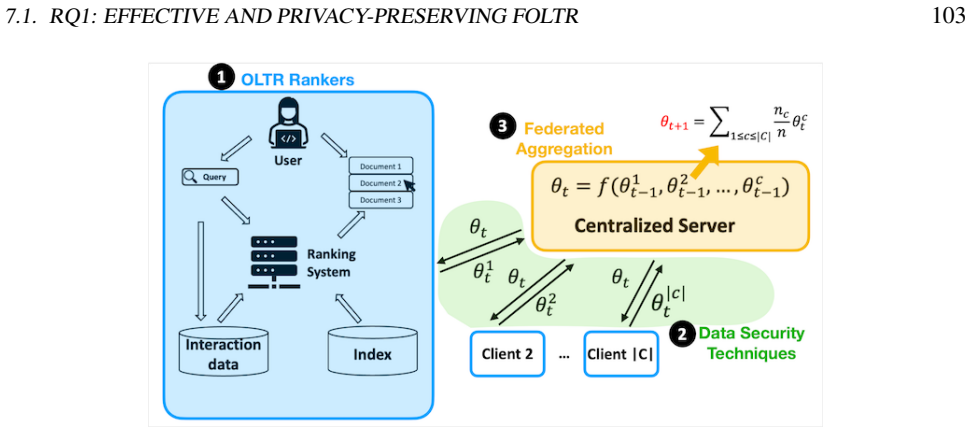
The method that carries the argument is FPDGD: Federated Pairwise Differentiable Gradient Descent. It combines PDGD, which estimates a pairwise gradient from click preferences using a Plackett-Luce ranking model and inverse-propensity-style reweighting to reduce position bias, with the Federated Averaging algorithm, where each client runs local PDGD updates on a batch of queries and the server averages the returned weight vectors. Privacy is enforced by clipping each local update's norm to a bound $\Delta$/2 and having each client contribute Gamma noise whose sum behaves as a Laplace random variable, implementing an epsilon-differential privacy mechanism.
What would settle it
Measure the true global sensitivity of the FedAvg-aggregated PDGD update by computing the maximum L1 distance between aggregated updates obtained from two click datasets that differ in one client's interaction, and compare that value with the $\Delta$ used in the privacy analysis; if the measured sensitivity exceeds $\Delta$, the stated epsilon-differential privacy guarantee is invalid. A complementary test is to run a membership inference attack against the released local updates and check whether the empirical attack advantage matches what the claimed epsilon would permit.
Extended reading notes
Core claim
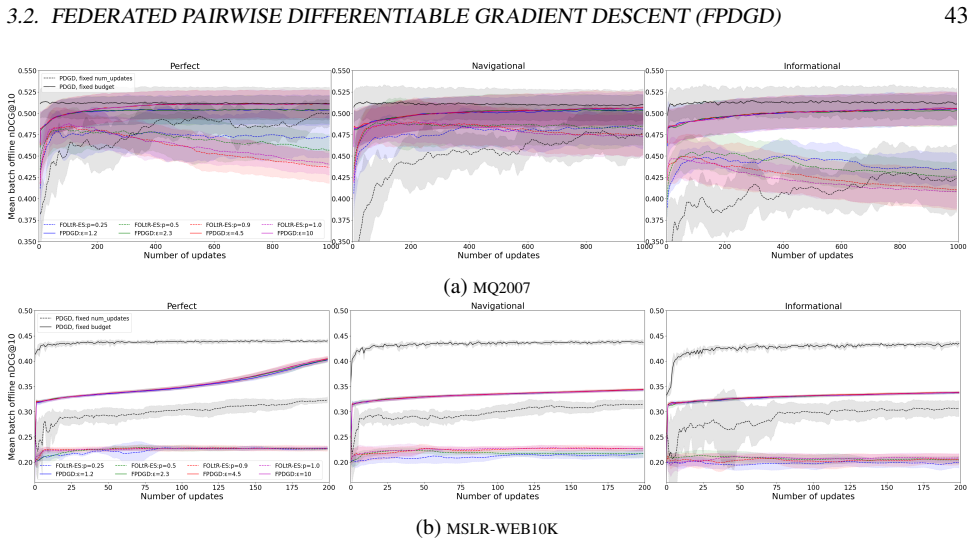
The central discovery is a new method, FPDGD, that casts the state-of-the-art centralised OLTR algorithm PDGD into the Federated Averaging framework and overlays an epsilon-differential privacy mechanism on the communicated updates. Each client performs local PDGD updates from clicks, clips the resulting weights to a norm bound, and adds Gamma noise that sums to a Laplace-distributed perturbation, so that the server never sees raw queries, documents, or clicks. The thesis reports that FPDGD consistently and significantly outperforms FOLtR-ES, the only prior FOLTR method, on large-scale datasets and under noisy click models, and that it remains stable when privacy budgets change. It further claims that only certain types of non-IID data, chiefly document preference skew and extreme label-distribution skew, seriously degrade FPDGD, and that standard non-IID remedies from general federated learning do not transfer, while data sharing helps the label-skew case. It also reports that data and model poisoning attacks can reduce ranking effectiveness and that robust aggregation rules such as Krum, Multi-Krum, Trimmed Mean, and Median provide defense, and finally that unlearning a client via historical local updates yields a ranker comparable to retraining from scratch.
Load-bearing premise
The differential privacy guarantee holds only if clipping each local weight update to norm $\Delta$/2 actually bounds the global sensitivity of the aggregated update by $\Delta$; the paper selects $\Delta$ by grid search rather than computing the true sensitivity.
Editorial extensions
If this is right
- FPDGD gives the first gradient-based federated online learning to rank method with reported consistent gains over the evolutionary-strategy baseline, making it a practical candidate for real federated search.
- Adding differential privacy to FPDGD has little effect on ranking quality when enough clients participate, but it can badly hurt convergence when only a handful of clients are available.
- Only some forms of non-IID data are dangerous for FPDGD: document-preference skew and single-label per-client skew degrade performance, while click-model variation and data-quantity skew do not.
- Standard federated non-IID remedies such as FedProx and FedPer do not close the gap for Type 1 non-IID data; sharing a small global dataset helps for extreme label-distribution skew.
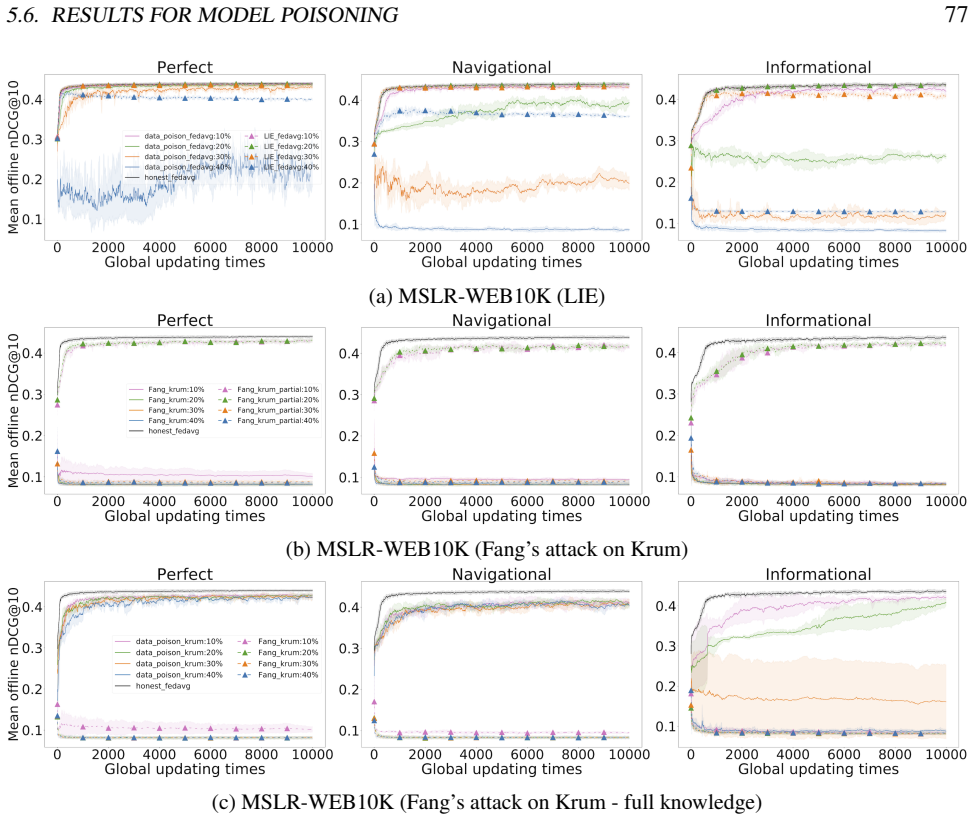
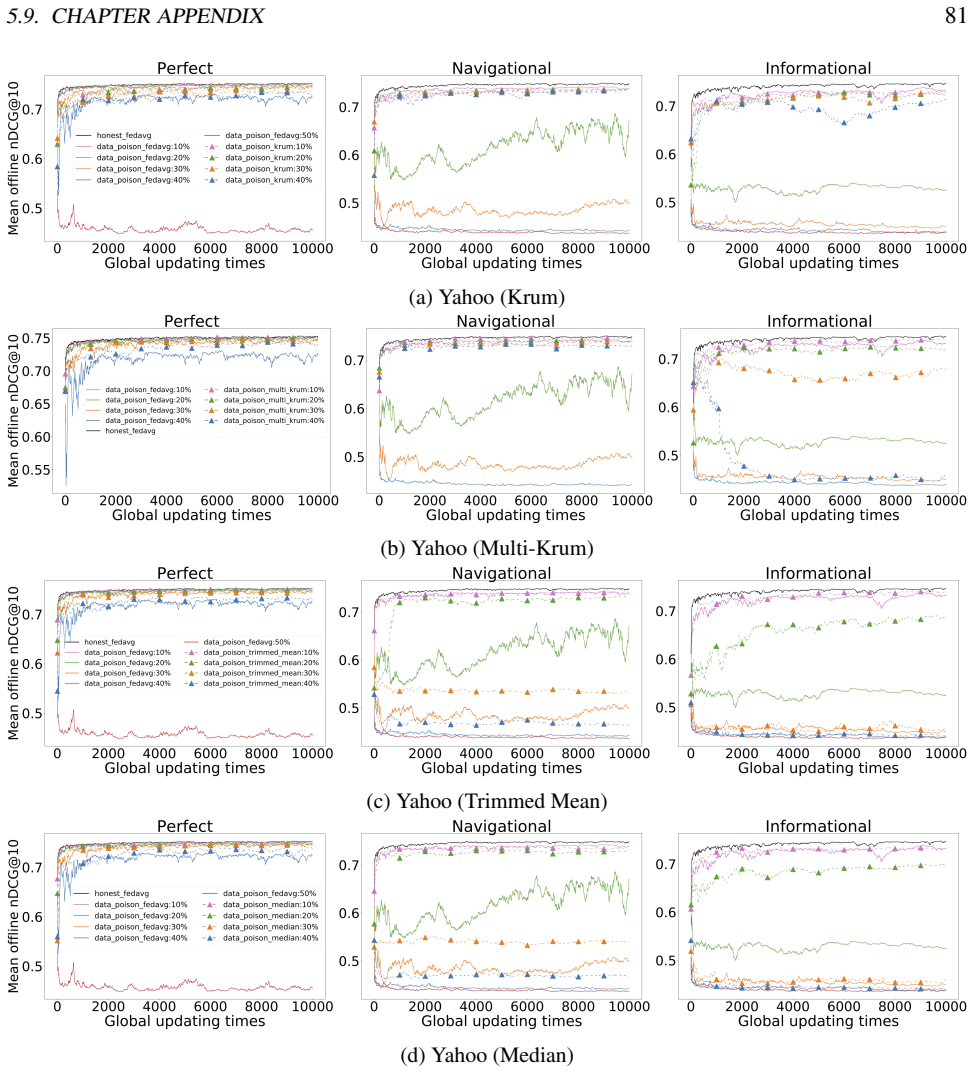
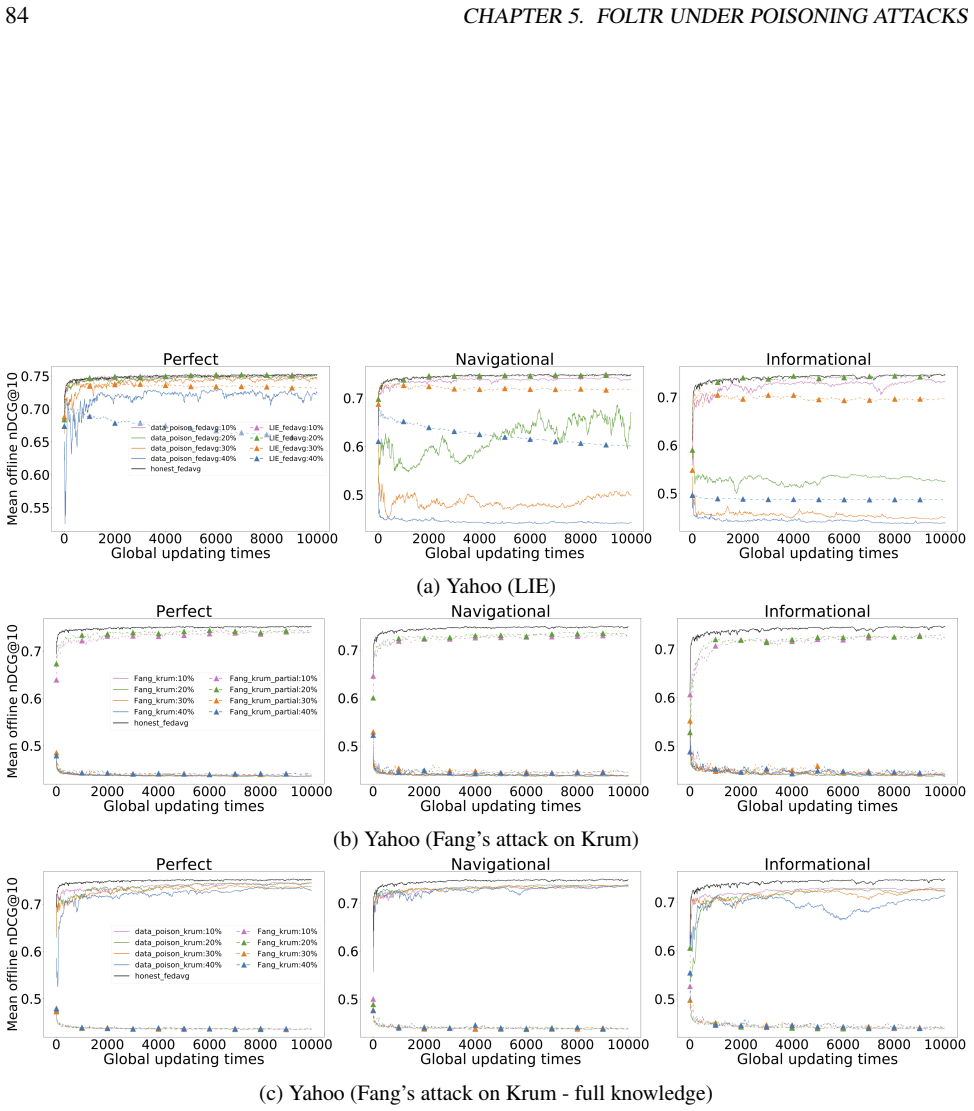
- Untargeted data and model poisoning attacks can degrade FOLTR effectiveness, and robust aggregation rules mitigate them, with Krum behaving differently from Trimmed Mean and Median depending on attack strength and attack type.
Reading between the lines
- The privacy guarantee is only as strong as the fitted clipping bound: because Delta is chosen by grid search rather than derived from PDGD's actual sensitivity, the reported epsilon values may understate the true privacy loss if the update's global sensitivity exceeds Delta.
- The non-IID findings are tied to FPDGD's pairwise loss and FedAvg aggregation; other federated ranking methods, especially ones not using pairwise preferences, could respond differently to the same data distributions.
- The poison-based unlearning verification is a transferable idea: a malicious-client probe can serve as a practical membership test for whether a federated model has erased a client's influence, beyond the ranking domain.
- As federated rankers move toward pretrained-language-model architectures, the same attack, non-IID, and unlearning questions will need to be revisited because gradient statistics and update norms differ substantially from linear rankers.
Editorial analysis
A structured set of objections, weighed in public.
Referee Report
Summary. The thesis studies Federated Online Learning to Rank (FOLTR), motivated by privacy concerns in centralized OLTR. It makes four contributions: (1) an analysis of the existing FOLtR-ES method, showing instability on large datasets; (2) a new method FPDGD, which adapts PDGD to the FedAvg framework and adds a differential privacy mechanism via norm clipping and Gamma-split Laplace noise; (3) an empirical taxonomy and study of non-IID data in FOLTR; (4) a study of poisoning attacks and defenses, and an unlearning method with a poisoning-based verification. The effectiveness comparison of FPDGD against FOLtR-ES is supported by extensive experiments on MQ2007 and MSLR-WEB10K with significance tests, and the thesis honestly reports settings where FOLtR-ES wins (Table 3.1, MQ2007 perfect and navigational clicks). However, the central 'secured' claim rests on a differentially private mechanism whose stated privacy guarantee does not follow from the presented analysis, because the sensitivity is computed in the L2 norm while Laplace noise requires L1 sensitivity.
Significance. If the privacy guarantee were valid, FPDGD would be the first gradient-based FOLTR method with consistent gains over the evolutionary-strategy baseline, and the thesis would make a solid contribution to privacy-preserving ranking. The non-IID taxonomy (Type 1--4), the poisoning attack/defense analysis, and the unlearning verification approach are useful empirical benchmarks for a nascent subfield. The thesis is also commendable for releasing code and experimental scripts for most chapters, and for including statistical significance testing and honest reporting of negative results (e.g., MQ2007 cases where FOLtR-ES is better). However, the privacy analysis in Chapter 3 is load-bearing for the thesis's claim that FPDGD is 'secured' and 'privacy-preserving', and that analysis is incorrect as presented; this materially weakens the contribution.
major comments (3)
- [Section 3.2.4 and Table 3.1] The differential privacy mechanism clips each local weight vector to L2 norm Delta/2 and adds Gamma-split Laplace noise with scale Delta/epsilon. The Laplace mechanism (Definition 3.2.2) requires the global sensitivity in the L1 norm, not the L2 norm. Two d-dimensional vectors each with L2 norm at most Delta/2 can differ in L1 norm by up to Delta*sqrt(d). For the linear ranker on MSLR-WEB10K, d = 136, so a claimed epsilon = 1.2 corresponds to an effective privacy budget of at least 1.2*sqrt(136) ≈ 14.0; for the neural ranker the gap is larger. The statement in Section 3.2.1 that clipping to Delta/2 'can meet the global sensitivity Delta' is therefore unsupported. The claimed epsilon-DP guarantee does not follow from the presented analysis, undermining the central 'secured' and 'privacy-preserving' claims of the thesis. The mechanism should either clip in L1 norm, calibrate the noise to the true L1 sensitivity Delta*sqrt(d), or use a different privacy accounting such as the moments accountant with L2 sensitivity and Gaussian noise.
- [Section 3.2.4 and Table 3.1] The summary states that 'Empirical evaluation shows FPDGD significantly outperforms the only other federated OLTR method (i.e., FOLtR-ES)'. Table 3.1 shows the opposite for MQ2007 under the perfect and navigational click models, where FOLtR-ES is significantly better than FPDGD (marked with ▼, p < 0.01) for all privacy levels epsilon. The claim should be qualified to the large-scale dataset (MSLR-WEB10K) or to the informational click model on MQ2007. As written, the claim is contradicted by the thesis's own results and overstates the reliability of FPDGD.
- [Section 6.1.4 and Section 6.3.1] The unlearning verification injects a poisoning attack designed by the authors (a reversed CCM click model and amplified updates) and measures whether its impact diminishes after unlearning. This is a plausible approach, but it only verifies removal of a contrived signal, not the removal of a client's actual data contributions. The thesis should explicitly state that the verification is conditional on the attack model and that it does not provide a formal or general guarantee of unlearning. This limitation is important because Chapter 6 claims, based on this verification, that the proposed method effectively forgets client contributions.
minor comments (4)
- [Definition 3.2.1] Typo: 'datesets' should be 'datasets'.
- [Section 3.2.1] Typo: 'outputed' should be 'output'.
- [Section 3.2.2] The mapping from FOLtR-ES privacy parameter p in {0.25, 0.5, 0.9, 1.0} to epsilon values in {1.2, 2.3, 4.5, 10} is asserted but not derived. Please show the calculation using Eq. (3.6) and state the number of discrete metric values n used in that formula.
- [Section 4.5-4.6] The conclusions that Type 3 (click preferences) and Type 4 (data quantity) non-IID data do not impact FPDGD effectiveness are based on experiments with a linear ranker and the MSLR-WEB10K dataset only. Please qualify the generality of these findings, as the thesis itself notes for Type 4 that the result 'may be specific to FPDGD'.
Circularity Check
No significant circularity: FPDGD's effectiveness is externally benchmarked; the DP guarantee has a correctness gap but is not circular.
full rationale
The thesis's central effectiveness claim (FPDGD outperforms FOLtR-ES) is an empirical comparison against an external baseline and against the non-federated PDGD method, using standard LTR datasets (MQ2007, MSLR-WEB10K), standard OLTR click simulation, and nDCG metrics. FPDGD is an adaptation of the externally published PDGD algorithm to the FedAvg framework; its gains are measured, not derived from its own definitions. The non-IID taxonomy (Chapter 4) and the poisoning attack/defense study (Chapter 5) define new evaluation conditions but do not use the target conclusion as an input. The unlearning verification (Chapter 6) uses a self-designed poisoning signal as an experimental proxy, with retraining-from-scratch as the baseline, so it is not a circular derivation. Self-citations are present but not load-bearing: the FOLtR-ES reproducibility study is conducted with the original author's code and external datasets, and the non-IID and attack experiments are new. The one load-bearing theoretical claim, the ε-DP guarantee in Section 3.2.1, is under-supported: Eq. 3.19 clips the L2 norm of updates while the Laplace mechanism requires an L1 global sensitivity, so the stated privacy budget is not established from the presented analysis. This is a correctness / omitted-proof gap rather than a circularity: the privacy parameter Δ is tuned by grid search, but the reported ranking effectiveness is an empirical outcome, not a quantity forced by that choice. No step reduces by construction to its own inputs.
Assumptions & free parameters
free parameters (2)
- DP sensitivity Delta =
Delta in {3,3,5,5} for epsilon in {1.2,2.3,4.5,10}
- Unlearning hyperparameters n'i and Delta t =
n'i in {1,2,3,4}, Delta t in {5,10,20}
assumptions (4)
- domain assumption CCM click models (perfect, navigational, informational, poison) faithfully simulate real user and attacker click behavior.
- domain assumption Weighted averaging of local PDGD-updated parameters in FedAvg produces a valid global ranker for online learning to rank.
- ad hoc to paper Clipping local weights to norm Delta/2 yields a global sensitivity of Delta for the PDGD update, so Laplace/Gamma noise provides epsilon-DP.
- standard math Laplace noise can be split into per-client Gamma noise as in Equations 3.21 and 3.22.
invented entities (2)
-
Poison click model instantiation (reverse CCM)
-
Type 1-4 non-IID taxonomy for FOLTR
Cite this review
Pith. "Pith review of Effective and secure federated online learning to rank." pith.science (2026). https://pith.science/paper/UGETOP4C
@misc{pith2026241219069,
  author       = {Pith},
  title        = {Pith review of: Effective and secure federated online learning to rank},
  year         = {2026},
  howpublished = {\url{https://pith.science/paper/UGETOP4C}},
  note         = {Machine review of arXiv:2412.19069}
}
read the original abstract
Online Learning to Rank (OLTR) optimises ranking models using implicit user feedback, such as clicks. Unlike traditional Learning to Rank (LTR) methods that rely on a static set of training data with relevance judgements to learn a ranking model, OLTR methods update the model continually as new data arrives. Thus, it addresses several drawbacks such as the high cost of human annotations, potential misalignment between user preferences and human judgments, and the rapid changes in user query intents. However, OLTR methods typically require the collection of searchable data, user queries, and clicks, which poses privacy concerns for users. Federated Online Learning to Rank (FOLTR) integrates OLTR within a Federated Learning (FL) framework to enhance privacy by not sharing raw data. While promising, FOLTR methods currently lag behind traditional centralised OLTR due to challenges in ranking effectiveness, robustness with respect to data distribution across clients, susceptibility to attacks, and the ability to unlearn client interactions and data. This thesis presents a comprehensive study on Federated Online Learning to Rank, addressing its effectiveness, robustness, security, and unlearning capabilities, thereby expanding the landscape of FOLTR.
Figures


Figures from the paper (40 more)












Reference graph
Works this paper leans on
-
[1]
S. Wang, S. Zhuang, G. Zuccon, Federated online learning to rank with evolution strategies: A reproducibility study, in: European Conference on Information Retrieval, Springer, 2021, pp. 134–149
2021
-
[2]
S. Wang, B. Liu, S. Zhuang, G. Zuccon, Effective and privacy-preserving federated online learning to rank, in: Proceedings of the 2021 ACM SIGIR international conference on theory of information retrieval, 2021, pp. 3–12
2021
-
[3]
S. Wang, G. Zuccon, Is non-iid data a threat in federated online learning to rank?, in: Proceedings of the 45th International ACM SIGIR Conference on Research and Development in Information Retrieval, 2022, pp. 2801–2813
2022
-
[4]
S. Wang, G. Zuccon, An analysis of untargeted poisoning attack and defense methods for federated online learning to rank systems, in: Proceedings of the 2023 ACM SIGIR International Conference on Theory of Information Retrieval, 2023, pp. 215–224
2023
-
[5]
S. Wang, B. Liu, G. Zuccon, How to forget clients in federated online learning to rank?, in: N. Goharian, N. Tonellotto, Y . He, A. Lipani, G. McDonald, C. Macdonald, I. Ounis (Eds.), Advances in Information Retrieval - 46th European Conference on Information Retrieval, ECIR 2024, Glasgow, UK, March 24-28, 2024, Proceedings, Part III, V ol. 14610 of Lectu...
-
[6]
H. Zhu, J. Xu, S. Liu, Y . Jin, Federated learning on non-iid data: A survey, Neurocomputing 465 (2021) 371–390
2021
-
[7]
McMahan, E
B. McMahan, E. Moore, D. Ramage, S. Hampson, B. A. y Arcas, Communication-efficient learning of deep networks from decentralized data, in: International Conference on Artificial Intelligence and Statistics, PMLR, 2017, pp. 1273–1282
2017
- [8]
Show all 162 references
-
[9]
J. Y . Kim, N. Craswell, S. Dumais, F. Radlinski, F. Liu, Understanding and modeling success in email search, in: Proceedings of the 40th International ACM SIGIR Conference on Research and Development in Information Retrieval, 2017, pp. 265–274
2017
-
[10]
Datta, D
R. Datta, D. Joshi, J. Li, J. Z. Wang, Image retrieval: Ideas, influences, and trends of the new age, ACM Computing Surveys (Csur) 40 (2) (2008) 1–60
2008
-
[11]
Orio, et al., Music retrieval: A tutorial and review, Foundations and Trends® in Information Retrieval 1 (1) (2006) 1–90
N. Orio, et al., Music retrieval: A tutorial and review, Foundations and Trends® in Information Retrieval 1 (1) (2006) 1–90
2006
-
[12]
Y . Cao, J. Xu, T.-Y . Liu, H. Li, Y . Huang, H.-W. Hon, Adapting ranking svm to document retrieval, in: Proceedings of the 29th annual international ACM SIGIR conference on Research and development in information retrieval, 2006, pp. 186–193
2006
-
[13]
Liu, et al., Learning to rank for information retrieval, Foundations and Trends ® in Information Retrieval 3 (3) (2009) 225–331
T.-Y . Liu, et al., Learning to rank for information retrieval, Foundations and Trends ® in Information Retrieval 3 (3) (2009) 225–331
2009
-
[14]
Sanderson, Test collection based evaluation of information retrieval systems, Now Publishers Inc, 2010
M. Sanderson, Test collection based evaluation of information retrieval systems, Now Publishers Inc, 2010
2010
-
[15]
Lefortier, P
D. Lefortier, P. Serdyukov, M. De Rijke, Online exploration for detecting shifts in fresh intent, in: Proceedings of the 23rd ACM International Conference on Conference on Information and Knowledge Management, 2014, pp. 589–598
2014
-
[16]
Zhuang, G
S. Zhuang, G. Zuccon, How do online learning to rank methods adapt to changes of intent?, in: Proceedings of the 44th International ACM SIGIR Conference on Research and Development in Information Retrieval, 2021
2021
-
[17]
X. Wang, M. Bendersky, D. Metzler, M. Najork, Learning to rank with selection bias in personal search, in: Proceedings of the 39th International ACM SIGIR conference on Research and Development in Information Retrieval, 2016, pp. 115–124
2016
-
[18]
Joachims, L
T. Joachims, L. Granka, B. Pan, H. Hembrooke, G. Gay, Accurately interpreting clickthrough data as implicit feedback, in: Acm Sigir Forum, V ol. 51, Acm New York, NY , USA, 2017, pp. 4–11
2017
-
[19]
Oosterhuis, R
H. Oosterhuis, R. Jagerman, M. de Rijke, Unbiased learning to rank: counterfactual and online approaches, in: Companion Proceedings of the Web Conference 2020, 2020, pp. 299–300
2020
-
[20]
Q. Ai, T. Yang, H. Wang, J. Mao, Unbiased learning to rank: online or offline?, ACM Transac- tions on Information Systems (TOIS) 39 (2) (2021) 1–29
2021
-
[21]
Cohen, C
S. Cohen, C. Domshlak, N. Zwerdling, On ranking techniques for desktop search, ACM Transactions on Information Systems (TOIS) 26 (2) (2008) 1–24. BIBLIOGRAPHY 113
2008
-
[22]
D. A. Hanauer, Emerse: the electronic medical record search engine, in: AMIA annual sympo- sium proceedings, V ol. 2006, American Medical Informatics Association, 2006, p. 941
2006
-
[23]
Hawking, Challenges in enterprise search, in: K
D. Hawking, Challenges in enterprise search, in: K. Schewe, H. E. Williams (Eds.), Database Technologies 2004, Proceedings of the Fifteenth Australasian Database Conference, ADC 2004, Dunedin, New Zealand, 18-22 January 2004, V ol. 27 of CRPIT, Australian Computer Society, 200...
2004
-
[24]
Barbaro, T
M. Barbaro, T. Zeller, S. Hansell, A face is exposed for aol searcher no. 4417749, New York Times 9 (2008) (2006) 8
2008
-
[25]
Carpineto, G
C. Carpineto, G. Romano, A review of ten year research on query log privacy, in: G. M. D. Nunzio, F. M. Nardini, S. Orlando (Eds.), Proceedings of the 7th Italian Information Retrieval Workshop, Venezia, Italy, May 30-31, 2016, V ol. 1653 of CEUR Workshop Proceedings, CEUR- WS...
2016
-
[26]
Sousa, C
S. Sousa, C. Guetl, R. Kern, Privacy in open search: A review of challenges and solutions, arXiv preprint arXiv:2110.10720 (2021)
2021 arXiv
-
[27]
Kharitonov, Federated online learning to rank with evolution strategies, in: Proceedings of the Twelfth ACM International Conference on Web Search and Data Mining, 2019, pp
E. Kharitonov, Federated online learning to rank with evolution strategies, in: Proceedings of the Twelfth ACM International Conference on Web Search and Data Mining, 2019, pp. 249–257
2019
-
[28]
Q. Yang, Y . Liu, T. Chen, Y . Tong, Federated machine learning: Concept and applications, ACM Transactions on Intelligent Systems and Technology (TIST) 10 (2) (2019) 1–19
2019
-
[29]
Y . Yue, T. Joachims, Interactively optimizing information retrieval systems as a dueling bandits problem, in: Proceedings of the 26th Annual International Conference on Machine Learning, 2009, pp. 1201–1208
2009
-
[30]
Y . Zhao, M. Li, L. Lai, N. Suda, D. Civin, V . Chandra, Federated learning with non-iid data, arXiv preprint arXiv:1806.00582 (2018)
2018 arXiv
-
[31]
Briggs, Z
C. Briggs, Z. Fan, P. Andras, Federated learning with hierarchical clustering of local updates to improve training on non-iid data, in: 2020 International Joint Conference on Neural Networks (IJCNN), IEEE, 2020, pp. 1–9
2020
-
[32]
Q. Li, Y . Diao, Q. Chen, B. He, Federated learning on non-iid data silos: An experimental study, in: IEEE International Conference on Data Engineering, 2022
2022
-
[33]
Bagdasaryan, A
E. Bagdasaryan, A. Veit, Y . Hua, D. Estrin, V . Shmatikov, How to backdoor federated learning, in: International Conference on Artificial Intelligence and Statistics, PMLR, 2020, pp. 2938– 2948. 114 BIBLIOGRAPHY
2020
-
[34]
V oigt, A
P. V oigt, A. V on dem Bussche, The eu general data protection regulation (gdpr), A Practical Guide, 1st Ed., Cham: Springer International Publishing 10 (3152676) (2017) 10–5555
2017
-
[35]
E. L. Harding, J. J. Vanto, R. Clark, L. Hannah Ji, S. C. Ainsworth, Understanding the scope and impact of the california consumer privacy act of 2018, Journal of Data Protection & Privacy 2 (3) (2019) 234–253
2019
-
[36]
Bourtoule, V
L. Bourtoule, V . Chandrasekaran, C. A. Choquette-Choo, H. Jia, A. Travers, B. Zhang, D. Lie, N. Papernot, Machine unlearning, in: 2021 IEEE Symposium on Security and Privacy (SP), IEEE, 2021, pp. 141–159
2021
-
[37]
G. Liu, X. Ma, Y . Yang, C. Wang, J. Liu, Federaser: Enabling efficient client-level data removal from federated learning models, in: 2021 IEEE/ACM 29th International Symposium on Quality of Service (IWQOS), IEEE, 2021, pp. 1–10
2021
-
[38]
Dwork, A
C. Dwork, A. Roth, et al., The algorithmic foundations of differential privacy., Foundations and Trends in Theoretical Computer Science 9 (3-4) (2014) 211–407
2014
-
[39]
Oosterhuis, M
H. Oosterhuis, M. de Rijke, Differentiable unbiased online learning to rank, in: Proceedings of the 27th ACM international conference on information and knowledge management, 2018, pp. 1293–1302
2018
-
[40]
T. Qin, T. Liu, Introducing LETOR 4.0 datasets, CoRR abs/1306.2597 (2013). URL http://arxiv.org/abs/1306.2597
2013 arXiv
-
[41]
J. Gao, H. Qi, X. Xia, J.-Y . Nie, Linear discriminant model for information retrieval, in: Pro- ceedings of the 28th annual international ACM SIGIR conference on Research and development in information retrieval, 2005, pp. 290–297
2005
-
[42]
Burges, T
C. Burges, T. Shaked, E. Renshaw, A. Lazier, M. Deeds, N. Hamilton, G. Hullender, Learning to rank using gradient descent, in: Proceedings of the 22nd international conference on Machine learning, 2005, pp. 89–96
2005
-
[43]
Z. Cao, T. Qin, T.-Y . Liu, M.-F. Tsai, H. Li, Learning to rank: from pairwise approach to listwise approach, in: Proceedings of the 24th international conference on Machine learning, 2007, pp. 129–136
2007
-
[44]
Burges, R
C. Burges, R. Ragno, Q. Le, Learning to rank with nonsmooth cost functions, Advances in neural information processing systems 19 (2006)
2006
-
[45]
Chapelle, Y
O. Chapelle, Y . Chang, Yahoo! learning to rank challenge overview, in: O. Chapelle, Y . Chang, T. Liu (Eds.), Proceedings of the Yahoo! Learning to Rank Challenge, held at ICML 2010, Haifa, Israel, June 25, 2010, V ol. 14 of JMLR Proceedings, JMLR.org, 2011, pp. 1–24. BIBLIOG...
2010
-
[46]
Agarwal, K
A. Agarwal, K. Takatsu, I. Zaitsev, T. Joachims, A general framework for counterfactual learning- to-rank, in: Proceedings of the 42nd International ACM SIGIR Conference on Research and Development in Information Retrieval, 2019, pp. 5–14
2019
-
[47]
Jagerman, H
R. Jagerman, H. Oosterhuis, M. de Rijke, To model or to intervene: A comparison of coun- terfactual and online learning to rank from user interactions, in: International ACM SIGIR Conference on Research and Development in Information Retrieval, 2019, pp. 15–24
2019
-
[48]
Hofmann, S
K. Hofmann, S. Whiteson, M. De Rijke, A probabilistic method for inferring preferences from clicks, in: Proceedings of the 20th ACM international conference on Information and knowledge management, 2011, pp. 249–258
2011
-
[49]
Oosterhuis, A
H. Oosterhuis, A. Schuth, M. de Rijke, Probabilistic multileave gradient descent, in: European Conference on Information Retrieval, Springer, 2016, pp. 661–668
2016
-
[50]
Zhuang, G
S. Zhuang, G. Zuccon, Counterfactual online learning to rank, in: European Conference on Information Retrieval, Springer, 2020, pp. 415–430
2020
-
[51]
Hofmann, A
K. Hofmann, A. Schuth, S. Whiteson, M. De Rijke, Reusing historical interaction data for faster online learning to rank for IR, in: Proceedings of the sixth ACM international conference on Web search and data mining, 2013, pp. 183–192
2013
-
[52]
Y . Jia, H. Wang, S. Guo, H. Wang, Pairrank: Online pairwise learning to rank by divide-and- conquer, in: Proceedings of the Web Conference 2021, 2021, pp. 146–157
2021
-
[53]
Y . Jia, H. Wang, Learning neural ranking models online from implicit user feedback, in: Proceedings of the ACM Web Conference 2022, 2022, pp. 431–441
2022
-
[54]
Y . Jia, H. Wang, Scalable exploration for neural online learning to rank with perturbed feedback, in: Proceedings of the 45th International ACM SIGIR Conference on Research and Development in Information Retrieval, 2022, pp. 533–545
2022
-
[55]
Schuth, H
A. Schuth, H. Oosterhuis, S. Whiteson, M. de Rijke, Multileave gradient descent for fast online learning to rank, in: Proceedings of the Ninth ACM International Conference on Web Search and Data Mining, San Francisco, CA, USA, February 22-25, 2016, ACM, 2016, pp. 457–466
2016
-
[56]
Lucchese, F
C. Lucchese, F. M. Nardini, S. Orlando, R. Perego, F. Silvestri, S. Trani, Post-learning opti- mization of tree ensembles for efficient ranking, in: Proceedings of the 39th International ACM SIGIR conference on Research and Development in Information Retrieval, 2016, pp. 949–952
2016
-
[57]
Allan, B
J. Allan, B. Carterette, J. A. Aslam, V . Pavlu, B. Dachev, E. Kanoulas, Million query track 2007 overview, Tech. rep., MASSACHUSETTS UNIV AMHERST DEPT OF COMPUTER SCIENCE (2007). 116 BIBLIOGRAPHY
2007
-
[58]
F. Guo, C. Liu, Y . M. Wang, Efficient multiple-click models in web search, in: Proceedings of the Second International Conference on Web Search and Web Data Mining, WSDM 2009, Barcelona, Spain, February 9-11, 2009, 2009, pp. 124–131
2009
-
[59]
Hofmann, Fast and reliable online learning to rank for information retrieval, in: ACM SIGIR Forum, V ol
K. Hofmann, Fast and reliable online learning to rank for information retrieval, in: ACM SIGIR Forum, V ol. 47, ACM New York, NY , USA, 2013, pp. 140–140
2013
-
[60]
Dwork, F
C. Dwork, F. McSherry, K. Nissim, A. Smith, Calibrating noise to sensitivity in private data analysis, in: Theory of cryptography conference, Springer, 2006, pp. 265–284
2006
-
[61]
Abadi, A
M. Abadi, A. Chu, I. Goodfellow, H. B. McMahan, I. Mironov, K. Talwar, L. Zhang, Deep learning with differential privacy, in: Proceedings of the 2016 ACM SIGSAC conference on computer and communications security, 2016, pp. 308–318
2016
-
[62]
H. B. McMahan, D. Ramage, K. Talwar, L. Zhang, Learning differentially private recurrent language models, in: International Conference on Learning Representations, 2018
2018
-
[63]
Fredrikson, S
M. Fredrikson, S. Jha, T. Ristenpart, Model inversion attacks that exploit confidence information and basic countermeasures, in: Proceedings of the 22nd ACM SIGSAC Conference on Computer and Communications Security, 2015, pp. 1322–1333
2015
-
[64]
Shokri, M
R. Shokri, M. Stronati, C. Song, V . Shmatikov, Membership inference attacks against machine learning models, in: 2017 IEEE Symposium on Security and Privacy (SP), IEEE, 2017, pp. 3–18
2017
-
[65]
Geiping, H
J. Geiping, H. Bauermeister, H. Dr¨oge, M. Moeller, Inverting gradients - how easy is it to break privacy in federated learning?, in: H. Larochelle, M. Ranzato, R. Hadsell, M. Balcan, H. Lin (Eds.), Advances in Neural Information Processing Systems 33: Annual Conference on Neu...
2020
-
[66]
Salimans, J
T. Salimans, J. Ho, X. Chen, S. Sidor, I. Sutskever, Evolution strategies as a scalable alternative to reinforcement learning, arXiv preprint arXiv:1703.03864 (2017)
2017 arXiv
-
[67]
Pinelli, G
F. Pinelli, G. Tolomei, G. Trappolini, Flirt: Federated learning for information retrieval, in: Proceedings of the 46th International ACM SIGIR Conference on Research and Development in Information Retrieval, 2023, pp. 3472–3475
2023
-
[68]
L. Zong, Q. Xie, J. Zhou, P. Wu, X. Zhang, B. Xu, Fedcmr: Federated cross-modal retrieval, in: International ACM SIGIR Conference on Research and Development in Information Retrieval, 2021, pp. 1672–1676
2021
-
[69]
Y . Wang, Y . Tong, D. Shi, K. Xu, An efficient approach for cross-silo federated learning to rank, in: International Conference on Data Engineering, IEEE, 2021, pp. 1128–1139. BIBLIOGRAPHY 117
2021
-
[70]
Hartmann, S
F. Hartmann, S. Suh, A. Komarzewski, T. D. Smith, I. Segall, Federated learning for ranking browser history suggestions, arXiv preprint arXiv:1911.11807 (2019)
2019 arXiv
-
[71]
T. Yang, G. Andrew, H. Eichner, H. Sun, W. Li, N. Kong, D. Ramage, F. Beaufays, Applied feder- ated learning: Improving google keyboard query suggestions, arXiv preprint arXiv:1812.02903 (2018)
2018 arXiv
-
[72]
M. R. Ghorab, D. Zhou, A. O’connor, V . Wade, Personalised information retrieval: survey and classification, User Modeling and User-Adapted Interaction 23 (4) (2013) 381–443
2013
-
[73]
J. Yao, Z. Dou, J.-R. Wen, Fedps: A privacy protection enhanced personalized search framework, in: The Web Conference 2021, 2021, pp. 3757–3766
2021
-
[74]
X. Li, K. Huang, W. Yang, S. Wang, Z. Zhang, On the convergence of fedavg on non-iid data, in: 8th International Conference on Learning Representations, 2020
2020
-
[75]
M. Duan, D. Liu, X. Chen, Y . Tan, J. Ren, L. Qiao, L. Liang, Astraea: Self-balancing federated learning for improving classification accuracy of mobile deep learning applications, in: IEEE International Conference on Computer Design, IEEE, 2019, pp. 246–254
2019
-
[76]
H. Wang, L. Mu ˜noz-Gonz´alez, D. Eklund, S. Raza, Non-iid data re-balancing at iot edge with peer-to-peer federated learning for anomaly detection, in: Proceedings of the 14th ACM Conference on Security and Privacy in Wireless and Mobile Networks, 2021, pp. 153–163
2021
-
[77]
K. Wang, R. Mathews, C. Kiddon, H. Eichner, F. Beaufays, D. Ramage, Federated evaluation of on-device personalization, arXiv preprint arXiv:1910.10252 (2019)
2019 arXiv
-
[78]
Fallah, A
A. Fallah, A. Mokhtari, A. Ozdaglar, Personalized federated learning with theoretical guarantees: A model-agnostic meta-learning approach, Advances in Neural Information Processing Systems 33 (2020)
2020
-
[79]
Smith, C.-K
V . Smith, C.-K. Chiang, M. Sanjabi, A. S. Talwalkar, Federated multi-task learning, Advances in neural information processing systems 30 (2017)
2017
-
[80]
Sattler, K.-R
F. Sattler, K.-R. M¨uller, W. Samek, Clustered federated learning: Model-agnostic distributed multitask optimization under privacy constraints, IEEE transactions on neural networks and learning systems (2020)
2020
-
[81]
Ghosh, J
A. Ghosh, J. Chung, D. Yin, K. Ramchandran, An efficient framework for clustered federated learning, Advances in Neural Information Processing Systems 33 (2020) 19586–19597
2020
-
[82]
A. N. Bhagoji, S. Chakraborty, P. Mittal, S. Calo, Analyzing federated learning through an adversarial lens, in: International Conference on Machine Learning, PMLR, 2019, pp. 634–643
2019
-
[83]
Lamport, R
L. Lamport, R. Shostak, M. Pease, The byzantine generals problem, ACM Transactions on Programming Languages and Systems 4 (3) (1982) 382–401. 118 BIBLIOGRAPHY
1982
-
[84]
Blanchard, E
P. Blanchard, E. M. El Mhamdi, R. Guerraoui, J. Stainer, Machine learning with adversaries: Byzantine tolerant gradient descent, Advances in Neural Information Processing Systems 30 (2017)
2017
-
[85]
D. Yin, Y . Chen, R. Kannan, P. Bartlett, Byzantine-robust distributed learning: Towards optimal statistical rates, in: International Conference on Machine Learning, PMLR, 2018, pp. 5650– 5659
2018
-
[86]
M. Fang, X. Cao, J. Jia, N. Z. Gong, Local model poisoning attacks to byzantine-robust federated learning, in: Proceedings of the 29th USENIX Conference on Security Symposium, 2020, pp. 1623–1640
2020
-
[87]
Shejwalkar, A
V . Shejwalkar, A. Houmansadr, Manipulating the byzantine: Optimizing model poisoning attacks and defenses for federated learning, in: NDSS, 2021
2021
-
[88]
Biggio, B
B. Biggio, B. Nelson, P. Laskov, Poisoning attacks against support vector machines, in: Pro- ceedings of the 29th International Coference on International Conference on Machine Learning, 2012, pp. 1467–1474
2012
-
[89]
Baruch, M
G. Baruch, M. Baruch, Y . Goldberg, A little is enough: Circumventing defenses for distributed learning, Advances in Neural Information Processing Systems 32 (2019)
2019
-
[90]
Y . Cao, J. Yang, Towards making systems forget with machine unlearning, in: 2015 IEEE Symposium on Security and Privacy, SP 2015, San Jose, CA, USA, May 17-21, 2015, IEEE Computer Society, 2015, pp. 463–480. doi:10.1109/SP.2015.35. URL https://doi.org/10.1109/SP.2015.35
2015 doi
-
[91]
Halimi, S
A. Halimi, S. Kadhe, A. Rawat, N. Baracaldo, Federated unlearning: How to efficiently erase a client in fl?, arXiv preprint arXiv:2207.05521 (2022)
2022 arXiv
-
[92]
J. Wang, S. Guo, X. Xie, H. Qi, Federated unlearning via class-discriminative pruning, in: Proceedings of the ACM Web Conference 2022, 2022, pp. 622–632
2022
-
[93]
T. Che, Y . Zhou, Z. Zhang, L. Lyu, J. Liu, D. Yan, D. Dou, J. Huan, Fast federated machine unlearning with nonlinear functional theory, in: International conference on machine learning, PMLR, 2023, pp. 4241–4268
2023
-
[94]
Baumhauer, P
T. Baumhauer, P. Sch¨ottle, M. Zeppelzauer, Machine unlearning: linear filtration for logit-based classifiers, Mach. Learn. 111 (9) (2022) 3203–3226. doi:10.1007/s10994-022-06178-9 . URL https://doi.org/10.1007/s10994-022-06178-9
2022 doi
-
[95]
Brophy, D
J. Brophy, D. Lowd, Machine unlearning for random forests, in: M. Meila, T. Zhang (Eds.), Proceedings of the 38th International Conference on Machine Learning, ICML 2021, 18-24 July 2021, Virtual Event, V ol. 139 of Proceedings of Machine Learning Research, PMLR, 2021, BIBLIOG...
2021
-
[96]
Y . Chen, J. Xiong, W. Xu, J. Zuo, A novel online incremental and decremental learning algorithm based on variable support vector machine, Clust. Comput. 22 (Supplement) (2019) 7435–7445. doi:10.1007/s10586-018-1772-4 . URL https://doi.org/10.1007/s10586-018-1772-4
2019 doi
-
[97]
Ginart, M
A. Ginart, M. Y . Guan, G. Valiant, J. Zou, Making AI forget you: Data deletion in machine learning, in: H. M. Wallach, H. Larochelle, A. Beygelzimer, F. d’Alch ´e-Buc, E. B. Fox, R. Garnett (Eds.), Advances in Neural Information Processing Systems 32: Annual Conference on Neu...
2019
-
[98]
Mahadevan, M
A. Mahadevan, M. Mathioudakis, Certifiable machine unlearning for linear models, arXiv preprint arXiv:2106.15093 (2021)
2021 arXiv
-
[99]
Aldaghri, H
N. Aldaghri, H. Mahdavifar, A. Beirami, Coded machine unlearning, IEEE Access 9 (2021) 88137–88150. doi:10.1109/ACCESS.2021.3090019. URL https://doi.org/10.1109/ACCESS.2021.3090019
2021
-
[100]
M. Chen, Z. Zhang, T. Wang, M. Backes, M. Humbert, Y . Zhang, Graph unlearning, in: H. Yin, A. Stavrou, C. Cremers, E. Shi (Eds.), Proceedings of the 2022 ACM SIGSAC Conference on Computer and Communications Security, CCS 2022, Los Angeles, CA, USA, November 7-11, 2022, ACM, 2...
2022
-
[101]
V . S. Chundawat, A. K. Tarun, M. Mandal, M. Kankanhalli, Zero-shot machine unlearning, IEEE Transactions on Information Forensics and Security (2023)
2023
-
[102]
Y . Liu, Z. Ma, X. Liu, J. Ma, Learn to forget: User-level memorization elimination in federated learning, CoRR abs/2003.10933 (2020). arXiv:2003.10933. URL https://arxiv.org/abs/2003.10933
2020 arXiv
-
[103]
Y . Liu, L. Xu, X. Yuan, C. Wang, B. Li, The right to be forgotten in federated learning: An efficient realization with rapid retraining, in: IEEE INFOCOM 2022 - IEEE Conference on Computer Communications, London, United Kingdom, May 2-5, 2022, IEEE, 2022, pp. 1749–
2022
-
[104]
T. T. Nguyen, T. T. Huynh, P. L. Nguyen, A. W.-C. Liew, H. Yin, Q. V . H. Nguyen, A survey of machine unlearning, arXiv preprint arXiv:2209.02299 (2022). 120 BIBLIOGRAPHY
2022 arXiv
-
[105]
M. Chen, Z. Zhang, T. Wang, M. Backes, M. Humbert, Y . Zhang, When machine unlearning jeopardizes privacy, in: Proceedings of the 2021 ACM SIGSAC conference on computer and communications security, 2021, pp. 896–911
2021
-
[106]
H. Hu, Z. Salcic, G. Dobbie, J. Chen, L. Sun, X. Zhang, Membership inference via backdooring, in: The 31st International Joint Conference on Artificial Intelligence (IJCAI-22), 2022
2022
-
[107]
W. Yuan, H. Yin, F. Wu, S. Zhang, T. He, H. Wang, Federated unlearning for on-device recommendation, in: Proceedings of the Sixteenth ACM International Conference on Web Search and Data Mining, 2023, pp. 393–401
2023
-
[108]
X. Gao, X. Ma, J. Wang, Y . Sun, B. Li, S. Ji, P. Cheng, J. Chen, Verifi: Towards verifiable federated unlearning, IEEE Transactions on Dependable and Secure Computing (2024)
2024
-
[109]
D. M. Sommer, L. Song, S. Wagh, P. Mittal, Athena: Probabilistic verification of machine unlearning, Proceedings on Privacy Enhancing Technologies 3 (2022) 268–290
2022
-
[110]
C. Wu, S. Zhu, P. Mitra, Federated unlearning with knowledge distillation, arXiv preprint arXiv:2201.09441 (2022)
2022 arXiv
-
[111]
Radlinski, R
F. Radlinski, R. Kleinberg, T. Joachims, Learning diverse rankings with multi-armed bandits, in: Proceedings of the 25th international conference on Machine learning, 2008, pp. 784–791
2008
-
[112]
R. J. Williams, Simple statistical gradient-following algorithms for connectionist reinforcement learning, Machine learning 8 (3-4) (1992) 229–256
1992
-
[113]
D. P. Kingma, J. Ba, Adam: A method for stochastic optimization, arXiv preprint arXiv:1412.6980 (2014)
2014 arXiv
-
[114]
Sz¨or´enyi, R
B. Sz¨or´enyi, R. Busa-Fekete, A. Paul, E. H¨ullermeier, Online rank elicitation for plackett-luce: A dueling bandits approach, in: Advances in Neural Information Processing Systems 28: Annual Conference on Neural Information Processing Systems 2015, December 7-12, 2015, Montr...
2015
-
[115]
Mugunthan, A
V . Mugunthan, A. Peraire-Bueno, L. Kagal, Privacyfl: A simulator for privacy-preserving and secure federated learning, in: Proceedings of the 29th ACM International Conference on Information & Knowledge Management, 2020, pp. 3085–3092
2020
-
[116]
Kairouz, H
P. Kairouz, H. B. McMahan, B. Avent, A. Bellet, M. Bennis, A. N. Bhagoji, K. Bonawitz, Z. Charles, G. Cormode, R. Cummings, et al., Advances and open problems in federated learning, Foundations and Trends® in Machine Learning 14 (1–2) (2021) 1–210
2021
-
[117]
C. L. Clarke, N. Craswell, E. M. V oorhees, Overview of the trec 2012 web track, Tech. rep. (2012). BIBLIOGRAPHY 121
2012
-
[118]
T. Li, A. K. Sahu, M. Zaheer, M. Sanjabi, A. Talwalkar, V . Smith, Federated optimization in heterogeneous networks, Proceedings of Machine Learning and Systems 2 (2020) 429–450
2020
-
[119]
M. G. Arivazhagan, V . Aggarwal, A. K. Singh, S. Choudhary, Federated learning with personal- ization layers, arXiv preprint arXiv:1912.00818 (2019)
2019 arXiv
-
[120]
Roberts, M
K. Roberts, M. S. Simpson, E. M. V oorhees, W. R. Hersh, Overview of the trec 2015 clinical decision support track, in: Text REtrieval Conference, 2015
2015
-
[121]
Roberts, M
K. Roberts, M. Simpson, D. Demner-Fushman, E. V oorhees, W. Hersh, State-of-the-art in biomedical literature retrieval for clinical cases: a survey of the trec 2014 cds track, Information Retrieval Journal 19 (1) (2016) 113–148
2016
-
[122]
Narang, S
K. Narang, S. T. Dumais, N. Craswell, D. Liebling, Q. Ai, Large-scale analysis of email search and organizational strategies, in: ACM SIGIR Conference on Human Information Interaction and Retrieval, 2017, pp. 215–223
2017
-
[123]
Whittaker, C
S. Whittaker, C. Sidner, Email overload: exploring personal information management of email, in: Conference on Human Factors in Computing Systems: Common Ground, 1996, pp. 276–283
1996
-
[124]
Craswell, O
N. Craswell, O. Zoeter, M. Taylor, B. Ramsey, An experimental comparison of click position- bias models, in: International Conference on Web Search and Data Mining, 2008, pp. 87–94
2008
-
[125]
Shafahi, W
A. Shafahi, W. R. Huang, M. Najibi, O. Suciu, C. Studer, T. Dumitras, T. Goldstein, Poison frogs! targeted clean-label poisoning attacks on neural networks, Advances in neural information processing systems 31 (2018)
2018
-
[126]
L. Lyu, H. Yu, Q. Yang, Threats to federated learning: A survey, arXiv preprint arXiv:2003.02133 (2020)
2020 arXiv
-
[127]
Y . Yu, Q. Liu, L. Wu, R. Yu, S. L. Yu, Z. Zhang, Untargeted attack against federated recommen- dation systems via poisonous item embeddings and the defense, in: Proceedings of the AAAI Conference on Artificial Intelligence, V ol. 37, 2023, pp. 4854–4863
2023
-
[128]
Guerraoui, S
R. Guerraoui, S. Rouault, et al., The hidden vulnerability of distributed learning in byzantium, in: International Conference on Machine Learning, PMLR, 2018, pp. 3521–3530
2018
-
[129]
Tolpegin, S
V . Tolpegin, S. Truex, M. E. Gursoy, L. Liu, Data poisoning attacks against federated learning systems, in: European Symposium on Research in Computer Security, Springer, 2020, pp. 480–501
2020
-
[130]
Shejwalkar, A
V . Shejwalkar, A. Houmansadr, P. Kairouz, D. Ramage, Back to the drawing board: A critical evaluation of poisoning attacks on production federated learning, in: 2022 IEEE Symposium on Security and Privacy (SP), IEEE, 2022, pp. 1354–1371
2022
-
[131]
Hersh, Information Retrieval: A Biomedical and Health Perspective, Springer Nature, 2020
W. Hersh, Information Retrieval: A Biomedical and Health Perspective, Springer Nature, 2020. 122 BIBLIOGRAPHY
2020
-
[132]
Q. Xia, Z. Tao, Z. Hao, Q. Li, Faba: an algorithm for fast aggregation against byzantine attacks in distributed neural networks, in: Proceedings of the 28th International Joint Conference on Artificial Intelligence, 2019, pp. 4824–4830
2019
-
[133]
X. Cao, M. Fang, J. Liu, N. Z. Gong, Fltrust: Byzantine-robust federated learning via trust bootstrapping, in: 28th Annual Network and Distributed System Security Symposium, NDSS 2021, virtually, February 21-25, 2021, 2021
2021
-
[134]
Xu, S.-L
J. Xu, S.-L. Huang, L. Song, T. Lan, Byzantine-robust federated learning through collaborative malicious gradient filtering, in: 2022 IEEE 42nd International Conference on Distributed Computing Systems (ICDCS), IEEE, 2022, pp. 1223–1235
2022
-
[135]
S. T. de Magalh˜aes, The european union’s general data protection regulation (gdpr), in: CYBER SECURITY PRACTITIONER’S GUIDE, World Scientific, 2020, pp. 529–558
2020
-
[136]
D. M. Sommer, L. Song, S. Wagh, P. Mittal, Towards probabilistic verification of machine unlearning, arXiv preprint arXiv:2003.04247 (2020)
2020 arXiv
-
[137]
Bhowmick, J
A. Bhowmick, J. Duchi, J. Freudiger, G. Kapoor, R. Rogers, Protection against reconstruction and its applications in private federated learning, arXiv preprint arXiv:1812.00984 (2018)
2018 arXiv
-
[138]
A. C. Yao, Protocols for secure computations, in: 23rd annual symposium on foundations of computer science (sfcs 1982), IEEE, 1982, pp. 160–164
1982
-
[139]
Gentry, Fully homomorphic encryption using ideal lattices, in: Proceedings of the forty-first annual ACM symposium on Theory of computing, 2009, pp
C. Gentry, Fully homomorphic encryption using ideal lattices, in: Proceedings of the forty-first annual ACM symposium on Theory of computing, 2009, pp. 169–178
2009
-
[140]
Oosterhuis, M
H. Oosterhuis, M. de Rijke, Unifying online and counterfactual learning to rank: A novel coun- terfactual estimator that effectively utilizes online interventions, in: International Conference on Web Search and Data Mining, 2021, pp. 463–471
2021
-
[141]
Cecchetti, N
J. Cecchetti, N. Tonellotto, R. Perego, Learning to rank for non independent and identically distributed datasets, in: Proceedings of the 2024 ACM SIGIR International Conference on Theory of Information Retrieval, 2024, pp. 71–79
2024
-
[142]
M. D. Cooper, A simulation model of an information retrieval system, Information Storage and Retrieval 9 (1) (1973) 13–32
1973
-
[143]
L. Azzopardi, Simulation of interaction: A tutorial on modelling and simulating user interaction and search behaviour, in: Proceedings of the 39th International ACM SIGIR conference on Research and Development in Information Retrieval, 2016, pp. 1227–1230
2016
-
[144]
Maxwell, L
D. Maxwell, L. Azzopardi, Simulating interactive information retrieval: Simiir: A framework for the simulation of interaction, in: Proceedings of the 39th International ACM SIGIR conference on Research and Development in Information Retrieval, 2016, pp. 1141–1144. BIBLIOGRAPHY 123
2016
-
[145]
Zhang, X
Y . Zhang, X. Liu, C. Zhai, Information retrieval evaluation as search simulation: A general formal framework for ir evaluation, in: Proceedings of the ACM SIGIR International Conference on Theory of Information Retrieval, 2017, pp. 193–200
2017
-
[146]
Balog, D
K. Balog, D. Maxwell, P. Thomas, S. Zhang, B. London, Report on the 1st simulation for information retrieval workshop (sim4ir 2021) at sigir 2021 (2021)
2021
-
[147]
Zhang, X
Z. Zhang, X. Cao, J. Jia, N. Z. Gong, Fldetector: Defending federated learning against model poisoning attacks via detecting malicious clients, in: Proceedings of the 28th ACM SIGKDD Conference on Knowledge Discovery and Data Mining, 2022, pp. 2545–2555
2022
-
[148]
L. Zou, H. Mao, X. Chu, J. Tang, W. Ye, S. Wang, D. Yin, A large scale search dataset for unbiased learning to rank, Advances in Neural Information Processing Systems 35 (2022) 1127–1139
2022
-
[149]
D. Dato, S. MacAvaney, F. M. Nardini, R. Perego, N. Tonellotto, The istella22 dataset: Bridging traditional and neural learning to rank evaluation, in: Proceedings of the 45th International ACM SIGIR Conference on Research and Development in Information Retrieval, 2022, pp. 3099–3107
2022
-
[150]
Vaswani, N
A. Vaswani, N. Shazeer, N. Parmar, J. Uszkoreit, L. Jones, A. N. Gomez,Ł. Kaiser, I. Polosukhin, Attention is all you need, Advances in neural information processing systems 30 (2017)
2017
-
[151]
J. Lin, R. Nogueira, A. Yates, Pretrained transformers for text ranking: Bert and beyond, Springer Nature, 2022
2022
-
[152]
S. E. Robertson, S. Walker, Some simple effective approximations to the 2-poisson model for probabilistic weighted retrieval, in: SIGIR’94: Proceedings of the Seventeenth Annual International ACM-SIGIR Conference on Research and Development in Information Retrieval, organised ...
1994
-
[153]
is this document relevant?. . . probably
F. Crestani, M. Lalmas, C. J. Van Rijsbergen, I. Campbell, “is this document relevant?. . . probably” a survey of probabilistic models in information retrieval, ACM Computing Surveys (CSUR) 30 (4) (1998) 528–552
1998
-
[154]
Robertson, H
S. Robertson, H. Zaragoza, et al., The probabilistic relevance framework: Bm25 and beyond, Foundations and Trends® in Information Retrieval 3 (4) (2009) 333–389
2009
-
[155]
Nogueira, K
R. Nogueira, K. Cho, Passage re-ranking with bert, arXiv preprint arXiv:1901.04085 (2019)
2019 arXiv
-
[156]
Hofst¨atter, S.-C
S. Hofst¨atter, S.-C. Lin, J.-H. Yang, J. Lin, A. Hanbury, Efficiently teaching an effective dense retriever with balanced topic aware sampling, in: Proceedings of the 44th International ACM SIGIR Conference on Research and Development in Information Retrieval, 2021, pp. 113–1...
2021
-
[157]
X. Hu, S. Yu, C. Xiong, Z. Liu, Z. Liu, G. Yu, P3 ranker: Mitigating the gaps between pre- training and ranking fine-tuning with prompt-based learning and pre-finetuning, in: Proceedings of the 45th International ACM SIGIR Conference on Research and Development in Information ...
2022
-
[158]
Zhuang, B
S. Zhuang, B. Liu, B. Koopman, G. Zuccon, Open-source large language models are strong zero-shot query likelihood models for document ranking, in: Findings of the Association for Computational Linguistics: EMNLP 2023, 2023, pp. 8807–8817
2023
-
[159]
X. Pan, M. Zhang, S. Ji, M. Yang, Privacy risks of general-purpose language models, in: 2020 IEEE Symposium on Security and Privacy (SP), IEEE, 2020, pp. 1314–1331
2020
-
[160]
Morris, V
J. Morris, V . Kuleshov, V . Shmatikov, A. Rush, Text embeddings reveal (almost) as much as text, in: H. Bouamor, J. Pino, K. Bali (Eds.), Proceedings of the 2023 Conference on Empirical Methods in Natural Language Processing, Association for Computational Linguistics, Singapo...
2023 doi
-
[161]
C. Li, H. Ouyang, Federated unbiased learning to rank, arXiv preprint arXiv:2105.04761 (2021)
2021 arXiv
-
[1758]
URL https://doi.org/10.1109/INFOCOM48880.2022.9796721
doi:10.1109/INFOCOM48880.2022.9796721. URL https://doi.org/10.1109/INFOCOM48880.2022.9796721
2022
Reviewed August 11, 2026 · model on record in the stance chip above.
Discussion (0). Continue with ORCID to comment.