REVIEW 3 major objections 4 minor 35 references
Elimination of Extreme Boundary Scattering via Polymer Thermal Bridging in Silica Nanoparticle Packings: Implications for Thermal Management
T0 review · 3 major / 4 minor · reviewed 2026-08-14 · deepseek-v4-flash
Pith's one-line read Filling the air gaps between silica nanoparticles with polystyrene eliminates the boundary scattering that suppresses heat flow, and the filled composite conducts better than either ingredient alone.
desk verdict Credible, counterintuitive measurement of polymer thermal bridging in silica NP films, with a needed model typo fix and missing error bars. read the letter →
The pith
A machine-rendered reading of the paper's core claim, the machinery that carries it, and where it could break.
The reading
What carries the argument
The load-bearing object is the nanoparticle boundary scattering time $\tau_{NP} = \alpha d / v$, where $d$ is the nanoparticle diameter, $v$ the sound speed, and $\alpha$ the boundary transmission factor; $\alpha = 1$ means boundaries transmit heat freely, while the fitted $\alpha \approx 0.03$ for the bare packing describes surfaces that are almost thermally isolated. The paper combines this with the minimum-limit scattering time $\tau_{min} = \omega/\pi$ through Matthiessen's rule, which adds the scattering rates, inside a Debye-model integral over vibrational frequencies, giving the thermal conductivity of each constituent, and then mixes the constituents with the effective medium rule $\kappa_{tot} = V_{poly}\kappa_{poly} + V_{NP}\kappa_{NP}$. The mechanism that carries the argument is vibrational bridging: polystyrene in the interstices coats the nanoparticles and replaces vacuum gaps with polymer contacts, which the model represents by setting $\alpha = 0$, so the silica returns to its intrinsic minimum-limit conductivity and the composite follows the zero-parameter effective medium curve.
What would settle it
A decisive experiment is to measure the composite thermal conductivity of identical silica packings with the same polymer fill but two different nanoparticle diameters: the paper's elimination model predicts no diameter dependence once the boundary term is removed, whereas any polymer-silica contact resistance would make smaller particles conduct worse; a clear drop with decreasing diameter would falsify the zero-interface-resistance assumption.
Extended reading notes
Core claim
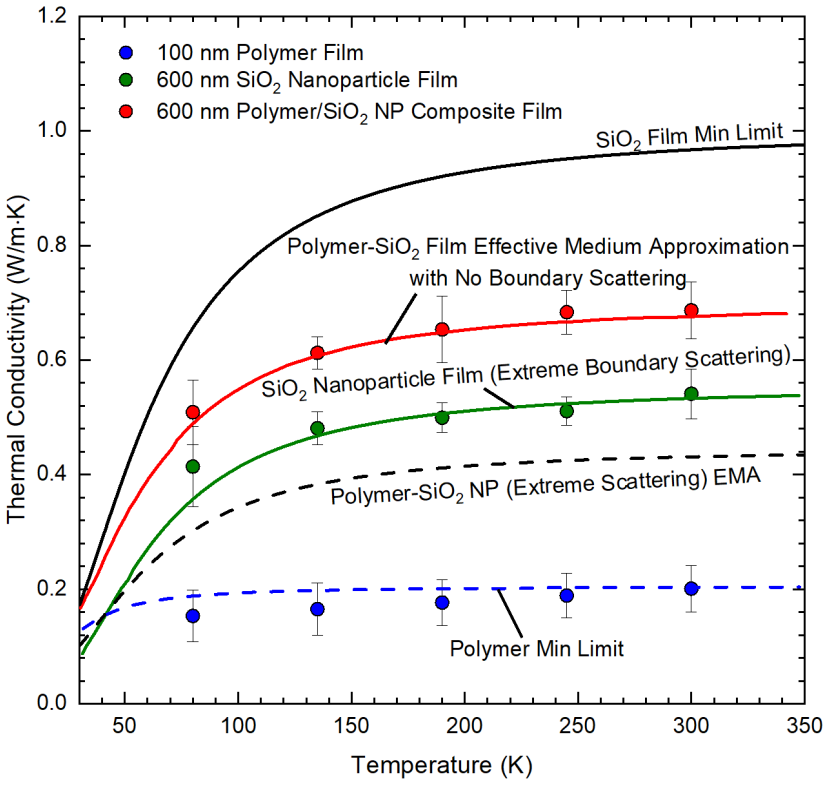
The central discovery is that the measured 300 K conductivity of the bare disordered silica nanoparticle film, 0.53 W/m·K, lies well below the roughly 1.2 W/m·K of bulk silica and below what the minimum-limit model predicts, requiring an additional scattering term $\tau_{NP} = \alpha d / v$ with $\alpha \approx 0.03$. When polystyrene fills the interstices by capillary rise infiltration (drawing the polymer into the pores by capillary action), the composite conductivity exceeds both constituents, and the effective medium rule $\kappa_{tot} = V_{poly}\kappa_{poly} + V_{NP}\kappa_{NP}$ captures the 80–300 K data only when this nanoparticle boundary scattering term is removed ($\alpha = 0$), using the intrinsic minimum-limit conductivity of silica. The paper's interpretation is that the polymer acts as a vibrational bridge: it replaces vacuum-exposed nanoparticle surfaces with polymer-contacted surfaces, reinstating heat flow that the isolated nanoparticle boundaries had suppressed. This is contrary to the ordinary expectation that adding a low-conductivity polymer to a low-conductivity packing would lower or leave unchanged the overall conductivity.
Load-bearing premise
The model assumes that once polystyrene fills the voids, the only effect is removal of the vacuum gap—that the polymer-silica contacts themselves add no resistance to heat flow and that the silica's intrinsic conductivity is unchanged; if those contacts do resist heat flow, or infiltration alters the silica, the zero-parameter agreement could be a coincidence.
Editorial extensions
If this is right
- Polymer infiltration can turn an ultra-low-conductivity disordered nanoparticle film into a film that conducts better than either the polymer or the silica alone, which standard effective medium theory with bulk constituent values does not predict.
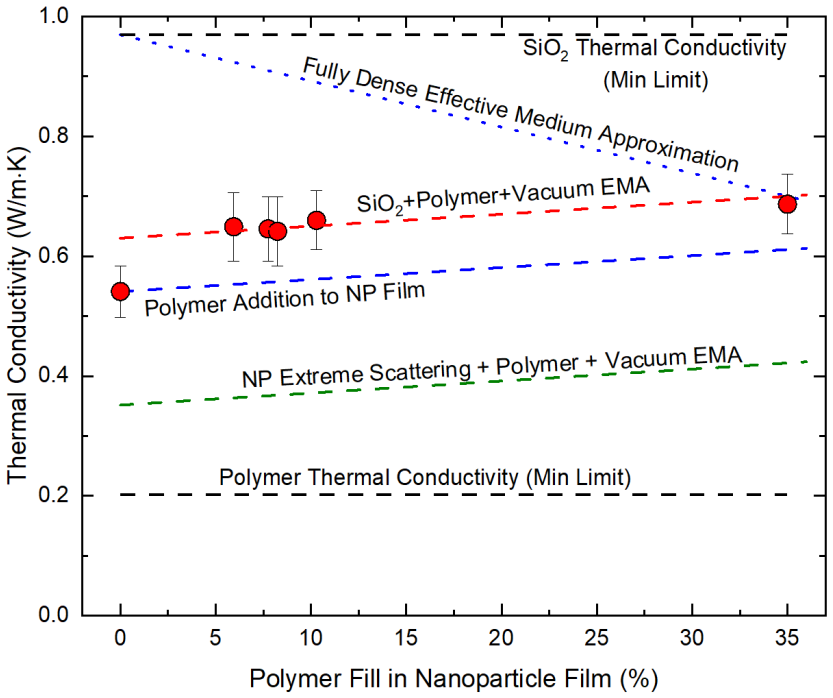
- Even partial polymer fill raises the composite conductivity immediately, because any polymer addition coats the nanoparticles and provides the vibrational bridge; this matches the paper's model and earlier observations of polymer coating at low fill fractions.
- Nanostructuring can reduce thermal conductivity below the amorphous minimum-limit value when nanoparticles are thermally isolated, and removing that isolation restores minimum-limit behavior.
- Interstitial stiffness becomes a design parameter: choosing a polymer, or tuning it through its glass transition, should let thermal conductivity be adjusted between the isolated-nanoparticle value and the bridged composite value.
- For thermal management, empty voids are useful for insulation while a stiff interstitial bridge is useful for heat spreading in disordered nanoparticle films such as optical coatings and solar-thermal desalination layers.
Reading between the lines
- A testable extension would vary the stiffness of the interstitial polymer: if the bridging is vibrational, a soft or rubbery polymer should produce a smaller conductivity jump than polystyrene at the same fill fraction, whereas the paper's simple elimination picture with $\alpha = 0$ does not discriminate between polymer stiffnesses.
- If polymer-silica contact resistance matters at all, the composite conductivity should fall as nanoparticle diameter decreases because interface area per volume grows; measuring the same polymer fill at two or three particle sizes would separate contact resistance from pure boundary-scattering elimination.
- The paper's partial-fill data suggest a near-zero threshold for the conductivity jump; mapping the jump versus fill fraction with finer steps and correlating it with polymer neck coverage could reveal whether the bridging effect is percolation-like or smooth.
Signed reviews
Editorial analysis
A structured set of objections, weighed in public.
Referee Report
Summary. The manuscript reports frequency-domain thermoreflectance (FDTR) measurements of thermal conductivity from 80 K to 300 K for three thin-film systems: disordered packings of amorphous silica nanoparticles, polystyrene films, and capillary-rise-infiltrated polystyrene/silica composite films. The authors model the bare nanoparticle film with a Debye-based minimum-limit model modified by Matthiessen's rule to include an additional nanoparticle boundary-scattering term tau_NP = alpha*d/v, fit alpha = 0.03, and then claim that the same model with alpha = 0 provides a zero-parameter effective-medium description of the composite via kappa_tot = V_poly*kappa_poly + V_NP*kappa_NP. From this they conclude that interstitial polymer eliminates the extreme boundary scattering in the disordered nanoparticle packing, increasing the composite conductivity above either constituent.
Significance. If correct, the result is significant: it provides a direct experimental demonstration that the dominant thermal resistance in disordered amorphous nanoparticle packings is boundary-related rather than intrinsic, and that infiltration of a low-conductivity polymer can markedly increase the overall conductivity. The qualitative increase in measured conductivity upon polymer infiltration is a direct observation, and the material system usefully isolates the boundary-scattering contribution. The quantitative support, however, currently rests on a model whose printed equations contain at least one dimensional error, and whose central 'zero-parameter' claim is weaker than stated. The paper does not include error bars on the extracted conductivities, a reproducibility artifact, or a treatment of interfacial (Kapitza) resistance, all of which are needed to make the elimination-of-boundary-scattering interpretation robust.
major comments (3)
- [Minimum-limit model, Eq. (6)] The printed intrinsic scattering time is tau_min = omega/pi, which has units of inverse time, not time. The standard minimum-limit form in the cited Cahill/Pohl literature is tau_min = pi/omega. If Eq. (6) is implemented literally, the scattering rate 1/tau_min becomes pi/omega, giving unphysically long lifetimes at high frequencies and an integrand in Eq. (5) that cannot yield the known low thermal conductivity of bulk a-SiO2 or polystyrene. This is a load-bearing issue because both the bare-film fit (alpha = 0.03) and the headline composite curve (alpha = 0) are evaluated using this intrinsic term. The formula must be corrected and a reproducibility artifact (code or tabulated model curves) provided so that the reported alpha values and the Fig. 4 composite curve can be independently verified.
- [Fig. 4 and the 'zero fitting parameters' claim] The statement that the composite model captures the data 'without any fitted parameters' overstates its inferential status. The parameter alpha is first fitted to the bare nanoparticle film, and the alpha = 0 curve is then chosen because it matches the composite data; setting alpha to zero is informed by the measurement being explained. The model has zero adjustable parameters only at the final evaluation step, not as a prior prediction. Please report the temperature dependence of the residuals for the alpha = 0.03 fit and the alpha = 0 composite curve, and rephrase the claim to distinguish a parameter-free evaluation from a parameter-free prediction.
- [Eq. (8) and the effective-medium interpretation] The central conclusion that polymer infiltration 'eliminates' nanoparticle boundary scattering assumes that the polymer-silica interfaces themselves contribute negligible thermal resistance and that the intrinsic conductivity of the silica is unchanged by infiltration. The model does not include a polymer-silica Kapitza conductance term, so the agreement of the alpha = 0 effective-medium curve could also arise from a finite interfacial conductance that happens to produce a similar temperature dependence over 80-300 K. A concrete test would be to include an interface conductance term in the effective medium or to measure the composite series with different nanoparticle diameters, for which the alpha = 0 prediction makes a falsifiable prediction.
minor comments (4)
- [Figs. 4 and 5] No error bars or uncertainty bands are shown for the FDTR-extracted thermal conductivities; the paper describes the transducer-thickness uncertainty but does not propagate it to kappa. Please add confidence intervals or state the estimated uncertainty for each data point.
- [Eq. (1)] The silica volume fraction is obtained from a linear refractive-index mixing rule, n = n_silica*phi_silica + n_air*(1-phi_silica). At phi = 0.65, a Maxwell-Garnett or Bruggeman effective-medium expression would be more defensible for a dense random packing; please justify the linear form or bound the resulting uncertainty in phi.
- [Throughout] There are typos and wording issues, including 'Mathiesenn's rule' (should be Matthiessen's rule), 'intercallated' (intercalated), and 'instrinsically' (intrinsically). The abstract's phrase 'stiff interstitial material' is also misleading because polystyrene is much less stiff than silica; 'mechanically continuous' or 'well-bonded' would better convey the intended idea.
- [Experimental Details / FDTR fitting] The paper leaves the transducer-film interfacial conductance G and volumetric heat capacity C_v as free parameters in the FDTR fit but does not report their fitted values or uncertainties. Given that the sensitivity to G is said to be low, please quantify this insensitivity so that the reader can assess the influence of these unknowns on the reported kappa values.
Circularity Check
Minor circularity: the 'zero-parameter' composite curve is obtained by deleting the only fitted parameter, a model-selection step informed by the same composite data.
-
fitted input called prediction
[Paragraph after Fig. 4 (pp. 12-13 of preprint), under 'To further understand these effects...']
"If we focus on the model used to fit for the silica nanoparticle thermal conductivity and use it in the effective medium calculation approach with the additional scattering from the nanoparticle boundaries removed (i.e. removing the only fitted parameter in this model, α) we find that we capture the composite film data without any fitted parameters and the system can be described by an effective medium of the polymer and SiO2 with no nanoparticle scattering."
The model's only free parameter is α, fitted to the bare nanoparticle film (α=0.03). The composite 'prediction' is produced by setting α=0, i.e., by deleting the boundary-scattering term. That deletion is not derived from an independent physical input; it is chosen after observing that the composite data exceed both constituents and are matched only by the α=0 effective-medium curve. The curve is therefore a data-informed model selection, not a parameter-free out-of-sample prediction. The central claim 'polymer eliminates boundary scattering' is effectively the same assumption used to build the successful curve, so the agreement confirms the assumption rather than testing it independently.
full rationale
The core experimental observation is not circular: FDTR measures a real increase in composite conductivity, and the composite curve is not obtained by fitting to those data. Volume fractions, sound speeds, and heat capacities are literature/dimensional inputs, and the CaRI/FDTR methods are externally anchored. The only significant circular aspect is the construction of the composite 'prediction': it is the same modified Debye effective-medium model with the sole fitted parameter α set to zero, a choice that is motivated by the observed composite behavior. This is a mild fitted-input-called-prediction step and a model-selection overstatement rather than a full reduction of the central claim. The apparent typo τmin=ω/π (dimensionally inverse time) is a correctness/reproducibility problem, not a circularity, and is not counted in the score. No load-bearing self-citation or imported uniqueness theorem was found; self-citations to prior CaRI and thermoreflectance work are methodological and verifiable.
Assumptions & free parameters
free parameters (4)
- alpha (nanoparticle boundary transmission factor) =
0.03
- Film thermal conductivity kappa (FDTR fit output) =
e.g., 0.53 W/m·K for bare NP film at 300 K
- Volumetric heat capacity C_v (FDTR fit output) =
Within 8% of literature constituent values
- Transducer-film interfacial conductance G (FDTR fit output) =
Not reported
assumptions (6)
- domain assumption Debye model and minimum thermal conductivity limit describe amorphous silica and polystyrene
- standard math Matthiessen's rule holds for combining intrinsic, film, and nanoparticle boundary scattering
- domain assumption Nanoparticle boundary scattering time has the form tau_NP = alpha*d/v
- domain assumption Effective medium weighted average without an interface resistance term is valid
- domain assumption Polymer fully fills the void network and coats all nanoparticle surfaces
- domain assumption Polymer infiltration eliminates nanoparticle boundary scattering, represented by setting alpha = 0 in the composite model
Cite this review
Pith. "Pith review of Elimination of Extreme Boundary Scattering via Polymer Thermal Bridging in Silica Nanoparticle Packings: Implications for Thermal Management." pith.science (2026). https://pith.science/paper/UHMTX4OB
@misc{pith2026190803258,
  author       = {Pith},
  title        = {Pith review of: Elimination of Extreme Boundary Scattering via Polymer Thermal Bridging in Silica Nanoparticle Packings: Implications for Thermal Management},
  year         = {2026},
  howpublished = {\url{https://pith.science/paper/UHMTX4OB}},
  note         = {Machine review of arXiv:1908.03258}
}
read the original abstract
Recent advances in our understanding of thermal transport in nanocrystalline systems are responsible for the integration of new technologies into advanced energy systems, including thermoelectric refrigeration systems and renewable energy platforms. However, there is little understanding of heat energy transport mechanisms that govern the thermal properties of disordered nanocomposites. In this work, we explore thermal transport mechanisms in disordered packings of amorphous nanoparticles with and without a polymer filling the interstices in order to quantify the impact of thermal boundary scattering introduced at nanoparticle edges in an already amorphous system and within the context of a minimum thermal conductivity approximation. By fitting a modified minimum thermal conductivity model to temperature-dependent measurements of thermal conductivity from 80 K to 300 K, we find that the interstitial polymer {\it eliminates} boundary scattering in the disordered nanoparticle packing, which surprisingly leads to an {\it increase} in the overall thermal conductivity of the disordered nanoparticle thin-film composite. This is contrary to our expectations relative to effective medium theory and our understanding of a minimum thermal conductivity limit. Instead, we find that a stiff interstitial material improves the transmission of heat through a nanoparticle boundary, improving the thermal properties of disordered nanoparticle packing. We expect these results to provide insight into the tunability of thermal properties in disordered solids that exhibit already low thermal conductivities through the use of nanostructuring and vibrational thermal bridging.
Figures


Figures from the paper (2 more)
Reference graph
Works this paper leans on
-
[1]
Warzoha, R. J.; Fleischer, A. S. Heat Flow at Nanoparticle Interfaces. Nano Energy 2014, 6, 137–158
work page 2014
-
[2]
Modified Effective Medium Formulation for the Thermal Conductivity of Nanocomposites
Minnich, A.; Chen, G. Modified Effective Medium Formulation for the Thermal Conductivity of Nanocomposites. Applied Physics Letters 2007, 91, 073105
work page 2007
-
[3]
Effect of Percolation on Thermal Transport in Nanotube Composites
Kumar, S.; Alam, M.; Murthy, J. Effect of Percolation on Thermal Transport in Nanotube Composites. Applied Physics Letters 2007, 90, 104105
work page 2007
-
[4]
Warzoha, R. J.; Fleischer, A. S. Effect of Graphene Layer Thickness and Mechanical Com- pliance on Interfacial Heat Flow and Thermal Conduction in Solid–Liquid Phase Change Materials. ACS Applied Materials & Interfaces 2014, 6, 12868–12876
work page 2014
-
[5]
Thermal Percolation in Stable Graphite Suspensions
Zheng, R.; Gao, J.; Wang, J.; Feng, S.-P.; Ohtani, H.; Wang, J.; Chen, G. Thermal Percolation in Stable Graphite Suspensions. Nano Letters 2011, 12, 188–192
work page 2011
-
[6]
Hakim, L. F.; King, D. M.; Zhou, Y.; Gump, C. J.; George, S. M.; Weimer, A. W. Nanoparticle Coating for Advanced Optical, Mechanical and Rheological Properties. Advanced Functional Materials 2007, 17, 3175–3181
work page 2007
-
[7]
Xia, D.; Biswas, A.; Li, D.; Brueck, S. R. Directed Self-Assembly of Silica Nanoparticles into Nanometer-Scale Patterned Surfaces using Spin-Coating. Advanced Materials 2004, 16, 1427–1432
work page 2004
-
[8]
Niksefat, N.; Jahanshahi, M.; Rahimpour, A. The Effect of SiO2 Nanoparticles on Morphol- ogy and Performance of Thin Film Composite Membranes for Forward Osmosis Application. Desalination 2014, 343, 140–146
work page 2014
Show all 35 references
-
[9]
Enhanced Thermal Conductivity of Metallic Nanoparticle Packed Bed by Sintering Treatment
Lin, Z.-Z.; Huang, C.-L.; Zhen, W.-K.; Huang, Z. Enhanced Thermal Conductivity of Metallic Nanoparticle Packed Bed by Sintering Treatment. Applied Thermal Engineering 2017, 119, 425–429
2017
-
[10]
P.; Mulhearn, W
Chan, E. P.; Mulhearn, W. D.; Huang, Y.-R.; Lee, J.-H.; Lee, D.; Stafford, C. M. Tailoring the Permselectivity of Water Desalination Membranes via Nanoparticle Assembly. Langmuir 2014, 30, 611–616
2014
-
[11]
G.; Watson, S
Cahill, D. G.; Watson, S. K.; Pohl, R. O. Lower Limit to the Thermal Conductivity of Disor- dered Crystals. Physical Review B 1992, 46, 6131
1992
-
[12]
E.; Mittal, M.; Phinney, L
Hopkins, P. E.; Mittal, M.; Phinney, L. M.; Grillet, A. M.; Furst, E. M. Ultra-Low Ther- 21 mal Conductivity of Ellipsoidal TiO 2 Nanoparticle Films. Applied Physics Letters 2011, 99, 133106
2011
-
[13]
Ordering Up the Minimum Thermal Conductivity of Solids
Goodson, K. Ordering Up the Minimum Thermal Conductivity of Solids. Science 2007, 315, 342–343
2007
-
[14]
Precise Control of Thermal Conductivity at the Nanoscale through Individual Phonon-Scattering Barriers
Pernot, G.; Stoffel, M.; Savic, I.; Pezzoli, F.; Chen, P.; Savelli, G.; Jacquot, A.; Schumann, J.; Denker, U.; M¨ onch, I. Precise Control of Thermal Conductivity at the Nanoscale through Individual Phonon-Scattering Barriers. Nature Materials 2010, 9, 491
2010
-
[15]
F.; Foley, B
Donovan, B. F.; Foley, B. M.; Ihlefeld, J. F.; Maria, J.-P.; Hopkins, P. E. Spectral Phonon Scattering Effects on the Thermal Conductivity of Nano-Grained Barium Titanate. Applied Physics Letters 2014, 105, 082907
2014
-
[16]
E.; Jang, W.; Garay, J
Wang, Z.; Alaniz, J. E.; Jang, W.; Garay, J. E.; Dames, C. Thermal Conductivity of Nanocrys- talline Silicon: Importance of Grain Size and Frequency-Dependent Mean Free Paths. Nano Letters 2011, 11, 2206–2213
2011
-
[17]
J.; Giri, A.; Warzoha, R.; Donovan, B
Szwejkowski, C. J.; Giri, A.; Warzoha, R.; Donovan, B. F.; Kaehr, B.; Hopkins, P. E. Molecular Tuning of the Vibrational Thermal Transport Mechanisms in Fullerene Derivative Solutions. ACS Nano 2017, 11, 1389–1396
2017
-
[18]
Heat Conduction Tuning by Wave Nature of Phonons
Maire, J.; Anufriev, R.; Yanagisawa, R.; Ramiere, A.; Volz, S.; Nomura, M. Heat Conduction Tuning by Wave Nature of Phonons. Science Advances 2017, 3, e1700027
2017
-
[19]
K.; Cheaito, R.; Rossen, P
Ravichandran, J.; Yadav, A. K.; Cheaito, R.; Rossen, P. B.; Soukiassian, A.; Suresha, S.; Duda, J. C.; Foley, B. M.; Lee, C.-H.; Zhu, Y. Crossover from Incoherent to Coherent Phonon Scattering in Epitaxial Oxide Superlattices. Nature Materials 2014, 13, 168
2014
-
[20]
L.; Gupta, R.; Zhang, L.; Stebe, K
Huang, Y.-R.; Jiang, Y.; Hor, J. L.; Gupta, R.; Zhang, L.; Stebe, K. J.; Feng, G.; Turner, K. T.; Lee, D. Polymer Nanocomposite Films with Extremely High Nanoparticle Loadings via Cap- illary Rise Infiltration (CaRI). Nanoscale 2015, 7, 798–805
2015
-
[21]
L.; Jiang, Y.; Ring, D
Hor, J. L.; Jiang, Y.; Ring, D. J.; Riggleman, R. A.; Turner, K. T.; Lee, D. Nanoporous Polymer-Infiltrated Nanoparticle Films with Uniform or Graded Porosity via Undersaturated Capillary Rise Infiltration. ACS Nano 2017, 11, 3229–3236
2017
-
[22]
L.; Lee, D.; Turner, K
Jiang, Y.; Hor, J. L.; Lee, D.; Turner, K. T. Toughening Nanoparticle Films via Polymer Infiltration and Confinement. ACS Applied Materials & Interfaces 2018, 10, 44011–44017
2018
-
[23]
H.; Brugarolas, T.; Lee, S.; Nolte, A
Prosser, J. H.; Brugarolas, T.; Lee, S.; Nolte, A. J.; Lee, D. Avoiding Cracks in Nanoparticle Films. Nano Letters 2012, 12, 5287–5291. 22
2012
-
[24]
Characterization of voids in spherical particle systems by Delaunay empty spheres
R´ emond, S.; Gallias, J.; Mizrahi, A. Characterization of voids in spherical particle systems by Delaunay empty spheres. Granular Matter 2008, 10, 329–334
2008
-
[25]
J.; Cheaito, R.; Chiesa, M
Schmidt, A. J.; Cheaito, R.; Chiesa, M. A Frequency-Domain Thermoreflectance Method for the Characterization of Thermal Properties. Review of Scientific Instruments 2009, 80, 094901
2009
-
[26]
minimum limit
and the Experimental Details section at the end of the manuscript. We use an analytical model for the thermal conductivity based on a Debye assumption to capture the thermo-physical mechanisms that drive heat flow within the CaRI composite film made of disordered silica nanopart...
-
[27]
J.; Donovan, B
Sharar, D. J.; Donovan, B. F.; Warzoha, R. J.; Wilson, A. A.; Leff, A. C.; Hanrahan, B. M. Solid-State Thermal Energy Storage Using Reversible Martensitic Transformations. Applied Physics Letters 2019, 114, 143902
2019
-
[28]
Introduction to Solid State Physics ; Wiley New York, 1976; Vol
Kittel, C.; McEuen, P.; McEuen, P. Introduction to Solid State Physics ; Wiley New York, 1976; Vol. 8
1976
-
[29]
Interpretation of the Thermal Conductivity of Glasses
Kittel, C. Interpretation of the Thermal Conductivity of Glasses. Physical Review 1949, 75, 972
1949
-
[30]
Proctor, T. M. Sound Speed Measurements in Solids:Absolute Accuracy of an Improved Tran- sient Pulse Method. Journal of Research of the National Bureau of Standards - C. Engineering and Instrumentation 1971, 75C
1971
-
[31]
incompressible
Mott, P.; Dorgan, J.; Roland, C. The bulk modulus and Poisson’s ratio of “incompressible” materials. Journal of Sound and Vibration 2008, 312
2008
-
[32]
P.; Turney, J.; McGaughey, A
Sellan, D. P.; Turney, J.; McGaughey, A. J.; Amon, C. H. Cross-Plane Phonon Transport in Thin Films. Journal of Applied Physics 2010, 108, 113524
2010
-
[33]
G.; Pohl, R
Cahill, D. G.; Pohl, R. O. Thermal Conductivity of Amorphous Solids Above the Plateau. Physical Review B 1987, 35, 4067
1987
-
[34]
E.; Kaehr, B.; Piekos, E
Hopkins, P. E.; Kaehr, B.; Piekos, E. S.; Dunphy, D.; Jeffrey Brinker, C. Minimum Thermal Conductivity Considerations in Aerogel Thin Films. Journal of Applied Physics 2012, 111, 113532
2012
-
[35]
L.; Szwejkowski, C
Braun, J. L.; Szwejkowski, C. J.; Giri, A.; Hopkins, P. E. On the Steady-State Temperature Rise During Laser Heating of Multilayer Thin Films in Optical Pump–Probe Techniques. Journal of Heat Transfer 2018, 140, 052801. 23
2018
Reviewed August 14, 2026 · model on record in the stance chip above.
Discussion (0). Continue with ORCID to comment.