REVIEW 3 major objections 5 minor 33 references
Conditional Generative Adversarial Networks for Data Augmentation and Adaptation in Remotely Sensed Imagery
T0 review · 3 major / 5 minor · reviewed 2026-08-14 · deepseek-v4-flash
Pith's one-line read This paper claims that augmenting a small real corpus of remote sensing imagery with synthetic image-label pairs produced by a sequential PGAN-CGAN pipeline improves vehicle detection mAP, with a greater than 10 percent relative increase…
desk verdict Plausible but statistically under-supported demonstration that sequential GANs can generate synthetic image-label pairs for low-data remote sensing vehicle detection; worth a serious referee, but the central effect is not established until repeated-seed evidence is added. read the letter →
The pith
A machine-rendered reading of the paper's core claim, the machinery that carries it, and where it could break.
The reading
What carries the argument
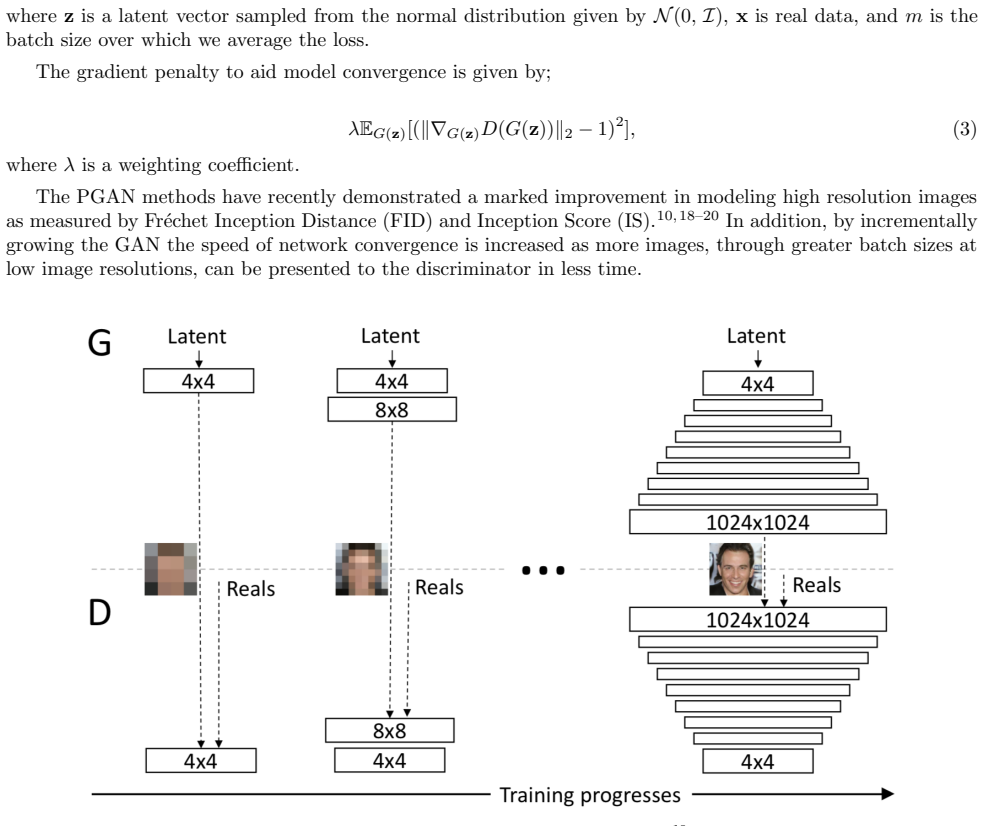
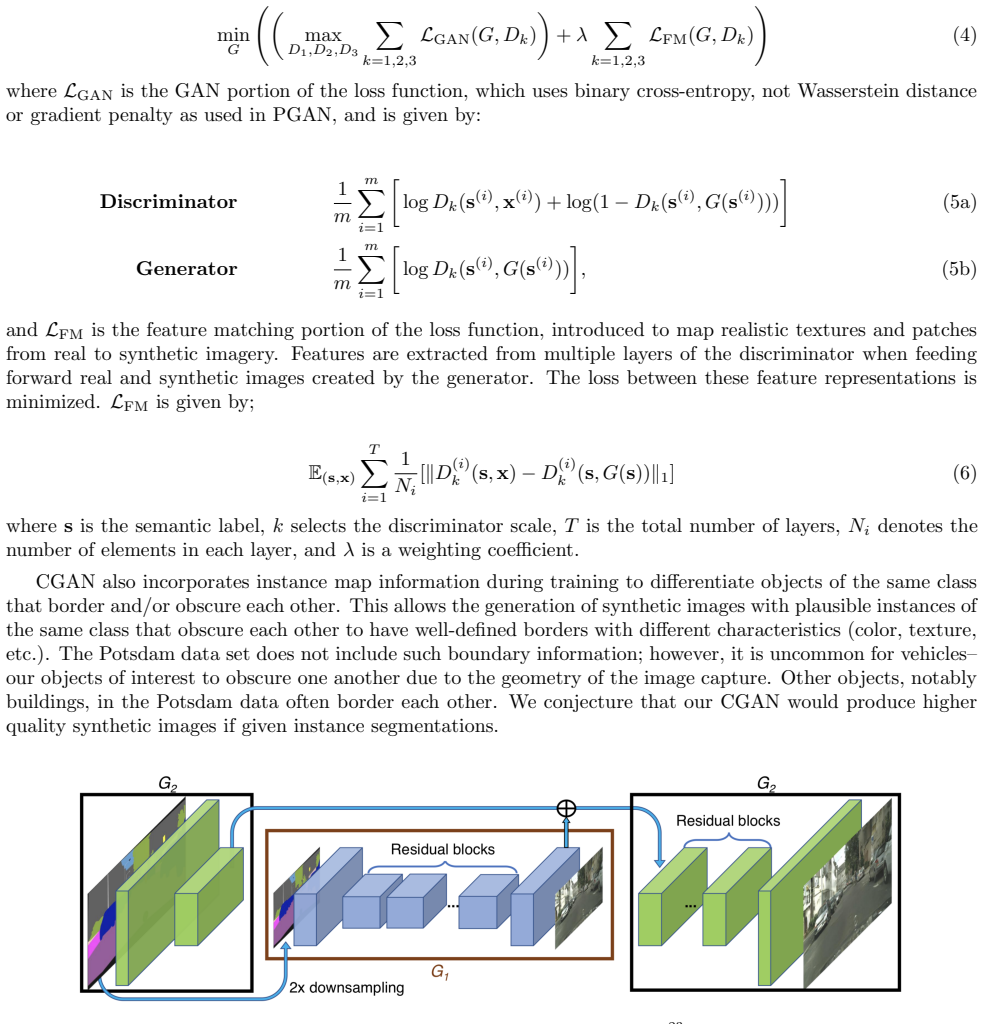
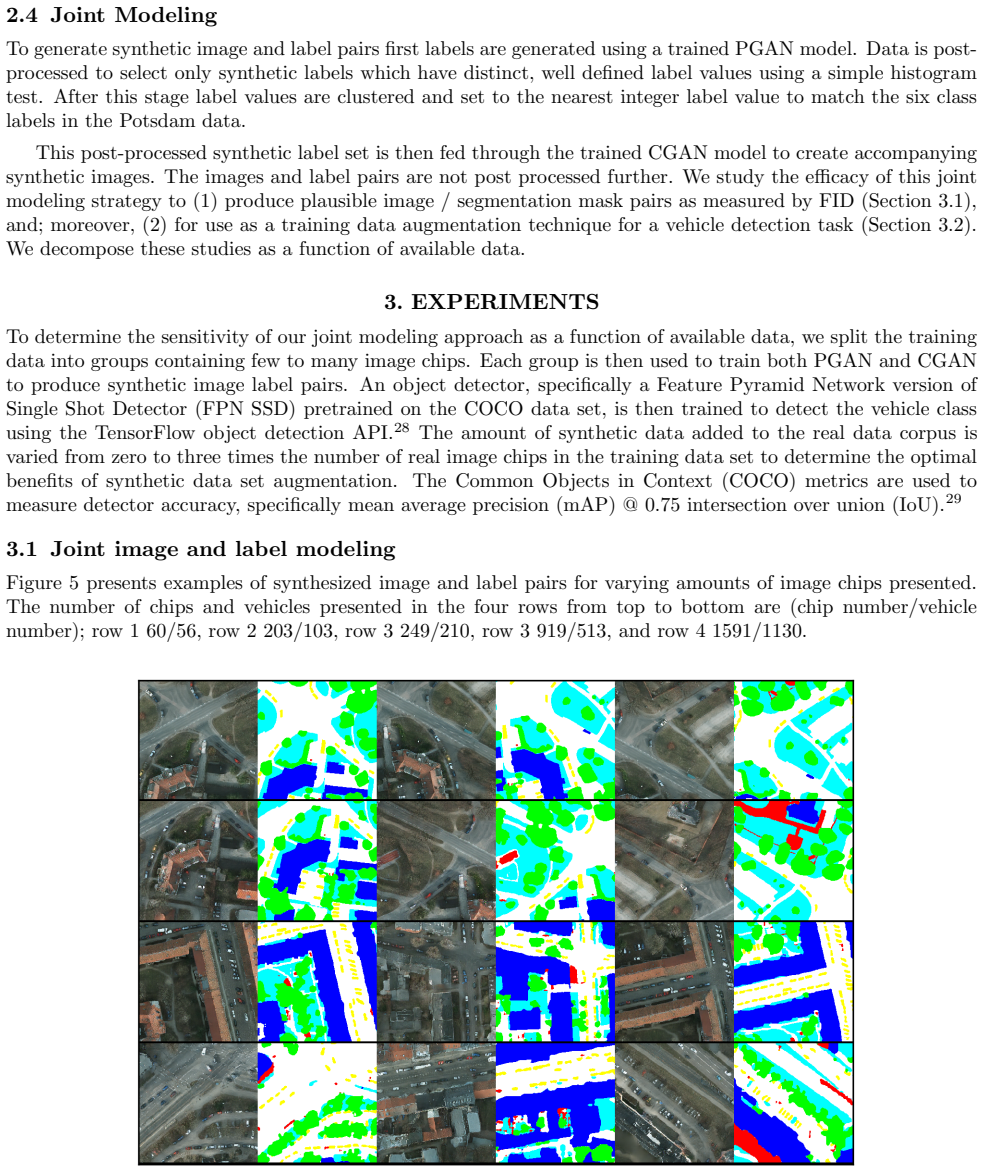
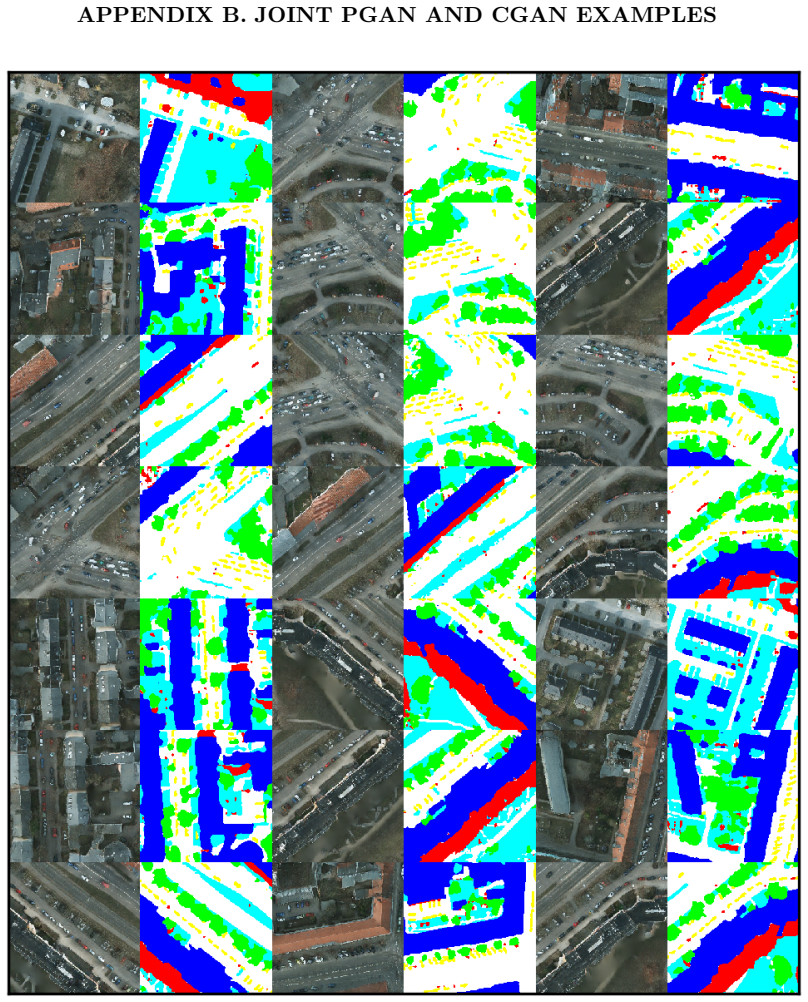
The load-bearing mechanism is the sequential GAN pipeline. A Progressive Growing GAN (PGAN) learns the distribution of semantic segmentation chips over six land-cover classes and produces synthetic masks; a conditional GAN (CGAN) then translates each mask into a synthetic RGB chip. Synthetic masks are filtered by a histogram test and quantized to the six class labels before conditioning the CGAN. The resulting image-label pairs are mixed with real training chips at ratios from 0 to 300 percent and fed to a feature-pyramid single-shot detector. Fréchet Inception Distance (a measure of distribution similarity between real and generated imagery) tracks how faithfully the generated chips match the real data as the training corpus grows.
What would settle it
Re-run the one-image and two-image augmentation experiments with ten random seeds per configuration and compare the distribution of mAP at 0.75 IoU against the real-only baselines; the central claim fails if the augmented runs do not show a consistent improvement over the baseline distribution. A second check: swap the four test images for a different held-out subset of the Potsdam data and see whether the 10 percent relative gain persists.
Extended reading notes
Core claim
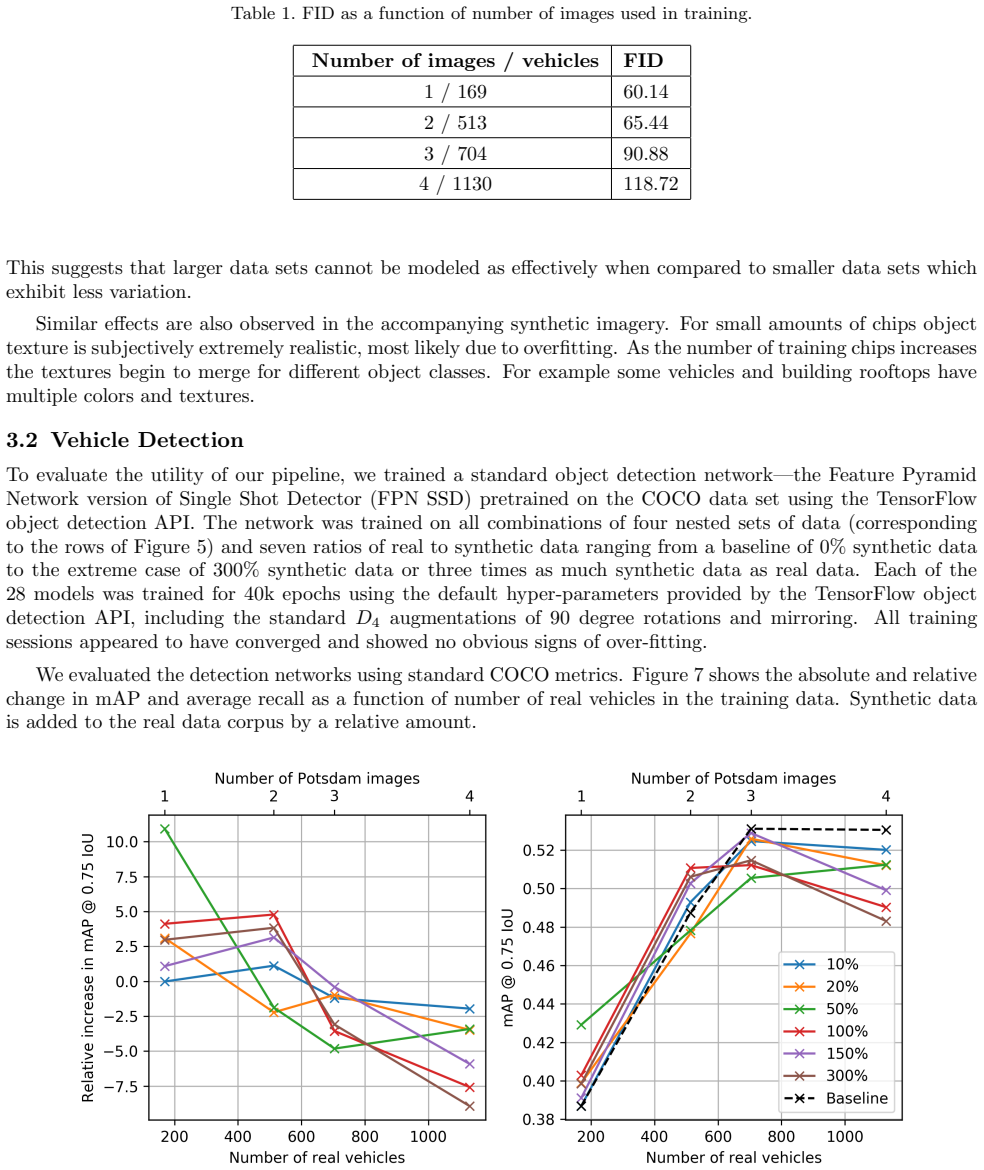
Running a Progressive Growing GAN to synthesize segmentation masks and then a semantically conditioned GAN to turn each mask into RGB imagery yields synthetic image-label pairs that are plausible enough to train a vehicle detector. In low-data settings the addition of these pairs consistently improves the detector's mAP at 0.75 IoU, with the largest relative gain (over 10 percent) when only one Potsdam image is available and 50 percent synthetic data is added. The benefit declines as real data grows, and for the largest corpora tested the synthetic pairs reduce performance; the paper attributes this to the generative models' inability to capture the full variability of a larger data set, as reflected in rising Fréchet Inception Distance.
Load-bearing premise
The paper's quantitative conclusions depend on treating a single run of each detector configuration, evaluated on one fixed set of four test images, as a reliable measurement of mAP; if detector training variance or test-set composition shifts the numbers, the reported improvements may not be real.
Editorial extensions
If this is right
- In a one- or two-image training regime, adding synthetic labeled pairs yields a consistent mAP improvement at 0.75 IoU, with the largest relative gain exceeding 10 percent.
- The benefit is not monotonic with synthetic volume: for a single image the maximum gain appears at 50 percent synthetic data, while for two images it appears at 100 percent or more.
- The technique's gain is roughly half that of adding one additional real training image, giving practitioners a quantitative basis for choosing between labeling and synthesis.
- The method stops helping, and can hurt, once the real corpus contains enough vehicles, so it is a low-data-regime tool rather than a general replacement for real data.
Reading between the lines
- A practical testable extension would be to compute FID (or a similar distribution-distance measure) on a new dataset before deciding whether GAN augmentation will help; the paper's FID trend suggests a cutoff beyond which synthetic data becomes harmful.
- The single fixed test split and single training run per configuration leave the size of the reported gains uncertain; a repeated-seed study would tell whether a 10 percent mAP increase is a stable effect.
- The authors' suggestions for improving the pipeline—conditioning the label generator on image identity, adding an autoencoder, or optimizing synthesis directly for detector loss—each offer a concrete next experiment that could extend the gains to larger corpora.
- Because the Potsdam labels lack instance boundaries, the synthetic building edges are distorted; supplying instance maps could plausibly improve the quality of the generated pairs and, in turn, detection or segmentation performance.
Signed reviews
Editorial analysis
A structured set of objections, weighed in public.
Referee Report
Summary. The paper proposes a data-augmentation pipeline for remote sensing imagery in which a Progressive Growing GAN (PGAN) first generates synthetic semantic segmentation masks and a Pix2PixHD-style conditional GAN (CGAN) then generates RGB imagery conditioned on those masks. The synthetic image-label pairs are added to the real training corpus at several ratios, and a COCO-pretrained FPN SSD is trained for vehicle detection on the ISPRS Potsdam dataset. The central claim is that in a low-data regime (one or two training images, fewer than 400 vehicles), this GAN-based augmentation improves vehicle detection mAP at 0.75 IoU relative to the real-only baseline, with a greater than 10% relative increase for a single Potsdam image. The paper also reports FID scores and training losses for the generative models and discusses why synthetic data can hurt performance on larger corpora.
Significance. If the central claim holds, the paper would provide a practical recipe for stretching very small labeled remote sensing corpora, a problem of real operational interest. The study has several strengths: it evaluates the synthetic data directly on a downstream detection task rather than only through image-quality metrics; it uses a public dataset and standard COCO detection metrics; it systematically varies both the amount of real data and the ratio of synthetic data; and the generative components are based on publicly available reference implementations. The observed qualitative trend, namely that synthetic data helps in low-data settings and hurts in richer settings, is plausible and consistent with earlier GAN-augmentation work. However, the quantitative evidence for the headline claim is not yet statistically established, as detailed in the major comments.
major comments (3)
- [§3.2, Fig. 7, §4] The central claim that GAN augmentation improves mAP@0.75 in the low-data regime rests on a single training run per configuration and one fixed test split of four Potsdam images; no seeds are varied, no confidence intervals are computed, and no significance test is applied. Because the absolute mAP values in the 56–169 vehicle regime are small, the reported >10% relative increase may correspond to a small absolute change that could be within run-to-run variation. The paper itself notes in §3.1 that low-data synthetic samples are near-duplicates of the real data, which further increases sensitivity to initialization. I request repeated-seed runs (at least five per configuration) with mean and variance reported, or an explicit reframing of the results as an uncontrolled case study; this statistical stability is the load-bearing assumption for the paper's main conclusion.
- [§2.3, §2.4] The CGAN training crops are sampled only when they contain at least 10 vehicles, and the synthetic labels are post-filtered by an unspecified 'simple histogram test' with no threshold or retention counts reported. These selection steps preferentially retain vehicle-dense material and could improve downstream vehicle detection independently of the generative model's quality, so the observed benefit cannot be cleanly attributed to the joint GAN pipeline. Please report the number and percentage of synthetic labels retained by the histogram filter, justify or vary the threshold, and include a control pipeline trained on random crops rather than vehicle-dense crops.
- [§2.4, §4] The paper claims the technique improves detector performance 'beyond standard data augmentation techniques' and 'about half as much as adding an additional training image would,' but no non-GAN control is reported in which the same number of real chips, or simple duplicated/transformed copies of real chips, is added to the training corpus. Without such an ablation, the improvement could be due to the increased number of training examples or to near-duplicate real content rather than to the GAN's distribution modeling; the 'about half as much' statement is a self-derived summary of the same single-run comparisons and inherits the statistical uncertainty identified above.
minor comments (5)
- [Fig. 5 caption] The caption says 'four rows' but lists five rows, and 'row 3' appears twice; please correct the row enumeration and the reported chip/vehicle counts.
- [§3.1, Table 1] The dataset-size accounting is inconsistent with Fig. 5: Table 1 lists 'Number of images / vehicles' as 1/169, 2/513, 3/704, and 4/1130, whereas Fig. 5's caption lists chip/vehicle numbers that do not match these values. Please clarify whether Table 1 uses full images or chips, and reconcile the numbers because the §3.2 discussion connects FID trends to detector performance.
- [Eq. (3)] The gradient penalty is written as λ E_{G(z)}[(‖∇_{G(z)} D(G(z))‖₂ − 1)²], but the standard WGAN-GP penalty is computed on interpolated points between real and generated samples, not only on generator outputs; please correct the equation or clarify the notation.
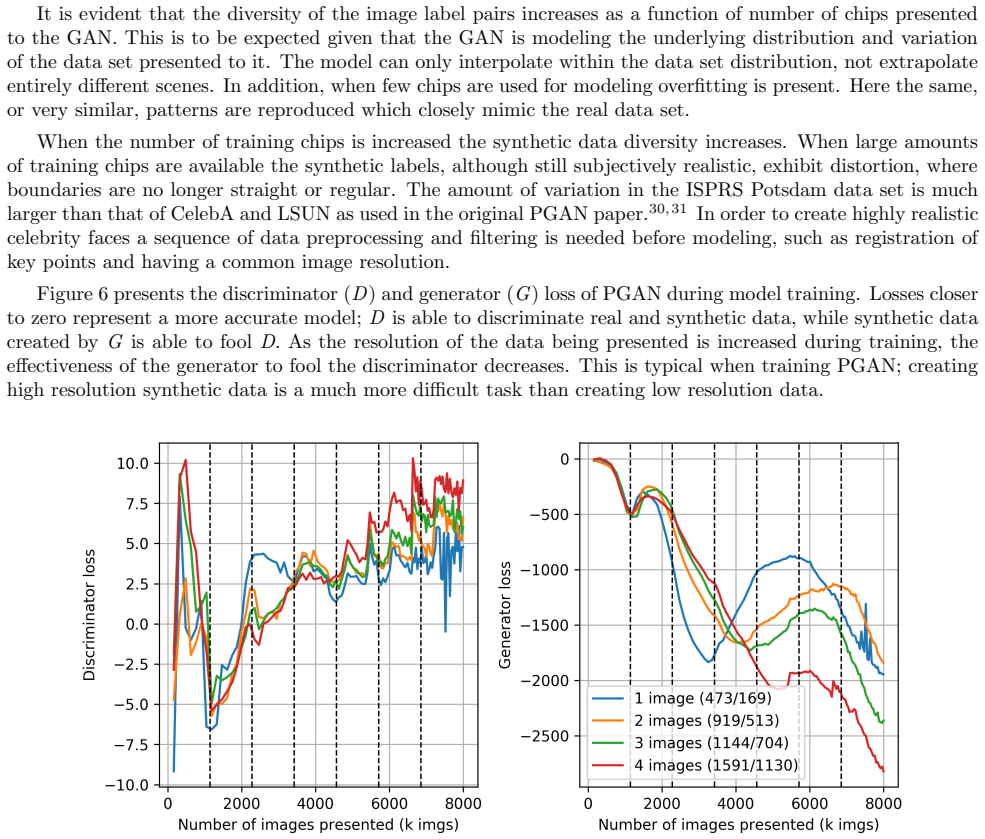
- [§3.2] The sentence 'with a richer corpus of real data, it becomes easier for the generator to fool the discriminator with data that is actually out-of-domain' appears to contradict the higher FID values reported in Table 1; higher FID indicates less realistic synthetic data, so the direction of the explanation should be reworded.
- [§3.2] The text says each detector was trained 'for 40k epochs'; for a small dataset this is likely intended to be 40k training steps, and the term should be clarified to avoid confusion.
Circularity Check
No significant circularity: the paper's claims rest on direct detector evaluations, not on self-referential derivations.
full rationale
The paper makes an empirical claim: in low-data regimes, augmenting real Potsdam imagery with GAN-generated image-label pairs improves vehicle detection mAP@0.75 compared to a real-only baseline. This claim is supported by directly training FPN SSD detectors on real and augmented corpora and measuring COCO metrics. No equation in the paper reduces to a fitted parameter that is then renamed as a prediction; the GANs are trained on real data, the detector is trained independently, and the reported mAP differences are measured outcomes. The architecture choices (PGAN and Pix2PixHD) are taken from external prior work, and the cited implementations are third-party official repositories, so there is no load-bearing self-citation chain. The statement in the summary that the technique improves performance 'about half as much as adding an additional training image would' is a qualitative interpretation of the same experiments rather than an independent predicted quantity, and it is not used as evidence for the central claim. The main weakness of the paper is statistical: all comparisons use a single fixed test split and single training runs without confidence intervals or significance tests. That is a correctness and reproducibility concern, not a circularity concern, because the compared values are not constructed to be equal by definition. The derivation chain is therefore self-contained with respect to circularity, and the appropriate score is 0.
Assumptions & free parameters
free parameters (3)
- CGAN crop vehicle threshold =
>=10 vehicles per 256x256 crop
- PGAN latent vector size =
1024
- Synthetic label histogram filter threshold =
not specified
assumptions (4)
- domain assumption The fixed test set of 4 ISPRS Potsdam images is a sufficient and unbiased evaluation set for the detection task.
- domain assumption FID scores computed with ImageNet-trained Inception-v3 features are a valid proxy for whether synthetic data helps the vehicle detector.
- domain assumption The official implementations of PGAN and Pix2PixHD, used with default configurations, behave as intended for this data set.
- domain assumption Sampling CGAN training crops only from vehicle-dense regions does not distort the learned image-label distribution in a way that changes the conclusions.
Cite this review
Pith. "Pith review of Conditional Generative Adversarial Networks for Data Augmentation and Adaptation in Remotely Sensed Imagery." pith.science (2026). https://pith.science/paper/UHWQPXVL
@misc{pith2026190803809,
  author       = {Pith},
  title        = {Pith review of: Conditional Generative Adversarial Networks for Data Augmentation and Adaptation in Remotely Sensed Imagery},
  year         = {2026},
  howpublished = {\url{https://pith.science/paper/UHWQPXVL}},
  note         = {Machine review of arXiv:1908.03809}
}
read the original abstract
The difficulty in obtaining labeled data relevant to a given task is among the most common and well-known practical obstacles to applying deep learning techniques to new or even slightly modified domains. The data volumes required by the current generation of supervised learning algorithms typically far exceed what a human needs to learn and complete a given task. We investigate ways to expand a given labeled corpus of remote sensed imagery into a larger corpus using Generative Adversarial Networks (GANs). We then measure how these additional synthetic data affect supervised machine learning performance on an object detection task. Our data driven strategy is to train GANs to (1) generate synthetic segmentation masks and (2) generate plausible synthetic remote sensing imagery corresponding to these segmentation masks. Run sequentially, these GANs allow the generation of synthetic remote sensing imagery complete with segmentation labels. We apply this strategy to the data set from ISPRS' 2D Semantic Labeling Contest - Potsdam, with a follow on vehicle detection task. We find that in scenarios with limited training data, augmenting the available data with such synthetically generated data can improve detector performance.
Figures

Figures from the paper (6 more)

Reference graph
Works this paper leans on
-
[1]
ISPRS WG III/4. ISPRS 2D Semantic Labeling Contest
“ISPRS WG III/4. ISPRS 2D Semantic Labeling Contest.” http://www2.isprs.org/commissions/comm3/ wg4/semantic-labeling.html
-
[2]
xview: Objects in context in overhead imagery,
D. Lam, R. Kuzma, K. McGee, S. Dooley, M. Laielli, M. Klaric, Y. Bulatov, and B. McCord, “xview: Objects in context in overhead imagery,” arXiv:1802.07856 , 2018
arXiv 2018
-
[3]
“SpaceNet competition.” https://spacenetchallenge.github.io/datasets/datasetHomePage.html
-
[4]
Dstl satellite imagery feature detection
“Dstl satellite imagery feature detection.” https://www.kaggle.com/c/ dstl-satellite-imagery-feature-detection
-
[5]
Learning active learning from data,
K. Konyushkova, R. Sznitman, and P. Fua, “Learning active learning from data,” in Advances in Neural Information Processing Systems , pp. 4225–4235, 2017. 9
work page 2017
-
[6]
Training deep networks with synthetic data: Bridging the reality gap by domain random- ization,
J. Tremblay, A. Prakash, D. Acuna, M. Brophy, V. Jampani, C. Anil, T. To, E. Cameracci, S. Boochoon, and S. Birchfield, “Training deep networks with synthetic data: Bridging the reality gap by domain random- ization,” in Proceedings of the IEEE Conference on Computer Vision and Pattern Recognition Workshops , pp. 969–977, 2018
work page 2018
-
[7]
Structured domain randomization: Bridging the reality gap by context-aware synthetic data,
A. Prakash, S. Boochoon, M. Brophy, D. Acuna, E. Cameracci, G. State, O. Shapira, and S. Birch- field, “Structured domain randomization: Bridging the reality gap by context-aware synthetic data,” arXiv preprint arXiv:1810.10093 , 2018
-
[8]
Multimodal 3D Object Detection from Simulated Pretraining
˚A. Brekke, F. Vatsendvik, and F. Lindseth, “Multimodal 3d object detection from simulated pretraining,” arXiv preprint arXiv:1905.07754 , 2019
work page Pith review arXiv 1905
Show all 33 references
-
[9]
A data augmentation strategy based on simulated samples for ship detection in rgb remote sensing images,
Y. Yan, Z. Tan, and N. Su, “A data augmentation strategy based on simulated samples for ship detection in rgb remote sensing images,” ISPRS International Journal of Geo-Information 8(6), 2019
2019
-
[10]
Progressive growing of gans for improved quality, stability, and variation,
T. Karras, T. Aila, S. Laine, and J. Lehtinen, “Progressive growing of gans for improved quality, stability, and variation,” arXiv preprint arXiv:1710.10196 , 2017
2017 arXiv
-
[11]
A style-based generator architecture for generative adversarial networks,
T. Karras, S. Laine, and T. Aila, “A style-based generator architecture for generative adversarial networks,” arXiv preprint arXiv:1812.04948 , 2018
2018 arXiv
-
[12]
Scargan: chained generative adversarial networks to simulate pathological tissue on cardiovascular mr scans,
F. Lau, T. Hendriks, J. Lieman-Sifry, S. Sall, and D. Golden, “Scargan: chained generative adversarial networks to simulate pathological tissue on cardiovascular mr scans,” in Deep Learning in Medical Image Analysis and Multimodal Learning for Clinical Decision Support , pp. 3...
2018
-
[13]
Rendergan: Generating realistic labeled data,
L. Sixt, B. Wild, and T. Landgraf, “Rendergan: Generating realistic labeled data,” Frontiers in Robotics and AI 5, p. 66, 2018
2018
-
[14]
Learning from simulated and unsupervised images through adversarial training,
A. Shrivastava, T. Pfister, O. Tuzel, J. Susskind, W. Wang, and R. Webb, “Learning from simulated and unsupervised images through adversarial training,” in Proceedings of the IEEE Conference on Computer Vision and Pattern Recognition , pp. 2107–2116, 2017
2017
-
[15]
Evaluation of generative networks through their data augmentation capacity,
T. Lesort, F. Bordes, J.-F. Goudou, and D. Filliat, “Evaluation of generative networks through their data augmentation capacity,” 2018
2018
-
[16]
Marta gans: Unsupervised representation learning for remote sensing image classification,
D. Lin, K. Fu, Y. Wang, G. Xu, and X. Sun, “Marta gans: Unsupervised representation learning for remote sensing image classification,” IEEE Geoscience and Remote Sensing Letters 14(11), pp. 2092–2096, 2017
2017
-
[17]
Domain adaptive generation of aircraft on satellite imagery via simulated and unsupervised learning,
J. Seo, S. Jeon, and T. Jeon, “Domain adaptive generation of aircraft on satellite imagery via simulated and unsupervised learning,” arXiv preprint arXiv:1806.03002 , 2018
2018 arXiv
-
[18]
Wasserstein gan,
M. Arjovsky, S. Chintala, and L. Bottou, “Wasserstein gan,” arXiv preprint arXiv:1701.07875 , 2017
2017 arXiv
-
[19]
Pioneer networks: Progressively growing generative autoencoder,
A. Heljakka, A. Solin, and J. Kannala, “Pioneer networks: Progressively growing generative autoencoder,” arXiv preprint arXiv:1807.03026 , 2018
2018 arXiv
-
[20]
Improved training of wasserstein gans,
I. Gulrajani, F. Ahmed, M. Arjovsky, V. Dumoulin, and A. C. Courville, “Improved training of wasserstein gans,” in Advances in Neural Information Processing Systems , pp. 5767–5777, 2017
2017
-
[21]
Progressive growing of gans for improved quality, stability, and variation
T. Karras, T. Aila, S. Laine, and J. Lehtinen, “Progressive growing of gans for improved quality, stability, and variation.” https://github.com/tkarras/progressive_growing_of_gans, 2017
2017
-
[22]
TensorFlow: Large-scale machine learning on heterogeneous systems,
M. Abadi, A. Agarwal, P. Barham, E. Brevdo, Z. Chen, C. Citro, G. S. Corrado, A. Davis, J. Dean, M. Devin, S. Ghemawat, I. Goodfellow, A. Harp, G. Irving, M. Isard, Y. Jia, R. Jozefowicz, L. Kaiser, M. Kudlur, J. Levenberg, D. Man´ e, R. Monga, S. Moore, D. Murray, C. Olah, M....
2015
-
[23]
High-resolution image synthesis and semantic manipulation with conditional gans,
T.-C. Wang, M.-Y. Liu, J.-Y. Zhu, A. Tao, J. Kautz, and B. Catanzaro, “High-resolution image synthesis and semantic manipulation with conditional gans,” in Proceedings of the IEEE Conference on Computer Vision and Pattern Recognition , pp. 8798–8807, 2018
2018
-
[24]
U-net: Convolutional networks for biomedical image segmenta- tion,
O. Ronneberger, P. Fischer, and T. Brox, “U-net: Convolutional networks for biomedical image segmenta- tion,” in International Conference on Medical image computing and computer-assisted intervention , pp. 234– 241, Springer, 2015
2015
-
[25]
Image-to-image translation with conditional adversarial networks,
P. Isola, J.-Y. Zhu, T. Zhou, and A. A. Efros, “Image-to-image translation with conditional adversarial networks,” in Proceedings of the IEEE conference on computer vision and pattern recognition , pp. 1125– 1134, 2017. 10
2017
-
[26]
High-resolution image synthesis and semantic manipulation with conditional gans
T.-C. Wang, M.-Y. Liu, J.-Y. Zhu, A. Tao, J. Kautz, and B. Catanzaro, “High-resolution image synthesis and semantic manipulation with conditional gans.” https://github.com/NVIDIA/pix2pixHD, 2017
2017
-
[27]
Automatic differentiation in pytorch,
A. Paszke, S. Gross, S. Chintala, G. Chanan, E. Yang, Z. DeVito, Z. Lin, A. Desmaison, L. Antiga, and A. Lerer, “Automatic differentiation in pytorch,” 2017
2017
-
[28]
Ssd: Single shot multibox detector,
W. Liu, D. Anguelov, D. Erhan, C. Szegedy, S. Reed, C.-Y. Fu, and A. C. Berg, “Ssd: Single shot multibox detector,” in European conference on computer vision , pp. 21–37, Springer, 2016
2016
-
[29]
Microsoft coco: Common objects in context,
T.-Y. Lin, M. Maire, S. Belongie, J. Hays, P. Perona, D. Ramanan, P. Doll´ ar, and C. L. Zitnick, “Microsoft coco: Common objects in context,” in European conference on computer vision, pp. 740–755, Springer, 2014
2014
-
[30]
Lsun: Construction of a large-scale image dataset using deep learning with humans in the loop,
F. Yu, Y. Zhang, S. Song, A. Seff, and J. Xiao, “Lsun: Construction of a large-scale image dataset using deep learning with humans in the loop,” arXiv preprint arXiv:1506.03365 , 2015
2015 arXiv
-
[31]
Deep learning face attributes in the wild,
Z. Liu, P. Luo, X. Wang, and X. Tang, “Deep learning face attributes in the wild,” in Proceedings of the IEEE international conference on computer vision , pp. 3730–3738, 2015
2015
-
[32]
Gans trained by a two time-scale update rule converge to a local nash equilibrium,
M. Heusel, H. Ramsauer, T. Unterthiner, B. Nessler, and S. Hochreiter, “Gans trained by a two time-scale update rule converge to a local nash equilibrium,” in Advances in Neural Information Processing Systems , pp. 6626–6637, 2017
2017
-
[33]
Imagenet: A large-scale hierarchical image database,
J. Deng, W. Dong, R. Socher, L. jia Li, K. Li, and L. Fei-fei, “Imagenet: A large-scale hierarchical image database,” in CVPR, 2009. 11 APPENDIX A. PGAN EXAMPLES Figure 8. Examples of synthetic labels generated by PGAN after filtering using a simple color histogram test. 12 APP...
2009
Reviewed August 14, 2026 · model on record in the stance chip above.
Discussion (0). Continue with ORCID to comment.