REVIEW 4 major objections 7 minor 98 references
Two aspherical PIAA mirrors and two step-index fibers can keep spatial-filter coupling above 95% across 4–18.5 µm, with <100 nm manufacturing precision.
Reviewed by Pith at T0; open to challenge. T0 means a machine referee read the full paper against a public rubric. the ladder, T0–T4 →
T0 review · deepseek-v4-flash
2026-08-01 10:36 UTC pith:UIRRVUTD
load-bearing objection A solid, honest simulation study showing PIAA plus two step-index fibers can reach >95% on-axis geometric coupling across LIFE's band; the off-axis gap is real but the authors flag it. the 4 major comments →
Achieving efficient broadband spatial filtering for LIFE: status and plan
The pith
A machine-rendered reading of the paper's core claim, the machinery that carries it, and where it could break.
Core claim
The central claim is that broadband spatial filtering for LIFE can be achieved without chromatic apodization: a pair of aspherical PIAA mirrors converts the incoming top-hat beam into an approximately Gaussian beam, and the resulting point-spread function couples into two step-index single-mode fibers with a geometric coupling efficiency that remains above 95% over the full 4–18.5 µm band. The simulation uses literature mode-field diameters for TAS and AgBr fibers and picks one focal length per fiber to maximize broadband coupling; the result holds for mirror surface errors of <100 nm, both for scaled 'slope' deviations and localized 'spot' deviations. The authors conclude that the LIFE wave
What carries the argument
Phase-induced amplitude apodization (PIAA): a pair of aspherical mirrors that redistributes light from a uniform entrance pupil into a Gaussian-like exit pupil, making the point-spread function match the fiber mode. This is what bypasses the ~82% geometric coupling ceiling of an Airy disk. The companion element is the per-fiber focal-length setting, chosen by the standard formula f = πD/(4λ) × MFD, which matches the apodized beam's size to the fiber's mode-field diameter; one fixed focal length per fiber covers roughly an octave of the band.
Load-bearing premise
The >95% coupling is computed for an ideal on-axis beam and ideal Gaussian fiber modes with literature mode-field diameters; the real beam must enter the PIAA mirrors off-axis, and the authors state that off-axis sources quickly suffer aberrations from the aspherical surfaces, which could erase the margin.
What would settle it
Measure the geometric coupling of a two-mirror PIAA system followed by a step-index fiber using an off-axis input beam at the angle required by the instrument layout; if the coupling drops below 95% over any part of the 4–18.5 µm band, the central claim fails. Alternatively, fabricate one PIAA pair with <100 nm surface error and measure the on-axis coupling curve against the simulated >95% values.
If this is right
- A LIFE spatial filter can be built from two step-index fibers (TAS for 4–9 µm, AgBr for 9–18.5 µm) preceded by two PIAA mirrors, with no chromatic apodization required.
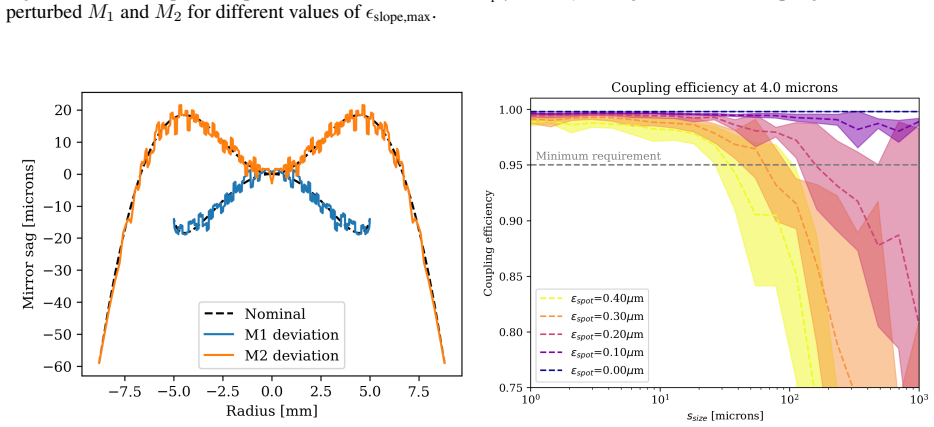
- A manufacturing precision of <100 nm on the PIAA mirror surfaces keeps the broadband geometric coupling efficiency above 95% against both scaled slope errors and localized spot errors.
- Splitting the LIFE waveband into at least two spectral channels, one per fiber, is sufficient; each channel spans roughly one octave.
- The classical single-mode-fiber coupling limit of ~82% for an Airy disk is not a barrier for LIFE; PIAA can in principle approach 100% geometric coupling.
Where Pith is reading between the lines
- The analysis is on-axis only; off-axis injection through the aspherical pair will introduce aberrations that likely push the coupling below 95%. A natural extension would be to design off-axis mirror segments or a central obstruction and re-run the coupling calculation.
- The <100 nm tolerance is encouraging for manufacturing, but alignment sensitivity (tip/tilt and decenter of the two mirrors) is untested and may prove tighter than the surface error budget; a tolerance study on alignment would be the next logical step.
- If single-mode AgBr fibers remain unavailable, the same PIAA scheme could be paired with endlessly single-mode photonic crystal waveguides for the long-wavelength channel, with likely similar coupling gains.
- Combining PIAA with step-index fibers could also benefit ground-based nullers operating in the mid-infrared, as long as the atmospheric wavefront error after correction is small enough for the spatial filter to clean.
Editorial analysis
A structured set of objections, weighed in public.
Referee Report
Summary. The paper proposes a spatial filter design for LIFE based on two step-index fibers (TAS chalcogenide for 4–9 µm and AgBr silver halide for 9–18.5 µm), preceded by a two-mirror phase-induced amplitude apodizer (PIAA). The authors use ∂Lux physical-optics simulations with PIAA mirror shapes derived from Guyon's mapping, compute the on-axis geometric coupling efficiency via the overlap integral (Eq. 5), and report >95% across the full LIFE band for optimised focal lengths f_TAS = 46 mm and f_AgBr = 18 mm. They also derive manufacturing tolerances of <100 nm for sag slope and spot errors, and conclude that an achromatic apodization is compatible with at least two spectral channels.
Significance. If the reported on-axis coupling result survives realistic off-axis and alignment effects, the scheme would provide a practical achromatic spatial filtering solution for LIFE, potentially replacing more complex chromatic apodization concepts. The manuscript has clear strengths: it uses an open differentiable-physics framework (∂Lux/JAX), the coupling calculation is standard and explicit, the tolerancing is a useful first step, and the authors are transparent about the remaining technology risks (fiber availability, Fresnel losses, off-axis aberrations). The value of the paper is as a status/plan report, and the central numerical claim is plausible for an idealized on-axis geometry, but as written it is not yet a demonstrated end-to-end solution for the actual planet beam geometry.
major comments (4)
- [Sec. 4 and Sec. 3.2 (Fig. 6)] The headline >95% coupling efficiency is computed for an ideal on-axis PIAA beam. In LIFE, the spatial filter must transmit the off-axis planet light, and the paper itself states in Sec. 4 that off-axis sources 'quickly suffer from optical aberrations induced by the aspherical mirrors' (Guyon 2003). No off-axis coupling simulation is provided, nor a quantitative estimate of the acceptable field angle or alignment tip/tilt. Since the conclusion that the coupling requirement 'can be met' depends on the actual beam geometry, this is a load-bearing gap. Please add a field-angle / tip-tilt sensitivity study for the proposed off-axis PIAA configuration (e.g., by tilting the on-axis sag surfaces as suggested in Sec. 4) and show the coupling for field angles relevant to LIFE's inner working angle.
- [Sec. 2.2 and Sec. 3.2 (Eqs. 4–5)] The reported >95% result is an optimised simulation outcome: f_TAS and f_AgBr are chosen to maximize broadband coupling, and Den = Dex = 10 mm are chosen 'as arbitrary numbers.' The paper does not explore how robust the result is to these choices. Given that the manuscript claims a requirement can be met, a parameter sensitivity scan (e.g., varying Den/Dex over a reasonable range and showing the coupling map near the adopted focal lengths) is needed to establish that the result is not a fine-tuned point in parameter space.
- [Sec. 3.3] The tolerancing is limited to sag slope and spot errors on the PIAA mirrors. Alignment errors between M1 and M2, lateral misalignment of the input beam, and relative tilt are not included. These are typically more demanding than surface figure errors for PIAA systems and directly affect the fibre injection. The paper mentions alignment only qualitatively in Sec. 4. Please include a quantitative alignment tolerance analysis, or clearly state that this is future work and soften the claim that the <100 nm manufacturing precision is sufficient for the full system.
- [Sec. 2.1 and Sec. 4] The coupling calculation assumes ideal Gaussian fibre modes with literature MFD values. The manuscript itself notes that single-mode AgBr fibres are not currently manufacturable and that rejection ratios and cryogenic performance require further testing. These are acknowledged technology risks, not errors, but they weaken the strength of the claim as a current 'can be met' statement. A quantitative estimate of the effect of non-Gaussian mode-field errors or MFD uncertainty on the overlap integral would help assess how much margin the >95% coupling actually provides.
minor comments (7)
- [Abstract] Grammar: 'LIFE requires to reach' should be 'LIFE requires reaching' or 'requires that it reach'.
- [Sec. 1] First paragraph: 'has was proposed' is a typo; should be 'was proposed'.
- [Sec. 2.2 (Eqs. 1–3)] The notation r2(t) − r1(t) in Eq. (2) may be ambiguous; parentheses would help. Also clarify the definition of t as the fractional encircled intensity.
- [Fig. 4 caption] The caption states MFD = 20 µm and f calculated at λ = 4 µm, but the text does not specify whether this is for TAS or AgBr. Please clarify the representative nature of this example.
- [Fig. 5] Add explicit labels for the two off-axis parabolas and the dichroic, and indicate the cut-on/cut-off wavelength of the ideal dichroic (presumably 9 µm).
- [Sec. 3.3 (Fig. 8)] The spot-error tolerancing plot is shown at λ = 4 µm only. Explain why this wavelength is representative for the full band, or show the worst-case wavelength.
- [References] Some reference URLs contain unwanted line breaks or spaces (e.g., Birbacher et al. JATIS URL). Ensure the final bibliography is clean.
Circularity Check
No significant circularity: the coupling claim follows from an explicit physical-optics simulation with externally sourced PIAA equations and fiber parameters; the optimized focal lengths are transparent design parameters, not fitted predictions.
full rationale
The paper's central claim—that a PIAA pair plus two step-index fibers can achieve >95% geometric coupling across 4–18.5 μm—rests on a direct simulation chain: PIAA mirror shapes are obtained from Guyon's differential equation (Eq. 1), the beam is propagated with the ∂Lux physical optics package, fiber modes are taken as Gaussians with literature MFD values, and the coupling efficiency is computed from the overlap integral (Eq. 5). The PIAA physics and fiber parameters are external, not defined in terms of the claimed result. The focal lengths f_TAS=46 mm and f_AgBr=18 mm are openly chosen to maximize broadband coupling; this is a design optimization, not a hidden fit of the reported metric. The tolerancing analysis adds prescribed slope/spot errors and finds a threshold (<100 nm), rather than inverting the coupling requirement to manufacture a conclusion. Self-citations (∂Lux, PIAA-ZWFS package, NICE warm results) support the simulation infrastructure but are not load-bearing for the coupling claim: the key PIAA equation is cited to Guyon (2003), an independent external source. The acknowledged limitation that the simulation is on-axis, with off-axis sources suffering PIAA aberrations, is a correctness/feasibility risk for a real LIFE instrument, not a circularity in the derivation. No step in the paper reduces by definition or construction to its own inputs; therefore the circularity score is 0.
Axiom & Free-Parameter Ledger
free parameters (3)
- f_TAS =
46 mm
- f_AgBr =
18 mm
- Den = Dex =
10 mm / 10 mm
axioms (5)
- domain assumption PIAA optics can be designed from a top-hat entrance beam to a Gaussian exit beam using Guyon's differential equation
- domain assumption Fiber modes can be approximated as ideal Gaussian with literature MFD values
- domain assumption Dichroic split and OAP focusing are ideal, with no Fresnel, alignment, or propagation losses
- ad hoc to paper On-axis PIAA propagation is representative of the real system
- domain assumption TAS and AgBr single-mode fibers are available with the required rejection at cryogenic temperatures
read the original abstract
Nulling interferometry is one of the most promising techniques that is envisioned for the imaging and characterization of exoplanets in the mid-infrared for ground-based and space-based observatories. On the ground, the upcoming Asgard/NOTT visitor instrument for the Very Large Telescope Interferometer (VLTI) is expected to be the first nuller to observe young giant exoplanets. The Large Interferometer For Exoplanets (LIFE) project aims at implementing long-baseline nulling interferometry in space to image and characterize Earth-like exoplanets. LIFE requires to reach deep ($<10^{-5}$) null depths over a large bandwidth in the mid-infrared (MIR: 4-18.5$\,\mu$m) with a high throughput ($>15\,\%$). These requirements are necessary to detect and characterize the thermal emission of Earth-like exoplanets. To achieve deep null depths, a spatial filter is necessary to wash away the wavefront aberrations that would otherwise be a limiting factor for the contrast. However, efficient spatial filtering with high throughput ($>95\,\%$) is challenging to achieve over such a large bandwidth. In this study, we explore the possibility of broadband spatial filtering using two step-index fibers previously studied for the Darwin mission proposal: Te-As-Se chalcogenide (TAS) and silver halide (AgBr) fibers. Using $\partial$Lux, we also simulate the performance of phase-induced amplitude apodization (PIAA) with aspherical mirrors to achromatically apodize the pupil plane of a beam and improve its coupling efficiency in both fibers. The results show that a broadband geometric coupling efficiency of $>95\,\%$ can be achieved, with a manufacturing precision of $<100\,$nm for the PIAA mirrors. An achromatic apodization of the beams for LIFE is therefore compatible with a number of spectral channels of $\geq2$, defined by the number of spatial filters used.
Figures


Reference graph
Works this paper leans on
-
[1]
The Astrophysical Journal , author =
Hints for a. The Astrophysical Journal , author =. 2019 , pages =. doi:10.3847/1538-4357/ab0300 , abstract =
-
[2]
The Astronomical Journal , author =
The. The Astronomical Journal , author =. 2018 , pages =. doi:10.3847/1538-3881/aaec00 , abstract =
-
[3]
Detecting nonsolar planets by spinning infrared interferometer , volume =. Nature , author =. 1978 , pages =. doi:10.1038/274780a0 , language =
doi:10.1038/274780a0 1978
-
[4]
Monthly Notices of the Royal Astronomical Society , author =
Nulling at short wavelengths: theoretical performance constraints and a demonstration of faint companion detection inside the diffraction limit with a rotating-baseline interferometer , volume =. Monthly Notices of the Royal Astronomical Society , author =. 2019 , pages =. doi:10.1093/mnras/stz2163 , abstract =
-
[5]
NIC: LBTI's nulling and imaging camera , volume =
Hinz, Philip and Solheid, Elliott and Durney, Oli and Hoffmann, William , year =. NIC: LBTI's nulling and imaging camera , volume =. Proceedings of SPIE - The International Society for Optical Engineering , doi =
-
[6]
and Zins, Gerard and Lazareff, B
Berger, J.-P. and Zins, Gerard and Lazareff, B. and Lebouquin, J. and Jocou, L. and Kern, Pierre and Millan-Gabet, Rafael and Traub, Wesley and Haguenauer, Pierre and Absil, Olivier and Augereau, Jean-Charles and Benisty, M. and Blind, Nicolas and Bonfils, X. and Delboulbé, Alain and Feautrier, P. and Germain, M. and Gillier, D. and Gitton, P. and Tatulli...
-
[7]
Nature Communications , author =
Scalable photonic-based nulling interferometry with the dispersed multi-baseline. Nature Communications , author =. 2021 , pages =. doi:10.1038/s41467-021-22769-x , abstract =
-
[8]
Defrère and M
D. Defrère and M. Ireland and O. Absil and J.-P. Berger and W. C. Danchi and S. Ertel and A. Gallenne and F. Hénault and P. Hinz and E. Huby and S. Kraus and L. Labadie and J.-B. Le Bouquin and G. Martin and A. Matter and B. Mennesson and A. Mérand and S. Minardi and J. D. Monnier and B. Norris and G. Orban de Xivry and E. Pedretti and J.-U. Pott and M. R...
2018
-
[9]
and Defrère, Denis and Martinache, Frantz and Monnier, John and Woillez, Julien and Tuthill, Peter G
Ireland, Michael J. and Defrère, Denis and Martinache, Frantz and Monnier, John and Woillez, Julien and Tuthill, Peter G. and Norris, Barnaby , editor =. Image-plane fringe tracker for adaptive-optics assisted long baseline interferometry , isbn =. Optical and. 2018 , pages =. doi:10.1117/12.2314393 , abstract =
-
[10]
Interferometry in Optical Astronomy , editor =
Eugene Serabyn , title =. Interferometry in Optical Astronomy , editor =. 2000 , doi =
2000
-
[11]
Koresko, Christopher D. and Mennesson, Bertrand P. and Serabyn, Eugene and Colavita, Mark and Akeson, Rachel L. and Swain, Mark R. , editor =. Longitudinal dispersion control for the. 2003 , pages =. doi:10.1117/12.458032 , urldate =
-
[12]
Journal of the Optical Society of America A , author =
Use of single-mode waveguides to correct the optical defects of a nulling interferometer , volume =. Journal of the Optical Society of America A , author =. 2002 , pages =. doi:10.1364/JOSAA.19.000596 , language =
-
[13]
Performance study of ground-based infrared Bracewell interferometers - Application to the detection of exozodiacal dust disks with GENIE , DOI= "10.1051/0004-6361:20053516", url= "https://doi.org/10.1051/0004-6361:20053516", journal =
-
[14]
and Dembet, R
Lacour, S. and Dembet, R. and Abuter, R. and Fédou, P. and Perrin, G. and Choquet, Elodie and Pfuhl, O. and Eisenhauer, F. and Woillez, Julien and Cassaing, Frédéric and Wieprecht, Ekkehard and Ott, T. and Wiezorrek, E. and Tristram, K.R.W. and Wolff, B. and Ramirez Molina, Andres and Haubois, X. and Perraut, Karine and Straubmeier, C. and Amorim, Antonio...
-
[15]
Contributions \`a l'instrument FLUOR
Filtrage modal et recombinaison de grands t \'e lescopes. Contributions \`a l'instrument FLUOR. Journal des Astronomes Francais , keywords =
-
[16]
Astronomy & Astrophysics , author =. 2021 , note =. doi:10.1051/0004-6361/202140749 , abstract =
-
[17]
2022 , booktitle =
The astrophotonics perspective for optical/IR interferometry: present and future , author =. 2022 , booktitle =
2022
-
[18]
Towards a photonic mid-infrared nulling interferometer in chalcogenide glass , volume =. Optics Express , author =. 2019 , pages =. doi:10.1364/OE.27.008626 , abstract =
-
[19]
and Gross, Simon and Ireland, Michael J
Defrère, Denis and Bigioli, Azzurra and Dandumont, Colin and Garreau, Germain and Laugier, Romain and Martinod, Marc-Antoine and Absil, Olivier and Berger, Jean-Philippe and Bouzerand, Emilie and Courtney-Barrer, Benjamin and Emsenhuber, Alexandre and Ertel, Steve and Gagne, Jonathan and Glauser, Adrian M. and Gross, Simon and Ireland, Michael J. and Kenc...
2022
-
[20]
Optical and Infrared Interferometry and Imaging VI , year = 2018, editor =
Photonics-based mid-infrared interferometry: 4-year results of the ALSI project and future prospects. Optical and Infrared Interferometry and Imaging VI , year = 2018, editor =. doi:10.1117/12.2312930 , archivePrefix =. 2003.02582 , primaryClass =
Pith/arXiv arXiv 2018
-
[21]
The expected performance of nulling at the
Laugier, Romain and Defrère, Denis and Matter, Alexis and Gross, Simon and Courtney-Barrer, Benjamin and Dannert, Felix and Woillez, Julien and Absil, Olivier and Dandumont, Colin , editor =. The expected performance of nulling at the. Optical and. 2022 , pages =. doi:10.1117/12.2629292 , abstract =
-
[22]
Meisner, Jeffrey A. and Tubbs, Robert N. and Jaffe, Walter J. , editor =. Coherent integration of complex fringe visibility employing dispersion tracking , url =. 2004 , pages =. doi:10.1117/12.551657 , urldate =
-
[23]
Martinod, Marc-Antoine and Defrère, Denis and Ireland, Michael J. and Kraus, Stefan and Martinache, Frantz and Tuthill, Peter and Bigioli, Azzurra and Bryant, Julia and Chhabra, Sorabh and Courtney-Barrer, Benjamin and Crous, Fred and Cvetojevic, Nick and Dandumont, Colin and Garreau, Germain and Lagadec, Tiphaine and Laugier, Romain and Mortimer, Daniel ...
2022
-
[24]
Sanny, Ahmed and Gross, Simon and Labadie, Lucas and Defrère, Denis and Bigioli, Azzurra and Laugier, Romain and Dandumont, Colin and Withford, Michael J. , editor =. Development of the four-telescope photonic nuller of. Optical and. 2022 , pages =. doi:10.1117/12.2628903 , abstract =
-
[25]
Astronomy and Astrophysics Supplement Series , author =
Deriving object visibilities from interferograms obtained with a fiber stellar interferometer , volume =. Astronomy and Astrophysics Supplement Series , author =. 1997 , pages =. doi:10.1051/aas:1997290 , abstract =
-
[26]
The Astrophysical Journal Supplement Series , author =
California. The Astrophysical Journal Supplement Series , author =. 2021 , pages =. doi:10.3847/1538-4365/abfcc1 , language =
-
[27]
Astronomy & Astrophysics , author =
First direct detection of an exoplanet by optical interferometry:. Astronomy & Astrophysics , author =. 2019 , pages =. doi:10.1051/0004-6361/201935253 , abstract =
-
[28]
Publications of the Astronomical Society of the Pacific , author =
Keck. Publications of the Astronomical Society of the Pacific , author =. 2009 , pages =. doi:10.1086/606063 , abstract =
-
[29]
and Azouaoui, N
Abuter, Roberto and Accardo, Matteo and Amorim, Antonio and Anugu, Narsireddy and Ávila, G. and Azouaoui, N. and Benisty, Myriam and Berger, J. and Blind, Nicolas and Bonnet, Henri and Bourget, P. and Brandner, Wolfgang and Brast, Roland and Buron, Alexander and Burtscher, Leonard and Cassaing, Frédéric and Chapron, Frédéric and Choquet, Elodie and Clénet...
-
[30]
and Mennesson, B
Foresto, V. and Mennesson, B. and Mariotti, Jasna and Perrin, Guy and Ridgway, S. and Ruilier, Cyril , year =. Thermal infrared stellar interferometry using single-mode guided optics: First results with the TISIS experiment on IOTA , volume =
-
[31]
Jocou, L. and Perraut, K. and Moulin, T. and Magnard, Y. and Labeye, P. and Lapras, V. and Nolot, A. and Perrin, G. and Eisenhauer, F. and Holmes, C. and Amorim, A. and Brandner, W. and Straubmeier, C. , editor =. The beam combiners of. 2014 , pages =. doi:10.1117/12.2054159 , abstract =
-
[32]
and Ruilier, Cyril and Mennesson, Bertrand P
Coude du Foresto, Vincent and Perrin, Guy S. and Ruilier, Cyril and Mennesson, Bertrand P. and Traub, Wesley A. and Lacasse, Marc G. , editor =. 1998 , pages =. doi:10.1117/12.317153 , abstract =
-
[33]
Garreau, Germain and Bigioli, Azzurra and Raskin, Gert and Berger, Jean-Philippe and Dandumont, Colin and Kenchington Goldsmith, Harry-Dean and Gross, Simon and Ireland, Michael J. and Labadie, Lucas and Laugier, Romain and Loicq, Jérome and Madden, Stephen and Martin, Guillermo and Mazzoli, Alexandra and Morren, Johan and Shao, Hancheng and Yan, Kunlun a...
-
[34]
Asgard/NOTT: L-band nulling interferometry at the VLTI - I. Simulating the expected high-contrast performance , DOI= "10.1051/0004-6361/202244351", url= "https://doi.org/10.1051/0004-6361/202244351", journal =
-
[35]
Demonstration on the PIONIER-VLTI instrument
A novel technique to control differential birefringence in optical interferometers. Demonstration on the PIONIER-VLTI instrument. , keywords =. doi:10.1051/0004-6361/201219160 , adsurl =
-
[36]
Optical and Infrared Interferometry and Imaging VIII , year = 2022, editor =
Towards a better understanding of OPD limitations for higher sensitivity and contrast at the VLTI. Optical and Infrared Interferometry and Imaging VIII , year = 2022, editor =. doi:10.1117/12.2628835 , archivePrefix =. 2209.08328 , primaryClass =
Pith/arXiv arXiv 2022
-
[37]
Optical and Infrared Interferometry and Imaging VIII , year = 2022, editor =
Measuring and compensating vibrations at the VLTI: MANHATTAN-II self-intrinsic noise and hardware extension. Optical and Infrared Interferometry and Imaging VIII , year = 2022, editor =. doi:10.1117/12.2629168 , adsurl =
-
[38]
Kernel-nulling for a robust direct interferometric detection of extrasolar planets. , keywords =. doi:10.1051/0004-6361/201832847 , archivePrefix =. 1802.06252 , primaryClass =
-
[39]
Optical and Infrared Interferometry and Imaging VI , year = 2018, editor =
Learnings from the use of fiber optics in GRAVITY. Optical and Infrared Interferometry and Imaging VI , year = 2018, editor =. doi:10.1117/12.2312477 , adsurl =
-
[40]
PIONIER: a 4-telescope visitor instrument at VLTI. , keywords =. doi:10.1051/0004-6361/201117586 , archivePrefix =. 1109.1918 , primaryClass =
Pith/arXiv arXiv 1918
-
[41]
First on-sky demonstration of an integrated-photonic nulling interferometer: the GLINT instrument. , keywords =. doi:10.1093/mnras/stz3277 , archivePrefix =. 1911.09808 , primaryClass =
Pith/arXiv arXiv 1911
-
[42]
MATISSE, the VLTI mid-infrared imaging spectro-interferometer. , keywords =. doi:10.1051/0004-6361/202141785 , archivePrefix =. 2110.15556 , primaryClass =
-
[43]
Observing inside the coronagraphic regime with optimized single-mode nulling interferometry. Space Telescopes and Instrumentation 2022: Optical, Infrared, and Millimeter Wave , year = 2022, editor =. doi:10.1117/12.2630589 , archivePrefix =. 2210.09412 , primaryClass =
Pith/arXiv arXiv 2022
-
[44]
Astronomical Optics (Second Edition) , publisher =
Chapter 12 - Spectrometry: Definitions and Basic Principles , editor =. Astronomical Optics (Second Edition) , publisher =. 2000 , isbn =. doi:https://doi.org/10.1016/B978-012629810-9/50013-X , url =
-
[45]
Optical System Design: Second Edition
-
[46]
Antenna Theory : Analysis and Design
-
[47]
Journal of Astronomical Telescopes, Instruments, and Systems , number =
Marc-Antoine Martinod and Denis Defr. Journal of Astronomical Telescopes, Instruments, and Systems , number =. 2023 , doi =
2023
-
[48]
, year = 2010, month = jan, volume =
Mid-Infrared Adaptive Nulling for the Detection of Earthlike Exoplanets. , year = 2010, month = jan, volume =. doi:10.1086/649850 , adsurl =
-
[49]
Optical and Infrared Interferometry and Imaging VIII , year = 2022, editor =
Technical requirements and optical design of the Hi-5 spectrometer. Optical and Infrared Interferometry and Imaging VIII , year = 2022, editor =. doi:10.1117/12.2627939 , adsurl =
-
[50]
Optical Engineering , year = 2014, month = mar, volume =
Electro-optic fringe locking and photometric tuning using a two-stage Mach-Zehnder lithium niobate waveguide for high-contrast mid-infrared interferometry. Optical Engineering , year = 2014, month = mar, volume =. doi:10.1117/1.OE.53.3.034101 , adsurl =
-
[51]
Nonlinear Optics and Applications V , year = 2011, editor =
Two telescopes ABCD electro-optic beam combiner based on lithium niobate for near infrared stellar interferometry. Nonlinear Optics and Applications V , year = 2011, editor =. doi:10.1117/12.886725 , adsurl =
-
[52]
S. Heidmann and G. Ulliac and N. Courjal and G. Martin , journal =. Characterization and control of the electro-optic phase dispersion in lithium niobate modulators for wide spectral band interferometry applications in the mid-infrared , volume =. 2017 , url =. doi:10.1364/AO.56.004153 , abstract =
-
[53]
Optical and Infrared Interferometry IV , year = 2014, editor =
Lithium Niobate active beam combiners: results of on-chip fringe locking, fringe scanning and high contrast integrated optics interferometry and spectrometry. Optical and Infrared Interferometry IV , year = 2014, editor =. doi:10.1117/12.2055516 , adsurl =
-
[54]
and Haubois, X
Widmann, F. and Haubois, X. and Schuhler, N. and Pfuhl, O. and Eisenhauer, F. and Gillessen, S. and Aimar, Nur and Amorim, Antonio and Bauböck, M. and Berger, J.B. and Bonnet, H. and Bourdarot, Guillaume and Brandner, W. and Clénet, Y. and Davies, Roger and de Zeeuw, Tim and Dexter, J. and Drescher, A. and Eckart, A. and Woillez, Julien , year =. Polariza...
-
[55]
Journal of Astronomical Telescopes, Instruments, and Systems , number =
Germain Garreau and Azzurra Bigioli and Romain Laugier and Gert Raskin and Johan Morren and Jean-Philippe Berger and Colin Dandumont and Harry-Dean Kenchington Goldsmith and Simon Gross and Michael Ireland and Lucas Labadie and J. Journal of Astronomical Telescopes, Instruments, and Systems , number =. 2024 , doi =
2024
-
[56]
Ertel and D
S. Ertel and D. Defrère and P. Hinz and B. Mennesson and G. M. Kennedy and W. C. Danchi and C. Gelino and J. M. Hill and W. F. Hoffmann and J. Mazoyer and G. Rieke and A. Shannon and K. Stapelfeldt and E. Spalding and J. M. Stone and A. Vaz and A. J. Weinberger and P. Willems and O. Absil and P. Arbo and V. P. Bailey and C. Beichman and G. Bryden and E. C...
2020
-
[57]
Ertel and G
S. Ertel and G. M. Kennedy and D. Defr. Space Telescopes and Instrumentation 2018: Optical, Infrared, and Millimeter Wave , editor =. 2018 , doi =
2018
-
[58]
Adam K. Taras and J. Gordon Robertson and Fatme Allouche and Benjamin Courtney-Barrer and Josh Carter and Fred Crous and Nick Cvetojevic and Michael Ireland and Stephane Lagarde and Frantz Martinache and Grace McGinness and Mamadou N'Diaye and Sylvie Robbe-Dubois and Peter Tuthill , journal =. Heimdallr, Baldr, and Solarstein: designing the next generatio...
-
[59]
B. Mennesson and R. Millan-Gabet and E. Serabyn and M. M. Colavita and O. Absil and G. Bryden and M. Wyatt and W. Danchi and D. Defrère and O. Doré and P. Hinz and M. Kuchner and S. Ragland and N. Scott and K. Stapelfeldt and W. Traub and J. Woillez , title =. 2014 , month =. doi:10.1088/0004-637X/797/2/119 , url =
-
[60]
B. Mennesson and C. Hanot and E. Serabyn and K. Liewer and S. R. Martin and D. Mawet , title =. 2011 , month =. doi:10.1088/0004-637X/743/2/178 , url =
-
[61]
Nature , year = 1998, month = sep, volume =
Imaging circumstellar environments with a nulling interferometer. Nature , year = 1998, month = sep, volume =. doi:10.1038/26172 , adsurl =
doi:10.1038/26172 1998
-
[62]
The mid-infrared integrated optics beam combiner for NOTT
Asgard/NOTT: L-band nulling interferometry at the VLTI: III. The mid-infrared integrated optics beam combiner for NOTT. , keywords =. doi:10.1051/0004-6361/202555865 , archivePrefix =. 2511.19790 , primaryClass =
-
[63]
An Imaging Nulling Interferometer to Study Extrasolar Planets. , keywords =. doi:10.1086/303529 , adsurl =
-
[64]
, year = 2005, month = nov, volume =
Direct detection and characterization of extrasolar planets: The Mariotti space interferometer. , year = 2005, month = nov, volume =. doi:10.1016/j.icarus.2005.05.012 , adsurl =
-
[65]
Optical and Infrared Interferometry and Imaging IX , year = 2024, editor =
Asgard/NOTT: first lab assembly and experimental results. Optical and Infrared Interferometry and Imaging IX , year = 2024, editor =. doi:10.1117/12.3017111 , archivePrefix =. 2407.08557 , primaryClass =
Pith/arXiv arXiv 2024
-
[66]
ESA Special Publication , year = 2006, editor =
Single Mode Chalcogenide Glass Fiber as Wavefront Filter for the Darwin Planet Finding Mission. ESA Special Publication , year = 2006, editor =
2006
-
[67]
Development of infrared single-mode fibers for 2 wavelength bands of the Darwin mission: test results of prototypes. Photonic Fiber and Crystal Devices: Advances in Materials and Innovations in Device Applications III , year = 2009, editor =. doi:10.1117/12.825251 , adsurl =
-
[68]
Optics Express , year = 2007, month = sep, volume =
Infrared single mode chalcogenide glass fiber for space. Optics Express , year = 2007, month = sep, volume =. doi:10.1364/OE.15.012529 , adsurl =
-
[69]
Society of Photo-Optical Instrumentation Engineers (SPIE) Conference Series , year = 2017, series =
Manufacturing of chalcogenide and silver-halide single-mode fibres for modal wavefront filtering for DARWIN. Society of Photo-Optical Instrumentation Engineers (SPIE) Conference Series , year = 2017, series =. doi:10.1117/12.2308140 , adsurl =
-
[70]
Society of Photo-Optical Instrumentation Engineers (SPIE) Conference Series , year = 2017, series =
Technology challenges for exoplanet detection with mid-IR interferometry. Society of Photo-Optical Instrumentation Engineers (SPIE) Conference Series , year = 2017, series =. doi:10.1117/12.2308239 , adsurl =
-
[71]
Silver halide single-mode microstructured fibers for the middle infrared. Photonic Fiber and Crystal Devices: Advances in Materials and Innovations in Device Applications II , year = 2008, editor =. doi:10.1117/12.792084 , adsurl =
-
[72]
Applied Physics Letters , keywords =
Silver halide single mode fibers for broadband middle infrared stellar interferometry. Applied Physics Letters , keywords =. doi:10.1063/1.3166864 , adsurl =
-
[73]
, year = 2008, month = oct, volume =
Modal filtering for midinfrared nulling interferometry using single mode silver halide fibers. , year = 2008, month = oct, volume =. doi:10.1364/AO.47.005728 , adsurl =
-
[74]
Optical and Infrared Interferometry , year = 2008, editor =
Silver halide single mode fibers for modal filtering in the middle infrared. Optical and Infrared Interferometry , year = 2008, editor =. doi:10.1117/12.791074 , adsurl =
-
[75]
New Frontiers in Stellar Interferometry , year = 2004, editor =
Development of silver-halide single-mode fibers for modal filtering in the mid-infrared. New Frontiers in Stellar Interferometry , year = 2004, editor =. doi:10.1117/12.551609 , adsurl =
-
[76]
, year =
Aggarwal, Ishwar and Sanghera, J. , year =. Development and applications of chalcogenide glass optical fibers at NRL , volume =
-
[77]
Hollow core fiber optics for mid-wave and long-wave infrared spectroscopy. Chemical, Biological, Radiological, Nuclear, and Explosives (CBRNE) Sensing XII , year = 2011, editor =. doi:10.1117/12.882840 , adsurl =
-
[78]
Phase-induced amplitude apodization of telescope pupils for extrasolar terrestrial planet imaging. , keywords =. doi:10.1051/0004-6361:20030457 , archivePrefix =. astro-ph/0301190 , primaryClass =
-
[79]
Phase-Induced Amplitude Apodization on Centrally Obscured Pupils: Design and First Laboratory Demonstration for the Subaru Telescope Pupil. , keywords =. doi:10.1086/648392 , archivePrefix =. 0903.5001 , primaryClass =
-
[80]
Exoplanet Imaging with a Phase-induced Amplitude Apodization Coronagraph. I. Principle. , keywords =. doi:10.1086/427771 , archivePrefix =. astro-ph/0412179 , primaryClass =
discussion (0)
Sign in with ORCID, Apple, or X to comment. Anyone can read and Pith papers without signing in.