REVIEW 4 major objections 5 minor 89 references
Adaptive collocation sampling and trainable loss weighting cut quantum physics-informed neural network errors by 60% or more, evidence that QPINNs are gated by optimization, not just circuit expressivity.
Reviewed by Pith at T0; open to challenge. T0 means a machine referee read the full paper against a public rubric. the ladder, T0–T4 →
T0 review · deepseek-v4-flash
2026-08-05 00:11 UTC pith:UJ7GUYUB
load-bearing objection Adaptive collocation and trainable loss weights deliver consistent gains in these QPINN benchmarks, but the paper's signature 'optimization, not expressivity' conclusion is untested and the 60–90% headline numbers are measured against a deliberately weak baseline. the 4 major comments →
Adaptive Quantum Physics-Informed Neural Networks for Differential Equations with Applications to Fluid Dynamics
The pith
A machine-rendered reading of the paper's core claim, the machinery that carries it, and where it could break.
Core claim
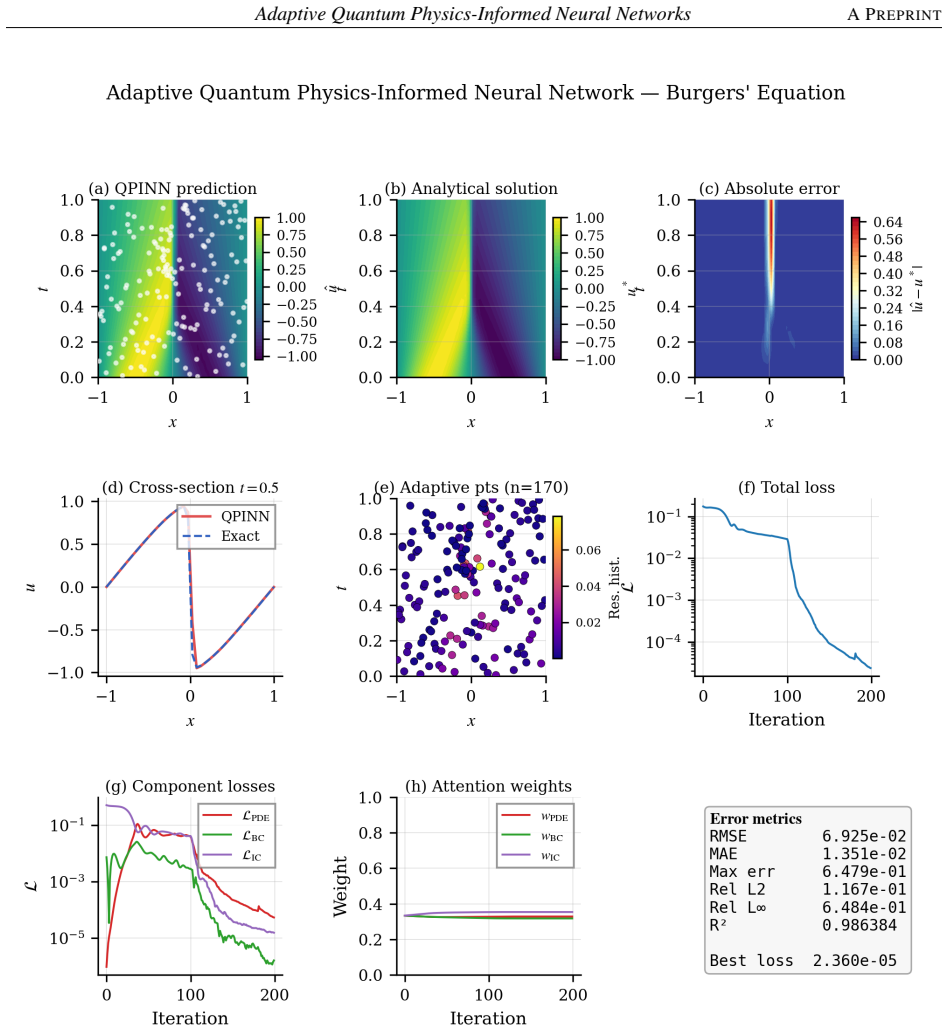
The paper's central claim is that standard QPINNs fail less from the expressive limits of their variational circuits than from static training choices: uniform collocation sampling and fixed loss weights trap the optimizer in poor regions of a non-convex landscape. AQPINN counters with residual-tracked collocation dynamics — gradient-ascent movement of high-error points, Gaussian-noise fission near persistent errors, age-aware pruning — and a softmax attention mechanism that learns the loss weights during training. With the quantum circuit held fixed, the baseline's R² rises from 0.395 or negative to 0.99 on the worst benchmarks, the Burgers shock's maximum error drops 66.8%, and RMSE falls
What carries the argument
Carrying the argument is a fixed hybrid quantum-classical ansatz uθ(t,x) = N_post ∘ Q_θq ∘ N_pre(t,x), whose quantum layer Q_θq is a variational circuit built from data-encoding RX/RZ gates, variational RZ–RY–RZ rotations, and CNOT entangling layers, outputting Pauli-Z expectation values and trained via the parameter-shift rule. Around this sits the adaptive loop: collocation points move along the residual gradient ∇(r²), spawn Gaussian-noise copies near persistent high-residual regions under exclusion zones and a hard cap, and are pruned by the importance score S_i = r̄_i + 0.1/(a_i + 1), which balances residual history against point age; the loss weights (ωp, ωb, ωi) = softmax(α) are thems
Load-bearing premise
The conclusion that optimization — not expressivity — is the QPINN bottleneck assumes that the 3–4 qubit circuits used in all six benchmarks can already represent the true PDE solutions; the paper never varies circuit size or depth to test this, and admits the sizes were chosen for computational feasibility (Section 3).
What would settle it
Run AQPINN with the adaptive mechanisms intact but the quantum layer replaced by a classical MLP of comparable parameter count: if accuracy is unchanged, the quantum circuit is not doing the work. Separately, scale the static baseline from 4 to 10+ qubits and layers: if added expressivity alone closes the gap to AQPINN's accuracy on the same benchmarks, the optimization-bottleneck claim is refuted.
If this is right
- Adaptive training should be treated as part of QPINN methodology: the mechanisms are architecture-agnostic, so the gains are expected to carry over to larger circuits and higher-dimensional PDEs without redesign.
- Baseline QPINN failures that look like representational limits — flat loss plateaus, unphysical trivial states, shock smearing — are frequently training artifacts, so expressivity-only explanations of QPINN underperformance are insufficient.
- Residual-driven collocation re-meshing resolves moving shocks and boundary layers without increasing model parameter count or dataset size, making it a practical route to higher resolution in stiff regimes.
- The two adaptive mechanisms are complementary: the ablation shows each alone improves accuracy on Burgers' and Taylor–Couette benchmarks, but the combined framework is strictly better.
Where Pith is reading between the lines
- A decisive test the paper leaves open: fix the adaptive collocation and loss weighting but swap the quantum layer for a classical MLP of matched width. If a classical adaptive PINN matches AQPINN, the reported gains are properties of the training scheme, and the quantum component's contribution to these benchmarks is not demonstrated.
- The abstract promises gains on reaction-diffusion systems, but the six reported benchmarks are ODEs and fluid-flow PDEs; the 'at least 60%' figure should be read as applying to those benchmarks, and extending it to reaction-diffusion would be extrapolation.
- If optimization is truly the bottleneck, increasing circuit depth or qubit count with static training should show sharply diminishing returns — the paper states this direction as future work, so a scaling study would directly test the central claim.
- The ablation shows the two mechanisms contribute unevenly across problems (attention beats collocation alone on Burgers; collocation beats attention alone on Taylor-Couette), suggesting the optimal adaptive strategy depends on solution smoothness — a dependence the paper leaves implicit.
Editorial analysis
A structured set of objections, weighed in public.
Referee Report
Summary. This manuscript proposes an Adaptive Quantum Physics-Informed Neural Network (AQPINN) that combines two modifications to a standard QPINN: residual-driven adaptive collocation point sampling (gradient-driven relocation, fission near persistent high-residual regions, and pruning of low-importance points) and a softmax-parameterized trainable loss-weighting scheme. The method is evaluated on six benchmarks—a 1D Helmholtz boundary-value problem, a spring-mass ODE, a 2D Poisson equation, Burgers' equation, Hagen-Poiseuille flow, and Taylor-Couette flow—against a fixed QPINN baseline. The reported results show consistent improvements in RMSE, relative error, and R² for AQPINN, and an ablation in the appendix separates the two adaptive components on Burgers' and Taylor-Couette benchmarks. The paper interprets these results as evidence that optimization, not only circuit expressivity, is an important bottleneck for QPINNs.
Significance. If the empirical claims hold, the paper provides a useful demonstration that classical training strategies—adaptive collocation and dynamic loss weighting—can materially improve QPINN accuracy, and it gives a concrete recipe for doing so. The six benchmarks and the two-benchmark ablation are strengths, as is the explicit acknowledgment that comparisons to classical adaptive PINNs and quantum speedups are outside the scope. However, the central conceptual conclusion about 'optimization, not only expressivity' is not directly tested, and the quantitative headline is measured against a baseline that the authors deliberately chose to be challenging. The paper is therefore a solid empirical contribution whose interpretational claims need to be brought in line with the evidence.
major comments (4)
- [Section 3 and Section 3.3] The abstract and conclusion claim that 'optimization, not only expressivity, can be an important bottleneck' in QPINNs. This claim is not supported by the experiments because no experiment varies circuit width or depth. All circuits use 3–4 qubits and 1–6 layers, chosen 'to balance computational feasibility' (Section 3), and the sentence that the method is 'architecture-agnostic and expected to scale to larger circuits' is asserted without supporting evidence. To make the bottleneck claim load-bearing, the authors should add a capacity sweep (e.g., increasing qubits/layers while keeping the training strategy fixed) or, alternatively, explicitly rephrase the conclusion as a statement about the small-circuit regime studied here.
- [Section 3, introductory paragraph] The authors state that rather than performing hyperparameter optimization, they 'identify a challenging configuration in which the baseline QPINN exhibits noticeable performance degradation or convergence failure,' and then use that configuration as the reference. This means the 60–90% improvements reported in the abstract and results are relative to a deliberately weakened baseline. The gains are still informative, but the paper should report results for a more standard baseline configuration (or a small set of baseline configurations) so the reader can see whether adaptive training helps when the baseline is not artificially handicapped, and should explicitly label the current numbers as a best-case demonstration.
- [Abstract and Section 3] The abstract promises improvements for 'benchmark fluid flows and reaction-diffusion systems,' but no reaction-diffusion benchmark appears in the Results section. The six benchmarks are Helmholtz, spring-mass, 2D Poisson, Burgers, Hagen-Poiseuille, and Taylor-Couette; none is a reaction-diffusion system. If reaction-diffusion experiments were performed, they should be added; otherwise the abstract should be revised to match the actual scope of the experiments.
- [Section 3.2.2, Burgers' equation] The text describes the baseline QPINN's large error as 'associated with shock smearing, where insufficient local representational capacity leads to over-smoothing of the sharp transition.' This wording conflicts with the paper's central claim that expressivity is not the main bottleneck and that adaptive training fixes optimization rather than representational capacity. If 'representational capacity' here means collocation-point density rather than circuit expressivity, this should be stated explicitly; as written, the sentence could be read as supporting the opposite of the paper's main conclusion.
minor comments (5)
- [Section 3.1.1] The Helmholtz boundary conditions are not stated explicitly; the text only says the analytical solution is 'consistent with the imposed boundary conditions.' Please specify the boundary conditions used in the numerical experiment.
- [Section 3.1.2] Equation (21) is described as a boundary-value problem, but the conditions given are initial conditions, u(0)=0 and u'(0)=5. 'Initial-value problem' would be more accurate.
- [Equation (20)] The importance score in Eq. (20) is introduced as 'ad-hoc,' but the meaning of rbar_i is not defined in the text. Clarify whether it is the time-averaged squared residual and specify units/scaling so the formula is reproducible.
- [Figures 6 and 7] The captions of Figures 6 and 7 are inconsistent: Figure 6 is labeled as the QPINN solution 'with attention mechanism and adaptive strategy' and Figure 7 as 'without attention mechanism and adaptive strategy,' while the surrounding text appears to describe the baseline and adaptive results in the opposite order. Please check the assignment of figures to models.
- [Section 3.2.1] The text mentions 'adaptive attention weights [0.4,0.6]' in the setup, which looks like fixed values rather than the output of the trainable softmax mechanism. Clarify whether these are initial values, final values, or a fixed schedule.
Circularity Check
No circular derivation: the adaptive gains are measured against closed-form analytical solutions, and no predicted quantity reduces to a fitted constant or to a self-citation.
full rationale
The paper's central numerical claims are empirical comparisons against analytical reference solutions (Helmholtz, spring-mass, Poisson, Burgers, Hagen-Poiseuille, Taylor-Couette), so the reported errors are not defined by the adaptive mechanism itself. The attention weights and collocation-point updates are trained using PDE residuals, but the final accuracy metrics are computed with respect to u_true, not with respect to the training signal. No equation in the paper reduces a prediction to a fitted parameter: the adaptive weights and points are optimization aids, not components of the ground-truth solution. The baseline QPINN is deliberately chosen as a 'challenging configuration' exhibiting 'noticeable performance degradation or convergence failure' (Section 3), which may inflate the reported relative improvements, but this is a benchmarking/validity concern, not a circularity of derivation. Similarly, the conclusion that optimization rather than expressivity is a bottleneck is under-supported because circuit size/depth is never varied, but this is a missing control, not an equation-level equivalence. The only apparent self-citation (Queiroz et al. 2021, which includes author Santos) supports a background statement about PINN applications and is not load-bearing. No uniqueness theorem or ansatz is imported from the authors' prior work to force the main conclusion. Therefore, no significant circularity is present.
Axiom & Free-Parameter Ledger
free parameters (5)
- Baseline configuration selection
- Collocation point budgets per benchmark =
Helmholtz 20->40, Poisson 40->100, Burgers 150->200, Hagen-Poiseuille 20->40, Taylor-Couette 200->600
- Adaptive sampling hyperparameters =
EMA decay 0.7, outlier factor 20.0, zeta_max 0.1, fission top 15%, sigma 0.05, pruning bottom 15%, ages 10-20% epochs
- Importance score coefficients =
S_i = rbar_i + 0.1/(a_i+1)
- Network and circuit sizes =
3-4 qubits, 1-6 layers, 1-32 classical neurons
axioms (4)
- standard math Parameter-shift rule gives unbiased gradient estimates for the variational circuit parameters.
- domain assumption The PennyLane default.qubit simulator faithfully represents the quantum circuit without decoherence or shot noise.
- ad hoc to paper The hybrid ansatz with 3-4 qubits is expressive enough to approximate the exact PDE solutions, so remaining baseline error is due to optimization, not capacity.
- ad hoc to paper Residual-based collocation adaptation and softmax loss reweighting improve QPINN training.
Cite this review
Pith. "Pith review of Adaptive Quantum Physics-Informed Neural Networks for Differential Equations with Applications to Fluid Dynamics." pith.science (2026). https://pith.science/paper/UJ7GUYUB
@misc{pith2026260800850,
  author       = {Pith},
  title        = {Pith review of: Adaptive Quantum Physics-Informed Neural Networks for Differential Equations with Applications to Fluid Dynamics},
  year         = {2026},
  howpublished = {\url{https://pith.science/paper/UJ7GUYUB}},
  note         = {Machine review of arXiv:2608.00850}
}
read the original abstract
Physics-informed neural networks (PINNs) have emerged as a versatile approach for solving nonlinear partial differential equations (PDEs), yet achieving high accuracy efficiently using these techniques remains challenging for high-dimensional or multiscale systems. Here, we present a hybrid quantum-classical framework that enhances Quantum PINNs (QPINNs) through adaptive collocation point sampling and loss-aware attention mechanisms. By dynamically prioritizing points in regions with large PDE residuals or steep solution gradients, our method mitigates the spectral bias inherent in conventional PINNs. Current Quantum Physics-Informed Neural Networks are commonly assumed to be limited by the expressive power of quantum circuits. In our work, we observed that, across diverse differential equations, optimization - not only expressivity - can be an important bottleneck. Furthermore, a trainable loss-weighting scheme balances contributions from physics residuals, boundary conditions, and data fidelity during training. Integrating these strategies with quantum computing techniques (including variational quantum circuits and quantum gradient estimation) can yield at least a 60% improvement in solution accuracy under specific regimes for benchmark fluid flows and reaction-diffusion systems. Finally, we argue that merely increasing model expressivity is insufficient for resolving complex PDEs via QPINNs, as they remain constrained by the structural optimization limitations of classical PINNs. This framework provides a scalable pathway for quantum-enhanced scientific machine learning, bridging physics-based modeling with emerging quantum computational capabilities.
Figures




Reference graph
Works this paper leans on
-
[1]
Feynman, Robert B
Richard P. Feynman, Robert B. Leighton, and Matthew Sands. The Feynman Lectures on Physics. Addison-Wesley, Boston, MA, 1964
1964
-
[2]
Finding solutions of the Navier--Stokes equations through quantum computing: Progress, a generalization, and next steps forward
Frank Gaitan. Finding solutions of the Navier--Stokes equations through quantum computing: Progress, a generalization, and next steps forward. Advanced Quantum Technologies, 4 0 (10): 0 2100055, 2021
2021
-
[3]
Quantum computation of fluid dynamics
Jeffrey Yepez. Quantum computation of fluid dynamics. In Colin P. Williams, editor, Quantum Computing and Quantum Communications, pages 34--60, Berlin, Heidelberg, 1999. Springer Berlin Heidelberg
1999
-
[4]
Quantum computing in the NISQ era and beyond
John Preskill. Quantum computing in the NISQ era and beyond. Quantum, 2: 0 79, August 2018
2018
-
[5]
Massively parallel numerical simulation using up to 36,000 CPU cores of an industrial-scale polydispersed reactive pressurized fluidized bed with a mesh of one billion cells
Herv \'e Neau, Maxime Pigou, Pascal Fede, Renaud Ansart, Cyril Baudry, Nicolas M \'e rigoux, J \'e r \^o me Lavi \'e ville, Yvan Fournier, Nicolas Renon, and Olivier Simonin. Massively parallel numerical simulation using up to 36,000 CPU cores of an industrial-scale polydispersed reactive pressurized fluidized bed with a mesh of one billion cells. Powder ...
2020
-
[6]
Childs, Dmitri Maslov, Yunseong Nam, Neil J
Andrew M. Childs, Dmitri Maslov, Yunseong Nam, Neil J. Ross, and Yuan Su. Toward the first quantum simulation with quantum speedup. Proceedings of the National Academy of Sciences, 115 0 (38): 0 9456--9461, 2018
2018
-
[7]
Quantum algorithms for fluid simulations
Ren \'e Steijl. Quantum algorithms for fluid simulations. In Francisco Bulnes, Vasilios N. Stavrou, Oleg Morozov, and Anton V. Bourdine, editors, Advances in Quantum Communication and Information, chapter 3. IntechOpen, Rijeka, 2020
2020
-
[8]
Ren \'e Steijl and George N. Barakos. Parallel evaluation of quantum algorithms for computational fluid dynamics. Computers and Fluids, 173: 0 22--28, 2018
2018
-
[9]
Quantum lattice-gas model for the burgers equation
Jeffrey Yepez. Quantum lattice-gas model for the burgers equation. Journal of Statistical Physics, 107: 0 203--224, 2002
2002
-
[10]
Joshi, Petar Jurcevic, Christine A
Christian Kokail, Christine Maier, Rick van Bijnen, Tiff Brydges, Manoj K. Joshi, Petar Jurcevic, Christine A. Muschik, Pietro Silvi, Rainer Blatt, Christian F. Roos, and Peter Zoller. Self-verifying variational quantum simulation of lattice models. Nature, 569: 0 355--360, 2019
work page 2019
-
[11]
Furkan Oz, Rohit K. S. S. Vuppala, Kursat Kara, and Frank Gaitan. Solving burgers' equation with quantum computing. Quantum Information Processing, 21: 0 30, 2022
work page 2022
-
[12]
Dominic W. Berry. High-order quantum algorithm for solving linear differential equations. Journal of Physics A: Mathematical and Theoretical, 47 0 (10): 0 105301, February 2014
work page 2014
-
[13]
Quantum algorithms and the finite element method
Ashley Montanaro and Sam Pallister. Quantum algorithms and the finite element method. Physical Review A, 93 0 (3): 0 032324, March 2016
work page 2016
-
[14]
Pedro C. S. Costa, Stephen Jordan, and Aaron Ostrander. Quantum algorithm for simulating the wave equation. Physical Review A, 99 0 (1): 0 012323, January 2019
work page 2019
-
[15]
Quantum amplitude amplification and estimation
Gilles Brassard, Peter Hoyer, Michele Mosca, and Alain Tapp. Quantum amplitude amplification and estimation. AMS Contemporary Mathematics Series, 305, 06 2000
work page 2000
-
[16]
Harrow, Avinatan Hassidim, and Seth Lloyd
Aram W. Harrow, Avinatan Hassidim, and Seth Lloyd. Quantum algorithm for linear systems of equations. Physical Review Letters, 103 0 (15), 2009
work page 2009
-
[17]
Cerezo, Yigit Subasi, Lukasz Cincio, and Patrick J
Carlos Bravo-Prieto, Ryan LaRose, M. Cerezo, Yigit Subasi, Lukasz Cincio, and Patrick J. Coles. Variational quantum linear solver. Quantum, 7: 0 1188, 2023. ISSN 2521-327X
work page 2023
-
[18]
Quantum simulation of partial differential equations via schr \"o dingerization
Shi Jin, Nana Liu, and Yue Yu. Quantum simulation of partial differential equations via schr \"o dingerization. Physical Review Letters, 133 0 (23): 0 230602, December 2024
work page 2024
- [19]
-
[20]
Quantum physics-informed neural networks
Corey Trahan, Mark Loveland, and Samuel Dent. Quantum physics-informed neural networks. Entropy, 26 0 (8), 2024
work page 2024
-
[21]
Quantum physics-informed neural networks for multivariable partial differential equations
Giorgio Panichi, Sebastiano Corli, and Enrico Prati. Quantum physics-informed neural networks for multivariable partial differential equations. Phys. Rev. Appl., 25: 0 014001, Jan 2026
work page 2026
-
[22]
Maziar Raissi, Paris Perdikaris, and George E Karniadakis. Physics-informed neural networks: A deep learning framework for solving forward and inverse problems involving partial differential equations. Journal of Computational Physics, 378: 0 686--707, 2019
work page 2019
-
[25]
Scientific machine learning through physics--informed neural networks: Where we are and what's next
Salvatore Cuomo, Vincenzo Schiano Di Cola, Fabio Giampaolo, Gianluigi Rozza, Maziar Raissi, and Francesco Piccialli. Scientific machine learning through physics--informed neural networks: Where we are and what's next. Journal of Scientific Computing, 92 0 (3): 0 88, July 2022
work page 2022
-
[26]
George E. Karniadakis, Ioannis G. Kevrekidis, Lu Lu, Paris Perdikaris, Sifan Wang, and Liu Yang. Physics-informed machine learning. Nature Reviews Physics, 3: 0 422--440, 2021
work page 2021
-
[27]
L. H. Queiroz, F. P. Santos, J. P. Oliveira, and M. B. Souza. Physics-informed deep learning to predict flow fields in cyclone separators. Digital Chemical Engineering, 1: 0 100002, 2021
work page 2021
-
[28]
Guofei Pang, Lu Lu, and George E. Karniadakis. fPINNs : Fractional physics-informed neural networks. SIAM Journal on Scientific Computing, 41 0 (4): 0 A2603--A2626, 2019
work page 2019
-
[29]
Maziar Raissi, Alireza Yazdani, and George E. Karniadakis. Hidden fluid mechanics: Learning velocity and pressure fields from flow visualizations. Science, 367 0 (6481): 0 1026--1030, 2020
work page 2020
-
[31]
The power of quantum neural networks
Amira Abbas, David Sutter, Christa Zoufal, Aurelien Lucchi, Alessio Figalli, and Stefan Woerner. The power of quantum neural networks. Nature Computational Science, 1 0 (6): 0 403--409, 2021
work page 2021
-
[32]
Barkoutsos, Chiara Macchiavello, Dario Gerace, Ivano Tavernelli, and Daniele Bajoni
Francesco Tacchino, Stefano Mangini, Panagiotis Kl. Barkoutsos, Chiara Macchiavello, Dario Gerace, Ivano Tavernelli, and Daniele Bajoni. Variational learning for quantum artificial neural networks. IEEE Transactions on Quantum Engineering, 2: 0 1--10, 2021
work page 2021
-
[33]
A variational algorithm for quantum neural networks
Antonio Macaluso, Luca Clissa, Stefano Lodi, and Claudio Sartori. A variational algorithm for quantum neural networks. In Computational Science -- ICCS 2020, pages 591--604, 2020
work page 2020
-
[34]
Quantum implementation of an artificial feed-forward neural network
Francesco Tacchino, Panagiotis Barkoutsos, Chiara Macchiavello, Ivano Tavernelli, Dario Gerace, and Daniele Bajoni. Quantum implementation of an artificial feed-forward neural network. Quantum Science and Technology, 5 0 (4): 0 044010, October 2020
work page 2020
-
[35]
David Peral Garc \'i a, Juan Cruz-Benito, and Francisco J. Garc \'i a-Pe \ n alvo. Systematic literature review: Quantum machine learning and its applications, 2022
work page 2022
-
[36]
Chenxi Wu, Min Zhu, Qinyang Tan, Yadhu Kartha, and Lu Lu. A comprehensive study of non-adaptive and residual-based adaptive sampling for physics-informed neural networks. Computer Methods in Applied Mechanics and Engineering, 403: 0 115671, 2023
work page 2023
-
[37]
Levi D. McClenny and Ulisses M. Braga-Neto. Self-adaptive physics-informed neural networks. Journal of Computational Physics, 474: 0 111722, 2023
work page 2023
-
[38]
Quantum physics-informed neural networks for multivariable partial differential equations , author =. Phys. Rev. Appl. , volume =. 2026 , month =
work page 2026
-
[39]
A comprehensive study of non-adaptive and residual-based adaptive sampling for physics-informed neural networks , journal =. 2023 , author =
work page 2023
-
[40]
Self-adaptive physics-informed neural networks , journal =. 2023 , author =
work page 2023
-
[41]
Journal of Computational Physics , volume=
Physics-informed neural networks: A deep learning framework for solving forward and inverse problems involving partial differential equations , author=. Journal of Computational Physics , volume=. 2019 , publisher=
work page 2019
-
[42]
Riva, Stefano and Introini, Carolina and Cammi, Antonio , title =. Physics of Fluids , volume =
-
[43]
Nature Computational Science , volume =
Abbas, Amira and Sutter, David and Zoufal, Christa and Lucchi, Aurelien and Figalli, Alessio and Woerner, Stefan , title =. Nature Computational Science , volume =
-
[44]
Advances in Quantum Deep Learning: An Overview
Advances in Quantum Deep Learning: An Overview , author=. arXiv preprint arXiv:2005.04316 , year=. 2005.04316 , archivePrefix=
work page internal anchor Pith review Pith/arXiv arXiv 2005
-
[45]
Berger, S. and Hosters, N. and M. Trainable embedding quantum physics informed neural networks for solving nonlinear. Scientific Reports , volume =
-
[46]
Trahan, Corey and Loveland, Mark and Dent, Samuel , TITLE =. Entropy , VOLUME =. 2024 , NUMBER =
work page 2024
-
[47]
Physical Review Letters , volume =
Jin, Shi and Liu, Nana and Yu, Yue , title =. Physical Review Letters , volume =
-
[48]
Advanced Quantum Technologies , volume =
Gaitan, Frank , title =. Advanced Quantum Technologies , volume =
-
[49]
Feynman, Richard P. and Leighton, Robert B. and Sands, Matthew , title =
-
[50]
Annual Review of Fluid Mechanics , volume =
Moin, Parviz and Mahesh, Krishnan , title =. Annual Review of Fluid Mechanics , volume =
- [51]
-
[52]
Massively parallel numerical simulation using up to 36,000
Neau, Herv. Massively parallel numerical simulation using up to 36,000. Powder Technology , volume =
-
[53]
and Maslov, Dmitri and Nam, Yunseong and Ross, Neil J
Childs, Andrew M. and Maslov, Dmitri and Nam, Yunseong and Ross, Neil J. and Su, Yuan , title =. Proceedings of the National Academy of Sciences , volume =
-
[54]
Quantum Computation of Fluid Dynamics , booktitle =
Yepez, Jeffrey , editor =. Quantum Computation of Fluid Dynamics , booktitle =
-
[55]
Journal of Statistical Physics , volume =
Yepez, Jeffrey , title =. Journal of Statistical Physics , volume =
-
[56]
Quantum Algorithms for Fluid Simulations , booktitle =
Steijl, Ren. Quantum Algorithms for Fluid Simulations , booktitle =
-
[57]
Parallel evaluation of quantum algorithms for computational fluid dynamics , journal =
Steijl, Ren. Parallel evaluation of quantum algorithms for computational fluid dynamics , journal =
-
[58]
Oz, Furkan and Vuppala, Rohit K. S. S. and Kara, Kursat and Gaitan, Frank , title =. Quantum Information Processing , volume =
- [59]
-
[60]
Berry, Dominic W. and Childs, Andrew M. and Ostrander, Aaron and Wang, Guoming , title =. Communications in Mathematical Physics , volume =
-
[61]
Montanaro, Ashley and Pallister, Sam , title =. Physical Review A , volume =
-
[62]
Costa, Pedro C. S. and Jordan, Stephen and Ostrander, Aaron , title =. Physical Review A , volume =
-
[63]
and Jurcevic, Petar and Muschik, Christine A
Kokail, Christian and Maier, Christine and van Bijnen, Rick and Brydges, Tiff and Joshi, Manoj K. and Jurcevic, Petar and Muschik, Christine A. and Silvi, Pietro and Blatt, Rainer and Roos, Christian F. and Zoller, Peter , title =. Nature , volume =
-
[64]
npj Quantum Information , volume =
Gaitan, Frank , title =. npj Quantum Information , volume =
-
[65]
Quantum Amplitude Amplification and Estimation , volume =
Brassard, Gilles and Hoyer, Peter and Mosca, Michele and Tapp, Alain , year =. Quantum Amplitude Amplification and Estimation , volume =
-
[66]
and Hassidim, Avinatan and Lloyd, Seth , title =
Harrow, Aram W. and Hassidim, Avinatan and Lloyd, Seth , title =. Physical Review Letters , volume =
-
[67]
Variational Quantum Linear Solver , author =. Quantum , volume =. 2023 , publisher =
work page 2023
-
[68]
and Kothari, Robin and Somma, Rolando D
Childs, Andrew M. and Kothari, Robin and Somma, Rolando D. , title =. SIAM Journal on Computing , volume =
-
[69]
Ray, Navamita and Banerjee, Tirtha and Nadiga, Balasubramanya and Karra, Satish , title =
-
[70]
Karniadakis, George E. and Kevrekidis, Ioannis G. and Lu, Lu and Perdikaris, Paris and Wang, Sifan and Yang, Liu , title =. Nature Reviews Physics , volume =
- [71]
-
[72]
Raissi, Maziar and Perdikaris, Paris and Karniadakis, George E. , title =. arXiv preprint arXiv:1711.10561 , year =
-
[73]
Raissi, Maziar and Perdikaris, Paris and Karniadakis, George E. , title =. arXiv preprint arXiv:1711.10566 , year =
-
[74]
Journal of Scientific Computing , volume =
Cuomo, Salvatore and Di Cola, Vincenzo Schiano and Giampaolo, Fabio and Rozza, Gianluigi and Raissi, Maziar and Piccialli, Francesco , title =. Journal of Scientific Computing , volume =. 2022 , month = jul, day =
work page 2022
-
[75]
Queiroz, L. H. and Santos, F. P. and Oliveira, J. P. and Souza, M. B. , title =. Digital Chemical Engineering , volume =
- [76]
- [77]
-
[78]
Systematic Literature Review: Quantum Machine Learning and its Applications , publisher =
Garc. Systematic Literature Review: Quantum Machine Learning and its Applications , publisher =
-
[79]
International Journal of Theoretical Physics , volume =
Chen, Bu-Qing and Niu, Xu-Feng , title =. International Journal of Theoretical Physics , volume =
-
[80]
and Macchiavello, Chiara and Gerace, Dario and Tavernelli, Ivano and Bajoni, Daniele , title =
Tacchino, Francesco and Mangini, Stefano and Barkoutsos, Panagiotis Kl. and Macchiavello, Chiara and Gerace, Dario and Tavernelli, Ivano and Bajoni, Daniele , title =. IEEE Transactions on Quantum Engineering , volume =
-
[81]
Computational Science -- ICCS 2020 , pages =
Macaluso, Antonio and Clissa, Luca and Lodi, Stefano and Sartori, Claudio , title =. Computational Science -- ICCS 2020 , pages =
work page 2020
-
[82]
Quantum Science and Technology , volume =
Tacchino, Francesco and Barkoutsos, Panagiotis and Macchiavello, Chiara and Tavernelli, Ivano and Gerace, Dario and Bajoni, Daniele , title =. Quantum Science and Technology , volume =
-
[83]
and Yoo, Jae Hyeon and Isakov, Sergei V
Broughton, Michael and Verdon, Guillaume and McCourt, Trevor and Martinez, Antonio J. and Yoo, Jae Hyeon and Isakov, Sergei V. and Massey, Philip and Halavati, Ramin and Niu, Murphy Yuezhen and Zlokapa, Alexander and Peters, Evan and Lockwood, Owen and Skolik, Andrea and Jerbi, Sofiene and Dunjko, Vedran and Leib, Martin and Streif, Michael and Von Dollen...
discussion (0)
Sign in with ORCID, Apple, or X to comment. Anyone can read and Pith papers without signing in.