Quantum Lazy Sampling and Path Recording for Any Group
Pith reviewed 2026-06-30 05:48 UTC · model grok-4.3
The pith
A path-recording oracle perfectly simulates random elements of any closed subgroup of U(N) by storing input-output pairs whose updates follow the group's commutant.
A machine-rendered reading of the paper's core claim, the machinery that carries it, and where it could break.
Core claim
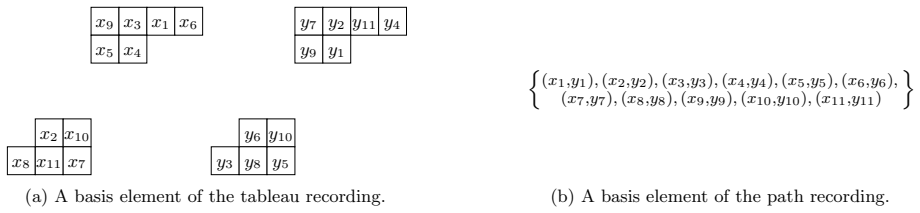
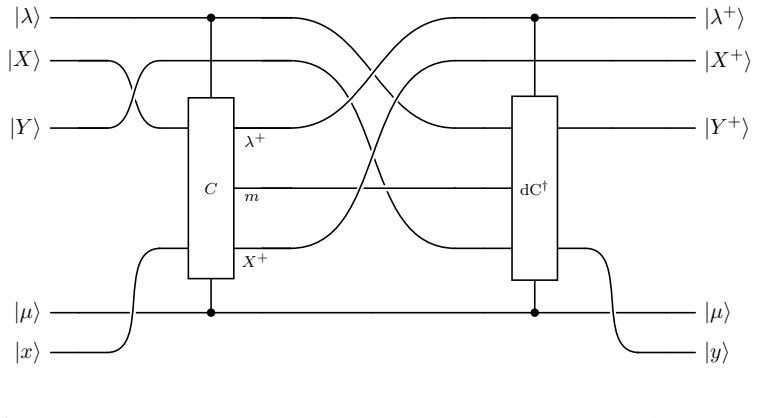
We define and analyze a general-purpose and interpretable path-recording oracle, derived from first principles, that perfectly simulates random elements of any closed subgroup of U(N). Our oracle stores, in superposition, t input-output pairs, with updates described in terms of the commutant of the group's tensor power representation.
What carries the argument
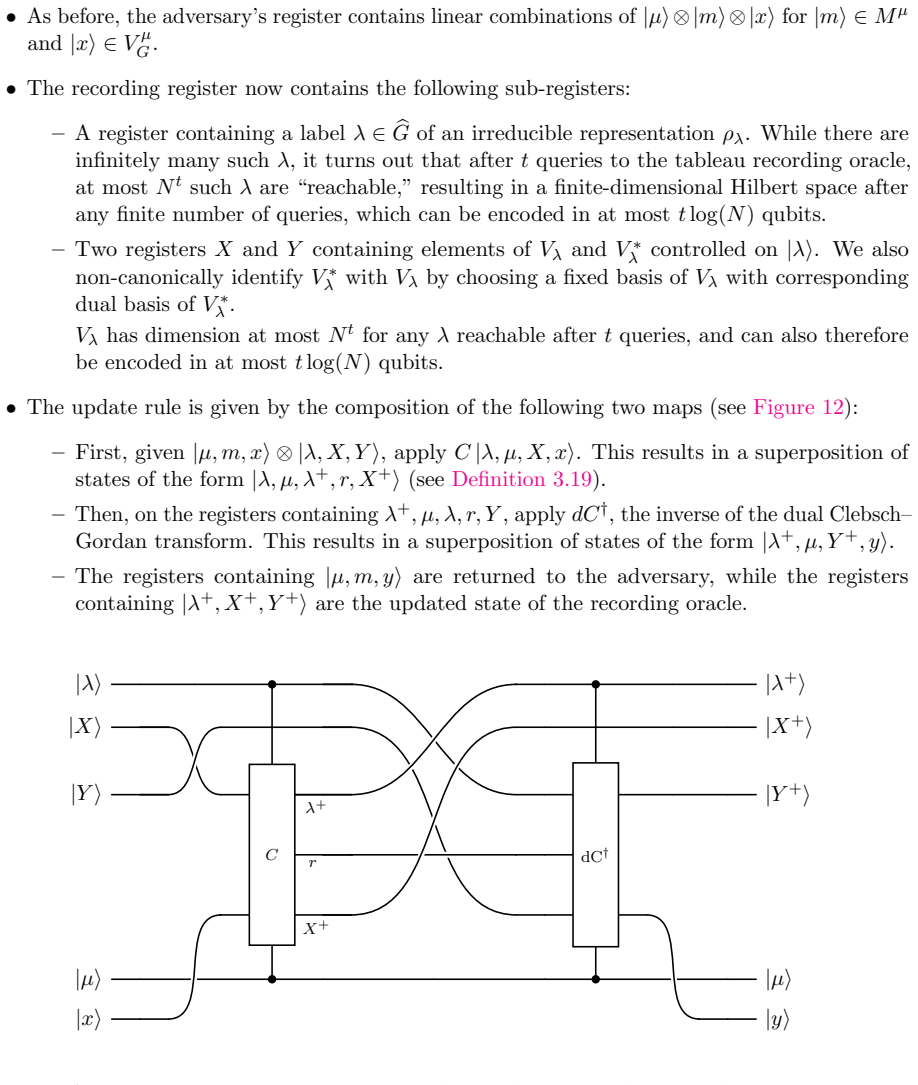
The path-recording oracle stores a superposition of input-output pairs and updates them using the commutant of the group's tensor-power representation to record learned information while maintaining perfect simulation.
If this is right
- Direct comparisons between compressed oracles for different groups become possible, such as between S_N and U(N).
- A simpler construction of pseudorandom unitaries follows as the product of a pseudorandom permutation and a random Clifford.
- Quantum algorithms with oracle access to random group elements can be simulated on the fly while revealing what information has been learned after t queries.
Where Pith is reading between the lines
- The same commutant-based recording technique could support lower-bound arguments in quantum query complexity for problems involving group oracles.
- Oracle comparisons across groups may produce new pseudorandomness results for other primitives that rely on random permutations or unitaries.
Load-bearing premise
The updates to the stored input-output pairs can be described exactly in terms of the commutant of the group's tensor-power representation while still perfectly simulating the random group element for every closed subgroup of U(N).
What would settle it
Finding a closed subgroup of U(N) where no commutant-based update rule can maintain both perfect simulation of the random element and transparent recording of learned pairs after multiple queries would falsify the claim.
Figures


read the original abstract
A central challenge in quantum algorithms and cryptography is reasoning about algorithms with oracle access to a random group element (e.g. a random function, permutation, or unitary). Can we efficiently simulate such algorithms? Can we determine what they know after t queries? A classical tool for this is lazy sampling: the oracle does not commit to the full group element upfront, but rather samples partial information about it on the fly. We study a quantum analog of lazy sampling: compressed oracles (or recording oracles). These are quantum data structures that allow on-the-fly simulation for quantum queries, originally introduced by Zhandry (CRYPTO '19) for random functions, and generalized to unitaries by Ma-Huang (STOC '25) and permutations by Carolan (STOC '26), and used to great effect in security proofs and lower bounds due to their interpretability. We define and analyze a general-purpose and interpretable path-recording oracle, derived from first principles, that perfectly simulates random elements of any closed subgroup of $U(N)$. Our oracle stores, in superposition, t input-output pairs, with updates described in terms of the commutant of the group's tensor power representation. This transparently records the information the algorithm has learned. Our oracle builds on recent work of Grinko-Yoshida (QIP '26), who gave a different general-purpose compressed oracle without clear interpretability. One interesting application of our path-recording is allowing direct comparisons between compressed oracles of different groups, giving a new technique for proving pseudorandomness results. For example, comparing $S_N$ and $U(N)$ yields what is arguably the simplest construction to date of pseudorandom unitaries: the product PC of a pseudorandom permutation and a random Clifford, improving on the prior PFC construction (Metger-Poremba-Sinha-Yuen, FOCS '24; Ma-Huang, STOC '25).
Editorial analysis
A structured set of objections, weighed in public.
Referee Report
Summary. The manuscript defines and analyzes a path-recording oracle that stores superpositions of t input-output pairs for any closed subgroup of U(N). Updates to these pairs are expressed via the commutant of the group's tensor-power representation, yielding a first-principles construction that perfectly simulates a uniform random group element while transparently recording the information learned by a quantum algorithm. The work extends prior compressed-oracle techniques and applies the construction to obtain a simple pseudorandom-unitary construction by comparing the oracles for S_N and U(N).
Significance. If the central derivation holds, the result supplies a general, interpretable quantum lazy-sampling tool applicable to arbitrary closed subgroups, improving on the non-interpretable general-purpose oracle of Grinko-Yoshida. The direct-comparison technique for proving pseudorandomness is a concrete methodological contribution, and the PC construction (pseudorandom permutation composed with random Clifford) is presented as simpler than the prior PFC construction.
minor comments (3)
- The abstract cites Grinko-Yoshida (QIP '26), Ma-Huang (STOC '25), Carolan (STOC '26), and Metger-Poremba-Sinha-Yuen (FOCS '24); the bibliography should list these works with full bibliographic details and arXiv numbers where applicable.
- Notation for the commutant of the tensor-power representation is introduced without an explicit reference to the standard definition in representation theory; a brief reminder or citation in the preliminaries would aid readability.
- The pseudorandom-unitary application is described at a high level; adding a short pseudocode or diagram contrasting the PC and PFC constructions would clarify the claimed simplification.
Simulated Author's Rebuttal
We thank the referee for their positive summary, significance assessment, and recommendation of minor revision. The report highlights the interpretability of the path-recording oracle and the direct-comparison technique for pseudorandom unitaries, which aligns with our goals.
Circularity Check
No significant circularity identified
full rationale
The paper defines a path-recording oracle derived from first principles whose updates are expressed via the commutant of the group's tensor-power representation, enabling perfect simulation of random elements from any closed subgroup of U(N). No step reduces by construction to a fitted input, self-definition, or load-bearing self-citation; the central claim rests on the mathematical properties of the commutant rather than re-labeling or prior author results. External citations (Grinko-Yoshida, Metger et al.) are used for comparison and improvement but do not justify the core construction. The derivation is therefore self-contained.
Axiom & Free-Parameter Ledger
axioms (2)
- domain assumption The group in question is a closed subgroup of U(N).
- domain assumption Updates to the stored pairs are governed by the commutant of the group's tensor-power representation.
Reference graph
Works this paper leans on
-
[1]
Pseudorandom unitaries in the haar random oracle model
[ABGL25a] Prabhanjan Ananth, John Bostanci, Aditya Gulati, and Yao-Ting Lin. Pseudorandom unitaries in the haar random oracle model. In Yael Tauman Kalai and Seny F. Kamara, editors, CRYPTO 2025, Part II , volume 16001 of LNCS, pages 301–333. Springer, Cham, August
2025
-
[2]
Pseudorandom- ness in the (inverseless) haar random oracle model
117 [ABGL25b] Prabhanjan Ananth, John Bostanci, Aditya Gulati, and Yao-Ting Lin. Pseudorandom- ness in the (inverseless) haar random oracle model. In Serge Fehr and Pierre-Alain Fouque, editors, EUROCRYPT 2025, Part VII , volume 15607 of LNCS, pages 138–166. Springer, Cham, May
2025
-
[3]
On the limitations of pseu- dorandom unitaries - or: Cryptographic applications of LOCC indistinguishability of identical versus independent haar unitaries
[AGL25] Prabhanjan Ananth, Aditya Gulati, and Yao-Ting Lin. On the limitations of pseu- dorandom unitaries - or: Cryptographic applications of LOCC indistinguishability of identical versus independent haar unitaries. In Benny Applebaum and Huijia (Rachel) Lin, editors, TCC 2025, Part III , volume 16270 of LNCS, pages 69–103. Springer, Cham, December
2025
-
[4]
Unclonable Encryption in the Haar Random Oracle Model
[BG26] James Bartusek and Eli Goldin. Unclonable encryption in the haar random oracle model. arXiv preprint arXiv:2603.11437 ,
work page internal anchor Pith review Pith/arXiv arXiv
-
[5]
[CFHL21] Kai-Min Chung, Serge Fehr, Yu-Hsuan Huang, and Tai-Ning Liao
Association for Computing Machinery. [CFHL21] Kai-Min Chung, Serge Fehr, Yu-Hsuan Huang, and Tai-Ning Liao. On the compressed- oracle technique, and post-quantum security of proofs of sequential work. In Anne Canteaut and Fran¸ cois-Xavier Standaert, editors,EUROCRYPT 2021, Part II , volume 12697 of LNCS, pages 598–629. Springer, Cham, October
2021
-
[6]
[GBO23] Dmitry Grinko, Adam Burchardt, and Maris Ozols. Gelfand-tsetlin basis for partially transposed permutations, with applications to quantum information. arXiv preprint arXiv:2310.02252,
-
[7]
Quantum Simulation of Random Unitaries from Clebsch-Gordan Transforms
[GY25] Dmitry Grinko and Satoshi Yoshida. Quantum simulation of random unitaries from clebsch-gordan transforms. arXiv preprint arXiv:2509.26623 ,
work page internal anchor Pith review Pith/arXiv arXiv
-
[8]
The NISQ complexity of collision finding
[HLS24] Yassine Hamoudi, Qipeng Liu, and Makrand Sinha. The NISQ complexity of collision finding. In Marc Joye and Gregor Leander, editors, EUROCRYPT 2024, Part IV , volume 14654 of LNCS, pages 3–32. Springer, Cham, May
2024
-
[9]
Pseudorandom function-like states from common haar unitary
[HY25] Minki Hhan and Shogo Yamada. Pseudorandom function-like states from common haar unitary. In Benny Applebaum and Huijia (Rachel) Lin, editors, TCC 2025, Part III , volume 16270 of LNCS, pages 134–165. Springer, Cham, December
2025
-
[10]
The compressed oracle is a worthy (multiplicative) adversary
[JZ25] Stacey Jeffery and Sebastian Zur. The compressed oracle is a worthy (multiplicative) adversary. arXiv preprint arXiv:2509.07876 ,
-
[11]
On finding quantum multi-collisions
[LZ19a] Qipeng Liu and Mark Zhandry. On finding quantum multi-collisions. In Yuval Ishai and Vincent Rijmen, editors, EUROCRYPT 2019, Part III , volume 11478 of LNCS, pages 189–218. Springer, Cham, May
2019
-
[12]
Revisiting post-quantum Fiat-Shamir
[LZ19b] Qipeng Liu and Mark Zhandry. Revisiting post-quantum Fiat-Shamir. In Alexandra Boldyreva and Daniele Micciancio, editors, CRYPTO 2019, Part II , volume 11693 of LNCS, pages 326–355. Springer, Cham, August
2019
-
[13]
The mixed schur transform: efficient quantum circuit and applications
[Ngu23] Quynh T Nguyen. The mixed schur transform: efficient quantum circuit and applications. arXiv preprint arXiv:2310.01613 ,
-
[14]
On quantum query complexities of collision- finding in non-uniform random functions
120 [PCX25] Tianci Peng, Shujiao Cao, and Rui Xue. On quantum query complexities of collision- finding in non-uniform random functions. In Goichiro Hanaoka and Bo-Yin Yang, editors, ASIACRYPT 2025, Part VIII, volume 16252 of LNCS, pages 193–223. Springer, Singapore, December
2025
-
[15]
Tight bounds for inverting permutations via compressed oracle arguments
[Ros21] Ansis Rosmanis. Tight bounds for inverting permutations via compressed oracle arguments. arXiv preprint arXiv:2103.08975 ,
-
[16]
Strong random unitaries and fast scrambling
[SML+25] Thomas Schuster, Fermi Ma, Alex Lombardi, Fernando Brandao, and Hsin-Yuan Huang. Strong random unitaries and fast scrambling. arXiv preprint arXiv:2509.26310 ,
-
[17]
Amplitude amplification and estimation require inverses
[TW25] Ewin Tang and John Wright. Amplitude amplification and estimation require inverses. arXiv preprint arXiv:2507.23787 ,
work page internal anchor Pith review Pith/arXiv arXiv
-
[18]
Towards compressed permutation oracles
[Unr23] Dominique Unruh. Towards compressed permutation oracles. In Jian Guo and Ron Steinfeld, editors, ASIACRYPT 2023, Part IV , volume 14441 of LNCS, pages 369–400. Springer, Singapore, December
2023
-
[19]
How to record quantum queries, and applications to quantum indiffer- entiability
[Zha19] Mark Zhandry. How to record quantum queries, and applications to quantum indiffer- entiability. In Alexandra Boldyreva and Daniele Micciancio, editors, CRYPTO 2019, Part II, volume 11693 of LNCS, pages 239–268. Springer, Cham, August
2019
-
[20]
How to model unitary oracles
[Zha25] Mark Zhandry. How to model unitary oracles. In Yael Tauman Kalai and Seny F. Kamara, editors, CRYPTO 2025, Part II , volume 16001 of LNCS, pages 237–268. Springer, Cham, August
2025
discussion (0)
Sign in with ORCID, Apple, or X to comment. Anyone can read and Pith papers without signing in.