On phase-space singular surfaces in f(R) gravity
Pith reviewed 2026-06-27 12:03 UTC · model grok-4.3
The pith
In f(R) gravity, Hamiltonian constraints degenerate on surfaces where f'(R)=0 or f''(R)=0, emptying the linearized spectrum for backgrounds satisfying f(R)=0 and f'(R)=0.
A machine-rendered reading of the paper's core claim, the machinery that carries it, and where it could break.
Core claim
The regular constraint classification in metric f(R) gravity in the Jordan frame degenerates on singular phase-space surfaces at f'(R)=0 and f''(R)=0. For exact backgrounds satisfying f(R)=0 and f'(R)=0, the linearized spectrum is empty. This makes the known pure R^2 result a special case of a more general degeneracy. FLRW trajectories in the Starobinsky model can cross f'(R)=0, yet inhomogeneous perturbations develop a degenerate constraint structure at the crossing, which is interpreted as a regularity condition for perturbative evolution rather than an ordinary constraint in the Dirac-Bergmann algorithm.
What carries the argument
Degeneration of the constraint classification on phase-space singular surfaces at f'(R)=0 and f''(R)=0 in the Jordan-frame Hamiltonian analysis of f(R) gravity.
If this is right
- Exact backgrounds with f(R)=0 and f'(R)=0 have an empty linearized spectrum.
- The pure R squared theory is a special case of this general degeneracy.
- FLRW solutions in Starobinsky can cross f'(R)=0 but require a regularity condition for inhomogeneous perturbations there.
- Dynamically crossing a singular surface produces different perturbative degeneracies than lying entirely on one.
Where Pith is reading between the lines
- Models with f(R) that admit such singular surfaces may need to avoid them in cosmological applications to preserve standard perturbation theory.
- Similar degeneracies could appear in other modified gravity theories analyzed via Hamiltonian methods.
- The distinction between static and dynamic encounters with singular surfaces may apply to phase-space analysis in other constrained systems.
Load-bearing premise
The standard Dirac-Bergmann constraint classification holds everywhere except exactly on the surfaces f'(R)=0 and f''(R)=0, where degeneration directly determines the absence or alteration of perturbative modes.
What would settle it
An explicit computation of the linear perturbation equations around a background solution satisfying both f(R)=0 and f'(R)=0 that finds non-zero propagating modes would contradict the empty spectrum result.
Figures
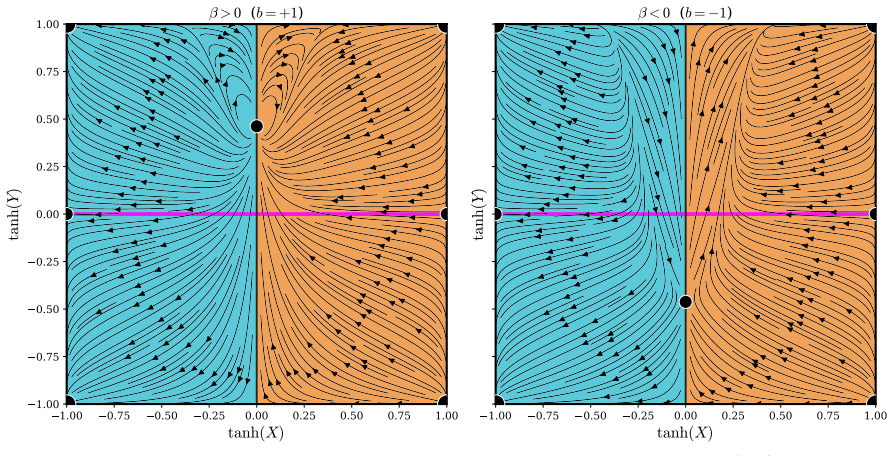
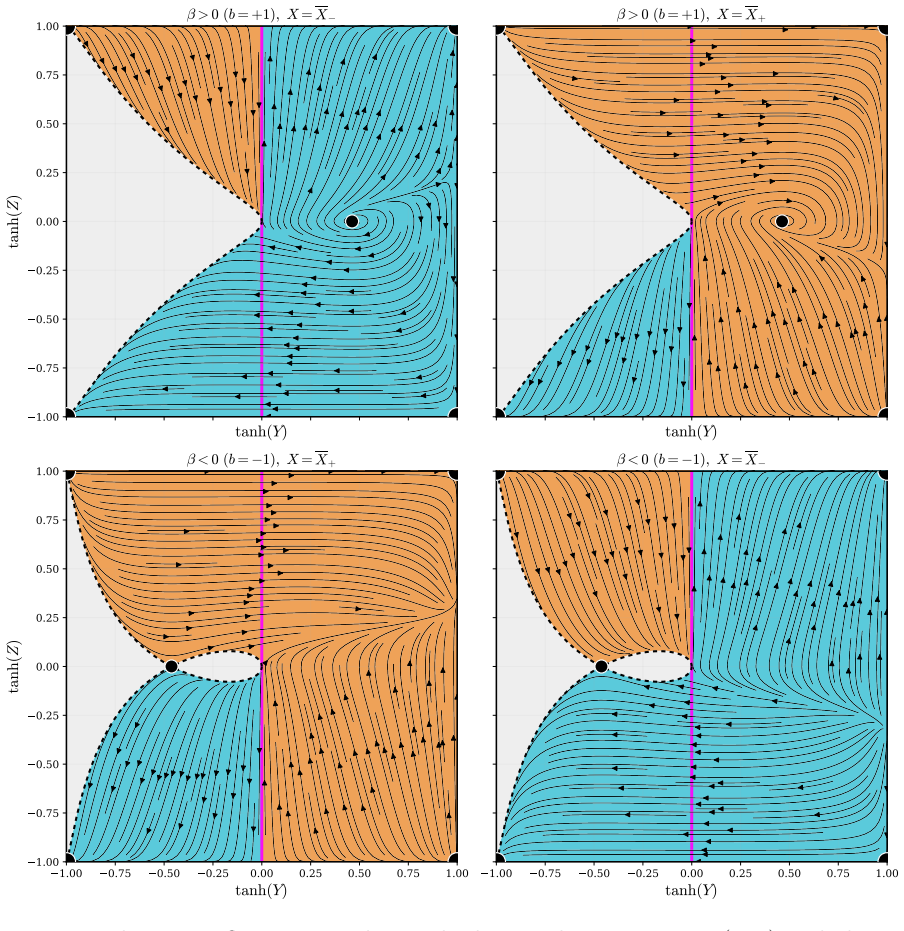
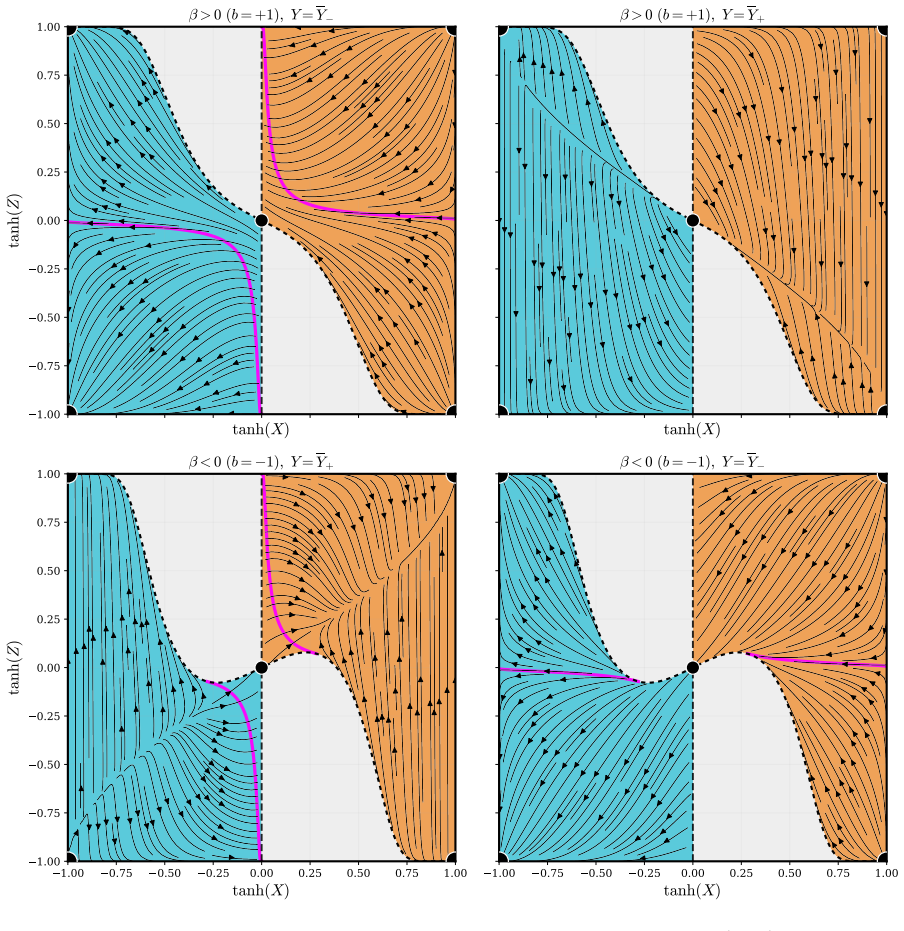
read the original abstract
We perform a Hamiltonian constraint analysis of metric $f(R)$ gravity in the Jordan frame and show that the regular constraint classification degenerates on singular phase-space surfaces located at $f'(R)\!=\!0$ and $f''(R)\!=\!0$. We then study the perturbative implications of these surfaces. For exact backgrounds satisfying $f(R)\!=\!0$ and $f'(R)\!=\!0$, the linearized spectrum is empty; the known pure $R^2$ result is therefore a special case of a more general degeneracy in $f(R)$ gravity. We also show that FLRW trajectories in the Starobinsky model can cross the surface $f'(R)=0$, but that inhomogeneous perturbations develop a degenerate constraint structure at the crossing. The resulting crossing condition is better interpreted as a regularity condition for perturbative evolution than as an ordinary constraint within the Dirac--Bergmann algorithm. Together, these results distinguish backgrounds that lie entirely on a singular surface from backgrounds that cross one dynamically, and show that the two situations lead to different perturbative degeneracies.
Editorial analysis
A structured set of objections, weighed in public.
Referee Report
Summary. The paper performs a Hamiltonian constraint analysis of metric f(R) gravity in the Jordan frame and shows that the regular constraint classification degenerates on singular phase-space surfaces at f'(R)=0 and f''(R)=0. For exact backgrounds satisfying f(R)=0 and f'(R)=0, the linearized spectrum is empty, generalizing the known pure R^2 result. FLRW trajectories in the Starobinsky model can cross f'(R)=0, but inhomogeneous perturbations develop a degenerate constraint structure at the crossing; this is interpreted as a regularity condition for perturbative evolution rather than an ordinary Dirac-Bergmann constraint. The work distinguishes backgrounds lying entirely on a singular surface from those crossing one dynamically.
Significance. If the central results hold, the analysis clarifies the phase-space structure of f(R) gravity by identifying how singular surfaces affect the constraint algebra and perturbative spectrum. This distinction between static and dynamical encounters with the surfaces f'(R)=0 and f''(R)=0 offers a general framework that encompasses the R^2 degeneracy and has implications for the consistency of cosmological solutions in modified gravity.
minor comments (2)
- The abstract summarizes the Hamiltonian analysis and its implications but does not include explicit steps or equations; the main text should present the constraint classification and degeneration conditions with sufficient detail for independent verification.
- Notation for the singular surfaces and the distinction between lying on versus crossing them should be introduced early and used consistently throughout.
Simulated Author's Rebuttal
We thank the referee for the positive and accurate summary of our manuscript and for the recommendation of minor revision. No major comments were raised in the report.
Circularity Check
No circularity; standard Dirac-Bergmann analysis applied to f(R) without reduction to inputs
full rationale
The derivation consists of applying the standard Dirac-Bergmann constraint classification to the Hamiltonian of metric f(R) gravity in the Jordan frame, locating degeneracies exactly where f'(R)=0 and f''(R)=0 by direct computation from the action. The empty spectrum on backgrounds with f(R)=f'(R)=0 and the crossing behavior in Starobinsky FLRW follow immediately from that classification without fitted parameters, self-definitional loops, or load-bearing self-citations that would make the central claim equivalent to its own inputs. The paper is therefore self-contained against external benchmarks.
Axiom & Free-Parameter Ledger
axioms (1)
- domain assumption Metric f(R) gravity in the Jordan frame admits a Hamiltonian formulation with constraints classifiable by the Dirac-Bergmann algorithm
Reference graph
Works this paper leans on
-
[1]
On the degrees of freedom of R2 gravity in flat spacetime,
A. Hell, D. Lust and G. Zoupanos, “On the degrees of freedom of R2 gravity in flat spacetime,” JHEP02(2024), 039 [arXiv:2311.08216 [hep-th]]
arXiv 2024
-
[2]
On the Degrees of Freedom Count on Singular Phase Space Submanifolds,
A. Golovnev, “On the Degrees of Freedom Count on Singular Phase Space Submanifolds,” Int. J. Theor. Phys.63(2024) no.8, 212 [arXiv:2311.10690 [hep-th]]
arXiv 2024
-
[3]
Particle content of (scalarcurvature)2 gravities revisited,
G. K. Karananas, “Particle content of (scalarcurvature)2 gravities revisited,” Phys. Rev. D 111(2025) no.4, 044068 [arXiv:2407.09598 [hep-th]]
arXiv 2025
-
[4]
Spectrum of pure R2 gravity: full Hamiltonian analysis,
W. Barker and D. Glavan, “Spectrum of pure R2 gravity: full Hamiltonian analysis,” JCAP 05(2026), 052 [arXiv:2510.08201 [gr-qc]]
Pith/arXiv arXiv 2026
-
[5]
T. P. Sotiriou and V. Faraoni, “f(R) Theories Of Gravity,” Rev. Mod. Phys.82(2010), 451-497 [arXiv:0805.1726 [gr-qc]]
Pith/arXiv arXiv 2010
-
[6]
A. De Felice and S. Tsujikawa, “f(R) theories,” Living Rev. Rel.13(2010), 3 [arXiv:1002.4928 [gr-qc]]
Pith/arXiv arXiv 2010
-
[7]
Unified cosmic history in modified gravity: from F(R) theory to Lorentz non-invariant models,
S. Nojiri and S. D. Odintsov, “Unified cosmic history in modified gravity: from F(R) theory to Lorentz non-invariant models,” Phys. Rept.505(2011), 59-144 [arXiv:1011.0544 [gr-qc]]
Pith/arXiv arXiv 2011
-
[8]
Physical nonviability of a wide class of f(R) models and their constant-curvature solutions,
A. Casado-Turrión, Á. de la Cruz-Dombriz and A. Dobado, “Physical nonviability of a wide class of f(R) models and their constant-curvature solutions,” Phys. Rev. D108(2023) no.6, 064006 [arXiv:2303.02103 [gr-qc]]
arXiv 2023
-
[9]
Propagating degrees of freedom on maximally symmetric backgrounds in f(R) theories of gravity,
A. Casado-Turrión, Á. de la Cruz-Dombriz and A. Dobado, “Propagating degrees of freedom on maximally symmetric backgrounds in f(R) theories of gravity,” Phys. Rev. D111(2025) no.4, 044030 [arXiv:2412.09366 [gr-qc]]
arXiv 2025
-
[10]
Various Hamiltonian formulations of f(R) gravity and their canonical relationships,
N. Deruelle, Y. Sendouda and A. Youssef, “Various Hamiltonian formulations of f(R) gravity and their canonical relationships,” Phys. Rev. D80(2009), 084032 [arXiv:0906.4983 [gr-qc]]
Pith/arXiv arXiv 2009
-
[11]
Non–Linear Field Theories II. Canonical Equations and Quantization
P. G. Bergmann and J. H. M. Brunings, “Non–Linear Field Theories II. Canonical Equations and Quantization” Rev. Mod. Phys. 21 (1949) 480
1949
-
[12]
Generalized Hamiltonian dynamics,
P. A. M. Dirac, “Generalized Hamiltonian dynamics,” Can. J. Math.2(1950), 129-148
1950
-
[13]
Lectures on quantum Mechanics,
P. A. M. Dirac, “Lectures on quantum Mechanics,” Belfer Graduate School of Sciences, Yeshiva University, New York, 1964
1964
-
[14]
Correspondence of F(R) gravity singularities in Jordan and Einstein frames,
S. Bahamonde, S. D. Odintsov, V. K. Oikonomou and M. Wright, “Correspondence of F(R) gravity singularities in Jordan and Einstein frames,” Annals Phys.373(2016), 96-114 [arXiv:1603.05113 [gr-qc]]
Pith/arXiv arXiv 2016
-
[15]
On dynamical systems approaches and methods inf(R) cosmology,
A. Alho, S. Carloni and C. Uggla, “On dynamical systems approaches and methods inf(R) cosmology,” JCAP08(2016), 064 [arXiv:1607.05715 [gr-qc]]
Pith/arXiv arXiv 2016
-
[16]
On the equivalence of Jordan and Einstein frames in scale-invariant gravity,
M. Rinaldi, “On the equivalence of Jordan and Einstein frames in scale-invariant gravity,” Eur. Phys. J. Plus133(2018) no.10, 408 [arXiv:1808.08154 [gr-qc]]. 26
Pith/arXiv arXiv 2018
-
[17]
Aspects of non-minimally coupled curvature with power laws,
A. Hell and D. Lust, “Aspects of non-minimally coupled curvature with power laws,” JHEP 12(2025), 091 [arXiv:2509.20217 [hep-th]]
arXiv 2025
-
[18]
The Dynamics of general relativity,
R. L. Arnowitt, S. Deser and C. W. Misner, “The Dynamics of general relativity,” Gen. Rel. Grav.40(2008), 1997-2027 [arXiv:gr-qc/0405109 [gr-qc]]
Pith/arXiv arXiv 2008
-
[19]
Canonical Quantization and Local Measure of R**2 Gravity,
I. L. Buchbinder and S. L. Lyakhovich, “Canonical Quantization and Local Measure of R**2 Gravity,” Class. Quant. Grav.4(1987), 1487-1501
1987
-
[20]
Spectrum of relict gravitational radiation and the early state of the universe,
A. A. Starobinsky, “Spectrum of relict gravitational radiation and the early state of the universe,” JETP Lett.30(1979), 682-685
1979
-
[21]
Quantization of fields with constraints,
D. M. Gitman and I. V. Tyutin, “Quantization of fields with constraints,” Springer, Berlin Heidelberg, Germany, 1990
1990
-
[22]
On the Role of Constraints and Degrees of Freedom in the Hamiltonian Formalism,
A. Golovnev, “On the Role of Constraints and Degrees of Freedom in the Hamiltonian Formalism,” Universe9, no.2, 101 (2023) [arXiv:2212.11260 [hep-th]]
arXiv 2023
-
[23]
The Phase space view of inflation. 2: Fourth order models,
S. Capozziello, F. Occhionero and L. Amendola, “The Phase space view of inflation. 2: Fourth order models,” Int. J. Mod. Phys. D1(1993), 615-639
1993
-
[24]
Cosmological dynamics of R**n gravity,
S. Carloni, P. K. S. Dunsby, S. Capozziello and A. Troisi, “Cosmological dynamics of R**n gravity,” Class. Quant. Grav.22(2005), 4839-4868 [arXiv:gr-qc/0410046 [gr-qc]]
Pith/arXiv arXiv 2005
-
[25]
A Dynamical system approach to higher order gravity,
S. Carloni and P. K. S. Dunsby, “A Dynamical system approach to higher order gravity,” J. Phys. A40(2007), 6919-6926 [arXiv:gr-qc/0611122 [gr-qc]]
Pith/arXiv arXiv 2007
-
[26]
The Phase space view of f(R) gravity,
J. C. C. de Souza and V. Faraoni, “The Phase space view of f(R) gravity,” Class. Quant. Grav.24(2007), 3637-3648 [arXiv:0706.1223 [gr-qc]]
Pith/arXiv arXiv 2007
-
[27]
Cosmological dynamics of scalar-tensor gravity,
S. Carloni, S. Capozziello, J. A. Leach and P. K. S. Dunsby, “Cosmological dynamics of scalar-tensor gravity,” Class. Quant. Grav.25(2008), 035008 [arXiv:gr-qc/0701009 [gr-qc]]
Pith/arXiv arXiv 2008
-
[28]
Some remarks on the dynamical systems approach to fourth order gravity,
S. Carloni, A. Troisi and P. K. S. Dunsby, “Some remarks on the dynamical systems approach to fourth order gravity,” Gen. Rel. Grav.41(2009), 1757-1776 [arXiv:0706.0452 [gr-qc]]
Pith/arXiv arXiv 2009
-
[29]
A new approach to the analysis of the phase space off(R)-gravity,
S. Carloni, “A new approach to the analysis of the phase space off(R)-gravity,” JCAP09 (2015), 013 [arXiv:1505.06015 [gr-qc]]
Pith/arXiv arXiv 2015
-
[30]
Autonomous dynamical system approach forf(R) gravity,
S. D. Odintsov and V. K. Oikonomou, “Autonomous dynamical system approach forf(R) gravity,” Phys. Rev. D96(2017) no.10, 104049 [arXiv:1711.02230 [gr-qc]]
Pith/arXiv arXiv 2017
-
[31]
A note on the dynamical system formulations in f(R) gravity,
S. Chakraborty, P. K. S. Dunsby and K. Macdevette, “A note on the dynamical system formulations in f(R) gravity,” Int. J. Geom. Meth. Mod. Phys.19(2022) no.08, 2230003 [arXiv:2112.13094 [gr-qc]]
arXiv 2022
-
[32]
Dynamics of quadratic f(R) cosmology with a perfect fluid: Jordan and Einstein frames,
A. Alho, M. Lima and F. C. Mena, “Dynamics of quadratic f(R) cosmology with a perfect fluid: Jordan and Einstein frames,” [arXiv:2603.09667 [gr-qc]]
-
[33]
The particle content of (scalar curvature)2 metric-affine gravity,
G. K. Karananas, “The particle content of (scalar curvature)2 metric-affine gravity,” [arXiv:2408.16818 [hep-th]]
-
[34]
Hamiltonian analysis of metric-affine-R2 theory,
D. Glavan, T. Zlosnik and C. Lin, “Hamiltonian analysis of metric-affine-R2 theory,” JCAP 04(2024), 072 [arXiv:2311.17459 [gr-qc]]
arXiv 2024
-
[35]
On the strong coupling of Einsteinian Cubic Gravity and its generalisations,
J. Beltrán Jiménez and A. Jiménez-Cano, “On the strong coupling of Einsteinian Cubic Gravity and its generalisations,” JCAP01(2021), 069 [arXiv:2009.08197 [gr-qc]]. 27
arXiv 2021
discussion (0)
Sign in with ORCID, Apple, or X to comment. Anyone can read and Pith papers without signing in.