Multi-Scale Contrastive Attention for Light-Curve Representation Learning
Pith reviewed 2026-07-01 03:19 UTC · model grok-4.3
The pith
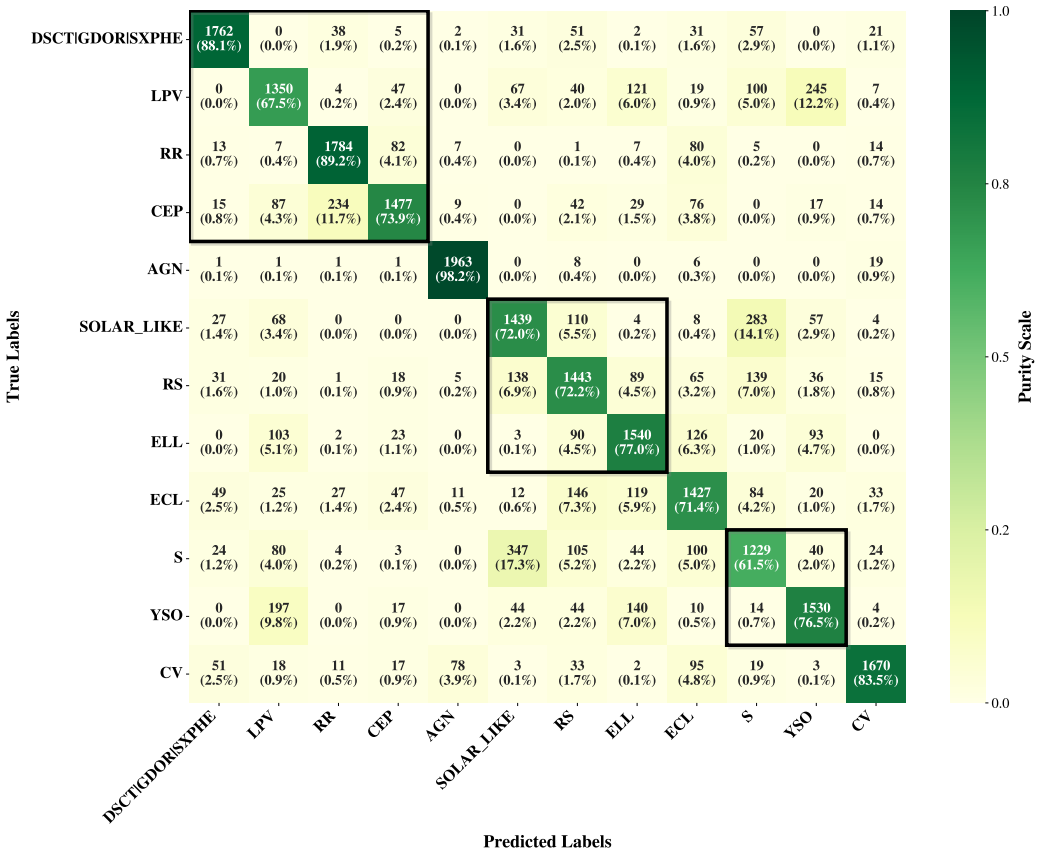
Self-supervised contrastive learning on partial ZTF light curves yields representations that classify 12 variability types at 0.70 accuracy.
A machine-rendered reading of the paper's core claim, the machinery that carries it, and where it could break.
Core claim
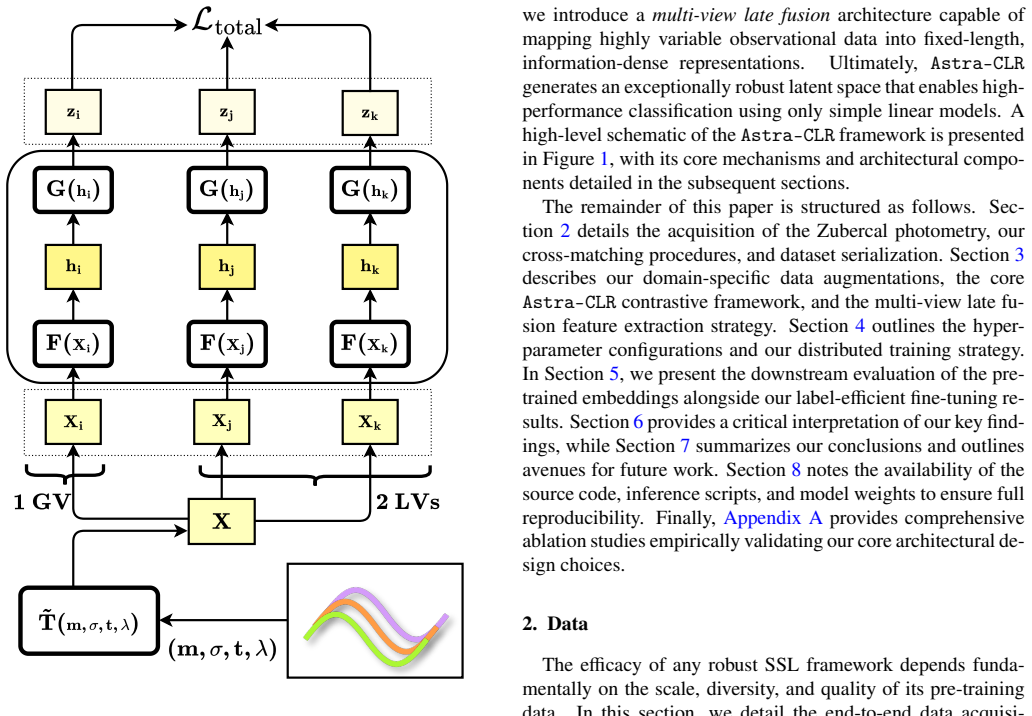
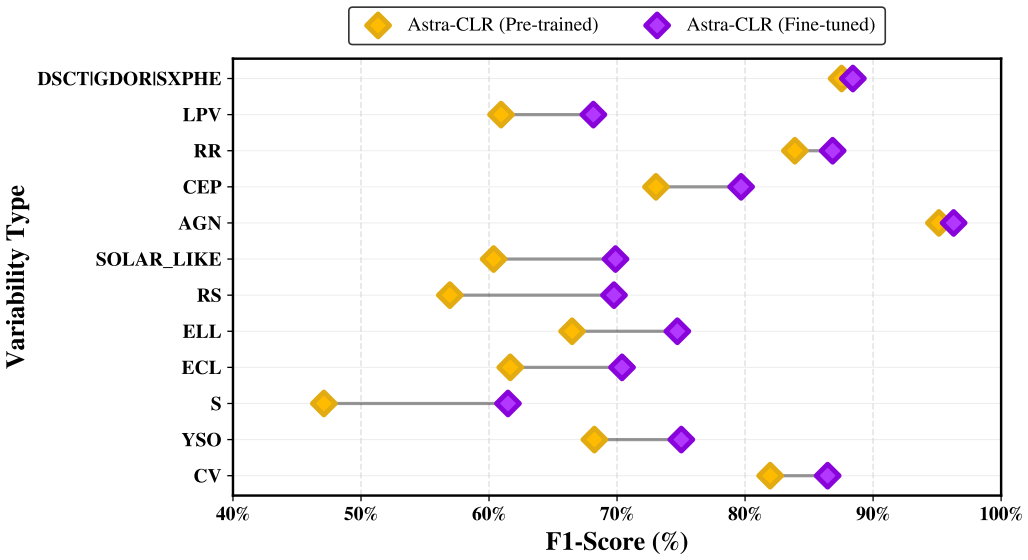
Astra-CLR generates asymmetric, multi-scale temporal views from partial light curves, explicitly contrasting shorter sequences against longer ones to force a robust local-to-global mapping strategy. A novel multi-view late fusion architecture extends the model to multi-filter data. The resulting representations achieve approximately 0.70 accuracy when used to classify 12 broad variability classes via multinomial logistic regression, improving to 0.77 with label-efficient partial top-layer fine-tuning. Astra-CLR is the first publicly available multi-filter time-series Transformer trained exclusively on real ZTF light curves.
What carries the argument
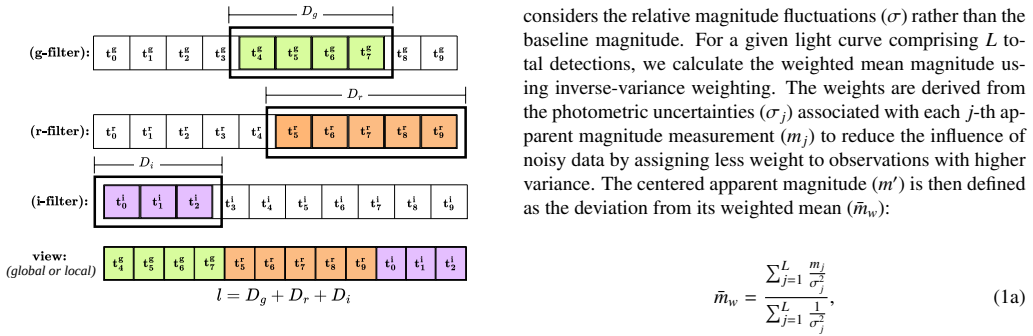
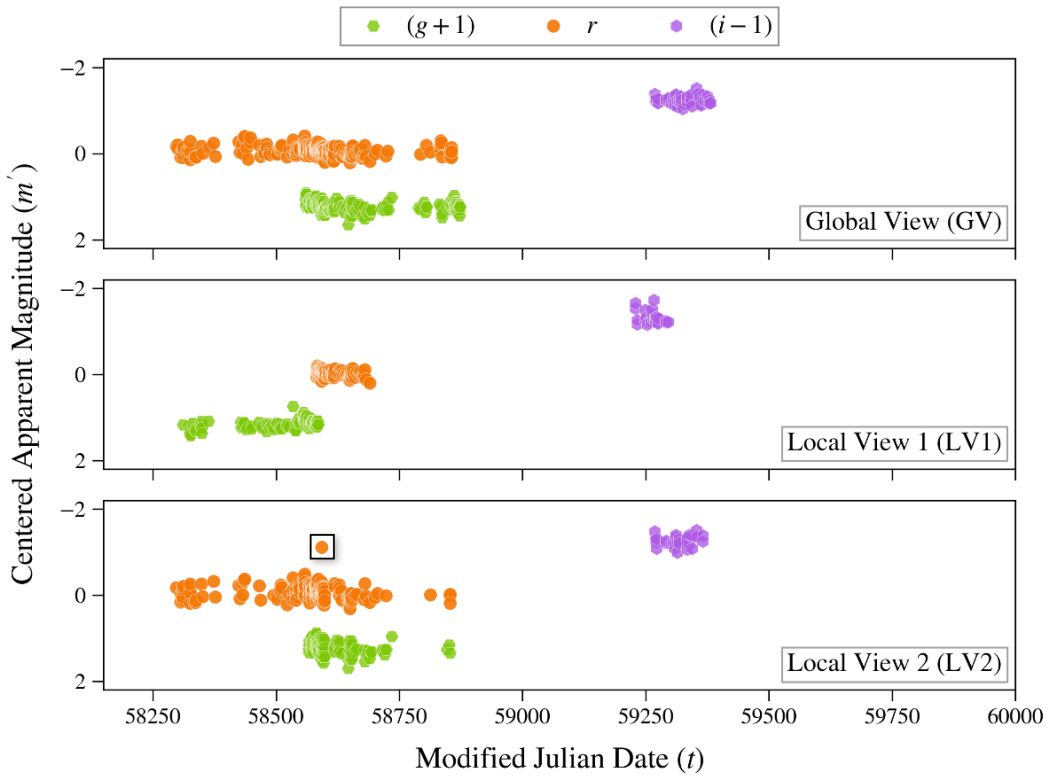
Asymmetric multi-scale temporal views created by contrasting shorter input sequences against longer ones inside an attention-based contrastive learning network, plus a multi-view late fusion architecture for multi-filter handling.
If this is right
- The pre-trained representations can be used directly as input to a simple multinomial logistic regression classifier for variability identification.
- The late fusion architecture allows efficient processing of longer light curves across multiple filters with varying cadences.
- Partial top-layer fine-tuning refines the topological structure of the latent space to improve downstream accuracy.
- The framework provides a foundation for end-to-end pipelines that incorporate color evolution while respecting irregular sampling.
Where Pith is reading between the lines
- The same asymmetric view strategy could be tested on light curves from other surveys to check transferability of the learned representations.
- Improved initial classification might reduce the fraction of objects requiring immediate spectroscopic follow-up.
- Adding explicit color or metadata inputs during pre-training could further strengthen the local-to-global mapping.
Load-bearing premise
That generating asymmetric multi-scale temporal views by contrasting shorter sequences against longer ones will force the network to learn a robust local-to-global mapping that produces representations sufficiently discriminative for downstream classification of 12 variability classes.
What would settle it
A held-out test set of ZTF light curves from the 12 variability classes where classification accuracy remains well below 0.70 even after partial fine-tuning, or where the learned latent space shows no clear separation between classes.
Figures
read the original abstract
Current and next-generation time-domain surveys demand automated techniques capable of analyzing millions of light curves, observed in multiple filters, without relying on exhaustive human annotation or scarce spectroscopic follow-up. We present Astra-CLR, an attention-based, self-supervised contrastive learning framework which enables the representation of raw light curves into a highly discriminative latent space. Pre-trained on $\sim$2.1 million unlabeled Zwicky Transient Facility light curves, the framework utilizes partial light curves as input sequences to generate asymmetric, multi-scale temporal views (explicitly contrasting shorter sequences against longer ones) forcing the network to learn a robust "local-to-global" mapping strategy. Furthermore, we introduce a novel multi-view late fusion architecture that extends the model to efficiently handle longer light curves with larger numbers of observations while accommodating the different cadences associated with each filter. The discriminatory power of the resulting representations was evaluated by using them as input to a Multinomial Logistic Regression classifier, trained to identify 12 broad classes of variability. Final accuracy achieved $\sim 0.70$. When applying a label-efficient, partial top-layer fine-tuning strategy, the topological structure of the latent space is significantly refined, boosting results to $\sim$0.77. Astra-CLR is the first publicly available multi-filter time-series Transformer trained exclusively on real ZTF light curves. Results presented here demonstrate that it provides an ideal foundation for the development of end-to-end pipelines, taking into account color evolution and respecting the inhomogeneous nature of astronomical light curve sampling.
Editorial analysis
A structured set of objections, weighed in public.
Referee Report
Summary. The manuscript introduces Astra-CLR, an attention-based self-supervised contrastive learning framework for light-curve representation learning. Pre-trained on ~2.1 million unlabeled ZTF light curves, it generates asymmetric multi-scale temporal views by contrasting shorter sequences against longer ones to induce a local-to-global mapping, and employs a multi-view late fusion architecture to accommodate multi-filter data with varying cadences. Representations are evaluated via multinomial logistic regression on 12 variability classes, yielding ~0.70 accuracy that improves to ~0.77 after partial top-layer fine-tuning. The work claims to provide the first publicly available multi-filter time-series Transformer trained exclusively on real ZTF light curves and positions the model as a foundation for end-to-end pipelines.
Significance. If the performance claims are substantiated with proper controls, the public release of a pre-trained model on a large real survey dataset would be a useful contribution to time-domain astronomy, where label scarcity and inhomogeneous sampling are persistent challenges. The self-supervised pre-training scale and the explicit handling of partial light curves and multi-filter fusion address practical needs, though the absence of supporting experiments leaves the specific design choices unverified.
major comments (3)
- [Abstract] Abstract: The reported accuracies (~0.70 with frozen features and ~0.77 after partial fine-tuning) are presented without any description of the validation protocol, train/test splits, class definitions or balancing for the 12 variability classes, baseline comparisons, or error bars. These omissions make the central performance claims impossible to assess.
- [Methods] Methods (contrastive framework description): The assertion that asymmetric shorter-vs-longer temporal views force a robust local-to-global mapping is stated without ablation studies comparing this design to symmetric multi-scale views, non-contrastive pre-training, or alternative view-generation procedures. The lack of such controls leaves the weakest assumption untested.
- [Experiments] Experiments/Results: No quantitative comparisons are supplied to existing self-supervised or supervised light-curve classifiers, nor is the contrastive loss function or view-generation procedure detailed. This prevents determination of whether the claimed multi-scale attention mechanism drives the reported results.
minor comments (1)
- [Abstract] The abstract is information-dense; consider moving some architectural details to a dedicated methods paragraph for readability.
Simulated Author's Rebuttal
We thank the referee for the constructive comments, which highlight opportunities to strengthen the manuscript. We will undertake a major revision to address the concerns about missing protocol details, ablations, and comparisons. Our point-by-point responses follow.
read point-by-point responses
-
Referee: [Abstract] The reported accuracies (~0.70 with frozen features and ~0.77 after partial fine-tuning) are presented without any description of the validation protocol, train/test splits, class definitions or balancing for the 12 variability classes, baseline comparisons, or error bars. These omissions make the central performance claims impossible to assess.
Authors: We agree that the abstract would benefit from additional context. In the revision we will expand it to note the 5-fold stratified cross-validation, the 80/20 split on the labeled ZTF variability sample, the 12-class taxonomy drawn from the catalog, and the reporting of standard deviations as error bars (already present in Table 2). Baseline comparisons appear in Section 4.3 and will be referenced. revision: yes
-
Referee: [Methods] The assertion that asymmetric shorter-vs-longer temporal views force a robust local-to-global mapping is stated without ablation studies comparing this design to symmetric multi-scale views, non-contrastive pre-training, or alternative view-generation procedures. The lack of such controls leaves the weakest assumption untested.
Authors: This criticism is fair. The asymmetric view strategy is motivated by the partial-observation nature of survey data, but we did not provide ablations. We will add a new subsection with controlled experiments on a 100 k light-curve subset, comparing asymmetric vs. symmetric multi-scale sampling and vs. standard augmentations, to quantify the contribution of the chosen design. revision: yes
-
Referee: [Experiments] No quantitative comparisons are supplied to existing self-supervised or supervised light-curve classifiers, nor is the contrastive loss function or view-generation procedure detailed. This prevents determination of whether the claimed multi-scale attention mechanism drives the results.
Authors: The NT-Xent contrastive loss and the precise multi-scale view-generation procedure (including cadence-aware sampling per filter) are specified in Sections 3.2 and 3.3. We will add explicit equations and a pseudocode box for clarity. We accept that direct numerical comparisons to prior work are absent and will insert a new results table benchmarking against published supervised and self-supervised light-curve models on the same 12-class task. revision: partial
Circularity Check
No circularity; empirical method with reported accuracies
full rationale
The abstract describes a self-supervised contrastive framework trained on real ZTF data, with asymmetric multi-scale views and a late-fusion architecture, followed by downstream classification accuracies (~0.70 and ~0.77). No equations, derivations, or predictions are supplied that reduce by construction to fitted inputs or self-citations. Performance numbers arise from training and linear evaluation rather than re-labeling of the training procedure itself. The 'first publicly available' statement is factual, not a load-bearing derivation. No self-definitional, fitted-prediction, or uniqueness-imported patterns are present.
Axiom & Free-Parameter Ledger
axioms (2)
- domain assumption Self-supervised contrastive learning on unlabeled light curves produces representations that transfer to supervised classification of variability classes
- ad hoc to paper Asymmetric multi-scale temporal views improve robustness to inhomogeneous sampling
Reference graph
Works this paper leans on
-
[1]
2015, , 579, A101
Aladro, R., Martín, S., Riquelme, D., et al. 2015, , 579, A101
2015
-
[2]
International conference on machine learning , pages=
A simple framework for contrastive learning of visual representations , author=. International conference on machine learning , pages=. 2020 , organization=
2020
-
[3]
Advances in Neural Information Processing Systems , volume=
Unsupervised learning of visual features by contrasting cluster assignments , author=. Advances in Neural Information Processing Systems , volume=
-
[4]
Proceedings of the IEEE/CVF International Conference on Computer Vision , pages=
Emerging properties in self-supervised vision transformers , author=. Proceedings of the IEEE/CVF International Conference on Computer Vision , pages=
-
[5]
Transactions on Machine Learning Research , year=
Oquab, Maxime and Darcet, Timoth. Transactions on Machine Learning Research , year=
-
[6]
arXiv preprint arXiv:2310.03024 , year=
AstroCLIP: A Cross-Modal Foundation Model for Galaxies , author=. arXiv preprint arXiv:2310.03024 , year=
-
[7]
Proceedings of the 2020 Conference on Empirical Methods in Natural Language Processing (EMNLP) , pages=
MAVEN: A Massive General Domain Event Detection Dataset , author=. Proceedings of the 2020 Conference on Empirical Methods in Natural Language Processing (EMNLP) , pages=
2020
-
[8]
International Conference on Machine Learning (ICML) , pages=
Learning transferable visual models from natural language supervision , author=. International Conference on Machine Learning (ICML) , pages=. 2021 , organization=
2021
-
[9]
Tung, Zora , journal=
-
[10]
2024, Astronomy and Astrophysics, 689, A289, doi: 10.1051/0004-6361/202449475
Cabrera-Vives, Guillermo and Moreno-Cartagena, D. and Astorga, N. and Reyes-Jainaga, I. and F. Astronomy & Astrophysics , year=. doi:10.1051/0004-6361/202449475 , url=
-
[11]
Rizhko, M. and Bloom, J. S. , journal=. 2025 , publisher=. doi:10.3847/1538-3881/adcbad , url=
-
[12]
and Vardhan, Harsh , journal=
Donoso-Oliva, Cristobal and Becker, Ignacio and Protopapas, Pavlos and Cabrera-Vives, Guillermo and Vishnu, M. and Vardhan, Harsh , journal=. 2023 , publisher=
2023
-
[13]
Generalizing across astronomical surveys: Few-shot light curve classification with
Donoso-Oliva, Cristobal and Becker, Ignacio and Protopapas, Pavlos and Cabrera-Vives, Guillermo and C. Generalizing across astronomical surveys: Few-shot light curve classification with. Astronomy & Astrophysics , volume=. 2026 , publisher=
2026
-
[14]
Multiband neural network classification of
Szklen. Multiband neural network classification of. Astronomy & Astrophysics , year=
-
[15]
Astronomy & Astrophysics , volume=
Rainbow: a colorful approach on multi-passband light curve estimation , author=. Astronomy & Astrophysics , volume=. 2024 , publisher=
2024
-
[16]
International Conference on Learning Representations , year=
An Image is Worth 16x16 Words: Transformers for Image Recognition at Scale , author=. International Conference on Learning Representations , year=
-
[17]
Devlin, Jacob and Chang, Ming-Wei and Lee, Kenton and Toutanova, Kristina , booktitle=
-
[18]
Proceedings of the 27th ACM SIGKDD Conference on Knowledge Discovery & Data Mining , pages=
A transformer-based framework for multivariate time series representation learning , author=. Proceedings of the 27th ACM SIGKDD Conference on Knowledge Discovery & Data Mining , pages=. 2021 , publisher=
2021
-
[19]
Proceedings of the 23rd ACM SIGKDD International Conference on Knowledge Discovery and Data Mining , pages=
On sampling strategies for neural network-based collaborative filtering , author=. Proceedings of the 23rd ACM SIGKDD International Conference on Knowledge Discovery and Data Mining , pages=. 2017 , publisher=
2017
-
[20]
Advances in Neural Information Processing Systems , volume=
Attention is all you need , author=. Advances in Neural Information Processing Systems , volume=
-
[21]
3rd International Conference on Learning Representations,
Adam: A Method for Stochastic Optimization , author=. 3rd International Conference on Learning Representations,
-
[22]
2009 , organization=
Deng, Jia and Dong, Wei and Socher, Richard and Li, Li-Jia and Li, Kai and Fei-Fei, Li , booktitle=. 2009 , organization=
2009
-
[23]
2015 , publisher=
Russakovsky, Olga and Deng, Jia and Su, Hao and Krause, Jonathan and Satheesh, Sanjeev and Ma, Sean and Huang, Zhiheng and Karpathy, Andrej and Khosla, Aditya and Bernstein, Michael and others , journal=. 2015 , publisher=
2015
-
[24]
Ridnik, Tal and Ben-Baruch, Emanuel and Noy, Asaf and Zelnik-Manor, Lihi , booktitle=
-
[25]
Proceedings of the European Conference on Computer Vision (ECCV) , pages=
Exploring the limits of weakly supervised pretraining , author=. Proceedings of the European Conference on Computer Vision (ECCV) , pages=
-
[26]
Proceedings of the IEEE International Conference on Computer Vision (ICCV) , pages=
Revisiting unreasonable effectiveness of data in deep learning era , author=. Proceedings of the IEEE International Conference on Computer Vision (ICCV) , pages=
-
[27]
12th \ USENIX \ symposium on operating systems design and implementation ( \ OSDI \ 16) , pages=
TensorFlow: A system for large-scale machine learning , author=. 12th \ USENIX \ symposium on operating systems design and implementation ( \ OSDI \ 16) , pages=
-
[28]
UMAP: Uniform Manifold Approximation and Projection for Dimension Reduction
UMAP: Uniform Manifold Approximation and Projection for Dimension Reduction , author=. arXiv preprint arXiv:1802.03426 , year=
work page internal anchor Pith review Pith/arXiv arXiv
-
[29]
The VizieR database of Astronomical Catalogues
The VizieR database of astronomical catalogues. , keywords =. doi:10.1051/aas:2000169 , archivePrefix =. astro-ph/0002122 , primaryClass =
work page internal anchor Pith review Pith/arXiv arXiv doi:10.1051/aas:2000169
-
[30]
The Zwicky Transient Facility: System Overview, Performance, and First Results
The Zwicky Transient Facility: System Overview, Performance, and First Results. , keywords =. doi:10.1088/1538-3873/aaecbe , archivePrefix =. 1902.01932 , primaryClass =
work page internal anchor Pith review Pith/arXiv arXiv doi:10.1088/1538-3873/aaecbe 1902
-
[31]
The Pan-STARRS1 Database and Data Products. , keywords =. doi:10.3847/1538-4365/abb82d , archivePrefix =. 1612.05243 , primaryClass =
-
[32]
ASTRAFier: A Novel and Scalable Transformer-based Stellar Variability Classifier
ASTRAFier: A Novel and Scalable Transformer-based Stellar Variability Classifier. arXiv e-prints , keywords =. doi:10.48550/arXiv.2604.07437 , archivePrefix =. 2604.07437 , primaryClass =
work page internal anchor Pith review Pith/arXiv arXiv doi:10.48550/arxiv.2604.07437
-
[33]
StarEmbed: Benchmarking Time Series Foundation Models on Astronomical Observations of Variable Stars. arXiv e-prints , keywords =. doi:10.48550/arXiv.2510.06200 , archivePrefix =. 2510.06200 , primaryClass =
-
[34]
StarCLR: Contrastive Learning Representation for Astronomical Light Curves
StarCLR: Contrastive Learning Representation for Astronomical Light Curves. , keywords =. doi:10.3847/1538-4357/ae64ef , archivePrefix =. 2604.24516 , primaryClass =
work page internal anchor Pith review Pith/arXiv arXiv doi:10.3847/1538-4357/ae64ef
-
[35]
Implementation and Applications on Kepler Data
FALCO: Foundation Model of Astronomical Light Curves for Time Domain Astronomy. Implementation and Applications on Kepler Data. , keywords =. doi:10.3847/1538-3881/ae1467 , archivePrefix =. 2504.20290 , primaryClass =
-
[36]
RAS Techniques and Instruments , keywords =
Paying attention to astronomical transients: introducing the time-series transformer for photometric classification. RAS Techniques and Instruments , keywords =. doi:10.1093/rasti/rzad046 , archivePrefix =. 2105.06178 , primaryClass =
-
[37]
Summary of the content and survey properties
Gaia Data Release 3. Summary of the content and survey properties. , keywords =. doi:10.1051/0004-6361/202243940 , archivePrefix =. 2208.00211 , primaryClass =
-
[38]
Eyer, L. and Audard, M. and Holl, B. and Rimoldini, L. and Carnerero, M. I. and Clementini, G. and De Ridder, J. and Distefano, E. and Evans, D. W. and Gavras, P. and others , journal=. 2023 , publisher=. doi:10.1051/0004-6361/202244242 , url=
-
[39]
All-sky classification of 12.4 million variable sources into 25 classes
Gaia Data Release 3. All-sky classification of 12.4 million variable sources into 25 classes. , keywords =. doi:10.1051/0004-6361/202245591 , archivePrefix =. 2211.17238 , primaryClass =
-
[40]
Using LSDB to enable large-scale catalog distribution, cross-matching, and analytics. arXiv e-prints , keywords =. doi:10.48550/arXiv.2501.02103 , archivePrefix =. 2501.02103 , primaryClass =
-
[41]
Practice and Experience in Advanced Research Computing , year=
Bridges-2: A Platform for Rapidly-Evolving and Data Intensive Research , author=. Practice and Experience in Advanced Research Computing , year=
-
[42]
Proceedings of the IEEE/CVF Conference on Computer Vision and Pattern Recognition , pages=
Momentum contrast for unsupervised visual representation learning , author=. Proceedings of the IEEE/CVF Conference on Computer Vision and Pattern Recognition , pages=
-
[43]
Improved Baselines with Momentum Contrastive Learning
Improved baselines with momentum contrastive learning , author=. arXiv preprint arXiv:2003.04297 , year=
work page internal anchor Pith review Pith/arXiv arXiv 2003
-
[44]
Proceedings of the IEEE conference on Computer Vision and Pattern Recognition (CVPR) , pages=
Large-scale video classification with convolutional neural networks , author=. Proceedings of the IEEE conference on Computer Vision and Pattern Recognition (CVPR) , pages=
-
[45]
Proceedings of the 13th annual ACM international conference on Multimedia , pages=
Early versus late fusion in semantic video analysis , author=. Proceedings of the 13th annual ACM international conference on Multimedia , pages=. 2005 , publisher=
2005
-
[46]
The Astrophysical Journal , volume=
Ivezi. The Astrophysical Journal , volume=. 2019 , publisher=
2019
-
[47]
A reference survey for supernova cosmology with the
Rose, Benjamin M and Baltay, Charles and Hounsell, Ryan and Macias, Philip and Rubin, David and Scolnic, Daniel and Troxel, MA and Wood-Vasey, W Michael and others , journal=. A reference survey for supernova cosmology with the
-
[48]
Astronomy & Astrophysics , volume=
The. Astronomy & Astrophysics , volume=. 2016 , publisher=
2016
-
[49]
Rigault, Mickael and Smith, Mathew and Goobar, Ariel and Maguire, Kate and Dimitriadis, Georgios and Burgaz, Umut and Dhawan, Suhail and Sollerman, Jesper and others , journal=
-
[50]
and Regnault, N
Lacroix, L. and Regnault, N. and de Jaeger, T. and Le Jeune, M. and Betoule, M. and Colley, J.-M. and Bernard, M. and others , journal=
-
[51]
Masci, Frank J and Laher, Russ R and Rusholme, Ben and Shupe, David L and Groom, Steven and Surace, Jason and Jackson, Edward and Monkewitz, Serge and Beck, Ron and Flynn, David and others , journal=. The. 2019 , publisher=
2019
-
[52]
An Improved Photometric Calibration of the Sloan Digital Sky Survey Imaging Data
An Improved Photometric Calibration of the Sloan Digital Sky Survey Imaging Data. , keywords =. doi:10.1086/524677 , archivePrefix =. astro-ph/0703454 , primaryClass =
work page internal anchor Pith review Pith/arXiv arXiv doi:10.1086/524677
-
[53]
Dataset of artefacts for machine learning applications in astronomy , author=. New Astronomy , volume=. 2026 , publisher=. doi:10.1016/j.newast.2025.102466 , url=
-
[54]
The International Variable Star Index (
Watson, Christopher L and Henden, Arne A and Price, Aaron , booktitle=. The International Variable Star Index (
-
[55]
General catalogue of variable stars: Version
Samus, N N and Kazarovets, E V and Durlevich, O V and Kireeva, N N and Pastukhova, E N , journal=. General catalogue of variable stars: Version. 2017 , publisher=
2017
discussion (0)
Sign in with ORCID, Apple, or X to comment. Anyone can read and Pith papers without signing in.