REVIEW 2 major objections 5 minor 19 references
Token compression in audio-video LLMs fails when one attention score both splits capacity across modalities and selects which tokens to keep; the paper's training-free MACER compressor separates the two decisions — explicit audio/video budg
Reviewed by Pith at T0; open to challenge. T0 means a machine referee read the full paper against a public rubric. the ladder, T0–T4 →
T0 review · deepseek-v4-flash
2026-08-04 23:17 UTC pith:ULGARW6G
load-bearing objection A real idea and credible Qwen experiments, but the OmniVinci transfer claim is oversold because alpha is swept on the evaluation set rather than frozen from calibration. the 2 major comments →
Allocation Before Ranking: Decoupled Token Compression for OmniLLMs
The pith
A machine-rendered reading of the paper's core claim, the machinery that carries it, and where it could break.
Core claim
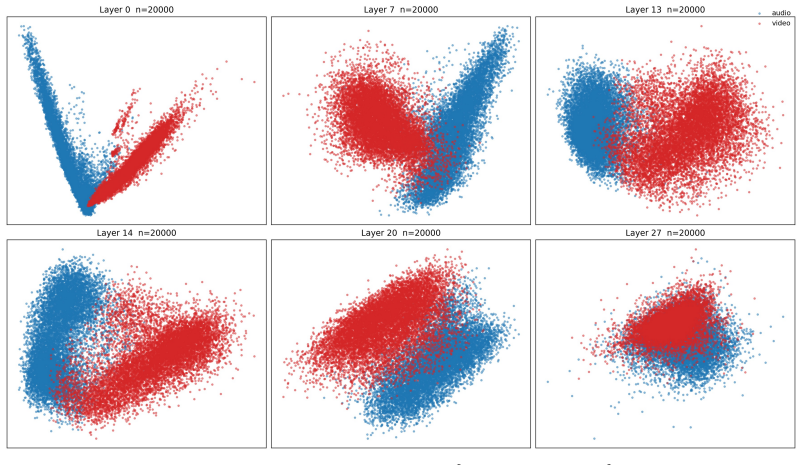
The central claim is that a shared top-K rule for omnimodal token compression is mis-specified because one number carries two decisions. The paper derives an exact decomposition of the log attention-mass ratio between audio and video, log massa(q)/massv(q) = q^T(ca − cv) + [log Σ_{i∈a} exp(q^T ε_i) − log Σ_{j∈v} exp(q^T ε_j)], where ca and cv are per-modality key centroids and the bracketed term aggregates within-modality residuals. The first term is an architectural cross-modal allocation factor; the second carries token-level selection, and no shared ranking can separate them. Empirically the coupling favors audio: under video-essential queries every pooled query position at layer 3 (645/6
What carries the argument
The load-bearing object is the audio-video attention-mass identity, which decomposes shared-softmax mass into a cross-modal allocation term q^T(ca − cv) and a within-modality residual aggregation term; it shows why changing the saliency score cannot fix the coupling — the budget split is induced by ranking no matter which score is used. MACER's machinery is the allocation-before-ranking pipeline: Capacity-Coordinated Split sets Ka and Kv from a frozen retained-audio share α before any token is chosen; Allocation-Normalized Modality Scoring renormalizes each attention row within the modality so audio competes only with audio and video only with video; and staged single-prefill pruning reads a
Load-bearing premise
The audio-favoring bias is measured on one backbone (Qwen2.5-Omni-7B) with a small diagnostic sample and then treated as a structural property of all shared-decoder omni-LLMs, which is why a single frozen audio share (0.30 for 7B, 0.32 for 3B, chosen on roughly 100 held-out clips) is supposed to work across models and benchmarks — if some backbone's attention does not favor audio, the fixed split would hurt instead of help.
What would settle it
Measure the mid-layer centroid geometry q^T(ca − cv) on another shared-decoder omni-LLM, e.g. one whose packing places video closer to the query. If the audio-favoring half-space result (all 645/645 query positions on the audio side) fails to reproduce, or if an audio-heavy split α=0.70 beats MACER's fixed α=0.30 at 25% retention on an audio-grounded benchmark, then the structural-prior assumption is falsified and an adaptive allocation would be needed.
If this is right
- At 25% multimodal retention, MACER preserves 98.7% of full-token performance on Qwen2.5-Omni-7B and 97.3% on Qwen2.5-Omni-3B, with Video-MME held at full-token level on 7B.
- On Qwen2.5-Omni-7B, the 25% MACER operating point Pareto-dominates OmniZip at 45% retention: higher average accuracy (+1.02), 4.4 pp lower FLOPs, 0.37 s lower total latency, and 4 GB lower peak memory.
- The principle transfers across backbones: on OmniVinci-9B under its native input packing, MACER beats shared top-K ranking by up to 12.9 points, so the audio-favoring prior is not a Qwen2.5-Omni artifact.
- The retained-audio share α becomes an explicit deployment-level control: a per-benchmark oracle α gains only 0.92 normalized points over the frozen setting, so the capacity split is a stable operating band rather than a fragile per-task hyperparameter.
- Because audio and video are read at different shallow depths (audio early, video later), compressors no longer need one probe layer that serves both modalities; allocation, selection, and readout can each be improved independently without retraining.
Where Pith is reading between the lines
- A natural extension the authors leave implicit is an adaptive capacity split: estimate q^T(ca − cv) per clip and adjust α before selection, rather than freezing one share per model scale; the paper's own oracle audit suggests the headroom is small, but per-clip adaptation is untested.
- The one-score-two-decisions argument is not limited to audio-video pairs — any two token groups sharing a softmax (image and video, multiple image streams) inherit the same coupling, so allocation-before-ranking could generalize to other asymmetric multimodal budgets.
- The appendix shows the readout asymmetry weakens and can reverse at ρ=0.10 on AVUTBench; extremely tight budgets may therefore require re-calibrated readout layers rather than the fixed (3,5) choice, a regime the main paper does not deploy in.
- The video-local coverage bonus is a template for other within-modality corrections — e.g., audio event continuity or shot boundaries — that can be layered onto any modality budget without disturbing the audio-video split.
Editorial analysis
A structured set of objections, weighed in public.
Referee Report
Summary. The paper argues that token compression in OmniLLMs is mis-specified as a single global top-K ranking, because the same attention score simultaneously decides cross-modal capacity allocation and within-modality token selection. The authors propose MACER, a training-free, single-forward-pass compressor that assigns explicit audio/video budgets via a retained-audio share α, ranks tokens within each modality using allocation-normalized attention scores, reads audio and video saliency at different shallow layers, and applies a video-local temporal-coverage bonus. Experiments on Qwen2.5-Omni-7B/3B across AVUTBench, DailyOmni, WorldSense, and Video-MME report 98.7%/97.3% of full-token performance at 25% retention and a Pareto-style improvement over OmniZip at 45% retention with lower estimated FLOPs. A cross-backbone study on OmniVinci-9B is reported in Appendix F.
Significance. If the results hold, MACER is a practical and well-motivated contribution: the exact decomposition in Eq. (2) cleanly separates cross-modal allocation from within-modality residual structure, and the ablation in Table 4 supports the claim that the main gain comes from decoupling allocation from selection. The paper is also transparent about using a held-out split for the Qwen hyperparameters and about reporting analytical FLOPs proxies. However, two load-bearing issues remain: the OmniVinci transfer claim is based on a post-hoc α sweep rather than a frozen pre-selected α, and the headline FLOPs comparison rests on an unvalidated proxy rather than measured FLOPs. These issues are fixable and do not undermine the core Qwen2.5-Omni results, but they currently prevent full support for the cross-backbone and lower-FLOPs claims.
major comments (2)
- [Appendix F, Table 19] The cross-backbone transfer claim is load-bearing but not yet established. The appendix states that the transfer study 'changes the backbone and sweeps only the retained-audio share α' while keeping readout layers fixed. No α is frozen before evaluation. The reported cells show that α=0.20 improves over shared top-K at all retention levels (+0.67, +0.62, +2.95), whereas α=0.40 degrades at 25% (−3.88) and produces the +12.91 headline at 45%. Because the sweep is performed on the evaluation benchmarks themselves, the 'up to 12.9 points' result is a selected favorable cell, not a transfer result. Please add an experiment with a frozen α chosen before evaluation (e.g., α=0.30 from Qwen2.5-Omni-7B, or an OmniVinci-specific held-out calibration split) and report all cells. Without this, the paper cannot distinguish 'allocation-before-ranking transfers' from 'OmniVinci has a favorable α discove
- [Tables 1–2 and Appendix E, Eq. (22)] The headline FLOPs comparison is based on analytical proxies, not measured FLOPs. Eq. (22) uses assumed attention shares η=0.235 (7B) and η=0.36 (3B) and charges all multimodal tokens until L_p=max(ℓ_a,ℓ_v); the resulting ratios (34.8%, 42.2%, 50.1%, etc.) are then used in Tables 1 and 2 to support the 'lower FLOPs' Pareto claim. Table 3 measures latency and memory only on WorldSense. Please provide measured FLOPs or validate the proxy with a profiler, use the same accounting for OmniZip, and at minimum label all main-table FLOPs values as analytical estimates with a sensitivity analysis over η. As written, the abstract's 'lower FLOPs' claim is not directly measured.
minor comments (5)
- [Table 2 and Section 5.1] FastV† is evaluated at 50% retention on an H100 while all other methods are at 25/35/45% on Ada6000, and its normalized average excludes Video-MME. This makes the 'unified protocol' claim imprecise. Please either run FastV at matched retention on the same hardware or explicitly state this limitation in the main text rather than only in a table footnote.
- [Table 4] The 'Single readout layer' ablation is not specified. The reader cannot tell which layer is used, whether it replaces both ℓ_a and ℓ_v, or why it performs below shared top-K (54.38 vs. 54.81). Please define this configuration and discuss the drop; otherwise the ablation's message is ambiguous.
- [Appendix F, Table 19] The abbreviation 'Cons. Norm. Avg.' is not defined in the table caption or the surrounding text. Define it explicitly and state how the superscripts (†, ‡) relate to the full-token reference runs.
- [Appendix E.2] Eq. (22) ignores text tokens and constant factors. Since text tokens are always preserved, the proxy may understate the effective cost reduction at low retention. Add a sentence explaining why this omission does not alter the relative comparison between MACER and the baselines.
- [Section 3, Observation 1] The pooled claim 'video wins per-token attention comparison in only 8.8% of cells' is informative, but the diagnostic subset is small (30 clips for some controls). Reporting a confidence interval or a paired percentile bootstrap would help calibrate how strongly to rely on this observation.
Circularity Check
Cross-backbone transfer claim rests on an evaluation-set alpha sweep; Qwen main results are not circular.
specific steps
-
fitted input called prediction
[Appendix F / Table 19; Abstract; Sec. 5.1]
"Thus, the transfer study changes the backbone and sweeps only the retained-audio share α, while keeping the video coverage strength fixed at λc = 0.20. Table 19 reports the OmniVinci-9B transfer results. ... MACER-B (α=0.40) is strongest in the moderate-retention regime (ρ∈{35%,45%}), with mean +7.50 pp over shared top-K. ... On OmniVinci-9B, MACER outperforms shared top-K ranking by up to 12.9 points, showing that the allocation–selection separation transfers across models."
The headline OmniVinci transfer result is the best cell of an alpha sweep performed directly on the OmniVinci evaluation benchmarks. No pre-frozen alpha is tested on OmniVinci: the Qwen-7B default α=0.30 never appears, and at 25% retention the two swept values disagree in sign (α=0.20: +0.67; α=0.40: -3.88). The '+12.91' at α=0.40/ρ=45% is therefore the maximum of the swept grid, not a prediction of a fixed configuration. As a result, the claimed cross-backbone support cannot distinguish the structural allocation-before-ranking principle from an oracle-like selection of α on the evaluation set.
full rationale
The main Qwen2.5-Omni derivation is self-contained and not circular. The mechanism decomposition in Eq. (1)-(2) is an exact algebraic identity from the definition of attention, and the diagnostics (audio prior, readout asymmetry, budget-vs-selection stress test) are measured rather than assumed. MACER's hyperparameters (ℓa, ℓv, α, λc) are selected once on a held-out split disjoint from the reported evaluation sets and then frozen, which is legitimate calibration rather than fitting the target result. The reported 98.7%/97.3% normalized averages are computed from fixed configurations on full evaluation sets, so those claims have independent empirical content. The only significant circularity-adjacent concern is the OmniVinci-9B transfer evidence in Appendix F: the paper sweeps the retained-audio share α on the OmniVinci benchmarks themselves and then reports the best cells as evidence that the principle 'transfers across models.' Because no frozen alpha (e.g., the Qwen default α=0.30) is evaluated, the transfer claim is not yet a prediction from a pre-specified method. This is a fitted-input-called-prediction pattern for that specific headline claim, though it does not undermine the Qwen main results or the conceptual argument. There is no load-bearing self-citation, no imported uniqueness theorem, and no ansatz smuggled in via prior work; the paper's own citations to prior work are contextual.
Axiom & Free-Parameter Ledger
free parameters (4)
- Retained audio share alpha =
0.30 for Qwen2.5-Omni-7B, 0.32 for 3B, 0.20/0.40 for OmniVinci-9B variants
- Readout layers (audio, video) =
(3,5) for 7B, (4,7) for 3B, reused (3,5) for OmniVinci
- Coverage strength lambda_c =
0.20 for 7B, 0.30 for 3B, 0.20 for OmniVinci
- Number of video chunks C =
8
axioms (4)
- domain assumption Attention probability mass is a valid token-saliency signal within a modality after row normalization.
- domain assumption The audio-favoring allocation prior observed on Qwen2.5-Omni-7B diagnostics transfers to Qwen2.5-Omni-3B and OmniVinci-9B.
- domain assumption Pruning audio after layer 3 or 4 and video after layer 5 or 7 in a single forward pass does not change the distributional properties used by later layers in a way that invalidates the measured benchmark scores.
- domain assumption Benchmark accuracy under fixed decoding with FlashAttention-2 is deterministic enough for single-run comparisons without error bars.
Cite this review
Pith. "Pith review of Allocation Before Ranking: Decoupled Token Compression for OmniLLMs." pith.science (2026). https://pith.science/paper/ULGARW6G
@misc{pith2026260801665,
  author       = {Pith},
  title        = {Pith review of: Allocation Before Ranking: Decoupled Token Compression for OmniLLMs},
  year         = {2026},
  howpublished = {\url{https://pith.science/paper/ULGARW6G}},
  note         = {Machine review of arXiv:2608.01665}
}
read the original abstract
Token compression in OmniLLMs is typically posed as a single saliency-ranking problem: score each multimodal token, keep the top-K. We argue this abstraction is mis-specified. The same attention score simultaneously decides two things: how much retained capacity each modality receives, and which tokens within a modality are kept. A shared top-K rule therefore inherits this audio-favoring allocation prior, spending retained capacity on audio before video tokens have a chance to compete. We propose Macer, a training-free compressor that first assigns explicit audio and video budgets, then performs allocation-normalized ranking within each modality at modality-specific shallow layers. Macer significantly reduces token cost while preserving accuracy across audio-grounded, audio--video joint, visual-dominant, and video-centric benchmarks. At 25 % retention, Macer preserves 98.7 % of full-token performance on Qwen2.5-Omni-7B and 97.3 % on Qwen2.5-Omni-3B. On Qwen2.5-Omni-7B, this 25 % setting reaches OmniZip-level performance at 45 % retention while using lower FLOPs. On OmniVinci-9B, the same allocation-before-ranking principle improves over shared top-K ranking by up to 12.9 points.
Figures


Reference graph
Works this paper leans on
-
[3]
Yue Ding, Yiyan Ji, Jungang Li, Xuyang Liu, Xinlong Chen, Junfei Wu, Bozhou Li, Bohan Zeng, Yang Shi, Yushuo Guan, Yuanxing Zhang, Jiaheng Liu, Qiang Liu, Pengfei Wan, and Liang Wang. OmniSIFT: Modality-asymmetric token compression for efficient omni-modal large language models.arXiv preprint arXiv:2602.04804,
-
[6]
Zhenghui Guo, Yuanbin Man, Junyuan Sheng, Bowen Lin, Ahmed Ahmed, Bo Jiang, Boyuan Zhang, Miao Yin, Sian Jin, Omprakash Gnawali, et al. Event-vstream: Event-driven real-time understanding for long video streams.arXiv preprint arXiv:2601.15655,
-
[7]
Xiaohu Huang, Hao Zhou, and Kai Han
URLhttps://arxiv.org/abs/2502.04326. Xiaohu Huang, Hao Zhou, and Kai Han. PruneVid: Visual token pruning for efficient video large language models. InFindings of the Association for Computational Linguistics: ACL 2025, pages 19959–19973,
Pith/arXiv arXiv 2025
-
[8]
URLhttps://aclanthology.org/2025.findings-acl.1024/. Jindong Jiang, Xiuyu Li, Zhijian Liu, Muyang Li, Guo Chen, Zhiqi Li, De-An Huang, Guilin Liu, Zhiding Yu, Kurt Keutzer, Sungjin Ahn, Jan Kautz, Hongxu Yin, Yao Lu, Song Han, and Wonmin Byeon. STORM: Token-efficient long video understanding for multimodal LLMs.arXiv preprint arXiv:2503.04130,
arXiv 2025
-
[9]
URLhttps://arxiv.org/abs/2503.04130
doi: 10.48550/arXiv.2503.04130. URLhttps://arxiv.org/abs/2503.04130. Chaeyoung Jung, Youngjoon Jang, Seungwoo Lee, and Joon Son Chung. FastA V: Efficient token pruning for audio-visual large language model inference.arXiv preprint arXiv:2601.13143,
-
[10]
doi: 10.48550/arXiv. 2601.13143. URLhttps://arxiv.org/abs/2601.13143. Bingzhou Li and Tao Huang. DASH: Dynamic audio-driven semantic chunking for efficient omnimodal token compression.arXiv preprint arXiv:2603.15685,
-
[11]
URL https://arxiv.org/abs/2603.15685
doi: 10.48550/arXiv.2603.15685. URL https://arxiv.org/abs/2603.15685. Yuzhang Shang, Mu Cai, Bingxin Xu, Yong Jae Lee, and Yan Yan. LLaV A-PruMerge: Adap- tive token reduction for efficient large multimodal models. InProceedings of the IEEE/CVF International Conference on Computer Vision, pages 22857–22867,
-
[12]
Kele Shao, Keda Tao, Can Qin, Haoxuan You, Yang Sui, and Huan Wang
URL https: //openaccess.thecvf.com/content/ICCV2025/html/Shang_LLaVA-PruMerge_Adaptive_Token_ Reduction_for_Efficient_Large_Multimodal_Models_ICCV_2025_paper.html. Kele Shao, Keda Tao, Can Qin, Haoxuan You, Yang Sui, and Huan Wang. HoliTom: Holistic token merging for fast video large language models.arXiv preprint arXiv:2505.21334, 2025a. doi: 10.48550/ar...
-
[13]
Huyu Wu, Meng Tang, Xinhan Zheng, and Haiyun Jiang
URLhttps://arxiv.org/abs/2509.18816. Huyu Wu, Meng Tang, Xinhan Zheng, and Haiyun Jiang. When language overrules: Revealing text dominance in multimodal large language models,
-
[14]
URLhttps://arxiv.org/abs/2508.10552. Long Xing, Qidong Huang, Xiaoyi Dong, Jiajie Lu, Pan Zhang, Yuhang Zang, Yuhang Cao, Conghui He, Jiaqi Wang, Feng Wu, and Dahua Lin. PyramidDrop: Accelerating your large vision-language models via pyramid visual redundancy reduction. InProceedings of the IEEE/CVF Conference on Computer Vision and Pattern Recognition,
-
[15]
URLhttps://arxiv.org/abs/2410.17247. Jin Xu, Zhifang Guo, Jinzheng He, Hangrui Hu, Ting He, Shuai Bai, Keqin Chen, Jialin Wang, Yang Fan, Kai Dang, Bin Zhang, Xiong Wang, Yunfei Chu, and Junyang Lin. Qwen2.5-Omni technical report.arXiv preprint arXiv:2503.20215,
-
[16]
URL https://arxiv.org/abs/2503.20215
doi: 10.48550/arXiv.2503.20215. URL https://arxiv.org/abs/2503.20215. Senqiao Yang, Yukang Chen, Zhuotao Tian, Chengyao Wang, Jingyao Li, Bei Yu, and Jiaya Jia. Vi- sionZip: Longer is better but not necessary in vision language models. InProceedings of the IEEE/CVF Conference on Computer Vision and Pattern Recognition, pages 19792–19802, 2025a. URL https:...
-
[17]
URLhttps://arxiv.org/abs/2407.12772. Qizhe Zhang, Aosong Cheng, Ming Lu, Renrui Zhang, Zhiyong Zhuo, Jiajun Cao, Shaobo Guo, Qi She, and Shanghang Zhang. Beyond text-visual attention: Exploiting visual cues for effective token pruning in VLMs. InProceedings of the IEEE/CVF International Conference on Computer Vision, pages 20857–20867, 2025a. Yuan Zhang, ...
-
[18]
Ziwei Zhou, Rui Wang, Zuxuan Wu, and Yu-Gang Jiang
URL https://arxiv.org/abs/2505.18657. Ziwei Zhou, Rui Wang, Zuxuan Wu, and Yu-Gang Jiang. Daily-omni: Towards audio-visual reasoning with temporal alignment across modalities,
-
[19]
The ratio∆ v/∆a measures whether video or audio readout is more sensitive to probe-layer choice
For modalitym∈ {a, v}, define the layer-induced accuracy range ∆m = max ℓm∈{1,...,5} Acc(ℓm)−min ℓm∈{1,...,5} Acc(ℓm),(19) where the other modality’s probe layer is fixed to MACER’s 7B default. The ratio∆ v/∆a measures whether video or audio readout is more sensitive to probe-layer choice. The key conclusion is asymmetric sensitivity, not a sharp audio op...
-
[2023]
Liang Chen, Haozhe Zhao, Tianyu Liu, Shuai Bai, Junyang Lin, Chang Zhou, and Baobao Chang
URLhttps://openreview.net/forum?id=JroZRaRw7Eu. Liang Chen, Haozhe Zhao, Tianyu Liu, Shuai Bai, Junyang Lin, Chang Zhou, and Baobao Chang. An image is worth 1/2 tokens after layer 2: Plug-and-play inference acceleration for large vision-language models. In Computer Vision – ECCV 2024, pages 19–35. Springer,
work page 2024
-
[2024]
URL https://doi.org/10.1007/978-3-031-73004-7_2
doi: 10.1007/978-3-031-73004-7_2. URL https://doi.org/10.1007/978-3-031-73004-7_2. Tri Dao. Flashattention-2: Faster attention with better parallelism and work partitioning.arXiv preprint arXiv:2307.08691,
-
[2025]
URL https://openaccess.thecvf.com/content/CVPR2025/html/Fu_Video-MME_The_First-Ever_ Comprehensive_Evaluation_Benchmark_of_Multi-modal_LLMs_in_CVPR_2025_paper.html. Yuying Ge, Yixiao Ge, Chen Li, Teng Wang, Junfu Pu, Yizhuo Li, Lu Qiu, Jin Ma, Lisheng Duan, Xinyu Zuo, et al. Arc-hunyuan-video-7b: Structured video comprehension of real-world shorts.arXiv p...
-
[2026]
URL https://arxiv.org/abs/2602.04804
doi: 10.48550/arXiv.2602.04804. URL https://arxiv.org/abs/2602.04804. Chaoyou Fu, Haojia Lin, Zuwei Long, Yunhang Shen, Yuhang Dai, Meng Zhao, Yi-Fan Zhang, Shaoqi Dong, Yangze Li, Xiong Wang, et al. Vita: Towards open-source interactive omni multimodal llm.arXiv preprint arXiv:2408.05211,
discussion (0)
Sign in with ORCID, Apple, or X to comment. Anyone can read and Pith papers without signing in.