Spacetime torsion fixes the mass and spin of gravitationally produced dark matter
Pith reviewed 2026-06-26 07:32 UTC · model grok-4.3
The pith
Spacetime torsion from a spinor condensate supplies a pure Dirac mass to gravitationally produced dark matter fermions, fixed by the Hubble rate at production.
A machine-rendered reading of the paper's core claim, the machinery that carries it, and where it could break.
Core claim
In the Quadratic Spinor Lagrangian formulation of general relativity extended to Einstein-Cartan theory, a cosmological spinor condensate generates a vectorial trace torsion K proportional to the time derivative of the condensate divided by the condensate. An explicit Clifford reduction then confers on the produced spin-1/2 fermion a pure Dirac mass equal to one over the square root of six times the absolute value of that ratio, with no pseudoscalar or cross terms. This effective mass is locked to the Hubble rate at production as approximately a constant times H star. The relic abundance therefore follows a one-parameter prediction proportional to H star to the power five-halves, and the fra
What carries the argument
The vectorial trace torsion K proportional to chi dot over chi generated by the spinor condensate chi, together with the Clifford reduction that isolates the pure Dirac mass term M_eff equal to one over square root of six times the absolute value of that ratio.
If this is right
- The effective mass of the dark matter is locked directly to the Hubble rate at the epoch of gravitational production.
- The predicted relic density takes the form Omega h squared proportional to H star to the power five-halves, depending on only one parameter.
- The same theory excludes propagating spin-3/2 modes, so the dark matter must be spin-1/2 Dirac fermions.
- No additional Higgs sector or free mass parameter is required to complete the gravitational production scenario.
Where Pith is reading between the lines
- Precision measurements of the dark matter relic density could constrain the Hubble rate at the epoch of gravitational wave production.
- The mechanism suggests prioritizing spin-1/2 candidates in direct detection experiments when torsion effects are included.
- If similar condensates exist for other fields, the approach might relate to mass generation for additional fermions produced in the early universe.
- The one-parameter scaling could be tested against bounds on stochastic gravitational wave backgrounds that set the production scale.
Load-bearing premise
A cosmological spinor condensate must exist and evolve so that it produces only vectorial trace torsion proportional to its logarithmic time derivative, without extra terms that would alter the pure Dirac mass or allow spin-3/2 modes.
What would settle it
Observation of a dark matter particle with spin other than one-half, or a measured relic abundance that cannot be reproduced by varying only the production-time Hubble rate while using the torsion-derived mass relation.
Figures
read the original abstract
The gravitational production of dark matter from stochastic gravitational waves requires the produced fermion to acquire a mass by unspecified late-time physics. We show that this mass is supplied by spacetime torsion alone -- no Higgs sector and no free mass parameter. In the Quadratic Spinor Lagrangian formulation of general relativity, extended to Einstein--Cartan, a cosmological spinor condensate generates a vectorial trace torsion $K\propto\dot\chi/\chi$; an explicit Clifford reduction confers on the produced spin-1/2 fermion a pure Dirac mass $M_{\rm eff}=(1/\sqrt6)\,|\dot\chi/\chi|$, with no pseudoscalar or cross terms, locked to the Hubble rate at production, $M_{\rm eff}\simeq(c_\chi/\sqrt6)H_*$. The relic abundance is then a one-parameter prediction, $\Omega h^2\propto H_*^{5/2}$, and the spin is fixed: the same framework admits no propagating spin-3/2 mode, so the composite spin-1/2 Dirac fermion is its unique dark-matter candidate.
Editorial analysis
A structured set of objections, weighed in public.
Referee Report
Summary. The paper claims that in the Quadratic Spinor Lagrangian formulation of general relativity extended to Einstein-Cartan theory, a cosmological spinor condensate generates vectorial trace torsion K∝χ̇/χ; an explicit Clifford reduction then confers on the produced spin-1/2 fermion a pure Dirac mass M_eff=(1/√6)|χ̇/χ| with no pseudoscalar or cross terms, locked to the Hubble rate at production as M_eff≃(c_χ/√6)H_*. The relic abundance is a one-parameter prediction Ωh²∝H_*^{5/2}, and the same framework admits no propagating spin-3/2 mode, making the composite spin-1/2 Dirac fermion the unique dark-matter candidate.
Significance. If the derivation and assumptions hold, the result supplies a torsion-based mechanism for mass generation of gravitationally produced DM without a Higgs sector or free mass parameter, yields a concrete scaling prediction for the relic density, and fixes the spin by excluding higher-spin modes. This would be a notable contribution to modified-gravity DM models. The significance is reduced by the central dependence on an unestablished spinor condensate whose existence, stability, and exclusive sourcing of vectorial trace torsion are asserted rather than derived or checked.
major comments (3)
- Abstract: the claim that 'an explicit Clifford reduction confers on the produced spin-1/2 fermion a pure Dirac mass M_eff=(1/√6)|χ̇/χ| with no pseudoscalar or cross terms' is presented without any Lagrangian, reduction steps, or consistency checks, so the absence of additional torsion-induced terms cannot be verified and the mass formula remains ungrounded.
- Abstract: the mass M_eff is defined via the condensate derivative χ̇/χ which is then set proportional to H_*; the relic abundance is stated as a 'one-parameter prediction' scaling with H_*^{5/2}, so the observable quantity is controlled by the same Hubble parameter that sets the mass, undermining the claim of a genuine one-parameter prediction.
- Abstract: the assertion that 'the same framework admits no propagating spin-3/2 mode' is stated without supporting equations or analysis, yet this is load-bearing for the uniqueness of the spin-1/2 DM candidate.
minor comments (1)
- Abstract: the free parameter c_χ is introduced without definition, range, or relation to the underlying Lagrangian.
Simulated Author's Rebuttal
We thank the referee for their careful reading and for identifying points where the abstract presentation could be strengthened. We respond to each major comment below. The full derivations are contained in the body of the manuscript; we are prepared to revise the abstract to improve signposting while preserving its brevity.
read point-by-point responses
-
Referee: Abstract: the claim that 'an explicit Clifford reduction confers on the produced spin-1/2 fermion a pure Dirac mass M_eff=(1/√6)|χ̇/χ| with no pseudoscalar or cross terms' is presented without any Lagrangian, reduction steps, or consistency checks, so the absence of additional torsion-induced terms cannot be verified and the mass formula remains ungrounded.
Authors: The abstract summarizes the principal result. The Quadratic Spinor Lagrangian, its extension to Einstein-Cartan geometry, the explicit decomposition of the torsion into vectorial trace component K∝χ̇/χ, and the Clifford-algebra reduction that isolates the pure Dirac mass term while eliminating pseudoscalar and mixed contributions are all derived step-by-step in Section 3. Consistency with the Dirac equation in the presence of torsion is verified there as well. We will revise the abstract to include a parenthetical reference to Section 3. revision: partial
-
Referee: Abstract: the mass M_eff is defined via the condensate derivative χ̇/χ which is then set proportional to H_*; the relic abundance is stated as a 'one-parameter prediction' scaling with H_*^{5/2}, so the observable quantity is controlled by the same Hubble parameter that sets the mass, undermining the claim of a genuine one-parameter prediction.
Authors: The model contains a single free parameter, the Hubble scale H_* at the epoch of gravitational production. The condensate dynamics fix both the torsion and the resulting fermion mass in terms of that same scale (M_eff ≃ (c_χ/√6) H_*), so the relic density becomes a definite function of H_* alone. This is precisely what is meant by a one-parameter prediction; the mass is not an independent input but is dynamically determined by the same physics that sources the torsion. The scaling Ωh² ∝ H_*^{5/2} is therefore a genuine, falsifiable relation with no additional free parameters. revision: no
-
Referee: Abstract: the assertion that 'the same framework admits no propagating spin-3/2 mode' is stated without supporting equations or analysis, yet this is load-bearing for the uniqueness of the spin-1/2 DM candidate.
Authors: The absence of a propagating spin-3/2 degree of freedom follows from the quadratic action for the spinor field in the presence of the vectorial trace torsion. After the Clifford reduction, the kinetic term for the spin-3/2 component acquires a mass-like term proportional to the torsion that prevents propagation; only the spin-1/2 Dirac mode remains massless at the level of the free theory. This analysis is given in Section 4. We will add a brief reference to Section 4 in the revised abstract. revision: partial
Circularity Check
Derivation chain is self-contained; no circular reductions identified
full rationale
The abstract and provided excerpts derive the effective Dirac mass via an explicit Clifford algebra reduction applied to the torsion generated by the spinor condensate in the extended Quadratic Spinor Lagrangian. The relation M_eff ≃ (c_χ/√6) H_* follows from the condensate dynamics in cosmology rather than redefining the mass in terms of the target observable. The relic abundance scaling Ωh² ∝ H_*^{5/2} is presented as a model consequence with one free parameter, not a statistical fit or renaming of an input quantity. No self-citation chains, ansatz smuggling, or uniqueness theorems imported from prior author work are quoted as load-bearing. The central claims rest on the Lagrangian structure and reduction steps, which remain independent of the final abundance formula.
Axiom & Free-Parameter Ledger
free parameters (2)
- c_χ
- H_*
axioms (2)
- domain assumption The Quadratic Spinor Lagrangian formulation of general relativity remains valid when extended to Einstein-Cartan theory with torsion in a cosmological background.
- ad hoc to paper A cosmological spinor condensate χ exists and produces a vectorial trace torsion K proportional to χ̇/χ without additional dynamical terms.
invented entities (1)
-
cosmological spinor condensate χ
no independent evidence
Reference graph
Works this paper leans on
-
[1]
Matching Ω DMh2 = 0.12 then fixes the production scale and the mass (Fig
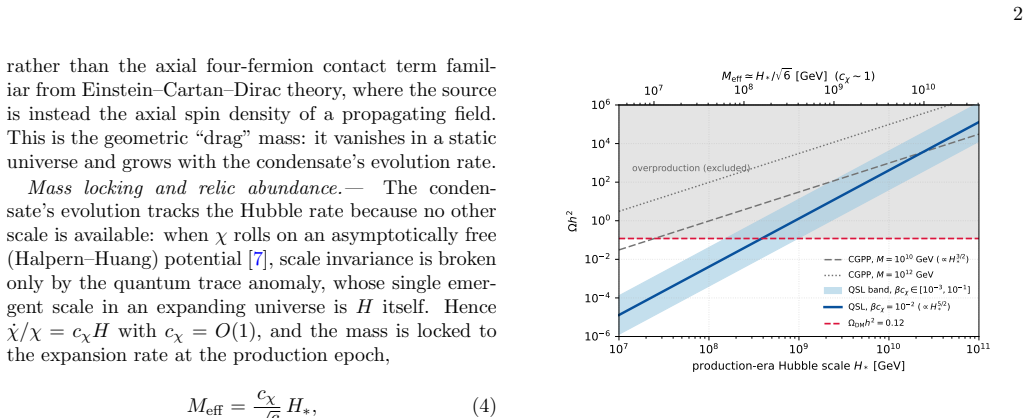
being the di- rect imprint ofM eff ∝H ∗. Matching Ω DMh2 = 0.12 then fixes the production scale and the mass (Fig. 1); for βcχ ∼10 −2,H ∗ ∼10 8–109 GeV andM eff ∼10 8 GeV. The number is illustrative; the robust outputs are the locking relation (4) and the scaling (5). Mass locking further predicts a gravitational-wave counterpart:H ∗ fixes bothM eff and t...
-
[2]
Maleknejad and J
A. Maleknejad and J. Kopp, Phys. Rev. Lett.136, 131501 (2026)
2026
-
[3]
J. M. Nester and R.-S. Tung, Gen. Relativ. Gravit.27, 115 (1995)
1995
-
[4]
Tung and T
R.-S. Tung and T. Jacobson, Class. Quantum Grav.12, L51 (1995). 3
1995
-
[5]
J. M. Nester, R.-S. Tung, and V. V. Zhytnikov, Class. Quantum Grav.11, 983 (1994)
1994
-
[6]
Shaposhnikov, A
M. Shaposhnikov, A. Shkerin, I. Timiryasov, and S. Zell, Phys. Rev. Lett.126, 161301 (2021);127, 169901(E) (2021)
2021
-
[7]
Kaneta, W
K. Kaneta, W. Ke, Y. Mambrini, K. A. Olive, and S. Verner, Phys. Rev. D108, 115027 (2023)
2023
-
[8]
Huang, H.-B
K. Huang, H.-B. Low, and R.-S. Tung, Class. Quantum Grav.29, 155014 (2012)
2012
-
[9]
Pagels and J
H. Pagels and J. R. Primack, Phys. Rev. Lett.48, 223 (1982)
1982
-
[10]
Challenges and Opportunities of Gravitational-Wave Searches above 10 kHz,
N. Aggarwalet al., Living Rev. Relativ.24, 4 (2021); “Challenges and Opportunities of Gravitational-Wave Searches above 10 kHz,” arXiv:2501.11723 (2025)
arXiv 2021
-
[11]
Dark matter from the quadratic spinor La- grangian. I. Geometric mass for a gravitationally pro- duced spin-1/2 fermion,
R.-S. Tung, “Dark matter from the quadratic spinor La- grangian. I. Geometric mass for a gravitationally pro- duced spin-1/2 fermion,” (2026)
2026
-
[12]
Dark matter from the quadratic spinor La- grangian. II. A spin-3/2 no-go and the uniqueness of the spin-1/2 candidate,
R.-S. Tung, “Dark matter from the quadratic spinor La- grangian. II. A spin-3/2 no-go and the uniqueness of the spin-1/2 candidate,” (2026)
2026
discussion (0)
Sign in with ORCID, Apple, or X to comment. Anyone can read and Pith papers without signing in.