Learning Low-Energy Subspace Overlaps in Many-Body Systems with Measurement-Based and Coherent Quantum Strategies
Pith reviewed 2026-07-02 18:22 UTC · model grok-4.3
The pith
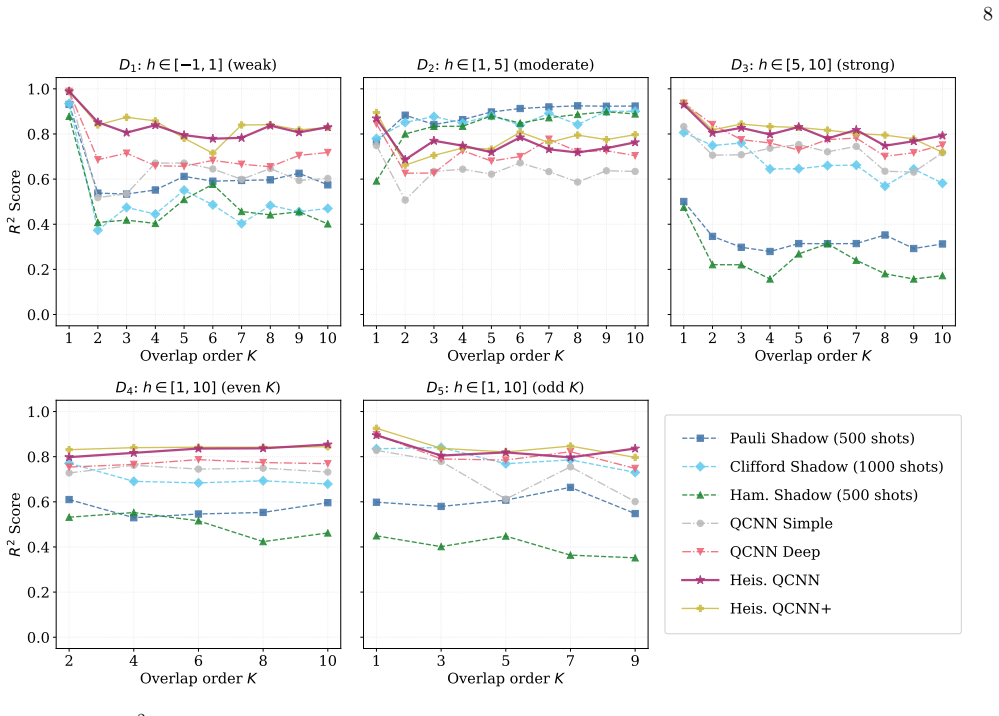
Physics-informed QCNNs maintain stable R^2 of 0.753-0.846 for subspace overlap prediction across weak to strong quenches on a 10-qubit Heisenberg chain while shadow methods vary by regime.
A machine-rendered reading of the paper's core claim, the machinery that carries it, and where it could break.
Core claim
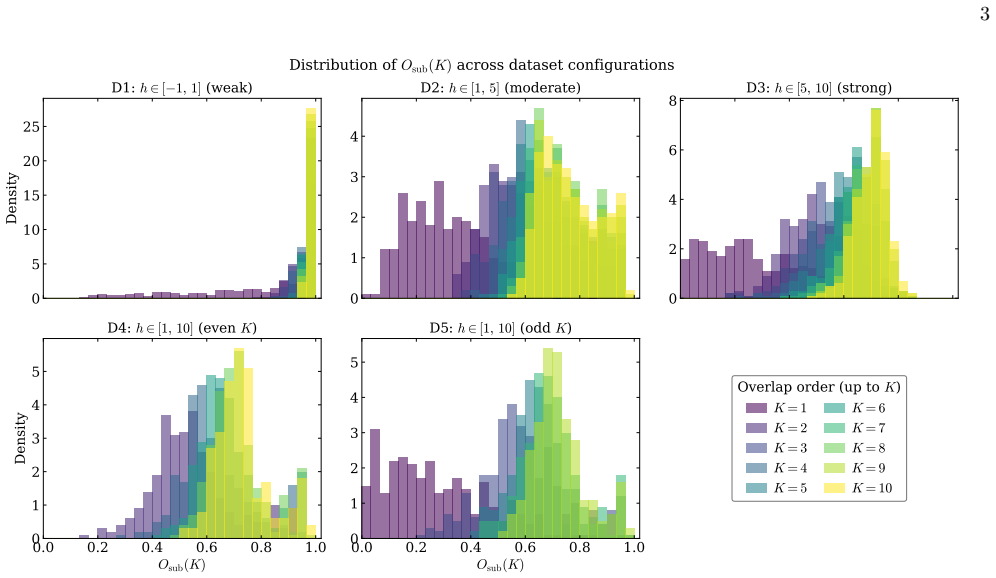
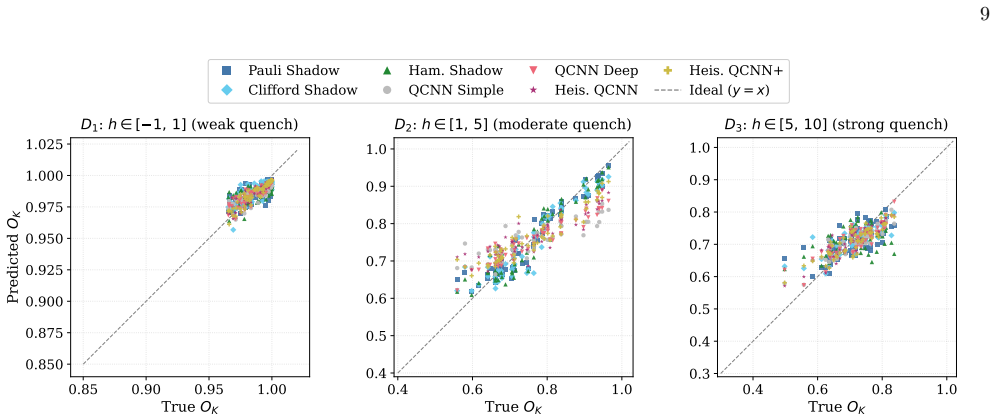
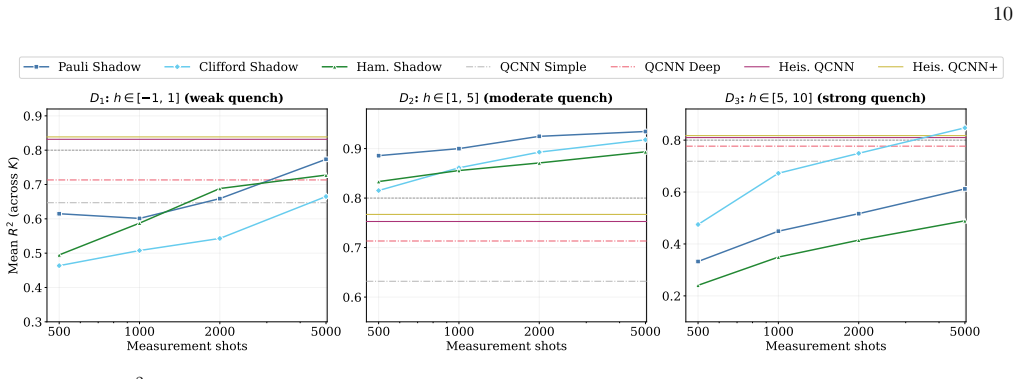
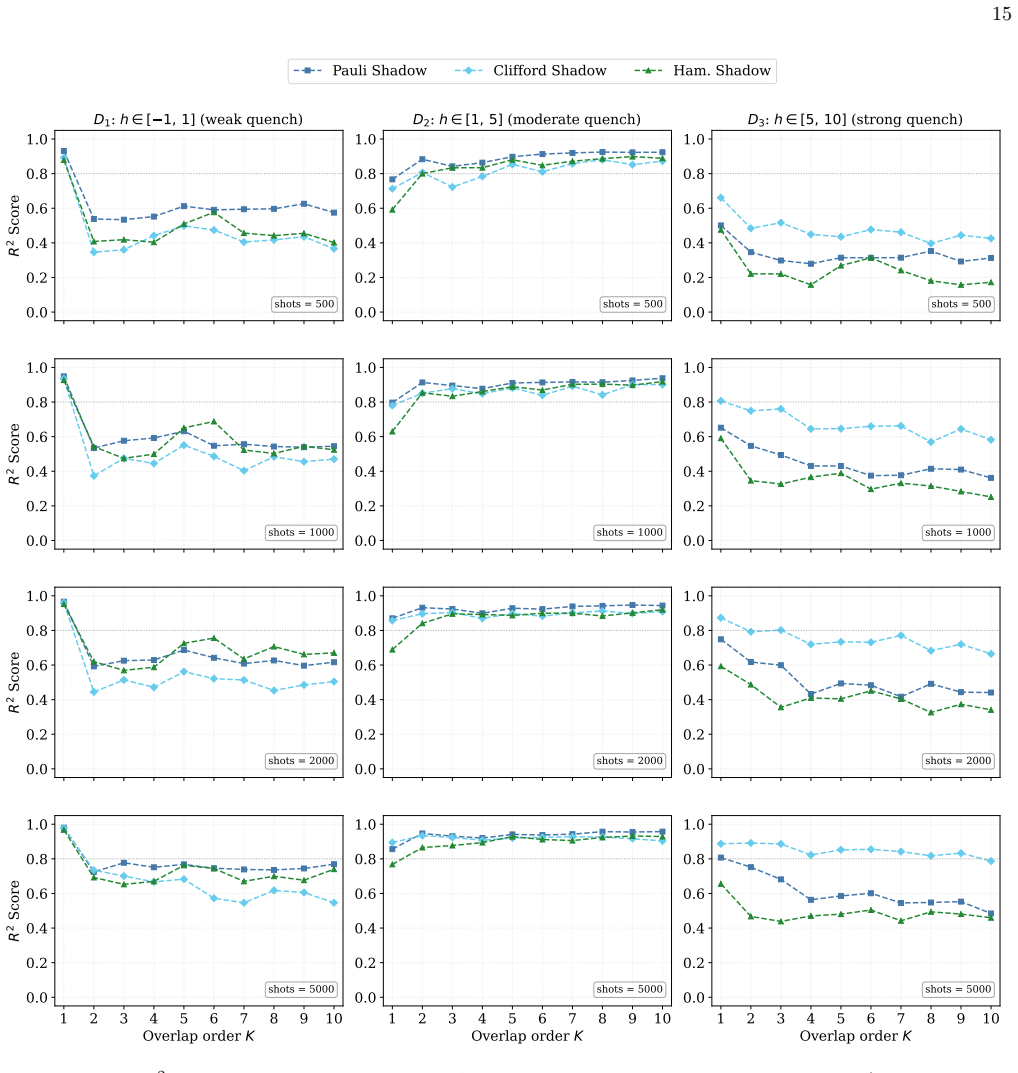
Supervised prediction of subspace overlaps O_K with K-dimensional low-energy eigenspaces after a local quench on the 10-qubit Heisenberg chain shows that physics-informed QCNNs achieve mean test R^2 values between 0.753 and 0.846 across all five dataset configurations, whereas shadow-based CNNs reach a higher peak of 0.886 only in the moderate-quench regime and drop to 0.615 and 0.672 in the weak and strong regimes at default shot budgets.
What carries the argument
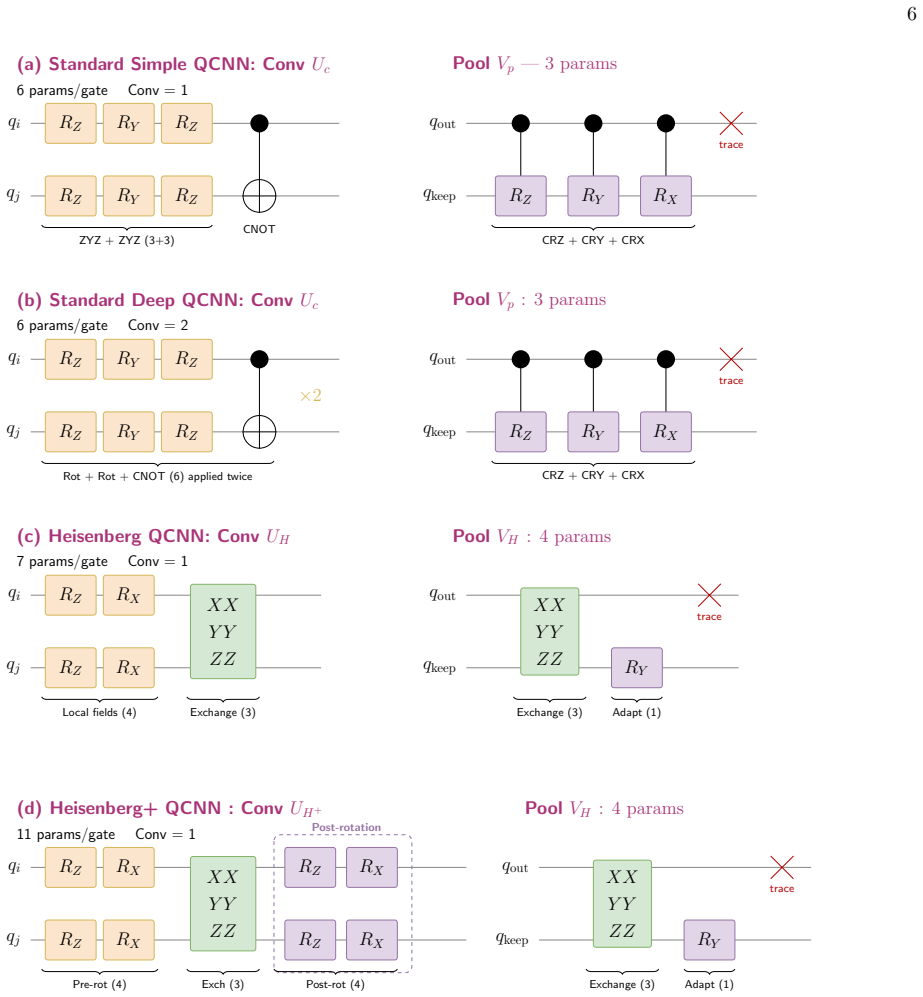
Physics-informed QCNNs whose gates are aligned with the Heisenberg exchange interactions for direct coherent processing of the input state.
If this is right
- Shadow methods can exceed QCNN accuracy when the quench remains moderate and the target subspace stays locally accessible.
- QCNN performance stays usable even when the quench strength is unknown in advance.
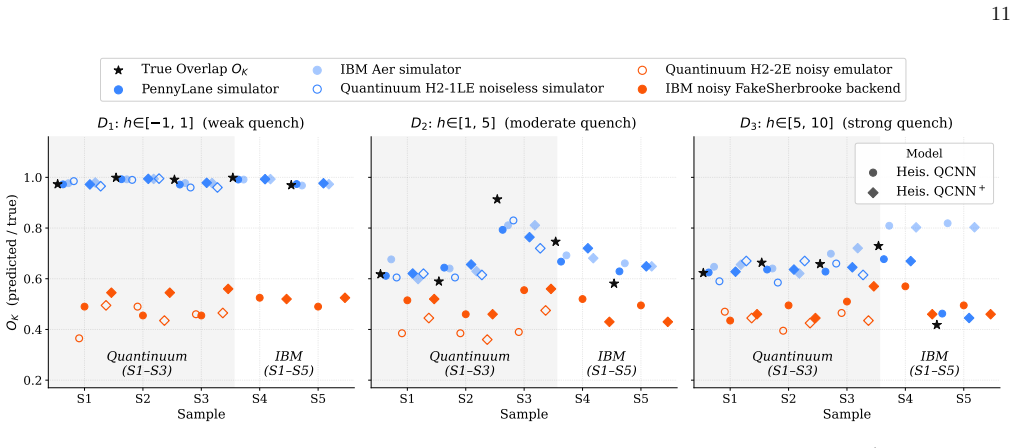
- Current hardware state-preparation overhead of roughly 2044 two-qubit gates depolarizes the state before any inference can occur.
- A clear regime-dependent tradeoff exists between measurement cost and coherent processing depth.
Where Pith is reading between the lines
- Hybrid pipelines that switch between shadow and QCNN routes according to estimated quench strength could improve overall accuracy without extra hardware.
- The same physics-informed gate alignment might transfer to other nearest-neighbor spin models without retraining from scratch.
- Reducing the state-preparation gate count below 2000 would be the single largest lever for making coherent QCNN inference practical on near-term devices.
Load-bearing premise
The 10-qubit Heisenberg chain under the chosen local perturbation and the five selected dataset configurations capture the dynamical regimes and measurement costs that matter for state preparation and thermalization applications.
What would settle it
Repeating the full comparison on an 11- or 12-qubit chain or on an Ising rather than Heisenberg model and finding that shadow methods become the more stable performer in every regime.
Figures
read the original abstract
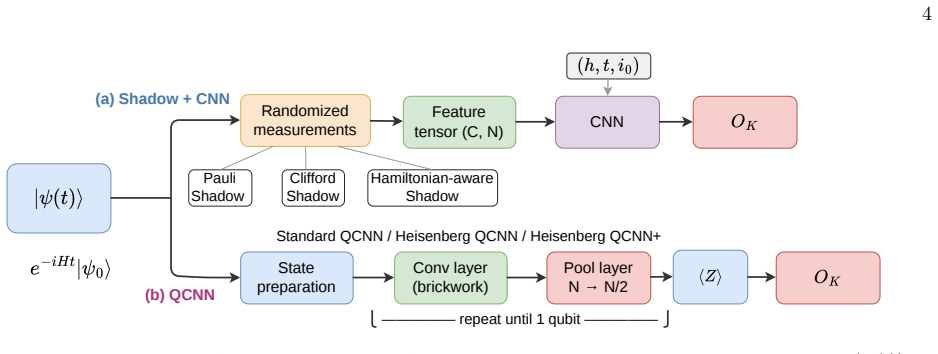
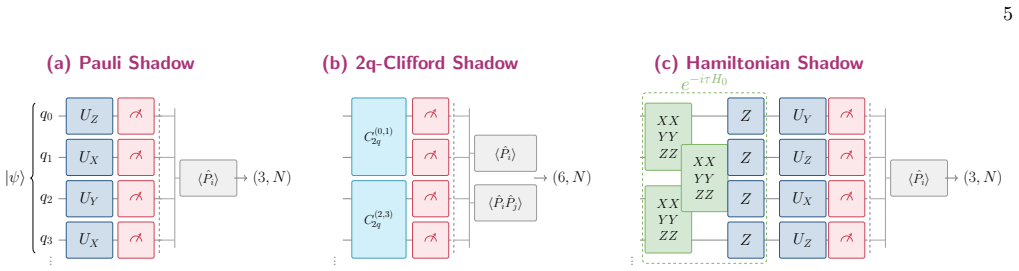
Predicting the overlap of quantum states with specified low-energy subspaces is a key diagnostic for quantum many-body dynamics, with direct applications in state preparation, subspace-based algorithms, and the study of thermalization. We study the supervised prediction of subspace overlaps O_K between time-evolved states and K-dimensional low-energy eigenspaces of a 10-qubit Heisenberg spin chain following a local perturbation. We compare two quantum information extraction strategies: measurement-based learning, in which classical shadow features are processed by convolutional neural networks, and coherent quantum learning, in which quantum convolutional neural networks process the state directly. We further introduce physics-informed variants for both approaches, including Hamiltonian-aware shadows and QCNN gates aligned with the Heisenberg exchange structure. Across five dataset configurations spanning weak, moderate, and strong quench regimes, physics-informed QCNNs achieve stable performance, with mean test-set coefficients of determination R^2 = 0.753-0.846. Shadow-based methods show stronger regime dependence: they outperform QCNNs in the moderate-quench regime, reaching R^2 = 0.886, but underperform in weak and strong quenches at default shot budgets, where the best shadow results are R^2 = 0.615 and 0.672, respectively. Hardware validation on Quantinuum and IBM noise models shows that arbitrary state preparation is the dominant limitation, requiring approximately 2,044 two-qubit gates and causing near-complete depolarization before inference. These results identify a regime-dependent tradeoff between measurement-based and coherent quantum learning, with shadow methods excelling when the target remains locally accessible and physics-informed QCNNs providing more robust performance across dynamical regimes.
Editorial analysis
A structured set of objections, weighed in public.
Referee Report
Summary. The manuscript studies supervised prediction of overlaps O_K between time-evolved states and K-dimensional low-energy subspaces of a 10-qubit Heisenberg chain after a local perturbation. It compares measurement-based learning (classical shadows fed to CNNs, including Hamiltonian-aware variants) against coherent learning (QCNNs with Heisenberg-aligned gates). Across five dataset configurations spanning weak/moderate/strong quenches, physics-informed QCNNs yield stable test-set R² values of 0.753–0.846 while shadow methods reach R²=0.886 in the moderate regime but drop to 0.615/0.672 in weak/strong regimes at default shot budgets. Hardware noise-model validation on Quantinuum/IBM devices identifies arbitrary state preparation (∼2044 two-qubit gates) as the dominant error source.
Significance. If the reported performance differences hold under the stated conditions, the work supplies a concrete, regime-dependent comparison between two quantum information extraction strategies that is directly relevant to subspace diagnostics in many-body dynamics. The inclusion of physics-informed variants for both approaches and the explicit hardware gate-count analysis are positive features; the empirical R² numbers and shot-budget comparisons constitute falsifiable benchmarks that can be reproduced or extended by other groups.
major comments (2)
- [dataset configurations and results sections] § on dataset construction and results (five quench regimes): the central claim of a stable QCNN vs. regime-dependent shadow tradeoff rests on a single fixed 10-qubit Heisenberg chain with one chosen local perturbation. No scaling with system size, no alternative Hamiltonians, and no larger-N results are presented, so it remains unclear whether the observed stability difference (R² ranges 0.753–0.846 vs. 0.615/0.672) is a general feature of the two strategies or an artifact of this specific model size and perturbation.
- [hardware validation] Hardware validation paragraph: the statement that arbitrary state preparation requires ∼2044 two-qubit gates and causes near-complete depolarization is presented as a dominant limitation, yet the manuscript does not quantify how this gate count scales with the number of training states or whether any mitigation (e.g., shallower circuits or error mitigation) was attempted; this directly affects the practical relevance of the coherent QCNN results.
minor comments (3)
- [methods] Notation for O_K and the definition of the K-dimensional low-energy subspace should be stated explicitly in the methods section rather than only in the abstract.
- [figures] Figure captions for the R² plots should include the number of independent training/test splits and any error bars or standard deviations on the reported mean R² values.
- [results] The precise shot budget used for the default shadow results (the value that yields R²=0.615/0.672) is not stated numerically in the text; it should be given explicitly alongside the moderate-regime budget.
Simulated Author's Rebuttal
We appreciate the referee's thorough review and valuable suggestions. Below we provide point-by-point responses to the major comments.
read point-by-point responses
-
Referee: [dataset configurations and results sections] § on dataset construction and results (five quench regimes): the central claim of a stable QCNN vs. regime-dependent shadow tradeoff rests on a single fixed 10-qubit Heisenberg chain with one chosen local perturbation. No scaling with system size, no alternative Hamiltonians, and no larger-N results are presented, so it remains unclear whether the observed stability difference (R² ranges 0.753–0.846 vs. 0.615/0.672) is a general feature of the two strategies or an artifact of this specific model size and perturbation.
Authors: We concur that the study is confined to a single 10-qubit Heisenberg chain and a specific local perturbation. This setup was chosen to thoroughly explore the five quench regimes while keeping the computational demands manageable. The stability of the QCNN performance and the regime dependence of the shadow methods are clearly demonstrated in this context. However, we recognize that without scaling studies or tests on other models, the generality of the tradeoff cannot be asserted. We will include an explicit statement in the discussion section acknowledging this limitation and outlining directions for future work on larger systems and different Hamiltonians. revision: partial
-
Referee: [hardware validation] Hardware validation paragraph: the statement that arbitrary state preparation requires ∼2044 two-qubit gates and causes near-complete depolarization is presented as a dominant limitation, yet the manuscript does not quantify how this gate count scales with the number of training states or whether any mitigation (e.g., shallower circuits or error mitigation) was attempted; this directly affects the practical relevance of the coherent QCNN results.
Authors: The ∼2044 two-qubit gate count refers to the state preparation circuit for each training state in our QCNN experiments. We have not analyzed how this number scales with the size of the training set nor have we implemented or tested mitigation strategies such as error mitigation or circuit optimization in the present manuscript. This omission limits the assessment of the coherent approach's hardware feasibility. We will revise the hardware validation section to clarify the gate count calculation and to discuss potential mitigation approaches as future work. revision: yes
- The absence of system-size scaling, alternative Hamiltonians, and larger-N results, as these would require substantial additional computational resources and are beyond the scope of the current study.
Circularity Check
No circularity: empirical R^2 metrics from supervised training
full rationale
The paper reports mean test-set coefficients of determination (R^2 = 0.753-0.846 for QCNNs, up to 0.886 for shadows) across five dataset configurations on a 10-qubit Heisenberg chain. These are direct outputs of supervised learning on held-out data, not quantities defined by or fitted to the model parameters themselves. The abstract and described results contain no derivation chain, self-definitional equations, fitted-input predictions, or load-bearing self-citations that reduce the reported performance to inputs by construction. The central claims are empirical comparisons of two learning strategies under different quench regimes; they stand or fall on the external validity of the chosen model and datasets rather than internal definitional closure.
Axiom & Free-Parameter Ledger
free parameters (1)
- neural-network weights and hyperparameters
axioms (1)
- domain assumption The chosen 10-qubit Heisenberg chain and local perturbation generate representative low-energy subspace overlaps across the weak/moderate/strong quench regimes.
Reference graph
Works this paper leans on
-
[1]
Biamonte, P
J. Biamonte, P. Wittek, N. Pancotti, P. Rebentrost, N. Wiebe, and S. Lloyd, Quantum machine learning, Na- ture549, 195 (2017)
2017
-
[2]
Preskill, Quantum computing in the NISQ era and beyond, Quantum2, 79 (2018)
J. Preskill, Quantum computing in the NISQ era and beyond, Quantum2, 79 (2018). 16
2018
-
[3]
Bharti, A
K. Bharti, A. Cervera-Lierta, T. H. Kyaw, T. Haug, S. Alperin-Lea, A. Anand, M. Degroote, H. Heimonen, J. S. Kottmann, T. Menke, W.-K. Mok, S. Sim, L.-C. Kwek, and A. Aspuru-Guzik, Noisy intermediate-scale quantum algorithms, Reviews of Modern Physics94, 015004 (2022)
2022
-
[4]
Cerezo, A
M. Cerezo, A. Arrasmith, R. Babbush, S. C. Benjamin, S. Endo, K. Fujii, J. R. McClean, K. Mitarai, X. Yuan, L. Cincio, and P. J. Coles, Variational quantum algo- rithms, Nature Reviews Physics3, 625 (2021)
2021
-
[5]
Henk and W
K.-H. Henk and W. Paul, Machine learning quantum me- chanical ground states based on stochastic mechanics, Phys. Rev. A108, 062412 (2023)
2023
-
[6]
S.-T. Bao, D. Wu, P. Zhang, and L. Wang, Learning eigenstates of quantum many-body Hamiltonians within the symmetric subspaces using neural network quantum states, Phys. Rev. B111, L161116 (2025)
2025
- [7]
-
[8]
I. Cong, S. Choi, and M. D. Lukin, Quantum convolu- tional neural networks, Nature Physics15, 1273 (2019)
2019
- [9]
-
[10]
J. Bowles, S. Ahmed, and M. Schuld, Better than classi- cal? The subtle art of benchmarking quantum machine learning models (2024), arXiv:2403.07059 [quant-ph]
-
[11]
Alvarez-Estevez, Benchmarking quantum machine learning kernel training for classification tasks, IEEE Trans
D. Alvarez-Estevez, Benchmarking quantum machine learning kernel training for classification tasks, IEEE Trans. Quantum Eng.6, 1 (2025)
2025
-
[12]
Huang, M
H.-Y. Huang, M. Broughton, J. Cotler, S. Chen, J. Li, M. Mohseni, H. Neven, R. Babbush, R. Kueng, J. Preskill, and J. R. McClean, Quantum advantage in learning from experiments, Science376, 1182 (2022)
2022
-
[13]
R. A. Jalabert and H. M. Pastawski, Environment- independent decoherence rate in classically chaotic sys- tems, Phys. Rev. Lett.86, 2490 (2001)
2001
-
[14]
ˇZunkoviˇ c, A
B. ˇZunkoviˇ c, A. Silva, and M. Fabrizio, Dynamical phase transitions and Loschmidt echo in the infinite-range XY model, Phil. Trans. R. Soc. A374, 20150160 (2016)
2016
-
[15]
Heyl, Dynamical quantum phase transitions: a re- view, Reports on Progress in Physics81, 054001 (2018)
M. Heyl, Dynamical quantum phase transitions: a re- view, Reports on Progress in Physics81, 054001 (2018)
2018
-
[16]
M. Heyl, A. Polkovnikov, and S. Kehrein, Dynamical quantum phase transitions in the transverse-field Ising model, Phys. Rev. Lett.110, 135704 (2013)
2013
-
[17]
L. S. Brown,Quantum Field Theory(Cambridge Univer- sity Press, Cambridge, 1992)
1992
-
[18]
Preskill, Quantum field theory (1990), lecture Notes, California Institute of Technology
J. Preskill, Quantum field theory (1990), lecture Notes, California Institute of Technology
1990
-
[19]
Rylands and N
C. Rylands and N. Andrei, Loschmidt amplitude and work distribution in quenches of the sine-Gordon model, Physical Review B99, 085133 (2019)
2019
-
[20]
C. Y. Wong and W. C. Yu, Loschmidt amplitude spec- trum in dynamical quantum phase transitions, Physical Review B105, 174307 (2022)
2022
-
[21]
J. M. Deutsch, Quantum statistical mechanics in a closed system, Physical Review A43, 2046 (1991)
2046
-
[22]
Srednicki, Chaos and quantum thermalization, Phys- ical Review E50, 888 (1994)
M. Srednicki, Chaos and quantum thermalization, Phys- ical Review E50, 888 (1994)
1994
-
[23]
Rigol, V
M. Rigol, V. Dunjko, and M. Olshanii, Thermalization and its mechanism for generic isolated quantum systems, Nature452, 854 (2008)
2008
-
[24]
D’Alessio, Y
L. D’Alessio, Y. Kafri, A. Polkovnikov, and M. Rigol, From quantum chaos and eigenstate thermalization to statistical mechanics and thermodynamics, Advances in Physics65, 239 (2016)
2016
-
[25]
Troyer and U.-J
M. Troyer and U.-J. Wiese, Computational complex- ity and fundamental limitations to fermionic quantum Monte Carlo simulations, Phys. Rev. Lett.94, 170201 (2005)
2005
-
[26]
Werner, QMC for nonequilibrium systems (2025), lec- ture notes (Keldysh real-time approaches; discusses the dynamical sign problem)
P. Werner, QMC for nonequilibrium systems (2025), lec- ture notes (Keldysh real-time approaches; discusses the dynamical sign problem)
2025
-
[27]
A. F. Mello, A. Santini, and M. Collura, Clifford-dressed variational principles for precise Loschmidt echoes, Phys. Rev. A111, 052401 (2025)
2025
-
[28]
H´ emery, K
K. H´ emery, K. Ghanem, E. Crane, S. L. Campbell, J. M. Dreiling, C. Figgatt, C. Foltz, J. P. Gaebler, J. Johansen, M. Mills, S. A. Moses, J. M. Pino, A. Ransford, M. Rowe, P. Siegfried, R. P. Stutz, H. Dreyer, A. Schuckert, and R. Nigmatullin, Measuring the Loschmidt amplitude for finite-energy properties of the Fermi-Hubbard model on an ion-trap quantum...
2024
-
[29]
R. A. Brice˜ no, R. G. Edwards, M. Eaton, C. Gonz´ alez- Arciniegas, O. Pfister, and G. Siopsis, Toward coherent quantum computation of scattering amplitudes with a measurement-based photonic quantum processor, Phys. Rev. Research6, 043065 (2024)
2024
-
[30]
T. Li, W. K. Lai, E. Wang, and H. Xing, Scattering am- plitude from quantum computing with reduction formula, Phys. Rev. D109, 036025 (2024)
2024
-
[31]
I. L. Guti´ errez and C. B. Mendl, Real time evolution with neural-network quantum states, Quantum6, 627 (2022)
2022
-
[32]
Medvidovi´ c and D
M. Medvidovi´ c and D. Sels, Variational quantum dynam- ics of two-dimensional rotor models, PRX Quantum4, 040302 (2023)
2023
-
[33]
Cincio, Y
L. Cincio, Y. Subasi, A. T. Sornborger, and P. J. Coles, Learning the quantum algorithm for state overlap, New Journal of Physics20, 113022 (2018)
2018
-
[34]
Aaronson, Shadow tomography of quantum states, SIAM Journal on Computing49, STOC18 (2020), pre- liminary version in STOC 2018
S. Aaronson, Shadow tomography of quantum states, SIAM Journal on Computing49, STOC18 (2020), pre- liminary version in STOC 2018
2020
-
[35]
Huang, R
H.-Y. Huang, R. Kueng, and J. Preskill, Predicting many properties of a quantum system from very few measure- ments, Nature Physics16, 1050 (2020)
2020
-
[36]
Elben, S
A. Elben, S. T. Flammia, H.-Y. Huang, R. Kueng, J. Preskill, B. Vermersch, and P. Zoller, The random- ized measurement toolbox, Nature Reviews Physics5, 9 (2023)
2023
-
[37]
Mangini, F
S. Mangini, F. Tacchino, D. Gerace, D. Bajoni, and C. Macchiavello, Quantum computing models for artifi- cial neural networks, Europhys. Lett.134, 10002 (2021)
2021
-
[38]
Pesah, M
A. Pesah, M. Cerezo, S. Wang, T. Volkoff, A. T. Sorn- borger, and P. J. Coles, Absence of barren plateaus in quantum convolutional neural networks, Physical Review X11, 041011 (2021)
2021
-
[39]
J. R. McClean, S. Boixo, V. N. Smelyanskiy, R. Bab- bush, and H. Neven, Barren plateaus in quantum neural network training landscapes, Nature Communications9, 4812 (2018)
2018
-
[40]
Cerezo, A
M. Cerezo, A. Sone, T. Volkoff, L. Cincio, and P. J. Coles, Cost function dependent barren plateaus in shal- 17 low parametrized quantum circuits, Nature Communica- tions12, 1791 (2021)
2021
-
[41]
Herrmann, S
J. Herrmann, S. M. Llima, A. Remm, P. Zapletal, N. A. McMahon, C. Scarato, F. Swiadek, C. K. Andersen, C. Hellings, S. Krinner, N. Lacroix, S. Lazar, M. Ker- schbaum, D. C. Zanuz, G. J. Norris, M. J. Hartmann, A. Wallraff, and C. Eichler, Realizing quantum convo- lutional neural networks on a superconducting quantum processor to recognize quantum phases, ...
2022
-
[42]
Quantum Convolutional Neural Networks are Effectively Classically Simulable
P. Bermejo, P. Braccia, M. S. Rudolph, Z. Holmes, L. Cincio, and M. Cerezo, Quantum convolutional neu- ral networks are (effectively) classically simulable, arXiv preprint arXiv:2408.12739 (2024), arXiv:2408.12739
work page internal anchor Pith review Pith/arXiv arXiv 2024
-
[43]
Wiersema, C
R. Wiersema, C. Zhou, Y. de Sereville, J. F. Carrasquilla, Y. B. Kim, and H. Yuen, Exploring entanglement and optimization within the Hamiltonian variational ansatz, PRX Quantum1, 020319 (2020)
2020
-
[44]
Q. T. Nguyen, B. T. Bespalova, Y. Kukla, J. Romero, C. Bravo-Prieto, and M. Cerezo, Theory for equivari- ant quantum neural networks, PRX Quantum5, 020328 (2024)
2024
-
[45]
J. J. Meyer, M. Mularski, E. Gil-Fuster, A. A. Mele, F. Arzani, A. Soltani, and H. Wilming, Exploiting sym- metry in variational quantum machine learning, PRX Quantum4, 010328 (2023)
2023
-
[46]
Larocca, F
M. Larocca, F. Ju, J. Carrasquilla, P. J. Coles, and M. Cerezo, Group-invariant quantum machine learning, PRX Quantum3, 030341 (2022)
2022
-
[47]
Y. Kim, A. Eddins, S. Anand, K. X. Wei, E. van den Berg, S. Rosenblatt, H. Nayfeh, Y. Wu, M. Zaletel, K. Temme, and A. Kandala, Evidence for the utility of quantum computing before fault tolerance, Nature618, 500 (2023)
2023
-
[48]
S. A. Moses, C. H. Baldwin, M. S. Allman, R. An- cona, L. Ascarrunz, C. Barnes, J. Bartolotta, B. Bjork, P. Bodik, J. G. Bohnet,et al., A race-track trapped- ion quantum processor, Physical Review X13, 041052 (2023)
2023
-
[49]
Auerbach,Interacting Electrons and Quantum Mag- netism(Springer, New York, 1994)
A. Auerbach,Interacting Electrons and Quantum Mag- netism(Springer, New York, 1994)
1994
-
[50]
I. M. Georgescu, S. Ashhab, and F. Nori, Quantum sim- ulation, Reviews of Modern Physics86, 153 (2014)
2014
-
[51]
Calabrese and J
P. Calabrese and J. Cardy, Quantum quenches in ex- tended systems, Journal of Statistical Mechanics: Theory and Experiment2007, P06008 (2007)
2007
-
[52]
Polkovnikov, K
A. Polkovnikov, K. Sengupta, A. Silva, and M. Vengalat- tore, Colloquium: Nonequilibrium dynamics of closed in- teracting quantum systems, Rev. Mod. Phys.83, 863 (2011)
2011
-
[53]
Calabrese and J
P. Calabrese and J. Cardy, Entanglement and correlation functions following a local quench: a conformal field the- ory approach, Journal of Statistical Mechanics: Theory and Experiment2007, P10004 (2007)
2007
-
[54]
Eisler and I
V. Eisler and I. Peschel, Evolution of entanglement after a local quench, Journal of Statistical Mechanics: Theory and Experiment2007, P06005 (2007)
2007
-
[55]
Zanardi and N
P. Zanardi and N. Paunkovi´ c, Ground state overlap and quantum phase transitions, Physical Review E74, 031123 (2006)
2006
-
[56]
Gu, Fidelity approach to quantum phase transi- tions, International Journal of Modern Physics B24, 4371 (2010)
S.-J. Gu, Fidelity approach to quantum phase transi- tions, International Journal of Modern Physics B24, 4371 (2010)
2010
-
[57]
Gogolin and J
C. Gogolin and J. Eisert, Equilibration, thermalisation, and the emergence of statistical mechanics in closed quantum systems, Reports on Progress in Physics79, 056001 (2016)
2016
-
[58]
H.-Y. Hu, S. Choi, and Y.-Z. You, Classical shadow tomography with locally scrambled quantum dynamics, Physical Review Research5, 023027 (2023)
2023
-
[59]
Hu and Y.-Z
H.-Y. Hu and Y.-Z. You, Hamiltonian-driven shadow to- mography of quantum states, Physical Review Research 4, 013054 (2022)
2022
-
[60]
LeCun, Y
Y. LeCun, Y. Bengio, and G. Hinton, Deep learning, Na- ture521, 436 (2015)
2015
- [61]
-
[62]
D. P. Kingma and J. Ba, Adam: A method for stochastic optimization (2017), arXiv:1412.6980 [cs.LG]
work page internal anchor Pith review Pith/arXiv arXiv 2017
-
[63]
PennyLane: Automatic differentiation of hybrid quantum-classical computations
V. Bergholm, J. Izaac, M. Schuld, C. Gogolin,et al., Pen- nyLane: Automatic differentiation of hybrid quantum- classical computations, arXiv preprint arXiv:1811.04968 (2018), arXiv:1811.04968
work page internal anchor Pith review Pith/arXiv arXiv 2018
-
[64]
Grant, L
E. Grant, L. Wossnig, M. Ostaszewski, and M. Benedetti, An initialization strategy for addressing barren plateaus in parametrized quantum circuits, Quantum3, 214 (2019)
2019
-
[65]
Sivarajah, S
S. Sivarajah, S. Dilkes, A. Cowtan, W. Simmons, A. Edg- ington, and R. Duncan, t|ket⟩: a retargetable compiler for NISQ devices, Quantum Science and Technology6, 014003 (2020)
2020
-
[66]
A. Javadi-Abhari, M. Treinish, K. Krsulich, C. J. Wood, J. Lishman, J. Gacon, S. Martiel, P. D. Na- tion, L. S. Bishop, A. W. Cross, B. R. Johnson, and J. M. Gambetta, Quantum computing with Qiskit, arXiv 10.48550/arXiv.2405.08810 (2024), arXiv:2405.08810
work page internal anchor Pith review Pith/arXiv arXiv doi:10.48550/arxiv.2405.08810 2024
-
[67]
Lloyd, Universal quantum simulators, Science273, 1073 (1996)
S. Lloyd, Universal quantum simulators, Science273, 1073 (1996)
1996
-
[68]
Temme, S
K. Temme, S. Bravyi, and J. M. Gambetta, Error mitiga- tion for short-depth quantum circuits, Phys. Rev. Lett. 119, 180509 (2017)
2017
-
[69]
T. Jones and J. Gacon, Efficient calculation of gra- dients in classical simulations of variational quantum algorithms, arXiv preprint arXiv:2009.02823 (2020), arXiv:2009.02823
-
[70]
Mitarai, M
K. Mitarai, M. Negoro, M. Kitagawa, and K. Fujii, Quan- tum circuit learning, Phys. Rev. A98, 032309 (2018)
2018
-
[71]
Schuld, V
M. Schuld, V. Bergholm, C. Gogolin, J. Izaac, and N. Kil- loran, Evaluating analytic gradients on quantum hard- ware, Phys. Rev. A99, 032331 (2019)
2019
-
[72]
L. D. Dalcin, R. R. Paz, P. A. Kler, and A. Cosimo, Parallel distributed computing using python, Advances in Water Resources34, 1124 (2011)
2011
-
[73]
S. Chen, W. Yu, P. Zeng, and S. T. Flammia, Robust shadow estimation, PRX Quantum2, 030348 (2021)
2021
discussion (0)
Sign in with ORCID, Apple, or X to comment. Anyone can read and Pith papers without signing in.