REVIEW 3 major objections 4 minor 2 cited by
In indefinite-causality quantum theory, observers are not primitive entities but perspective-relative groupings of input and output data, and a stance called operational eternalism makes this precise.
Reviewed by Pith at T0; open to challenge. T0 means a machine referee read the full paper against a public rubric. the ladder, T0–T4 →
T0 review · deepseek-v4-flash
2026-08-03 13:46 UTC pith:ULRHPAKP
load-bearing objection A well-sourced interpretive paper whose perspectival-agency thesis holds up; the friendliness criterion's symmetry is asserted without proof and the anti-reconciliation conclusion overreaches, but it deserves a serious referee. the 3 major comments →
Agency under indefinite causality: operational eternalism in higher-order quantum theory
The pith
A machine-rendered reading of the paper's core claim, the machinery that carries it, and where it could break.
Core claim
The central claim is that agents arise from admissible groupings of input and output data in a global Hilbert space, and that redefining these groupings can eliminate non-causality. Because any fixed perspective imposes a local time arrow and a circuit representation, an agent's operations may appear time-delocalized from another agent's perspective, making observerhood genuinely perspectival. The paper calls the global view 'operational eternalism' — a block-universe stance applied to information rather than geometry — and states that observers are well-defined from that global view but not universal across perspectives. It then defines friendliness: observer A is a friend of B iff A's oper
What carries the argument
The central machinery is higher-order quantum theory in a global Hilbert space, where supermaps connect slots for agents' channels without any global time ordering. Within this, the key defined object is the friendliness criterion: A is a friend of B iff A's operations are time-localized transformations in B's circuit, taken to require a common unitary respecting both agents' time arrows. This criterion carries the argument by deciding which agents in friend scenarios are causally compatible; time-delocalization of an agent's input/output subspaces in another agent's frame is the obstruction that makes non-friendly agents operationally incoherent. Operational eternalism supplies the global p
Load-bearing premise
The friendliness criterion assumes that A's time-localizability in B's circuit and B's time-localizability in A's circuit are equivalent — i.e., that friendliness is symmetric — but this equivalence is asserted rather than proven, and the conclusions about who counts as an observer depend on it.
What would settle it
Search process matrices for a bipartite or tripartite setting where Alice's operations admit a time-local representation in Bob's circuit but Bob's operations are time-delocalized in Alice's circuit; any such example would break the symmetry of friendliness. Concretely, one can take the quantum switch and test, using the standard time-delocalization conditions, whether mutual localizability holds for all pairs of agents; if it fails in either direction, the friendliness criterion collapses.
If this is right
- The observer in operational quantum theory becomes a derived mathematical object: any grouping of inputs and outputs that satisfies consistency constraints (no grandfather paradox, no two-way signalling) counts as a valid observer.
- In a fixed perspective, only 'friendly' agents — those whose operations are mutually time-localizable — can share a causal sequence and exchange classical results; all other observers are operationally incoherent from that perspective.
- Non-causal processes such as the Lugano process and the cyclic quantum switch can be made causal by adding agents in the global past and future, at the cost of reducing those extra agents to epiphenomenal single-data observers.
- If the operational-spacetime tension is indeed unbridgeable for fundamental theories, the operational approach signals the obsolescence of the spacetime picture rather than a gap to be reconciled.
- The framework suggests that even the input/output bipartition is not sacred: the theory may eventually decide which data points are inputs and which are outputs.
Where Pith is reading between the lines
- If friendliness is symmetric, mutual time-localizability defines an equivalence relation among observers; one could then partition global data into equivalence classes of mutually compatible perspectives, and the two lab frames in the quantum switch would belong to different classes.
- A testable extension: numerically search process matrices with three or more parties for cases where A's operations are time-local in B's frame but B's are not in A's; finding one would falsify the symmetry claim and force a revision of the friendliness criterion.
- Applied to friend-scenario no-go theorems, operational eternalism suggests the apparent paradox arises from comparing incompatible observer perspectives, which would dissolve the contradiction rather than require a new physical mechanism.
- Operational eternalism could guide experiment: in optical realizations of the quantum switch, one could attempt to assign a definite time to the other lab's operation and look for the predicted unavoidable time-delocalization, within reach of current interferometric controls.
Editorial analysis
A structured set of objections, weighed in public.
Referee Report
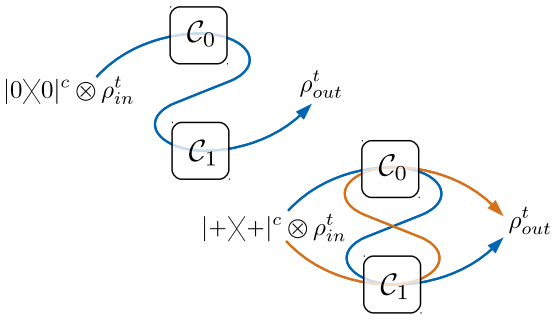
Summary. The paper argues that two decades of work on indefinite causality in higher-order quantum theory motivate a new interpretive stance, 'operational eternalism.' On this view, the primitive objects of an operational theory are inputs and outputs in a global Hilbert space; agents or observers are not metatheoretical assumptions but are constituted by admissible groupings of those data. Because different groupings are possible, agency is perspectival: from Alice's perspective Bob may not qualify as an observer, and vice versa. The paper illustrates this with the quantum switch and the Lugano process, discusses why non-causal processes are difficult to embed as circuits in spacetime, and proposes an operational criterion of 'friendliness' for Wigner-type scenarios: A is a friend of B iff A's operations can be represented as time-localized transformations in B's circuit representation. It concludes that observers are 'servants of causality' and that the spacetime/operational tension cannot be bridged if both frameworks are taken as fundamental.
Significance. If correct, the paper would make a substantive contribution to the foundations of quantum mechanics by offering a coherent philosophical framework for indefinite causality and by connecting results about time-delocalized subsystems to the Wigner-friend debate. It draws on established technical results—Hardy's causaloids, Oreshkov's time-delocalization, Wechs-Oreshkov's perspective transformations, and Baumeler-Wolf's Lugano process—and contains no free parameters or curve fitting, which keeps the interpretive claims cleanly separated from adjustable assumptions. The friendliness criterion is a genuinely new proposal with the potential to sharpen future discussions of causally compatible observers. However, the central load-bearing step—the symmetry of friendliness—is asserted rather than proved, and the paper's strong conclusion about the unbridgeable tension with spacetime relies on an interpretive premise that is not derived.
major comments (3)
- [Sec. 4] The friendliness criterion is defined directionally: 'observer A is a friend of observer B iff A's operations can be represented as time-localized transformations in the circuit representation of B.' The very next sentence states: 'From the eternalist viewpoint, this requires the existence of a unitary transformation respecting the time arrows of both observers. Hence friendliness is symmetric.' This 'hence' is a non-sequitur unless one proves that A-local-in-B's-frame is equivalent to the existence of a common unitary respecting both time arrows. No derivation or citation is supplied for this equivalence, and the cited results [62,85] concern one-way time-delocalization from a chosen perspective, not an equivalence relation. If there is a process in which A's operations are time-local in B's circuit but B's operations are not time-local in A's circuit, then the Abstract's 'and vice vers
- [Sec. 6] The friendliness criterion is operationalized in the conclusion as: 'a friend is another observer whose measurement result can be communicated to the initial one and compared with their measurement result without any temporal non-locality.' This is not derived from the formal criterion. One needs to show that time-local representability of A's operations in B's circuit is sufficient (and necessary) for A and B to classically communicate and compare their outcomes with compatible time labels. The paper gives no argument for this equivalence. Without it, the criterion does not connect to the Wigner-friend paradox literature in the way the paper claims.
- [Abstract and Sec. 6] The motivating claim that the tension between operational quantum theory and dynamical spacetime physics is 'impossible to bridge if both types of theories are taken as fundamental' is used to dismiss reconciliation attempts such as [82]. This is a strong philosophical premise, not a consequence of the technical results cited (time-delocalized subsystems and non-embeddable processes show a conflict, not in-principle unbridgeability). The conditional form 'if one believes both types of theories to be fundamental' softens the claim, but the paper's paradigm-shift conclusion depends on it. Please either provide a precise no-go argument for the unbridgeability, or explicitly state that this is a starting assumption of the interpretive proposal rather than a theorem.
minor comments (4)
- [Sec. 5 / Fig. 5] The caption says 'the subspace of the quantum system is assumed to be accessible in both labs,' yet the surrounding text says Alice's input and output are time-delocalized in Bob's perspective. It would help to explain how accessibility and delocalization are compatible in this example.
- [Sec. 5] The sentence 'one out of eight settings allowed by the consistency constraints (green graphs in Figure 7) belongs to this category' is unclear: Figure 7 displays several graphs, and the reader cannot tell which of the eight settings is meant or how the green graphs map onto the enumeration. Please specify.
- [References] Reference [44] contains a typo: 'A VS Quantum Science' should be 'AVS Quantum Science.'
- [Sec. 4] The distinction between 'observer-neutral' (attributed to [85]) and 'observer-indefinite' is made in a single sentence. Since this distinction matters for the global perspective of operational eternalism, a fuller explanation would improve readability.
Circularity Check
No significant circularity: the paper is a conceptual synthesis; its self-citations are background, and the only flagged logical gap is an unproved symmetry assumption, not a circular reduction.
full rationale
Walking the paper's claimed derivation chain: there are no fitting parameters, no data, and no equations whose outputs are the inputs under a new name. The central claims are (i) agents are lawful groupings of inputs/outputs, taken from Hardy's causaloid cards; (ii) regrouping inputs/outputs can remove non-causality, supported by external results on the Lugano process and quantum switch (e.g., [55,75,62,85]); and (iii) under the proposed 'friendliness' criterion, A is a friend of B iff A's operations are time-localized in B's circuit representation. None of these steps is derived by fitting a parameter and then calling the result a prediction. The author's self-citations ([45,46,47,59,78]) are used for historical context, background views, or concrete examples; they do not carry the load-bearing argument. The main logical concern is in Sec. 4: the text states, 'From the eternalist viewpoint, this requires the existence of a unitary transformation respecting the time arrows of both observers. Hence friendliness is symmetric.' This is an omitted proof or unstated assumption: the symmetry of the friendliness relation does not follow from the asymmetric definition alone, and the cited one-way time-delocalization results do not establish it. However, an unproved assumption is not circularity—it is a correctness or completeness risk. The conclusion would fail if the assumption were false, but it is not equivalent to the premise by construction. Therefore the paper has no significant circularity; the low nonzero score reflects only the presence of minor, non-load-bearing self-citations and the unresolved symmetry premise that should be weighed in a correctness review rather than a circularity verdict.
Axiom & Free-Parameter Ledger
axioms (6)
- domain assumption Inputs and outputs are primitive; a physical theory correlates data points, and agents are groupings of such data (Hardy's causaloid postulates 1-2)
- domain assumption Physicalization axiom: every test can be realized as a channel followed by a measurement on an ancilla
- domain assumption Admissible observer groupings are those avoiding the grandfather paradox and two-way signalling (consistency constraints)
- ad hoc to paper The operational/spacetime tension is in principle unbridgeable if both types of theory are fundamental
- domain assumption Higher-order quantum theory (supermaps) in a global Hilbert space, including the observer-neutral top-down construction, is the correct description of indefinite causality
- standard math Standard Hilbert-space mathematics (tensor products, unitaries, subspaces)
invented entities (2)
-
operational eternalism
no independent evidence
-
friendliness (operational criterion)
no independent evidence
read the original abstract
After two decades of research on indefinite causality, a conceptual lesson emerges: the tension between operational quantum theory and dynamical spacetime physics requires observers, or agents, to be defined within the theory itself. Agents arise from admissible groupings of input and output data in a global Hilbert space, and redefining these groupings may eliminate non-causality. Agency is perspectival: from Alice's perspective, Bob may fail to qualify as an observer, and vice versa. We interpret these results through an \emph{operational eternalism}, a stance analogous to the block-universe view but applied to information rather than geometry. Observers are thus well-defined in the global eternalist picture, but they are not universal across local perspectives.
Figures


Forward citations
Cited by 2 Pith papers
-
Causality from the spectrum: Emergence of causal order from process-matrix mereology
A process matrix can be unitarily transformed to a fixed-causal-order process exactly when its eigenvalue multiplicities are divisible by the final output dimension; generic high-dimensional spectra are close to such spectra.
-
Frame perspectives for process matrices: from coordinate parametrization to spacetime representation
Causal reference frame and time-delocalized subsystem descriptions of pure processes are coordinate parametrizations of a single neutral object, with unitary perspective transformations possible by reshuffling time or...
Reference graph
Works this paper leans on
-
[1]
A. Abbott, C. Giarmatzi, F. Costa, and C. Branciard. Multipartite causal correlations: Polytopes and inequalities.Phys. Rev. A, 94:032131, 2016, arXiv:1608.01528
Pith/arXiv arXiv 2016
-
[2]
A. A. Abbott, M. Mhalla, and P. Pocreau. Quantum query complexity of boolean functions under indefinite causal order.Phys. Rev. Res., 6:L032020, 2024, arXiv:2307.10285
Pith/arXiv arXiv 2024
-
[3]
E. Adlam. Spooky action at a temporal distance.Entropy, 20(1), 2018
2018
-
[4]
E. Adlam and C. Rovelli. Information is physical: Cross-perspective links in relational quantum mechanics.Philosophy of Physics, Nov 2023, arXiv:2203.13342
Pith/arXiv arXiv 2023
-
[5]
Ara´ ujo, C
M. Ara´ ujo, C. Branciard, F. Costa, A. Feix, C. Giarmatzi, andˇC. Brukner. Witnessing causal nonseparability.New Journal of Physics, 17(10):102001, 2015
2015
-
[6]
Ara´ ujo, F
M. Ara´ ujo, F. Costa, and ˇC. Brukner. Computational advantage from quantum-controlled ordering of gates.Phys. Rev. Lett., 113:250402, 2014
2014
-
[7]
Bacciagaluppi and A
G. Bacciagaluppi and A. Valentini.Quantum Theory at the Crossroads: Reconsidering the 1927 Solvay Conference. Cambridge University Press, Cambridge, 2009
1927
-
[8]
J. Barrett. Information processing in generalized probabilistic theories. Physical Review A, 75(3):032304, Mar. 2007
2007
-
[9]
J. Barrett, R. Lorenz, and O. Oreshkov. Cyclic quantum causal models. Nature Communications, 12(1), Feb. 2021, arXiv:2002.12157
Pith/arXiv arXiv 2021
-
[10]
Baumeler and S
¨A. Baumeler and S. Wolf. The space of logically consistent classical pro- cesses without causal order.New Journal of Physics, 18:013036, 2016
2016
-
[11]
J. Bavaresco, M. Murao, and M. T. Quintino. Unitary channel discrimi- nation beyond group structures: Advantages of sequential and indefinite- causal-order strategies.Journal of Mathematical Physics, 63(4):042203, 2022, arXiv:2105.13369
Pith/arXiv arXiv 2022
-
[12]
J. Bell. On the Einstein-Podolsky-Rosen paradox.Physica, 1:195–200, 1964
1964
-
[13]
J. Bell. On the problem of hidden variables in quantum theory.Rev. Mod. Phys., 38:447–452, 1966. Reprinted in J. Bell.Speakable and unspeakable in quantum mechanics.Cambridge University Press, 1987
1966
-
[14]
J. Bell. The theory of local beables. Technical report, TH-2053-CERN,
2053
-
[15]
J. Bell. Einstein-Podolsky-Rosen experiments. InProceedings of the Sym- posium on Frontier Problems in High Energy Physics in honour of Gilberto Bernardini on his 70th birthday, Pisa, 1976. Reprinted in J. Bell.Speakable and unspeakable in quantum mechanics.Cambridge University Press, 1987
1976
-
[16]
J. Bell. Free variables and local causality.Epistemological Letters, February 1977
1977
-
[17]
J. Bell. Bertlmann’s socks and the nature of reality.J. Phys. Colloques, 42:41–61, 1981. Reprinted in J. Bell.Speakable and unspeakable in quantum mechanics.Cambridge University Press, 1987
1981
-
[18]
C. H. Bennett, D. P. DiVincenzo, C. A. Fuchs, T. Mor, E. Rains, P. W. Shor, J. A. Smolin, and W. K. Wootters. Quantum nonlocality without entanglement.Phys. Rev. A, 59:1070–1091, Feb 1999
1999
-
[19]
Bohm.Quantum theory
D. Bohm.Quantum theory. Prentice Hall, New York, 1951
1951
-
[20]
Bohm.Causality and chance in modern physics
D. Bohm.Causality and chance in modern physics. Routledge and Kegan Paul, London, 1957
1957
-
[21]
K.-W. Bong, A. Utreras-Alarc´ on, F. Ghafari, Y.-C. Liang, N. Tischler, E. G. Cavalcanti, G. J. Pryde, and H. M. Wiseman. A strong no-go theorem on the Wigner’s friend paradox.Nature Physics, 2020
2020
-
[22]
Branciard, M
C. Branciard, M. Ara´ ujo, A. Feix, F. Costa, andˇC. Brukner. The simplest causal inequalities and their violation.New Journal of Physics, 18:013008, 2015
2015
-
[23]
ˇC. Brukner. Quantum causality.Nature Physics, 10:259–263, 2014
2014
-
[24]
ˇC. Brukner, S. Taylor, S. Cheung, and V. Vedral. Quantum entanglement in time, 2004, quant-ph/0402127
Pith/arXiv arXiv 2004
-
[25]
E. Castro-Ruiz, F. Giacomini, A. Belenchia, and ˇC. Brukner. Quan- tum clocks and the temporal localisability of events in the presence of gravitating quantum systems.Nature Communications, 11(1), May 2020, arXiv:1908.10165
Pith/arXiv arXiv 2020
-
[26]
G. Chiribella. Dilation of states and processes in operational-probabilistic theories.Electronic Proceedings in Theoretical Computer Science, 172:1–14, Dec. 2014, arXiv:1412.8539
Pith/arXiv arXiv 2014
-
[27]
Chiribella, G
G. Chiribella, G. M. D’Ariano, and P. Perinotti. Transforming quantum operations: Quantum supermaps.Europhysics Letters, 83(3):30004, jul 2008
2008
-
[28]
Chiribella, G
G. Chiribella, G. M. d’Ariano, and P. Perinotti. Informational derivation of quantum theory.Phys. Rev. A, 84:012311, 2011. 21
2011
-
[29]
G. Chiribella, G. M. D’Ariano, P. Perinotti, and B. Valiron. Quan- tum computations without definite causal structure.Physical Review A, 88(2):022318, Aug. 2013, arXiv:0912.0195
Pith/arXiv arXiv 2013
-
[30]
G. Chiribella and Z. Liu. Quantum operations with indefinite time direc- tion.Communications Physics, 5(1), 2022, arXiv:2012.03859
Pith/arXiv arXiv 2022
-
[31]
Clauser, R
J. Clauser, R. Holt, M. Horne, and A. Shimony. Proposed experiment to test local hidden-variable theories.Phys. Rev. Lett., 23:880–884, 1969
1969
-
[32]
Clauser and M
J. Clauser and M. Horne. Experimental consequences of objective local theories.Phys. Rev. D, 10:526–535, 1974
1974
-
[33]
B. Coecke. Quantum picturalism.Contemporary Physics, 51:59–83, 2010
2010
-
[34]
Coecke and A
B. Coecke and A. Kissinger.Picturing Quantum Processes: A First Course in Quantum Theory and Diagrammatic Reasoning. Cambridge University Press, Cambridge, 2017
2017
-
[35]
Einstein
A. Einstein. Die Grundlage der allgemeinen Relativit¨ atstheorie.Annalen der Physik, 49:769–822, 1916
1916
-
[36]
Einstein
A. Einstein. What is the theory of relativity?London Times, 1919. Reprinted in: A. Einstein,Ideas and Opinions, Crown Publishers, New York, 1982
1919
-
[37]
Einstein.Letters to Solovine 1906-1955
A. Einstein.Letters to Solovine 1906-1955. Philosophical Library, New York, 1987
1906
-
[38]
Einstein, B
A. Einstein, B. Podolsky, and N. Rosen. Can quantum-mechanical de- scription of physical reality be considered complete?Phys. Rev., 47:777, 1935
1935
-
[39]
T. Filk. Temporal non-locality.Foundations of Physics, 43:533–547, 2013
2013
-
[40]
Frauchiger and R
D. Frauchiger and R. Renner. Quantum theory cannot consistently describe the use of itself.Nature Communications, 9:3711, 2018
2018
-
[41]
Freire, Jr.The Quantum Dissidents: Rebuilding the Foundations of Quantum Mechanics (1950-1990)
O. Freire, Jr.The Quantum Dissidents: Rebuilding the Foundations of Quantum Mechanics (1950-1990). Springer, Berlin, Heidelberg, 2015
1950
-
[42]
Friedman.Dynamics of Reason
M. Friedman.Dynamics of Reason. CSLI Publications, Stanford, 2001
2001
-
[43]
T. Fritz. Quantum correlations in the temporal CHSH scenario.New Journal of Physics, 12(8):083055, 2010, arXiv:1005.3421
Pith/arXiv arXiv 2010
-
[44]
Goswami and J
K. Goswami and J. Romero. Experiments on quantum causality.A VS Quantum Science, 2(3):037101, 09 2020
2020
-
[45]
A. Grinbaum. How device-independent approaches change the meaning of physical theory.Studies in History and Philosophy of Science Part B, 58:22–30, 2017, arXiv:1512.01035. 22
Pith/arXiv arXiv 2017
-
[46]
Grinbaum
A. Grinbaum. The effectiveness of mathematics in physics of the unknown. Synthese, 196:973–989, 2019, philsci/13191
2019
-
[47]
Grinbaum
A. Grinbaum. Quantum information and the quest for reconstruction of quantum theory. In O. Freire, editor,Oxford Handbook of the History of Interpretations of Quantum Physics, pages 417–436. Oxford University Press, Oxford, 2022
2022
-
[48]
L. Hardy. Quantum theory from five reasonable axioms. 2000, arXiv:quant- ph/00101012
arXiv 2000
-
[49]
L. Hardy. Probability theories with dynamic causal structure: A new frame- work for quantum gravity. 2005, arXiv:gr-qc/0509120
Pith/arXiv arXiv 2005
-
[50]
L. Hardy. Towards quantum gravity: a framework for probabilistic theories with non-fixed causal structure.Journal of Physics A: Mathematical and Theoretical, 40(12):3081–3099, 2007
2007
-
[51]
Heisenberg
W. Heisenberg. ¨Uber quantentheoretische Umdeutung kinematischer und mechanischer Beziehungen.Zeit. f. Phys., 33:879–893, 1925
1925
-
[52]
Heisenberg.Der Teil und das Ganze: Gespr¨ ache im Umkreis der Atom- physik
W. Heisenberg.Der Teil und das Ganze: Gespr¨ ache im Umkreis der Atom- physik. R. Piper and Co. Verlag, M¨ unchen, 1969. English translation: Physics and Beyond, Harper Collins, 1971
1969
-
[53]
Hilbert, J
D. Hilbert, J. von Neumann, and L. Nordheim. ¨Uber die Grundlagen der Quantenmechanik.Math. Ann., 98:1–30, 1927. (Reprinted in J. von NeumannCollected WorksPergamon Press, Oxford, 1961, Vol. I, pp. 104– 133)
1927
-
[54]
Jauch and C
J. Jauch and C. Piron. “can hidden variables be excluded in quantum mechanics?Helvetica Physica Acta, 36:827–837, 1963
1963
-
[55]
Kunjwal and ¨A
R. Kunjwal and ¨A. Baumeler. Trading causal order for locality.Physical Review Letters, 131(12), Sept. 2023
2023
-
[56]
F. Laudisa. How and when did locality become ‘local realism’ ? A historical and critical analysis (1963–1978).Studies in History and Philosophy of Science, 97:44–57, 2023
1963
-
[57]
A. J. Leggett and A. Garg. Quantum mechanics versus macroscopic realism: Is the flux there when nobody looks?Phys. Rev. Lett., 54:857–860, 1985
1985
-
[58]
Liu and G
Z. Liu and G. Chiribella. Tsirelson bounds for quantum correlations with indefinite causal order.Nature Communications, 16(1), Apr. 2025
2025
-
[59]
Loizeau and A
N. Loizeau and A. Grinbaum. Channel capacity enhancement with indefi- nite causal order.Phys. Rev. A, 101:012340, 2020
2020
-
[60]
London and E
F. London and E. Bauer.La th´ eorie de l’observation en m´ ecanique quan- tique. Hermann, Paris, 1939. English translation in [86, p. 218–259]. 23
1939
-
[61]
I. Mejdoub and A. Vanrietvelde. Unilateral determination of causal order in a cyclic process, 2025, arXiv:2506.18540
Pith/arXiv arXiv 2025
-
[62]
O. Oreshkov. Time-delocalized quantum subsystems and operations: on the existence of processes with indefinite causal structure in quantum me- chanics.Quantum, 3:206, 2019, 1801.07594
Pith/arXiv arXiv 2019
-
[63]
Oreshkov, F
O. Oreshkov, F. Costa, and ˇC. Brukner. Quantum correlations with no causal order.Nature Communications, 3:1092, 2012
2012
-
[64]
O. Oreshkov and C. Giarmatzi. Causal and causally separable processes. New Journal of Physics, 18(9):093020, Sept. 2016, arXiv:1506.05449
Pith/arXiv arXiv 2016
-
[65]
J. Pienaar. A quintet of quandaries: Five no-go theorems for re- lational quantum mechanics.Foundations of Physics, 51(5), 2021, arXiv:2107.00670
Pith/arXiv arXiv 2021
-
[66]
S. Popescu. Nonlocality beyond quantum mechanics.Nature Physics, 10:264–270, 2014
2014
-
[67]
S. Popescu and D. Rohrlich. Nonlocality as an axiom for quantum theory. Foundations of Physics, 24:379, 1994, quant-ph/9508009
Pith/arXiv arXiv 1994
-
[68]
Price.Time’s arrow and Archimedes’ point
H. Price.Time’s arrow and Archimedes’ point. Oxford University Press, 1996
1996
-
[69]
C. Rovelli. Time in quantum gravity: An hypothesis.Phys. Rev. D, 43(2):442–456, 1991
1991
-
[70]
L. A. Rozema, T. Str¨ omberg, H. Cao, Y. Guo, B.-H. Liu, and P. Walther. Experimental aspects of indefinite causal order in quantum mechanics.Na- ture Reviews Physics, 6:483, 2024, arXiv:2405.00767
Pith/arXiv arXiv 2024
-
[71]
M. Salzger and V. Vilasini. Mapping indefinite causal order processes to composable quantum protocols in a spacetime.New Journal of Physics, 27(2):023002, 2025, arXiv:2404.05319
Pith/arXiv arXiv 2025
-
[72]
D. Schmid, Y. Y ¯ ıng, and M. Leifer. Copenhagenish interpretations of quan- tum mechanics, 2025, arXiv:2506.00112
Pith/arXiv arXiv 2025
-
[73]
A. Shimony. Controllable and uncontrollable non-locality. In S. Kamefuchi et al., editors,Foundations of Quantum Mechanics in the Light of New Technology, pages 225–230. Physical Society of Japan, Tokyo, 1984
1984
-
[74]
Sider.Four-Dimensionalism: An Ontology of Persistence and Time
T. Sider.Four-Dimensionalism: An Ontology of Persistence and Time. Oxford University Press, Oxford, 2001
2001
-
[75]
A. Steffinlongo and H. Dourdent. Simulating noncausality with quantum control of causal orders, 2025, arXiv:2502.15579. 24
arXiv 2025
-
[76]
T. Str¨ omberg, P. Schiansky, M. T. Quintino, M. Antesberger, L. A. Rozema, I. Agresti, v. Brukner, and P. Walther. Experimental super- position of a quantum evolution with its time reverse.Physical Review Research, 6(2), 2024, arXiv:2211.01283
Pith/arXiv arXiv 2024
-
[77]
P. Taranto, S. Milz, M. Murao, M. T. Quintino, and K. Modi. Higher-order quantum operations. 2025, arXiv:2503.09693
Pith/arXiv arXiv 2025
-
[78]
Terris and A
B. Terris and A. Grinbaum. Observation as a temporal process: Rethinking empirical confirmation in relational quantum mechanics. 2025
2025
-
[79]
E.-E. Tselentis and ¨A. Baumeler. Admissible causal structures and corre- lations.PRX Quantum, 4(4), Oct. 2023, arXiv:2210.12796
Pith/arXiv arXiv 2023
-
[80]
T. van der Lugt, J. Barrett, and G. Chiribella. Device-independent certification of indefinite causal order in the quantum switch, 2023, arXiv:2208.00719
Pith/arXiv arXiv 2023
discussion (0)
Sign in with ORCID, Apple, or X to comment. Anyone can read and Pith papers without signing in.