REVIEW 2 major objections 5 minor 42 references
Negative thermal expansion in CdSe quasi-two-dimensional nanoplatelets
T0 review · 2 major / 5 minor · reviewed 2026-08-14 · deepseek-v4-flash
Pith's one-line read The paper claims that CdSe nanoplatelets two to five monolayers thick develop a strongly negative in-plane coefficient of thermal expansion that exceeds the bulk value and persists over a wider temperature range.
desk verdict Solid first-principles QHA study that finds a new mechanism for negative in-plane CTE in CdSe nanoplatelets; the 2 ML all-temperature result is the least certain piece but the overall argument holds. read the letter →
The pith
A machine-rendered reading of the paper's core claim, the machinery that carries it, and where it could break.
The reading
What carries the argument
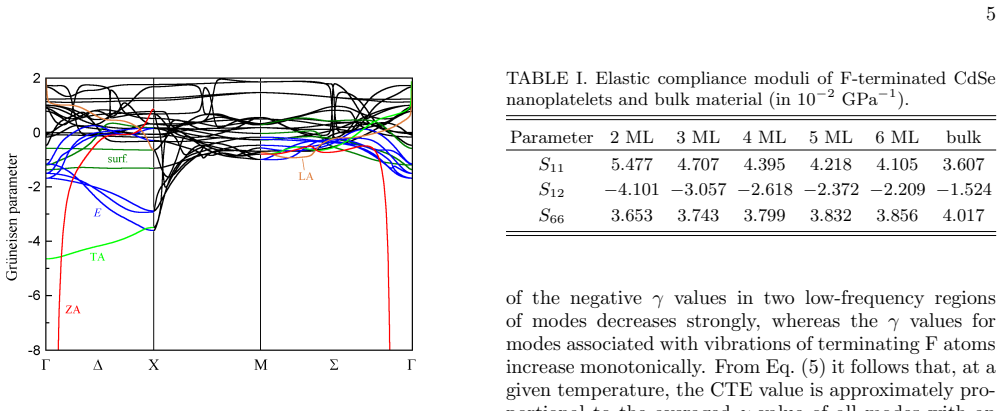
The machinery is the quasiharmonic approximation expressed through the strain-dependent phonon free energy $F(V_0,T)=E_{\mathrm{tot}}(V_0)+F_{\mathrm{vib}}(V_0,T)$, combined with mode-resolved Grüneisen parameters $\gamma_{jq}=-d\ln\omega_{jq}/d\ln a$ for the in-plane lattice parameter. The negative sign of $\gamma$ for selected modes, weighted by the thermal occupation factor $\hbar\omega/kT$, is what converts vibrational entropy into contraction. In the nanoplatelets the load-bearing objects are the ZA flexural mode and the folded acoustic-like E modes whose displacement patterns are in-plane but whose restoring forces come from bending of Cd-Se bonds.
What would settle it
Measure the in-plane thermal expansion of freestanding two-to-five-monolayer zinc-blende CdSe nanoplatelets between 5 and 300 K using electron diffraction or nanomechanical deflection; if the CTE is not negative with magnitude at least as large as the bulk, the central claim fails. Alternatively, run full anharmonic molecular dynamics on the two-monolayer platelet and check whether the predicted whole-range negative expansion survives beyond the quasiharmonic approximation.
Extended reading notes
Core claim
On the paper's own terms, the central discovery is that the large negative in-plane thermal expansion in CdSe nanoplatelets is produced by two cooperating groups of modes: the out-of-plane flexural acoustic ZA mode, common to all quasi-two-dimensional systems, and a set of in-plane-polarized optical E modes plus surface E modes that arise when the transverse-acoustic branch of bulk CdSe folds into the slab Brillouin zone. These folded modes inherit the negative Grüneisen parameter of the bulk TA phonon, and the paper reports that this is the first time negative Grüneisen parameters are found for in-plane-polarized optical modes in a quasi-2D system. The same folding mechanism is then checked in twelve two-layer systems, and in-plane optical modes with negative gamma appear in nearly all of them, suggesting the effect is generic for multilayer quasi-2D materials with strong interlayer interaction.
Load-bearing premise
The load-bearing premise is that each phonon mode remains harmonic at every strain state, so all anharmonicity is captured by the strain dependence of mode frequencies; for two-monolayer platelets with large out-of-plane flexural displacements this could miss genuine anharmonic renormalization.
Editorial extensions
If this is right
- Freestanding CdSe nanoplatelets with 2-5 monolayers should contract in-plane on heating across a wide temperature range, most strongly for the thinnest platelets.
- Thermal expansion contributes no more than about $+1.2\times10^{-5}$ eV/K to $dE_g/dT$ at 300 K, so the large negative band-gap shift seen in CdSe nanoparticles must come from electron-phonon coupling.
- Negative Grüneisen parameters for in-plane-polarized optical E modes should appear in most two-layer quasi-2D systems with strong interlayer interaction, including two-layer graphene, BN, SiC, silicene, germanene, blue and black phosphorene, SnS, and TiO$_2$.
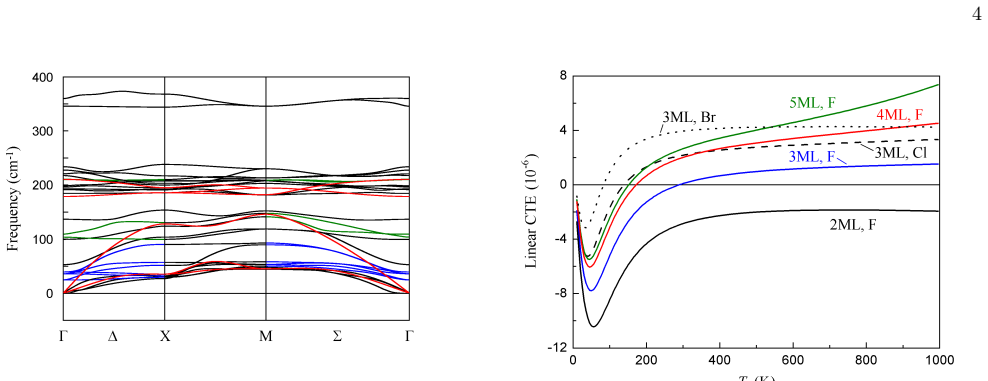
- Heavier halide termination (Cl, Br instead of F) reduces the magnitudes of the negative Grüneisen parameters and shifts the CTE curves, giving a chemical handle on the thermal response.
Reading between the lines
- Because the mechanism is the folding of a bulk TA branch with negative $\gamma$, the same enhanced negative in-plane expansion should occur in other zinc-blende II-VI and III-V nanoplatelets; a first-principles check on CdS, ZnSe, or ZnS would be a direct test.
- The whole-range contraction of the two-monolayer platelet implies its in-plane sound velocities should stiffen anomalously with temperature, an effect measurable by Raman or Brillouin scattering.
- The absence of pressure-induced softening in a system with negative thermal expansion suggests that, in quasi-2D materials, the two effects are not coupled the way they are in framework crystals such as $\mathrm{Zn(CN)}_2$.
- A full anharmonic treatment for the two-monolayer case, where flexural displacements are largest, would reveal whether the predicted negative expansion survives beyond the quasiharmonic approximation.
Signed reviews
Editorial analysis
A structured set of objections, weighed in public.
Referee Report
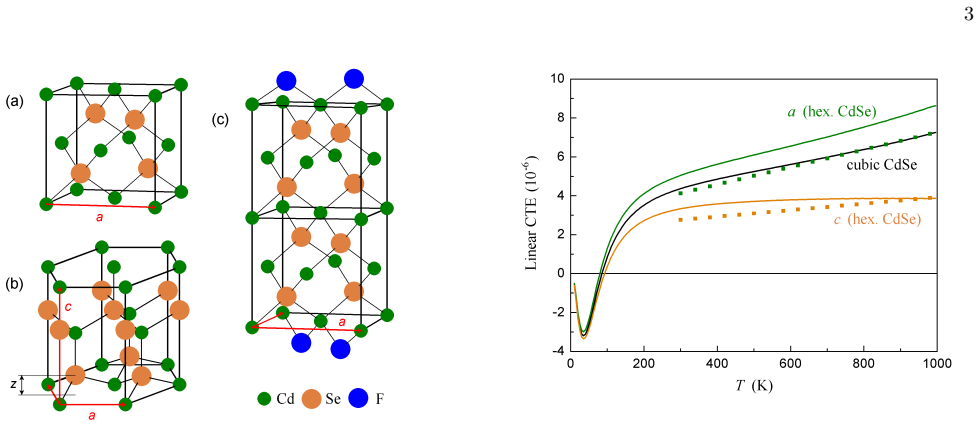
Summary. The paper presents first-principles quasiharmonic (QHA) calculations of the in-plane coefficient of thermal expansion (CTE) for free-standing zinc-blende CdSe nanoplatelets of 2–5 monolayers, using DFT (LDA) with norm-conserving pseudopotentials. It also computes CTE for bulk zinc-blende and wurtzite CdSe and validates the bulk results against experimental data for wurtzite CdSe. The central findings are that nanoplatelets exhibit a significantly larger negative in-plane CTE than bulk CdSe and that the 2 ML platelet remains negatively expanding over the entire 5–1000 K range. The authors attribute the enhanced NTE mainly to the out-of-plane flexural ZA mode and to in-plane optical E modes and surface E modes originating from folding of the bulk TA branch with negative Grüneisen parameters. They further report that in-plane polarized optical modes with negative γ appear in a wide range of two-layer quasi-2D systems, which they argue is a first observation.
Significance. If accepted, the paper provides a parameter-free first-principles prediction of an enhanced negative thermal expansion regime in quasi-2D CdSe, with a clear mode-resolved mechanism. The bulk CTE comparison in Fig. 2 gives confidence in the computational methodology, and the Appendix's survey of twelve two-layer systems makes the claim about negative-γ in-plane optical modes a general and falsifiable statement. The machine-checked details of the phonon interpolation, strain dependence, and effective-stress handling in Appendix B are strengths. The main limitation is that the quantitative nanoplatelet predictions, particularly the all-temperature negative CTE of the 2 ML platelet, rely entirely on QHA without direct validation in the flexural-dominated few-monolayer regime.
major comments (2)
- [Section V, Fig. 4 and Eq. (5)] The load-bearing quantitative claim—that the in-plane CTE of CdSe nanoplatelets appreciably exceeds the bulk magnitude and that the 2 ML platelet remains negatively expanding up to 1000 K—is computed entirely within the quasiharmonic approximation. The QHA assumption stated in Section II (modes remain independent and harmonic at each strain, with anharmonicity entering only through the strain dependence of frequencies) is precisely the weak point for the flexural ZA mode in ultrathin platelets: large out-of-plane displacements drive strong bending-stretching anharmonic coupling, and the paper's own explanation of the 2 ML effect ('the out-of-plane thermal motion of very thin nanoplatelets results in shrinking') is an anharmonic mechanism that QHA does not renormalize. The bulk validation in Fig. 2 does not cover this regime, and no molecular dynamics, self-consistent phonon, or experimental check is provided for nanoplatelets. I recommend that the authors either perform an explicit anharmonic benchmark (e.g., MD or anharmonic perturbation theory) for the 2 ML and 3 ML platelets, or provide a quantitative estimate of how ZA-mode frequency renormalization would alter the sum of Grüneisen parameters that governs the high-temperature CTE. Without this, the magnitude—and potentially the sign at high temperature—of the headline result remains unverified.
- [Section II, Eq. (5) and Section III] The derivation of the CTE connects it to the sum of mode Grüneisen parameters through A0, which is stated as 1/(3B0) in Eq. (5). For the nanoplatelets, the paper later replaces A0 by S11+S12, but the dimensional and notational connection between Eq. (5) and the biaxial stress-strain treatment is not explicit. Please clarify the exact prefactor used for the quasi-2D case and validate it against the standard formula α = (S11+S12) * (∂S_vib/∂T) / A, so that the reader can verify that the 'three times larger' strain-derivative issue mentioned in Section III was properly divided by 3 before solving for uxx(T). If the factor of 1/3 was not applied correctly, all bulk CTE values would be off by a factor of three.
minor comments (5)
- [Section IV, Eq. (5)] In Eq. (5), the quantity A0 is defined as 1/(3B0) but it appears multiplied by 1/V0; please state explicitly whether V0 is the unit-cell volume and whether the final CTE expression is intended as the linear CTE in the cubic case.
- [Table I] For the bulk column, specify that the values correspond to zinc-blende CdSe and describe how the effective-thickness correction described in Appendix B enters the reported compliance values for the nanoplatelets.
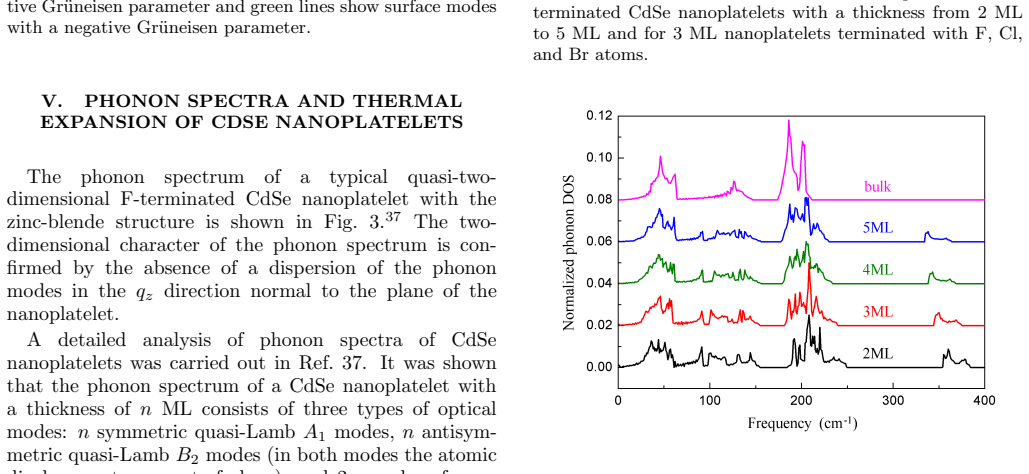
- [Section V, phonon spectra text] The text states that modes with negative γ reach energies up to ~140 cm^{-1} and that this explains the wider NTE temperature range, but no figure or table directly shows this energy range; consider adding a panel in Fig. 6 or a small table listing the negative-γ modes and their energies.
- [Reference [29]] The footnote about LDA for quasi-2D systems is attached to a reference entry; please move it to the main text or rephrase so that the argument for choosing LDA is part of the computational methodology.
- [Section V, Fig. 4] For the Cl- and Br-terminated 3 ML platelets, only the final CTE curves are shown in Fig. 4 with no comment on the differences in the underlying phonon modes beyond the Γ-point frequencies in Table S3; a brief discussion in the text would help the reader connect the mode changes to the CTE evolution.
Circularity Check
No significant circularity: the CTE is computed from first-principles phonon data within QHA, with no fitted parameter renamed as a prediction; self-citations to prior mode analysis are explanatory rather than load-bearing.
full rationale
The paper's central quantity, the in-plane CTE of CdSe nanoplatelets, is obtained by a standard first-principles quasiharmonic calculation. Equations (1)-(3) and (5) define the free energy and CTE directly from DFT total energies and phonon frequencies, and Section III states that phonon frequencies are computed explicitly at several strains for the bulk and nanoplatelet systems. No parameter is fitted to experimental CTE data, and no target quantity is inserted by construction. The bulk CdSe results are checked against independent experimental data (Fig. 2), which provides an external benchmark for the method. The author's prior work (Ref. 37) is cited for the classification of nanoplatelet phonon modes and for the folding argument that identifies low-frequency E modes with bulk TA phonons. This citation is not load-bearing for the numerical CTE result: the current paper independently calculates phonon spectra and Grüneisen parameters for the nanoplatelets (Figs. 3 and 6). The folding argument is used to interpret the calculated negative Grüneisen parameters, not to generate them. No uniqueness theorem is imported from the author's prior work, and no ansatz is smuggled in solely by citation. The acknowledged quasiharmonic approximation, especially for very thin flexural platelets, is a possible accuracy limitation, but it is a stated approximation rather than a definitional equivalence or fitted-input circularity. Overall, the derivation is self-contained and no circular step can be identified from the text.
Assumptions & free parameters
assumptions (5)
- domain assumption Quasiharmonic approximation: phonon modes remain independent and harmonic at each strain, with anharmonicity entering only through the strain dependence of frequencies.
- domain assumption DFT-LDA with norm-conserving pseudopotentials accurately describes CdSe lattice dynamics and energetics.
- domain assumption A 20 Å vacuum gap makes periodic images of nanoplatelets noninteracting.
- standard math Fvib as a function of strain is adequately approximated by a quadratic (bulk) or quadratic form (nanoplatelet) over ±1-2% strain.
- domain assumption The mode projection analysis of Ref 37, by the same author, correctly identifies E modes as folded TA phonons.
Cite this review
Pith. "Pith review of Negative thermal expansion in CdSe quasi-two-dimensional nanoplatelets." pith.science (2026). https://pith.science/paper/UM2SHQ7V
@misc{pith2026190804581,
  author       = {Pith},
  title        = {Pith review of: Negative thermal expansion in CdSe quasi-two-dimensional nanoplatelets},
  year         = {2026},
  howpublished = {\url{https://pith.science/paper/UM2SHQ7V}},
  note         = {Machine review of arXiv:1908.04581}
}
abstract
The in-plane coefficient of thermal expansion (CTE) for CdSe nanoplatelets with the zinc-blende structure containing from two to five monolayers is calculated from first principles within the quasiharmonic approximation. A comparison of the obtained results with those for bulk CdSe with both the zinc-blende and wurtzite structures finds a significant increase in the magnitude of negative CTE and the temperature range of its observation in nanoplatelets. The main contribution to the negative thermal expansion in CdSe nanoplatelets is given by the out-of-plane flexural ZA mode and in-plane optical $E$ modes that arise from the folding of TA phonon of bulk CdSe.
Figures
Figures from the paper (1 more)
Reference graph
Works this paper leans on
-
[1]
author author A. Olkhovets , author R.-C. \ Hsu , author A. Lipovskii , \ and\ author F. W. \ Wise ,\ 10.1103/PhysRevLett.81.3539 journal journal Phys. Rev. Lett. \ volume 81 ,\ pages 3539 ( year 1998 ) NoStop
-
[2]
author author Q. Dai , author Y. Song , author D. Li , author H. Chen , author S. Kan , author B. Zou , author Y. Wang , author Y. Deng , author Y. Hou , author S. Yu , author L. Chen , author B. Liu , \ and\ author G. Zou ,\ 10.1016/j.cplett.2007.03.034 journal journal Chem. Phys. Lett. \ volume 439 ,\ pages 65 ( year 2007 ) NoStop
-
[3]
author author B. Pejova , author B. Abay , \ and\ author I. Bineva ,\ 10.1021/jp102773z journal journal J. Phys. Chem. C \ volume 114 ,\ pages 15280 ( year 2010 ) NoStop
-
[4]
author author A. Al Salman , author A. Tortschanoff , author M. B. \ Mohamed , author D. Tonti , author F. van Mourik , \ and\ author M. Chergui ,\ 10.1063/1.2696687 journal journal Appl. Phys. Lett. \ volume 90 ,\ pages 093104 ( year 2007 ) NoStop
-
[5]
author author R. B. \ Vasiliev , author A. I. \ Lebedev , author E. P. \ Lazareva , author N. N. \ Shlenskaya , author V. B. \ Zaytsev , author A. G. \ Vitukhnovsky , author Y. Yao , \ and\ author K. Sakoda ,\ 10.1103/PhysRevB.95.165414 journal journal Phys. Rev. B \ volume 95 ,\ pages 165414 ( year 2017 ) NoStop
-
[6]
author author H. Iwanaga , author A. Kunishige , \ and\ author S. Takeuchi ,\ 10.1023/A:1004709500331 journal journal J. Mater. Sci. \ volume 35 ,\ pages 2451 ( year 2000 ) NoStop
-
[7]
author author D. Berlincourt , author H. Jaffe , \ and\ author L. R. \ Shiozawa ,\ 10.1103/PhysRev.129.1009 journal journal Phys. Rev. \ volume 129 ,\ pages 1009 ( year 1963 ) NoStop
-
[8]
author author Y. S. \ Touloukian , author R. K. \ Kirby , author R. E. \ Taylor , \ and\ author T. Y. R. \ Lee ,\ @noop title Thermophysical Properties of Matter --- the TPRC Data Series ,\ Vol. volume 13 \ ( publisher IFI/Plenum ,\ year 1977 )\ pp.\ pages 1185--1186 NoStop
work page 1977
Show all 42 references
-
[9]
author author R. R. \ Reeber ,\ title Low temperature thermal expansion of wurtzite phases of IIB-VIB compounds ,\ @noop Ph.D. thesis ,\ school Ohio State University ( year 1968 ) NoStop
1968
-
[10]
Ithurria \ and\ author B
author author S. Ithurria \ and\ author B. Dubertret ,\ 10.1021/ja807724e journal journal J. Am. Chem. Soc. \ volume 130 ,\ pages 16504 ( year 2008 ) NoStop
2008 doi
-
[11]
author author J. S. \ Son , author X.-D. \ Wen , author J. Joo , author J. Chae , author S.-i. \ Baek , author K. Park , author J. H. \ Kim , author K. An , author J. H. \ Yu , author S. G. \ Kwon , author S.-H. \ Choi , author Z. Wang , author Y.-W. \ Kim , author Y. Kuk , au...
-
[12]
\ Tan , author Y
author author J.-J. \ Tan , author Y. Cheng , author W.-J. \ Zhu , \ and\ author Q.-Q. \ Gou ,\ 10.1088/0253-6102/50/1/42 journal journal Commun. Theor. Phys. \ volume 50 ,\ pages 220 ( year 2008 ) NoStop
2008 doi
-
[13]
Ouendadji , author S
author author S. Ouendadji , author S. Ghemid , author H. Meradji , \ and\ author F. H. \ Hassan ,\ 10.1016/j.commatsci.2010.11.035 journal journal Comput. Mater. Sci. \ volume 50 ,\ pages 1460 ( year 2011 ) NoStop
2010 doi
-
[14]
Mounet \ and\ author N
author author N. Mounet \ and\ author N. Marzari ,\ 10.1103/PhysRevB.71.205214 journal journal Phys. Rev. B \ volume 71 ,\ pages 205214 ( year 2005 ) NoStop
2005 doi
-
[15]
Sevik ,\ 10.1103/PhysRevB.89.035422 journal journal Phys
author author C. Sevik ,\ 10.1103/PhysRevB.89.035422 journal journal Phys. Rev. B \ volume 89 ,\ pages 035422 ( year 2014 ) NoStop
2014 doi
-
[16]
\ Jiang , author B.-S
author author J.-W. \ Jiang , author B.-S. \ Wang , author J.-S. \ Wang , \ and\ author H. S. \ Park ,\ 10.1088/0953-8984/27/8/083001 journal journal J. Phys.: Condens. Matter \ volume 27 ,\ pages 083001 ( year 2015 ) NoStop
2015 doi
-
[17]
Mann , author R
author author S. Mann , author R. Kumar , \ and\ author V. K. \ Jindal ,\ 10.1039/c7ra01591g journal journal RSC Adv. \ volume 7 ,\ pages 22378 ( year 2017 ) NoStop
2017 doi
-
[18]
author author L. F. \ Huang , author P. L. \ Gong , \ and\ author Z. Zeng ,\ 10.1103/PhysRevB.90.045409 journal journal Phys. Rev. B \ volume 90 ,\ pages 045409 ( year 2014 ) NoStop
2014 doi
-
[19]
\ Wang , author Y.-L
author author Z.-Y. \ Wang , author Y.-L. \ Zhou , author X.-Q. \ Wang , author F. Wang , author Q. Sun , author Z.-X. \ Guo , \ and\ author Y. Jia ,\ 10.1088/1674-1056/24/2/026501 journal journal Chin. Phys. B \ volume 24 ,\ pages 026501 ( year 2015 ) NoStop
-
[20]
Aierken , author D
author author Y. Aierken , author D. C akir , author C. Sevik , \ and\ author F. M. \ Peeters ,\ 10.1103/PhysRevB.92.081408 journal journal Phys. Rev. B \ volume 92 ,\ pages 081408(R) ( year 2015 ) NoStop
2015 doi
-
[21]
\ Ge , author K.-L
author author X.-J. \ Ge , author K.-L. \ Yao , \ and\ author J.-T. \ L \"u ,\ 10.1103/PhysRevB.94.165433 journal journal Phys. Rev. B \ volume 94 ,\ pages 165433 ( year 2016 ) NoStop
2016 doi
-
[22]
Sun , author G
author author H. Sun , author G. Liu , author Q. Li , \ and\ author X. Wan ,\ 10.1016/j.physleta.2016.04.021 journal journal Phys. Lett. A \ volume 380 ,\ pages 2098 ( year 2016 ) NoStop
2016 doi
-
[23]
author author P. K. \ Schelling \ and\ author P. Keblinski ,\ 10.1103/PhysRevB.68.035425 journal journal Phys. Rev. B \ volume 68 ,\ pages 035425 ( year 2003 ) NoStop
2003 doi
-
[24]
author author K. V. \ Zakharchenko , author M. I. \ Katsnelson , \ and\ author A. Fasolino ,\ 10.1103/PhysRevLett.102.046808 journal journal Phys. Rev. Lett. \ volume 102 ,\ pages 046808 ( year 2009 ) NoStop
2009 doi
-
[25]
Pozzo , author D
author author M. Pozzo , author D. Alf\`e , author P. Lacovig , author P. Hofmann , author S. Lizzit , \ and\ author A. Baraldi ,\ 10.1103/PhysRevLett.106.135501 journal journal Phys. Rev. Lett. \ volume 106 ,\ pages 135501 ( year 2011 ) NoStop
-
[26]
author author G. J. \ Slotman \ and\ author A. Fasolino ,\ 10.1088/0953-8984/25/4/045009 journal journal J. Phys.: Condens. Matter \ volume 25 ,\ pages 045009 ( year 2013 ) NoStop
2013 doi
-
[27]
author author S. Q. \ Wang ,\ 10.1063/1.2172145 journal journal Appl. Phys. Lett. \ volume 88 ,\ pages 061902 ( year 2006 ) NoStop
2006 doi
-
[28]
author author A. M. \ Rappe , author K. M. \ Rabe , author E. Kaxiras , \ and\ author J. D. \ Joannopoulos ,\ 10.1103/PhysRevB.41.1227 journal journal Phys. Rev. B \ volume 41 ,\ pages 1227 ( year 1990 ) NoStop
1990 doi
-
[29]
PhysRevLett.96.136404 Earlier, we used LDA when studying ferroelectric and piezoelectric properties of SnS mono- and multilayers
note For quasi-2D systems, the LDA approximation was shown to provide better results as compared to the GGA one. PhysRevLett.96.136404 Earlier, we used LDA when studying ferroelectric and piezoelectric properties of SnS mono- and multilayers. JApplPhys.124.164302 NoStop
-
[30]
author author O. H. \ Nielsen \ and\ author R. M. \ Martin ,\ 10.1103/PhysRevB.32.3792 journal journal Phys. Rev. B \ volume 32 ,\ pages 3792 ( year 1985 ) NoStop
1985 doi
-
[31]
author author D. F. \ Gibbons ,\ 10.1103/PhysRev.112.136 journal journal Phys. Rev. \ volume 112 ,\ pages 136 ( year 1958 ) NoStop
1958 doi
-
[32]
author author P. W. \ Sparks \ and\ author C. A. \ Swenson ,\ 10.1103/PhysRev.163.779 journal journal Phys. Rev. \ volume 163 ,\ pages 779 ( year 1967 ) NoStop
1967 doi
-
[33]
author author R. R. \ Reeber \ and\ author B. A. \ Kulp ,\ @noop journal journal Trans. AIME \ volume 233 ,\ pages 698 ( year 1965 ) NoStop
1965
-
[34]
Ibach ,\ 10.1002/pssb.19690330124 journal journal Phys
author author H. Ibach ,\ 10.1002/pssb.19690330124 journal journal Phys. Status Solidi B \ volume 33 ,\ pages 257 ( year 1969 ) NoStop
1969 doi
-
[35]
author author C. H. \ Xu , author C. Z. \ Wang , author C. T. \ Chan , \ and\ author K. M. \ Ho ,\ 10.1103/PhysRevB.43.5024 journal journal Phys. Rev. B \ volume 43 ,\ pages 5024 ( year 1991 ) NoStop
1991 doi
-
[36]
Wang , author F
author author Z. Wang , author F. Wang , author L. Wang , author Y. Jia , \ and\ author Q. Sun ,\ 10.1063/1.4817902 journal journal J. Appl. Phys. \ volume 114 ,\ pages 063508 ( year 2013 ) NoStop
2013 doi
-
[37]
author author A. I. \ Lebedev ,\ 10.1103/PhysRevB.96.184306 journal journal Phys. Rev. B \ volume 96 ,\ pages 184306 ( year 2017 ) NoStop
2017 doi
-
[38]
D'Souza \ and\ author S
author author R. D'Souza \ and\ author S. Mukherjee ,\ 10.1103/PhysRevB.95.085435 journal journal Phys. Rev. B \ volume 95 ,\ pages 085435 ( year 2017 ) NoStop
2017 doi
-
[39]
Fang \ and\ author M
author author H. Fang \ and\ author M. T. \ Dove ,\ 10.1103/PhysRevB.87.214109 journal journal Phys. Rev. B \ volume 87 ,\ pages 214109 ( year 2013 ) NoStop
2013 doi
-
[40]
Fang , author M
author author H. Fang , author M. T. \ Dove , author L. H. N. \ Rimmer , \ and\ author A. J. \ Misquitta ,\ 10.1103/PhysRevB.88.104306 journal journal Phys. Rev. B \ volume 88 ,\ pages 104306 ( year 2013 ) NoStop
2013 doi
-
[41]
Marini , author P
author author A. Marini , author P. Garc \'i a-Gonz \'a lez , \ and\ author A. Rubio ,\ 10.1103/PhysRevLett.96.136404 journal journal Phys. Rev. Lett. \ volume 96 ,\ pages 136404 ( year 2006 ) NoStop
2006 doi
-
[42]
author author A. I. \ Lebedev ,\ 10.1063/1.5035419 journal journal J. Appl. Phys. \ volume 124 ,\ pages 164302 ( year 2018 ) NoStop
2018 doi
Reviewed August 14, 2026 · model on record in the stance chip above.
Discussion (0). Continue with ORCID to comment.