Hierarchy of mixed symmetry protected topological states in extended cluster states under subsystem decoherence
Pith reviewed 2026-06-26 10:26 UTC · model grok-4.3
The pith
Subsystem decoherence on extended cluster states produces a hierarchy of mixed SPT phases that ends in a glassy GHZ state.
A machine-rendered reading of the paper's core claim, the machinery that carries it, and where it could break.
Core claim
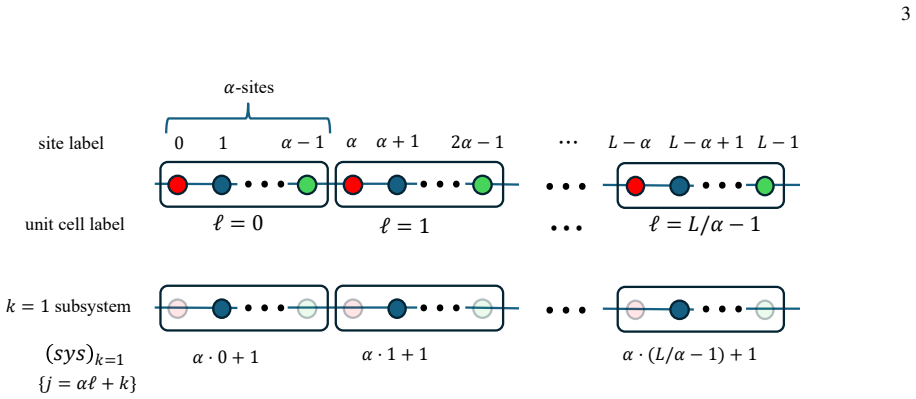
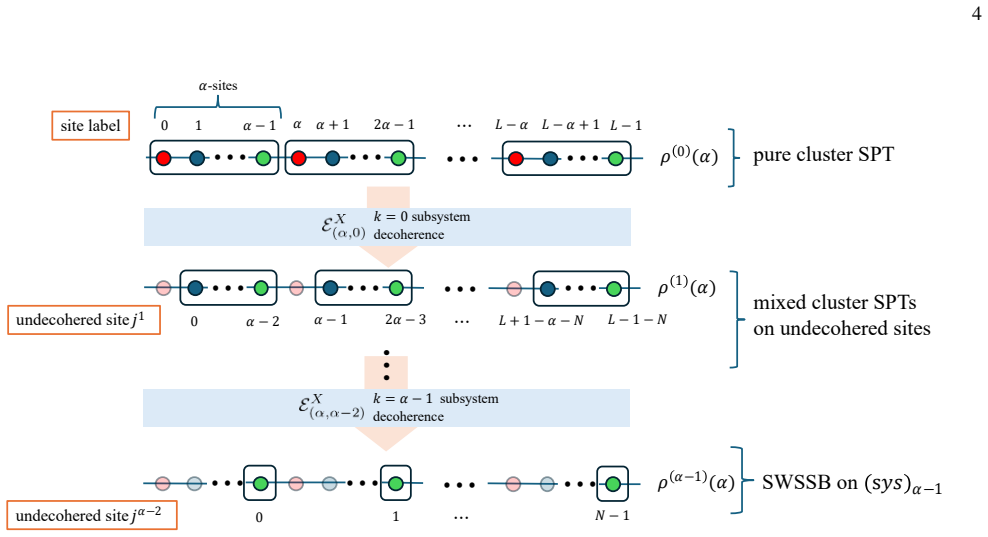
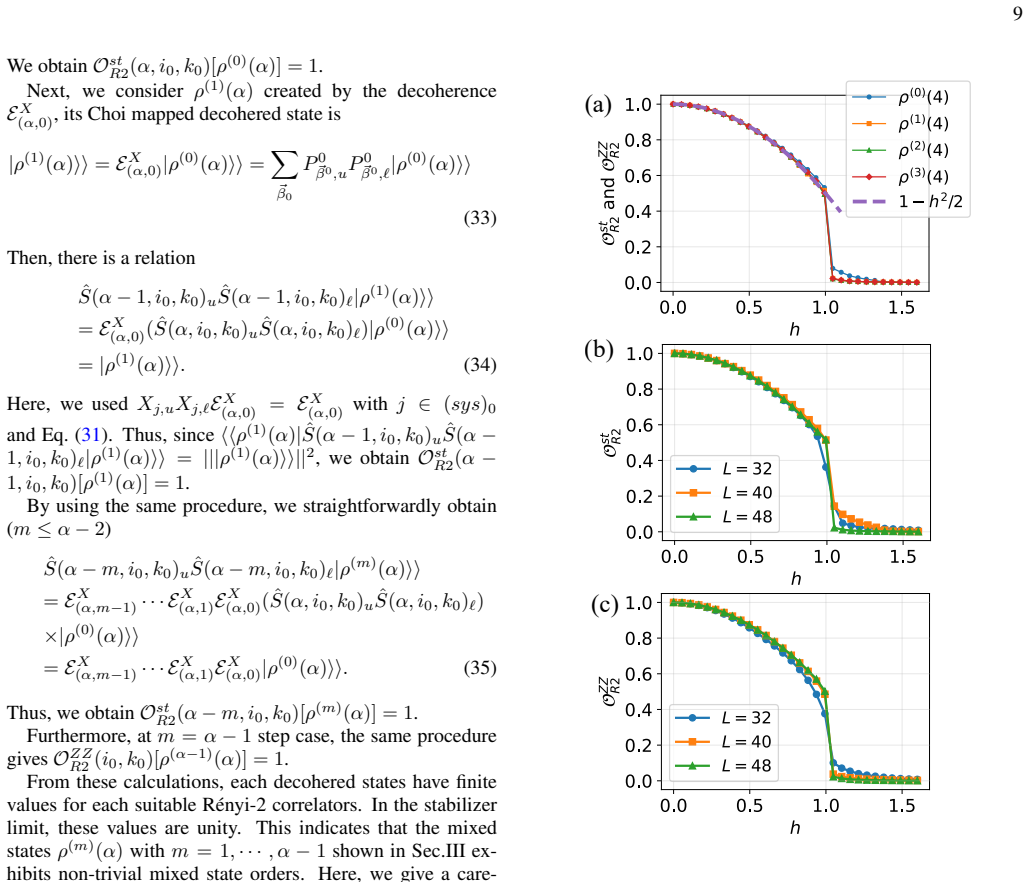
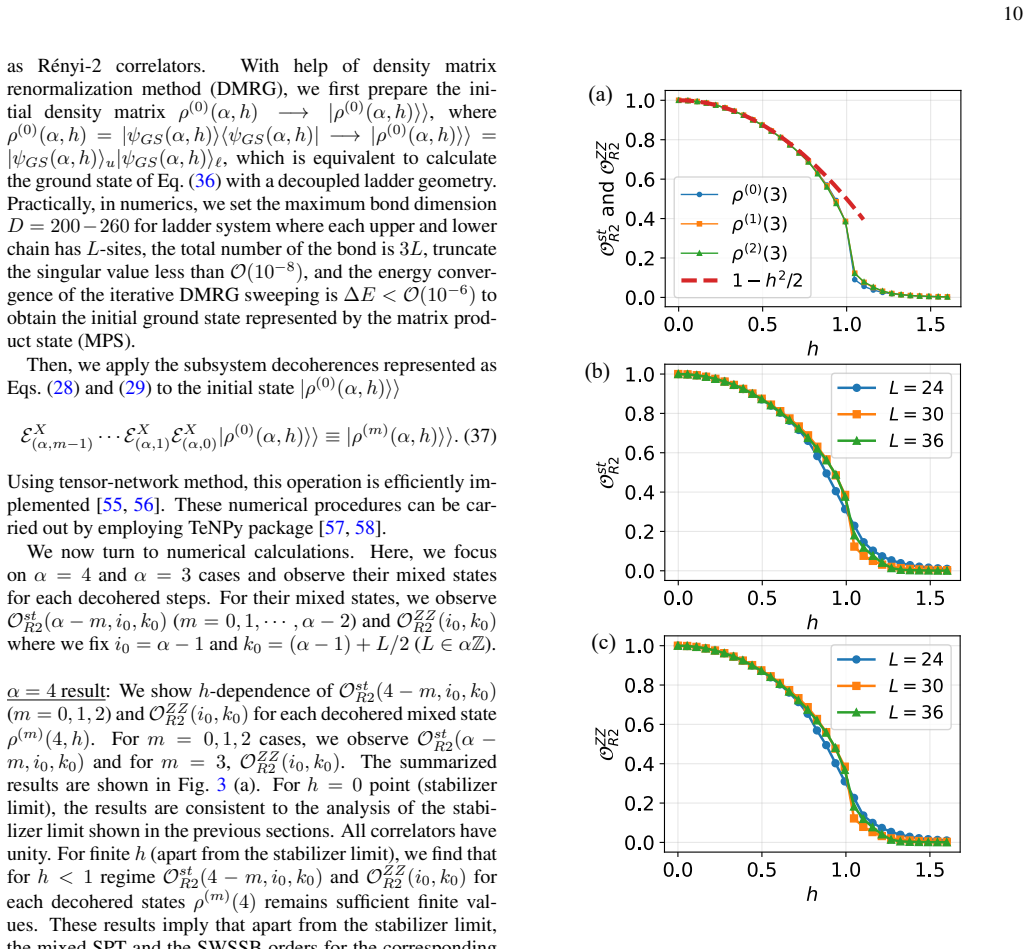
Starting from the extended cluster state, step-by-step subsystem decoherences generate hierarchical mixed-state SPT phases that keep the strong symmetries protecting the initial cluster SPT and are characterized by Rényi-2 string orders; the hierarchy terminates in a Z2 SWSSB state on the final subsystem that hosts a glassy GHZ long-range entangled state.
What carries the argument
The extended cluster state model with its multiple independent subsystem Z2 symmetries, whose protection survives partial decoherence and is diagnosed by Rényi-2 string orders in the resulting mixed states.
Load-bearing premise
The extended cluster state possesses multiple independent subsystem Z2 symmetries whose protection survives partial subsystem decoherence and can be diagnosed by Rényi-2 string orders in the resulting mixed states.
What would settle it
Measure Rényi-2 string order parameters after decohering one or more but not all subsystems and check whether they remain nonzero while the final single-subsystem state shows long-range glassy GHZ correlations without full strong symmetry protection.
Figures
read the original abstract
We study the effect of subsystem decoherence to an extended cluster state which is a symmetry protected topological (SPT) phase. The model includes many subsystem $Z_2$ symmetries. We report that subsystem decoherence induces local charge fluctuations, leading to a mixed SPT state in the unaffected subsystems. If we start from the extended cluster state, hierarchical mixed-state SPT phases emerge in response to step-by-step subsystem decoherences. These mixed-state SPT phases keep strong symmetries the symmetry of which is protecting symmetries for the initial cluster SPT. Moreover, these SPTs can be characterized by R\'{e}nyi-2 string orders. Then, as the subsystems are progressively decohered, the hierarchy of mixed-state SPT phases terminates in a $Z_2$ strong-to-weak spontaneous symmetry breaking (SWSSB) state on the final remaining subsystem, where a long-range entangled state appears, namely a glassy Greenberger-Horne-Zeilinger (GHZ) state. Our work demonstrates that decoherence is not merely a destructive process, but can induce and organize series of nontrivial mixed-states. This reveals a systematic route from mixed-state SPT order to SWSSB with the glassy GHZ-type long-range entanglement.
Editorial analysis
A structured set of objections, weighed in public.
Referee Report
Summary. The manuscript examines subsystem decoherence applied to an extended cluster state that realizes an SPT phase protected by multiple independent subsystem Z2 symmetries. It claims that progressive decoherence on individual subsystems induces local charge fluctuations while preserving mixed-state SPT order on the remaining subsystems, diagnosed via Rényi-2 string orders; these phases form a hierarchy that terminates in a Z2 strong-to-weak spontaneous symmetry breaking (SWSSB) phase on the final subsystem, hosting a glassy GHZ state with long-range entanglement. The work concludes that decoherence can constructively organize nontrivial mixed states rather than only destroy order.
Significance. If the central claims are verified by explicit calculations, the result would establish a concrete route from pure-state cluster SPT order through a sequence of mixed-state SPT phases to SWSSB with glassy long-range entanglement, offering a systematic example of how partial decoherence can reorganize symmetry-protected order in open systems. This would be of interest to the mixed-state topology community provided the Rényi-2 diagnostics remain robust.
major comments (2)
- [Abstract] Abstract: the assertion that Rényi-2 string orders continue to diagnose protected mixed SPT order after partial subsystem decoherence is load-bearing for the hierarchy claim, yet no explicit reduced density matrix, partial trace, or correlator calculation is referenced; the stress-test concern that local charge fluctuations may damp or average the string order therefore remains unaddressed and must be resolved with concrete expressions for the Rényi-2 correlator on the undecohereed subsystems.
- [Abstract] Abstract: the termination of the hierarchy in a Z2 SWSSB phase hosting a 'glassy GHZ state' is presented as the endpoint, but the manuscript provides no derivation showing how the final reduced state acquires long-range entanglement or why the symmetry breaking is strong-to-weak rather than conventional; this step is central to the reported route from mixed SPT to SWSSB and requires an explicit density-matrix argument or order-parameter calculation.
Simulated Author's Rebuttal
We thank the referee for their thorough review and valuable comments on our manuscript. We address each major comment below and will incorporate the suggested clarifications in the revised version.
read point-by-point responses
-
Referee: [Abstract] Abstract: the assertion that Rényi-2 string orders continue to diagnose protected mixed SPT order after partial subsystem decoherence is load-bearing for the hierarchy claim, yet no explicit reduced density matrix, partial trace, or correlator calculation is referenced; the stress-test concern that local charge fluctuations may damp or average the string order therefore remains unaddressed and must be resolved with concrete expressions for the Rényi-2 correlator on the undecohereed subsystems.
Authors: We appreciate the referee highlighting the need for explicit verification. The manuscript derives the preservation of Rényi-2 string orders under subsystem decoherence, but we acknowledge that more detailed expressions for the reduced density matrices and partial traces would better address concerns about damping by local charge fluctuations. In the revised manuscript, we will add explicit calculations of the Rényi-2 correlators on the undecohereed subsystems, showing that the string order parameters remain finite and protected by the remaining symmetries. revision: yes
-
Referee: [Abstract] Abstract: the termination of the hierarchy in a Z2 SWSSB phase hosting a 'glassy GHZ state' is presented as the endpoint, but the manuscript provides no derivation showing how the final reduced state acquires long-range entanglement or why the symmetry breaking is strong-to-weak rather than conventional; this step is central to the reported route from mixed SPT to SWSSB and requires an explicit density-matrix argument or order-parameter calculation.
Authors: We thank the referee for this observation. The manuscript characterizes the final phase as Z2 SWSSB with a glassy GHZ state based on the symmetry analysis and entanglement properties, but we agree that an explicit density matrix derivation would strengthen the claim. We will include in the revision a detailed calculation of the reduced density matrix for the final subsystem, demonstrating the long-range entanglement characteristic of the glassy GHZ state and explaining the strong-to-weak symmetry breaking distinction from conventional SSB. revision: yes
Circularity Check
No significant circularity; derivation rests on direct model analysis
full rationale
The paper reports results from explicit consideration of subsystem decoherence applied to an extended cluster state possessing multiple independent Z2 symmetries. Hierarchical mixed SPT phases are stated to emerge under progressive decoherence and are characterized via Rényi-2 string orders, terminating in a glassy GHZ-type SWSSB state. No quoted equations or steps reduce any claimed order parameter, phase, or diagnostic to a fitted input, self-definition, or load-bearing self-citation chain; the abstract and description indicate model-specific calculations of density matrices and correlators. This matches the default expectation that most papers contain no circularity, with the provided text showing self-contained theoretical steps.
Axiom & Free-Parameter Ledger
axioms (1)
- domain assumption The extended cluster state possesses multiple independent subsystem Z2 symmetries that protect the initial SPT order.
invented entities (1)
-
glassy GHZ state
no independent evidence
Reference graph
Works this paper leans on
-
[1]
B. Zeng, X. Chen, D.-L. Zhou, and X.-G. Wen, Quantum information meets quantum matter – from quantum entan- glement to topological phase in many-body systems (2018), arXiv:1508.02595 [cond-mat.str-el]
Pith/arXiv arXiv 2018
-
[2]
Wang, Strong-to-weak spontaneous symmetry breaking (2026), arXiv:2606.02555 [quant-ph]
C. Wang, Strong-to-weak spontaneous symmetry breaking (2026), arXiv:2606.02555 [quant-ph]
Pith/arXiv arXiv 2026
-
[3]
Bu ˇca and T
B. Bu ˇca and T. Prosen, New J. of Phys.14, 073007 (2012)
2012
-
[4]
de Groot, A
C. de Groot, A. Turzillo, and N. Schuch, Quantum6, 856 (2022)
2022
-
[5]
Ma and C
R. Ma and C. Wang, Phys. Rev. X13, 031016 (2023)
2023
-
[6]
Ma, J.-H
R. Ma, J.-H. Zhang, Z. Bi, M. Cheng, and C. Wang, Phys. Rev. X15, 021062 (2025)
2025
-
[7]
J. Y . Lee, Y .-Z. You, and C. Xu, Quantum9, 1607 (2025)
2025
-
[8]
Ma and A
R. Ma and A. Turzillo, PRX Quantum6, 010348 (2025)
2025
-
[9]
Y . Guo, K. Ding, and S. Yang, Reports on Progress in Physics 88, 118001 (2025)
2025
-
[10]
Guo and S
Y . Guo and S. Yang, Phys. Rev. B111, L201108 (2025)
2025
-
[11]
Guo and Y
Y . Guo and Y . Ashida, Phys. Rev. B109, 195420 (2024)
2024
-
[12]
R. Fan, Y . Bao, E. Altman, and A. Vishwanath, PRX Quantum 5, 10.1103/prxquantum.5.020343 (2024)
-
[13]
Y . Kuno, T. Orito, and I. Ichinose, Phys. Rev. B111, 064111 (2025)
2025
-
[14]
T. D. Ellison and M. Cheng, PRX Quantum6, 010315 (2025)
2025
-
[15]
Sohal and A
R. Sohal and A. Prem, PRX Quantum6, 010313 (2025)
2025
-
[16]
Zhang, Y
C. Zhang, Y . Xu, J.-H. Zhang, C. Xu, Z. Bi, and Z.-X. Luo, Phys. Rev. B111, 115137 (2025)
2025
-
[17]
Z. Wang, Z. Wu, and Z. Wang, PRX Quantum6, 010314 (2025)
2025
-
[18]
K. Kataoka, Y . Kuno, T. Orito, and I. Ichinose, Decohered color code and emerging mixed toric code by anyon prolifer- ation: Topological entanglement negativity perspective (2026), arXiv:2604.22521 [quant-ph]
Pith/arXiv arXiv 2026
- [19]
-
[20]
J. Y . Lee, C.-M. Jian, and C. Xu, Phys. Rev. X Quantum4, 030317 (2023)
2023
-
[21]
L. A. Lessa, R. Ma, J.-H. Zhang, Z. Bi, M. Cheng, and C. Wang, PRX Quantum6, 010344 (2025)
2025
-
[22]
P. Sala, S. Gopalakrishnan, M. Oshikawa, and Y . You, Phys. Rev. B110, 155150 (2024)
2024
-
[23]
Y . Kuno, T. Orito, and I. Ichinose, Phys. Rev. B110, 094106 (2024)
2024
-
[24]
L. Chen, N. Sun, and P. Zhang, Phys. Rev. B111, L060304 (2025)
2025
-
[25]
Y . Guo, S. Yang, and X.-J. Yu, PRX Quantum6, 040311 (2025)
2025
-
[26]
H.-H. Teh and T. Orito, Krylov complexity and mixed-state phase transition (2026), arXiv:2510.22542 [quant-ph]
Pith/arXiv arXiv 2026
-
[27]
T. Haga, M. Kunimi, and M. Nakagawa, Discontinuous strong- to-weak symmetry breaking transition from thermal pure states (2026), arXiv:2606.15062 [quant-ph]
arXiv 2026
-
[28]
Weinstein, Phys
Z. Weinstein, Phys. Rev. Lett.134, 150405 (2025)
2025
-
[29]
S. Wang, T. G. Kiely, D. Tell, J. Obermeyer, M. Barendregt, P. Bojovi´c, P. M. Preiss, A. Sarma, T. Franz, M. P. A. Fisher, C. Xu, and I. Bloch, Observation of strong-to-weak sponta- neous symmetry breaking in a dephased fermi gas (2026), arXiv:2604.16137 [cond-mat.quant-gas]
Pith/arXiv arXiv 2026
-
[30]
R. Raussendorf, S. Bravyi, and J. Harrington, Physical Review A71, 062313 (2005), arXiv:quant-ph/0407255 [quant-ph]
Pith/arXiv arXiv 2005
-
[31]
R. Verresen, N. Tantivasadakarn, and A. Vishwanath, Effi- ciently preparing schr ¨odinger’s cat, fractons and non-abelian topological order in quantum devices (2022), arXiv:2112.03061 [quant-ph]
arXiv 2022
-
[32]
Tantivasadakarn, R
N. Tantivasadakarn, R. Thorngren, A. Vishwanath, and R. Ver- resen, Phys. Rev. X14, 021040 (2024)
2024
-
[33]
T.-C. Lu, Z. Zhang, S. Vijay, and T. H. Hsieh, PRX Quantum4, 030318 (2023), arXiv:2303.15507 [quant-ph]
arXiv 2023
-
[34]
Y . Kuno, T. Orito, and I. Ichinose, Phys. Rev. B110, 014110 (2024)
2024
-
[35]
S. Lu, L. Q. Silveira, and Y . You, Nonequilibrium topologi- cal response under charge dephasing (2026), arXiv:2602.23484 [cond-mat.str-el]
arXiv 2026
-
[36]
Suzuki, Progress of Theoretical Physics46, 1337 (1971)
M. Suzuki, Progress of Theoretical Physics46, 1337 (1971)
1971
-
[37]
S. O. Skrøvseth and S. D. Bartlett, Physical Review A80, 022316 (2009)
2009
-
[38]
Smacchia, L
P. Smacchia, L. Amico, P. Facchi, R. Fazio, G. Florio, S. Pas- cazio, and V . Vedral, Phys. Rev. A84, 022304 (2011)
2011
-
[39]
S. M. Giampaolo and B. C. Hiesmayr, Physical Review A92, 012306 (2015)
2015
-
[40]
Lahtinen and E
V . Lahtinen and E. Ardonne, Physical Review Letters115, 237203 (2015)
2015
-
[41]
M. A. Nielsen and I. L. Chuang, Quantum Computation and Quantum Information, 10th ed. (Cambridge University Press, Cambridge, 2010)
2010
-
[42]
Morral-Yepes, F
R. Morral-Yepes, F. Pollmann, and I. Lovas, Phys. Rev. B108, 224304 (2023)
2023
-
[43]
Verresen, R
R. Verresen, R. Moessner, and F. Pollmann, Phys. Rev. B96, 165124 (2017)
2017
-
[44]
W. Son, L. Amico, R. Fazio, A. Hamma, S. Pascazio, and V . Ve- dral, Europhysics Letters95, 50001 (2011)
2011
-
[45]
Klocke and M
K. Klocke and M. Buchhold, Physical Review B106, 104307 (2022)
2022
-
[46]
D. Gottesman, The heisenberg representation of quantum com- puters (1998), expanded version of a plenary speech at the 1998 International Conference on Group Theoretical Methods in Physics, arXiv:quant-ph/9807006 [quant-ph]
Pith/arXiv arXiv 1998
-
[47]
S. Aaronson and D. Gottesman, Physical Review A70, 052328 (2004), arXiv:quant-ph/0406196 [quant-ph]
Pith/arXiv arXiv 2004
-
[48]
M. A. Nielsen and I. L. Chuang, Quantum Computation and Quantum Information, 10th ed. (Cambridge University Press, USA, 2011)
2011
-
[49]
Kliesch, T
M. Kliesch, T. Barthel, C. Gogolin, M. Kastoryano, and J. Eis- ert, Phys. Rev. Lett.107, 120501 (2011)
2011
-
[50]
An, J.-P
D. An, J.-P. Liu, and L. Lin, Phys. Rev. Lett.131, 150603 (2023)
2023
-
[51]
Lee and E.-G
S. Lee and E.-G. Moon, Phys. Rev. B112, L161121 (2025)
2025
-
[52]
T. Ando, S. Ryu, and M. Watanabe, Phys. Rev. B113, 115106 (2026)
2026
-
[53]
Choi, Lin
M.-D. Choi, Lin. Alg. Appl.10, 285 (1975)
1975
-
[54]
Jamiołkowski, Rep
A. Jamiołkowski, Rep. Math. Phys.3, 275 (1972)
1972
-
[55]
Orito, Y
T. Orito, Y . Kuno, and I. Ichinose, Phys. Rev. B111, 054106 (2025)
2025
-
[56]
Y . Kuno, T. Orito, and I. Ichinose, Phys. Rev. B111, 174110 (2025)
2025
-
[57]
Hauschild and F
J. Hauschild and F. Pollmann, SciPost Phys. Lect. Notes , 5 (2018)
2018
-
[58]
Hauschild, J
J. Hauschild, J. Unfried, S. Anand, B. Andrews, M. Bintz, U. Borla, S. Divic, M. Drescher, J. Geiger, M. Hefel, K. H ´emery, W. Kadow, J. Kemp, N. Kirchner, V . S. Liu, G. M ¨oller, D. Parker, M. Rader, A. Romen, S. Scalet, L. Schoonderwoerd, M. Schulz, T. Soejima, P. Thoma, Y . Wu, P. Zechmann, L. Zweng, R. S. K. Mong, M. P. Zaletel, and F. Pollmann, Sci...
2024
-
[59]
While it may play some role, we leave it as a future problem
For simplicity, we don’t take into account the role of logical 16 operator explicitly. While it may play some role, we leave it as a future problem
-
[60]
McGreevy, Annual Review of Condensed Matter Physics14, 57–82 (2023)
J. McGreevy, Annual Review of Condensed Matter Physics14, 57–82 (2023)
2023
-
[61]
Raussendorf and H
R. Raussendorf and H. J. Briegel, Phys. Rev. Lett.86, 5188 (2001)
2001
-
[62]
Tantivasadakarn, R
N. Tantivasadakarn, R. Thorngren, A. Vishwanath, and R. Ver- resen, SciPost Physics14, 012 (2023)
2023
-
[63]
Bu ˇca and T
B. Bu ˇca and T. Prosen, New Journal of Physics14, 073007 (2012)
2012
-
[64]
D. A. Lidar, Lecture notes on the theory of open quantum sys- tems (2020), arXiv:1902.00967 [quant-ph]
arXiv 2020
discussion (0)
Sign in with ORCID, Apple, or X to comment. Anyone can read and Pith papers without signing in.