REVIEW 4 major objections 5 minor 52 references
Bi-Sparse Unsupervised Feature Selection
T0 review · 4 major / 5 minor · reviewed 2026-08-11 · deepseek-v4-flash
Pith's one-line read Adding an elementwise sparsity penalty to row-sparse PCA improves unsupervised feature selection.
desk verdict A coherent bi-sparse PCA extension with honest limitations, but the claimed empirical edge over existing PCA-based UFS methods is not backed by the paper's own statistics. read the letter →
The pith
A machine-rendered reading of the paper's core claim, the machinery that carries it, and where it could break.
The reading
What carries the argument
The load-bearing mechanism is a proximal alternating minimization loop whose three subproblems split the two sparsity structures and the orthogonality constraint. The $W$-update is a trust-region problem on the Stiefel manifold using the projected Riemannian gradient and Hessian; the $U$-update applies the proximal map of $|x|^q$ elementwise; and the $V$-update applies the proximal map of $\|x\|_p$ row-wise, with closed forms for the tested values $p,q\in\{0,1/2,2/3\}$. Alternating these steps is what lets BSUFS enforce row sparsity and entrywise sparsity simultaneously while keeping $W^\top W=I_m$.
What would settle it
Run Algorithm 1 on a small fixed dataset from many random initializations and record the limiting objective values and selected feature sets; if different initializations converge to markedly different objective values or features, the claimed numerical convergence is not robust to initialization. A sharper test is to search for a single iteration in which the full objective increases, which would directly contradict the sufficient-decrease property the missing lemma was meant to provide.
Extended reading notes
Core claim
The paper's central claim is that a PCA transformation matrix with two simultaneous sparsity structures selects more discriminative features and tolerates noise better than any single-sparsity PCA variant. BSUFS solves $\min_{W^\top W=I_m} -\operatorname{Tr}(W^\top S W)+\lambda_1\|W\|_{2,p}^p+\lambda_2\|W\|_q^q$ with $p,q\in[0,1)$, where the $\ell_{2,p}$ term pushes whole rows of $W$ to zero for feature selection and the $\ell_q$ term pushes individual entries to zero for noise filtering. In its numerical study the method achieves the highest average clustering accuracy on eight real-world datasets, and ablation experiments indicate that removing either penalty lowers performance.
Load-bearing premise
The convergence argument assumes that each $W$-update decreases the objective by an amount comparable to a sufficiently accurate solution of the Stiefel subproblem, but the trust-region method is only proved to reach a zero Riemannian gradient point, so the paper cannot supply the needed descent lemma and instead presents numerical evidence of decreasing objective values.
Editorial extensions
If this is right
- If BSUFS is correct, unsupervised feature selection on high-dimensional unlabeled data can be improved by adding an entrywise sparsity penalty to an already row-sparse PCA model, without changing the feature-scoring procedure.
- Because BSUFS reduces to existing single-penalty methods at $\lambda_2=0$ and to the earlier double-sparse model as $p,q$ approach $1$, a correct BSUFS gives a continuum of models between those baselines, so tuning $p$ and $q$ interpolates between them.
- The reported ablation results imply that the $\ell_{2,p}$ term is the dominant selector while the $\ell_q$ term is complementary, suggesting that datasets with fine-grained noise benefit most from nonzero $q$.
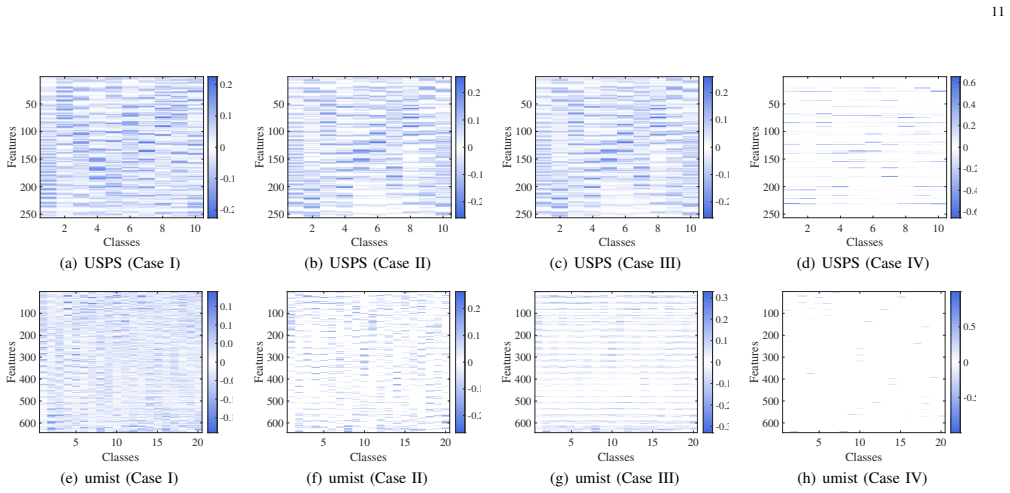
- The sparser transformation matrices shown for BSUFS suggest the method can serve as a label-free preprocessing step for clustering pipelines on image and gene data.
Reading between the lines
- A testable extension: on a dataset whose features are a known union of informative, redundant, and noisy coordinates, the optimal $\lambda_2$ at fixed $\lambda_1$ should trace an interior peak in clustering accuracy; the paper's parameter-sensitivity plots hint at this but do not isolate noise type.
- Because the paper only proves a zero-gradient result for the $W$ update, the practical convergence of BSUFS is likely initialization-dependent; comparing random and warm starts would quantify how much the reported gains depend on initialization.
- The restriction of $p,q$ to $\{0,1/2,2/3\}$ is computational, not conceptual; if efficient proximal maps for other values in $[0,1)$ become available, the claimed benefits of the full range could be tested more finely.
- The same bi-sparse penalty could be attached to other projection-based objectives, such as tensor PCA or supervised discriminative projections, where the row term would select variables and the entrywise term would denoise.
Editorial analysis
A structured set of objections, weighed in public.
Referee Report
Summary. The paper proposes BSUFS, an unsupervised feature selection method built from PCA with two nonconvex sparsity regularizers: an ℓ_{2,p} row-sparsity term for feature selection and an ℓ_q elementwise sparsity term for noise suppression, with p,q ∈ [0,1). The model in problem (8) unifies SPCAFS and the Lagrangian form of FSPCA as special cases. The algorithm is a proximal alternating minimization scheme (Algorithm 1) in which the W-subproblem is solved by trust-region Riemannian optimization and the U and V subproblems by closed-form proximal operators. The paper reports synthetic and real-world clustering experiments, ablation studies, statistical tests, parameter analyses, and complexity estimates, and it makes code publicly available. The central claims are that BSUFS 'consistently selects discriminative features and performs robustly on different noises' and that the bi-sparse formulation improves over single-sparse PCA-based alternatives.
Significance. If the claimed empirical advantage were established, BSUFS would be a useful contribution: it gives a unified nonconvex bi-sparse PCA framework, includes existing row-sparse PCA methods as special cases, provides closed-form proximal updates for commonly used p and q, and comes with public code and synthetic-data demonstrations of robustness to noise. The ablation and feature-visualization material is also a genuine attempt to attribute the effect to the two regularizers. However, the significance is currently limited because the paper's own statistical analysis does not support the headline advantage over the closest PCA-based baselines, the evaluation protocol appears to select hyperparameters and feature numbers on the test data, and the PAM algorithm lacks a convergence theorem. These are load-bearing issues for the central empirical claim, not presentation defects.
major comments (4)
- [Section IV-A.2 and Tables II–III] The evaluation protocol appears to fit the model to the test data. Section IV-A.2 selects regularization parameters from a candidate set, and Tables II and III report 'the best result with the number of features shown in brackets,' meaning the number of selected features is chosen to maximize ACC on the same data used for final evaluation. No separate validation split or nested tuning procedure is described. Because the abstract and conclusion claim that BSUFS 'consistently selects discriminative features,' this selection-on-test-set protocol can inflate the reported advantage and should be replaced by a held-out validation protocol or otherwise justified.
- [Section IV-E, Figures 9 and 10] The paper's own post-hoc Nemenyi test shows no statistically significant difference between BSUFS and FSPCA, SPCAFS, SPCA-PSD, or FEN-PCAFS on either ACC or NMI; only the graph-based methods are significantly worse. The raw average gaps in Tables II and III (about 2.2 percentage points in ACC and 0.5 percentage points in NMI over the closest baselines) are within the noise of that comparison. Since the central claim of the paper is that BSUFS improves feature selection over existing PCA-based UFS methods, this statistical result directly undermines the headline empirical conclusion as currently worded.
- [Remark 3.4 and Section IV-G-4] Algorithm 1 is presented as an efficient proximal alternating minimization algorithm, but no convergence theorem is provided. Remark 3.4 states that the sufficient-decrease lemma required by the PAM framework cannot be proved because Algorithm 2 is only guaranteed to converge to a zero Riemannian gradient point, and Section IV-G-4 explicitly says 'the convergence theorem cannot be derived.' The abstract and introduction do not qualify the algorithmic claim accordingly. Either the missing sufficient-decrease argument should be supplied, or the theoretical status of Algorithm 1 should be stated accurately in the main text rather than deferred to future work.
- [Section IV-D, Tables IV and V] The text states that 'Case IV consistently achieves the top performance,' but the NMI results do not support this. In Table V, Case IV is worse than Case III on USPS (60.16 vs. 61.14) and umist (67.62 vs. 69.45), and worse than Case II on GLIOMA (45.14 vs. 52.11). Since the added value of the ℓ_q-norm is the core novelty of BSUFS, the ablation evidence needs a more careful quantitative treatment, including the variability across the 50 k-means runs and statistical significance tests, rather than only averages over eight datasets.
minor comments (5)
- [Section II-A and problem (8)] The norms ∥W∥_{2,p} and ∥W∥_q are defined only for p,q ∈ (0,1), but the model (8) allows p,q ∈ [0,1); the p=0 and q=0 cases should be defined precisely (for example via ∥·∥_{2,0} and ∥·∥_0) before they appear in the model.
- [Section IV-E] The text refers to 'PEN-PCAFS' in the discussion of the Nemenyi test, but the method is FEN-PCAFS; this typo should be corrected.
- [Figure 1 caption] The caption contains the typo 'tranformation matrix' and should read 'transformation matrix.'
- [Section V] The conclusion says 'respected to ACC and NMI'; this should be 'with respect to ACC and NMI.'
- [Section IV-C] The sentence 'Here is another compared method called ALLfea' is awkward; ALLfea is not a feature-selection method but the baseline of using all features, so the description should be reworded for clarity.
Circularity Check
No derivation assumes its conclusion; BSUFS is a defined optimization model, the optimization steps are algebraic reformulations, and comparisons are against external baselines. Minor self-citations are not load-bearing, and the admitted convergence-proof gap is a correctness risk, not circularity.
full rationale
The formal derivation is self-contained: model (8) is a stated objective, the reformulations (9)-(11) and PAM updates (12)-(14) follow by algebra, and the U/V updates use proximal operators stated in Lemmas 3.1-3.2. No equation is defined in terms of the intended conclusion; the containment claims, such as 'When λ2 = 0 in (8), our proposed BSUFS unifies SPCAFS and the Lagrangian form of FSPCA' and 'When p and q tend to 1 in (8), our proposed BSUFS equals the model in [31],' are algebraic identities rather than circular predictions. The self-citations [43] and [47] for Lq proximal operators and for the parameter choices p,q in {0,1/2,2/3} are not load-bearing, because the needed lemmas are restated in full in this paper and are standard mathematical facts. The paper explicitly flags an omitted proof in Remark 3.4: 'the main challenge is to obtain a sufficient decent lemma, because of the fact that the update of W^{k+1} relies on Algorithm 2... Therefore, it is deferred as a future work to tackle this challenge.' Section IV-G-4 similarly states: 'Although the convergence theorem cannot be derived as in Remark 3.4, the algorithm has good convergence in the numerical perspective.' I weigh this as a proof gap and correctness risk, not circularity, because no convergence theorem is being passed off as a derived result. The empirical advantage is weakened by the paper's own statistical test: 'no significant differences are observed in the performance of BSUFS relative to FSPCA, SPCAFS, SPCA-PSD, and PEN-PCAFS,' and by the protocol of reporting the best result with the number of features chosen on the test data. Those are evidence-strength issues, not reductions of the central claim to its own inputs. No circular step is present.
Assumptions & free parameters
free parameters (6)
- lambda1 =
grid {1e-6, 1e-4, 1e-2, 1, 1e2, 1e4, 1e6}, best per dataset
- lambda2 =
grid {1e-6, 1e-4, 1e-2, 1, 1e2, 1e4, 1e6}, best per dataset
- p =
chosen from {0, 1/2, 2/3} per dataset
- q =
chosen from {0, 1/2, 2/3} per dataset
- number_of_selected_features =
10 to 100, best per dataset
- beta1, beta2, tau1, tau2, tau3 =
not reported in the paper
assumptions (3)
- standard math Trust-region algorithm on the Stiefel manifold converges to a stationary point of the W subproblem.
- standard math Proximal operators for |x|^q and for ||x||_p are correct and available for the chosen exponent values.
- domain assumption Data is centralized or handled through S = X H X^T.
Cite this review
Pith. "Pith review of Bi-Sparse Unsupervised Feature Selection." pith.science (2026). https://pith.science/paper/UO3OGIIA
@misc{pith2026241216819,
  author       = {Pith},
  title        = {Pith review of: Bi-Sparse Unsupervised Feature Selection},
  year         = {2026},
  howpublished = {\url{https://pith.science/paper/UO3OGIIA}},
  note         = {Machine review of arXiv:2412.16819}
}
abstract
To deal with high-dimensional unlabeled datasets in many areas, principal component analysis (PCA) has become a rising technique for unsupervised feature selection (UFS). However, most existing PCA-based methods only consider the structure of datasets by embedding a single sparse regularization or constraint on the transformation matrix. In this paper, we introduce a novel bi-sparse method called BSUFS to improve the performance of UFS. The core idea of BSUFS is to incorporate $\ell_{2,p}$-norm and $\ell_q$-norm into the classical PCA, which enables our method to select relevant features and filter out irrelevant noises, thereby obtaining discriminative features. Here, the parameters $p$ and $q$ are within the range of $[0, 1)$. Therefore, BSUFS not only constructs a unified framework for bi-sparse optimization, but also includes some existing works as special cases. To solve the resulting non-convex model, we propose an efficient proximal alternating minimization (PAM) algorithm using Stiefel manifold optimization and sparse optimization techniques. In addition, the computational complexity analysis is presented. Extensive numerical experiments on synthetic and real-world datasets demonstrate the effectiveness of our proposed BSUFS. The results reveal the advantages of bi-sparse optimization in feature selection and show its potential for other fields in image processing. Our code is available at https://github.com/xianchaoxiu/BSUFS.
Figures


Figures from the paper (12 more)




Reference graph
Works this paper leans on
-
[31]
Double sparse- representation feature selection algorithm for classification,
Y . Zhu, X. Zhang, G. Wen, W. He, and D. Cheng, “Double sparse- representation feature selection algorithm for classification,” Multimedia Tools and Applications, vol. 76, pp. 17 525–17 539, 2017
work page 2017
-
[1]
Machine learning: Trends, perspec- tives, and prospects,
M. I. Jordan and T. M. Mitchell, “Machine learning: Trends, perspec- tives, and prospects,” Science, vol. 349, no. 6245, pp. 255–260, 2015
work page 2015
-
[2]
R. Zebari, A. Abdulazeez, D. Zeebaree, D. Zebari, and J. Saeed, “A comprehensive review of dimensionality reduction techniques for feature selection and feature extraction,” Journal of Applied Science and Technology Trends, vol. 1, no. 1, pp. 56–70, 2020
work page 2020
-
[3]
Feature selection in image anal- ysis: a survey,
V . Bolon-Canedo and B. Remeseiro, “Feature selection in image anal- ysis: a survey,” Artificial Intelligence Review , vol. 53, no. 4, pp. 2905– 2931, 2020
work page 2020
-
[4]
Unsupervised feature selection via nonnegative spectral analysis and redundancy control,
Z. Li and J. Tang, “Unsupervised feature selection via nonnegative spectral analysis and redundancy control,” IEEE Transactions on Image Processing, vol. 24, no. 12, pp. 5343–5355, 2015
2015
-
[5]
Bi-level spectral feature selection,
Z. Hu, J. Wang, K. Zhang, W. Pedrycz, and N. R. Pal, “Bi-level spectral feature selection,” IEEE Transactions on Neural Networks and Learning Systems, vol. 36, no. 4, pp. 6597–6611, 2025
work page 2025
-
[6]
Supervised, unsupervised, and semi-supervised feature selection: A review on gene selection,
J. C. Ang, A. Mirzal, H. Haron, and H. N. A. Hamed, “Supervised, unsupervised, and semi-supervised feature selection: A review on gene selection,” IEEE/ACM Transactions on Computational Biology and Bioinformatics, vol. 13, no. 5, pp. 971–989, 2016
work page 2016
-
[7]
P. Garc ´ıa-D´ıaz, I. S ´anchez-Berriel, J. A. Mart ´ınez-Rojas, and A. M. Diez-Pascual, “Unsupervised feature selection algorithm for multiclass cancer classification of gene expression RNA-Seq data,” Genomics, vol. 112, no. 2, pp. 1916–1925, 2020
work page 1916
Show all 52 references
-
[8]
A review of machine learning methods of feature selection and classification for autism spectrum disorder,
M. M. Rahman, O. L. Usman, R. C. Muniyandi, S. Sahran, S. Mo- hamed, and R. A. Razak, “A review of machine learning methods of feature selection and classification for autism spectrum disorder,” Brain Sciences, vol. 10, no. 12, p. 949, 2020
2020
-
[9]
Feature selection in machine learning: A new perspective,
J. Cai, J. Luo, S. Wang, and S. Yang, “Feature selection in machine learning: A new perspective,” Neurocomputing, vol. 300, pp. 70–79, 2018. 15
2018
-
[10]
Feature selection for unsupervised learning,
J. G. Dy and C. E. Brodley, “Feature selection for unsupervised learning,” Journal of Machine Learning Research , vol. 5, no. Aug, pp. 845–889, 2004
2004
-
[11]
Unsupervised feature learning with emergent data-driven prototypicality,
Y . Guo, Y . Zhang, Y . Chen, and S. X. Yu, “Unsupervised feature learning with emergent data-driven prototypicality,” in Proceedings of the IEEE/CVF Conference on Computer Vision and Pattern Recognition, 2024, pp. 23 199–23 208
2024
-
[12]
A review of unsupervised feature selection methods,
S. Solorio-Fern ´andez, J. A. Carrasco-Ochoa, and J. F. Mart´ınez-Trinidad, “A review of unsupervised feature selection methods,” Artificial Intelli- gence Review, vol. 53, no. 2, pp. 907–948, 2020
2020
-
[13]
Unsupervised discriminative feature selection via contrastive graph learning,
Q. Zhou, Q. Wang, Q. Gao, M. Yang, and X. Gao, “Unsupervised discriminative feature selection via contrastive graph learning,” IEEE Transactions on Image Processing , vol. 33, pp. 972–986, 2024
2024
-
[14]
Unsupervised adaptive feature selection with binary hashing,
D. Shi, L. Zhu, J. Li, Z. Zhang, and X. Chang, “Unsupervised adaptive feature selection with binary hashing,” IEEE Transactions on Image Processing, vol. 32, pp. 838–853, 2023
2023
-
[15]
Feature selection: A data perspective,
J. Li, K. Cheng, S. Wang, F. Morstatter, R. P. Trevino, J. Tang, and H. Liu, “Feature selection: A data perspective,” ACM Computing Surveys, vol. 50, no. 6, pp. 1–45, 2017
2017
-
[16]
Laplacian score for feature selection,
X. He, D. Cai, and P. Niyogi, “Laplacian score for feature selection,” in Advances in Neural Information Processing Systems , vol. 18, 2005, pp. 507–514
2005
-
[17]
Unsupervised feature selection for multi- cluster data,
D. Cai, C. Zhang, and X. He, “Unsupervised feature selection for multi- cluster data,” in Proceedings of the 16th ACM SIGKDD International Conference on Knowledge Discovery and Data Mining , 2010, pp. 333– 342
2010
-
[18]
ℓ2,1-norm regularized discriminative feature selection for unsupervised learning,
Y . Yang, H. T. Shen, Z. Ma, Z. Huang, and X. Zhou, “ ℓ2,1-norm regularized discriminative feature selection for unsupervised learning,” in IJCAI International Joint Conference on Artificial Intelligence , 2011, pp. 1589–1594
2011
-
[19]
Unsupervised feature selection with structured graph optimization,
F. Nie, W. Zhu, and X. Li, “Unsupervised feature selection with structured graph optimization,” in Proceedings of the AAAI Conference on Artificial Intelligence , vol. 30, no. 1, 2016
2016
-
[20]
Robust neighborhood em- bedding for unsupervised feature selection,
Y . Liu, D. Ye, W. Li, H. Wang, and Y . Gao, “Robust neighborhood em- bedding for unsupervised feature selection,” Knowledge-Based Systems, vol. 193, p. 105462, 2020
2020
-
[21]
Precise feature selection via non- convex regularized graph embedding and self-representation for unsuper- vised learning,
H. Bai, M. Huang, and P. Zhong, “Precise feature selection via non- convex regularized graph embedding and self-representation for unsuper- vised learning,” Knowledge-Based Systems, vol. 296, p. 111900, 2024
2024
-
[22]
Principal component analysis,
M. Greenacre, P. J. Groenen, T. Hastie, A. I. d’Enza, A. Markos, and E. Tuzhilina, “Principal component analysis,” Nature Reviews Methods Primers, vol. 2, no. 1, p. 100, 2022
2022
-
[23]
A selective overview of sparse principal component analysis,
H. Zou and L. Xue, “A selective overview of sparse principal component analysis,” Proceedings of the IEEE , vol. 106, no. 8, pp. 1311–1320, 2018
2018
-
[24]
Sparse PCA via ℓ2,p-norm regularization for unsupervised feature selection,
Z. Li, F. Nie, J. Bian, D. Wu, and X. Li, “Sparse PCA via ℓ2,p-norm regularization for unsupervised feature selection,” IEEE Transactions on Pattern Analysis and Machine Intelligence , vol. 45, no. 4, pp. 5322– 5328, 2023
2023
-
[25]
A comprehensive survey on regularization strategies in machine learning,
Y . Tian and Y . Zhang, “A comprehensive survey on regularization strategies in machine learning,” Information Fusion , vol. 80, pp. 146– 166, 2022
2022
-
[26]
Learning feature-sparse principal subspace,
F. Nie, L. Tian, R. Wang, and X. Li, “Learning feature-sparse principal subspace,” IEEE Transactions on Pattern Analysis and Machine Intelli- gence, vol. 45, no. 4, pp. 4858–4869, 2023
2023
-
[27]
Struc- tured sparsity optimization with non-convex surrogates of ℓ2,0-norm: A unified algorithmic framework,
X. Zhang, J. Zheng, D. Wang, G. Tang, Z. Zhou, and Z. Lin, “Struc- tured sparsity optimization with non-convex surrogates of ℓ2,0-norm: A unified algorithmic framework,” IEEE Transactions on Pattern Analysis and Machine Intelligence , vol. 45, no. 5, pp. 6386–6402, 2023
2023
-
[28]
Fast sparse PCA via positive semidefinite projection for unsupervised feature selection,
J. Zheng, X. Zhang, Y . Liu, W. Jiang, K. Huo, and L. Liu, “Fast sparse PCA via positive semidefinite projection for unsupervised feature selection,” arXiv preprint arXiv:2309.06202 , 2023
2023 arXiv
-
[29]
Prin- cipal component analysis with fuzzy elastic net for feature selection,
Y . Gao, Q. Wu, Z. Xu, C. Cao, J. Pan, G. Shao, F. Nie, and Q. Zhu, “Prin- cipal component analysis with fuzzy elastic net for feature selection,” IEEE Transactions on Fuzzy Systems , vol. 32, no. 12, pp. 6878–6890, 2024
2024
-
[30]
Group sparse optimization via ℓp,q regularization,
Y . Hu, C. Li, K. Meng, J. Qin, and X. Yang, “Group sparse optimization via ℓp,q regularization,” Journal of Machine Learning Research, vol. 18, no. 30, pp. 1–52, 2017
2017
-
[32]
Identifying disease sensitive and quantitative trait-relevant biomarkers from multidimensional heterogeneous imaging genetics data via sparse multimodal multitask learning,
H. Wang, F. Nie, H. Huang, S. L. Risacher, A. J. Saykin, L. Shen, and A. D. N. Initiative, “Identifying disease sensitive and quantitative trait-relevant biomarkers from multidimensional heterogeneous imaging genetics data via sparse multimodal multitask learning,” Bioinformat...
2012
-
[33]
Multi-view clustering and feature learning via structured sparsity,
H. Wang, F. Nie, and H. Huang, “Multi-view clustering and feature learning via structured sparsity,” inInternational Conference on Machine Learning. PMLR, 2013, pp. 352–360
2013
-
[34]
Double sparsity: Learning sparse dictionaries for sparse signal approximation,
R. Rubinstein, M. Zibulevsky, and M. Elad, “Double sparsity: Learning sparse dictionaries for sparse signal approximation,” IEEE Transactions on Signal Processing , vol. 58, no. 3, pp. 1553–1564, 2010
2010
-
[35]
Double-sparsity recovery for adc- distorted compressive sensing,
X. Bian, W. Xu, and S. Wang, “Double-sparsity recovery for adc- distorted compressive sensing,” in 2022 IEEE 33rd Annual International Symposium on Personal, Indoor and Mobile Radio Communications (PIMRC). IEEE, 2022, pp. 1215–1220
2022
-
[36]
DSTPCA: Double-sparse constrained tensor principal component analysis method for feature selection,
Y . Hu, J.-X. Liu, Y .-L. Gao, and J. Shang, “DSTPCA: Double-sparse constrained tensor principal component analysis method for feature selection,” IEEE/ACM Transactions on Computational Biology and Bioinformatics, vol. 18, no. 4, pp. 1481–1491, 2021
2021
-
[37]
Micro-doppler effects removed sparse aperture isar imaging via low-rank and double sparsity constrained ADMM and linearized ADMM,
S. Zhang, Y . Liu, and X. Li, “Micro-doppler effects removed sparse aperture isar imaging via low-rank and double sparsity constrained ADMM and linearized ADMM,” IEEE Transactions on Image Process- ing, vol. 30, pp. 4678–4690, 2021
2021
-
[38]
Clustering-guided sparse structural learning for unsupervised feature selection,
Z. Li, J. Liu, Y . Yang, X. Zhou, and H. Lu, “Clustering-guided sparse structural learning for unsupervised feature selection,” IEEE Transac- tions on Knowledge and Data Engineering , vol. 26, no. 9, pp. 2138– 2150, 2014
2014
-
[39]
Non-convex optimization for machine learning,
P. Jain, P. Kar et al., “Non-convex optimization for machine learning,” Foundations and Trends® in Machine Learning , vol. 10, no. 3-4, pp. 142–363, 2017
2017
-
[40]
Sparse SVM for sufficient data reduction,
S. Zhou, “Sparse SVM for sufficient data reduction,” IEEE Transactions on Pattern Analysis and Machine Intelligence , vol. 44, no. 9, pp. 5560– 5571, 2022
2022
-
[41]
A new insight on augmented lagrangian method with applications in machine learning,
J. Bai, L. Jia, and Z. Peng, “A new insight on augmented lagrangian method with applications in machine learning,” Journal of Scientific Computing, vol. 99, no. 2, p. 53, 2024
2024
-
[42]
Absil, R
P.-A. Absil, R. Mahony, and R. Sepulchre, Optimization Algorithms on Matrix Manifolds. Princeton University Press, 2008
2008
-
[43]
Revisiting Lq(0 ≤ q <1) norm regularized optimization,
S. Zhou, X. Xiu, Y . Wang, and D. Peng, “Revisiting Lq(0 ≤ q <1) norm regularized optimization,” arXiv:2306.14394, 2023
2023 arXiv
-
[44]
Beck, First-order Methods in Optimization
A. Beck, First-order Methods in Optimization . SIAM, 2017
2017
-
[45]
L1/2 regularization: A thresholding representation theory and a fast solver,
Z. Xu, X. Chang, F. Xu, and H. Zhang, “ L1/2 regularization: A thresholding representation theory and a fast solver,” IEEE Transactions on Neural Networks and Learning Systems , vol. 23, no. 7, pp. 1013– 1027, 2012
2012
-
[46]
Fast image deconvolution using closed- form thresholding formulas of Lq (q = 1 2 , 2 3 ) regularization,
W. Cao, J. Sun, and Z. Xu, “Fast image deconvolution using closed- form thresholding formulas of Lq (q = 1 2 , 2 3 ) regularization,” Journal of Visual Communication and Image Representation , vol. 24, no. 1, pp. 31–41, 2013
2013
-
[47]
Efficient and robust sparse linear discriminant analysis for data classification,
J. Liu, M. Feng, X. Xiu, W. Liu, and X. Zeng, “Efficient and robust sparse linear discriminant analysis for data classification,” IEEE Trans- actions on Emerging Topics in Computational Intelligence, vol. 9, no. 1, pp. 617–629, 2025
2025
-
[48]
Proximal alternating linearized minimization for nonconvex and nonsmooth problems,
J. Bolte, S. Sabach, and M. Teboulle, “Proximal alternating linearized minimization for nonconvex and nonsmooth problems,” Mathematical Programming, vol. 146, no. 1, pp. 459–494, 2014
2014
-
[49]
Learning feature sparse principal subspace,
L. Tian, F. Nie, R. Wang, and X. Li, “Learning feature sparse principal subspace,” Advances in Neural Information Processing Systems, vol. 33, pp. 14 997–15 008, 2020
2020
-
[50]
Sparse tensor PCA via tensor decomposition for unsupervised feature selection,
J. Zheng, X. Zhang, W. Jiang, X. Qiu, and M. Ren, “Sparse tensor PCA via tensor decomposition for unsupervised feature selection,” arXiv preprint arXiv:2407.16985, 2024
2024 arXiv
-
[51]
Subspace Newton method for sparse group ℓ0 optimization problem,
S. Liao, C. Han, T. Guo, and B. Li, “Subspace Newton method for sparse group ℓ0 optimization problem,” Journal of Global Optimization, vol. 90, no. 1, pp. 93–125, 2024
2024
-
[52]
Physics-inspired com- pressive sensing: Beyond deep unrolling,
J. Zhang, B. Chen, R. Xiong, and Y . Zhang, “Physics-inspired com- pressive sensing: Beyond deep unrolling,” IEEE Signal Processing Magazine, vol. 40, no. 1, pp. 58–72, 2023
2023
Reviewed August 11, 2026 · model on record in the stance chip above.
Discussion (0). Continue with ORCID to comment.