REVIEW 3 major objections 5 minor 45 references
A computational model of infant sensorimotor exploration in the mobile paradigm
T0 review · 3 major / 5 minor · reviewed 2026-08-16 · deepseek-v4-flash
Pith's one-line read A neural-network model of surprise and noise reproduces the mobile-paradigm results in simulations, and ablations show each component is needed.
desk verdict A solid, honest mobile-paradigm model combining predictive surprise and motor redundancy; the effects reproduce, but parameter circularity and visual-only curve matching keep the claims from being established. read the letter →
The pith
A machine-rendered reading of the paper's core claim, the machinery that carries it, and where it could break.
The reading
What carries the argument
The engine is the activity interest map, a $4\times 10$ table that discretizes each limb's activity into ten ranges and assigns each range an interest value. After each step, the sensory prediction error is compared to a novelty threshold; surprise sets the visited range to 1, and lack of surprise decrements it by 0.1, so the agent repeatedly re-enters ranges whose sensory effects it cannot yet predict. A second mechanism, the fixed random projection from 600 muscle commands to the four limb scalars, is sampled from a $\beta$ distribution with $z_1=0.01$, $z_2=0.1$ so that each limb is affected by only a handful of commands; this makes credit assignment non-trivial because many commands co-activate all limbs, so the network must learn which outputs actually drive the connected limb. The neural network is trained on three mean-squared-error losses (sensory prediction error, distance to the most interesting limb activity, and deviation from a slowly rising baseline), so that exploration and prediction pulling against each other generate the behavior.
What would settle it
If a reanalysis of the two infant datasets, matching for overall kick rate and attention time, showed that conjugate and binary conditions produce equally fast connected-limb differentiation, then the model's mechanism (threshold crossing creating a larger sensory change) would be falsified as the explanation for the binary advantage.
Extended reading notes
Core claim
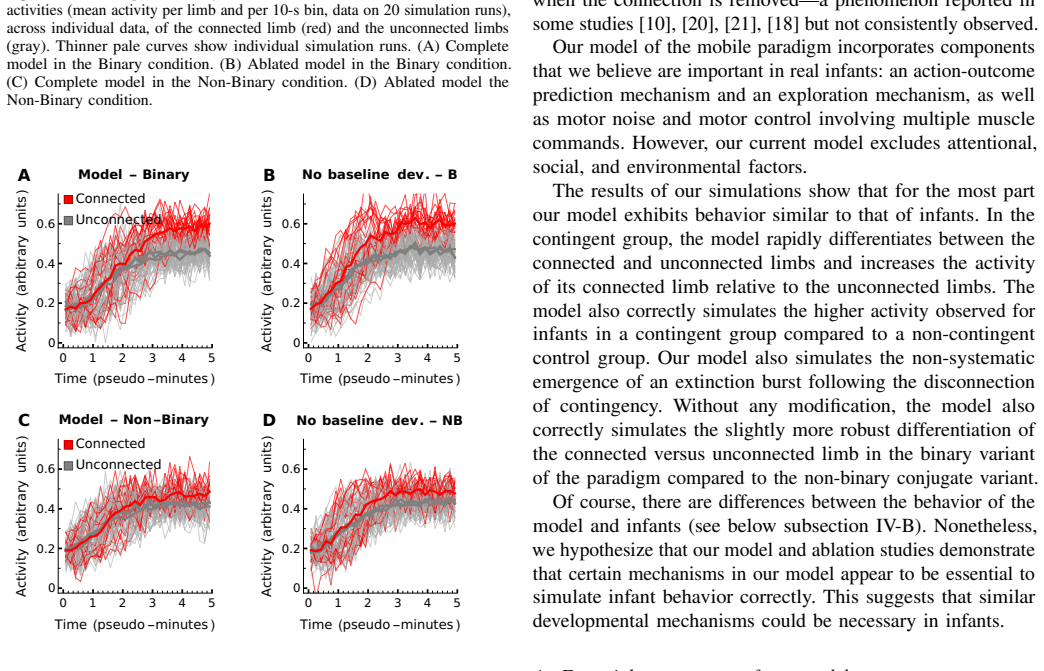
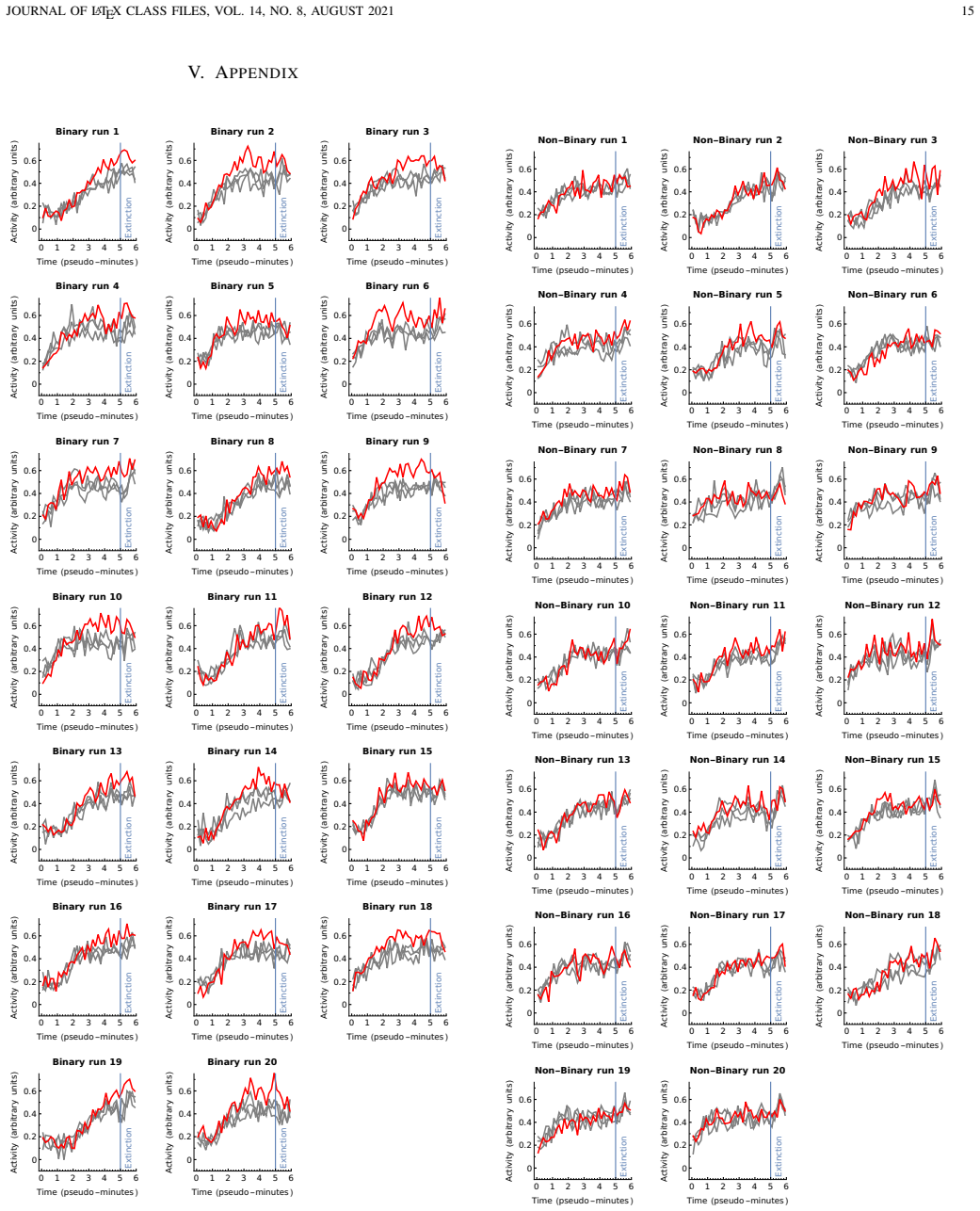
The central claim is that a minimal cognitive architecture built around action-outcome prediction and surprise-driven exploration can account for the four main mobile-paradigm findings without any explicit reward or notion of agency. The model contains no reward; it selects limb activities through an activity interest map in which surprising outcomes raise interest and predictable outcomes lower it. A neural network outputs 600 abstract muscle commands that are projected through a fixed random sparse matrix onto four scalar limb activities, and motor noise is added before the limb state is updated. Each run is treated as one infant; the network learns by backpropagation on three losses: prediction error, distance from the currently most interesting activity, and distance from a preferred baseline. The paper reports that this reproduces preferential movement of the connected limb, higher activity in contingent than in non-contingent replay controls, the larger effect for binary than for conjugate coupling, and a non-systematic extinction burst, and that ablation of any core component except the baseline term destroys the replication.
Load-bearing premise
The whole behavior emerges through a fixed random projection of 600 abstract muscle commands onto a single scalar activity per limb, with no other sensory input; if real limb control is structured differently, the model's similarity to infants may be a coincidence of that abstraction.
Editorial extensions
If this is right
- The paper's account implies that the same architecture should transfer to other sensorimotor contingencies, such as vocalization-contingent sounds, without adding any reward or agency machinery.
- The ablation results suggest that internal prediction and surprise are not optional refinements; they are the mechanism that makes the connected limb discoverable, so developmental theories of the mobile paradigm should include a predictive component.
- The model explains the binary-conjugate asymmetry: threshold crossing turns small activity changes into large sensory changes, making the connected limb easier to identify, so conjugate studies should show weaker and slower differentiation.
- The occasional extinction burst is a natural consequence of a surprise-driven explorer; it will not appear in every run, matching the inconsistent reports in the literature.
- Reducing the muscle-command count below about 100 in the binary condition or about 300 in the conjugate condition makes the model fail in some runs, suggesting that motor redundancy itself contributes to reliable learning.
Reading between the lines
- Inference: The model could be read as predicting that infants should detect a time-lagged contingency less well, because the prediction error at the moment of feedback would not align with the action that caused it; a delayed-feedback mobile experiment would test this directly.
- Inference: The same surprise-driven architecture might be applied to vocalization paradigms, where the 'limb' is replaced by vocalization effort; the model would predict that a contingent adult response is learned only when the infant's motor variability spans the response threshold.
- Inference: The ablation claim depends on the particular random muscle-command projection; an alternative implementation with a structured, low-dimensional body model might require far fewer commands, so the '600 commands' number is likely a property of this architecture rather than a general biological bound.
- Inference: The model's low within-run variability suggests that adding attention or habituation mechanisms would make it testable against more granular data, such as individual kick-rate time series.
Signed reviews
Editorial analysis
A structured set of objections, weighed in public.
Referee Report
Summary. The paper presents a neural-network model of the mobile paradigm, comprising 600 abstract muscle commands mapped onto four limb scalars through a fixed random sparse matrix, a sensory prediction module, an activity-interest map driving exploration, motor noise, and a baseline activity term. The model is compared visually with infant data from a binary-condition study [12] and a conjugate-condition study [11]. The authors report that the model replicates preferential movement of the connected limb, the contingent versus non-contingent difference, the binary versus conjugate difference, and occasional extinction bursts. A series of ablation studies claims that prediction error, the exploration loss, motor noise, and a large number of muscle commands are essential for reproducing infant behavior.
Significance. The paper addresses an important developmental phenomenon with an unusual combination of mechanisms (action-outcome prediction, novelty-based exploration, noise-driven variability) and ships open-source code, individual simulation runs, and comparisons against two recent empirical datasets. If the mechanism claims were supported, the model would be a valuable step toward understanding sensorimotor contingency learning in infancy. However, the model's architecture pre-assigns credit to the just-active limb via the per-limb activity-interest map, and the main parameters are tuned on the same infant data, so the central explanatory claims are not currently supported.
major comments (3)
- [II-C3 and Fig. 3] The activity interest map is an array of dimensions (4,10), one row per limb, and whenever a limb action generates surprise the interest for that limb's activity range is set to 1. This pre-specifies credit assignment at the level of individual limbs: the model never has to discover which movement is causally effective, because the surprise signal is attributed directly to the limb that was just active. The limb-specificity result of Fig. 4 therefore largely follows from the map's structure, and the prediction-error ablation in Section III-E1 does not demonstrate that the network learns the contingency.
- [III-E3 and Fig. 10] The muscle-command ablation varies the number of output neurons while keeping the fixed random sparse mapping M from commands to four limb scalars. Since surprise credit is assigned only at limb level and never propagates to individual commands, the degradation at 50 commands is expected from the beta(0.01, 0.1) sampling leaving some limbs poorly controllable through this particular random matrix. This ablation cannot support the claim in Section IV-A that 'numerous muscle commands' are essential for infant-like contingency learning; it only shows that four scalar readouts require enough output dimensions for this random mapping.
- [II-C1 and II-C4] The learning rate was chosen 'after empirical testing' to best match the infant studies, and the baseline activity mean and standard deviation were taken from the same studies [11, 12]. The main results are therefore fits to the benchmark data, not predictions. All model-data comparisons (e.g., Figs. 4, 6, 7) are qualitative visual assessments without quantitative fit measures, effect sizes, or statistical tests. The phrase 'correctly simulates' is not supported by the evidence presented.
minor comments (5)
- [Figs. 4, 6, 7] Model activity is plotted in arbitrary units while infant activity is plotted in gravitational acceleration units (g); provide a normalization or a defined units mapping to make the visual comparisons interpretable.
- [III-C] The text reports 'no evidence' for an extinction burst in the binary condition and 'a clear one' in the non-binary condition, but then states that individual runs do not show clear evidence; clarify the model's actual prediction regarding extinction bursts.
- [III-E5] The novelty threshold ablation is described only qualitatively; quantify variability (e.g., standard deviation of limb activity) to support the claim that the threshold can be adjusted to match infant variability.
- [II-C4] The baseline module's linear increase in the maximum activity and the fatigue-from-stillness assumption are ad hoc; report sensitivity analyses for these choices.
- [Throughout] The term 'muscle commands' is used as an abstraction; consider explicitly distinguishing between muscles and output neurons in the ablation discussion to avoid implying that the model simulates anatomical muscles.
Circularity Check
Learning rate and baseline are tuned to the benchmark infant data, and the per-limb activity-interest map pre-specifies credit assignment; the core qualitative effects remain emergent.
-
fitted input called prediction
[Section II-C1, Neural network (learning rate)]
"We used a constant learning rate of 0.00075 for all simulations. We chose this value after empirical testing and found that it gave results that best matched those of infant studies [12], [11]."
The same studies [12,11] are the benchmarks against which the model is evaluated in Section III. The learning rate is a free parameter selected by the authors specifically to maximize agreement with those datasets, so the reported match of the time course and magnitude of limb differentiation is a fitted result rather than an independent prediction. This does not force the qualitative effects (binary vs. conjugate, extinction burst), so the circularity is partial.
-
fitted input called prediction
[Section II-C1, Neural network (baseline activity)]
"Based on infant data of previous studies [12], [11], we chose an activity with a mean of 0.15 and a standard deviation of 0.15 for the baseline."
The model's resting activity is calibrated from the same two infant datasets that later serve as the target of the replication. This anchors the model's absolute activity levels to the empirical values, so those absolute levels are not an independent prediction. Because the central findings are relative differences between limbs and conditions, this is a secondary circularity.
1 more flagged steps
-
self definitional
[Section II-C3, Exploration module (Activity Interest Map)]
"We discretize the continuous values for each limb activity into 10 action ranges of equal size... resulting in an overall array of dimensions (4,10) (four limbs and 10 ranges for each). At each simulation step, if a limb action generates surprise, the value in the table for the corresponding action range is directly set to 1... if the limb action generates no surprise, the value in the array for the corresponding action range is decreased by 0.1."
The activity-interest map is indexed per limb, so surprise is attributed to the limb whose activity was just produced. Since the mobile feedback is defined as a function of the connected limb only, the connected limb's ranges are the ones that can generate sustained surprise, and the exploration loss drives that limb toward those ranges while unconnected limbs' interest decays. The limb-differentiation result is therefore substantially built into the limb-level credit assignment of the map: the model is not required to discover which of the 600 muscle commands are causally effective.
full rationale
The model is not wholly circular: the binary-vs-conjugate difference, the extinction burst, and the contingent-vs-noncontingent contrast are not directly encoded in any single parameter and do emerge from the simulation dynamics, which supports some independent content. However, two free inputs are explicitly tuned to the benchmark datasets (learning rate and baseline activity), so the quantitative agreement with those datasets is partly a fit rather than a prediction. More structurally, the per-limb activity-interest map gives the model a separate interest channel for each limb and credits surprise to the limb that just acted; because feedback is caused only by the connected limb, preferential connected-limb activity follows from this architectural choice to a substantial degree. This weakens the inference that the model's 'numerous muscle commands' are essential for infant-like contingency learning: the credit-assignment problem is solved at the limb-scalar level before the muscle mapping is even engaged. The novel qualitative predictions remain emergent, so the circularity is partial rather than total.
Assumptions & free parameters
free parameters (7)
- learning_rate =
0.00075
- novelty_threshold =
0.1
- motor_noise_uniform_range =
-0.3 to 0.3
- baseline_activity_mean_sd =
mean 0.15, sd 0.15
- baseline_max_increase_per_step =
0.0001 per step up to max 0.454
- activity_interest_decay =
0.1 decrement, floor 0.1, cap 1.0
- muscle_command_beta_parameters =
z1=0.01, z2=0.1
assumptions (5)
- domain assumption Infant sensorimotor behavior in this paradigm can be captured by scalar limb activities and a single scalar sensory feedback, with all non-mobile sensory input excluded.
- domain assumption A fixed random sparse map from 600 abstract muscle commands to four limbs approximates human motor redundancy and cross-limb coupling.
- domain assumption The neural network can be trained with backpropagation and MSE losses over 2440-step runs, and this approximates infant online sensorimotor learning.
- ad hoc to paper Baseline activity is modeled as per-limb random values with a linearly growing maximum, including fatigue from both moving and staying still.
- ad hoc to paper Prediction error above a novelty threshold drives interest, implemented through a discretized activity interest map.
Cite this review
Pith. "Pith review of A computational model of infant sensorimotor exploration in the mobile paradigm." pith.science (2026). https://pith.science/paper/UOBQS7VZ
@misc{pith2026250417939,
  author       = {Pith},
  title        = {Pith review of: A computational model of infant sensorimotor exploration in the mobile paradigm},
  year         = {2026},
  howpublished = {\url{https://pith.science/paper/UOBQS7VZ}},
  note         = {Machine review of arXiv:2504.17939}
}
read the original abstract
We present a computational model of the mechanisms that may determine infant behavior in the "mobile paradigm". This paradigm has been used in developmental psychology to explore how infants learn the sensory effects of their actions. In this paradigm, a mobile (an articulated and movable object hanging above an infant's crib) is connected to one of the infant's limbs, prompting the infant to preferentially move that "connected" limb. This ability to detect a "sensorimotor contingency" is considered to be a foundational cognitive ability in development. To understand how infants learn sensorimotor contingencies, we built a model that attempts to replicate infant behavior. Our model incorporates a neural network, action-outcome prediction, exploration, motor noise, preferred activity level, and biologically inspired motor control. We find that simulations with our model replicate the classic findings in the literature showing preferential movement of the connected limb. An interesting observation is that the model sometimes exhibits a burst of movement after the mobile is disconnected, shedding light on a similar occasional finding in infants. In addition to these general findings, the simulations also replicate data from two recent more detailed studies using a connection with the mobile that was either gradual or all-or-none. A series of ablation studies further shows that the inclusion of mechanisms of action-outcome prediction, exploration, motor noise, and biologically inspired motor control was essential for the model to correctly replicate infant behavior. This suggests that these components are also involved in infant sensorimotor learning.
Figures


Figures from the paper (9 more)



Reference graph
Works this paper leans on
-
[12]
S. T. Popescu, A. Dauphin, J. Vergne, and J. K. O’Regan, “6-Month-Old Infants’ Sensitivity to Contingency in a Variant of the Mobile Paradigm With Proximal Stimulation Studied at Fine Temporal Resolution in the Laboratory,” Frontiers in Psychology, vol. 12, 2021. Publisher: Frontiers. JOURNAL OF LATEX CLASS FILES, VOL. 14, NO. 8, AUGUST 2021 14
work page 2021
-
[11]
Development of body knowledge as measured by arm differentiation in infants: From global to local?,
L. Jacquey, S. T. Popescu, J. Vergne, J. Fagard, R. Esseily, and K. O’Regan, “Development of body knowledge as measured by arm differentiation in infants: From global to local?,” British Journal of Developmental Psychology, vol. 38, no. 1, pp. 108–124, 2020. eprint: https://onlinelibrary.wiley.com/doi/pdf/10.1111/bjdp.12309
-
[1]
Detection of sensorimotor contingencies in infants before the age of 1 year: A comprehensive review,
L. Jacquey, J. Fagard, R. Esseily, and J. K. O’Regan, “Detection of sensorimotor contingencies in infants before the age of 1 year: A comprehensive review,” Developmental Psychology, vol. 56, pp. 1233– 1251, July 2020
work page 2020
-
[2]
Making the World Behave: A New Embodied Account on Mobile Paradigm,
U. Sen and G. Gredeb ¨ack, “Making the World Behave: A New Embodied Account on Mobile Paradigm,” Frontiers in Systems Neuroscience, vol. 15, Mar. 2021. Publisher: Frontiers
work page 2021
-
[3]
G. M. Tarabulsy, R. Tessier, and A. Kappas, “Contingency detection and the contingent organization of behavior in interactions: Implications for socioemotional development in infancy,” Psychological Bulletin, vol. 120, no. 1, pp. 25–41, 1996. Place: US Publisher: American Psychological Association
work page 1996
-
[4]
The still face: A history of a shared experimental paradigm,
L. Adamson and J. Frick, “The still face: A history of a shared experimental paradigm,” INFANCY, vol. 4, no. 4, pp. 451–473, 2003. International Conference on Infant Studies, TORONTO, CANADA, APR, 2002
work page 2003
-
[5]
Conjugate reinforcement of infant exploratory behavior,
C. K. Rovee and D. T. Rovee, “Conjugate reinforcement of infant exploratory behavior,” Journal of experimental child psychology , vol. 8, no. 1, pp. 33–39, 1969. 00334 Citation Key Alias: rovee1969
work page 1969
-
[6]
Reactions to response-contingent stimulation in early infancy,
J. S. Watson and C. T. Ramey, “Reactions to response-contingent stimulation in early infancy,” Merrill-Palmer Quarterly of Behavior and Development, vol. 18, no. 3, pp. 219–227, 1972. Publisher: Wayne State University Press
work page 1972
Show all 45 references
-
[7]
Ontogeny of Early Event Memory: I. Forgetting and Retrieval by 2- and 3-Month-Olds,
C. Greco, C. K. Rovee-Collier, H. Hayne, P. C. Griesler, and L. A. Earley, “Ontogeny of Early Event Memory: I. Forgetting and Retrieval by 2- and 3-Month-Olds,” Infant Behavior and Development , vol. 9, pp. 441–460, 1986
1986
-
[8]
Ontogeny of Early Event Memory: II. Encoding and Retrieval by 2- and 3-Month-Olds,
H. Hayne, C. Greco, L. A. Earley, P. C. Griesler, and C. Rovee-Collier, “Ontogeny of Early Event Memory: II. Encoding and Retrieval by 2- and 3-Month-Olds,” Infant Behavior and Development , vol. 9, pp. 461–472, 1986
1986
-
[9]
Emotional behaviour during the learning of a contingency in early infancy,
M. Lewis, M. W. Sullivan, and J. Brooks-Gunn, “Emotional behaviour during the learning of a contingency in early infancy,” British Journal of Developmental Psychology , vol. 3, pp. 307–316, Sept. 1985. Citation Key Alias: lewisEmotionalBehaviourLearning1985
1985
-
[10]
Violation of expectancy and frustration in early infancy,
S. M. Alessandri, M. W. Sullivan, and M. Lewis, “Violation of expectancy and frustration in early infancy,” Developmental Psychology, vol. 26, no. 5, pp. 738–744, 1990. Place: US Publisher: American Psychological Association
1990
-
[13]
The Development of Infant Memory,
C. Rovee-Collier, “The Development of Infant Memory,” Current Directions in Psychological Science , vol. 8, no. 3, p. 6, 1999
1999
-
[14]
Long-term mainte- nance of infant memory,
C. Rovee-Collier, K. Hartshorn, and M. DiRubbo, “Long-term mainte- nance of infant memory,” Developmental Psychobiology, vol. 35, pp. 91– 102, Sept. 1999
1999
-
[15]
Methodological integrity assessment in the mobile paradigm literature: A lesson for understanding opportunistic use of researcher degrees of freedom in psychology,
U. Sen and G. Gredeb ¨ack, “Methodological integrity assessment in the mobile paradigm literature: A lesson for understanding opportunistic use of researcher degrees of freedom in psychology,” Child Development, vol. 95, no. 2, pp. 338–353, 2024. Place: United Kingdom Publishe...
2024
-
[16]
Meaning from move- ment and stillness: Signatures of coordination dynamics reveal infant agency,
A. T. Sloan, N. A. Jones, and J. A. S. Kelso, “Meaning from move- ment and stillness: Signatures of coordination dynamics reveal infant agency,” Proceedings of the National Academy of Sciences , vol. 120, p. e2306732120, Sept. 2023. Publisher: Proceedings of the National Acade...
2023
-
[17]
General to specific development of movement patterns and memory for contingency between actions and events in young infants,
H. Watanabe and G. Taga, “General to specific development of movement patterns and memory for contingency between actions and events in young infants,” Infant Behavior and Development , vol. 29, no. 3, pp. 402–422,
-
[18]
Topographical response differentiation and reversal in 3-month-old infants,
C. K. Rovee-Collier, B. A. Morrongiello, M. Aron, and J. Kupersmidt, “Topographical response differentiation and reversal in 3-month-old infants,” Infant Behavior and Development , vol. 1, pp. 323–333, Jan. 1978
1978
-
[19]
Three-Month-Old Infants Can Select Specific Leg Motor Solutions,
R. M. Angulo-Kinzler, B. Ulrich, and E. Thelen, “Three-Month-Old Infants Can Select Specific Leg Motor Solutions,” Motor Control, vol. 6, pp. 52–68, Jan. 2002. Publisher: Human Kinetics, Inc. Section: Motor Control
2002
-
[20]
The Relative Kicking Frequency of Infants Born Full-term and Preterm During Learning and Short-term and Long-term Memory Periods of the Mobile Paradigm,
J. C. Heathcock, A. N. Bhat, M. A. Lobo, and J. C. Galloway, “The Relative Kicking Frequency of Infants Born Full-term and Preterm During Learning and Short-term and Long-term Memory Periods of the Mobile Paradigm,” Physical Therapy, vol. 85, pp. 8–18, 2005
2005
-
[21]
Violation of expectancy, loss of control, and anger expressions in young infants.,
M. Lewis, S. M. Alessandri, and M. W. Sullivan, “Violation of expectancy, loss of control, and anger expressions in young infants.,” Developmental Psychology, vol. 26, no. 5, p. 745, 1990
1990
-
[22]
Detecting contingencies: an infomax approach,
N. J. Butko and J. R. Movellan, “Detecting contingencies: an infomax approach,” Neural Networks: The Official Journal of the International Neural Network Society , vol. 23, no. 8-9, pp. 973–984, 2010
2010
-
[23]
The development of gaze following as a Bayesian systems identification problem,
J. R. Movellan and J. S. Watson, “The development of gaze following as a Bayesian systems identification problem,” in Development and Learning,
-
[24]
Learning to learn,
N. J. Butko and J. R. Movellan, “Learning to learn,” in 2007 IEEE 6th International Conference on Development and Learning , pp. 151–156, July 2007
2007
-
[25]
Can infants’ sense of agency be found in their behavior? Insights from babybot simulations of the mobile-paradigm,
L. Zaadnoordijk, M. Otworowska, J. Kwisthout, and S. Hunnius, “Can infants’ sense of agency be found in their behavior? Insights from babybot simulations of the mobile-paradigm,” Cognition, vol. 181, pp. 58–64, Dec. 2018
2018
-
[26]
The coordination dynamics of mobile conjugate reinforcement,
J. A. S. Kelso and A. Fuchs, “The coordination dynamics of mobile conjugate reinforcement,” Biological Cybernetics, vol. 110, pp. 41–53, Feb. 2016
2016
-
[27]
Dynamical systems model of development of the action differentiation in early infancy: a requisite of physical agency,
R. Fujihira and G. Taga, “Dynamical systems model of development of the action differentiation in early infancy: a requisite of physical agency,” Biological Cybernetics, vol. 117, no. 1, pp. 81–93, 2023
2023
-
[28]
Baldassarre, M
G. Baldassarre, M. Mirolli, et al. , Intrinsically motivated learning in natural and artificial systems . Springer, 2013
2013
-
[29]
What is intrinsic motivation? a typology of computational approaches,
P.-Y . Oudeyer and F. Kaplan, “What is intrinsic motivation? a typology of computational approaches,” Frontiers in neurorobotics, vol. 1, p. 108, 2007
2007
-
[30]
Reinforcement learning: An introduction,
R. S. Sutton, “Reinforcement learning: An introduction,” A Bradford Book, 2018
2018
-
[31]
W. H. Edwards, Motor Learning and Control: From Theory to Practice . Belmont, CA: Cengage Learning, 1st edition ed., Aug. 2010
2010
-
[32]
From movement to action: An EEG study into the emerging sense of agency in early infancy,
L. Zaadnoordijk, M. Meyer, M. Zaharieva, F. Kemalasari, S. van Pelt, and S. Hunnius, “From movement to action: An EEG study into the emerging sense of agency in early infancy,” Developmental Cognitive Neuroscience, vol. 42, p. 100760, Apr. 2020
2020
-
[33]
The performance of infants born preterm and full-term in the mobile paradigm: Learning and memory,
J. C. Heathcock, A. N. Bhat, M. A. Lobo, and J. C. Galloway, “The performance of infants born preterm and full-term in the mobile paradigm: Learning and memory,” Physical Therapy, vol. 84, no. 9, pp. 808–821, 2004
2004
-
[34]
Do infants have agency? – The importance of control for the study of early agency,
F. M. Bednarski, K. Musholt, and C. Grosse Wiesmann, “Do infants have agency? – The importance of control for the study of early agency,” Developmental Review, vol. 64, p. 101022, June 2022
2022
-
[35]
Motor prediction,
D. M. Wolpert and J. R. Flanagan, “Motor prediction,” Current Biology, vol. 11, pp. R729–R732, Sept. 2001
2001
-
[36]
World model learning and inference,
K. Friston, R. J. Moran, Y . Nagai, T. Taniguchi, H. Gomi, and J. Tenenbaum, “World model learning and inference,” Neural Networks, Sept. 2021
2021
-
[37]
Curiosity and the dynamics of optimal exploration,
F. Poli, J. X. O’Reilly, R. B. Mars, and S. Hunnius, “Curiosity and the dynamics of optimal exploration,” Trends in Cognitive Sciences , vol. 0, Feb. 2024. Publisher: Elsevier
2024
-
[38]
Dirigent: End-to-end robotic imitation of human demonstrations based on a diffusion model,
J. Spisak, M. Kerzel, and S. Wermter, “Dirigent: End-to-end robotic imitation of human demonstrations based on a diffusion model,” arXiv preprint arXiv:2501.16800, 2025
2025 arXiv
-
[39]
From neural noise to co- adaptability: Rethinking the multifaceted architecture of motor variability,
L. Casartelli, C. Maronati, and A. Cavallo, “From neural noise to co- adaptability: Rethinking the multifaceted architecture of motor variability,” Physics of Life Reviews , vol. 47, pp. 245–263, Dec. 2023
2023
-
[40]
Telling Apart Motor Noise and Exploratory Behavior, in Early Development,
T. Gliga, “Telling Apart Motor Noise and Exploratory Behavior, in Early Development,” Frontiers in Psychology, vol. 9, 2018
2018
-
[41]
Integrating reinforcement learning, equilibrium points, and minimum variance to understand the development of reaching: a computational model,
D. Caligiore, D. Parisi, and G. Baldassarre, “Integrating reinforcement learning, equilibrium points, and minimum variance to understand the development of reaching: a computational model,” Psychological Review, vol. 121, pp. 389–421, July 2014
2014
-
[42]
Variety Wins: Soccer-Playing Robots and Infant Walking,
O. Ossmy, J. E. Hoch, P. MacAlpine, S. Hasan, P. Stone, and K. E. Adolph, “Variety Wins: Soccer-Playing Robots and Infant Walking,” Frontiers in Neurorobotics, vol. 12, 2018
2018
-
[43]
Models of habituation in infancy,
S. Sirois and D. Mareschal, “Models of habituation in infancy,” Trends in Cognitive Sciences, vol. 6, pp. 293–298, July 2002. Publisher: Elsevier. JOURNAL OF LATEX CLASS FILES, VOL. 14, NO. 8, AUGUST 2021 15 V. A PPENDIX Extinction 0 1 2 3 4 5 6 0 0.2 0.4 0.6 Time(pseudo-minut...
2002
-
[2002]
The 2nd International Conference on , pp
Proceedings. The 2nd International Conference on , pp. 34–40, IEEE, 2002
2002
-
[2006]
Citation Key Alias: watanabe2006a, watanabe2006b
Reviewed August 16, 2026 · model on record in the stance chip above.
Discussion (0). Continue with ORCID to comment.