Range-controlled entanglement in Lindbladian skin states of monitored fermions
Pith reviewed 2026-06-27 16:26 UTC · model grok-4.3
The pith
Tuning hopping range in monitored fermion chains switches Lindbladian skin states from complete edge accumulation with area-law entanglement to bulk tails with algebraic sub-volume-law entanglement.
A machine-rendered reading of the paper's core claim, the machinery that carries it, and where it could break.
Core claim
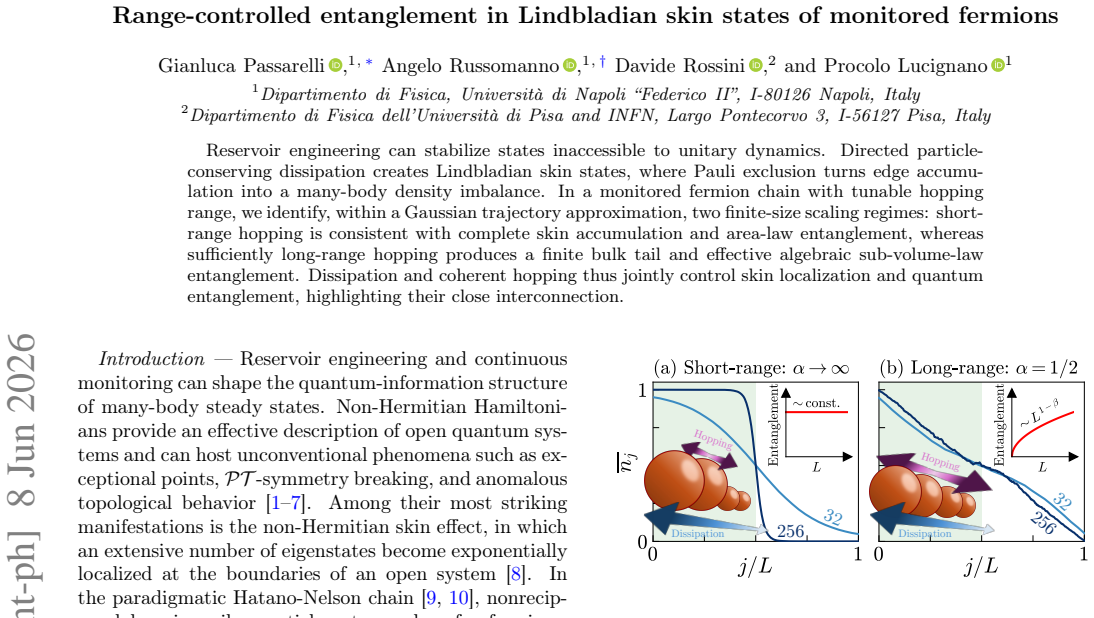
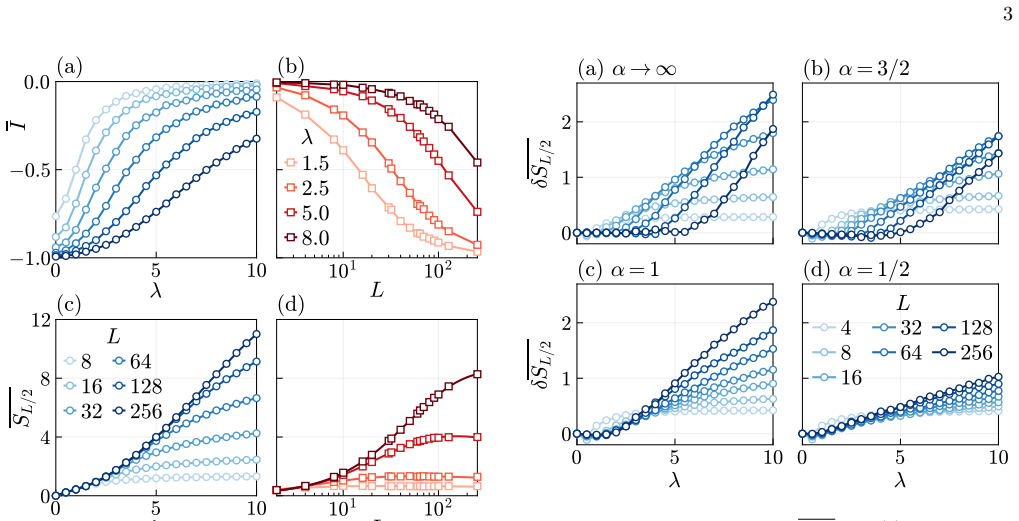
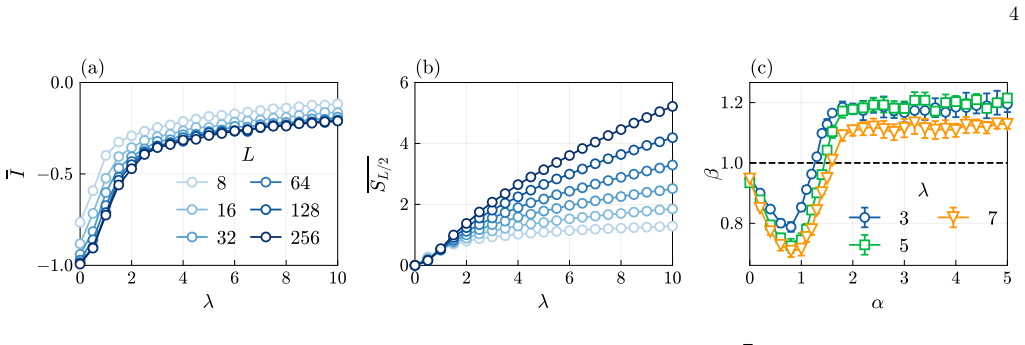
Within a Gaussian trajectory approximation, short-range hopping is consistent with complete skin accumulation and area-law entanglement, whereas sufficiently long-range hopping produces a finite bulk tail and effective algebraic sub-volume-law entanglement. Dissipation and coherent hopping thus jointly control skin localization and quantum entanglement, highlighting their close interconnection.
What carries the argument
The tunable hopping range acting on Lindbladian skin states of monitored fermions under directed particle-conserving dissipation, which sets the transition between full edge pile-up and partial bulk occupation.
If this is right
- Directed dissipation can stabilize either area-law or sub-volume-law entangled states by choice of hopping range.
- The skin effect becomes partial rather than complete once hopping exceeds a threshold set by the dissipation strength.
- Entanglement scaling is directly tied to the spatial profile of the many-body density imbalance.
- Finite-size scaling distinguishes the two regimes without requiring full many-body wave-function reconstruction.
Where Pith is reading between the lines
- Varying hopping range offers an experimental knob to interpolate between localized and delocalized entanglement in open chains.
- The Gaussian approximation may link single-particle non-Hermitian skin physics to many-body entanglement area laws in a controllable way.
- Similar range dependence could appear in other monitored systems where coherent terms compete with local dissipation.
Load-bearing premise
The Gaussian trajectory approximation remains valid across the range of hopping distances studied and correctly captures the many-body density imbalance and entanglement scaling.
What would settle it
A numerical or experimental measurement of entanglement entropy versus system size that shows a clear crossover from area-law to algebraic scaling as hopping range increases, or the absence of such a crossover.
Figures
read the original abstract
Reservoir engineering can stabilize states inaccessible to unitary dynamics. Directed particle-conserving dissipation creates Lindbladian skin states, where Pauli exclusion turns edge accumulation into a many-body density imbalance. In a monitored fermion chain with tunable hopping range, we identify, within a Gaussian trajectory approximation, two finite-size scaling regimes: short-range hopping is consistent with complete skin accumulation and area-law entanglement, whereas sufficiently long-range hopping produces a finite bulk tail and effective algebraic sub-volume-law entanglement. Dissipation and coherent hopping thus jointly control skin localization and quantum entanglement, highlighting their close interconnection.
Editorial analysis
A structured set of objections, weighed in public.
Referee Report
Summary. The manuscript examines Lindbladian skin states in a monitored fermion chain with directed particle-conserving dissipation and tunable hopping range. Within a Gaussian trajectory approximation, it identifies two finite-size scaling regimes: short-range hopping yields complete skin accumulation and area-law entanglement, while sufficiently long-range hopping produces a finite bulk tail and effective algebraic sub-volume-law entanglement. The work argues that dissipation and coherent hopping jointly control skin localization and quantum entanglement.
Significance. If the Gaussian approximation remains quantitatively accurate, the result demonstrates an explicit interconnection between reservoir engineering, hopping range, and many-body entanglement scaling in open quantum systems, providing a concrete example of how dissipation can stabilize states with controlled localization and correlation properties.
major comments (1)
- [Gaussian trajectory approximation (central results section)] The headline distinction between short-range (complete skin + area law) and long-range (finite bulk tail + algebraic entanglement) regimes rests exclusively on the Gaussian trajectory approximation. No independent check—such as exact diagonalization on small chains, higher-order cumulant closure, or direct comparison to full stochastic unraveling—is supplied to confirm that the approximation remains valid once hopping range exceeds nearest-neighbor, where non-Gaussian correlations induced by long-range jump operators could modify both the steady-state density imbalance and the entanglement scaling.
Simulated Author's Rebuttal
We thank the referee for the careful reading and constructive feedback. We address the single major comment below.
read point-by-point responses
-
Referee: [Gaussian trajectory approximation (central results section)] The headline distinction between short-range (complete skin + area law) and long-range (finite bulk tail + algebraic entanglement) regimes rests exclusively on the Gaussian trajectory approximation. No independent check—such as exact diagonalization on small chains, higher-order cumulant closure, or direct comparison to full stochastic unraveling—is supplied to confirm that the approximation remains valid once hopping range exceeds nearest-neighbor, where non-Gaussian correlations induced by long-range jump operators could modify both the steady-state density imbalance and the entanglement scaling.
Authors: We agree that additional benchmarks would strengthen the presentation. The Gaussian trajectory approximation is the natural and exact closure for this class of models: the Hamiltonian is quadratic and the jump operators are linear in the fermionic fields, so the stochastic evolution preserves Gaussianity exactly within each trajectory. This is the same controlled approximation used throughout the monitored-fermion literature for both short- and long-range cases. While we acknowledge that non-Gaussian corrections could appear for very long-range jumps, they are expected to be sub-leading for the scaling regimes we extract. We have added a dedicated paragraph in the revised manuscript that (i) recalls the exact closure property, (ii) cites the relevant literature on Gaussian unravelings, and (iii) explicitly states the regime where higher-order cumulants are expected to remain small. We therefore view the central distinction between the two scaling regimes as robust within the stated approximation. revision: partial
Circularity Check
No circularity detected in derivation chain
full rationale
The abstract and provided context present results obtained within a Gaussian trajectory approximation for short-range vs. long-range hopping regimes, but contain no equations, parameter fits, self-citations, or ansatzes that reduce any claimed prediction or scaling law to its own inputs by construction. No load-bearing steps are visible that match the enumerated circularity patterns, so the derivation is treated as self-contained.
Axiom & Free-Parameter Ledger
Reference graph
Works this paper leans on
-
[1]
Ashida, Z
Y. Ashida, Z. Gong, and M. Ueda, Non-Hermitian physics, Adv. Phys.69, 249 (2020)
2020
-
[2]
C. E. Rüter, K. G. Makris, R. El-Ganainy, D. N. Christodoulides, M. Segev, and D. Kip, Observation of parity–time symmetry in optics, Nat. Phys.6, 192 (2010)
2010
-
[3]
V. M. Martinez Alvarez, J. E. Barrios Vargas, M. Berdakin, and L. E. F. Foa Torres, Topological states of non-Hermitian systems, Eur. Phys. J.: Spec. Top. 227, 1295 (2018)
2018
-
[4]
Opt.23, 123001 (2021)
H.Wang, X.Zhang, J.Hua, D.Lei, M.Lu,andY.Chen, Topological physics of non-Hermitian optics and pho- tonics: a review, J. Opt.23, 123001 (2021)
2021
-
[5]
E. J. Bergholtz, J. C. Budich, and F. K. Kunst, Excep- tional topology of non-Hermitian systems, Rev. Mod. Phys.93, 015005 (2021)
2021
-
[6]
K. Ding, C. Fang, and G. Ma, Non-Hermitian topology and exceptional-point geometries, Nat. Rev. Phys.4, 745 (2022)
2022
-
[7]
Yao and Z
S. Yao and Z. Wang, Edge States and Topological In- variants of Non-Hermitian Systems, Phys. Rev. Lett. 121, 086803 (2018)
2018
-
[8]
Zhang, T
X. Zhang, T. Zhang, M.-H. Lu, and Y.-F. Chen, A re- view on non-Hermitian skin effect, Adv. Phys.: X7, 2109431 (2022)
2022
-
[9]
Hatano and D
N. Hatano and D. R. Nelson, Localization Transitions in Non-Hermitian Quantum Mechanics, Phys. Rev. Lett. 77, 570 (1996)
1996
-
[10]
Hatano and D
N. Hatano and D. R. Nelson, Vortex pinning and non- Hermitian quantum mechanics, Phys. Rev. B56, 8651 (1997)
1997
-
[11]
R. Shen, T. Chen, B. Yang, and C. H. Lee, Observa- tion of the non-Hermitian skin effect and Fermi skin on a digital quantum computer, Nat. Commun.16, 1340 (2025)
2025
-
[12]
L. Xiao, T. Deng, K. Wang, G. Zhu, Z. Wang, W. Yi, and P. Xue, Non-Hermitian bulk–boundary correspon- dence in quantum dynamics, Nat. Phys.16, 761 (2020)
2020
-
[13]
Liang, D
Q. Liang, D. Xie, Z. Dong, H. Li, H. Li, B. Gad- way, W. Yi, and B. Yan, Dynamic Signatures of Non- HermitianSkinEffectandTopologyinUltracoldAtoms, Phys. Rev. Lett.129, 070401 (2022)
2022
-
[14]
E.Zhao, Z.Wang, C.He, T.F.J.Poon, K.K.Pak, Y.-J. Liu, P. Ren, X.-J. Liu, and G.-B. Jo, Two-dimensional non-Hermitian skin effect in an ultracold Fermi gas, Na- ture637, 565 (2025)
2025
-
[15]
F. Song, S. Yao, and Z. Wang, Non-Hermitian Skin Ef- fect and Chiral Damping in Open Quantum Systems, Phys. Rev. Lett.123, 170401 (2019)
2019
-
[16]
Zhou and Z
Z. Zhou and Z. Yu, Non-Hermitian skin effect in quadratic Lindbladian systems: An adjoint fermion ap- proach, Phys. Rev. A106, 032216 (2022)
2022
-
[17]
Y.-M. Hu, Z. Wang, B. Lian, and Z. Wang, Many-Body Non-Hermitian Skin Effect with Exact Steady States in the Dissipative Quantum Link Model, Phys. Rev. Lett. 135, 260401 (2025)
2025
-
[18]
Li, Z.-F
Y. Li, Z.-F. Cai, T. Liu, and F. Nori, Dissipation and interaction-controlled non-Hermitian skin effects, Phys. Rev. B113, 035444 (2026)
2026
-
[19]
Kawabata, T
K. Kawabata, T. Numasawa, and S. Ryu, Entanglement Phase Transition Induced by the Non-Hermitian Skin Effect, Phys. Rev. X13, 021007 (2023)
2023
- [20]
-
[21]
Y. L. Gal, X. Turkeshi, and M. Schirò, Volume-to-area law entanglement transition in a non-Hermitian free fermionic chain, SciPost Phys.14, 138 (2023)
2023
-
[22]
M. J. Gullans and D. A. Huse, Dynamical Purification Phase Transition Induced by Quantum Measurements, Phys. Rev. X10, 041020 (2020)
2020
-
[23]
Y. Li, X. Chen, and M. P. A. Fisher, Quantum Zeno ef- fect and the many-body entanglement transition, Phys. Rev. B98, 205136 (2018)
2018
-
[24]
A. Chan, R. M. Nandkishore, M. Pretko, and G. Smith, Unitary-projective entanglement dynamics, Phys. Rev. B99, 224307 (2019)
2019
-
[25]
Skinner, J
B. Skinner, J. Ruhman, and A. Nahum, Measurement- Induced Phase Transitions in the Dynamics of Entan- glement, Phys. Rev. X9, 031009 (2019)
2019
-
[26]
Szyniszewski, A
M. Szyniszewski, A. Romito, and H. Schomerus, En- tanglement transition from variable-strength weak mea- surements, Phys. Rev. B100, 064204 (2019)
2019
-
[27]
A. C. Potter and R. Vasseur, Entanglement Dynamics in Hybrid Quantum Circuits, inQuantum Science and Technology(Springer International Publishing, Cham,
-
[28]
Y. Bao, S. Choi, and E. Altman, Symmetry enriched phases of quantum circuits, Ann. Phys.435, 168618 (2021)
2021
-
[29]
Nahum and B
A. Nahum and B. Skinner, Entanglement and dynam- ics of diffusion-annihilation processes with Majorana de- fects, Phys. Rev. Res.2, 023288 (2020)
2020
-
[30]
X.Chen, Y.Li, M.P.A.Fisher,andA.Lucas,Emergent conformal symmetry in nonunitary random dynamics of free fermions, Phys. Rev. Res.2, 033017 (2020)
2020
-
[31]
Y. Li, X. Chen, and M. P. A. Fisher, Measurement- driven entanglement transition in hybrid quantum cir- cuits, Phys. Rev. B100, 134306 (2019)
2019
-
[32]
Jian, Y.-Z
C.-M. Jian, Y.-Z. You, R. Vasseur, and A. W. W. Lud- wig, Measurement-induced criticality in random quan- 6 tum circuits, Phys. Rev. B101, 104302 (2020)
2020
-
[33]
Y. Li, R. Vasseur, M. P. A. Fisher, and A. W. W. Lud- wig, Statistical mechanics model for Clifford random tensor networks and monitored quantum circuits, Phys. Rev. B109, 174307 (2024)
2024
-
[34]
Szyniszewski, A
M. Szyniszewski, A. Romito, and H. Schomerus, Univer- sality of Entanglement Transitions from Stroboscopic to Continuous Measurements, Phys. Rev. Lett.125, 210602 (2020)
2020
-
[35]
Turkeshi, R
X. Turkeshi, R. Fazio, and M. Dalmonte, Measurement- induced criticality in(2 + 1)-dimensional hybrid quan- tum circuits, Phys. Rev. B102, 014315 (2020)
2020
-
[36]
O. Lunt, M. Szyniszewski, and A. Pal, Measurement- induced criticality and entanglement clusters: A study of one-dimensional and two-dimensional Clifford cir- cuits, Phys. Rev. B104, 155111 (2021)
2021
-
[37]
Sierant, M
P. Sierant, M. Schirò, M. Lewenstein, and X. Turkeshi, Measurement-induced phase transitions in(d+ 1)- dimensional stabilizer circuits, Phys. Rev. B106, 214316 (2022)
2022
-
[38]
Nahum, S
A. Nahum, S. Roy, B. Skinner, and J. Ruhman, Mea- surement and Entanglement Phase Transitions in All- To-All Quantum Circuits, on Quantum Trees, and in Landau-Ginsburg Theory, PRX Quantum2, 010352 (2021)
2021
-
[39]
Zabalo, M
A. Zabalo, M. J. Gullans, J. H. Wilson, S. Gopalakrish- nan, D. A. Huse, and J. H. Pixley, Critical properties of the measurement-induced transition in random quan- tum circuits, Phys. Rev. B101, 060301 (2020)
2020
-
[40]
Sierant and X
P. Sierant and X. Turkeshi, Universal Behavior beyond Multifractality of Wave Functions at Measurement- Induced Phase Transitions, Phys. Rev. Lett.128, 130605 (2022)
2022
-
[41]
Chiriacò, M
G. Chiriacò, M. Tsitsishvili, D. Poletti, R. Fazio, and M. Dalmonte, Diagrammatic method for many-body non-Markovian dynamics: Memory effects and entan- glement transitions, Phys. Rev. B108, 075151 (2023)
2023
-
[42]
Klocke and M
K. Klocke and M. Buchhold, Majorana Loop Models for Measurement-Only Quantum Circuits, Phys. Rev. X13, 041028 (2023)
2023
-
[43]
Lira-Solanilla, X
A. Lira-Solanilla, X. Turkeshi, and S. Pappalardi, Mul- tipartite entanglement structure of monitored quantum circuits, Phys. Rev. Lett.135, 080401 (2025)
2025
-
[44]
Nehra, A
R. Nehra, A. Romito, and D. Meidan, Controlling measurement-induced phase transitions with tunable detector coupling, Quantum9, 1697 (2025)
2025
-
[45]
A. C. C. de Albornoz, D. C. Rose, and A. Pal, En- tanglement transition and heterogeneity in long-range quadratic Lindbladians, Phys. Rev. B109, 214204 (2024)
2024
-
[46]
M. Fava, L. Piroli, D. Bernard, and A. Nahum, Moni- tored fermions with conservedU(1)charge, Phys. Rev. Res.6, 043246 (2024)
2024
-
[47]
Chahine and M
K. Chahine and M. Buchhold, Entanglement phases, localization, and multifractality of monitored free fermions in two dimensions, Phys. Rev. B110, 054313 (2024)
2024
-
[48]
Delmonte, Z
A. Delmonte, Z. Li, G. Passarelli, E. Y. Song, D. Bar- berena, A. M. Rey, and R. Fazio, Measurement-induced phase transitions in monitored infinite-range interacting systems, Phys. Rev. Res.7, 023082 (2025)
2025
-
[49]
Passarelli, X
G. Passarelli, X. Turkeshi, A. Russomanno, P. Lucig- nano, M. Schirò, and R. Fazio, Many-Body Dynamics in Monitored Atomic Gases without Postselection Bar- rier, Phys. Rev. Lett.132, 163401 (2024)
2024
-
[50]
X. Cao, A. Tilloy, and A. De Luca, Entanglement in a fermion chain under continuous monitoring, SciPost Phys.7, 24 (2019)
2019
-
[51]
Buchhold, Y
M. Buchhold, Y. Minoguchi, A. Altland, and S. Diehl, Effective Theory for the Measurement-Induced Phase Transition of Dirac Fermions, Phys. Rev. X11, 041004 (2021)
2021
-
[52]
C.-M. Jian, B. Bauer, A. Keselman, and A. W. W. Ludwig, Criticality and entanglement in nonunitary quantum circuits and tensor networks of noninteracting fermions, Phys. Rev. B106, 134206 (2022)
2022
-
[53]
Coppola, E
M. Coppola, E. Tirrito, D. Karevski, and M. Collura, Growth of entanglement entropy under local projective measurements, Phys. Rev. B105, 094303 (2022)
2022
-
[54]
M. Fava, L. Piroli, T. Swann, D. Bernard, and A. Nahum, Nonlinear Sigma Models for Monitored Dy- namics of Free Fermions, Phys. Rev. X13, 041045 (2023)
2023
-
[55]
Poboiko, P
I. Poboiko, P. Pöpperl, I. V. Gornyi, and A. D. Mir- lin, Theory of Free Fermions under Random Projective Measurements, Phys. Rev. X13, 041046 (2023)
2023
-
[56]
C.-M. Jian, H. Shapourian, B. Bauer, and A. W. W. Ludwig, Measurement-induced entanglement tran- sitions in quantum circuits of non-interacting fermions: Born-rule versus forced measurements (2023), arXiv:2302.09094 [cond-mat.stat-mech]
arXiv 2023
-
[57]
Merritt and L
J. Merritt and L. Fidkowski, Entanglement transitions with free fermions, Phys. Rev. B107, 064303 (2023)
2023
-
[58]
Alberton, M
O. Alberton, M. Buchhold, and S. Diehl, Entanglement Transition in a Monitored Free-Fermion Chain: From Extended Criticality to Area Law, Phys. Rev. Lett.126, 170602 (2021)
2021
-
[59]
Turkeshi, A
X. Turkeshi, A. Biella, R. Fazio, M. Dalmonte, and M. Schirò, Measurement-induced entanglement transi- tions in the quantum Ising chain: From infinite to zero clicks, Phys. Rev. B103, 224210 (2021)
2021
-
[60]
Szyniszewski, O
M. Szyniszewski, O. Lunt, and A. Pal, Disordered mon- itored free fermions, Phys. Rev. B108, 165126 (2023)
2023
-
[61]
Turkeshi, M
X. Turkeshi, M. Dalmonte, R. Fazio, and M. Schirò, En- tanglement transitions from stochastic resetting of non- Hermitian quasiparticles, Phys. Rev. B105, L241114 (2021)
2021
-
[62]
Piccitto, A
G. Piccitto, A. Russomanno, and D. Rossini, Entangle- ment transitions in the quantum Ising chain: A com- parison between different unravelings of the same Lind- bladian, Phys. Rev. B105, 064305 (2022)
2022
-
[63]
Piccitto, A
G. Piccitto, A. Russomanno, and D. Rossini, Erratum: Entanglement transitions in the quantum Ising chain: A comparison between different unravelings of the same Lindbladian, Phys. Rev. B106, 219901(E) (2022)
2022
-
[64]
Piccitto, A
G. Piccitto, A. Russomanno, and D. Rossini, Entan- glement dynamics with string measurement operators, SciPost Phys. Core6, 078 (2023)
2023
-
[65]
Tirrito, A
E. Tirrito, A. Santini, R. Fazio, and M. Collura, Full counting statistics as probe of measurement-induced transitions in the quantum Ising chain, SciPost Phys. 15, 096 (2023)
2023
-
[66]
Paviglianiti and A
A. Paviglianiti and A. Silva, Multipartite entanglement in the measurement-induced phase transition of the quantum Ising chain, Phys. Rev. B108, 184302 (2023)
2023
-
[67]
Lang and H
N. Lang and H. P. Büchler, Entanglement transition in the projective transverse field Ising model, Phys. Rev. B102, 094204 (2020). 7
2020
-
[68]
Minato, K
T. Minato, K. Sugimoto, T. Kuwahara, and K. Saito, FateofMeasurement-InducedPhaseTransitioninLong- Range Interactions, Phys. Rev. Lett.128, 010603 (2022)
2022
-
[69]
Core6, 051 (2023)
C.ZerbaandA.Silva,Measurementphasetransitionsin the no-click limit as quantum phase transitions of a non- hermitean vacuum, SciPost Phys. Core6, 051 (2023)
2023
-
[70]
Paviglianiti, X
A. Paviglianiti, X. Turkeshi, M. Schirò, and A. Silva, Enhanced Entanglement in the Measurement-Altered Quantum Ising Chain, Quantum8, 1576 (2024)
2024
-
[71]
Chatterjee and R
P. Chatterjee and R. Modak, Measurement-induced phase transition in periodically driven free-fermionic systems, Phys. Rev. B112, 024304 (2025)
2025
-
[72]
Piccitto, D
G. Piccitto, D. Rossini, and A. Russomanno, The im- pact of different unravelings in a monitored system of free fermions, Eur. Phys. J. B97, 90 (2024)
2024
-
[73]
Le Gal, X
Y. Le Gal, X. Turkeshi, and M. Schirò, Entanglement Dynamics in Monitored Systems and the Role of Quan- tum Jumps, PRX Quantum5, 030329 (2024)
2024
-
[74]
Piccitto, G
G. Piccitto, G. Chiriacò, D. Rossini, and A. Russo- manno, Entanglement behavior and localization prop- erties in monitored fermion systems, Phys. Rev. B112, 174311 (2025)
2025
-
[75]
Russomanno, G
A. Russomanno, G. Piccitto, and D. Rossini, Entan- glement transitions and quantum bifurcations under continuous long-range monitoring, Phys. Rev. B108, 104313 (2023)
2023
-
[76]
Lunt and A
O. Lunt and A. Pal, Measurement-induced entangle- ment transitions in many-body localized systems, Phys. Rev. Res.2, 043072 (2020)
2020
-
[77]
Rossini and E
D. Rossini and E. Vicari, Measurement-induced dynam- ics of many-body systems at quantum criticality, Phys. Rev. B102, 035119 (2020)
2020
-
[78]
Tang and W
Q. Tang and W. Zhu, Measurement-induced phase transition: A case study in the nonintegrable model by density-matrix renormalization group calculations, Phys. Rev. Res.2, 013022 (2020)
2020
-
[79]
Fuji and Y
Y. Fuji and Y. Ashida, Measurement-induced quantum criticality under continuous monitoring, Phys. Rev. B 102, 054302 (2020)
2020
-
[80]
Sierant, G
P. Sierant, G. Chiriacò, F. M. Surace, S. Sharma, X. Turkeshi, M. Dalmonte, R. Fazio, and G. Pagano, Dissipative Floquet Dynamics: from Steady State to Measurement Induced Criticality in Trapped-ion Chains, Quantum6, 638 (2022)
2022
discussion (0)
Sign in with ORCID, Apple, or X to comment. Anyone can read and Pith papers without signing in.