OCCAM X. Neutron Capture Abundances with Keck/HIRES & Magellan/MIKE
Pith reviewed 2026-07-02 09:50 UTC · model grok-4.3
The pith
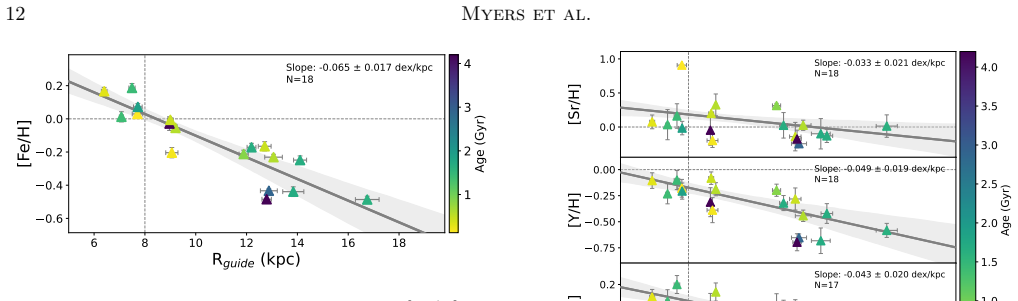
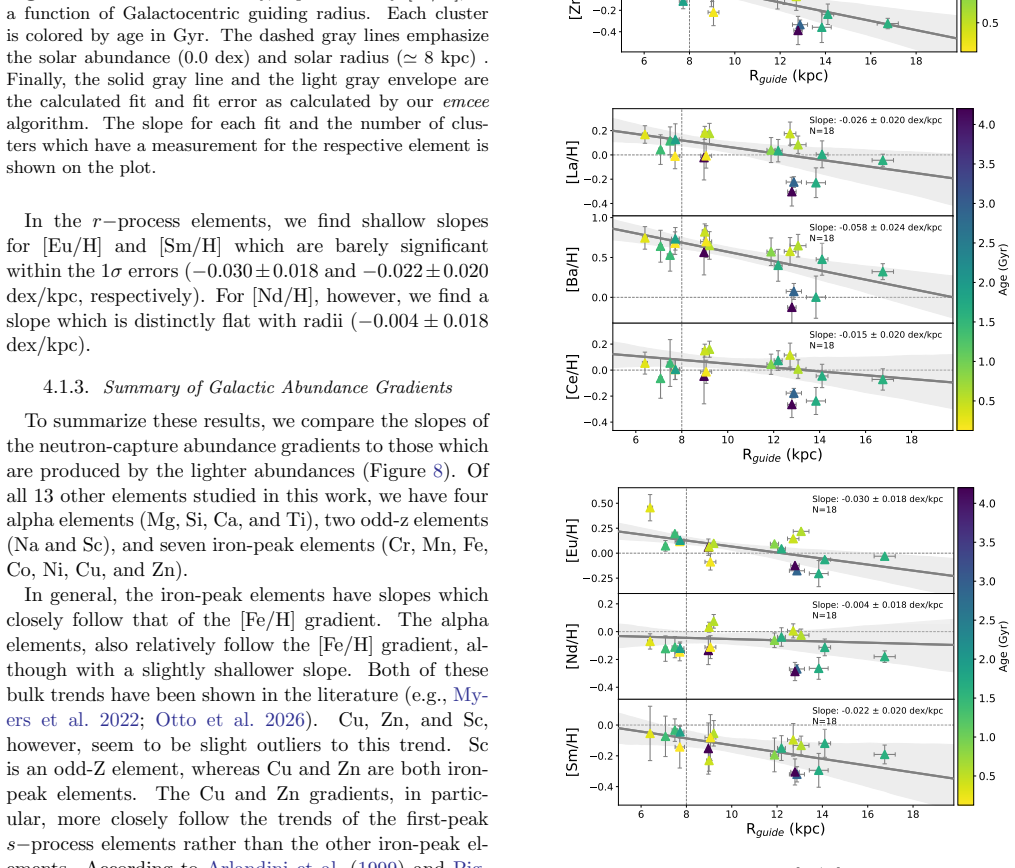
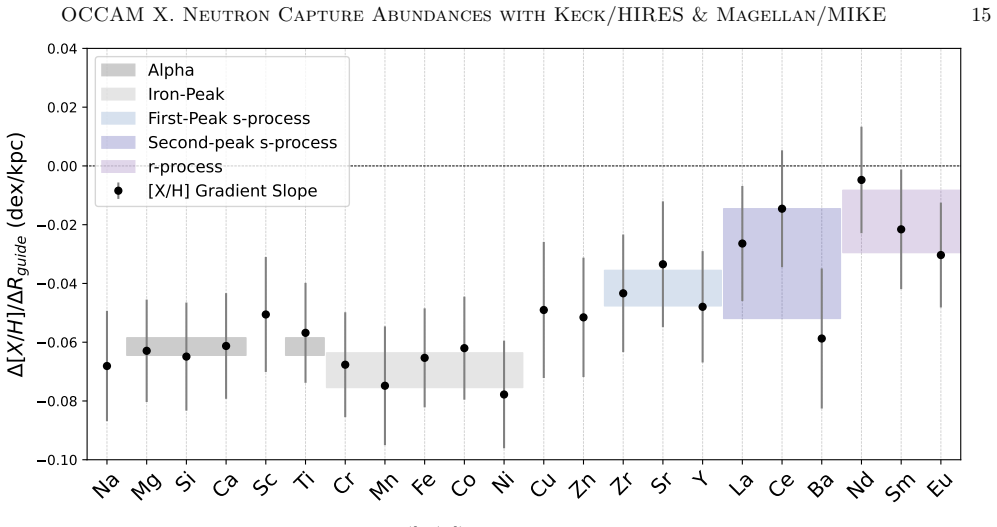
Neutron-capture abundances in open clusters show flatter Milky Way radial gradients than alpha or iron-peak elements.
A machine-rendered reading of the paper's core claim, the machinery that carries it, and where it could break.
Core claim
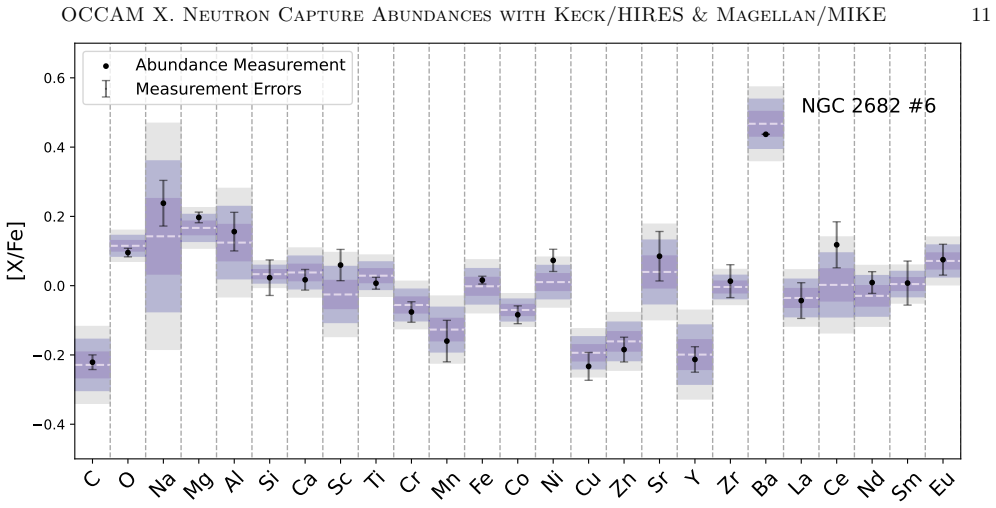
Using BACCHUS on high-resolution spectra of confirmed open-cluster members, the authors derive abundances for 23 elements including seven neutron-capture species. They find that second-peak s-process and r-process abundances exhibit relatively flat gradients across the Milky Way disk. First-peak s-process abundances display slopes that are shallower, though still detectable, compared with the steeper gradients of alpha and iron-peak elements. These differences indicate that the nucleosynthetic sources and enrichment timescales for neutron-capture elements differ from those of lighter species.
What carries the argument
Radial abundance gradients of neutron-capture elements measured in open clusters.
If this is right
- The nucleosynthetic sources of second-peak s-process and r-process elements must operate on longer or more spatially uniform timescales than core-collapse supernovae.
- First-peak s-process production shares some but not all of the radial dependence seen in lighter elements.
- Galactic chemical-evolution models must incorporate a metallicity dependence for AGB yields to reproduce the heaviest s-process abundances.
- Open clusters remain usable as birth-radius tracers once neutron-capture abundances are added to the element set.
Where Pith is reading between the lines
- If r-process events are tied to rare, high-mass mergers or explosions, their flat gradient implies these events occur with little radial preference across the disk.
- Future surveys that add neutron-capture lines to existing APOGEE-like data sets could test whether the flat gradients persist at larger radii or lower metallicities.
- The reported difference between first- and second-peak slopes supplies a direct observational test for yield tables that vary with progenitor mass or metallicity.
Load-bearing premise
The 56 stars are true cluster members whose measured abundances faithfully record the composition of the gas from which they formed, without large systematic offsets introduced by the analysis pipeline.
What would settle it
A larger sample of open clusters at a wide range of birth radii that shows a steep negative gradient in second-peak s-process or r-process abundances comparable to the alpha-element gradient would contradict the reported flat trends.
Figures
read the original abstract
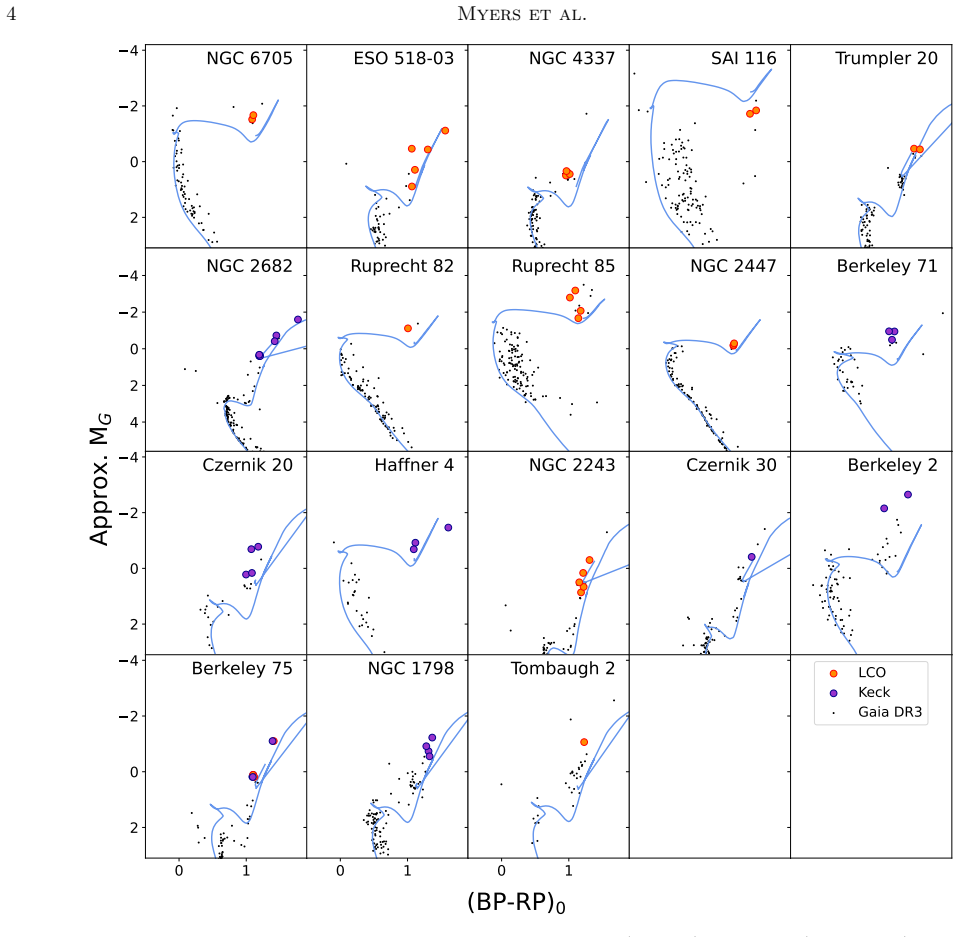
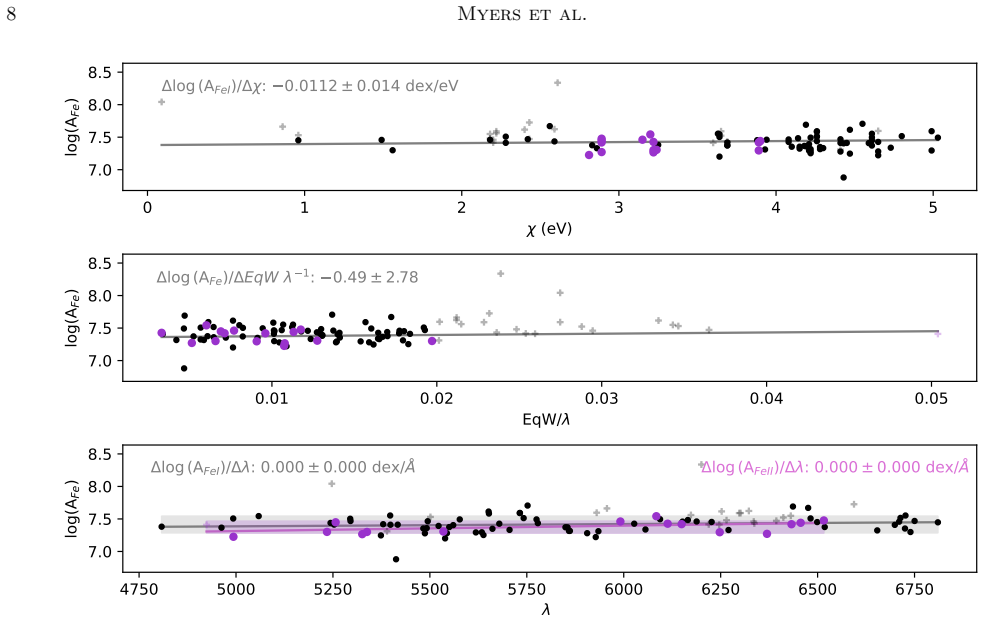
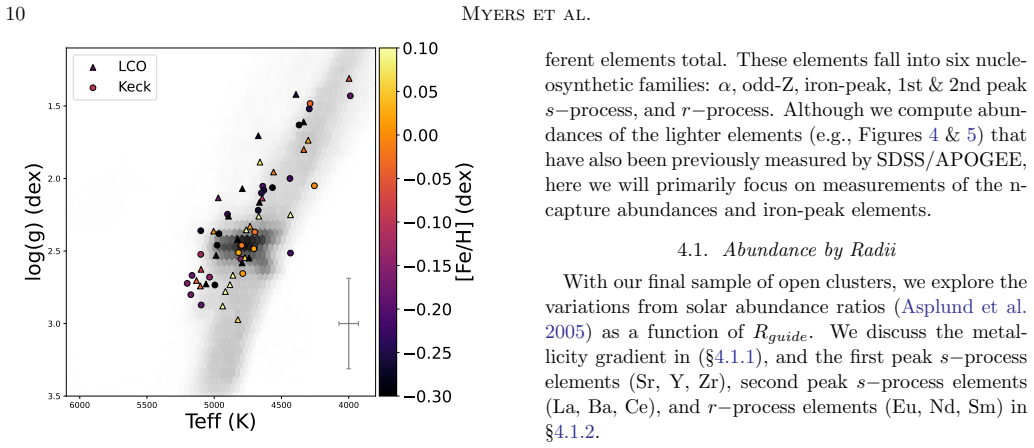
The chemistry of stars provides powerful insight into the history of the Milky Way. With multiple large-sky spectroscopic surveys that are currently available, using chemistry as a means to study the evolution and history of the Milky Way has flourished. Open clusters have long been used as landmarks to calibrate different age dating methods (e.g., gyrochronology and asteroseismology). In this work, we utilize the SDSS-IV/APOGEE-based Open Cluster Chemical Abundances and Mapping (OCCAM) survey as our foundation for new optical observations; enabling us to characterize neutron-capture abundances for known cluster members. For 56 stars in 18 open clusters, we collected high-resolution (R > 50,000), high-S/N (>75 at 5500A), spectra from Keck I and Magellan Baade telescopes. With these data, we derive abundances for 23 elements using BACCHUS, including 7 neutron capture abundances not measurable by APOGEE. Finally, we characterize the radial distribution of these neutron-capture elements in the Milky Way. We find that the second-peak s-process and r-process abundances exhibit relatively flat gradients in the Milky Way. Although not as distinct, the first-peak s-process abundances also have slopes which are shallower than the alpha and iron-peak elements. The differences in the neutron-capture gradients from the lighter elements not just indicates the sources producing these elements are fundamentally different, but that the timescales on which they are produced also differ (especially for the r-process). Moreover, a metallicity dependence of the AGB stars responsible for producing the heaviest s-process abundances may be necessary to consider in Galactic evolution models.
Editorial analysis
A structured set of objections, weighed in public.
Referee Report
Summary. This paper uses new Keck/HIRES and Magellan/MIKE high-resolution spectra of 56 stars in 18 open clusters to derive neutron-capture abundances with the BACCHUS code, extending the APOGEE-based OCCAM survey. It reports that second-peak s-process and r-process elements show relatively flat radial gradients in the Milky Way, while first-peak s-process elements have shallower slopes than alpha and iron-peak elements, suggesting differences in production sites and timescales, and possibly a metallicity dependence for AGB yields.
Significance. The results, if confirmed, highlight the value of combining optical and infrared spectroscopy for a complete picture of Galactic chemical evolution. The flatter gradients for heavier elements provide observational constraints that can test models of r-process and s-process enrichment, particularly the role of AGB stars at different metallicities. The dataset of 23 elements for cluster stars is a useful addition to the field.
major comments (3)
- [Membership Validation] The description of how the 56 stars were confirmed as cluster members lacks detail on the specific criteria used (e.g., proper motions from Gaia, radial velocity agreement, or chemical homogeneity). This is critical because any field star contamination would directly impact the derived gradients and the comparison between element groups.
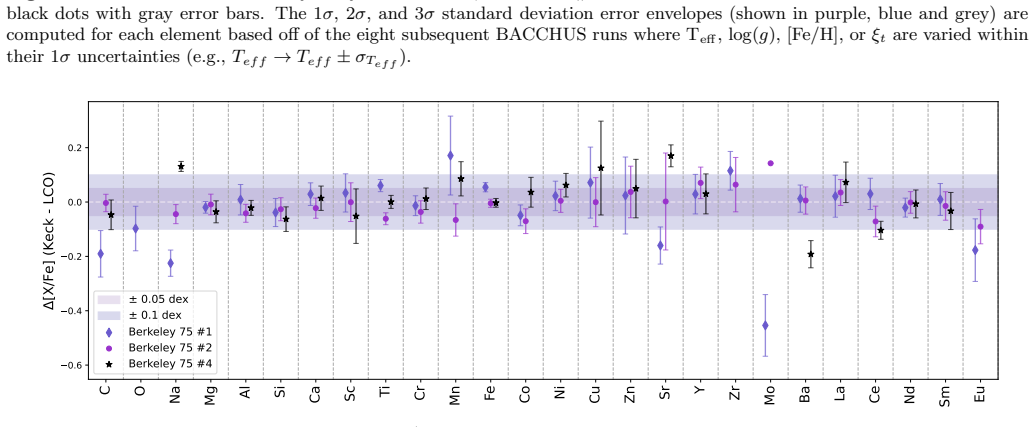
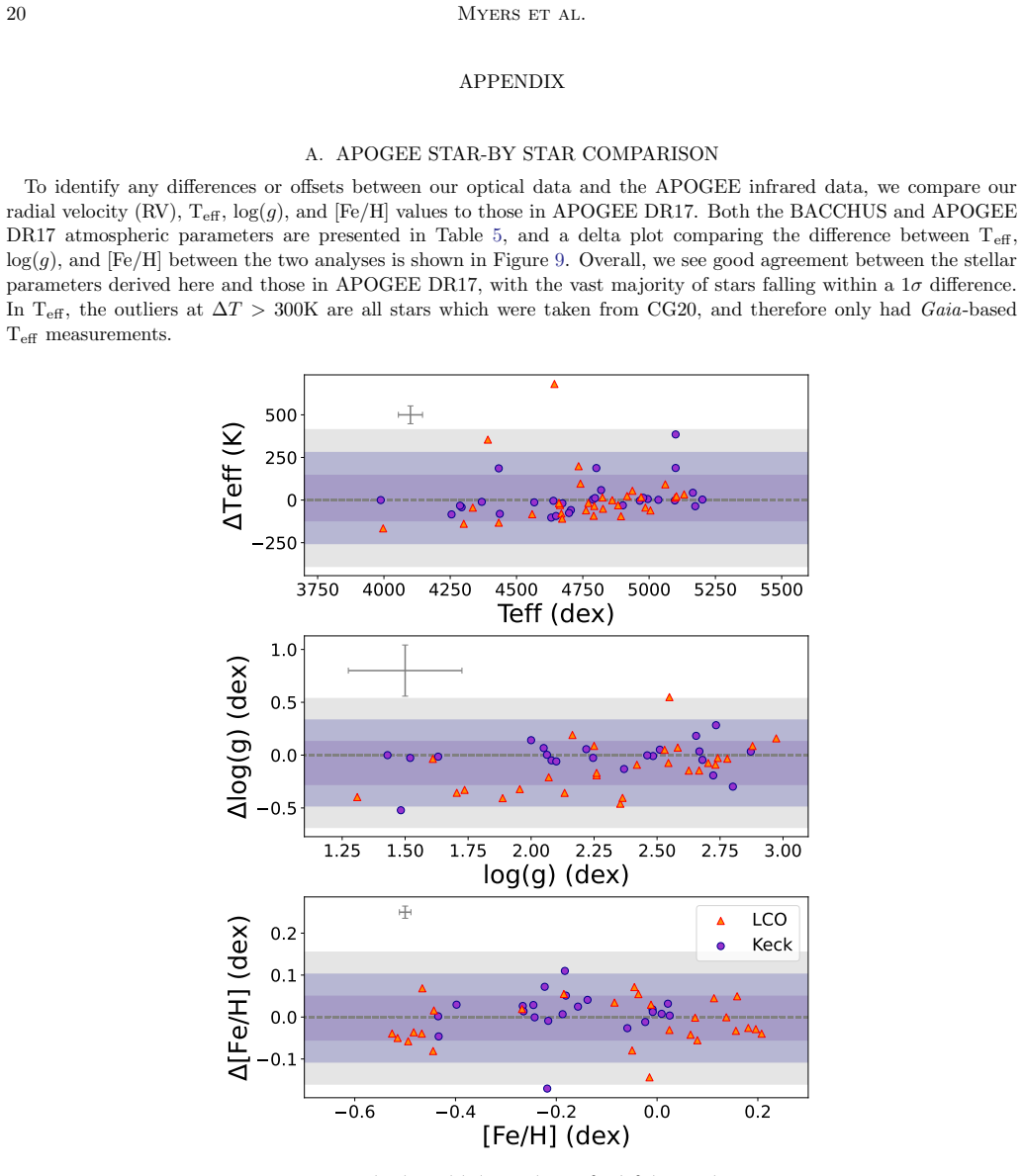
- [Abundance Comparison] The section on abundance analysis does not report quantitative comparisons (mean offset, scatter) between the BACCHUS abundances and APOGEE values for the 16 overlapping elements. Without this, it is difficult to assess whether systematic differences could explain the reported difference in gradients between neutron-capture and lighter elements.
- [Gradient Fitting] In the radial gradient analysis, the use of present-day Galactocentric radii is not accompanied by a discussion of radial migration or birth-radius estimates. This assumption is load-bearing for interpreting the flat gradients as evidence of distinct production timescales.
minor comments (2)
- [Abstract] The abstract would benefit from including the number of clusters and stars, and a brief note on the uncertainties associated with the gradient slopes.
- [Tables] Table listing the clusters and stars should include the derived abundances or at least references to where they are tabulated.
Simulated Author's Rebuttal
We thank the referee for their constructive comments on our manuscript. We address each major point below and will revise the paper to improve clarity and address concerns where possible.
read point-by-point responses
-
Referee: [Membership Validation] The description of how the 56 stars were confirmed as cluster members lacks detail on the specific criteria used (e.g., proper motions from Gaia, radial velocity agreement, or chemical homogeneity). This is critical because any field star contamination would directly impact the derived gradients and the comparison between element groups.
Authors: We agree additional detail is warranted. The membership is inherited from the OCCAM survey, but in the revised manuscript we will expand Section 2 to explicitly list the criteria applied: Gaia DR3 proper motions consistent with the cluster mean within 3 sigma, radial velocities agreeing to within 4 km/s of the cluster systemic velocity, and chemical homogeneity in [Fe/H] and [Mg/Fe] within the observed cluster dispersion. We will also cite the prior OCCAM membership validation. revision: yes
-
Referee: [Abundance Comparison] The section on abundance analysis does not report quantitative comparisons (mean offset, scatter) between the BACCHUS abundances and APOGEE values for the 16 overlapping elements. Without this, it is difficult to assess whether systematic differences could explain the reported difference in gradients between neutron-capture and lighter elements.
Authors: We will add a new table in the abundance analysis section reporting mean offsets and standard deviations for all 16 overlapping elements. Our internal checks show typical offsets below 0.05 dex and scatters of ~0.08-0.12 dex, confirming that systematics are small and cannot account for the distinct neutron-capture gradient slopes, which rely on the newly measured elements. revision: yes
-
Referee: [Gradient Fitting] In the radial gradient analysis, the use of present-day Galactocentric radii is not accompanied by a discussion of radial migration or birth-radius estimates. This assumption is load-bearing for interpreting the flat gradients as evidence of distinct production timescales.
Authors: We will add a dedicated paragraph in the discussion acknowledging that birth-radius estimates are not feasible with the current dataset and require additional dynamical modeling. However, the differential gradients (flatter for neutron-capture species versus alpha and iron-peak elements) remain informative even under migration, as migration would affect all species similarly; we will cite relevant literature on this point while noting the limitation. revision: partial
Circularity Check
No circularity: gradients are direct fits to new observational data
full rationale
The paper collects new Keck/HIRES and Magellan/MIKE spectra for 56 stars, derives abundances for 23 elements (including 7 neutron-capture species) via the BACCHUS pipeline, and reports the resulting radial gradients as empirical measurements. No step equates a claimed prediction or first-principles result to a fitted parameter from the same dataset by construction, nor does any load-bearing premise reduce to a self-citation chain. The central claim (shallower neutron-capture gradients) is the output of applying standard abundance analysis and linear fitting to the newly acquired data, with no equations or derivations shown that would make the reported slopes tautological with the inputs.
Axiom & Free-Parameter Ledger
Reference graph
Works this paper leans on
-
[6]
Solar twins and the Barium puzzle
Solar Twins and the Barium Puzzle. , keywords =. doi:10.3847/1538-4357/aa81d6 , archivePrefix =. 1707.07051 , primaryClass =
work page internal anchor Pith review Pith/arXiv arXiv doi:10.3847/1538-4357/aa81d6
-
[7]
Keck/HIRES Spectroscopic Analysis of Barium Abundances. , keywords =. doi:10.3847/1538-4357/ab8f33 , adsurl =
-
[9]
Implications for the formation of star clusters from extragalactic star formation rates. , keywords =. doi:10.1111/j.1365-2966.2004.07758.x , archivePrefix =. astro-ph/0402631 , primaryClass =
-
[15]
The Gaia-ESO Survey: Homogenisation of stellar parameters and elemental abundances. , keywords =. doi:10.1051/0004-6361/202345910 , archivePrefix =. 2304.07720 , primaryClass =
-
[18]
Gas expulsion and the destruction of massive young clusters. , keywords =. doi:10.1111/j.1365-2966.2006.11078.x , archivePrefix =. astro-ph/0609477 , primaryClass =
-
[19]
The GALAH survey: Improving chemical abundances using star clusters. arXiv e-prints , keywords =. doi:10.48550/arXiv.2501.06140 , archivePrefix =. 2501.06140 , primaryClass =
-
[20]
The GALAH survey: elemental abundances in open clusters using joint effective temperature and surface gravity photometric priors. , keywords =. doi:10.1093/mnras/stae439 , archivePrefix =. 2402.07748 , primaryClass =
-
[21]
A Gaia DR2 view of the Open Cluster population in the Milky Way
A Gaia DR2 view of the open cluster population in the Milky Way. , keywords =. doi:10.1051/0004-6361/201833476 , archivePrefix =. 1805.08726 , primaryClass =
work page internal anchor Pith review Pith/arXiv arXiv doi:10.1051/0004-6361/201833476
-
[23]
Astronomische Nachrichten , archivePrefix = "arXiv", eprint =
Chemical abundance gradients from open clusters in the Milky Way disk: Results from the APOGEE survey. Astronomische Nachrichten , archivePrefix = "arXiv", eprint =. doi:10.1002/asna.201612398 , adsurl =
-
[26]
Turbospectrum: Code for spectral synthesis
-
[28]
The GALAH survey: tracing the Galactic disc with open clusters. , keywords =. doi:10.1093/mnras/stab471 , archivePrefix =. 2011.02533 , primaryClass =
-
[29]
The Solar Twin Planet Search. III. The [Y/Mg] clock: estimating stellar ages of solar-type stars. , keywords =. doi:10.1051/0004-6361/201527848 , archivePrefix =. 1604.05733 , primaryClass =
work page internal anchor Pith review Pith/arXiv arXiv doi:10.1051/0004-6361/201527848
-
[30]
Asteroseismic fundamental properties of solar-type stars observed by the NASA Kepler Mission
Asteroseismic Fundamental Properties of Solar-type Stars Observed by the NASA Kepler Mission. , keywords =. doi:10.1088/0067-0049/210/1/1 , archivePrefix =. 1310.4001 , primaryClass =
work page internal anchor Pith review Pith/arXiv arXiv doi:10.1088/0067-0049/210/1/1
-
[31]
The Second APOKASC Catalog: The Empirical Approach
The Second APOKASC Catalog: The Empirical Approach. , keywords =. doi:10.3847/1538-4365/aaebfd , archivePrefix =. 1804.09983 , primaryClass =
work page internal anchor Pith review Pith/arXiv arXiv doi:10.3847/1538-4365/aaebfd
-
[32]
Advanced Technology Optical/IR Telescopes VI , year = 1998, editor =
Early performance and present status of the Hobby-Eberly Telescope. Advanced Technology Optical/IR Telescopes VI , year = 1998, editor =. doi:10.1117/12.319287 , adsurl =
-
[33]
Optical Astronomical Instrumentation , year = 1998, editor =
High-resolution fiber-coupled spectrograph of the Hobby-Eberly Telescope. Optical Astronomical Instrumentation , year = 1998, editor =. doi:10.1117/12.316774 , adsurl =
-
[34]
APOKASC-3: The Third Joint Spectroscopic and Asteroseismic Catalog for Evolved Stars in the Kepler Fields. , keywords =. doi:10.3847/1538-4365/ad9fef , archivePrefix =. 2410.00102 , primaryClass =
-
[35]
, year = 1951, month = nov, volume =
The Possible Influence of Interstellar Clouds on Stellar Velocities. , year = 1951, month = nov, volume =. doi:10.1086/145478 , adsurl =
-
[36]
Lu, Yuxi (Lucy) and Angus, Ruth and Curtis, Jason L. and David, Trevor J. and Kiman, Rocio , title =. The Astronomical Journal , abstract =. 2021 , month =. doi:10.3847/1538-3881/abe4d6 , url =
-
[37]
s-processing in AGB Stars Revisited. III. Neutron Captures from MHD Mixing at Different Metallicities and Observational Constraints. , keywords =. doi:10.3847/1538-4357/abca8e , archivePrefix =. 2011.07469 , primaryClass =
-
[38]
The GALAH Survey: Observational Overview and Gaia DR1 companion
The GALAH survey: observational overview and Gaia DR1 companion. , keywords =. doi:10.1093/mnras/stw2835 , archivePrefix =. 1609.02822 , primaryClass =
work page internal anchor Pith review Pith/arXiv arXiv doi:10.1093/mnras/stw2835
-
[39]
Comparative analysis of atmospheric parameters from high-resolution spectroscopic sky surveys: APOGEE, GALAH, Gaia-ESO. , keywords =. doi:10.1051/0004-6361/202244813 , archivePrefix =. 2211.03416 , primaryClass =
-
[43]
The Messenger , year = 2012, month = mar, volume =
The Gaia-ESO Public Spectroscopic Survey. The Messenger , year = 2012, month = mar, volume =
2012
-
[46]
The origin and evolution of r- and s-process elements in the Milky Way stellar disk
The origin and evolution of r- and s-process elements in the Milky Way stellar disk. , keywords =. doi:10.1051/0004-6361/201527385 , archivePrefix =. 1511.00966 , primaryClass =
work page internal anchor Pith review Pith/arXiv arXiv doi:10.1051/0004-6361/201527385
-
[47]
Photometric content and validation
Gaia Early Data Release 3. Photometric content and validation. , keywords =. doi:10.1051/0004-6361/202039587 , archivePrefix =. 2012.01916 , primaryClass =
-
[49]
arXiv e-prints , keywords =
TLUSTY and SYNSPEC Users's Guide IV: Upgraded Versions 208 and 54. arXiv e-prints , keywords =
-
[52]
New Astronomy Reviews , year = 2013, month = sep, volume =
Elemental abundances in the Milky Way stellar disk(s), bulge, and halo. New Astronomy Reviews , year = 2013, month = sep, volume =. doi:10.1016/j.newar.2013.06.001 , adsurl =
-
[53]
The Gaia-ESO Survey: radial metallicity gradients and age-metallicity relation of stars in the Milky Way disk. , keywords =. doi:10.1051/0004-6361/201423456 , archivePrefix =. 1401.4437 , primaryClass =
work page internal anchor Pith review Pith/arXiv arXiv doi:10.1051/0004-6361/201423456
-
[54]
, archivePrefix = "arXiv", eprint =
A Chemical Abundance Study of 10 Open Clusters Based on WIYN-Hydra Spectroscopy. , archivePrefix = "arXiv", eprint =. doi:10.1088/0004-6256/142/2/59 , adsurl =
-
[55]
, keywords =
Metallicities and radial velocities of old open clusters. , keywords =
-
[56]
Some Revised Observational Constraints on the Formation and Evolution of the Galactic Disk
Some Revised Observational Constraints on the Formation and Evolution of the Galactic Disk. , keywords =. doi:10.1086/118667 , archivePrefix =. astro-ph/9709122 , primaryClass =
work page internal anchor Pith review Pith/arXiv arXiv doi:10.1086/118667
-
[60]
The Gaia-ESO survey: Age-chemical-clock relations spatially resolved in the Galactic disc. , keywords =. doi:10.1051/0004-6361/202142937 , archivePrefix =. 2202.04863 , primaryClass =
-
[61]
The Apache Point Observatory Galactic Evolution Experiment (APOGEE) Spectrographs
The Apache Point Observatory Galactic Evolution Experiment (APOGEE) Spectrographs. , keywords =. doi:10.1088/1538-3873/ab0075 , archivePrefix =. 1902.00928 , primaryClass =
work page internal anchor Pith review Pith/arXiv arXiv doi:10.1088/1538-3873/ab0075 1902
-
[64]
Berkeley 17: The Oldest Open Cluster?. , keywords =. doi:10.1086/304272 , adsurl =
-
[65]
High-precision abundances of elements in solar twin stars. Trends with stellar age and elemental condensation temperature. , keywords =. doi:10.1051/0004-6361/201526269 , archivePrefix =. 1504.07598 , primaryClass =
work page internal anchor Pith review Pith/arXiv arXiv doi:10.1051/0004-6361/201526269
-
[66]
Identification of Neodymium in the Apogee H-Band Spectra. , keywords =. doi:10.3847/1538-4357/833/1/81 , adsurl =
-
[67]
FIRE-2 Simulations: Physics versus Numerics in Galaxy Formation
FIRE-2 simulations: physics versus numerics in galaxy formation. , keywords =. doi:10.1093/mnras/sty1690 , archivePrefix =. 1702.06148 , primaryClass =
work page internal anchor Pith review Pith/arXiv arXiv doi:10.1093/mnras/sty1690
-
[68]
Reconciling Dwarf Galaxies with CDM Cosmology: Simulating a Realistic Population of Satellites around a Milky Way-mass Galaxy. , keywords =. doi:10.3847/2041-8205/827/2/L23 , archivePrefix =. 1602.05957 , primaryClass =
work page internal anchor Pith review Pith/arXiv arXiv doi:10.3847/2041-8205/827/2/l23 2041
-
[69]
Summary of the content and survey properties
Gaia Data Release 3. Summary of the content and survey properties. , keywords =. doi:10.1051/0004-6361/202243940 , archivePrefix =. 2208.00211 , primaryClass =
-
[72]
Instrumentation in Astronomy VIII , year = 1994, editor =
HIRES: the high-resolution echelle spectrometer on the Keck 10-m Telescope. Instrumentation in Astronomy VIII , year = 1994, editor =. doi:10.1117/12.176725 , adsurl =
-
[78]
Updated radial velocities from Gaia DR2
Gaia Early Data Release 3. Updated radial velocities from Gaia DR2. , keywords =. doi:10.1051/0004-6361/202141008 , archivePrefix =. 2108.02796 , primaryClass =
-
[79]
Summary of the contents and survey properties
Gaia Data Release 2. Summary of the contents and survey properties. ArXiv e-prints , archivePrefix = "arXiv", eprint =
-
[80]
ArXiv e-prints , archivePrefix = "arXiv", eprint =
Gaia Data Release 2: The astrometric solution. ArXiv e-prints , archivePrefix = "arXiv", eprint =
-
[81]
Production of ^ 14 C and neutrons in red giants. , keywords =. doi:10.1086/155030 , adsurl =
-
[82]
ArXiv e-prints , archivePrefix = "arXiv", eprint =
Gaia Data Release 2: processing of the photometric data. ArXiv e-prints , archivePrefix = "arXiv", eprint =
-
[83]
Publications of the Astronomical Society of Australia , keywords =
The GALAH survey: Data release 4. Publications of the Astronomical Society of Australia , keywords =. doi:10.1017/pasa.2025.26 , archivePrefix =. 2409.19858 , primaryClass =
-
[84]
Journal of Astronomical Telescopes, Instruments, and Systems , year = 2015, month = jul, volume =
First light results from the High Efficiency and Resolution Multi-Element Spectrograph at the Anglo-Australian Telescope. Journal of Astronomical Telescopes, Instruments, and Systems , year = 2015, month = jul, volume =. doi:10.1117/1.JATIS.1.3.035002 , adsurl =
-
[85]
Spectroscopic Analysis of Neutron Capture Elements in Open Clusters
-
[86]
, archivePrefix = "arXiv", eprint =
The Apache Point Observatory Galactic Evolution Experiment (APOGEE). , archivePrefix = "arXiv", eprint =. doi:10.3847/1538-3881/aa784d , adsurl =
-
[87]
, archivePrefix = "arXiv", eprint =
SDSS-III: Massive Spectroscopic Surveys of the Distant Universe, the Milky Way, and Extra-Solar Planetary Systems. , archivePrefix = "arXiv", eprint =. doi:10.1088/0004-6256/142/3/72 , adsurl =
-
[89]
, archivePrefix = "arXiv", eprint =
Sloan Digital Sky Survey IV: Mapping the Milky Way, Nearby Galaxies, and the Distant Universe. , archivePrefix = "arXiv", eprint =. doi:10.3847/1538-3881/aa7567 , adsurl =
-
[91]
Answers Research Journal , keywords =
A Discussion of Stellar Nucleosynthesis. Answers Research Journal , keywords =. doi:10.1126/science.aau9540 , url =
-
[92]
The chemical make-up of the Sun: A 2020 vision
The chemical make-up of the Sun: A 2020 vision. , keywords =. doi:10.1051/0004-6361/202140445 , archivePrefix =. 2105.01661 , primaryClass =
work page internal anchor Pith review Pith/arXiv arXiv doi:10.1051/0004-6361/202140445 2020
-
[93]
Understanding the Origin and Dynamical Evolution of the Unique Open Star Cluster Berkeley 20 Using FIRE Simulations. , keywords =. doi:10.3847/2041-8213/ae21bf , archivePrefix =. 2511.14958 , primaryClass =
-
[96]
The Evolution and Explosion of Massive Stars. II. Explosive Hydrodynamics and Nucleosynthesis. , keywords =. doi:10.1086/192237 , adsurl =
-
[99]
The role of radial migration in open cluster and field star populations with Gaia DR3. , keywords =. doi:10.1051/0004-6361/202346963 , archivePrefix =. 2309.17153 , primaryClass =
-
[102]
BACCHUS: Brussels Automatic Code for Characterizing High accUracy Spectra
-
[107]
isochrones: Stellar model grid package
-
[108]
Cosmic Abundances as Records of Stellar Evolution and Nucleosynthesis , year = 2005, editor =
The Solar Chemical Composition. Cosmic Abundances as Records of Stellar Evolution and Nucleosynthesis , year = 2005, editor =
2005
-
[109]
MESA Isochrones and Stellar Tracks (MIST) 0: Methods for the construction of stellar isochrones
MESA Isochrones and Stellar Tracks (MIST) 0: Methods for the Construction of Stellar Isochrones. , keywords =. doi:10.3847/0067-0049/222/1/8 , archivePrefix =. 1601.05144 , primaryClass =
work page internal anchor Pith review Pith/arXiv arXiv doi:10.3847/0067-0049/222/1/8
-
[110]
Modules for Experiments in Stellar Astrophysics (MESA)
Modules for Experiments in Stellar Astrophysics (MESA). , keywords =. doi:10.1088/0067-0049/192/1/3 , archivePrefix =. 1009.1622 , primaryClass =
work page internal anchor Pith review Pith/arXiv arXiv doi:10.1088/0067-0049/192/1/3
-
[111]
Modules for Experiments in Stellar Astrophysics (MESA): Planets, Oscillations, Rotation, and Massive Stars. , keywords =. doi:10.1088/0067-0049/208/1/4 , archivePrefix =. 1301.0319 , primaryClass =
work page internal anchor Pith review Pith/arXiv arXiv doi:10.1088/0067-0049/208/1/4
-
[112]
Modules for Experiments in Stellar Astrophysics (MESA): Binaries, Pulsations, and Explosions
Modules for Experiments in Stellar Astrophysics (MESA): Binaries, Pulsations, and Explosions. , keywords =. doi:10.1088/0067-0049/220/1/15 , archivePrefix =. 1506.03146 , primaryClass =
work page internal anchor Pith review Pith/arXiv arXiv doi:10.1088/0067-0049/220/1/15
-
[113]
Mesa Isochrones and Stellar Tracks (MIST). I. Solar-scaled Models. , keywords =. doi:10.3847/0004-637X/823/2/102 , archivePrefix =. 1604.08592 , primaryClass =
work page internal anchor Pith review Pith/arXiv arXiv doi:10.3847/0004-637x/823/2/102
-
[114]
Modules for Experiments in Stellar Astrophysics (MESA): Convective Boundaries, Element Diffusion, and Massive Star Explosions. , keywords =. doi:10.3847/1538-4365/aaa5a8 , archivePrefix =. 1710.08424 , primaryClass =
work page internal anchor Pith review Pith/arXiv arXiv doi:10.3847/1538-4365/aaa5a8
-
[115]
Modules for Experiments in Stellar Astrophysics (MESA): Pulsating Variable Stars, Rotation, Convective Boundaries, and Energy Conservation. , keywords =. doi:10.3847/1538-4365/ab2241 , archivePrefix =. 1903.01426 , primaryClass =
work page internal anchor Pith review Pith/arXiv arXiv doi:10.3847/1538-4365/ab2241 1903
-
[116]
Modules for Experiments in Stellar Astrophysics (MESA): Time-dependent Convection, Energy Conservation, Automatic Differentiation, and Infrastructure. , keywords =. doi:10.3847/1538-4365/acae8d , archivePrefix =. 2208.03651 , primaryClass =
-
[119]
Evolutionary Sequences of Stellar Models with New Radiative Opacities. II. Z = 0.02. , keywords =
-
[121]
Zero-metallicity stars. I. Evolution at constant mass. , keywords =. doi:10.1051/0004-6361:20010309 , archivePrefix =. astro-ph/0102253 , primaryClass =
work page internal anchor Pith review Pith/arXiv arXiv doi:10.1051/0004-6361:20010309
-
[123]
Instrumentation in astronomy VI , year = 1986, editor =
The IRAF Data Reduction and Analysis System. Instrumentation in astronomy VI , year = 1986, editor =. doi:10.1117/12.968154 , adsurl =
-
[124]
Astronomical Data Analysis Software and Systems II , year = 1993, editor =
IRAF in the Nineties. Astronomical Data Analysis Software and Systems II , year = 1993, editor =
1993
-
[127]
, keywords =
Barium abundances in cool dwarf stars as a constraint to s- and r-process nucleosynthesis. , keywords =
-
[130]
Can Neutron Star Mergers Alone Explain the r-process Enrichment of the Milky Way?. , keywords =. doi:10.3847/2041-8213/acad82 , archivePrefix =. 2211.04964 , primaryClass =
-
[131]
Chemical Cartography with APOGEE: Metallicity Distribution Functions and the Chemical Structure of the Milky Way Disk. , keywords =. doi:10.1088/0004-637X/808/2/132 , archivePrefix =. 1503.02110 , primaryClass =
work page internal anchor Pith review Pith/arXiv arXiv doi:10.1088/0004-637x/808/2/132
-
[132]
The Galactic Thick Disk Stellar Abundances
The Galactic Thick Disk Stellar Abundances. , keywords =. doi:10.1086/316818 , archivePrefix =. astro-ph/0008075 , primaryClass =
work page internal anchor Pith review Pith/arXiv arXiv doi:10.1086/316818
-
[133]
Spectroscopic age estimates for APOGEE red-giant stars: Precise spatial and kinematic trends with age in the Galactic disc. , keywords =. doi:10.1051/0004-6361/202346666 , archivePrefix =. 2304.08276 , primaryClass =
-
[134]
The Gaia-ESO survey: Calibrating a relationship between age and the [C/N] abundance ratio with open clusters. , keywords =. doi:10.1051/0004-6361/201935282 , archivePrefix =. 1907.07350 , primaryClass =
-
[135]
APOGEE DR17 [C/N]-Age Calibration
The Open Cluster Chemical Abundances and Mapping Survey: VII. APOGEE DR17 [C/N]-Age Calibration. arXiv e-prints , keywords =
-
[136]
The Gaia-ESO survey: the non-universality of the age-chemical-clocks-metallicity relations in the Galactic disc. , keywords =. doi:10.1051/0004-6361/202038055 , archivePrefix =. 2006.05763 , primaryClass =
-
[137]
How Magnetic Activity Alters What We Learn from Stellar Spectra. , keywords =. doi:10.3847/1538-4357/ab8bd7 , archivePrefix =. 2004.09771 , primaryClass =
discussion (0)
Sign in with ORCID, Apple, or X to comment. Anyone can read and Pith papers without signing in.