REVIEW 5 major objections 6 minor 31 references
CPR: Leveraging LLMs for Topic and Phrase Suggestion to Facilitate Comprehensive Product Reviews
T0 review · 5 major / 6 minor · reviewed 2026-08-16 · deepseek-v4-flash
Pith's one-line read A fine-tuned large language model, guided by product-type topics and per-topic star ratings, can suggest review phrases that match the vocabulary and sentiment of real customer reviews, and can generate relevant topics even for products…
desk verdict CPR is a plausible review-guidance system whose quantitative evaluation is too shaky to support the stated claims. read the letter →
The pith
A machine-rendered reading of the paper's core claim, the machinery that carries it, and where it could break.
The reading
What carries the argument
The load-bearing mechanism is the CPR prompt template, which couples three inputs—product type, topic tags, and a star rating per tag—to one phrase output, with a closing instruction that tells the model not to mention ratings and to use synonyms for the tags. Around this template sits a two-part data pipeline: frequent-mention tags are mined from existing reviews for product types that have them, and for product types without reviews an LLM first retrieves similar product types and then generates tags. The phrase generator is the pre-trained LLM fine-tuned with Low-Rank Adaptation (LoRA), which updates only small low-rank matrices in the attention layers, along with 4-bit quantization and gradient checkpointing, so the 12,000-review fine-tune runs on a consumer GPU. The prompt format and the fine-tuning data together are what keep the output inside customer vocabulary and sentiment range rather than drifting into generic or hallucinated text.
What would settle it
Re-run the evaluation with a strict split that removes every BLEU reference review from the 12,000-review fine-tuning set, then recompute the three BLEU scores under the same filtering rules; if the 12.3 percent advantage over the baselines disappears, the improvement is memorization rather than phrase-generation quality.
Extended reading notes
Core claim
CPR's central claim is that review phrase generation should be a rating-conditioned, guided act rather than free-form text generation. Given a product type, a few frequent-mention topic tags, and a star rating per tag, a fine-tuned LLM trained on 12,000 reviews in an instruction/context/response format produces phrases that express the intended sentiment without naming the rating and without inventing product details absent from the prompt. The same LLM, prompted to find similar product types, supplies topic tags for new products that have no review history, a step the authors show is more accurate than edit-distance or embedding cosine similarity. In case studies on perfumes, stuffed toys, and ruffled tops, the generated phrases track the intended sentiment (for example, sentiment scores of 0.17 for roughly one-star perfume reviews and 0.88 for roughly five-star toy reviews), score BLEU values of 0.41 to 0.52, and the topic-suggestion step reaches 79.3 percent average accuracy across 1,000 product types, giving the 12.3 percent average BLEU improvement over the two baselines.
Load-bearing premise
The reported quality gain rests on the assumption that the automatic comparison against real customer reviews is a fair test: the reviews used as reference texts must not also be in the 12,000-review fine-tuning set, and the filters that keep only matching-length, stop-word-removed reviews must not bias which texts are compared.
Editorial extensions
If this is right
- A retailer that puts CPR in its review form lets a customer rate four or five topics and receive ready-made, sentiment-consistent sentences, cutting the time and effort of writing.
- Products with no prior reviews can still be shown relevant topics, so the system covers the long tail of the catalog rather than only products with established review histories.
- Because the model is fine-tuned on real review text, suggested phrases stay close to how customers actually talk about products, which is what the reported BLEU gains measure.
- Keeping the customer in the loop—choosing topics and ratings—avoids the fully automated bot-generated review path that the authors identify as a fraud risk, while still making review writing faster.
- More comprehensive reviews that cover multiple product aspects would give later shoppers stronger signals for purchase decisions.
Reading between the lines
- The BLEU metric measures n-gram overlap with reference reviews, not whether the phrase's sentiment matches the rating, so the reported 12.3 percent gain is primarily a vocabulary-match result; a held-out aspect-level sentiment check would test the sentiment-alignment claim directly.
- The cold-start topic step could be stress-tested across many more product types; the paper's own example shows edit distance wrongly linking '3D Glasses' and 'Wine Glasses,' so any similarity error in the LLM step would propagate into topics and then into phrase suggestions.
- A natural field test is to let customers edit the suggested phrases and compare final reviews against an unassisted control group, measuring review length, aspect coverage, and helpfulness votes rather than BLEU.
- The same 'topics plus per-topic rating' prompt format could transfer to other review domains such as hotels, restaurants, or app stores, provided a reference corpus exists for evaluation.
Signed reviews
Editorial analysis
A structured set of objections, weighed in public.
Referee Report
Summary. The paper proposes CPR, a three-stage framework for product review assistance: (i) collect frequent topics per product type from Walmart reviews, or generate them for products without prior reviews via LLM-based similar-product-type retrieval; (ii) fine-tune a pretrained LLM (LoRA on a Llama-2-style architecture) to generate short phrases conditioned on product type, topic, and a star rating; and (iii) integrate customer-written text via topic modeling. The paper reports a 12.3% relative BLEU improvement over a Bison baseline, topic-suggestion accuracy around 79%, and three qualitative case studies (perfumes, toys, ruffled tops). The abstract also claims manual evaluation of generated phrases. The central claim is that CPR generates sentiment-aligned, vocabulary-matched review phrases and provides useful topics even for products with no review history.
Significance. If substantiated, the idea of guiding customers through topic ratings and offering optional sentiment-aware phrases is practically useful for e-commerce and addresses a real gap in review-writing support. The qualitative examples in Table V do show plausible sentiment alignment, and the cold-start topic-generation direction is worthwhile. The strengths are the problem framing, the use of product-type-level transfer for new products, and the attempt to compare against real customer-review references. However, the quantitative evidence as reported is not reliable: the promised manual evaluation is absent, the BLEU procedure is non-standard and may be invalidated by training/evaluation overlap, Table VI contains arithmetic inconsistencies, and no reproducible artifacts are provided (Section II). The current version therefore provides only anecdotal support for its headline claims; a rigorous evaluation is needed before the central claims can be accepted.
major comments (5)
- [Abstract and Section IV] The abstract states that the quantitative results are "further supported by manual evaluation of generated phrases," but no manual evaluation protocol, annotator instructions, inter-annotator agreement, or results appear anywhere in the paper. This is an unsupported claim of evidence; a revision must either supply a complete manual evaluation or remove the claim from the abstract.
- [Section III-B2 and Section III-C] The fine-tuning set consists of 12K Walmart reviews (Section III-B2), and the BLEU references are drawn from "this product's 2.3k+ reviews" in the same Walmart data (Section III-C). No temporal, product-level, or reviewer-level split is reported, so the fine-tuning set and the BLEU reference set may overlap. If overlap exists, the reported BLEU improvements can reflect memorization rather than useful phrase generation. The authors must report the exact data split and recompute all BLEU scores on a held-out set that is disjoint from fine-tuning at the review level.
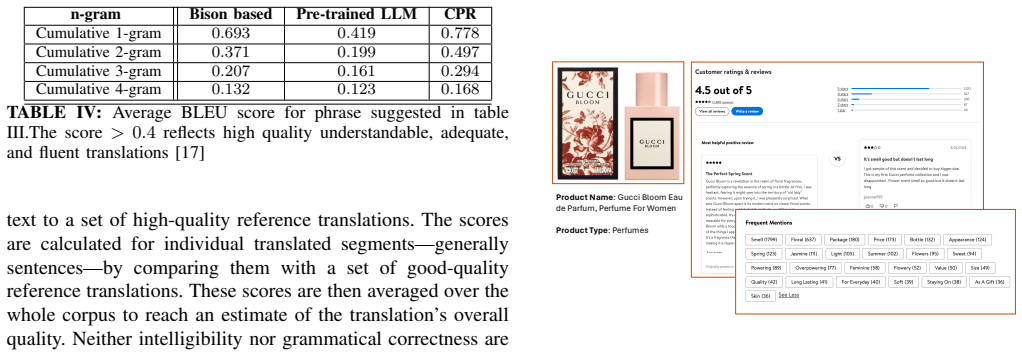
- [Section III-C] The BLEU evaluation is non-standard and likely biased: stop words are removed, and only 57% of reviews are kept because "the reference and candidates require the same word length." BLEU does not require equal-length hypothesis and reference, and post-hoc length filtering plus stop-word removal can distort the metric. In addition, Table IV is described as the "average BLEU score for phrase suggested in table III," which suggests an average over a single example; the evaluation corpus and aggregation procedure are not defined. The revision should use standard BLEU over full reference reviews, report corpus-level scores with confidence intervals, state the number of products and reviews used, and justify any preprocessing.
- [Table VI] The counts in Table VI are internally inconsistent: 4,172 + 128 = 4,300, not 5,000, and 3,760 + 476 = 4,236, not 5,000. The reported accuracy of 75.2% is computed as 3,760/5,000, which is inconsistent with the reported number of irrelevant topics (which should be 1,240). The table and the accuracy definition must be corrected and clarified.
- [Section III-B2] The sentence "We tested 10k reviews and found out that behavior is consistent with most of the reviews" is an unsupported experimental claim. No details are given about which 10K reviews were used, whether they were disjoint from the fine-tuning data, or what criterion defined "consistent." If this is intended as evidence, it must be replaced by a fully specified experiment with a clear metric and a defined test set.
minor comments (6)
- [Section III-C] The statement "score > 0.4 reflects high quality understandable, adequate, and fluent translations" cites a machine-translation tutorial [17]; this threshold is not a validated measure of review-phrase quality and should be removed or replaced with a task-appropriate justification.
- [Section II-B] The workflow description says CPR "start detecting topics in customer's written text and tagging them to its sentence," but this topic-detection component is not described in Section III or evaluated anywhere in the paper; please clarify or remove it.
- [Section III-B2] Key fine-tuning details are omitted: the specific base-model variant, learning rate, number of epochs, LoRA rank, and training time are not reported, which makes the fine-tuning procedure non-reproducible even within the stated privacy constraints.
- [Section IV-C] The text refers to an "average human readability score" (e.g., 0.49), but Table V contains a "BLEU Score" column and no separately defined human readability metric; the terminology should be aligned.
- [Figure 2] The screenshots in Figure 2 appear to be from other e-commerce platforms but are not attributed; if they are reproduced, permission or citation should be provided.
- [Section V] The phrase "real-time product case studies" overstates the experiments; the case studies are retrospective demonstrations on existing product types, not real-time deployments. Consider rewording.
Circularity Check
The headline 12.3% BLEU improvement is partially self-referential: fine-tuning and BLEU references are drawn from the same Walmart review pool with no reported held-out split.
-
fitted input called prediction
[Section III-B2 (fine-tuning) and Section III-C (BLEU evaluation)]
"We fine-tune our base model using a smaller dataset consisting 12K reviews and approximate 200 reviews per product type ... To compute the BLEU score, we tokenized all the phrase text of the product and removed stop words. This product consists of 2.3k+ reviews and 57% reviews are eligible to compute BLEU score as the reference and candidates require the same word length."
The model is trained to map product type, topic, and star rating to review text drawn from Walmart reviews, and the BLEU reference set is a Walmart product's reviews from the same review pool. The paper reports no temporal, product-level, or held-out split between the 12K fine-tuning reviews and the 2.3k+ reference reviews, so the n-gram overlap measured by BLEU can be a measure of overlap with the training distribution rather than of generalization. As reported, the abstract's central claim of a 12.3% BLEU improvement reduces to similarity with the model's own training data unless an excluded evaluation set is supplied.
full rationale
CPR is an empirical fine-tuning paper; its derivation chain is the training/evaluation loop. The only load-bearing quantitative claim is the 12.3% BLEU improvement over Bison. That claim is not independently grounded because the paper never separates the 12K-review fine-tuning set from the 2.3k+ review BLEU reference set; both are described as Walmart review text, and no exclusion or held-out split is reported. Since BLEU is pure n-gram overlap, a model trained on the same review pool can score high by reproducing training text. The qualitative case studies (Table V) and the topic-suggestion check against YAKE keyword extraction are external and non-circular, which prevents a higher score, but they do not support the quantitative headline. The abstract's promised manual evaluation is also absent from the paper, removing the one stated external check that could have broken the self-referential evaluation. Overall, the finding is partial circularity in the central quantitative evaluation, not in the method's formulation.
Assumptions & free parameters
free parameters (4)
- K, number of similar product types considered =
10
- N, number of topics per product type =
10
- Phrase length limits =
20 to 25 words
- BLEU eligibility filter =
57% of reviews kept
assumptions (5)
- domain assumption Products in the same product type share review-relevant topics.
- domain assumption LLM-generated topics for a new product are comparable to frequent mentions mined from real reviews.
- domain assumption YAKE keyword extraction from product descriptions is a valid ground truth for topic relevance.
- domain assumption BLEU with stop-word removal and length filtering is a valid measure of review phrase quality.
- domain assumption A single star rating per topic is a sufficient condition for generating a sentiment-aligned phrase.
Cite this review
Pith. "Pith review of CPR: Leveraging LLMs for Topic and Phrase Suggestion to Facilitate Comprehensive Product Reviews." pith.science (2026). https://pith.science/paper/UPDG2AKH
@misc{pith2026250413993,
  author       = {Pith},
  title        = {Pith review of: CPR: Leveraging LLMs for Topic and Phrase Suggestion to Facilitate Comprehensive Product Reviews},
  year         = {2026},
  howpublished = {\url{https://pith.science/paper/UPDG2AKH}},
  note         = {Machine review of arXiv:2504.13993}
}
read the original abstract
Consumers often heavily rely on online product reviews, analyzing both quantitative ratings and textual descriptions to assess product quality. However, existing research hasn't adequately addressed how to systematically encourage the creation of comprehensive reviews that capture both customers sentiment and detailed product feature analysis. This paper presents CPR, a novel methodology that leverages the power of Large Language Models (LLMs) and Topic Modeling to guide users in crafting insightful and well-rounded reviews. Our approach employs a three-stage process: first, we present users with product-specific terms for rating; second, we generate targeted phrase suggestions based on these ratings; and third, we integrate user-written text through topic modeling, ensuring all key aspects are addressed. We evaluate CPR using text-to-text LLMs, comparing its performance against real-world customer reviews from Walmart. Our results demonstrate that CPR effectively identifies relevant product terms, even for new products lacking prior reviews, and provides sentiment-aligned phrase suggestions, saving users time and enhancing reviews quality. Quantitative analysis reveals a 12.3% improvement in BLEU score over baseline methods, further supported by manual evaluation of generated phrases. We conclude by discussing potential extensions and future research directions.
Figures


Figures from the paper (2 more)

Reference graph
Works this paper leans on
-
[30]
Towards automatic generation of product reviews from aspect-sentiment scores
Hongyu Zang and Xiaojun Wan. Towards automatic generation of product reviews from aspect-sentiment scores. In Proceedings of the 10th International Conference on Natural Language Generation , pages 168–177, 2017
work page 2017
-
[1]
Rohan Anil, Andrew M Dai, Orhan Firat, Melvin Johnson, Dmitry Lepikhin, Alexandre Passos, Siamak Shakeri, Emanuel Taropa, Paige Bailey, Zhifeng Chen, et al. Palm 2 technical report. arXiv preprint arXiv:2305.10403, 2023
arXiv 2023
-
[2]
Graph of thoughts: Solving elaborate problems with large language models
Maciej Besta, Nils Blach, Ales Kubicek, Robert Gerstenberger, Michal Podstawski, Lukas Gianinazzi, Joanna Gajda, Tomasz Lehmann, Hubert Niewiadomski, Piotr Nyczyk, et al. Graph of thoughts: Solving elaborate problems with large language models. In Proceedings of the AAAI Conference on Artificial Intelligence , volume 38, pages 17682–17690, 2024
work page 2024
-
[3]
Walmart Business. Walmart.com. https://www.walmart.com/. [2024 Walmart. All Rights Reserved.]
work page 2024
-
[4]
Yake! keyword extraction from single documents using multiple local features
Ricardo Campos, V ´ıtor Mangaravite, Arian Pasquali, Al ´ıpio Jorge, C´elia Nunes, and Adam Jatowt. Yake! keyword extraction from single documents using multiple local features. Information Sciences, 509:257– 289, 2020
work page 2020
-
[5]
Keith Carlson, Praveen K Kopalle, Allen Riddell, Daniel Rockmore, and Prasad Vana. Complementing human effort in online reviews: A deep learning approach to automatic content generation and review synthesis. International Journal of Research in Marketing , 40(1):54–74, 2023
work page 2023
-
[6]
Evaluation of text generation: A survey
Asli Celikyilmaz, Elizabeth Clark, and Jianfeng Gao. Evaluation of text generation: A survey. arXiv preprint arXiv:2006.14799 , 2020
arXiv 2006
-
[7]
Ishita Chakraborty, Minkyung Kim, and K Sudhir. Attribute sentiment scoring with online text reviews: Accounting for language structure and missing attributes. Journal of Marketing Research, 59(3):600–622, 2022
work page 2022
Show all 31 references
-
[8]
Channels of impact: User reviews when quality is dynamic and managers respond
Judith A Chevalier, Yaniv Dover, and Dina Mayzlin. Channels of impact: User reviews when quality is dynamic and managers respond. Marketing Science, 37(5):688–709, 2018
2018
-
[9]
The effects of online user reviews on movie box office performance: Accounting for sequential rollout and aggregation across local markets
Pradeep K Chintagunta, Shyam Gopinath, and Sriram Venkataraman. The effects of online user reviews on movie box office performance: Accounting for sequential rollout and aggregation across local markets. Marketing science, 29(5):944–957, 2010
2010
-
[10]
Palm: Scaling language modeling with pathways
Aakanksha Chowdhery, Sharan Narang, Jacob Devlin, Maarten Bosma, Gaurav Mishra, Adam Roberts, Paul Barham, Hyung Won Chung, Charles Sutton, Sebastian Gehrmann, et al. Palm: Scaling language modeling with pathways. Journal of Machine Learning Research , 24(240):1–113, 2023
2023
-
[11]
Auto- matic generation of natural language explanations
Felipe Costa, Sixun Ouyang, Peter Dolog, and Aonghus Lawlor. Auto- matic generation of natural language explanations. In Proceedings of the 23rd international conference on intelligent user interfaces companion , pages 1–2, 2018
2018
-
[12]
Prompt engineering for chatgpt: a quick guide to techniques, tips, and best practices
Sabit Ekin. Prompt engineering for chatgpt: a quick guide to techniques, tips, and best practices. Authorea Preprints, 2023
2023
-
[13]
Automatic generation of product-image sequence in e-commerce
Xiaochuan Fan, Chi Zhang, Yong Yang, Yue Shang, Xueying Zhang, Zhen He, Yun Xiao, Bo Long, and Lingfei Wu. Automatic generation of product-image sequence in e-commerce. In Proceedings of the 28th ACM SIGKDD Conference on Knowledge Discovery and Data Mining , pages 2851–2859, 2022
2022
-
[14]
Conditional text generation for harmonious human- machine interaction
Bin Guo, Hao Wang, Yasan Ding, Wei Wu, Shaoyang Hao, Yueqi Sun, and Zhiwen Yu. Conditional text generation for harmonious human- machine interaction. ACM Transactions on Intelligent Systems and Technology (TIST), 12(2):1–50, 2021
2021
-
[15]
Lora: Low-rank adaptation of large language models
Edward J Hu, Yelong Shen, Phillip Wallis, Zeyuan Allen-Zhu, Yuanzhi Li, Shean Wang, Lu Wang, and Weizhu Chen. Lora: Low-rank adaptation of large language models. arXiv preprint arXiv:2106.09685 , 2021
2021 arXiv
-
[16]
Proceedings of the 57th annual meeting of the association for computational linguistics
Anna Korhonen, David Traum, and Llu ´ıs M `arquez. Proceedings of the 57th annual meeting of the association for computational linguistics. In Proceedings of the 57th Annual Meeting of the Association for Computational Linguistics, 2019
2019
-
[17]
Evaluating the output of machine translation systems
Alon Lavie. Evaluating the output of machine translation systems. https://www.cs.cmu.edu/%7Ealavie/Presentations/ MT-Evaluation-MT-Summit-Tutorial-19Sep11.pdf, 2011. 13th MT Summit Tutorial,Xiamen, China
2011
-
[18]
Timelms: Diachronic language models from twitter
Daniel Loureiro, Francesco Barbieri, Leonardo Neves, Luis Espinosa Anke, and Jose Camacho-Collados. Timelms: Diachronic language models from twitter. arXiv preprint arXiv:2202.03829 , 2022
2022 arXiv
-
[19]
More than words: The influence of affective content and linguistic style matches in online reviews on conversion rates
Stephan Ludwig, Ko De Ruyter, Mike Friedman, Elisabeth C Br ¨uggen, Martin Wetzels, and Gerard Pfann. More than words: The influence of affective content and linguistic style matches in online reviews on conversion rates. Journal of marketing , 77(1):87–103, 2013
2013
-
[20]
Peft: State-of-the-art parameter- efficient fine-tuning methods
Sourab Mangrulkar, Sylvain Gugger, Lysandre Debut, Younes Belkada, Sayak Paul, and Benjamin Bossan. Peft: State-of-the-art parameter- efficient fine-tuning methods. https://github.com/huggingface/peft, 2022
2022
-
[21]
Federal trade commission announces final rule banning fake reviews and testimonials
Office of Public Affairs. Federal trade commission announces final rule banning fake reviews and testimonials. https://www.ftc.gov/news- events/news/press-releases/2024/08/federal-trade-commission- announces-final-rule-banning-fake-reviews- testimonials, 2023. [Press Releases,...
2024
-
[22]
Bleu: a method for automatic evaluation of machine translation
Kishore Papineni, Salim Roukos, Todd Ward, and Wei-Jing Zhu. Bleu: a method for automatic evaluation of machine translation. In Proceedings of the 40th annual meeting of the Association for Computational Linguistics, pages 311–318, 2002
2002
-
[23]
Efficiency of automatic text generators for online review content gener- ation
Amparo Perez-Castro, Mar ´ıa del Roc ´ıo Mart´ınez-Torres, and SL Toral. Efficiency of automatic text generators for online review content gener- ation. Technological Forecasting and Social Change, 189:122380, 2023
2023
-
[24]
A hierarchical model of reviews for aspect-based sentiment analysis
Sebastian Ruder, Parsa Ghaffari, and John G Breslin. A hierarchical model of reviews for aspect-based sentiment analysis. arXiv preprint arXiv:1609.02745, 2016
2016 arXiv
-
[25]
Pae: Llm-based product attribute extrac- tion for e-commerce fashion trends
Apurva Sinha and Ekta Gujral. Pae: Llm-based product attribute extrac- tion for e-commerce fashion trends. arXiv preprint arXiv:2405.17533 , 2024
2024 arXiv
-
[26]
Automatic generation of review content in specific domain of social network based on rnn
Yu Tai, Hui He, WeiZhe Zhang, and Yanguo Jia. Automatic generation of review content in specific domain of social network based on rnn. In 2018 IEEE Third International Conference on Data Science in Cyberspace (DSC), pages 601–608. IEEE, 2018
2018
-
[27]
Llama 2: Open foundation and fine- tuned chat models
Hugo Touvron, Louis Martin, Kevin Stone, Peter Albert, Amjad Alma- hairi, Yasmine Babaei, Nikolay Bashlykov, Soumya Batra, Prajjwal Bhargava, Shruti Bhosale, et al. Llama 2: Open foundation and fine- tuned chat models. arXiv preprint arXiv:2307.09288 , 2023
2023 arXiv
-
[28]
Text generation and recall by high-knowledge and low-knowledge individuals
James F V oss, Gregg T Vesonder, and George J Spilich. Text generation and recall by high-knowledge and low-knowledge individuals. Journal of verbal Learning and verbal Behavior , 19(6):651–667, 1980
1980
-
[29]
Personalized showcases: Generating multi-modal explanations for rec- ommendations
An Yan, Zhankui He, Jiacheng Li, Tianyang Zhang, and Julian McAuley. Personalized showcases: Generating multi-modal explanations for rec- ommendations. In Proceedings of the 46th International ACM SIGIR Conference on Research and Development in Information Retrieval , pages 22...
2023
-
[31]
Review response generation in e-commerce platforms with external product information
Lujun Zhao, Kaisong Song, Changlong Sun, Qi Zhang, Xuanjing Huang, and Xiaozhong Liu. Review response generation in e-commerce platforms with external product information. In The world wide web conference, pages 2425–2435, 2019
2019
Reviewed August 16, 2026 · model on record in the stance chip above.
Discussion (0). Continue with ORCID to comment.