WaveDriver: a Laser Guide Star AO System for HWO
Pith reviewed 2026-05-20 07:37 UTC · model grok-4.3
The pith
WaveDriver laser guide star AO system could be needed to meet HWO picometer wavefront stability.
A machine-rendered reading of the paper's core claim, the machinery that carries it, and where it could break.
Core claim
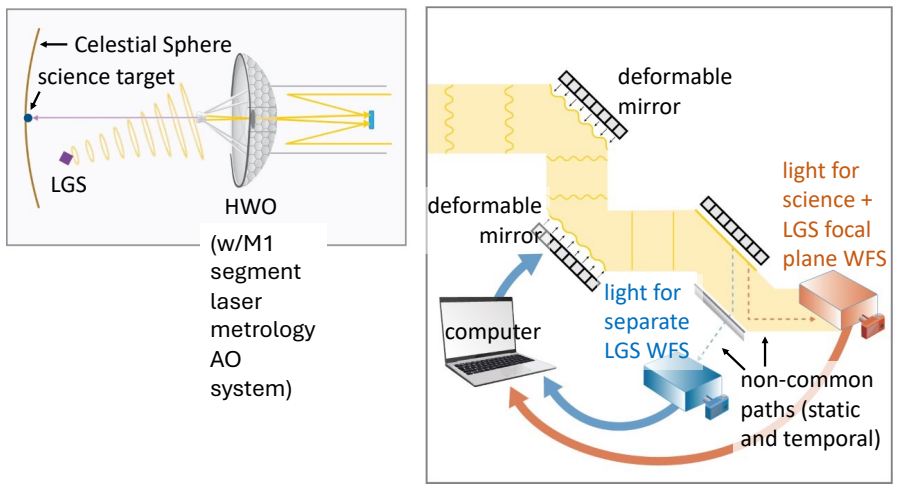
WaveDriver is a concept for a laser guide star spacecraft coupled to an adaptive optics system onboard HWO that would enable HWO to reach its picometer-level wavefront stability requirements while relaxing other HWO subsystem requirements. Initial results from AO control developments with Linear Quadratic Gaussian control and machine learning, AO wavefront sensor trade study simulations, and simulations of a photonic lantern natural guide star WFS support the finding that WaveDriver could be needed to enable HWO's primary mirror segment stability and/or low order wavefront stability requirements.
What carries the argument
The WaveDriver system: a laser guide star spacecraft paired with an onboard adaptive optics system that supplies a stable reference for wavefront sensing and correction on HWO.
If this is right
- Primary mirror segment stability requirements for HWO can be relaxed if WaveDriver provides the reference.
- Low order wavefront stability specifications for HWO can be met using the laser guide star spacecraft.
- Linear Quadratic Gaussian and machine learning control methods can be used effectively for the adaptive optics on HWO.
- A photonic lantern can serve as a viable natural guide star wavefront sensor for this application.
Where Pith is reading between the lines
- WaveDriver could simplify overall HWO design by shifting some stability control to an external spacecraft.
- The hybrid laser guide star and onboard AO approach may apply to other space telescopes needing extreme stability for exoplanet observations.
- Further end-to-end modeling of the full HWO mission with WaveDriver would clarify integration challenges.
Load-bearing premise
The AO control developments, WFS trade study simulations, and photonic lantern natural guide star WFS simulations accurately represent the performance achievable on HWO without additional real-world constraints or validation.
What would settle it
A higher-fidelity simulation or test in which HWO achieves its required primary mirror segment stability and low order wavefront stability without WaveDriver, or fails to meet those stabilities even when using the WaveDriver system.
Figures




read the original abstract
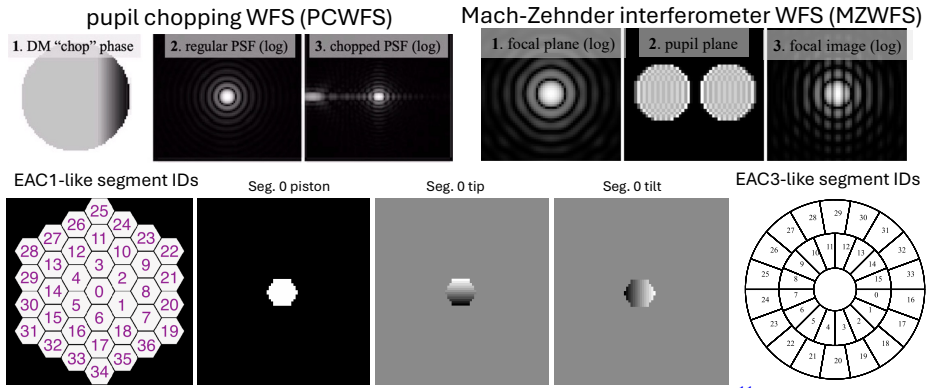
Habitable Worlds Observatory (HWO) presents a key challenge for technology development in the coming years, requiring a $>$ $100\times$ more stable system than \textit{JWST}. WaveDriver is a concept for a laser guide star spacecraft coupled to an adaptive optics (AO) system onboard HWO that would enable HWO to reach its picometer-level wavefront stability requirements while relaxing other HWO subsystem requirements. At LLNL and UCSC we are revisiting the concept initially proposed by Douglas et al.\ (2019). We present key results key initial results from the first phase of our project, including (1) AO control developments, including with Linear Quadratic Gaussian control and machine learning, (2) AO wavefront sensor (WFS) trade study simulations, and (3) simulations of a photonic lantern natural guide star WFS. A key finding from our work is that WaveDriver could be needed to enable HWO's primary mirror segment stability and/or low order wavefront stability requirements.
Editorial analysis
A structured set of objections, weighed in public.
Referee Report
Summary. The manuscript proposes WaveDriver, a laser guide star spacecraft coupled to an onboard adaptive optics system for the Habitable Worlds Observatory (HWO). It reports initial simulation results on AO control developments (including Linear Quadratic Gaussian and machine learning approaches), a wavefront sensor trade study, and photonic lantern natural guide star WFS performance. The central finding is that WaveDriver could be needed to satisfy HWO primary mirror segment stability and/or low-order wavefront stability requirements while relaxing other subsystem constraints.
Significance. If the reported simulation results are shown to hold under realistic conditions, the concept could meaningfully influence HWO technology development by providing a route to picometer-level stability that exceeds JWST performance by more than two orders of magnitude. The explicit use of LQG/ML control and photonic-lantern sensing constitutes a concrete technical contribution that builds directly on the 2019 Douglas et al. concept.
major comments (2)
- [AO control developments and WFS trade study simulations] The claim that WaveDriver could be needed for primary mirror segment stability and low-order wavefront stability is supported only by the AO control (LQG/ML), WFS trade-study, and photonic-lantern NGS simulations. These simulations are not shown to incorporate the full HWO disturbance spectrum (thermal, jitter, segment dynamics), leaving open whether the reported residual errors actually exceed the picometer requirements under flight-like conditions.
- [Abstract and initial results section] No quantitative performance metrics, error budgets, or benchmark comparisons are supplied for any of the three simulation campaigns, so it is not possible to evaluate whether the modeled performance gap is large enough to justify the added complexity of a dedicated laser-guide-star spacecraft.
minor comments (1)
- [Abstract] The abstract contains the duplicated phrase 'key results key initial results'; this should be corrected.
Simulated Author's Rebuttal
We thank the referee for their constructive and detailed review of our manuscript on the WaveDriver concept. We address each major comment below, clarifying the preliminary scope of the work while making targeted revisions to improve transparency and quantitative presentation.
read point-by-point responses
-
Referee: [AO control developments and WFS trade study simulations] The claim that WaveDriver could be needed for primary mirror segment stability and low-order wavefront stability is supported only by the AO control (LQG/ML), WFS trade-study, and photonic-lantern NGS simulations. These simulations are not shown to incorporate the full HWO disturbance spectrum (thermal, jitter, segment dynamics), leaving open whether the reported residual errors actually exceed the picometer requirements under flight-like conditions.
Authors: We agree that the reported simulations represent initial results from the first phase of the project and do not yet incorporate the complete HWO disturbance spectrum, including the full range of thermal, jitter, and segment dynamics effects. These simulations were designed to isolate and demonstrate the performance of the LQG/ML control approaches and the WFS concepts under controlled conditions as a proof of concept. In the revised manuscript we have added explicit language in the abstract, Section 3, and the conclusions to state the preliminary nature of the results and to outline the planned follow-on work that will integrate a more comprehensive disturbance model. This revision directly addresses the concern without overstating the current findings. revision: yes
-
Referee: [Abstract and initial results section] No quantitative performance metrics, error budgets, or benchmark comparisons are supplied for any of the three simulation campaigns, so it is not possible to evaluate whether the modeled performance gap is large enough to justify the added complexity of a dedicated laser-guide-star spacecraft.
Authors: We acknowledge that the abstract and the summary of initial results would benefit from more explicit quantitative metrics, error budgets, and benchmark comparisons. Although detailed numerical results appear in the body of the paper, we have revised the abstract to include key residual wavefront error values and performance deltas relative to JWST and HWO requirements. We have also added a summary table in the results section that consolidates the metrics, error budgets, and direct comparisons for the three simulation campaigns. These changes enable readers to assess the magnitude of the performance gap and the rationale for the added complexity of the WaveDriver spacecraft. revision: yes
Circularity Check
No circularity: claims rest on forward simulations of proposed AO system
full rationale
The paper derives its key finding—that WaveDriver could be needed for HWO segment and low-order stability—from forward simulations of AO control (LQG/ML), WFS trade studies, and photonic lantern NGS performance. These generate predicted residual errors from modeled inputs and proposed hardware rather than fitting parameters to target outcomes or redefining quantities in terms of the results themselves. The reference to Douglas et al. (2019) is an external concept revisit and does not supply load-bearing justification for the current simulation outputs. No self-definitional loops, fitted-input predictions, or ansatz smuggling via self-citation appear in the derivation chain. The analysis is self-contained against external benchmarks of simulation validity.
Axiom & Free-Parameter Ledger
invented entities (1)
-
WaveDriver laser guide star spacecraft
no independent evidence
Reference graph
Works this paper leans on
-
[1]
National Academies of Sciences and Medicine, Engineering , title = ". doi:10.17226/26141 , adsurl =
-
[2]
Laser Guide Star for Large Segmented-aperture Space Telescopes. I. Implications for Terrestrial Exoplanet Detection and Observatory Stability. Astronomical Journal , keywords =. doi:10.3847/1538-3881/aaf385 , archivePrefix =. 1811.05309 , primaryClass =
work page internal anchor Pith review Pith/arXiv arXiv doi:10.3847/1538-3881/aaf385
-
[3]
Space-based laser guide stars for astronomical observatories , author =
-
[4]
Journal of Astronomical Telescopes, Instruments, and Systems , keywords =
Adaptive optics performance of a simulated coronagraph instrument on a large, segmented space telescope in steady state. Journal of Astronomical Telescopes, Instruments, and Systems , keywords =. doi:10.1117/1.JATIS.8.3.035002 , archivePrefix =. 2209.15063 , primaryClass =
-
[5]
Wavefront sensing and control for a future Habitable Worlds Observatory. Space Telescopes and Instrumentation 2024: Optical, Infrared, and Millimeter Wave , year = 2024, editor =. doi:10.1117/12.3020583 , adsurl =
-
[6]
The photonic lantern. Advances in Optics and Photonics , keywords =. doi:10.1364/AOP.7.000107 , archivePrefix =. 1503.02837 , primaryClass =
work page internal anchor Pith review Pith/arXiv arXiv doi:10.1364/aop.7.000107
-
[7]
Experimental validation of photonic lantern imaging and wavefront sensing performance. arXiv e-prints , keywords =. doi:10.48550/arXiv.2508.20078 , archivePrefix =. 2508.20078 , primaryClass =
-
[8]
Publications of the Astronomical Society of the Pacific , keywords =
High-speed Focal Plane Wave Front Sensing with an Optical Chopper. Publications of the Astronomical Society of the Pacific , keywords =. doi:10.1088/1538-3873/acb6b6 , archivePrefix =. 2301.11282 , primaryClass =
-
[9]
Society of Photo-Optical Instrumentation Engineers (SPIE) Conference Series , year = 2023, series =
Deformable mirror-based pupil chopping for exoplanet imaging and adaptive optics. Society of Photo-Optical Instrumentation Engineers (SPIE) Conference Series , year = 2023, series =. doi:10.1117/12.2676556 , adsurl =
-
[10]
Astronomical adaptive optics. I. Modal control optimization. Astronomy and Astrophysics , keywords =
-
[11]
Applied Optics , year = 2023, month = mar, volume =
Laboratory demonstration of the prediction of wind-blown turbulence by adaptive optics at 8 kHz with use of LQG control. Applied Optics , year = 2023, month = mar, volume =. doi:10.1364/AO.474730 , adsurl =
-
[12]
Limits of Adaptive Optics for high contrast imaging
Limits of Adaptive Optics for High-Contrast Imaging. Astrophysical Journal , keywords =. doi:10.1086/431209 , archivePrefix =. astro-ph/0505086 , primaryClass =
work page internal anchor Pith review Pith/arXiv arXiv doi:10.1086/431209
-
[13]
Journal of Astronomical Telescopes, Instruments, and Systems , keywords =
Microelectromechanical deformable mirror development for high-contrast imaging, part 1: miniaturized, flight-capable control electronics. Journal of Astronomical Telescopes, Instruments, and Systems , keywords =. doi:10.1117/1.JATIS.6.4.045001 , archivePrefix =. 2011.02098 , primaryClass =
-
[14]
Demonstration of single-picometer deformable mirror wavefront control using high-resolution electronics. Space Telescopes and Instrumentation 2024: Optical, Infrared, and Millimeter Wave , year = 2024, editor =. doi:10.1117/12.3017631 , adsurl =
-
[15]
HWO25 conference proceedings , year = 2025, series =
Habitable Worlds Observatory Overall Approach and Progress. HWO25 conference proceedings , year = 2025, series =
work page 2025
-
[16]
HWO25 conference proceedings , year = 2025, series =
Reaching Concept Maturity Level 3 on HWO. HWO25 conference proceedings , year = 2025, series =
work page 2025
-
[17]
Lightbeam: Simulate light through weakly-guiding waveguides
-
[18]
Adaptive Optics Systems VI , year = 2018, editor =
High Contrast Imaging for Python (HCIPy): an open-source adaptive optics and coronagraph simulator. Adaptive Optics Systems VI , year = 2018, editor =. doi:10.1117/12.2314407 , adsurl =
-
[19]
Optical Modeling and Performance Predictions XIV , year = 2024, editor =
Habitable world observatory modeling optical and metrology models, and performance predictions. Optical Modeling and Performance Predictions XIV , year = 2024, editor =. doi:10.1117/12.3030015 , adsurl =
-
[20]
Adaptive Optics Systems VIII , year = 2022, editor =
Various wavefront sensing and control developments on the Santa Cruz Extreme AO Laboratory (SEAL) testbed. Adaptive Optics Systems VIII , year = 2022, editor =. doi:10.1117/12.2630519 , archivePrefix =. 2208.03402 , primaryClass =
-
[21]
Jacoby and Alison Nordt and Liz Osborne , title =
Alain Carrier and Kiarash Tajdaran and Michael S. Jacoby and Alison Nordt and Liz Osborne , title =. UV/Optical/IR Space Telescopes and Instruments: Innovative Technologies and Concepts XII , editor =. 2025 , doi =
work page 2025
-
[22]
WaveDriver: a Laser Guide Star AO System for HWO
WaveDriver: a Laser Guide Star AO System for HWO. arXiv e-prints , keywords =. doi:10.48550/arXiv.2509.18643 , archivePrefix =. 2509.18643 , primaryClass =
work page internal anchor Pith review Pith/arXiv arXiv doi:10.48550/arxiv.2509.18643
-
[23]
Monthly Notices of the Royal Astronomical Society , volume =
Swanson, Robin and Lamb, Masen and Correia, Carlos M and Sivanandam, Suresh and Kutulakos, Kiriakos , title =. Monthly Notices of the Royal Astronomical Society , volume =. 2021 , month =. doi:10.1093/mnras/stab632 , url =
-
[24]
Adaptive optics control using model-based reinforcement learning , volume =
Jalo Nousiainen and Chang Rajani and Markus Kasper and Tapio Helin , journal =. Adaptive optics control using model-based reinforcement learning , volume =. 2021 , url =. doi:10.1364/OE.420270 , abstract =
-
[25]
Alison P. Wong and Barnaby R. M. Norris and Peter G. Tuthill and Richard Scalzo and Julien Lozi and S. Journal of Astronomical Telescopes, Instruments, and Systems , number =. 2021 , doi =
work page 2021
-
[26]
Adaptive Optics Systems VIII , editor =
Jalo Nousiainen and Byron Engler and Markus Kasper and Tapio Helin and C. Adaptive Optics Systems VIII , editor =. 2022 , doi =
work page 2022
-
[27]
B. Pou and F. Ferreira and E. Quinones and D. Gratadour and M. Martin , journal =. Adaptive optics control with multi-agent model-free reinforcement learning , volume =. 2022 , url =. doi:10.1364/OE.444099 , abstract =
-
[28]
Adaptive optics based on machine learning: a review , journal =. 2022 , issn =. doi:10.29026/oea.2022.200082 , url =
-
[29]
Bartomeu Pou and Jeffrey Smith and Eduardo Quinones and Mario Martin and Damien Gratadour , journal =. Integrating supervised and reinforcement learning for predictive control with an unmodulated pyramid wavefront sensor for adaptive optics , volume =. 2024 , url =. doi:10.1364/OE.530254 , abstract =
- [30]
-
[31]
Adaptive Optics Systems IX , editor =
Jonathan Dray and Baptiste Sinquin and Morgan Gray and Benoit Neichel and C. Adaptive Optics Systems IX , editor =. 2024 , doi =
work page 2024
-
[32]
doi:10.5281/zenodo.1201549 , url =
fastmachinelearning/hls4ml , year = 2024, publisher =. doi:10.5281/zenodo.1201549 , url =
- [33]
-
[34]
Fast inference of deep neural networks in FPGAs for particle physics
Duarte, Javier and others. Fast inference of deep neural networks in FPGAs for particle physics. JINST. 2018. doi:10.1088/1748-0221/13/07/P07027. arXiv:1804.06913
-
[35]
hls4ml: An Open-Source Codesign Workflow to Empower Scientific Low-Power Machine Learning Devices
Fahim, Farah and others. hls4ml: An Open-Source Codesign Workflow to Empower Scientific Low-Power Machine Learning Devices. tinyML Research Symposium 2021. 2021. arXiv:2103.05579
-
[36]
Machine Learning: Science and Technology , abstract =
Aarrestad, Thea and Loncar, Vladimir and Ghielmetti, Nicolò and Pierini, Maurizio and Summers, Sioni and Ngadiuba, Jennifer and Petersson, Christoffer and Linander, Hampus and Iiyama, Yutaro and Di Guglielmo, Giuseppe and Duarte, Javier and Harris, Philip and Rankin, Dylan and Jindariani, Sergo and Pedro, Kevin and Tran, Nhan and Liu, Mia and Kreinar, Edw...
-
[37]
Machine Learning: Science and Technology , abstract =
Khoda, Elham E and Rankin, Dylan and Teixeira de Lima, Rafael and Harris, Philip and Hauck, Scott and Hsu, Shih-Chieh and Kagan, Michael and Loncar, Vladimir and Paikara, Chaitanya and Rao, Richa and Summers, Sioni and Vernieri, Caterina and Wang, Aaron , title =. Machine Learning: Science and Technology , abstract =. 2023 , month =. doi:10.1088/2632-2153...
-
[38]
Summers, S. and Guglielmo, G. Di and Duarte, J. and Harris, P. and Hoang, D. and Jindariani, S. and Kreinar, E. and Loncar, V. and Ngadiuba, J. and Pierini, M. and Rankin, D. and Tran, N. and Wu, Z. , title =. Journal of Instrumentation , abstract =. 2020 , month =. doi:10.1088/1748-0221/15/05/P05026 , url =
-
[39]
IMPETUS-UdeS/rule4ml , year = 2024, publisher =
work page 2024
-
[40]
and Di Guglielmo, Giuseppe and Duarte, Javier and Loncar, Vladimir , title =
Hawks, Benjamin and Plotnikov, Dennis and Tran, Nhan and Tame-Narvaez, Karla and Rahimifar, Mohammad Mehdi and Rahali, Hamza Ezzaoui and Therrien, Audrey C. and Di Guglielmo, Giuseppe and Duarte, Javier and Loncar, Vladimir , title =. Proceedings of the 2025 ACM/SIGDA International Symposium on Field Programmable Gate Arrays , pages =. 2025 , isbn =. doi:...
-
[41]
A Graph Neural Network Surrogate Model for hls4ml
Plotnikov, Dennis and Hawks, Benjamin and Tran, Nhan V. A Graph Neural Network Surrogate Model for hls4ml
-
[42]
Alveo U200 and U250 Data Center Accelerator Cards Data Sheet (DS962) , organization =. 2023 , url =
work page 2023
-
[43]
Alveo U200 and U250 Accelerator Cards User Guide (UG1289) , organization =. 2023 , url =
work page 2023
-
[44]
Vivado Design Suite User Guide: High-Level Synthesis (UG902) , organization =. 2021 , version =
work page 2021
-
[45]
Vitis High-Level Synthesis User Guide (UG1399) , organization =. 2025 , url =
work page 2025
-
[46]
Proximal Policy Optimization Algorithms
Proximal Policy Optimization Algorithms. arXiv e-prints , keywords =. doi:10.48550/arXiv.1707.06347 , archivePrefix =. 1707.06347 , primaryClass =
work page internal anchor Pith review Pith/arXiv arXiv doi:10.48550/arxiv.1707.06347
-
[47]
Model-based policy optimization for adaptive optics
Toward on-sky adaptive optics control using reinforcement learning. Model-based policy optimization for adaptive optics. Astronomy and Astrophysics , keywords =. doi:10.1051/0004-6361/202243311 , archivePrefix =. 2205.07554 , primaryClass =
-
[48]
Astronomy and Astrphysics , keywords =
Model atmospheres broad-band colors, bolometric corrections and temperature calibrations for O - M stars. Astronomy and Astrphysics , keywords =
-
[49]
Astronomy and Astrophysics , keywords =
Modeling noise propagation in Fourier-filtering wavefront sensing, fundamental limits, and quantitative comparison. Astronomy and Astrophysics , keywords =. doi:10.1051/0004-6361/202245351 , archivePrefix =. 2212.13577 , primaryClass =
-
[50]
Journal of Astronomical Telescopes, Instruments, and Systems , keywords =
Linking strategic astrophysics missions, technology gaps, and technology maturation investments. Journal of Astronomical Telescopes, Instruments, and Systems , keywords =. doi:10.1117/1.JATIS.11.2.024003 , adsurl =
-
[51]
Adaptive Optics for Astronomy , year = 1994, editor =
Adaptive Optics for Astronomy. Adaptive Optics for Astronomy , year = 1994, editor =
work page 1994
-
[52]
Astronomical adaptive optics. I. Modal control optimization. Astronomy & Astrophysics , keywords =
-
[53]
Modern control engineering
-
[54]
Type II Woofer-Tweeter Control for NFIRAOS on TMT , year =
Jean-Pierre V\'. Type II Woofer-Tweeter Control for NFIRAOS on TMT , year =. Frontiers in Optics 2009/Laser Science XXV/Fall 2009 OSA Optics & Photonics Technical Digest , journal =. doi:10.1364/AOPT.2009.JTuC2 , abstract =
-
[55]
Journal of Astronomical Telescopes, Instruments, and Systems , keywords =
Coronagraphic detection of Earth-like planets with large, actively controlled space telescopes. Journal of Astronomical Telescopes, Instruments, and Systems , keywords =. doi:10.1117/1.JATIS.8.4.049002 , adsurl =
-
[56]
N. Sanchez-Soria and S. D. Will and J. R. Fienup , title =. Techniques and Instrumentation for Detection of Exoplanets XII , editor =. 2025 , doi =
work page 2025
-
[57]
Publications of the Astronomical Society of the Pacific , keywords =
HWO Target Stars and Systems: A Prioritized Community List of Potential Stellar Targets for the Habitable Worlds Observatory's ExoEarth Survey. Publications of the Astronomical Society of the Pacific , keywords =. doi:10.1088/1538-3873/ae0a81 , archivePrefix =. 2509.20544 , primaryClass =
-
[58]
Astronomy and Astrophysics , keywords =
Variation on a Zernike wavefront sensor theme: Optimal use of photons. Astronomy and Astrophysics , keywords =. doi:10.1051/0004-6361/202140870 , archivePrefix =. 2105.07690 , primaryClass =
-
[59]
Optical Engineering , number =
Hagyong Kihm and Ho-Soon Yang , title =. Optical Engineering , number =. 2013 , doi =
work page 2013
-
[60]
Experimental and on-sky demonstration of spectrally dispersed wavefront sensing using a photonic lantern. Optics Letters , keywords =. doi:10.1364/OL.551624 , archivePrefix =. 2505.00765 , primaryClass =
discussion (0)
Sign in with ORCID, Apple, or X to comment. Anyone can read and Pith papers without signing in.