REVIEW 3 major objections 3 minor 86 references
Polarization-Resolved Core Exciton Dynamics in LiF Using Attosecond Transient Absorption Spectroscopy
T0 review · 3 major / 3 minor · reviewed 2026-08-10 · deepseek-v4-flash
Pith's one-line read This paper claims that the 62.5 eV transient absorption feature in LiF is an NIR-induced coupling from the bright 1s2p core exciton to a dark s-like excitonic state, and that crossing the pump and probe polarizations suppresses this…
desk verdict A real and well-presented experimental result—90% polarization suppression of a core-exciton transient feature—whose dark-state interpretation is plausible but not uniquely forced, because the analysis never tests whether the AC Stark shift itself is angle-dependent. read the letter →
The pith
A machine-rendered reading of the paper's core claim, the machinery that carries it, and where it could break.
The reading
What carries the argument
The load-bearing object is a seven-level model (ground state, four bright exciton states X1, X2', X2'', X3, and two dark states d1 and d2) driven by the XUV pump and NIR probe, with the time-dependent dipole moment computed from the Schrödinger equation and augmented by an AC Stark phase and a phonon-coupling phase. The mechanism that carries the argument is the dipole selection rule: for parallel pump and probe polarizations the NIR field couples the XUV-aligned p-like bright exciton (m=0) to the m=0 component of an s-like dark state, whereas for perpendicular polarizations the prepared p-states have m=±1 and the NIR field cannot change m, so the coupling is forbidden. In the model, turning off the d2 coupling removes the 62.5 eV peak and leaves only Stark-shift signals, matching the crossed-polarization data.
What would settle it
If the NIR central wavelength is tuned so that one photon no longer bridges 61.7 eV and 63.2 eV, the 62.5 eV feature should disappear; if it persists unchanged at all NIR wavelengths, the resonant dark-state coupling interpretation is wrong. A direct check of the orbital character, for example momentum-resolved or angle-dependent absorption that places the coupled state primarily in Li 2s bands, would settle the s-like assignment.
Extended reading notes
Core claim
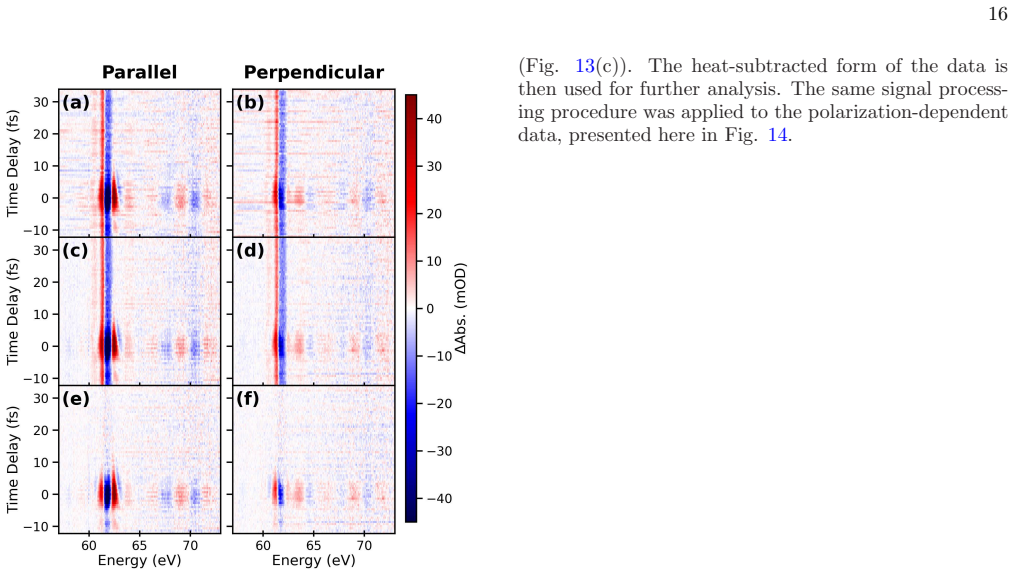
The central discovery is that the polarization of the NIR probe acts as a selection-rule switch on core-exciton couplings in LiF. With parallel XUV and NIR polarizations, a strong positive transient absorption feature appears at 62.5 eV, one NIR photon above the X2'' component of the 1s2p bright exciton; the paper assigns this feature to a resonant one-photon coupling from the bright p-like exciton to a dark state (d2) located at 63.23 eV in the model. When the polarizations are crossed, the feature is suppressed by roughly 90%, consistent with the dark state being primarily Li 2s-like, because a perpendicular NIR field cannot change the magnetic quantum number of the aligned p-state to reach an s-state. A few-level model that includes this coupling reproduces the parallel-polarization spectrum, while removing the coupling reproduces the crossed-polarization spectrum, and the remaining signals are attributed to AC Stark shifts. The small residual signal at 62.5 eV in the crossed configuration is assigned to weak s/p mixing in the exciton wavefunctions or symmetry-relaxing lattice distortions.
Load-bearing premise
The load-bearing premise is that the 62.5 eV signal is a resonant one-photon coupling to a specific dark s-like state (d2 at 63.23 eV) rather than an AC Stark shift or a coupling to states of other orbital character; this premise rests on model parameters fitted to the same transient absorption data they explain, with the supporting calculations requiring a 14 eV scissor correction and including only n=1 and n=2 orbitals.
Editorial extensions
If this is right
- Laser polarization becomes a practical experimental knob for assigning the orbital angular-momentum character (s, p, d) of dark core-exciton states in solids, not just in gas-phase atoms.
- The X3 feature in the LiF K-edge absorption spectrum is identified as predominantly a set of 1s2s-like dark excitons lying one NIR photon above the bright 1s2p exciton.
- The residual ~10% crossed-polarization signal provides a quantitative measure of orbital mixing in the exciton wavefunctions and of symmetry relaxation from lattice distortions.
- The measured coherence lifetime of ~2.4 ± 0.4 fs is an upper limit consistent with phonon-mediated dephasing as the dominant decoherence channel, matching the behavior reported for MgO and other halite-structure insulators.
- The same all-optical approach can be applied to other ionic insulators and heterostructures to map dark-state orbital character without requiring momentum-resolved detection.
Reading between the lines
- Going beyond the paper, tuning the NIR central wavelength across the X2''–d2 resonance should shift the 62.5 eV feature in energy; observing such a shift would independently confirm the one-photon coupling assignment without relying on the fitted model.
- A temperature-dependent version of the crossed-polarization measurement could separate intrinsic s/p mixing from lattice-distortion-induced relaxation: if the residual signal grows with temperature, the relaxation mechanism dominates.
- The same polarization protocol could be applied to MgO, NaCl, and CaF2 to test whether the dark-state coupling pattern seen in LiF generalizes across the alkali halide family.
- Another testable extension is to use a second XUV pulse to populate the dark state directly and then probe its coherence, providing a direct measurement of its lifetime rather than inferring it from the bright-state coupling.
Signed reviews
Editorial analysis
A structured set of objections, weighed in public.
Referee Report
Summary. The paper reports attosecond extreme-ultraviolet transient absorption measurements of LiF at the Li+ K edge, comparing parallel and perpendicular relative polarizations of the XUV pump and NIR probe. Several transient features are observed between 59 and 72 eV, the 61.7 eV 1s2p core exciton signal decays with a fitted coherence lifetime of about 2.4 fs that the authors correctly treat as an upper limit, and the positive differential-absorption feature at 62.5 eV is suppressed by approximately 90% when the XUV and NIR polarizations are crossed. The central claim is that this suppression reveals an NIR-induced coupling between the aligned 1s2p bright exciton and an s-like dark exciton near 63 eV, which is dipole-allowed only for parallel polarizations. Supporting evidence is provided by a few-level model with two dark states and by DFT/BSE calculations of the band structure and excitonic weights.
Significance. If the interpretation is correct, the work extends polarization-based dark-state identification from atomic systems to condensed-phase core excitons and demonstrates a generally useful experimental route to orbital-character assignment in solids. The measurement itself has notable strengths: the two polarization configurations were acquired in the same run, the 90% suppression of the 62.5 eV feature is a direct and robust experimental observation, and the paper is unusually candid about its limitations, including the upper-bound character of the coherence lifetime, the large 14 eV scissor correction, the restriction of the pseudopotential projections to n = 1 and 2 orbitals, and the fact that the no-dark-state model is not fitted to the perpendicular data. The central difficulty is that the interpretation rests on a few-level model whose dark-state parameters are fitted to the same parallel-polarization data that the model is used to explain, and on the untested assumption that the AC Stark shift is isotropic across the two polarization geometries.
major comments (3)
- [Section III A / Appendix B 1, Eq. (B3)] The central inference that the 90% suppression of the 62.5 eV feature proves a dark-state coupling assumes that the AC Stark phase is represented by a single scalar α fitted to the parallel data and then used unchanged for the perpendicular geometry in Fig. 11(f). This assumption is not tested. The XUV prepares an ensemble of aligned 1s2p excitons, and the NIR-induced light shift and broadening of this aligned ensemble can in principle depend on the angle between the NIR and XUV polarizations. If α is anisotropic, the suppression could be produced by the angular dependence of the Stark shift alone, with no dark-state coupling required. As published, the no-dark-state comparison in Fig. 11(f) is therefore not a valid control for this alternative. Please either fit an independent α_perp to the perpendicular data within the no-dark-state model and show it cannot reproduce the 90% suppression, or compute the polarization-dependent Stark phase from a microscopic model, or provide another experiment that isolates the resonant coupling (for example, an intensity scan across the NIR field strength).
- [Appendix B 1, Table II] The energies and couplings of dark states d1 and d2, as well as the AC Stark constant α, are obtained by least-squares fitting to the same temporally-stabilized parallel-polarization transient absorption spectrum that the model is used to interpret. Consequently, the agreement between the full model and the parallel data in Fig. 10 is not independent evidence for the existence or s-like character of d2. The polarization-dependent data provide the true test, but that test is weakened by the isotropic-α assumption identified above. Please present a version of the analysis in which the dark-state parameters are fixed by a separate constraint or in which the perpendicular data are used as a genuine out-of-sample test with independently varied model parameters.
- [Section III B / Fig. 6] The computational support for assigning the coupled dark state as s-like rests on a BSE calculation requiring a constant 14 eV scissor correction and on pseudopotential projections that include only n = 1 and n = 2 orbitals. The paper acknowledges these limitations, but their consequence is that the calculated s-like character of states near 62.5–63 eV is suggestive rather than decisive. In particular, the BSE calculation cannot rule out contributions from n = 3 orbitals or other angular-momentum components that would alter the polarization selection rule. Please state more explicitly that the DFT/BSE results do not by themselves establish the s-like orbital assignment and that the experimental polarization dependence carries the weight of that claim.
minor comments (3)
- [Table I] The header contains the typo “Paramter” for “Parameter”.
- [Section III A] It would aid the reader if the lineouts in Fig. 3(c) were accompanied by a statement of the integration window or averaging procedure used to extract the 51 ± 5 mOD and 4 ± 1 mOD peak values, since these numbers are the quantitative basis for the 90% suppression claim.
- [Appendix B 1, Fig. 11] The text describing panel (f) is appropriately cautious, but the phrase “qualitative agreement” could be sharpened by reporting a quantitative similarity metric or by overlaying the normalized line shapes; this would also make the residual 4 mOD signal more meaningful.
Circularity Check
Dark-state d2 is introduced and least-squares fitted to the same 62.5 eV transient feature it is then used to explain, so the few-level model support is partly circular; the raw polarization-suppression measurement and BSE orbital-character analysis are independent.
-
fitted input called prediction
[Appendix B 1 (Tables I-II), Section III B, Fig. 4(b)-(e)]
"In order to reproduce the strong differential absorption signal observed at 62.5 eV in the experiment, a dark state (d2) located around 63.3 eV (one NIR photon above X2'') is introduced to the model system, and this state is reached by the NIR pulse. ..."
The model's ability to 'closely reproduce' the 62.5 eV parallel-polarization signal is guaranteed by construction: d2 is inserted for the explicit purpose of reproducing that signal, and its energy and coupling strengths are free parameters optimized by least-squares minimization against the same transient absorption data. Therefore, the agreement of the full simulation with the 62.5 eV feature is a restatement of the fit, not an independent confirmation that the feature is caused by a bright-to-dark coupling. The s-like assignment receives separate support from the BSE/DFT calculations, but those calculations also require a 14 eV empirical scissor shift and n = 1,2 projections, so the model itself does not independently validate the dark-state resonance.
-
fitted input called prediction
[Section III B, Fig. 4(c); Appendix B 1, Fig. 11(f)]
"Fig. 4(c) gives the result of the model when dark state coupling is excluded from the dipole moment calculation, leaving the AC Stark phase as the only delay-dependent dynamic phase remaining in the calculation. This configuration closely resembles the results of measurements utilizing perpendicular XUV and NIR polarizations (Fig. 4(e))."
This control removes d2, the very state that was inserted and fitted to create the 62.5 eV feature in the parallel simulation; the disappearance of that feature is thus a logical consequence of the input choice rather than an independent test. The simulation also carries the fitted scalar AC Stark constant from the parallel-polarization fit into the perpendicular comparison, assuming the Stark phase is polarization-independent. That assumption is what allows the residual perpendicular signal to be classified as Stark-only, so the agreement with the crossed-polarization data cannot by itself rule out an anisotropic Stark contribution as an alternative source of the 90% suppression.
full rationale
The direct experimental result is not circular: the 90% suppression of the 62.5 eV feature under crossed XUV/NIR polarizations is a measurement, and the assignment of the nearby states as s-like has independent content from the atomic-He angular-momentum argument (Ref. [10]) and from BSE/DFT orbital-composition calculations. The circularity is confined to the few-level model's role as 'support': dark state d2 is introduced explicitly to reproduce the 62.5 eV parallel-polarization feature and its parameters are least-squares fitted to the same transient absorption data, so the full-model agreement is a fit rather than a prediction. The no-dark-state comparison is a tautological deletion of that fitted state, and it assumes a single fitted scalar AC Stark phase for both polarizations, leaving an unmodeled anisotropic Stark shift as an untested alternative. Because the central orbital-character claim still rests on independent external evidence, the paper is only partially circular; the modeling support is the circular component. Self-citations to Refs. [10,33,34,48] supply equations, methods, and a helium benchmark, but are not used as a uniqueness theorem or as the sole justification for the LiF dark-state assignment, so they are not separately load-bearing.
Assumptions & free parameters
free parameters (21)
- X1 bright state energy =
60.75 eV
- X2' bright state energy =
61.46 eV
- X2'' bright state energy =
61.76 eV
- X3 bright state energy =
62.60 eV
- Transition dipole mu_0,1 =
0.187 a.u.
- Transition dipole mu_0,2' =
0.259 a.u.
- Transition dipole mu_0,2'' =
0.559 a.u. (fixed)
- Transition dipole mu_0,3 =
0.248 a.u.
- Phonon coupling M1 =
0.199 eV
- Phonon coupling M2' =
0.166 eV
- Phonon coupling M2'' =
0.259 eV
- Phonon coupling M3 =
0.417 eV
- Dark state d1 energy =
60.83 eV
- Dark state d2 energy =
63.23 eV
- Dark state coupling mu_1,d1 =
5.67 a.u.
- Dark state coupling mu_2',d1 =
-1.90 a.u.
- Dark state coupling mu_2'',d1 =
0.59 a.u.
- Dark state coupling mu_2',d2 =
0.29 a.u.
- Dark state coupling mu_2'',d2 =
2.20 a.u.
- Dark state coupling mu_3,d2 =
0.025 a.u.
- AC Stark phase constant alpha =
0.40
assumptions (5)
- standard math Time-dependent Schrodinger equation and dipole approximation for light-matter interaction
- domain assumption The few-level model with four bright and two dark states captures the essential core exciton dynamics in the 60-64 eV range
- domain assumption Dipole selection rules based on orbital angular momentum determine the polarization dependence of NIR couplings
- domain assumption Mahan's phonon dephasing model applies to LiF core excitons
- domain assumption DFT and BSE calculations with PBE functionals and a 14 eV scissor correction reliably predict the orbital character of core excitons
invented entities (2)
-
Dark state d1
independent evidence
-
Dark state d2
independent evidence
Cite this review
Pith. "Pith review of Polarization-Resolved Core Exciton Dynamics in LiF Using Attosecond Transient Absorption Spectroscopy." pith.science (2026). https://pith.science/paper/UPRHEVYY
@misc{pith2026250118083,
  author       = {Pith},
  title        = {Pith review of: Polarization-Resolved Core Exciton Dynamics in LiF Using Attosecond Transient Absorption Spectroscopy},
  year         = {2026},
  howpublished = {\url{https://pith.science/paper/UPRHEVYY}},
  note         = {Machine review of arXiv:2501.18083}
}
read the original abstract
The ability to control absorption by modifying the polarization of light presents an exciting opportunity to experimentally determine the orbital alignment of absorption features. Here, attosecond extreme ultraviolet (XUV) transient absorption spectroscopy is used to investigate the polarization dependence of core exciton dynamics in LiF thin films at the Li+ K edge. XUV pulses excite electrons from the Li 1s core level into the conduction band, allowing for the formation of a p-orbital-like core exciton, aligned along the XUV light polarization axis. A sub-5 fs near-infrared (NIR) probe pulse then arrives at variable time delays, perturbing the XUV-excited states and allowing the coherence decay of the core exciton to be mapped. The coherence lifetimes are found to be ~2.4 +- 0.4 fs, which is attributed to a phonon-mediated dephasing mechanism as in previous core exciton studies. The differential absorption features are also shown to be sensitive to the relative polarization of the XUV and NIR fields. The parallel NIR probe induces couplings between the initial XUV-excited p-like bright exciton and s-like dark excitons. When crossed pump and probe polarizations are used, the coupling between the bright and dark states is no longer dipole-allowed, and the transient absorption signal associated with the coupling is suppressed by approximately 90%. This interpretation is supported by simulations of a few-level model system, as well as analysis of the calculated band structure. The results indicate that laser polarization can serve as a powerful experimental tool for exploring the orbital alignment of core excitonic states in solid-state materials.
Figures


Figures from the paper (10 more)


Reference graph
Works this paper leans on
-
[1]
Density functional the- ory (DFT) calculations detailed in Section III B indicate that this peak is composed of three Li 1s2p-like excitonic states
The sharp peak at 61.7 eV (labeled X 2) has been attributed to a core exciton formed by excitation of a Li+ 1s core electron into Li 2p-like regions below the conduction band (CB) [ 21, 22]. Density functional the- ory (DFT) calculations detailed in Section III B indicate that this peak is composed of three Li 1s2p-like excitonic states. In the remainder ...
-
[2]
These are re- solved here because of the high degree of temporal sta- bility achieved in the measurements
This signal is characterized by clear subcycle oscillations (T = 1.3 fs), hereinafter referred to as 2 ω oscillations. These are re- solved here because of the high degree of temporal sta- bility achieved in the measurements. The negative slope with respect to delay of the fringes indicates that these are the result of couplings to a dark state lying one ...
-
[3]
J. P. J. Driessen, C. J. Smith, and S. R. Leone, Relative cross sections for calcium( 1F3) sublevels ( |M| = 0-3) through alignment effects in collisional en- ergy transfer: Calcium(4s4f, 1F3) + rare gas → Calcium(4p2,1S0) + rare gas as a function of rare gas, J. Phys. Chem. 95, 8163 (1991)
work page 1991
-
[4]
12 (Appendix B 2)
The complete band structure including the core levels is available in Fig. 12 (Appendix B 2). The valence band consists primarily of F 2p orbitals. The CB edge is dominated by Li 2p orbitals, apart from a large density of Li 2s character near the Γ-point. The projection also places small F 2s density near the CB minimum at Γ. Other calculations of the pDO...
-
[5]
The band structure and pDOS were computed using the Quantum Espresso software package [ 50, 51]
enables analysis of the orbital composition of core ex- citonic features present in the XUV absorption profile. The band structure and pDOS were computed using the Quantum Espresso software package [ 50, 51]. The cal- culated band structure near and above the band gap is shown in Fig. 5 and apart from underestimation of the band gap is consistent with prev...
-
[6]
a band elec- tron dressed by a cloud of virtual excitons (electronic po- laron)
because of symmetry-breaking lattice distor- tions [41] that relax the selection rules regarding the Li 1s to 2s transition. It is of note that the s-like excitonic states forming X 3 extend to energies close to the energy of d2 determined in the few-level model simulation. Sig- nificant excitonic contributions to the linear absorption profile are also iden...
-
[7]
Few-Level Model Simulation As discussed in the main text, a two-step fitting proce- dure was used to determine the unknown parameters in the theoretical model. First the parameters of the bright states are extracted by fitting the experimental XUV- only linear absorption spectrum in the 60-64 eV energy range. Next, the energies of two dark states, their cou...
-
[8]
E. M. Spain, M. J. Dalberth, P. D. Kleiber, S. R. Leone, S. S. Op De Beek, and J. P. J. Driessen, Orbital alignment cross sections by stimu- lated emission probing: The state-to-state Ca Ryd- berg process Ca(4 s17d 1D 2)+Xe→ Ca(4s18p 1P 1)+Xe, J. Chem. Phys. 102, 9532 (1995)
work page 1995
Show all 86 references
-
[9]
Density Functional Theory Calculations The methods used to calculate the ground and ex- cited state projected band structures in LiF closely follow those described by Quintero-Bermudez and Leone [ 33]. An 8 x 8 x 8 k point mesh and Perdew-Burke-Ernzerhof (PBE) projector augmen...
-
[10]
Reduzzi, J
M. Reduzzi, J. Hummert, A. Dubrouil, F. Calegari, M. Nisoli, F. Frassetto, L. Poletto, S. Chen, M. Wu, M. B. Gaarde, K. Schafer, and G. Sansone, Polarization control of absorption of virtual dressed states in helium, Phys. Rev. A 92, 033408 (2015)
2015
-
[11]
(c) shows the simulated delay-dependent absorption spectrum for the full model, using the parameters out- lined in Table II
Panels (a) and (b) show the experimen- tal result obtained when using parallel and perpendic- ular XUV and NIR polarizations, respectively, included here for comparison to the variations of the model sys- tem. (c) shows the simulated delay-dependent absorption spectrum for the...
-
[12]
The calcu- lated bandgap ( ∼ 7 eV) is nearly half of the experimen- tal bandgap energy of 13.6 eV, as is common for DFT calculations [ 73–75]. We do not attempt to correct the bandgap energies of the band structures presented here, as the aim of these calculations is to interr...
-
[13]
Bussert, D
W. Bussert, D. Neusch¨ afer, and S. Leone, The effect of or- bital alignment on the forward and reverse electronic en- ergy transfer Ca(4s5p 1P1)+M⇄Ca(4s5p 3PJ)+M with rare gases, J. Chem. Phys. 87, 3833 (1987)
1987
-
[14]
J. P. J. Driessen, C. J. Smith, and S. R. Leone, Alignment effects of ‖J=3〉 states prepared by three- photon excitation: Sixfold Symmetry in Collisional Energy Transfer, Ca(4s4f , 1F3)+He→Ca(4p2, 1S0)+He, Phys. Rev. A 44, R1431 (1991)
1991
-
[15]
J. P. J. Driessen and S. R. Leone, n-Vector correlations in collision dynamics with atomic orbital alignment: the importance of coherence denoting azimuthal structure for n ≥ 3, J. Phys. Chem. 96, 6136 (1992)
1992
-
[16]
C. J. Smith, J. P. J. Driessen, L. Eno, and S. R. Leone, Laser preparation and probing of ini- tial and final orbital alignment in collision-induced energy transfer Ca(4s5p, 1P1) +He → Ca(4s5p,3P2)+He, J. Chem. Phys. 96, 8212 (1992)
1992
-
[17]
de Vivie-Riedle, J
R. de Vivie-Riedle, J. P. J. Driessen, and S. R. Leone, Three-vector correlation study of orientation and coherence effects in Na(3p, 2P1/2← 2P3/2)+He: Semiclassical and quantum calculations, J. Chem. Phys. 98, 2038 (1993)
1993
-
[18]
C. J. Smith, E. M. Spain, M. J. Dalberth, S. R. Leone, and J. P. J. Driessen, Initial and final orbital align- ment probing of the fine-structure-changing collisions among the Ca (4s) 1(4p)1, 3PJ states with He: deter- mination of coherence and conventional cross-sections, J. Ch...
1993
-
[19]
Zeidler, A
D. Zeidler, A. Staudte, A. B. Bardon, D. M. Villeneuve, R. D¨ orner, and P. B. Corkum, Controlling Attosecond Double Ionization Dynamics via Molecular Alignment, Phys. Rev. Lett. 95, 203003 (2005)
2005
-
[20]
S. T. Pantelides, Electronic excitation energies and the soft-x-ray absorption spectra of alkali halides, Phys. Rev. B 11, 2391 (1975)
1975
-
[21]
A. Chew, N. Douguet, C. Cariker, J. Li, E. Lindroth, X. Ren, Y. Yin, L. Argenti, W. T. Hill, and Z. Chang, Attosecond transient absorption spectrum of argon at the L2,3 edge, Phys. Rev. A 97, 031407 (2018) . 17
2018
-
[22]
Pandey, J
A. Pandey, J. Min, M. Reddeppa, Y. Malhotra, Y. Xiao, Y. Wu, K. Sun, and Z. Mi, An Ultrahigh Efficiency Ex- citonic Micro-LED, Nano Lett. 23, 1680 (2023)
2023
-
[23]
B. A. Gregg, Excitonic Solar Cells, J. Phys. Chem. B 107, 4688 (2003)
2003
-
[24]
S. M. Menke and R. J. Holmes, Exci- ton diffusion in organic photovoltaic cells, Energy Environ. Sci. 7, 499 (2014)
2014
-
[25]
Classen, C
A. Classen, C. L. Chochos, L. L¨ uer, V. G. Gregoriou, J. Wortmann, A. Osvet, K. Forberich, I. McCulloch, T. Heum¨ uller, and C. J. Brabec, The role of exciton life- time for charge generation in organic solar cells at negli- gible energy-level offsets, Nat. Energy 5, 711 (2020)
2020
-
[26]
L. Zhu, Z. Wei, and Y. Yi, Exciton Binding Energies in Organic Photovoltaic Materials: A Theoretical Perspec- tive, J. Phys. Chem. C 126, 14 (2022)
2022
-
[27]
Ghosh and T
S. Ghosh and T. C. H. Liew, Quantum com- puting with exciton-polariton condensates, Npj Quantum Inf. 6, 1 (2020)
2020
-
[28]
Harankahage, J
D. Harankahage, J. Cassidy, M. Yang, D. Porot- nikov, M. Williams, N. Kholmicheva, and M. Zamkov, Quantum Computing with Exciton Qubits in Colloidal Semiconductor Nanocrystals, J. Phys. Chem. C 125, 22195 (2021)
2021
-
[29]
G. W. Rubloff, Far-Ultraviolet Reflectance Spec- tra and the Electronic Structure of Ionic Crystals, Phys. Rev. B 5, 662 (1972)
1972
-
[30]
G. D. Mahan, Emission spectra and phonon relaxation, Phys. Rev. B 15, 4587 (1977)
1977
-
[31]
Haensel, C
R. Haensel, C. Kunz, and B. Sonntag, Measurement of Photoabsorption of the Lithium Halides Near the Lithium K Edge, Phys. Rev. Lett. 20, 262 (1968)
1968
-
[32]
Gudat, C
W. Gudat, C. Kunz, and H. Petersen, Core Exciton and Band Structure in LiF, Phys. Rev. Lett. 32, 1370 (1974)
1974
-
[33]
S. T. Pantelides and F. C. Brown, New Interpretation of the Soft-X-Ray Absorption Spectra of Several Alkali Halides, Phys. Rev. Lett. 33, 298 (1974)
1974
-
[34]
S. P. Kowalczyk, F. R. McFeely, L. Ley, R. A. Pollak, and D. A. Shirley, X-ray photoemission studies of the alkali halides, Phys. Rev. B 9, 3573 (1974)
1974
-
[35]
J. P. Stott, S. L. Hulbert, F. C. Brown, B. Bunker, T. C. Chiang, T. Miller, and K. H. Tan, Core excitons at the K edge of LiF, Phys. Rev. B 30, 2163 (1984)
1984
-
[36]
P. H. Citrin, Interatomic Auger Processes: Effects on Lifetimes of Core Hole States, Phys. Rev. Lett. 31, 1164 (1973)
1973
-
[37]
G. J. Lapeyre, A. D. Baer, J. Hermanson, J. An- derson, J. A. Knapp, and P. L. Gobby, Pho- toemission studies of core exciton decay in KI, Solid State Commun. 15, 1601 (1974)
1974
-
[38]
J. A. D. Matthew and M. G. Devey, The breadths of X-ray photoelectron peaks in ionic crystals, J. Phys. C: Solid State Phys. 7, L335 (1974)
1974
-
[39]
P. H. Citrin, P. Eisenberger, and D. R. Hamann, Phonon Broadening of X-Ray Photoemission Linewidths, Phys. Rev. Lett. 33, 965 (1974)
1974
-
[40]
J. R. Fields, P. C. Gibbons, and S. E. Schnat- terly, Electronic Excitations in LiF: 10-70 eV, Phys. Rev. Lett. 38, 430 (1977)
1977
-
[41]
Moulet, J
A. Moulet, J. B. Bertrand, T. Klostermann, A. Guggen- mos, N. Karpowicz, and E. Goulielmakis, Soft x-ray ex- citonics, Science 357, 1134 (2017)
2017
-
[42]
Chang, A
H.-T. Chang, A. Guggenmos, C. T. Chen, J. Oh, R. G´ eneaux, Y.-D. Chuang, A. M. Schwartzberg, S. Aloni, D. M. Neumark, and S. R. Leone, Coupled va- lence carrier and core-exciton dynamics in WS 2 probed by few-femtosecond extreme ultraviolet transient absorp- tion spectroscopy...
2021
-
[43]
Quintero-Bermudez and S
R. Quintero-Bermudez and S. R. Leone, Deciphering core-exciton dynamics in CaF 2 with attosecond spec- troscopy, Phys. Rev. B 109, 024308 (2024)
2024
-
[44]
G´ eneaux, C
R. G´ eneaux, C. J. Kaplan, L. Yue, A. D. Ross, J. E. Bækhøj, P. M. Kraus, H.-T. Chang, A. Guggenmos, M.-Y. Huang, M. Z¨ urch, K. J. Schafer, D. M. Neu- mark, M. B. Gaarde, and S. R. Leone, Attosecond Time- Domain Measurement of Core-Level-Exciton Decay in Magnesium Oxide, Phy...
2020
-
[45]
Lucchini, S
M. Lucchini, S. A. Sato, G. D. Lucarelli, B. Moio, G. Inzani, R. Borrego-Varillas, F. Frassetto, L. Po- letto, H. H¨ ubener, U. De Giovannini, A. Rubio, and M. Nisoli, Unravelling the intertwined atomic and bulk nature of localised excitons by attosecond spectroscopy, Nat. Com...
2021
-
[46]
J. D. Gaynor, A. P. Fidler, Y.-C. Lin, H.-T. Chang, M. Zuerch, D. M. Neumark, and S. R. Leone, Solid state core-exciton dynamics in NaCl observed by tabletop attosecond four-wave mixing spectroscopy, Phys. Rev. B 103, 245140 (2021)
2021
-
[47]
C. E. Moore, Atomic Energy Levels , Circulation, Vol. I (National Bureau of Standards, U.S. GPO, Washington, D.C., 1949)
1949
-
[48]
A. B. Kunz, D. J. Mickish, and T. C. Collins, Absorption of Soft X Rays by Insulators with a Forbidden Exciton Transition, Phys. Rev. Lett. 31, 756 (1973)
1973
-
[49]
forbidden
B. F. Sonntag, Observations of “forbidden” soft- x-ray transitions: Li K absorption in LiF, Phys. Rev. B 9, 3601 (1974)
1974
-
[50]
Giannozzi, S
P. Giannozzi, S. Baroni, N. Bonini, M. Calandra, R. Car, C. Cavazzoni, D. Ceresoli, G. L. Chiarotti, M. Cococ- cioni, I. Dabo, A. D. Corso, S. d. Gironcoli, S. Fabris, G. Fratesi, R. Gebauer, U. Gerstmann, C. Gougoussis, A. Kokalj, M. Lazzeri, L. Martin-Samos, N. Marzari, F. M...
2009
-
[51]
Olovsson, I
W. Olovsson, I. Tanaka, P. Puschnig, and C. Ambrosch- Draxl, Near-edge structures from first principles all-electron Bethe–Salpeter equation calculations, J. Phys.: Condens. Matter 21, 104205 (2009)
2009
-
[52]
A. B. Kunz, J. T. Devreese, and T. Collins, The role of the electronic polaron in the soft X-ray absorption of the lithium halides, J. Phys. C: Solid State Phys. 5, 3259 (1972)
1972
-
[53]
Rottke, R
H. Rottke, R. Y. Engel, D. Schick, J. O. Schunck, P. S. Miedema, M. C. Borchert, M. Kuhlmann, N. Ekanayake, S. Dziarzhytski, G. Brenner, U. Eichmann, C. von Korff Schmising, M. Beye, and S. Eisebitt, Prob- ing electron and hole colocalization by resonant four- wave mixing spect...
2022
-
[54]
K. S. Zinchenko, F. Ardana-Lamas, V. U. Lanfaloni, T. T. Luu, Y. Pertot, M. Huppert, and H. J. W¨ orner, Apparatus for attosecond transient-absorption spectroscopy in the water-window soft-X-ray region, Sci. Rep. 13, 3059 (2023)
2023
-
[55]
S. Chen, M. Wu, M. B. Gaarde, and K. J. Schafer, Quantum interference in attosecond tran- sient absorption of laser-dressed helium atoms, Phys. Rev. A 87, 033408 (2013)
2013
-
[56]
Lucchini, S
M. Lucchini, S. A. Sato, A. Ludwig, J. Herrmann, M. Volkov, L. Kasmi, Y. Shinohara, K. Yabana, 18 L. Gallmann, and U. Keller, Attosecond dynami- cal Franz-Keldysh effect in polycrystalline diamond, Science 353, 916 (2016)
2016
-
[57]
Combescot, Semiconductors in strong laser fields: from polariton to exciton optical Stark ef- fect, Phys
M. Combescot, Semiconductors in strong laser fields: from polariton to exciton optical Stark ef- fect, Phys. Rep. 221, 167 (1992)
1992
-
[58]
M. Wu, S. Chen, S. Camp, K. J. Schafer, and M. B. Gaarde, Theory of strong-field attosecond transient absorption, J. Phys. B: At. Mol. Opt. Phys. 49, 062003 (2016) , publisher: IOP Publishing
2016
-
[59]
P. H. Citrin, G. K. Wertheim, and Y. Baer, Many-body processes in x-ray photoemission line shapes from Li, Na, Mg, and Al metals, Phys. Rev. B 16, 4256 (1977)
1977
-
[60]
Z¨ urch, H.-T
M. Z¨ urch, H.-T. Chang, L. J. Borja, P. M. Kraus, S. K. Cushing, A. Gandman, C. J. Kaplan, M. H. Oh, J. S. Prell, D. Prendergast, C. D. Pemmaraju, D. M. Neu- mark, and S. R. Leone, Direct and Simultaneous Obser- vation of Ultrafast Electron and Hole Dynamics in Ger- manium, N...
2017
-
[61]
Giannozzi, O
P. Giannozzi, O. Andreussi, T. Brumme, O. Bunau, M. B. Nardelli, M. Calandra, R. Car, C. Cavazzoni, D. Ceresoli, M. Cococcioni, N. Colonna, I. Carnimeo, A. D. Corso, S. d. Gironcoli, P. Delugas, R. A. DiStasio, A. Ferretti, A. Floris, G. Fratesi, G. Fugallo, R. Gebauer, U. Ger...
2017
-
[62]
N.-P. Wang, M. Rohlfing, P. Kr¨ uger, and J. Pollmann, Quasiparticle band structure and optical spectrum of LiF(001), Phys. Rev. B 67, 115111 (2003)
2003
-
[63]
Sommer, P
C. Sommer, P. Kr¨ uger, and J. Pollmann, Optical spectra of alkali-metal fluorides, Phys. Rev. B 86, 155212 (2012)
2012
-
[64]
T. A. Pascal, U. Boesenberg, R. Kostecki, T. J. Richardson, T.-C. Weng, D. Sokaras, D. Nord- lund, E. McDermott, A. Moewes, J. Cabana, and D. Prendergast, Finite temperature effects on the X- ray absorption spectra of lithium compounds: First- principles interpretation of X-ray...
2014
-
[65]
Rajput, V
K. Rajput, V. Kumar, and D. R. Roy, Two-Dimensional lithium fluoride (LiF) as an efficient hydrogen storage material, Appl. Surf. Sci. 581, 151776 (2022)
2022
-
[66]
Gulans, S
A. Gulans, S. Kontur, C. Meisenbichler, D. Nabok, P. Pavone, S. Rigamonti, S. Sagmeister, U. Werner, and C. Draxl, exciting: a full-potential all- electron package implementing density-functional theory and many-body perturbation theory, J. Phys.: Condens. Matter 26, 363202 (2014)
2014
-
[67]
Draxl and C
C. Draxl and C. Cocchi, Exciting core-level spectroscopy (2017), arXiv:1709.02288 [cond-mat.mtrl-sci]
2017 arXiv
-
[68]
Vorwerk, C
C. Vorwerk, C. Cocchi, and C. Draxl, Addressing electron-hole correlation in core excitations of solids: A n all-electron many-body approach from first principles, Phys. Rev. B 95, 155121 (2017)
2017
-
[69]
C.-Y. Wang, P. Elliott, S. Sharma, and J. K. De- whurst, Real time scissor correction in TD-DFT, J. Phys.: Condens. Matter 31, 214002 (2019)
2019
-
[70]
Timmers, Y
H. Timmers, Y. Kobayashi, K. F. Chang, M. Reduzzi, D. M. Neumark, and S. R. Leone, Generating high- contrast, near single-cycle waveforms with third-order dispersion compensation, Opt. Lett. 42, 811 (2017)
2017
-
[71]
J. A. D. Matthew, A temperature dependent con- tribution to Auger electron energy distributions, Surf. Sci. 20, 183 (1970)
1970
-
[72]
Almbladh, Effects of incomplete phonon re- laxation on x-ray emission edges in simple metals, Phys
C.-O. Almbladh, Effects of incomplete phonon re- laxation on x-ray emission edges in simple metals, Phys. Rev. B 16, 4343 (1977)
1977
-
[73]
G. D. Mahan, Photoemission from alkali halides: Ener- gies and line shapes, Phys. Rev. B 21, 4791 (1980)
1980
-
[74]
T. E. Gallon and J. A. D. Matthew, Low En- ergy Auger Emission from Lithium Fluoride, Phys. Stat. Sol. (b) 41, 343 (1970)
1970
-
[75]
J. A. D. Matthew and Y. Komninos, Transition rates for interatomic Auger processes, Surf. Sci. 53, 716 (1975)
1975
-
[76]
Hotokka, H
M. Hotokka, H. ˚ Agren, H. Aksela, and S. Ak- sela, Auger spectrum of the LiF molecule,Phys. Rev. A 30, 1855 (1984)
1984
-
[77]
Dolling, H
G. Dolling, H. G. Smith, R. M. Nicklow, P. R. Vija- yaraghavan, and M. K. Wilkinson, Lattice Dynamics of Lithium Fluoride, Phys. Rev. 168, 970 (1968)
1968
-
[78]
T. I. Willett-Gies, C. M. Nelson, L. S. Ab- dallah, and S. Zollner, Two-phonon absorp- tion in LiF and NiO from infrared ellipsometry, J. Vac. Sci. Technol. A 33, 061202 (2015)
2015
-
[79]
R. K. Singh and K. S. Upadhyaya, Crystal Dynamics of Magnesium Oxide, Phys. Rev. B 6, 1589 (1972)
1972
-
[81]
Gilbertson, M
S. Gilbertson, M. Chini, X. Feng, S. Khan, Y. Wu, and Z. Chang, Monitoring and Controlling the Electron Dynamics in Helium with Isolated Attosecond Pulses, Phys. Rev. Lett. 105, 263003 (2010)
2010
-
[82]
Kaldun, A
A. Kaldun, A. Bl¨ attermann, V. Stooß, S. Donsa, H. Wei, R. Pazourek, S. Nagele, C. Ott, C. D. Lin, J. Burgd¨ orfer, and T. Pfeifer, Observing the ultrafast buildup of a Fano resonance in the time domain, Science 354, 738 (2016)
2016
-
[83]
Mori-S´ anchez, A
P. Mori-S´ anchez, A. J. Cohen, and W. Yang, Lo- calization and delocalization errors in density func- tional theory and implications for band-gap prediction, Phys. Rev. Lett. 100, 146401 (2008)
2008
-
[84]
J. P. Perdew and M. Levy, Physical content of the exact kohn-sham orbital energies: Band gaps and derivative discontinuities, Phys. Rev. Lett. 51, 1884 (1983)
1983
-
[85]
L. J. Sham and M. Schl¨ uter, Density-functional theory of the energy gap, Phys. Rev. Lett. 51, 1888 (1983)
1983
-
[86]
G´ eneaux, H.-T
R. G´ eneaux, H.-T. Chang, A. M. Schwartzberg, and H. J. B. Marroux, Source noise suppression in attosecond transient absorption spectroscopy by edge-pixel referenc - ing, Opt. Express 29, 951 (2021)
2021
-
[334]
101066334–SR- XTRS-2DLayMat
LD acknowledges the European Union’s Hori- zon research and innovation programme under the Marie Sk/suppress lodowska-Curie grant agreement No. 101066334–SR- XTRS-2DLayMat. DFT calculations were performed through the UC Berkeley College of Chemistry Molecular Graphics and Comp...
Reviewed August 10, 2026 · model on record in the stance chip above.
Discussion (0). Continue with ORCID to comment.