Magnetic field strengths of hot giant exoplanets consistent with Solar System values
Pith reviewed 2026-06-26 10:02 UTC · model grok-4.3
The pith
Observations of seven ultra-hot Jupiters show wind speeds decreasing with temperature, implying magnetic field strengths of at most a few gauss.
A machine-rendered reading of the paper's core claim, the machinery that carries it, and where it could break.
Core claim
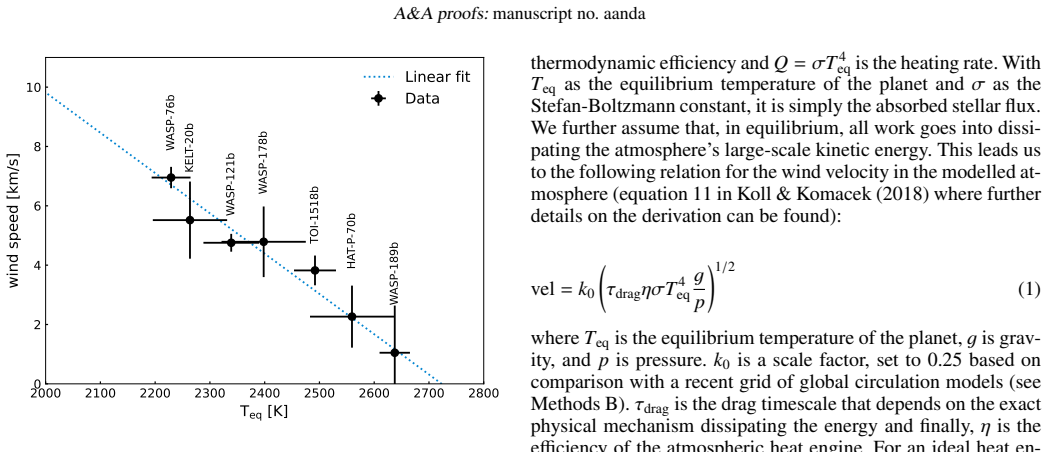
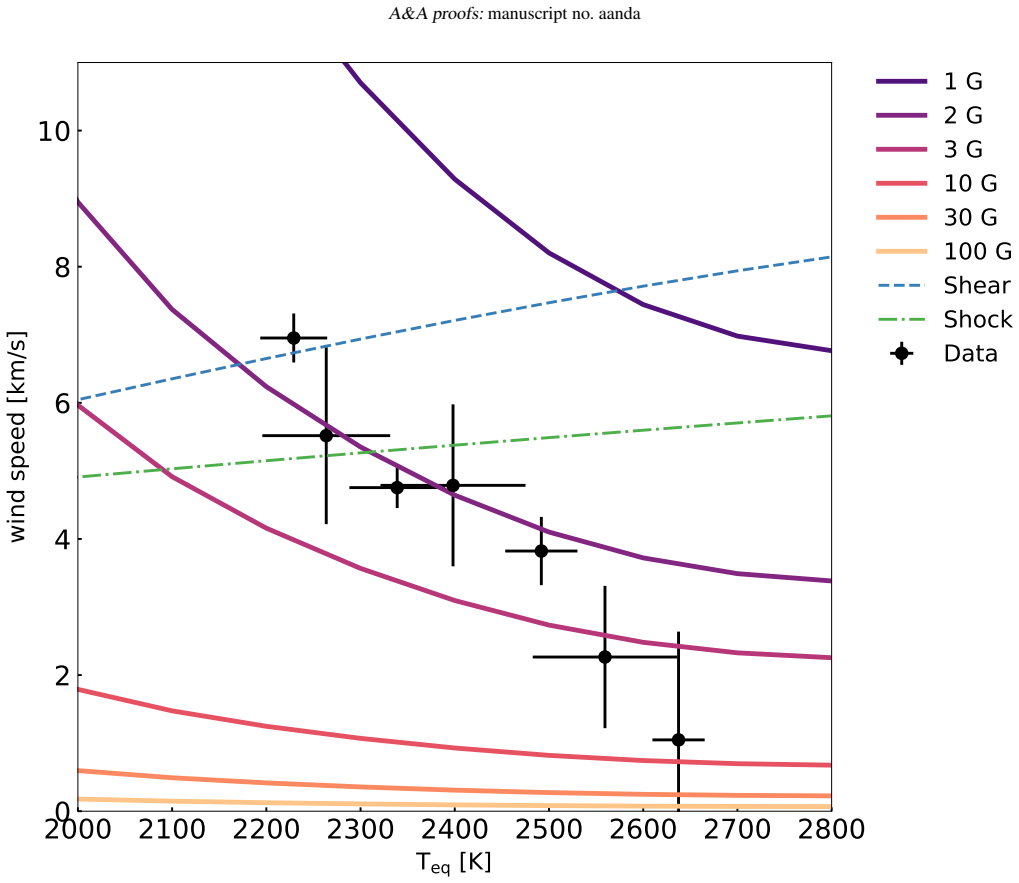
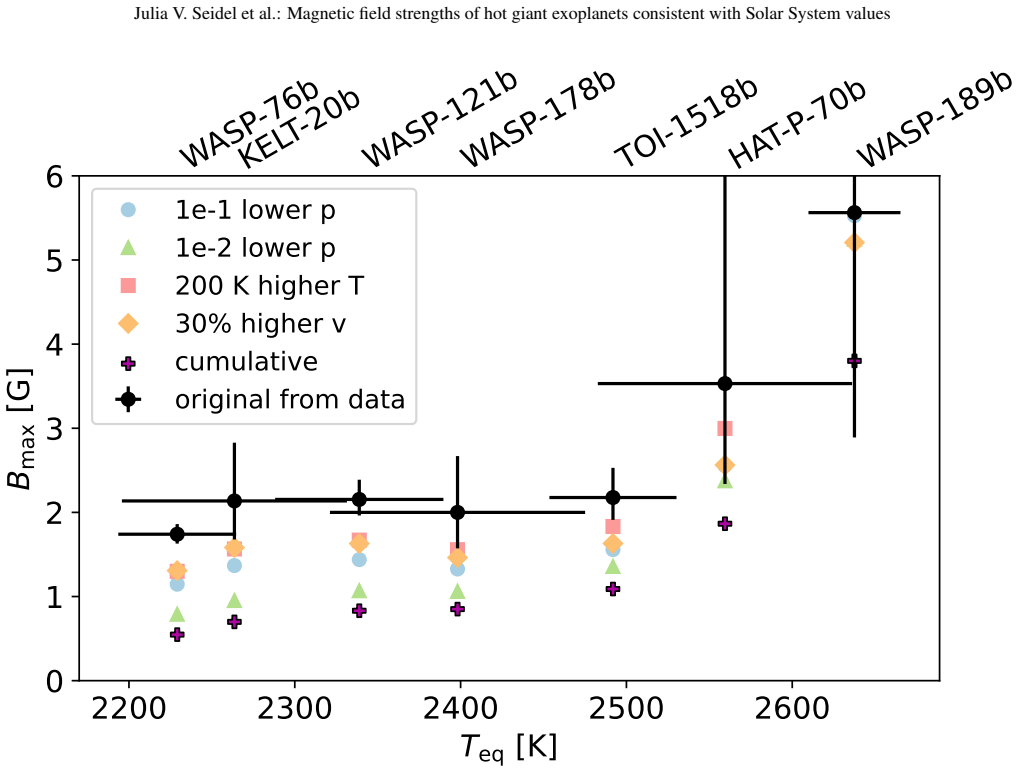
High-spectral-resolution transit observations reveal that wind speeds in ultra-hot Jupiters decrease with increasing equilibrium temperature; this relation is reproduced by atmospheric models that incorporate magnetic drag but not by purely hydrodynamic models, leading to an estimate that the magnetic field strengths of hot giant planets are at most a few gauss.
What carries the argument
Magnetic drag on the ionized upper atmosphere, which strengthens with temperature and thereby reduces wind speeds, used to convert the observed temperature-wind-speed trend into a field-strength upper limit.
If this is right
- Magnetic fields shape the atmospheric circulation of ultra-hot Jupiters.
- Magnetic field strengths of hot giant planets lie in the same range as Solar-System values.
- The relation supplies a benchmark for scaling laws that predict magnetic fields on exoplanets from hot Jupiters to rocky worlds.
Where Pith is reading between the lines
- Similar spectroscopy on cooler hot Jupiters could test whether the same magnetic-drag scaling holds outside the ultra-hot regime.
- The field-strength limit bears on models of atmospheric escape and long-term retention for these planets.
- If the drag interpretation is correct, future direct magnetic-field detections should find values near a few gauss rather than much higher.
Load-bearing premise
The measured drop in wind speed with rising temperature is produced by magnetic drag rather than other unmodeled atmospheric processes.
What would settle it
A set of wind-speed measurements for ultra-hot Jupiters that show no decrease with temperature or that imply field strengths orders of magnitude above a few gauss.
Figures
read the original abstract
Magnetic fields are ubiquitous in the universe. They play a key role in shaping the activity of stars, the habitability of rocky planets, and the long-term retention of planetary atmospheres. Theoretical scaling laws are largely constrained by the limited set of stars and Solar System planets, leading to a wide range of possible values for hot giant planets outside of the Solar System from fractions of the Jovian field to orders of magnitude larger. Ultra-hot Jupiters, with their highly ionised atmospheres, provide a new avenue to probe magnetic effects, as their atmospheric circulation could be directly sensitive to atmospheric magnetic field strength. Using high-spectral resolution observations targeting the iron lines of ultra-hot Jupiters we measure the Doppler shift and thus the wind speed of seven transiting ultra-hot Jupiters. We find a clear decrease of wind speed with increasing planetary temperature, a trend inconsistent with purely hydrodynamic mechanisms but naturally reproduced by magnetic drag. From this relation we estimate the possible strength of magnetic fields of hot giant planets to at most a few gauss - comparable to the Jovian equatorial field. Our results support the idea that magnetic fields affect the atmospheric circulation of ultra-hot Jupiters and could provide a crucial benchmark for scaling laws used to predict magnetic fields in exoplanets, from hot Jupiters to rocky Earths with additional implications for future direct observations.
Editorial analysis
A structured set of objections, weighed in public.
Referee Report
Summary. The manuscript reports high-spectral-resolution observations targeting iron lines in seven transiting ultra-hot Jupiters, from which Doppler shifts are used to measure atmospheric wind speeds. A clear anti-correlation is found between wind speed and planetary equilibrium temperature. This trend is stated to be inconsistent with purely hydrodynamic circulation models but naturally reproduced by a magnetic-drag model. From the observed relation the authors infer that magnetic field strengths in hot giant planets are at most a few gauss, comparable to Jupiter's equatorial field. The results are presented as supporting magnetic effects on ultra-hot Jupiter circulation and as an empirical benchmark for exoplanet magnetic-field scaling laws.
Significance. If the central mapping from observed wind speeds to field strength is robust, the work supplies a rare observational anchor for magnetic-field predictions in exoplanets, extending beyond the limited Solar-System sample. It directly links an observable atmospheric diagnostic to an interior property and carries implications for atmospheric retention, future direct imaging, and theoretical dynamo scaling relations.
major comments (3)
- [Abstract] Abstract: the central claim that the data support a field-strength upper limit of a few gauss rests on the assertion that the wind-temperature anti-correlation is 'naturally reproduced by magnetic drag' and that the conversion is parameter-free. No error bars on the measured wind speeds, no tabulated data, no explicit model equations, and no exclusion criteria for alternative processes (ionization, radiative timescale, or cloud effects) are supplied, rendering the claim unverifiable from the presented material.
- [Abstract] Abstract: the magnetic-field estimate is obtained by relating the observed wind-temperature trend to a magnetic-drag model. The text gives no indication that the model's functional form or parameters were fixed independently of the present dataset (e.g., via Solar-System validation or first-principles derivation), raising the possibility that the derived B value is shaped by the same data used to infer it.
- [Abstract] Abstract: the claim that the observed trend is inconsistent with hydrodynamic mechanisms but reproduced by magnetic drag requires demonstration that other temperature-dependent processes cannot produce a comparable anti-correlation. No such comparative analysis or exclusion test is described.
minor comments (1)
- [Abstract] The abstract would benefit from a concise statement of the number of planets, the typical uncertainty on the wind-speed measurements, and the temperature range spanned by the sample.
Simulated Author's Rebuttal
We thank the referee for their constructive comments on our manuscript. We address each major comment below in a point-by-point manner. We agree that the abstract can be clarified to better direct readers to supporting details in the main text and will revise accordingly.
read point-by-point responses
-
Referee: [Abstract] Abstract: the central claim that the data support a field-strength upper limit of a few gauss rests on the assertion that the wind-temperature anti-correlation is 'naturally reproduced by magnetic drag' and that the conversion is parameter-free. No error bars on the measured wind speeds, no tabulated data, no explicit model equations, and no exclusion criteria for alternative processes (ionization, radiative timescale, or cloud effects) are supplied, rendering the claim unverifiable from the presented material.
Authors: The abstract serves as a concise summary; the full manuscript supplies error bars on all reported wind speeds (Table 1 and Figures 2-3), the complete tabulated dataset, the explicit magnetic-drag model equations (Section 3.2, derived from Lorentz force balance), and discussion of alternative processes (Section 4). We will revise the abstract to reference these elements and their locations in the main text for improved verifiability. revision: yes
-
Referee: [Abstract] Abstract: the magnetic-field estimate is obtained by relating the observed wind-temperature trend to a magnetic-drag model. The text gives no indication that the model's functional form or parameters were fixed independently of the present dataset (e.g., via Solar-System validation or first-principles derivation), raising the possibility that the derived B value is shaped by the same data used to infer it.
Authors: The functional form of the magnetic-drag model (including the temperature dependence through ionization fraction) follows from first-principles MHD considerations and was validated against Solar-System field strengths in prior theoretical work, independent of the current observations. The exoplanet data are used solely to constrain the overall amplitude of B after confirming the predicted trend shape; no parameters were adjusted to fit this dataset. This separation is explained in the methods and discussion. revision: no
-
Referee: [Abstract] Abstract: the claim that the observed trend is inconsistent with hydrodynamic mechanisms but reproduced by magnetic drag requires demonstration that other temperature-dependent processes cannot produce a comparable anti-correlation. No such comparative analysis or exclusion test is described.
Authors: Section 4 already compares the observed trend against published hydrodynamic circulation models (which lack the anti-correlation) and against magnetic-drag predictions. Brief arguments are also given that ionization fraction changes, radiative timescale variations, and cloud effects would not reproduce the specific observed slope. To make the exclusion more explicit, we will add a short dedicated paragraph with quantitative estimates of these alternatives. revision: partial
Circularity Check
B-field estimate obtained by fitting observed wind-temperature trend to magnetic-drag model
specific steps
-
fitted input called prediction
[abstract]
"We find a clear decrease of wind speed with increasing planetary temperature, a trend inconsistent with purely hydrodynamic mechanisms but naturally reproduced by magnetic drag. From this relation we estimate the possible strength of magnetic fields of hot giant planets to at most a few gauss - comparable to the Jovian equatorial field."
The wind-temperature data are used both to select the magnetic-drag explanation and to extract the numerical B value; the 'estimate' is therefore the output of fitting the model to the same observations rather than an independent prediction.
full rationale
The paper measures wind speeds, observes an anti-correlation with temperature, states that magnetic drag reproduces the trend, and then estimates B ≲ few G directly from that same relation. No independent anchor (Solar-System calibration, parameter-free derivation, or external validation) is shown in the provided text for the drag-to-B conversion; the derived field strength therefore reduces to a quantity shaped by the chosen model applied to the present dataset.
Axiom & Free-Parameter Ledger
axioms (1)
- domain assumption The observed wind-speed versus temperature trend is produced by magnetic drag
Reference graph
Works this paper leans on
-
[1]
The Astrophysical Journal , volume =
Magnetohydrodynamic shock waves in molecular clouds , volume =. The Astrophysical Journal , author =. 1983 , pages =. doi:10.1086/160617 , language =
-
[2]
Geophysical Research Letters , author =
A. Geophysical Research Letters , author =. 2018 , pages =. doi:10.1002/2018GL077312 , abstract =
-
[3]
Astronomy & Astrophysics , author =
The hot dayside and asymmetric transit of. Astronomy & Astrophysics , author =. 2020 , pages =. doi:10.1051/0004-6361/202038677 , abstract =
-
[4]
Martínez, Romy Rodríguez and Gaudi, B. Scott and Rodriguez, Joseph E. and Zhou, George and Labadie-Bartz, Jonathan and Quinn, Samuel N. and Penev, Kaloyan Minev and Tan, Thiam-Guan and Latham, David W. and Paredes, Leonardo A. and Kielkopf, John and Addison, Brett C. and Wright, Duncan J. and Teske, Johanna K. and Howell, Steve B. and Ciardi, David R. and...
-
[5]
Astronomy & Astrophysics , author =
Three irradiated and bloated hot. Astronomy & Astrophysics , author =. 2016 , pages =. doi:10.1051/0004-6361/201527276 , urldate =
-
[6]
The Astronomical Journal , author =. 2016 , pages =. doi:10.3847/0004-6256/151/2/45 , number =
-
[7]
The. Astronomy & Astrophysics , author =. 2019 , pages =. doi:10.1051/0004-6361/201935718 , abstract =
-
[8]
Monthly Notices of the Royal Astronomical Society , author =. 2025 , pages =. doi:10.1093/mnras/staf1648 , abstract =
-
[9]
and Wang, Ji and Asnodkar, Anusha Pai and Petz, Sydney and Duck, Alison and Strassmeier, Klaus G
Lenhart, Calder and Johnson, Marshall C. and Wang, Ji and Asnodkar, Anusha Pai and Petz, Sydney and Duck, Alison and Strassmeier, Klaus G. and Ilyin, Ilya , year =. doi:10.48550/ARXIV.2503.07719 , abstract =
-
[10]
The Astrophysical Journal , author =
Size and. The Astrophysical Journal , author =. 2018 , pages =. doi:10.3847/1538-4357/aac6e8 , abstract =
-
[11]
Monthly Notices of the Royal Astronomical Society , author =
Magnetic induction processes in hot. Monthly Notices of the Royal Astronomical Society , author =. 2022 , pages =. doi:10.1093/mnras/stac2849 , abstract =
-
[12]
Astronomy & Astrophysics , author =
Inflated hot. Astronomy & Astrophysics , author =. 2025 , pages =. doi:10.1051/0004-6361/202555219 , abstract =
-
[13]
The Astrophysical Journal , author =
Rossby. The Astrophysical Journal , author =. 2025 , pages =. doi:10.3847/1538-4357/adf057 , abstract =
-
[14]
Monthly Notices of the Royal Astronomical Society , author =
Magnetic field evolution of hot exoplanets , volume =. Monthly Notices of the Royal Astronomical Society , author =. 2024 , pages =. doi:10.1093/mnras/stae2505 , abstract =
-
[15]
The Astrophysical Journal Letters , author =
Estimating the. The Astrophysical Journal Letters , author =. 2017 , pages =. doi:10.3847/2041-8213/aa93fd , abstract =
-
[16]
The Astrophysical Journal , author =. 2010 , pages =. doi:10.1088/0004-637X/716/2/1060 , number =
-
[17]
Lichtenberg, Tim and Miguel, Yamila , month = may, year =. Super-. doi:10.48550/arXiv.2405.04057 , abstract =
-
[18]
and Graham, Matthew , month = oct, year =
Malsky, Isaac and Kataria, Tiffany and Batalha, Natasha E. and Graham, Matthew , month = oct, year =. Accelerating. doi:10.48550/arXiv.2510.27050 , abstract =
-
[19]
Pereira, B. and Gonzalez-Gaitan, S. and Mourao, A. M. and Rino-Silvestre, J. and Paulino-Afonso, A. and Anderson, J. P. and Cikota, A. and Morales-Garoffolo, A. , month = oct, year =. Moonlit sky polarization patterns from. doi:10.48550/arXiv.2510.27308 , abstract =
-
[20]
Carone, Ludmila and Helling, Christiane and Gernjak, Sebastian and Leitner, Hanna and Janz, Tamara , month = nov, year =. Exoplanet climate characterization with transit asymmetries --. doi:10.48550/arXiv.2511.01548 , abstract =
work page internal anchor Pith review Pith/arXiv arXiv doi:10.48550/arxiv.2511.01548
-
[21]
arXiv e-prints , author =. 2025 , pages =. doi:10.48550/arXiv.2509.12737 , abstract =
-
[22]
The Astrophysical Journal , author =
Atmospheric. The Astrophysical Journal , author =. 2015 , pages =. doi:10.1088/0004-637X/806/2/180 , abstract =
-
[23]
Goodis and Karalidi, Theodora and Bott, Kimberly M
Gordon, Kenneth E. Goodis and Karalidi, Theodora and Bott, Kimberly M. and Vancil, Connor J. and Millar-Blanchaer, Maxwell A. and Wogan, Nicholas F. and Wolf, Eric T. , month = sep, year =. Polarized. doi:10.48550/arXiv.2509.16338 , abstract =
-
[24]
An idealized general circulation model for the atmospheric circulation on the ice giants , url =
Guendelman, Ilai and Kaspi, Yoahi , month = sep, year =. An idealized general circulation model for the atmospheric circulation on the ice giants , url =. doi:10.48550/arXiv.2509.17217 , abstract =
-
[25]
Bestha, Manjunath and Unni, Athira and Sivarani, T. and R, Dhanush S. and Manickavasaham, Lokesh and M, Parvathy and Divakar, Devika K. and Surya, Arun , month = sep, year =. A multi-object approach for studying exoplanet atmospheres using high-resolution spectrographs , url =. doi:10.48550/arXiv.2509.18721 , abstract =
-
[26]
The impact of stellar winds and tidal locking effects on the habitability of. arXiv e-prints , author =. 2025 , pages =. doi:10.48550/arXiv.2510.20417 , abstract =
-
[27]
Constraining exoplanet interiors using observations of their atmospheres , url =. arXiv e-prints , author =. 2025 , pages =. doi:10.48550/arXiv.2510.08844 , abstract =
-
[28]
and Kopparla, Pushkar and Li, Jiazheng and Yung, Yuk L
Wiktorowicz, Sloane J. and Kopparla, Pushkar and Li, Jiazheng and Yung, Yuk L. , month = sep, year =. A. doi:10.48550/arXiv.2509.19172 , abstract =
-
[29]
Estimating the magnetic field strength in hot Jupiters
Yadav, Rakesh K. and Thorngren, Daniel P. , month = oct, year =. Estimating the magnetic field strength in hot. doi:10.48550/arXiv.1709.05676 , abstract =
work page internal anchor Pith review Pith/arXiv arXiv doi:10.48550/arxiv.1709.05676
-
[30]
A, Babenko I. and G, Zhilkin A. , month = sep, year =. Evaluation of the magnetic field of hot. doi:10.48550/arXiv.2509.16565 , abstract =
-
[31]
O'Brien, Shane and Wong, Amber and Han, Te and Robertson, Paul and Kanodia, Shubham and Cañas, Caleb I. and Gupta, Arvind F. and Swaby, Tera and Kobulnicky, Henry A. and Morrell, Nidia and Rodruck, Michael and Lin, Andrea S. J. and Monson, Andrew and Cochran, William D. and Bender, Chad F. and Diddams, Scott A. and Halverson, Samuel and Krolikowski, Danie...
-
[32]
Bugatti, Maddalena and Lovis, Christophe and Billot, Nicolas and Blind, Nicolas and Lavie, Baptiste and Turbet, Martin and Chazelas, Bruno and Pepe, Francesco , month = sep, year =. Simulating. doi:10.48550/arXiv.2509.07644 , abstract =
-
[33]
The Astrophysical Journal , author =. 2016 , pages =. doi:10.3847/0004-637X/825/2/99 , abstract =
-
[34]
Splinter, Jared and Coulombe, Louis-Philippe and Frazier, Robert C. and Cowan, Nicolas B. and Rauscher, Emily and Dang, Lisa and Radica, Michael and Collins, Sean and Pelletier, Stefan and Allart, Romain and MacDonald, Ryan J. and Lafrenière, David and Albert, Loïc and Benneke, Björn and Doyon, René and Jayawardhana, Ray and Johnstone, Doug and Krishnamur...
-
[35]
Sithajan, Sirinrat and Kaewbiang, Lalita and Jones, Hugh R. A. and Rittipruk, Pakakaew and Meethong, Sukanya , year =. Identification of. doi:10.48550/ARXIV.2509.06496 , abstract =
-
[36]
Jupiter’s atmospheric jet streams extend thousands of kilometres deep , volume =. Nature , author =. 2018 , pages =. doi:10.1038/nature25793 , language =
-
[37]
Mechanisms of. Journal of the Atmospheric Sciences , author =. 2010 , pages =. doi:10.1175/2010JAS3492.1 , abstract =
-
[38]
Up,. The Astrophysical Journal , author =. 2024 , pages =. doi:10.3847/1538-4357/ad772f , abstract =
-
[39]
The Astrophysical Journal , author =
The. The Astrophysical Journal , author =. 2019 , pages =. doi:10.3847/2041-8213/ab43d0 , abstract =
-
[40]
The Astrophysical Journal , author =
Doppler. The Astrophysical Journal , author =. 2013 , pages =. doi:10.1088/0004-637X/762/1/24 , abstract =
-
[41]
On the radiative equilibrium of irradiated planetary atmospheres
On the radiative equilibrium of irradiated planetary atmospheres , volume =. Astronomy and Astrophysics , author =. 2010 , pages =. doi:10.1051/0004-6361/200913396 , abstract =
-
[42]
Astronomy & Astrophysics, Volume 692, id.A113, 19 pp
Breaking degeneracies in exoplanetary parameters through self-consistent atmosphere–interior modelling , volume =. Astronomy & Astrophysics, Volume 692, id.A113, 19 pp. , author =. 2024 , pages =. doi:10.1051/0004-6361/202348945 , abstract =
-
[43]
Computer program for calculation of complex chemical equilibrium compositions and applications
-
[44]
The Astrophysical Journal, Volume 714, Issue 1, pp
Gravity. The Astrophysical Journal, Volume 714, Issue 1, pp. 904-914 (2010). , author =. 2010 , pages =. doi:10.1088/0004-637X/714/1/904 , abstract =
-
[45]
Modelling magnetic star-planet interaction in the iconic
Peña-Moñino, Luis and Pérez-Torres, Miguel , month = aug, year =. Modelling magnetic star-planet interaction in the iconic. doi:10.48550/arXiv.2508.20891 , abstract =
-
[46]
Nail, F. and Oklopčić, A. and MacLeod, M. and Baka, K. and Czesla, S. and Nagel, E. and Linssen, D. and Matthijsse, J. , month = aug, year =. Probing the extent of. doi:10.48550/arXiv.2508.20572 , abstract =
-
[47]
Astronomy and Astrophysics , author =
The effect of tidal locking on the magnetospheric and atmospheric evolution of ``. Astronomy and Astrophysics , author =. 2004 , pages =. doi:10.1051/0004-6361:20035684 , abstract =
-
[48]
Journal of Geophysical Research: Space Physics, Volume 129, Issue 5, article id
A. Journal of Geophysical Research: Space Physics, Volume 129, Issue 5, article id. e2024JA032422 , author =. 2024 , pages =. doi:10.1029/2024JA032422 , abstract =
-
[49]
Nature Communications, Volume 14, article id
Drifting discrete. Nature Communications, Volume 14, article id. 5981 , author =. 2023 , pages =. doi:10.1038/s41467-023-41617-8 , abstract =
-
[50]
and Lafrenière, David and Cowan, Nicolas B
Pelletier, Stefan and Coulombe, Louis-Philippe and Splinter, Jared and Benneke, Björn and MacDonald, Ryan J. and Lafrenière, David and Cowan, Nicolas B. and Allart, Romain and Rauscher, Emily and Frazier, Robert C. and Meyer, Michael R. and Albert, Loïc and Dang, Lisa and Doyon, René and Ehrenreich, David and Flagg, Laura and Johnstone, Doug and Langeveld...
-
[51]
and Seidler, Fabian and Sossi, Paolo A
Hakim, Kaustubh and Bower, Dan J. and Seidler, Fabian and Sossi, Paolo A. , month = aug, year =. Silane-. doi:10.48550/arXiv.2508.19235 , abstract =
-
[52]
Astronomy & Astrophysics , author =
Is ozone a reliable proxy for molecular oxygen?. Astronomy & Astrophysics , author =. 2025 , note =. doi:10.1051/0004-6361/202556015 , abstract =
-
[53]
Boldt-Christmas, Linn and Rains, Adam D. and Piskunov, Nikolai and Nortmann, Lisa and Lesjak, Fabio and Cont, David and Kochukhov, Oleg and Hahlin, Axel and Lavail, Alexis and Marquart, Thomas and Heiter, Ulrike and Rengel, Miriam and Shulyak, Denis and Yan, Fei and Hatzes, Artie and Nagel, Evangelos and Reiners, Ansgar and Seemann, Ulf , month = aug, yea...
work page internal anchor Pith review Pith/arXiv arXiv doi:10.48550/arxiv.2508.18964
-
[54]
A high internal heat flux and large core in a warm. Nature , author =. 2024 , keywords =. doi:10.1038/s41586-024-07514-w , abstract =
-
[55]
Thorngren, Daniel P. and Fortney, Jonathan J. , month = may, year =. Bayesian. The Astronomical Journal, Volume 155, Issue 5, article id. 214,. doi:10.3847/1538-3881/aaba13 , abstract =
-
[56]
Astronomy and Astrophysics , author =
High-resolution transmission spectroscopy study of ultra-hot. Astronomy and Astrophysics , author =. 2022 , note =. doi:10.1051/0004-6361/202141799 , abstract =
-
[57]
Smith, Peter C. B. and Sanchez, Jorge A. and Line, Michael R. and Rauscher, Emily and Weiner Mansfield, Megan and Kempton, Eliza M. -R. and Savel, Arjun and Wardenier, Joost P. and Pino, Lorenzo and Bean, Jacob L. and Beltz, Hayley and Panwar, Vatsal and Brogi, Matteo and Malsky, Isaac and Fortney, Jonathan and Desert, Jean-Michel and Pelletier, Stefan an...
-
[58]
A warm. Nature , author =. 2024 , keywords =. doi:10.1038/s41586-024-07395-z , abstract =
-
[59]
Simonnin, A. and Parmentier, V. and Wardenier, J. P. and Chauvin, G. and Chiavassa, A. and N'Diaye, M. and Tan, X. and Heidari, N. and Bean, B. Prinoth J. and Hébrard, G. and Line, M. and Kitzmann, D. and Kasper, D. and Pelletier, S. and Seidel, J. V. and Seifhart, A. and Benneke, B. and Bonfils, X. and Brogi, M. and Désert, J.-M. and Gandhi, S. and Hammo...
-
[60]
Astronomy and Astrophysics , author =
The. Astronomy and Astrophysics , author =. 2025 , keywords =. doi:10.1051/0004-6361/202451937 , abstract =
-
[61]
Showman, Adam P. and Polvani, Lorenzo M. , month = sep, year =. Equatorial. The Astrophysical Journal, Volume 738, Issue 1, article id. 71,. doi:10.1088/0004-637X/738/1/71 , abstract =
-
[62]
Hot. Monthly Notices of the Royal Astronomical Society, Volume 531, Issue 1, pp.1056-1083 , author =. 2024 , keywords =. doi:10.1093/mnras/stae984 , abstract =
-
[63]
The Astronomical Journal , author =
A. The Astronomical Journal , author =. 2025 , note =. doi:10.3847/1538-3881/adc43f , abstract =
-
[64]
and Barman, Travis and Koskinen, Tommi , month = oct, year =
Lothringer, Joshua D. and Barman, Travis and Koskinen, Tommi , month = oct, year =. Extremely. The Astrophysical Journal, Volume 866, Issue 1, article id. 27,. doi:10.3847/1538-4357/aadd9e , abstract =
-
[65]
The shocking transit of. Monthly Notices of the Royal Astronomical Society: Letters, Volume 416, Issue 1, pp. L41-L44. , author =. 2011 , pages =. doi:10.1111/j.1745-3933.2011.01093.x , abstract =
-
[66]
A solar. Nature , author =. 2021 , note =. doi:10.1038/s41586-021-03912-6 , abstract =
-
[67]
Lesjak, F. and Nortmann, L. and Cont, D. and Yan, F. and Reiners, A. and Piskunov, N. and Hatzes, A. and Boldt-Christmas, L. and Czesla, S. and Lavail, A. and Nagel, E. and Rains, A. D. and Rengel, M. and Seemann, U. and Shulyak, D. , month = nov, year =. Retrieving wind properties from the ultra-hot dayside of. doi:10.48550/arXiv.2411.19662 , abstract =
-
[68]
Koll, Daniel D. B. and Komacek, Thaddeus D. , month = feb, year =. Atmospheric. The Astrophysical Journal , publisher =. doi:10.3847/1538-4357/aaa3de , abstract =
-
[69]
Cloud property trends in hot and ultra-hot giant gas planets (. Astronomy & Astrophysics , author =. 2021 , note =. doi:10.1051/0004-6361/202039911 , abstract =
-
[70]
Monthly Notices of the Royal Astronomical Society , author =. 2019 , pages =. doi:10.1093/mnras/stz2713 , abstract =
-
[71]
The Astronomical Journal, Volume 168, Issue 1, id.4, 19 pp
Two-dimensional. The Astronomical Journal, Volume 168, Issue 1, id.4, 19 pp. , author =. 2024 , keywords =. doi:10.3847/1538-3881/ad434d , abstract =
-
[72]
The Astronomical Journal , author =
The. The Astronomical Journal , author =. 2022 , keywords =. doi:10.3847/1538-3881/ac80bf , abstract =
-
[73]
Bello-Arufe, Aaron and Cabot, Samuel H. C. and Mendonça, João M. and Buchhave, Lars A. and Rathcke, Alexander D. , month = feb, year =. Mining the. The Astronomical Journal , publisher =. doi:10.3847/1538-3881/ac402e , abstract =
-
[74]
Solar. Space Science Reviews, v. 92, Issue 1/2, p. 39-54 (2000). , author =. 2000 , pages =. doi:10.1023/A:1005293132737 , abstract =
-
[75]
Astronomy and Astrophysics , author =. 2020 , note =. doi:10.1051/0004-6361/202039234 , abstract =
-
[76]
Monthly Notices of the Royal Astronomical Society , author =
Investigating the. Monthly Notices of the Royal Astronomical Society , author =. 2020 , note =. doi:10.1093/mnras/stz3207 , abstract =
-
[77]
Astronomy and Astrophysics , author =
A transition between the hot and the ultra-hot. Astronomy and Astrophysics , author =. 2020 , pages =. doi:10.1051/0004-6361/201937394 , abstract =
-
[79]
Menou, Kristen , month = feb, year =. Magnetic. The Astrophysical Journal, Volume 745, Issue 2, article id. 138,. doi:10.1088/0004-637X/745/2/138 , abstract =
-
[80]
Bazinet, Luc and Allart, Romain and Benneke, Björn and Pelletier, Stefan and Wardenier, Joost P. and Cook, Neil J. and Forveille, Thierry and Nielsen, Louise D. and Moulla, Khaled Al and Artigau, Étienne and Baron, Frédérique and Barros, Susana C. C. and Bonfils, Xavier and Bouchy, François and Bryan, Marta and Martins, Bruno L. Canto and Cloutier, Ryan a...
-
[81]
Monthly Notices of the Royal Astronomical Society , author =. 2018 , pages =. doi:10.1093/mnras/stx2826 , abstract =
discussion (0)
Sign in with ORCID, Apple, or X to comment. Anyone can read and Pith papers without signing in.