Clinically Aligned Geometry Constraints for Robust IVUS Vessel Boundary Segmentation
Pith reviewed 2026-06-26 21:22 UTC · model grok-4.3
The pith
GeoCat uses a differentiable geometry loss on diameters and angles to improve IVUS boundary segmentation for clinical use.
A machine-rendered reading of the paper's core claim, the machinery that carries it, and where it could break.
Core claim
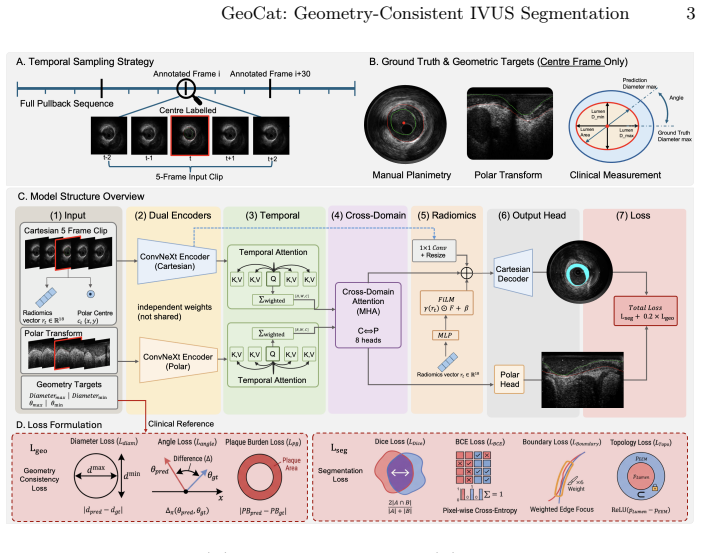
GeoCat is a geometry-consistent network that processes 5-frame IVUS clips using dual Cartesian-polar encoders with cross-domain attention and temporal fusion. It employs a differentiable geometry consistency loss to supervise diameters, orientations, and cross-sectional areas. Trained on 12,242 annotated frames from 146 patients across two IVUS systems, the model achieves a Dice score of 0.93, 95HD of 0.14 mm, 1.0% topology violations, diameter errors of 0.13-0.16 mm, and angular errors of approximately 8 degrees.
What carries the argument
Differentiable geometry consistency loss supervising diameters, orientations, and cross-sectional areas in a dual-encoder network for 5-frame IVUS clips.
If this is right
- Segmentation reaches Dice of 0.93 and 95HD of 0.14 mm.
- Topology violation rate falls to 1.0%.
- Diameter errors drop to 0.13-0.16 mm.
- Angular errors reach approximately 8 degrees.
- The outputs support reliable plaque burden quantification.
Where Pith is reading between the lines
- The dual Cartesian-polar encoding could apply to segmentation of other tubular medical structures.
- Direct clinical-metric supervision might reduce reliance on post-processing steps in analysis software.
- Results across two commercial systems suggest the constraints help with device variation.
- Better geometric fidelity could support automated tracking of plaque changes over time.
Load-bearing premise
That supervising diameters, orientations, and areas with a differentiable loss during training will improve clinical geometry metrics on new data without introducing new failure modes.
What would settle it
A held-out test set from a new patient cohort where diameter errors stay above 0.2 mm or topology violations exceed 5 percent.
Figures
read the original abstract
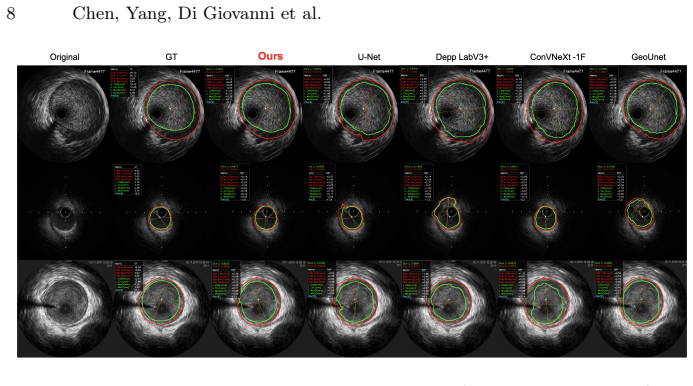
Intravascular ultrasound (IVUS) lumen and external elastic membrane (EEM) segmentation is important for quantitative coronary plaque burden assessment. Errors in lumen or EEM delineation directly propagate to plaque area, plaque burden and geometric measurements. However, standard methods prioritising overlap scores often suffer from boundary drift and topology errors, leading to inaccurate clinical measurements. We present GeoCat, a geometry-consistent network that processes 5-frame IVUS clips using dual Cartesian-polar encoders with cross-domain attention and temporal fusion. A differentiable geometry consistency loss directly supervises clinically relevant descriptors including diameters, orientations, and cross-sectional areas. The model is trained on 12,242 annotated frames from 146 patients acquired with two commercial IVUS systems. We evaluate performance using both segmentation accuracy and plaque-relevant clinical metrics, including Dice/IoU, boundary measures(95HD (mm), ASSD), topology violation rate, and clinical geometry errors (dmax/dmin, angles, and areas). On our dataset, GeoCat achieves a Dice of 0.93, reduces 95HD to 0.14 mm, and lowers topology violations to 1.0%. Importantly, it significantly improves geometric fidelity, yielding diameter errors of 0.13-0.16 mm and angular errors of ~8 degrees, supporting reliable plaque burden quantification.
Editorial analysis
A structured set of objections, weighed in public.
Referee Report
Summary. The paper presents GeoCat, a network for IVUS lumen and EEM segmentation that combines dual Cartesian-polar encoders with cross-domain attention and temporal fusion, plus a differentiable geometry consistency loss supervising diameters, orientations, and cross-sectional areas. Trained on 12,242 frames from 146 patients across two IVUS systems, it reports Dice 0.93, 95HD 0.14 mm, 1% topology violations, and clinical geometry errors of 0.13-0.16 mm (diameters) and ~8° (angles) on held-out data, claiming support for reliable plaque burden quantification.
Significance. If the geometry loss demonstrably improves true clinical fidelity on patient-disjoint held-out data without direct supervision of the reported metrics or undetected failure modes, the work would meaningfully advance IVUS analysis by addressing boundary drift that affects plaque area and burden calculations. The multi-system dataset and joint evaluation on segmentation plus clinical geometry metrics are strengths; however, the absence of ablations, baselines, and loss formulation details limits current impact.
major comments (3)
- [Abstract / Methods] Abstract and Methods: the description states that the geometry consistency loss 'directly supervises clinically relevant descriptors including diameters, orientations, and cross-sectional areas,' yet provides no formulation for differentiable extraction of dmax/dmin or area from the mask, nor the loss functional (L1/L2 on scalars). This is load-bearing for the central claim that reported diameter/angular errors reflect improved robustness rather than direct optimization of the evaluation quantities.
- [Abstract / Experiments] Abstract and Experiments: no confirmation is given that the train/test split on 12,242 frames from 146 patients is strictly patient-disjoint. Patient-level leakage would undermine the generalization claim that the model supports 'reliable plaque burden quantification' on held-out data.
- [Experiments] Experiments: the abstract and reported results contain no baseline comparisons, ablation results on the geometry loss weight, or statistical tests (e.g., paired t-tests on clinical metrics). These omissions directly affect confidence that the 0.13-0.16 mm diameter and ~8° angular improvements are attributable to the proposed loss rather than architecture or data specifics.
minor comments (2)
- [Abstract] Notation for clinical descriptors (dmax/dmin, angles) should be defined explicitly when first introduced to avoid ambiguity with standard diameter measurements.
- [Results] Figure captions or results tables should clarify whether topology violation rate is computed per frame or per patient to match the clinical metric reporting.
Simulated Author's Rebuttal
We thank the referee for the constructive comments that identify key areas for clarification and additional analysis. We agree that providing the loss formulation, confirming the data split details, and including baselines/ablations/statistics will strengthen the manuscript. We address each major comment below and will revise accordingly.
read point-by-point responses
-
Referee: [Abstract / Methods] Abstract and Methods: the description states that the geometry consistency loss 'directly supervises clinically relevant descriptors including diameters, orientations, and cross-sectional areas,' yet provides no formulation for differentiable extraction of dmax/dmin or area from the mask, nor the loss functional (L1/L2 on scalars). This is load-bearing for the central claim that reported diameter/angular errors reflect improved robustness rather than direct optimization of the evaluation quantities.
Authors: We acknowledge that the manuscript omitted the explicit differentiable formulation for extracting dmax/dmin, orientations, and areas from predicted masks, as well as the precise loss functional. This is a valid point that affects reproducibility and the strength of the central claim. In the revised manuscript, we will add a detailed Methods subsection describing the differentiable operations (e.g., contour-based or moment-based extraction) and the loss terms (L1/L2 on the scalars), clarifying how supervision occurs without directly optimizing the held-out evaluation metrics. revision: yes
-
Referee: [Abstract / Experiments] Abstract and Experiments: no confirmation is given that the train/test split on 12,242 frames from 146 patients is strictly patient-disjoint. Patient-level leakage would undermine the generalization claim that the model supports 'reliable plaque burden quantification' on held-out data.
Authors: The splits were performed at the patient level with no patient overlap between training and test sets to ensure generalization to unseen patients. We will explicitly state this in the revised Methods and Experiments sections, including the patient counts per split (e.g., details on the 146-patient partitioning) to directly address the generalization claim. revision: yes
-
Referee: [Experiments] Experiments: the abstract and reported results contain no baseline comparisons, ablation results on the geometry loss weight, or statistical tests (e.g., paired t-tests on clinical metrics). These omissions directly affect confidence that the 0.13-0.16 mm diameter and ~8° angular improvements are attributable to the proposed loss rather than architecture or data specifics.
Authors: We agree that baselines, loss-weight ablations, and statistical tests would strengthen attribution of the reported gains. In the revision, we will add: comparisons to standard baselines (e.g., Cartesian U-Net and polar variants), ablation experiments varying the geometry loss weight, and paired statistical tests (e.g., t-tests) on the clinical metrics. These will be incorporated into the Experiments section. revision: yes
Circularity Check
No significant circularity; geometry loss and reported metrics remain distinct on held-out evaluation
full rationale
The abstract describes a differentiable geometry consistency loss that supervises diameters, orientations, and cross-sectional areas during training on 12,242 frames. Reported results include Dice 0.93, 95HD 0.14 mm, topology violations 1.0%, and clinical errors (diameter 0.13-0.16 mm, angular ~8°). No equations or formulations are given that equate the test-set clinical error quantities directly to the training loss terms by construction. Evaluation uses separate segmentation and clinical metrics on held-out data; the derivation chain does not reduce predictions to inputs via self-definition, fitted-parameter renaming, or self-citation load-bearing steps. The paper is self-contained against external benchmarks.
Axiom & Free-Parameter Ledger
Reference graph
Works this paper leans on
-
[1]
Mintz, G.S., Nissen, S.E., Anderson, W.D., et al.: American College of Cardiol- ogy clinical expert consensus document on standards for acquisition, measurement and reporting of IVUS studies.J. Am. Coll. Cardiol.37(5), 1478–1492 (2001). doi:10.1016/S0735-1097(01)01175-5
-
[2]
Balocco, S., Gatta, C., Ciompi, F., et al.: Standardized evaluation methodology and reference database for evaluating IVUS image segmentation.Comput. Med. Imaging Graph.38(2), 70–90 (2014). doi:10.1016/j.compmedimag.2013.07.001
-
[3]
Mintz, G.S., Garcia-Garcia, H.M., Nicholls, S.J., et al.: Clinical expert con- sensus document on standards for acquisition, measurement and reporting of IVUS regression/progression studies.EuroIntervention6(9), 1123–1130 (2011). doi:10.4244/EIJV6I9A195
-
[4]
Yoon, H.J., Hur, S.H.: Optimization of stent deployment by intravascular ultra- sound.Korean J. Intern. Med.27(1), 30–38 (2012). doi:10.3904/kjim.2012.27.1.30
-
[5]
doi:10.1016/j.compbiomed.2025.111312
Zhang,L.,Scholl,B.,Un,S.,etal.:FullyautomatedIVUSimagesegmentationwith efficient deep-learning-assisted annotation.Computers in Biology and Medicine 199, 111312 (2025). doi:10.1016/j.compbiomed.2025.111312
-
[6]
doi:10.1016/j.compmedimag.2024.102336
Sun, Y., Zhang, X., Gao, G., et al.: Distraction-aware hierarchical learn- ing for vascular structure segmentation in intravascular ultrasound im- ages.Computerized Medical Imaging and Graphics111, 102336 (2024). doi:10.1016/j.compmedimag.2024.102336
-
[7]
Jeong, J., et al.: Deep learning-based lumen and vessel segmentation of intravas- cular ultrasound images in coronary artery disease.Korean Circulation Journal (2024). doi:10.4070/kcj.2023.0297
-
[8]
In: MICCAI 2015, LNCS, vol
Ronneberger, O., Fischer, P., Brox, T.: U-Net: Convolutional networks for biomed- ical image segmentation. In: MICCAI 2015, LNCS, vol. 9351, pp. 234–241. Springer (2015)
2015
-
[9]
In: ECCV 2018, LNCS, vol
Chen, L.-C., et al.: Encoder-decoder with atrous separable convolution for semantic image segmentation. In: ECCV 2018, LNCS, vol. 11211, pp. 833–851. Springer (2018)
2018
-
[10]
doi:10.1186/s12938-023-01171-2
Dong, L., et al.: Comparison of deep learning-based image segmentation methods for intravascular ultrasound.Biomedical Engineering Online22(1), 111 (2023). doi:10.1186/s12938-023-01171-2
-
[11]
doi:10.1016/j.compmedimag.2021.101939 10 Chen, Yang, Di Giovanni et al
Szarski, M., Cazottes, A., et al.: Improved real-time segmentation of intravascular ultrasound images using coordinate-aware fully convolu- tional networks.Computerized Medical Imaging and Graphics(2021). doi:10.1016/j.compmedimag.2021.101939 10 Chen, Yang, Di Giovanni et al
-
[12]
doi:10.1016/j.ijcard.2021.06.065
Gerlach, J., et al.: Advanced deep learning methodology for accurate, real-time seg- mentation of high-resolution intravascular ultrasound images.International Jour- nal of Cardiology338, 169–175 (2021). doi:10.1016/j.ijcard.2021.06.065
-
[13]
doi:10.1016/j.compbiomed.2024.109162
Bransby, K.M., Bajaj, R., Ramasamy, A., et al.: POLYCORE: Polygon- based contour refinement for improved Intravascular Ultrasound Seg- mentation.Computers in Biology and Medicine182, 109162 (2024). doi:10.1016/j.compbiomed.2024.109162
-
[14]
doi:10.1016/j.media.2023.102922
Huang, X., Bajaj, R., Li, Y., et al.: POST-IVUS: A perceptual organisation-aware selectivetransformerframeworkforintravascularultrasoundsegmentation.Medical Image Analysis89, 102922 (2023). doi:10.1016/j.media.2023.102922
-
[15]
Chen, Y., et al.: Geo-UNet: A Geometrically Constrained Neural Framework for Clinical-Grade Lumen Segmentation in Intravascular Ultrasound. In: Xu, X., et al. (eds.) MLMI 2024. LNCS, vol. 15241. Springer, Cham (2025). doi:10.1007/978-3- 031-73284-3_30
-
[16]
Zwanenburg, A., Vallières, M., Abdalah, M.A., et al.: The image biomarker standardization initiative: standardized quantitative radiomics for high- throughput image-based phenotyping.Radiology295(2), 328–338 (2020). doi:10.1148/radiol.2020191145
-
[17]
In: AAAI, vol
Perez, E., Strub, F., De Vries, H., Dumoulin, V., Courville, A.: FiLM: Visual reasoning with a general conditioning layer. In: AAAI, vol. 32, no. 1, pp. 3942– 3951 (2018)
2018
-
[18]
In: CVPR, pp
Liu, Z., Mao, H., Wu, C.-Y., Feichtenhofer, C., Darrell, T., Xie, S.: A ConvNet for the 2020s. In: CVPR, pp. 11976–11986 (2022)
2022
-
[19]
In: DLMIA/ML-CDS 2018, LNCS, vol
Zhou, Z., et al.: UNet++: A nested U-Net architecture for medical image segmen- tation. In: DLMIA/ML-CDS 2018, LNCS, vol. 11045, pp. 3–11. Springer (2018)
2018
-
[20]
In: Ad- vances in Neural Information Processing Systems, vol
Vaswani, A., Shazeer, N., Parmar, N., et al.: Attention is all you need. In: Ad- vances in Neural Information Processing Systems, vol. 30, pp. 5998–6008. Curran Associates (2017)
2017
-
[21]
In: Fourth International Conference on 3D Vision (3DV), pp
Milletari,F.,Navab,N.,Ahmadi,S.-A.:V-Net:Fullyconvolutionalneuralnetworks for volumetric medical image segmentation. In: Fourth International Conference on 3D Vision (3DV), pp. 565–571. IEEE (2016). doi:10.1109/3DV.2016.79
discussion (0)
Sign in with ORCID, Apple, or X to comment. Anyone can read and Pith papers without signing in.