An atypical X-ray variability component in the black hole candidate AT2019wey
Pith reviewed 2026-06-26 23:34 UTC · model grok-4.3
The pith
AT2019wey is the fifth black hole X-ray binary found to host an imaginary QPO visible only in the cross spectrum.
A machine-rendered reading of the paper's core claim, the machinery that carries it, and where it could break.
Core claim
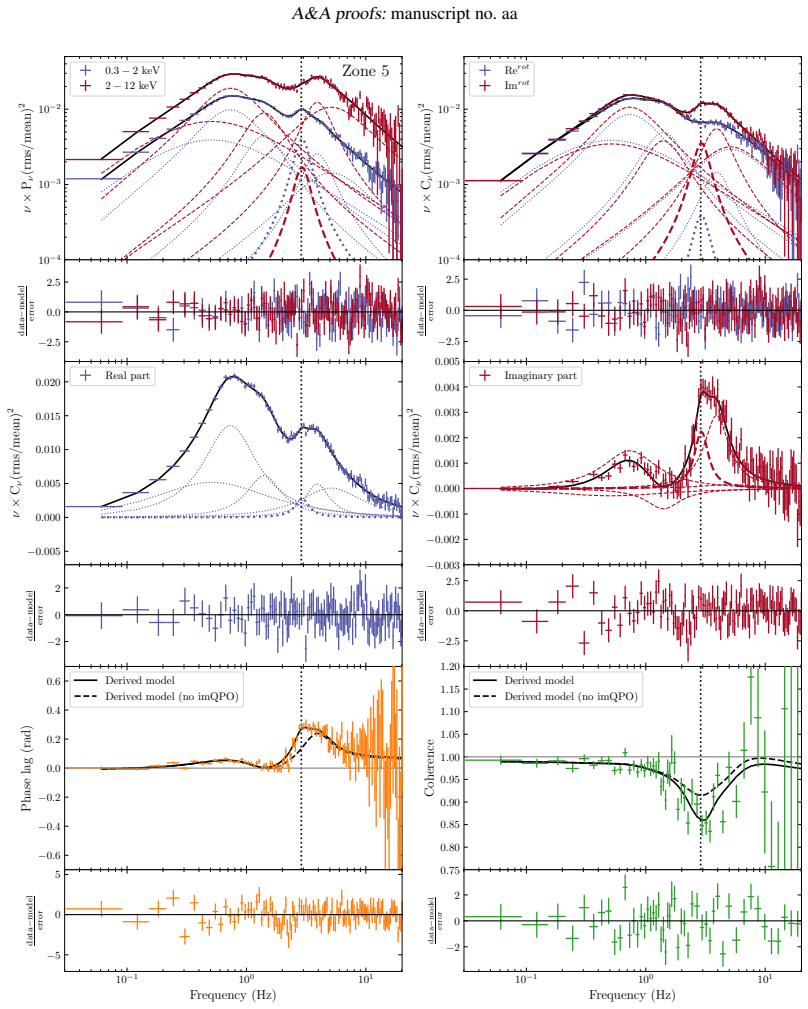
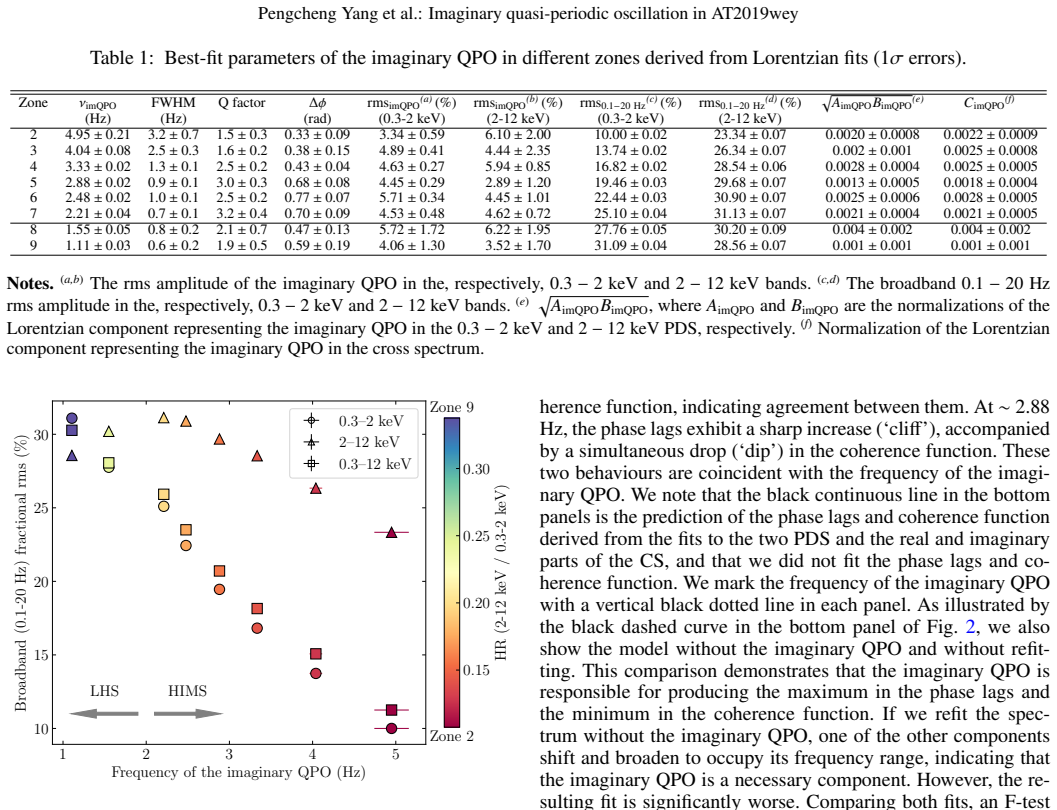
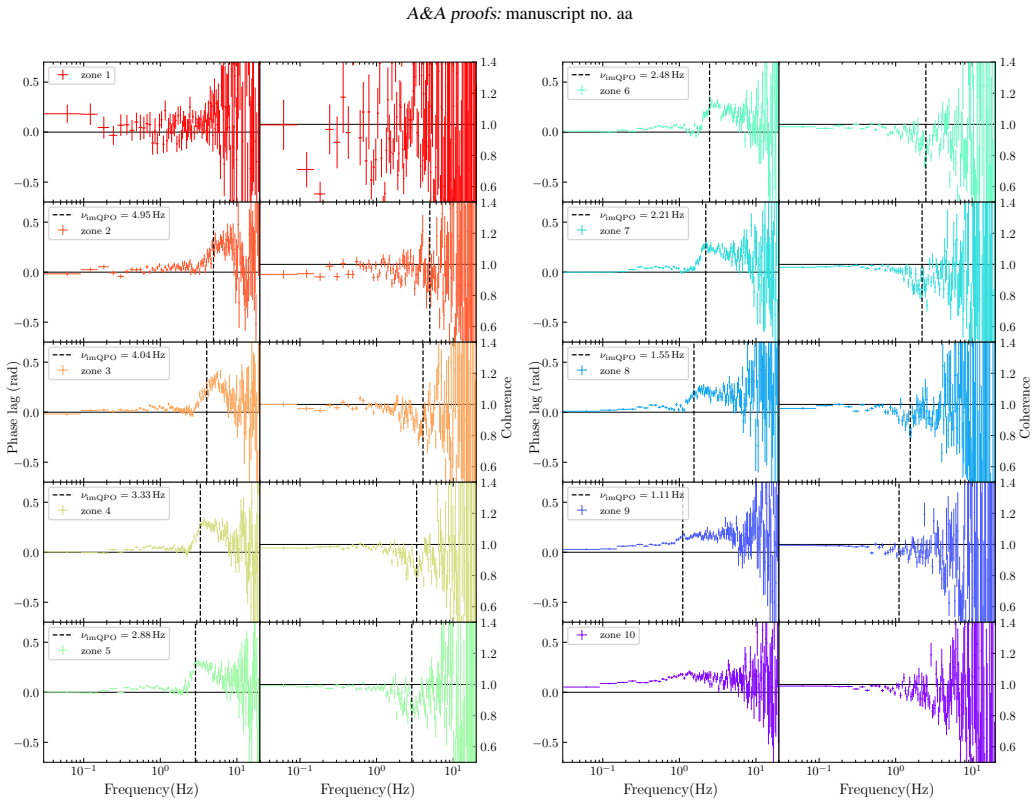
AT2019wey exhibits an imaginary QPO in the cross spectrum during the HIMS and LHS, undetected in the PDS, with frequency dropping from ~5 Hz to ~1 Hz and phase lags increasing as the source hardens, showing a U-shaped phase-lag energy spectrum in the HIMS and a specific rms spectrum possibly indicating a cool corona, with tentative link to type-C QPOs and a systematic increase of phase lags with frequency across sources.
What carries the argument
The imaginary QPO, a quasi-periodic oscillation visible only in the imaginary part of the cross spectrum between high- and low-energy light curves, marked by a sudden phase lag increase and coherence drop in a narrow frequency band.
If this is right
- As the source hardens, the imaginary QPO frequency decreases from approximately 5 Hz to 1 Hz.
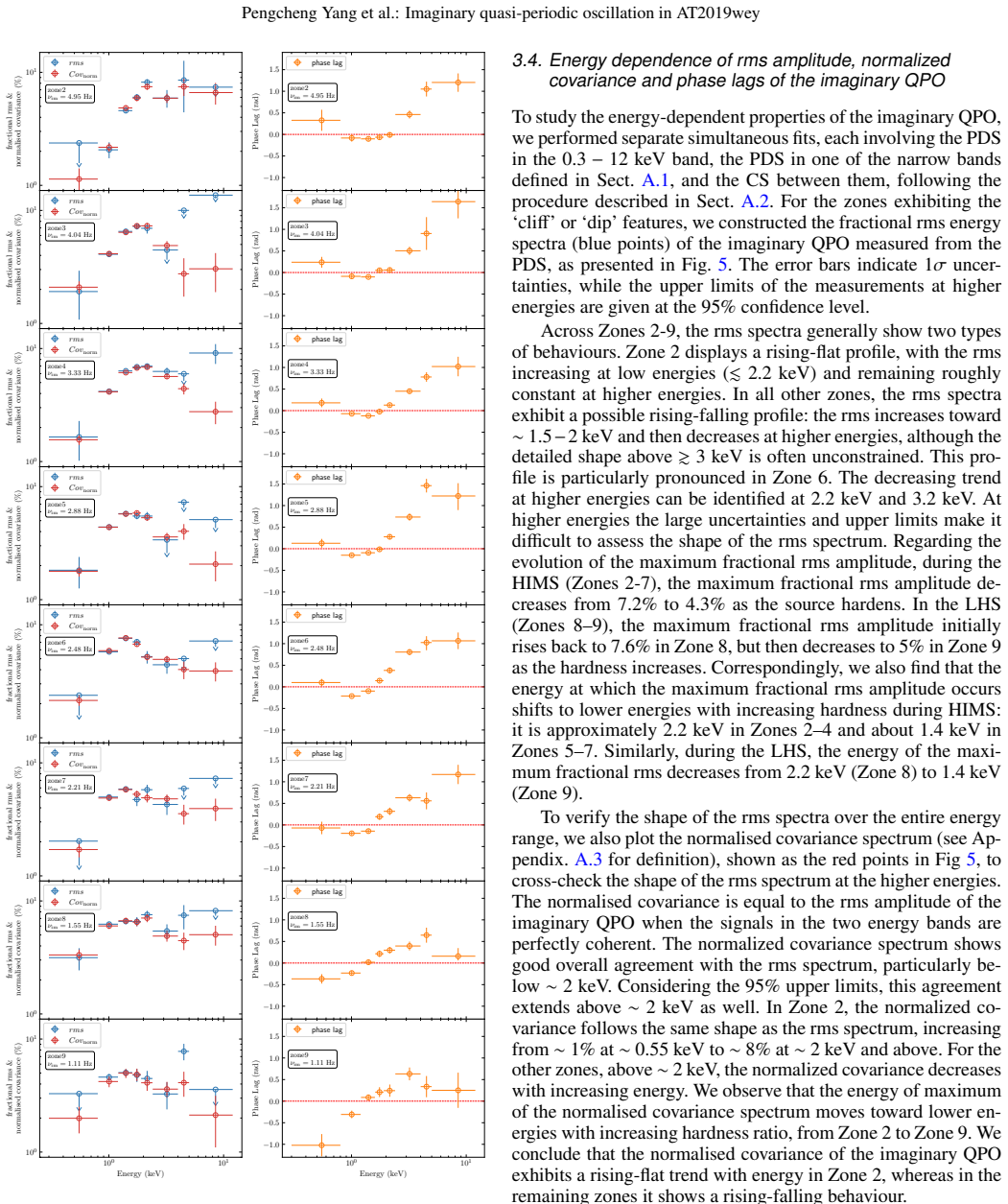
- During the HIMS the phase-lag energy spectrum of the imaginary QPO shows a U-shaped profile while the shape changes in the LHS.
- The rms spectrum of the imaginary QPO rises below ~2 keV, peaks around ~2 keV and decreases at higher energies.
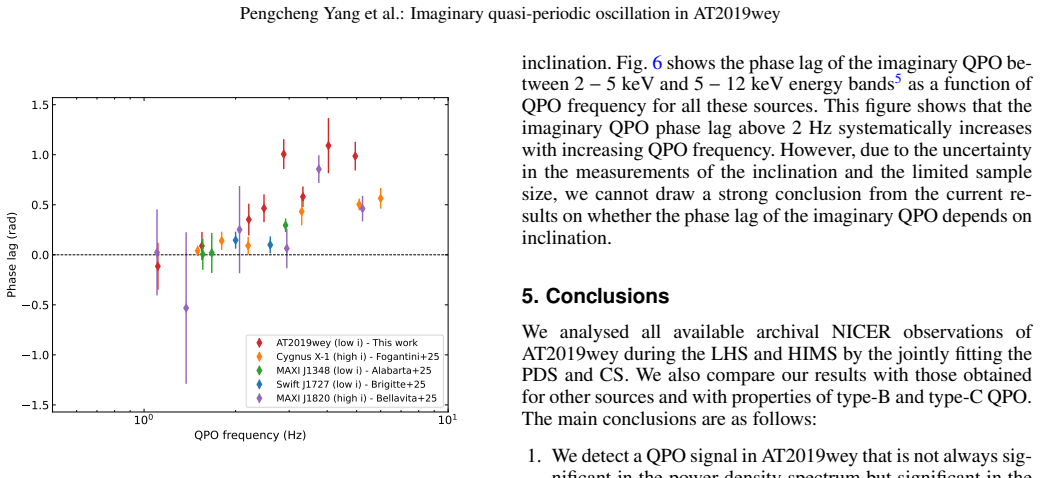
- Combining imaginary QPOs from multiple sources shows a systematic increase of phase lags with QPO frequency.
- The properties suggest a tentative connection to type-C QPOs rather than type-B QPOs.
Where Pith is reading between the lines
- If the same narrow cross-spectrum feature recurs across many sources, it may trace a shared accretion-flow process active during hard-state evolution.
- Targeted observations of sources at extreme inclinations could test whether the phase lags of imaginary QPOs follow the same viewing-angle dependence reported for type-C QPOs.
- Spectral modeling that ties the rms peak near 2 keV to corona temperature could be checked against simultaneous broadband X-ray data to see whether cool-corona conditions are required for the feature.
Load-bearing premise
The observed drop in coherence and sudden phase-lag increase within a narrow frequency band indicates a genuine distinct variability component rather than an analysis artifact.
What would settle it
Re-analysis of the NICER light curves with altered energy bands or time binning that fails to recover the narrow coherence drop and phase-lag jump, or the appearance of an identical feature in simulated Poisson noise data without any periodic signal.
Figures
read the original abstract
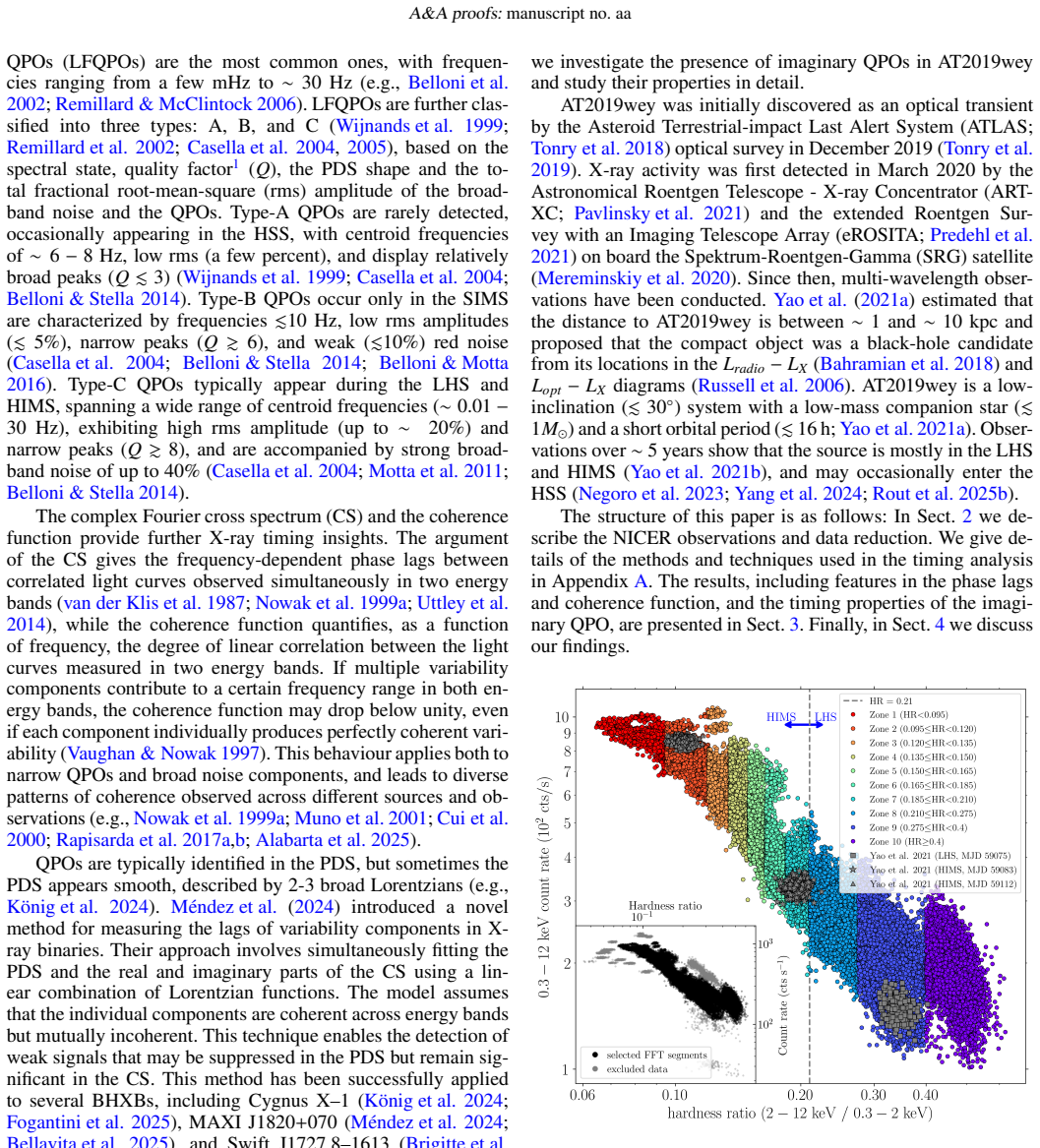
Recent studies have revealed a notable timing feature in several black hole X-ray binaries (BHXBs) during the soft-to-hard transition at the outburst decay. Within a narrow frequency range, the phase lags between high- and low-energy X-ray light curves exhibit a sudden increase, accompanied by a drop in the coherence function. These narrow features have been associated with a quasi-periodic oscillation (QPO) appearing only in the imaginary part of the cross spectrum (CS). This QPO remains undetected in the power density spectrum (PDS) and is known as imaginary QPO. Motivated by these results, we analyse five years of NICER observations of the BHXB AT2019wey during its low-hard state (LHS) and hard-intermediate state (HIMS). We find an imaginary QPO in the CS of AT2019wey, with similar characteristics as those found in other BHXBs, making AT2019wey the fifth BHXB in which such QPOs have been found. As the source hardens, the frequency of the imaginary QPO drops from $\sim$ 5 Hz to $\sim$ 1 Hz, while its phase lag rises from $\sim$ 0.3 rad to $\sim$ 0.7 rad during the HIMS and from $\sim$ 0.5 rad to $\sim$ 0.6 rad during the LHS. During the HIMS, the phase-lag energy spectrum of the imaginary QPO shows a typical U-shaped profile, while the shape changes in the LHS. The rms spectrum of the imaginary QPO rises below $\sim$ 2 keV, peaks at around $\sim$ 2 keV and decreases at higher energies, which may be associated with the presence of a relatively cool corona. We compare the properties of the imaginary QPO with those of the type-B and C QPOs in BHXBs and find a tentative connection to type-C QPOs. Combining the imaginary QPOs detected in AT2019wey with those reported in other sources, we find a systematic increase of QPO phase lags with QPO frequency. However, we cannot conclude whether the phase lags of imaginary QPOs exhibit the inclination dependence previously observed in type-C QPOs.
Editorial analysis
A structured set of objections, weighed in public.
Referee Report
Summary. The paper analyzes five years of NICER observations of the BHXB AT2019wey in the LHS and HIMS, reporting the detection of an imaginary QPO visible only in the cross-spectrum (via coherence drop and phase-lag jump in a narrow frequency band). The QPO frequency decreases from ~5 Hz to ~1 Hz with hardening, phase lags increase (0.3–0.7 rad in HIMS, 0.5–0.6 rad in LHS), the phase-lag energy spectrum is U-shaped in HIMS, and the rms spectrum peaks near 2 keV. This positions AT2019wey as the fifth such source, with a tentative link to type-C QPOs and a noted systematic rise in phase lag with frequency across sources.
Significance. If the detection holds, the work enlarges the sample of BHXBs showing imaginary QPOs and documents their evolution with spectral state using public NICER data. The reported frequency–phase-lag trend across sources is a concrete observational result that can be tested with future observations; the rms spectrum shape offers a potential handle on corona properties. The analysis applies an established timing pipeline without introducing new free parameters or circular definitions.
major comments (2)
- [§3] §3 (data selection and state classification): the HIMS/LHS assignments rest on spectral fitting; without explicit reporting of the hardness-intensity diagram boundaries, count-rate thresholds, or goodness-of-fit metrics for the spectral models, it is difficult to assess whether the reported evolutionary trends in QPO frequency and phase lag are robust to alternative state definitions.
- [§4.1] §4.1 (cross-spectrum analysis): the identification of the imaginary QPO is based on a coherence drop plus phase-lag jump within a narrow band, but the manuscript provides no quantitative significance test (e.g., Monte Carlo simulations against the underlying continuum or comparison with neighboring frequency bins) that would demonstrate the feature exceeds the expected fluctuations from red noise or leakage.
minor comments (3)
- [Figure 3] Figure 3 (rms spectrum): the plotted points lack error bars; adding 1σ uncertainties would allow readers to judge whether the reported peak near 2 keV is statistically significant.
- [Figure 5] The abstract states phase lags rise from ~0.5 to ~0.6 rad in the LHS, but the corresponding panel in Figure 5 shows overlapping error bars; a brief statistical test for the trend would strengthen the claim.
- [References] Reference list omits the original papers that first defined the imaginary QPO in other sources (e.g., the works on MAXI J1820+070 and GX 339–4); adding these would clarify the comparison sample.
Simulated Author's Rebuttal
We thank the referee for the positive assessment of our work and the recommendation for minor revision. We address each major comment below and will revise the manuscript accordingly.
read point-by-point responses
-
Referee: [§3] §3 (data selection and state classification): the HIMS/LHS assignments rest on spectral fitting; without explicit reporting of the hardness-intensity diagram boundaries, count-rate thresholds, or goodness-of-fit metrics for the spectral models, it is difficult to assess whether the reported evolutionary trends in QPO frequency and phase lag are robust to alternative state definitions.
Authors: We agree that additional documentation of the state classification is required for full reproducibility and robustness checks. In the revised manuscript we will include the hardness-intensity diagram with the explicit boundaries adopted for HIMS versus LHS classification, the count-rate thresholds used in data selection, and the goodness-of-fit metrics (reduced χ² and null-hypothesis probabilities) for the spectral models. These additions will allow readers to test the sensitivity of the reported frequency and phase-lag trends to alternative state definitions. revision: yes
-
Referee: [§4.1] §4.1 (cross-spectrum analysis): the identification of the imaginary QPO is based on a coherence drop plus phase-lag jump within a narrow band, but the manuscript provides no quantitative significance test (e.g., Monte Carlo simulations against the underlying continuum or comparison with neighboring frequency bins) that would demonstrate the feature exceeds the expected fluctuations from red noise or leakage.
Authors: The referee is correct that the current text does not contain a formal quantitative significance assessment. Although the detection follows the established cross-spectrum pipeline used for imaginary QPOs in prior works, we will add Monte Carlo simulations of the underlying red-noise continuum in the revised manuscript to quantify the significance of both the coherence drop and the phase-lag jump. We will also report comparisons with neighboring frequency bins. These tests will be presented for representative observations in each state. revision: yes
Circularity Check
No significant circularity; observational detection via established pipeline
full rationale
The paper applies standard cross-spectrum analysis (coherence drop and phase-lag jump in a narrow band) to NICER data of AT2019wey to identify an imaginary QPO, directly matching the definition and characteristics reported in prior independent sources. State classifications come from spectral fitting, frequency/phase-lag trends are measured quantities, and the claim of it being the fifth such source is a count of detections rather than a derived prediction. No equations reduce a result to its own inputs by construction, no fitted parameters are relabeled as predictions, and no load-bearing uniqueness theorem or ansatz is imported via self-citation. The derivation chain is self-contained as empirical measurement.
Axiom & Free-Parameter Ledger
axioms (2)
- standard math Fourier transforms and cross-spectrum calculations correctly isolate variability components in X-ray light curves
- domain assumption The imaginary QPO is identified by its exclusive appearance in the imaginary part of the cross-spectrum together with a coherence drop, following the definition established in prior BHXB studies
Reference graph
Works this paper leans on
-
[1]
Unveiling hidden variability components in accreting X-ray binaries using both the Fourier power and cross-spectra. , keywords =. doi:10.1093/mnras/stad3786 , archivePrefix =. 2312.03476 , primaryClass =
-
[2]
Space Telescopes and Instrumentation 2016: Ultraviolet to Gamma Ray , year = 2016, editor =
The Neutron star Interior Composition Explorer (NICER): design and development. Space Telescopes and Instrumentation 2016: Ultraviolet to Gamma Ray , year = 2016, editor =. doi:10.1117/12.2231304 , adsurl =
-
[3]
, keywords =
An atlas of aperiodic variability in HMXB. , keywords =
-
[4]
Astronomical Data Analysis Software and Systems V , year = 1996, editor =
XSPEC: The First Ten Years. Astronomical Data Analysis Software and Systems V , year = 1996, editor =
1996
-
[5]
The nature of an imaginary quasi-periodic oscillation in the soft-to-hard transition of MAXI J1820+070. , keywords =. doi:10.1051/0004-6361/202453092 , archivePrefix =. 2502.12283 , primaryClass =
-
[6]
The Astronomer's Telegram , keywords =
The optical fading and X-ray softening of the Galactic X-ray transient AT2019wey. The Astronomer's Telegram , keywords =
-
[7]
A Hidden Pulse: Uncovering a New Timing Signal in Cygnus X-1 with AstroSat. , keywords =. doi:10.3847/1538-4357/adf1a5 , archivePrefix =. 2507.13884 , primaryClass =
-
[8]
A hidden quasi-periodic oscillation in Cygnus X-1 revealed by NICER. , keywords =. doi:10.1051/0004-6361/202453523 , archivePrefix =. 2503.03078 , primaryClass =
-
[9]
Accretion disc variability in the hard state of black hole X-ray binaries. , keywords =. doi:10.1111/j.1365-2966.2009.15008.x , archivePrefix =. 0905.0587 , primaryClass =
-
[10]
X-ray reverberation around accreting black holes
X-ray reverberation around accreting black holes. , keywords =. doi:10.1007/s00159-014-0072-0 , archivePrefix =. 1405.6575 , primaryClass =
work page internal anchor Pith review Pith/arXiv arXiv doi:10.1007/s00159-014-0072-0
-
[11]
A Comprehensive X-Ray Report on AT2019wey. , keywords =. doi:10.3847/1538-4357/ac15f8 , archivePrefix =. 2012.00160 , primaryClass =
-
[12]
Long term variability of Cygnus X-1. VIII. A spectral-timing look at low energies with NICER. , keywords =. doi:10.1051/0004-6361/202449333 , archivePrefix =. 2405.07754 , primaryClass =
-
[13]
Low-frequency oscillations in black holes: a spectral-timing approach to the case of GX 339-4. , keywords =. doi:10.1111/j.1365-2966.2011.19566.x , archivePrefix =. 1108.0540 , primaryClass =
-
[14]
A variable corona for GRS 1915+105. , keywords =. doi:10.1093/mnras/stab827 , archivePrefix =. 2103.09675 , primaryClass =
-
[15]
vKompth: a variable Comptonization model for low-frequency quasi-periodic oscillations in black hole X-ray binaries. , keywords =. doi:10.1093/mnras/stac1922 , archivePrefix =. 2206.13609 , primaryClass =
-
[16]
A two-component Comptonization model for the type-B QPO in MAXI J1348-630. , keywords =. doi:10.1093/mnras/staa3944 , archivePrefix =. 2012.10354 , primaryClass =
-
[17]
Geometry of the Comptonization Region of MAXI J1348‑630 through Type-C Quasiperiodic Oscillations with NICER. , keywords =. doi:10.3847/1538-4357/ada7f9 , archivePrefix =. 2409.14883 , primaryClass =
-
[18]
Variability and phase lags of the type-C quasi-periodic oscillation of MAXI J1348-630 with NICER. , keywords =. doi:10.1093/mnras/stac1533 , archivePrefix =. 2205.11581 , primaryClass =
-
[19]
The evolution of the corona in MAXI J1535-571 through type-C quasi-periodic oscillations with Insight-HXMT. , keywords =. doi:10.1093/mnras/stac690 , archivePrefix =. 2203.05308 , primaryClass =
-
[20]
A systematic analysis of the phase lags associated with the type-C quasi-periodic oscillation in GRS 1915+105. , keywords =. doi:10.1093/mnras/staa797 , archivePrefix =. 2003.08928 , primaryClass =
-
[21]
A variable corona during the transition from type-C to type-B quasi-periodic oscillations in the black hole X-ray binary MAXI J1820+070. , keywords =. doi:10.1093/mnras/stad2284 , archivePrefix =. 2307.12728 , primaryClass =
-
[22]
, archivePrefix = "arXiv", eprint =
Low-frequency quasi-periodic oscillations spectra and Lense-Thirring precession. , keywords =. doi:10.1111/j.1745-3933.2009.00693.x , archivePrefix =. 0901.1238 , primaryClass =
-
[23]
Dual-corona Comptonization model for the type-b quasi-periodic oscillations in GX 339-4. , keywords =. doi:10.1093/mnras/stac3553 , archivePrefix =. 2212.00062 , primaryClass =
-
[24]
Transitions and Origin of the Type-B Quasi-periodic Oscillations in the Black Hole X-Ray Binary MAXI J1348-630. , keywords =. doi:10.3847/1538-4357/ac88c6 , archivePrefix =. 2208.07066 , primaryClass =
-
[25]
Discovery of two simultaneous non-harmonically related quasi-periodic oscillations in the 2005 outburst of the black hole binary GRO J1655-40. , keywords =. doi:10.1111/j.1365-2966.2012.22037.x , archivePrefix =. 1209.0327 , primaryClass =
-
[26]
NICER observations reveal that the X-ray transient MAXI J1348-630 is a black hole X-ray binary. , keywords =. doi:10.1093/mnras/staa2842 , archivePrefix =. 2009.07749 , primaryClass =
-
[27]
A Systematic Spectral-timing Analysis of Kilohertz Quasi-periodic Oscillations in the Rossi X-Ray Timing Explorer Archive. , keywords =. doi:10.3847/1538-4357/aac4a4 , archivePrefix =. 1805.05234 , primaryClass =
work page internal anchor Pith review Pith/arXiv arXiv doi:10.3847/1538-4357/aac4a4
-
[28]
A study of natural frequencies in a dynamic corona - disk system. , keywords =. doi:10.1051/0004-6361/202243397 , archivePrefix =. 2204.14139 , primaryClass =
-
[29]
Transient Name Server Discovery Report , keywords =
ATLAS Transient Discovery Report for 2019-01-01. Transient Name Server Discovery Report , keywords =
2019
-
[30]
The Astronomer's Telegram , keywords =
SRG discovery of SRGA J043520.9+552226 = SRGE J043523.3+552234, an X-ray counterpart of optical transient ATLAS19bcxp. The Astronomer's Telegram , keywords =
-
[31]
Multi-wavelength Observations of AT2019wey: a New Candidate Black Hole Low-mass X-ray Binary. , keywords =. doi:10.3847/1538-4357/ac15f9 , archivePrefix =. 2012.00169 , primaryClass =
-
[32]
The Astronomer's Telegram , keywords =
MAXI/GSC detection of AT 2019wey in an extremely soft state. The Astronomer's Telegram , keywords =
-
[33]
Handbook of X-ray and Gamma-ray Astrophysics , year = 2023, publisher=
Low-Mass X-ray Binaries. Handbook of X-ray and Gamma-ray Astrophysics , year = 2023, publisher=. doi:10.1007/978-981-16-4544-0_94-1 , adsurl =
-
[34]
X-Ray Properties of Black-Hole Binaries. , keywords =. doi:10.1146/annurev.astro.44.051905.092532 , archivePrefix =. astro-ph/0606352 , primaryClass =
work page internal anchor Pith review Pith/arXiv arXiv doi:10.1146/annurev.astro.44.051905.092532
-
[35]
Galactic Black Hole Binaries: Multifrequency Connections
Galactic black hole binaries: Multifrequency connections. Proceedings of the Fourth Compton Symposium , year = 1997, editor =. doi:10.1063/1.54121 , archivePrefix =. astro-ph/9707321 , primaryClass =
work page internal anchor Pith review Pith/arXiv arXiv doi:10.1063/1.54121 1997
-
[36]
Modelling the behaviour of accretion flows in X-ray binaries
Modelling the behaviour of accretion flows in X-ray binaries. Everything you always wanted to know about accretion but were afraid to ask. , keywords =. doi:10.1007/s00159-007-0006-1 , archivePrefix =. 0708.0148 , primaryClass =
work page internal anchor Pith review Pith/arXiv arXiv doi:10.1007/s00159-007-0006-1
-
[37]
The evolution of the timing properties of the black-hole transient GX 339-4 during its 2002/2003 outburst. , keywords =. doi:10.1051/0004-6361:20042457 , archivePrefix =. astro-ph/0504577 , primaryClass =
work page internal anchor Pith review Pith/arXiv arXiv doi:10.1051/0004-6361:20042457 2002
-
[38]
Correlated X-Ray Spectral and Timing Behavior of the Black Hole Candidate XTE J1550-564: A New Interpretation of Black Hole States. , keywords =. doi:10.1086/318954 , archivePrefix =. astro-ph/0001163 , primaryClass =
work page internal anchor Pith review Pith/arXiv arXiv doi:10.1086/318954
-
[39]
Failed-transition outbursts in black hole low-mass X-ray binaries. , keywords =. doi:10.1093/mnras/stab2241 , archivePrefix =. 2107.10035 , primaryClass =
-
[40]
A review of quasi-periodic oscillations from black hole X-ray binaries: Observation and theory. , keywords =. doi:10.1016/j.newar.2020.101524 , archivePrefix =. 2001.08758 , primaryClass =
-
[41]
A Unified Description of the Timing Features of Accreting X-ray Binaries
A Unified Description of the Timing Features of Accreting X-Ray Binaries. , keywords =. doi:10.1086/340290 , archivePrefix =. astro-ph/0202213 , primaryClass =
work page internal anchor Pith review Pith/arXiv arXiv doi:10.1086/340290
-
[42]
Quasi periodic oscillations in black hole binaries
Quasi periodic oscillations in black hole binaries. Astronomische Nachrichten , keywords =. doi:10.1002/asna.201612320 , archivePrefix =. 1603.07885 , primaryClass =
work page internal anchor Pith review Pith/arXiv arXiv doi:10.1002/asna.201612320
-
[43]
Phase Lag and Coherence Function of X-ray emission from Black Hole Candidate XTE J1550-564
Phase Lag and Coherence Function of X-Ray Emission from Black Hole Candidate XTE J1550-564. , keywords =. doi:10.1086/312520 , archivePrefix =. astro-ph/0001095 , primaryClass =
work page internal anchor Pith review Pith/arXiv arXiv doi:10.1086/312520
-
[44]
Rossi X-Ray Timing Explorer Observation of Cygnus X-1. II. Timing Analysis. , keywords =. doi:10.1086/306610 , archivePrefix =. astro-ph/9807278 , primaryClass =
-
[45]
X-Ray Variability Coherence: How to Compute It, What It Means, and How It Constrains Models of GX 339-4 and Cygnus X-1. , keywords =. doi:10.1086/310430 , archivePrefix =. astro-ph/9610257 , primaryClass =
work page internal anchor Pith review Pith/arXiv arXiv doi:10.1086/310430
-
[46]
Cross-spectral modelling of the black hole X-ray binary XTE J1550-564: challenges to the propagating fluctuations paradigm. , keywords =. doi:10.1093/mnras/stx991 , archivePrefix =. 1704.07705 , primaryClass =
work page internal anchor Pith review Pith/arXiv arXiv doi:10.1093/mnras/stx991
-
[47]
Radio Emission and the Timing Properties of the Hard X-ray State of GRS 1915+105
Radio Emission and the Timing Properties of the Hard X-Ray State of GRS 1915+105. , keywords =. doi:10.1086/321604 , archivePrefix =. astro-ph/0104067 , primaryClass =
work page internal anchor Pith review Pith/arXiv arXiv doi:10.1086/321604 1915
-
[48]
Modelling hard and soft state of Cygnus X-1 with propagating mass accretion rate fluctuations
Modelling hard and soft states of Cygnus X-1 with propagating mass accretion rate fluctuations. , keywords =. doi:10.1093/mnras/stx2110 , archivePrefix =. 1708.04182 , primaryClass =
work page internal anchor Pith review Pith/arXiv arXiv doi:10.1093/mnras/stx2110
-
[49]
Variable QPO lags and reduced coherence between the disc and corona in MAXI J1820+070. , keywords =. doi:10.1093/mnras/staf1238 , archivePrefix =. 2507.18437 , primaryClass =
-
[50]
Observational appearance
Black holes in binary systems. Observational appearance. , year = 1973, month = jan, volume =
1973
-
[51]
, keywords =
Comptonization of X-Rays in Plasma Clouds - Typical Radiation Spectra. , keywords =
-
[52]
Energy Spectra of Low-Mass Binary X-Ray Sources Observed from Tenma. , keywords =. doi:10.1093/pasj/36.4.741 , adsurl =
-
[53]
Simultaneous X-Ray and Optical Observations of GX 339-4 in an X-Ray High State. , keywords =. doi:10.1086/164534 , adsurl =
-
[54]
Spectral properties of MXB 1658-298 in the low/hard and high/soft state
Spectral properties of MXB 1658-298 in the low/hard and high/soft state. , keywords =. doi:10.1093/mnras/sty2678 , archivePrefix =. 1810.01827 , primaryClass =
work page internal anchor Pith review Pith/arXiv arXiv doi:10.1093/mnras/sty2678
-
[55]
X-ray and Optical Monitoring of State Transitions in MAXI J1820+070
X-Ray and Optical Monitoring of State Transitions in MAXI J1820+070. , keywords =. doi:10.3847/1538-4357/ab09ff , archivePrefix =. 1903.01686 , primaryClass =
work page internal anchor Pith review Pith/arXiv arXiv doi:10.3847/1538-4357/ab09ff 1903
-
[56]
The Complex Phase-Lag Behavior of the 3-12 HZ Quasi-Periodic Oscillations during the Very High State of XTE J1550-564. , keywords =. doi:10.1086/312365 , archivePrefix =. astro-ph/9909515 , primaryClass =
work page internal anchor Pith review Pith/arXiv arXiv doi:10.1086/312365
-
[57]
Towards a unified model for black hole X-ray binary jets. , keywords =. doi:10.1111/j.1365-2966.2004.08384.x , archivePrefix =. astro-ph/0409360 , primaryClass =
-
[58]
The EXOSAT data on GX 339-4: further evidence for an ``intermediate'' state
The EXOSAT Data on GX 339-4: Further Evidence for an ``Intermediate'' State. , keywords =. doi:10.1086/303914 , archivePrefix =. astro-ph/9611015 , primaryClass =
work page internal anchor Pith review Pith/arXiv arXiv doi:10.1086/303914
-
[59]
Characterizing the QPO Behavior of the X-ray Nova XTE J1550--564
Characterizing the Quasi-periodic Oscillation Behavior of the X-Ray Nova XTE J1550-564. , keywords =. doi:10.1086/324276 , archivePrefix =. astro-ph/0105508 , primaryClass =
work page internal anchor Pith review Pith/arXiv arXiv doi:10.1086/324276
-
[60]
Lecture Notes in Physics, Berlin Springer Verlag , year = 2010, publisher=
X-Ray Emission from Black-Hole Binaries. Lecture Notes in Physics, Berlin Springer Verlag , year = 2010, publisher=. doi:10.1007/978-3-540-76937-8_2 , adsurl =
-
[61]
A study of the low-frequency quasi-periodic oscillations in the X-ray light curves of the black hole candidate <ASTROBJ>XTE J1859+226</ASTROBJ>. , keywords =. doi:10.1051/0004-6361:20041231 , archivePrefix =. astro-ph/0407262 , primaryClass =
work page internal anchor Pith review Pith/arXiv arXiv doi:10.1051/0004-6361:20041231
-
[62]
The ABC of Low-Frequency Quasi-periodic Oscillations in Black Hole Candidates: Analogies with Z Sources. , keywords =. doi:10.1086/431174 , archivePrefix =. astro-ph/0504318 , primaryClass =
work page internal anchor Pith review Pith/arXiv arXiv doi:10.1086/431174
-
[63]
Quasi-periodic oscillations and noise in low-mass X-ray binaries. , keywords =. doi:10.1146/annurev.aa.27.090189.002505 , adsurl =
-
[64]
Transient Black Hole Binaries. Astrophysics of Black Holes: From Fundamental Aspects to Latest Developments , year = 2016, editor =. doi:10.1007/978-3-662-52859-4_2 , archivePrefix =. 1603.07872 , primaryClass =
work page internal anchor Pith review Pith/arXiv arXiv doi:10.1007/978-3-662-52859-4_2 2016
-
[65]
Fast variability from black-hole binaries
Fast Variability from Black-Hole Binaries. , keywords =. doi:10.1007/s11214-014-0076-0 , archivePrefix =. 1407.7373 , primaryClass =
work page internal anchor Pith review Pith/arXiv arXiv doi:10.1007/s11214-014-0076-0
-
[66]
Fast-varying time lags in the quasi-periodic oscillation in GRS 1915 + 105. , keywords =. doi:10.1093/mnras/stad3639 , archivePrefix =. 2311.13467 , primaryClass =
-
[67]
Error formulae for the energy-dependent cross-spectrum. , keywords =. doi:10.1093/mnras/stz2409 , archivePrefix =. 1909.01385 , primaryClass =
-
[68]
The Complex Cross-Spectra of Cygnus X-2 and GX 5-1. , keywords =. doi:10.1086/184946 , adsurl =
-
[69]
Journal of High Energy Astrophysics , keywords =
Spectral and timing analysis of the frequent flares experienced by AT2019wey. Journal of High Energy Astrophysics , keywords =. doi:10.1016/j.jheap.2024.04.004 , adsurl =
-
[70]
Accretion Geometry of the New Galactic Black Hole Candidate AT2019wey in the Hard State. , keywords =. doi:10.3847/1538-4357/ae2d1f , archivePrefix =. 2511.06393 , primaryClass =
-
[71]
Global optical/infrared-X-ray correlations in X-ray binaries: quantifying disc and jet contributions. , keywords =. doi:10.1111/j.1365-2966.2006.10756.x , archivePrefix =. astro-ph/0606721 , primaryClass =
-
[72]
doi:10.5281/zenodo.1252036 , url =
Arash Bahramian and James Miller-Jones and Jay Strader and Alexandra Tetarenko and Richard Plotkin and Anthony Rushton and Vlad Tudor and Sara Motta and Laura Shishkovsky , title =. doi:10.5281/zenodo.1252036 , url =
-
[73]
The comptonizing medium of the black hole X-ray binary MAXI J1535-571 through type-C quasi-periodic oscillations. , keywords =. doi:10.1093/mnras/stad126 , archivePrefix =. 2301.04418 , primaryClass =
-
[74]
Tracing the power-law component in the energy spectrum of black hole candidates as a function of the QPO frequency. , keywords =. doi:10.1051/0004-6361:20021542 , archivePrefix =. astro-ph/0210517 , primaryClass =
work page internal anchor Pith review Pith/arXiv arXiv doi:10.1051/0004-6361:20021542
-
[75]
Determination of Black Hole Masses in Galactic Black Hole Binaries Using Scaling of Spectral and Variability Characteristics. , keywords =. doi:10.1088/0004-637X/699/1/453 , archivePrefix =. 0902.2852 , primaryClass =
work page internal anchor Pith review Pith/arXiv arXiv doi:10.1088/0004-637x/699/1/453
-
[76]
The 2003 Outburst of the X-Ray Transient H1743-322: Comparisons with the Black Hole Microquasar XTE J1550-564. , keywords =. doi:10.1088/0004-637X/698/2/1398 , archivePrefix =. 0705.1034 , primaryClass =
work page internal anchor Pith review Pith/arXiv arXiv doi:10.1088/0004-637x/698/2/1398 2003
-
[77]
Correlations between Low-Frequency QPOs and Spectral Parameters in XTE J1550-564 and GRO J1655-40
Correlations between Low-Frequency Quasi-periodic Oscillations and Spectral Parameters in XTE J1550-564 and GRO J1655-40. , keywords =. doi:10.1086/308463 , archivePrefix =. astro-ph/9910519 , primaryClass =
work page internal anchor Pith review Pith/arXiv arXiv doi:10.1086/308463
-
[78]
ATLAS: A High-Cadence All-Sky Survey System
ATLAS: A High-cadence All-sky Survey System. , keywords =. doi:10.1088/1538-3873/aabadf , archivePrefix =. 1802.00879 , primaryClass =
work page internal anchor Pith review Pith/arXiv arXiv doi:10.1088/1538-3873/aabadf
-
[79]
The eROSITA X-ray telescope on SRG. , keywords =. doi:10.1051/0004-6361/202039313 , archivePrefix =. 2010.03477 , primaryClass =
-
[80]
The ART-XC telescope on board the SRG observatory. , keywords =. doi:10.1051/0004-6361/202040265 , archivePrefix =. 2103.12479 , primaryClass =
discussion (0)
Sign in with ORCID, Apple, or X to comment. Anyone can read and Pith papers without signing in.