REVIEW 87 references
COUNTESS I: A Uniformly Vetted Catalog of Known and New Transiting Exoplanets in the TESS Northern Continuous Viewing Zone
T0 review · reviewed 2026-08-04 · deepseek-v4-flash
Pith's one-line read A multi-cadence TESS pipeline recovers 72% of known northern-CVZ TOIs and delivers 10 new planet candidates, including two statistically validated sub-Neptunes.
The pith
A machine-rendered reading of the paper's core claim, the machinery that carries it, and where it could break.
The reading
The pipeline detrends the stitched light curves with a 'biweight' filter, searches for repeating transit dips with a fast-folding Box Least Squares code called GERBLS, fits transit shapes with EXOTIC, removes false alarms with the LEOVetter suite, and finally runs surviving signals through triceratops, which computes the probability that a signal is a false positive versus a real planet.
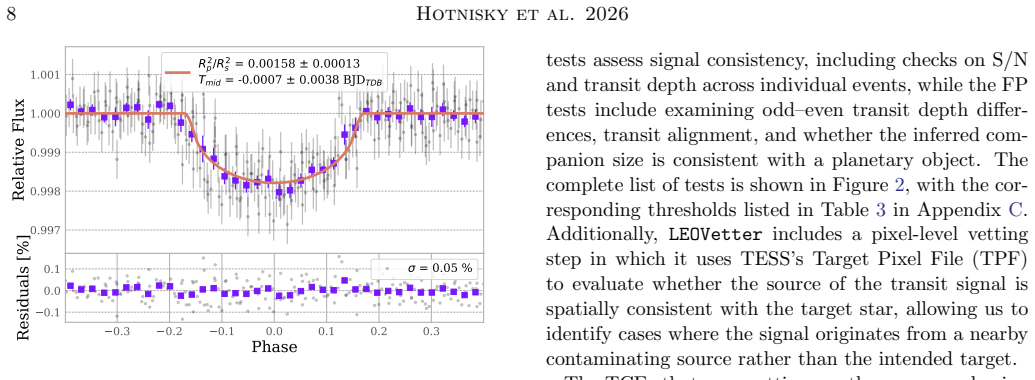
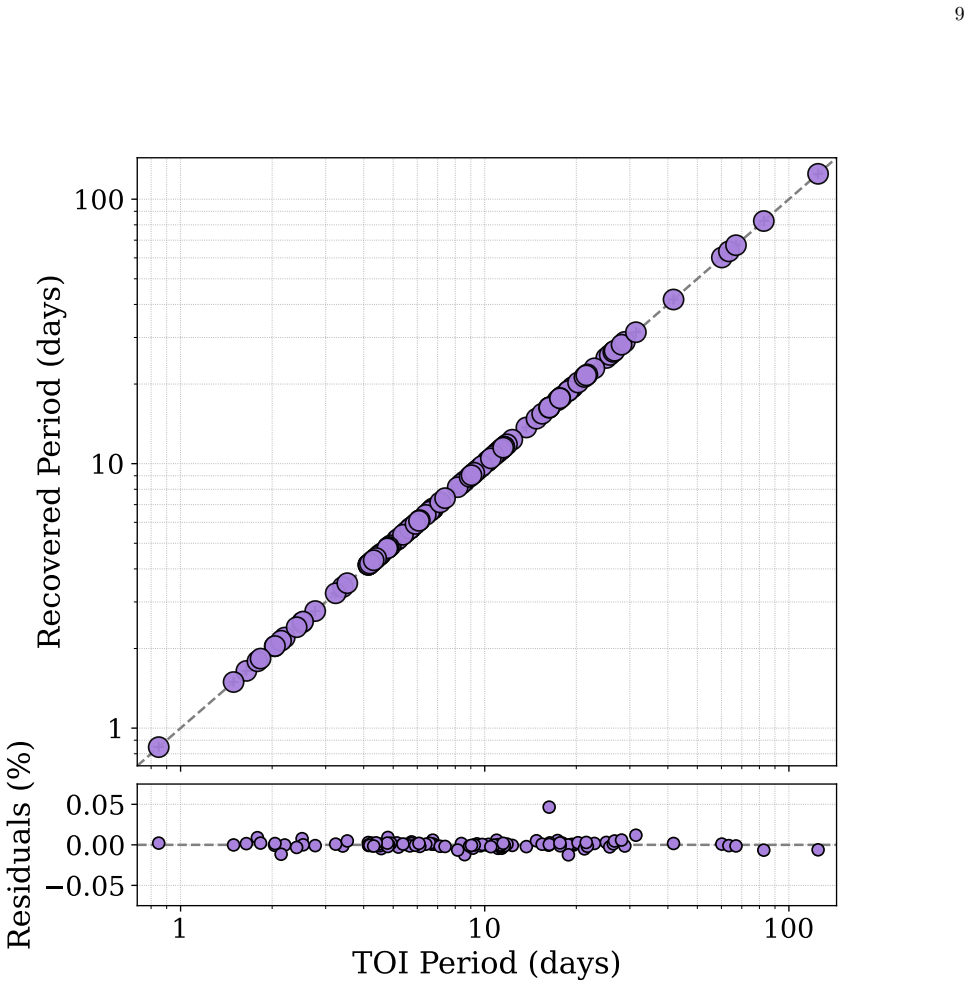
On 26,114 stars with TESS-SPOC light curves, COUNTESS recovered 115 of 159 previously known planet signals (72%) and found 38 new transit signals, 10 of which survived all vetting. Two — TIC 219893931b and TIC 237254473b — have false-positive probabilities below 1.5% and are designated statistically validated sub-Neptunes. Caveats: one of those two was already reported as a community candidate in 2023, the pipeline's planet radii come out systematically smaller than published values, and the 'likely planet' list uses a looser nearby false-positive threshold (10^-1) than the one stated in the methods (10^-3).
Extended reading notes
Core claim
The central load-bearing assertion is that COUNTESS 'recovers 115 out of 159 known TESS Objects of Interest' and that its blind search produced '10 new exoplanet candidates... including two new statistically validated sub-Neptunes, TIC 219893931b and TIC 237254473b' (Abstract; §4.2–4.4). If the paper is correct, the pipeline genuinely stitches heterogeneous-cadence CVZ light curves into a sensitive long-baseline search, the 72% recovery rate reflects real performance, and the two 'b' designations are statistically validated planets (with the caveat that TIC 219893931b was previously reported by Montalto 2023).
Load-bearing premise
The step-function detrending window w(P) = 0.5 days for P ≤ 100 days and 1.75 days for P > 100 days (§3.2, 'our window length w as a function of period P is...'). Every transit depth — and hence every recovered planet radius and the sub-Neptune classifications — passes through this filter, and the 100-day boundary was chosen by hand to maximize recovery of the known TOI sample (the same sample later used to report the 72% recovery). The paper itself demonstrates that the 0.5-day window removes part of the transit depth for long-duration transits (Figure 10). The re-processing at 1.75 days only triggers after the first-pass search has returned P > 100 days, so any long-duration signal that the short window over-detrends in the first pass is lost before the longer window is applied. If the window function is wrong for some period/duration range, the candidate list — and the completeness the pipeline needs for its stated demographic goal — is biased in a way the paper does not quantify (n
Editorial analysis
A structured set of objections, weighed in public.
Assumptions & free parameters
free parameters (5)
- Detrending window function w(P) =
0.5 d for P ≤ 100 d; 1.75 d for P > 100 d
- Minimum transit count =
3 transits
- GERBLS BLS SNR threshold =
S/N ≥ 6 (MES ≥ 6.2)
- triceratops NFPP threshold =
10^-3 stated (§3.5, §5 bullet); 10^-1 applied for 8 candidates (§4.3)
- EM1 cadence binning =
10-min → 30-min
assumptions (5)
- domain assumption TESS-SPOC PDC-SAP FFI light curves are adequately corrected for instrumental systematics
- domain assumption Stellar radius/mass derivation (color-Teff relation, random-forest [Fe/H]/log g on LAMOST, MIST isochrones, Mann/Torres relations) is accurate
- domain assumption triceratops FPP/NFPP correctly represent the false-positive probability given the modeled scenarios
- domain assumption RUWE < 1.4 plus Gaia non-single-star flag = 0 isolates single stars
- standard math Standard transit-search statistical machinery (BLS significance, MES thresholds, Kepler vetting thresholds) is valid without recalibration for CVZ data
Cite this review
Pith. "Pith review of COUNTESS I: A Uniformly Vetted Catalog of Known and New Transiting Exoplanets in the TESS Northern Continuous Viewing Zone." pith.science (2026). https://pith.science/paper/UTSHVEEU
@misc{pith2026260613789,
  author       = {Pith},
  title        = {Pith review of: COUNTESS I: A Uniformly Vetted Catalog of Known and New Transiting Exoplanets in the TESS Northern Continuous Viewing Zone},
  year         = {2026},
  howpublished = {\url{https://pith.science/paper/UTSHVEEU}},
  note         = {Machine review of arXiv:2606.13789}
}
abstract
The Transiting Exoplanet Survey Satellite (TESS) has transformed the study of nearby exoplanetary systems; however, its nominal observing strategy limits sensitivity to planets with orbital periods shorter than $\sim$10 days for most parts of the sky. The two TESS Continuous Viewing Zones (CVZs) provide extended temporal baselines that help overcome this limitation, enabling the detection of longer-period ($>$10 days) transiting planets around nearby stars. Here, we present COUNTESS, a transit-search pipeline optimized for long-baseline TESS observations that combines multi-sector light curves with heterogeneous cadences, and implements fast-folding BLS period detection, vetting, and statistical validation. As a first application of the pipeline, we conducted a search on the primary and first extended mission photometry in the TESS northern CVZ. For this analysis, we used Gaia DR3 and 2MASS photometry to homogeneously derive a stellar catalog of FGKM stars for the TESS northern CVZ, resulting in a sample of 391,059 stars. We used COUNTESS to search for transiting planets around 26,114 of these stars with TESS-SPOC light curves and assessed its performance, recovering 115 out of 159 known TESS Objects of Interest (TOIs; $0.85\ \text{days} < P <124.72\ \text{days}$; $1.03\ R_\oplus < R_p < 16.35\ R_\oplus$). Additionally, we identified 10 new exoplanet candidates ($1.20\ \text{days} < P <34.62\ \text{days}$; $1.73\ R_\oplus < R_p < 4.19\ R_\oplus$) that passed vetting tests, including two new statistically validated sub-Neptunes, TIC 219893931b and TIC 237254473b. COUNTESS enables extended-baseline TESS analyses and identification of longer-period planets, establishing a foundation for future exoplanet demographic studies, including comparisons with Kepler and K2.
Figures


Figures from the paper (7 more)



Reference graph
Works this paper leans on
-
[1]
Alsubai, K., Tsvetanov, Z. I., Pyrzas, S., et al. 2019, The Astronomical Journal, 157, 224, doi: 10.3847/1538-3881/ab19bc Astropy Collaboration, Price-Whelan, A. M., Sip˝ ocz, B. M., et al. 2018, The Astronomical Journal, 156, 123, doi: 10.3847/1538-3881/aabc4f
-
[2]
2021, AJ, 161, 147, doi: 10.3847/1538-3881/abd806
Demleitner, M., & Andrae, R. 2021, AJ, 161, 147, doi: 10.3847/1538-3881/abd806
-
[3]
Bakos, G. A., Hartman, J. D., Bhatti, W., et al. 2021, The Astronomical Journal, 162, 7, doi: 10.3847/1538-3881/abf637
-
[4]
Barkaoui, K., Timmermans, M., Soubkiou, A., et al. 2023, Astronomy and Astrophysics, 677, A38, doi: 10.1051/0004-6361/202346838 Beaug´ e, C., & Nesvorn´ y, D. 2013, The Astrophysical Journal, 763, 12, doi: 10.1088/0004-637X/763/1/12
-
[5]
Boley, K. M., Wang, J., Zinn, J. C., et al. 2021, AJ, 162, 85, doi: 10.3847/1538-3881/ac0e2d
-
[6]
J., Koch, D., Basri, G., et al
Borucki, W. J., Koch, D., Basri, G., et al. 2010, Science, 327, 977, doi: 10.1126/science.1185402
-
[7]
Brady, M., Bean, J. L., Seifahrt, A., et al. 2024, The Astronomical Journal, 168, 67, doi: 10.3847/1538-3881/ad500a
-
[8]
Bryson, S. T., Jenkins, J. M., Gilliland, R. L., et al. 2013, Publications of the Astronomical Society of the Pacific, 125, 889, doi: 10.1086/671767
Show all 87 references
-
[9]
2021, The Journal of Open Source Software, 6, 3001, doi: 10.21105/joss.03001
Buchner, J. 2021, The Journal of Open Source Software, 6, 3001, doi: 10.21105/joss.03001
2021 doi
-
[10]
2022, The Astronomical Journal, 164, 96, doi: 10.3847/1538-3881/ac7cea
Cadieux, C., Doyon, R., Plotnykov, M., et al. 2022, The Astronomical Journal, 164, 96, doi: 10.3847/1538-3881/ac7cea
2022 doi
-
[11]
2016, The Astrophysical Journal, 834, 17, doi: 10.3847/1538-4357/834/1/17
Chen, J., & Kipping, D. 2016, The Astrophysical Journal, 834, 17, doi: 10.3847/1538-4357/834/1/17
2016 doi
-
[12]
2016, ApJ, 823, 102, doi: 10.3847/0004-637X/823/2/102
Choi, J., Dotter, A., Conroy, C., et al. 2016, ApJ, 823, 102, doi: 10.3847/0004-637X/823/2/102
2016 doi
-
[13]
L., McElroy, D
Christiansen, J. L., McElroy, D. L., Harbut, M., et al. 2025, The Planetary Science Journal, 6, 186, doi: 10.3847/PSJ/ade3c2
2025 doi
-
[14]
Coughlin, J. L. 2017,, Tech. Rep. KSCI-19105-002, Kepler Science Document
2017
-
[15]
Crossfield, I. J. M., Polanski, A. S., Robertson, P., et al. 2025, The Astronomical Journal, 169, 89, doi: 10.3847/1538-3881/ad9aa6
2025 doi
-
[16]
2012, Research in Astronomy and Astrophysics, 12, 1197, doi: 10.1088/1674-4527/12/9/003
Cui, X.-Q., Zhao, Y.-H., Chu, Y.-Q., et al. 2012, Research in Astronomy and Astrophysics, 12, 1197, doi: 10.1088/1674-4527/12/9/003
2012 doi
-
[17]
V., Harada, C
Desai, A., Turtelboom, E. V., Harada, C. K., et al. 2024, The Astronomical Journal, 167, 194, doi: 10.3847/1538-3881/ad29ee
2024 doi
-
[18]
2023, The Astrophysical Journal, 951, L29, doi: 10.3847/2041-8213/acd93d
Dong, J., Wang, S., Rice, M., et al. 2023, The Astrophysical Journal, 951, L29, doi: 10.3847/2041-8213/acd93d
2023 doi
-
[19]
2024, Astronomy and Astrophysics, 692, A220, doi: 10.1051/0004-6361/202451404
Ehrhardt, J., Thomas, L., Kellermann, H., et al. 2024, Astronomy and Astrophysics, 692, A220, doi: 10.1051/0004-6361/202451404
2024 doi
-
[20]
Eschen, Y. N. E., Bayliss, D., Wilson, T. G., et al. 2024, MNRAS, 535, 1778, doi: 10.1093/mnras/stae2427
2024 doi
-
[21]
Eschen, Y. N. E., & Kunimoto, M. 2024, Monthly Notices of the Royal Astronomical Society, 531, 5053, doi: 10.1093/mnras/stae1496
2024 doi
-
[22]
L., Plavchan, P., Bianco, S
Feliz, D. L., Plavchan, P., Bianco, S. N., et al. 2021, The Astronomical Journal, 161, 247, doi: 10.3847/1538-3881/abedb3
2021 doi
-
[23]
B., Mulders, G
Fernandes, R. B., Mulders, G. D., Pascucci, I., et al. 2022, The Astronomical Journal, 164, 78, doi: 10.3847/1538-3881/ac7b29
2022 doi
-
[24]
B., Hardegree-Ullman, K
Fernandes, R. B., Hardegree-Ullman, K. K., Pascucci, I., et al. 2023, AJ, 166, 175, doi: 10.3847/1538-3881/acf4f0
2023 doi
-
[25]
2021a, The Journal of Open Source Software, 6, 3285, doi: 10.21105/joss.03285
Foreman-Mackey, D., Luger, R., Agol, E., et al. 2021a, The Journal of Open Source Software, 6, 3285, doi: 10.21105/joss.03285
-
[26]
2021b, doi: 10.5281/zenodo.1998447
Foreman-Mackey, D., Savel, A., Luger, R., et al. 2021b, doi: 10.5281/zenodo.1998447
-
[27]
H., et al
Fukui, A., Korth, J., Livingston, J. H., et al. 2021, The Astronomical Journal, 162, 167, doi: 10.3847/1538-3881/ac13a5
2021 doi
-
[28]
J., Petigura, E
Fulton, B. J., Petigura, E. A., Howard, A. W., et al. 2017, The Astronomical Journal, 154, 109, doi: 10.3847/1538-3881/aa80eb Gaia Collaboration, Arenou, F., Babusiaux, C., et al. 2023, A&A, 674, A34, doi: 10.1051/0004-6361/202243782
2017 doi
-
[29]
X., Wang, S., et al
Gan, T., Wang, S. X., Wang, S., et al. 2022, The Astronomical Journal, 165, 17, doi: 10.3847/1538-3881/ac9b12
2022 doi
-
[30]
D., et al
Ghachoui, M., Soubkiou, A., Wells, R. D., et al. 2023, Astronomy and Astrophysics, 677, A31, doi: 10.1051/0004-6361/202347040
2023 doi
-
[31]
Giacalone, S., & Dressing, C. D. 2020, Astrophysics Source Code Library, ascl:2002.004. https://ui.adsabs.harvard.edu/abs/2020ascl.soft02004G
2020
-
[32]
D., Jensen, E
Giacalone, S., Dressing, C. D., Jensen, E. L. N., et al. 2021, The Astronomical Journal, 161, 24, doi: 10.3847/1538-3881/abc6af
2021 doi
-
[33]
D., Hedges, C., et al
Giacalone, S., Dressing, C. D., Hedges, C., et al. 2022, The Astronomical Journal, 163, 99, doi: 10.3847/1538-3881/ac4334 28 Hotnisky et al. 2026 Gomez Barrientos, J., Greklek-McKeon, M., Knutson, H. A., et al. 2025, The Astronomical Journal, 170, 148, doi: 10.3847/1538-3881/ade68b
2022 doi
-
[34]
Green, G. M. 2018, The Journal of Open Source Software, 3, 695, doi: 10.21105/joss.00695
2018 doi
-
[35]
2019, ApJ, 887, 93, doi: 10.3847/1538-4357/ab5362
Finkbeiner, D. 2019, ApJ, 887, 93, doi: 10.3847/1538-4357/ab5362
2019 doi
-
[36]
J., Cui, K., et al
Hadjigeorghiou, A., Armstrong, D. J., Cui, K., et al. 2025, arXiv, doi: 10.48550/arXiv.2509.17645
2025 doi
-
[37]
Han, T., & Brandt, T. D. 2023, The Astronomical Journal, 165, 71, doi: 10.3847/1538-3881/acaaa7
2023 doi
-
[38]
C., Unger, N., Delisle, J.-B., D ´ ıaz, R
Hara, N. C., Unger, N., Delisle, J.-B., D ´ ıaz, R. F., & S´ egransan, D. 2022, Astronomy & Astrophysics, 663, A14, doi: 10.1051/0004-6361/202140543
2022 doi
- [39]
-
[40]
K., Cushing, M
Hardegree-Ullman, K. K., Cushing, M. C., Muirhead, P. S., & Christiansen, J. L. 2019, AJ, 158, 75, doi: 10.3847/1538-3881/ab21d2
2019 doi
-
[42]
K., Zink, J
Hardegree-Ullman, K. K., Zink, J. K., Christiansen, J. L., et al. 2020b, ApJS, 247, 28, doi: 10.3847/1538-4365/ab7230
-
[43]
K., Bergsten, G
Hardegree-Ullman, K. K., Bergsten, G. J., Christiansen, J. L., et al. 2025, AJ, 170, 183, doi: 10.3847/1538-3881/adf633
2025 doi
-
[44]
R., Millman, K
Harris, C. R., Millman, K. J., van der Walt, S. J., et al. 2020, Nature, 585, 357, doi: 10.1038/s41586-020-2649-2
2020 doi
-
[45]
J., Mulders, G
Hippke, M., David, T. J., Mulders, G. D., & Heller, R. 2019, The Astronomical Journal, 158, 143, doi: 10.3847/1538-3881/ab3984
2019 doi
-
[46]
B., Sobeck, C., Haas, M., et al
Howell, S. B., Sobeck, C., Haas, M., et al. 2014, Publications of the Astronomical Society of the Pacific, 126, 398, doi: 10.1086/676406
2014 doi
-
[47]
X., Vanderburg, A., P´ al, A., et al
Huang, C. X., Vanderburg, A., P´ al, A., et al. 2020, Research Notes of the American Astronomical Society, 4, 204, doi: 10.3847/2515-5172/abca2e
2020 doi
-
[48]
T., Haas, M
Huber, D., Bryson, S. T., Haas, M. R., et al. 2016, ApJS, 224, 2, doi: 10.3847/0067-0049/224/1/2
2016 doi
-
[49]
2017, ApJ, 844, 102, doi: 10.3847/1538-4357/aa75ca
Huber, D., Zinn, J., Bojsen-Hansen, M., et al. 2017, ApJ, 844, 102, doi: 10.3847/1538-4357/aa75ca
2017 doi
-
[50]
Hunter, J. D. 2007, Computing in Science and Engineering, 9, 90, doi: 10.1109/MCSE.2007.55
2007 doi
-
[51]
M., Twicken, J
Jenkins, J. M., Twicken, J. D., McCauliff, S., et al. 2016, in Society of Photo-Optical Instrumentation Engineers (SPIE) Conference Series, Vol. 9913, Software and Cyberinfrastructure for Astronomy IV, ed. G. Chiozzi & J. C. Guzman, 99133E, doi: 10.1117/12.2233418
2016 doi
-
[52]
M.-R., Bean, J
Kempton, E. M.-R., Bean, J. L., Louie, D. R., et al. 2018, Publications of the Astronomical Society of the Pacific, 130, 114401, doi: 10.1088/1538-3873/aadf6f
2018 doi
-
[53]
2015, Publications of the Astronomical Society of the Pacific, 127, 1161, doi: 10.1086/683602
Kreidberg, L. 2015, Publications of the Astronomical Society of the Pacific, 127, 1161, doi: 10.1086/683602
2015 doi
-
[54]
F., Lendl, M., Sulis, S., et al
Krenn, A. F., Lendl, M., Sulis, S., et al. 2024, Astronomy and Astrophysics, 692, A17, doi: 10.1051/0004-6361/202450681
2024 doi
-
[55]
R., & Vanderspek, R
Kunimoto, M., Winn, J., Ricker, G. R., & Vanderspek, R. K. 2022, The Astronomical Journal, 163, 290, doi: 10.3847/1538-3881/ac68e3
2022 doi
- [56]
-
[57]
J., Cui, K., et al
Lafarga, M., Armstrong, D. J., Cui, K., et al. 2026, Monthly Notices of the Royal Astronomical Society, doi: 10.1093/mnras/stag512 Lightkurve Collaboration, Cardoso, J. V. d. M., Hedges, C., et al. 2018,, Astrophysics Source Code Library, record ascl:1812.013 http://ascl.net/1812.013
2026 doi
-
[58]
2018, A&A, 616, A2, doi: 10.1051/0004-6361/201832727
Lindegren, L., Hern´ andez, J., Bombrun, A., et al. 2018, A&A, 616, A2, doi: 10.1051/0004-6361/201832727
2018 doi
-
[59]
G., Petigura, E
MacDougall, M. G., Petigura, E. A., Angelo, I., et al. 2021, The Astronomical Journal, 162, 265, doi: 10.3847/1538-3881/ac295e
2021 doi
-
[60]
W., Feiden, G
Mann, A. W., Feiden, G. A., Gaidos, E., Boyajian, T., & von Braun, K. 2015, ApJ, 804, 64, doi: 10.1088/0004-637X/804/1/64
2015 doi
-
[61]
W., Dupuy, T., Kraus, A
Mann, A. W., Dupuy, T., Kraus, A. L., et al. 2019, ApJ, 871, 63, doi: 10.3847/1538-4357/aaf3bc
2019 doi
-
[62]
P., et al
Mireles, I., Dragomir, D., Osborn, H. P., et al. 2023, The Astrophysical Journal, 954, L15, doi: 10.3847/2041-8213/aceb69
2023 doi
-
[63]
2023, Monthly Notices of the Royal Astronomical Society, 518, L31, doi: 10.1093/mnrasl/slac131
Montalto, M. 2023, Monthly Notices of the Royal Astronomical Society, 518, L31, doi: 10.1093/mnrasl/slac131
2023 doi
-
[64]
2023, A&A, 674, A3, doi: 10.1051/0004-6361/202243880
Montegriffo, P., De Angeli, F., Andrae, R., et al. 2023, A&A, 674, A3, doi: 10.1051/0004-6361/202243880
2023 doi
-
[65]
Mosteller, F., & Tukey, J. W. 1977, Data analysis and regression. A second course in statistics (Addison-Wesley Publishing Company)
1977
-
[66]
2023, Astronomy and Astrophysics, 677, A182, doi: 10.1051/0004-6361/202346692
Murgas, F., Castro-Gonz´ alez, A., Pall´ e, E., et al. 2023, Astronomy and Astrophysics, 677, A182, doi: 10.1051/0004-6361/202346692
2023 doi
-
[67]
2022, A&A, 658, A31, doi: 10.1051/0004-6361/202142256 29
Nascimbeni, V., Piotto, G., B¨ orner, A., et al. 2022, A&A, 658, A31, doi: 10.1051/0004-6361/202142256 29
2022 doi
-
[68]
2025, A&A, 694, A313, doi: 10.1051/0004-6361/202452325 NExScI
Nascimbeni, V., Piotto, G., Cabrera, J., et al. 2025, A&A, 694, A313, doi: 10.1051/0004-6361/202452325 NExScI. 2022, IPAC, doi: 10.26134/ExoFOP5
2025 doi
- [69]
-
[70]
J., & Mamajek, E
Pecaut, M. J., & Mamajek, E. E. 2013, ApJS, 208, 9, doi: 10.1088/0067-0049/208/1/9
2013 doi
-
[71]
2011, Journal of Machine Learning Research, 12, 2825, doi: 10.48550/arXiv.1201.0490 Pel´ aez-Torres, A., Pozuelos, F
Pedregosa, F., Varoquaux, G., Gramfort, A., et al. 2011, Journal of Machine Learning Research, 12, 2825, doi: 10.48550/arXiv.1201.0490 Pel´ aez-Torres, A., Pozuelos, F. J., Morello, G., et al. 2026, arXiv. https://ui.adsabs.harvard.edu/abs/2026arXiv260415816P P´ erez, F., & Gr...
-
[72]
M., Knudstrup, E., Carleo, I., et al
Persson, C. M., Knudstrup, E., Carleo, I., et al. 2025, Astronomy and Astrophysics, 702, A69, doi: 10.1051/0004-6361/202555318
2025 doi
-
[73]
A., Kane, S
Pidhorodetska, D., Gilbert, E. A., Kane, S. R., et al. 2024, The Astronomical Journal, 168, 135, doi: 10.3847/1538-3881/ad6901
2024 doi
-
[74]
S., Lubin, J., Beard, C., et al
Polanski, A. S., Lubin, J., Beard, C., et al. 2024, The Astrophysical Journal Supplement Series, 272, 32, doi: 10.3847/1538-4365/ad4484
2024 doi
-
[75]
R., Winn, J
Ricker, G. R., Winn, J. N., Vanderspek, R., et al. 2014, in Society of Photo-Optical Instrumentation Engineers (SPIE) Conference Series, Vol. 9143, Space Telescopes and Instrumentation 2014: Optical, Infrared, and Millimeter Wave, ed. J. M. Oschmann, Jr., M. Clampin, G. G. Faz...
2014 doi
-
[76]
P., Tollerud, E
Robitaille, T. P., Tollerud, E. J., Greenfield, P., et al. 2013, Astronomy & Astrophysics, 558, A33, doi: 10.1051/0004-6361/201322068
2013 doi
-
[77]
2024, Monthly Notices of the Royal Astronomical Society, 529, 715, doi: 10.1093/mnras/stae474
Rodel, T., Bayliss, D., Gill, S., & Hawthorn, F. 2024, Monthly Notices of the Royal Astronomical Society, 529, 715, doi: 10.1093/mnras/stae474
2024 doi
-
[78]
A., Dai, F., Howard, A
Rubenzahl, R. A., Dai, F., Howard, A. W., et al. 2024, The Astronomical Journal, 167, 153, doi: 10.3847/1538-3881/ad28bb
2024 doi
-
[79]
V., & Fonnesbeck, C
Salvatier, J., Wiecki, T. V., & Fonnesbeck, C. 2016, PeerJ Computer Science, 2, e55
2016
-
[80]
F., Cutri, R
Skrutskie, M. F., Cutri, R. M., Stiening, R., et al. 2006, AJ, 131, 1163, doi: 10.1086/498708
2006 doi
-
[81]
2025, Astronomy and Astrophysics, 696, A86, doi: 10.1051/0004-6361/202452969
Stalport, M., Mortier, A., Cretignier, M., et al. 2025, Astronomy and Astrophysics, 696, A86, doi: 10.1051/0004-6361/202452969
2025 doi
-
[82]
G., Oelkers, R
Stassun, K. G., Oelkers, R. J., Paegert, M., et al. 2019, AJ, 158, 138, doi: 10.3847/1538-3881/ab3467 TESS Team. 2021a, STScI/MAST, doi: 10.17909/T9-NMC8-F686 TESS Team. 2021b, STScI/MAST, doi: 10.17909/T9-YK4W-ZC73
2019 doi
-
[83]
E., Coughlin, J
Thompson, S. E., Coughlin, J. L., Hoffman, K., et al. 2018, The Astrophysical Journal Supplement Series, 235, 38, doi: 10.3847/1538-4365/aab4f9
2018 doi
-
[84]
2010, A&A Rv, 18, 67, doi: 10.1007/s00159-009-0025-1
Torres, G., Andersen, J., & Gim´ enez, A. 2010, A&A Rv, 18, 67, doi: 10.1007/s00159-009-0025-1
2010 doi
-
[85]
H., Bowler, B
Tran, Q. H., Bowler, B. P., Endl, M., et al. 2022, The Astronomical Journal, 163, 225, doi: 10.3847/1538-3881/ac5c4f
2022 doi
-
[86]
E., et al
Virtanen, P., Gommers, R., Oliphant, T. E., et al. 2020, Nature Methods, 17, 261, doi: 10.1038/s41592-019-0686-2 Wes McKinney. 2010, in Proceedings of the 9th Python in Science Conference, ed. St´ efan van der Walt & Jarrod Millman, 56 – 61, doi: 10.25080/Majora-92bf1922-00a Y...
2020 doi
-
[87]
T., Pearson, K
Zellem, R. T., Pearson, K. A., Blaser, E., et al. 2020, Publications of the Astronomical Society of the Pacific, 132, 054401, doi: 10.1088/1538-3873/ab7ee7
2020 doi
-
[88]
K., Hardegree-Ullman, K
Zink, J. K., Hardegree-Ullman, K. K., Christiansen, J. L., et al. 2020, The Astronomical Journal, 159, 154, doi: 10.3847/1538-3881/ab7448
2020 doi
Reviewed August 4, 2026 · model on record in the stance chip above.
Discussion (0). Sign in to comment.