REVIEW 3 major objections 4 minor 50 references
TransformEEG: Towards Improving Model Generalizability in Deep Learning-based EEG Parkinson's Disease Detection
T0 review · 3 major / 4 minor · reviewed 2026-08-06 · deepseek-v4-flash
Pith's one-line read TransformEEG, a hybrid convolutional-transformer with a depthwise convolutional tokenizer, reports the highest median balanced accuracy and lowest variability among eight EEG deep learning models on a 290-subject Parkinson's disease…
desk verdict A serious, well-run benchmark whose headline claim is not yet supported: the young healthy cohort in ds004148 is never tested as a confound, and the paper's own two-dataset result reverses the ranking. read the letter →
The pith
A machine-rendered reading of the paper's core claim, the machinery that carries it, and where it could break.
The reading
What carries the argument
The central object is the depthwise convolutional tokenizer, a two-block stack of depthwise 1D convolutions with batch normalization, ELU activation, average pooling (kernel 4, stride 2), dropout, and residual connections. It maps an input window $(B,C,L)$ to $(B,C\times D,\lfloor (L+(S-K)(1+S))/S^2\rfloor)$—for this paper, $(64,32,2000)$ to $(64,128,498)$—while keeping each feature tied to one EEG channel. The attached transformer encoder (two layers, single attention head, no positional embeddings, no class token) then performs all cross-channel mixing, and a global-average-pooled MLP produces the Parkinson's disease probability.
What would settle it
Train TransformEEG and the baselines on the two age-matched datasets only (81 subjects, as in the paper's scalability analysis) and compare per-split balanced accuracy; if TransformEEG's median no longer exceeds ShallowNet's 78.73% baseline, or if the aggregated four-dataset advantage disappears when the young healthy cohort is removed, the claim that the architecture improves generalizability for Parkinson's disease detection would be falsified.
Extended reading notes
Core claim
The central claim is that a hybrid architecture with deliberately separated roles—depthwise convolutions extract channel-specific local temporal features, and self-attention mixes across channels—generalizes better across subjects than existing EEG deep learning models. The evidence is an aggregated benchmark of four datasets with 290 subjects; across 100 nested cross-validation splits, TransformEEG ranks first in median balanced accuracy and interquartile range, and is the only model whose test accuracies are almost all above 70% when optimal augmentation is used. The authors attribute the gain to the tokenizer design: maintaining channel identity in the tokens enables more effective feature mixing inside the transformer encoder, reducing overfitting and split-to-split variability.
Load-bearing premise
The benchmark assumes that combining the four datasets yields a clean Parkinson's-versus-healthy contrast, so the model is not latching onto age or dataset identity rather than disease.
Editorial extensions
If this is right
- On the aggregated four-dataset benchmark, TransformEEG reports the highest median balanced accuracy among eight models: 78.45% baseline and 80.10% with data augmentation plus threshold correction.
- Its interquartile range is the lowest in every training configuration (6.37% baseline, 5.74% with augmentation and threshold correction), which the paper interprets as more consistent and less skewed predictions across subject splits.
- With optimal augmentation, 99 of 100 nested cross-validation test accuracies are above 70%, the only model in the comparison to achieve this.
- When training data shrink to 81 subjects, all models including TransformEEG show increased variability, indicating that the architecture's advantage requires sufficiently large, multi-center data.
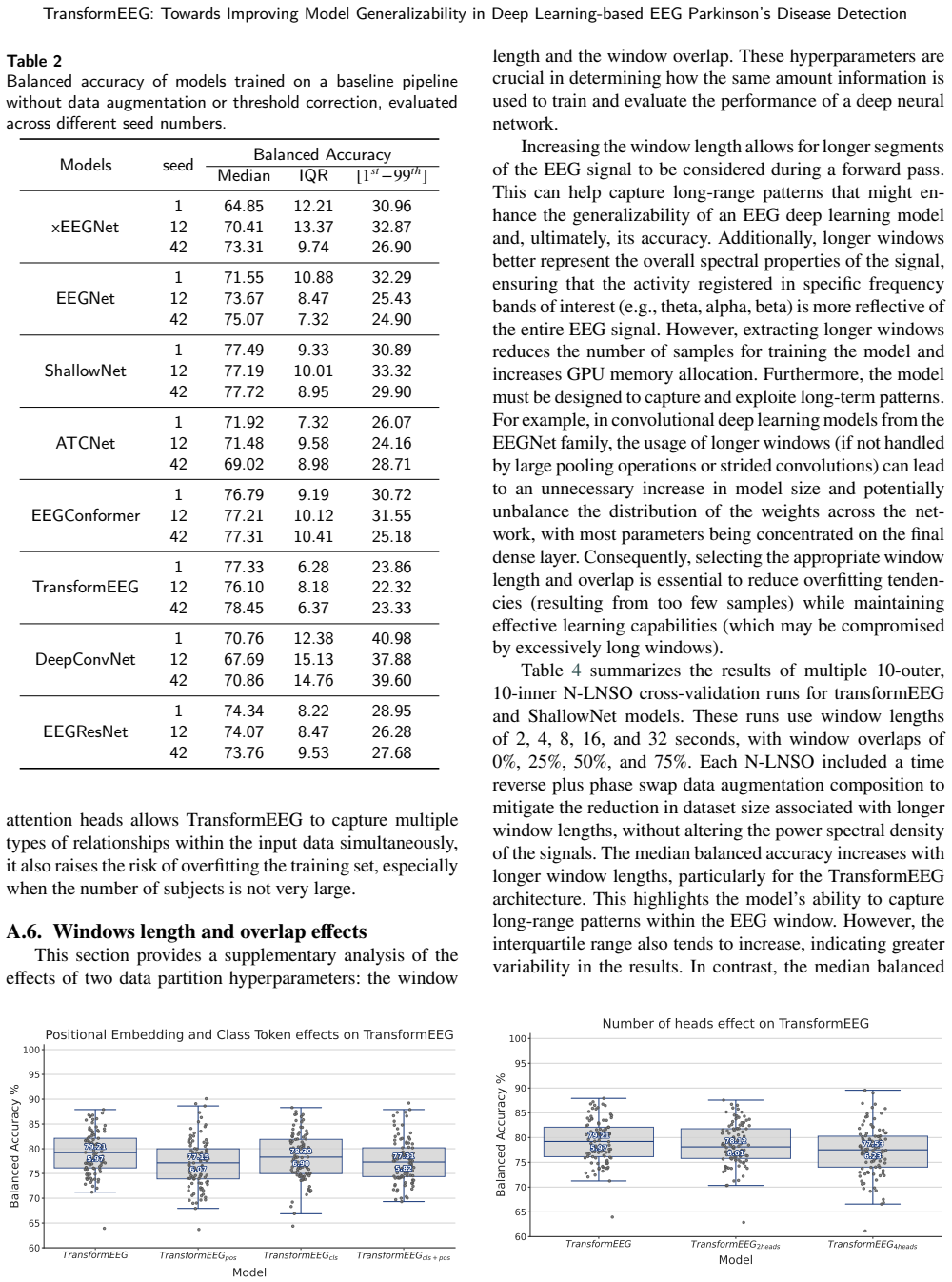
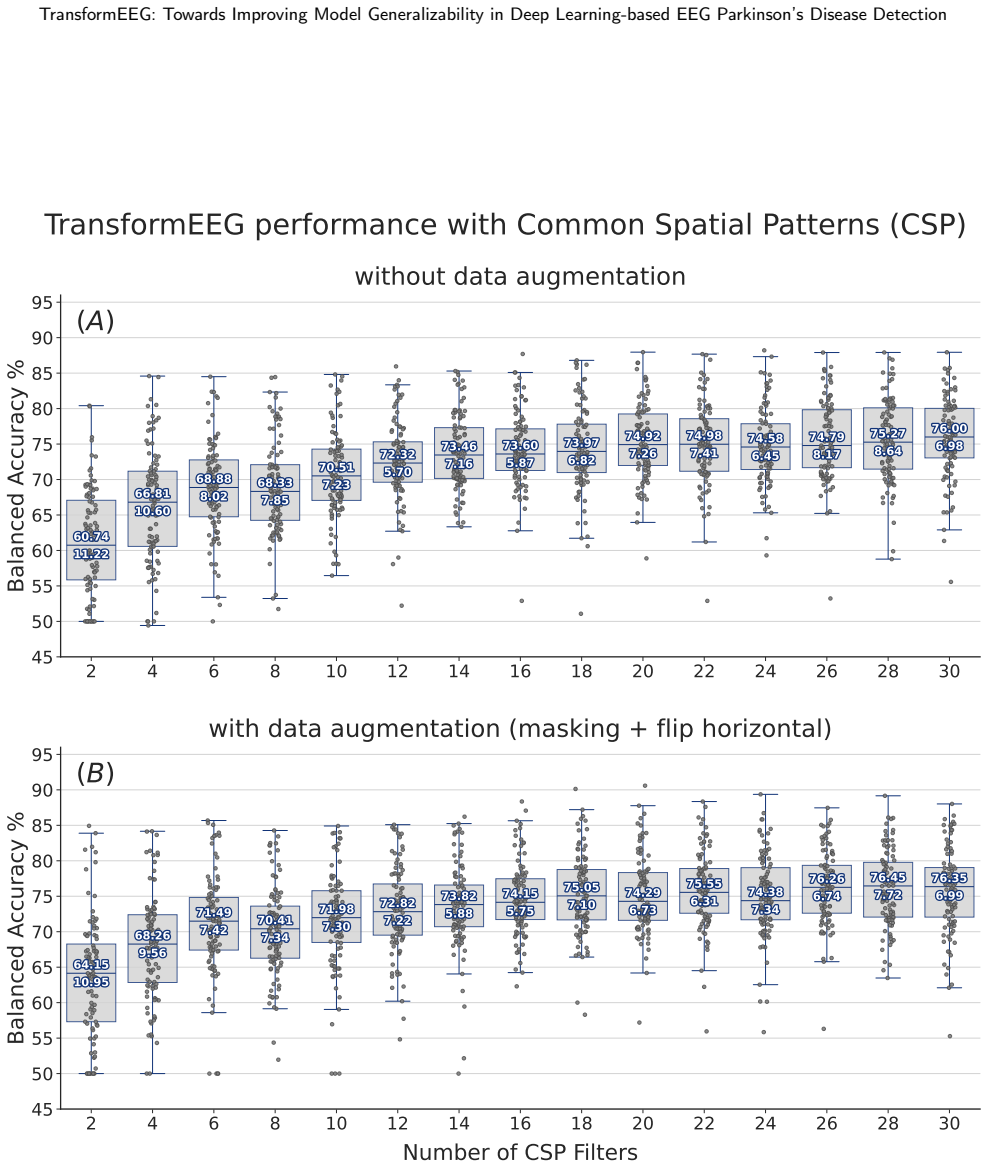
- Supplementary ablations show that positional embeddings, class tokens, additional attention heads, spectral-fusion branches, and common spatial pattern scaling do not improve TransformEEG.
Reading between the lines
- Editorial inference: if the four-dataset advantage is partly driven by the young healthy cohort in one dataset, the generalizability claim should be re-tested on age-matched data; the paper's own two-dataset results already show ShallowNet ahead (78.73% vs 72.09% median baseline).
- Editorial inference: the same depthwise tokenizer design could be transferred to other EEG pathology tasks where channel-level local features matter, which would test whether the benefit is task-specific or general.
- Editorial inference: the paper's Augmentation Relative Improvement Score could be reused as a standard metric for selecting EEG data augmentations in other benchmark studies.
Editorial analysis
A structured set of objections, weighed in public.
Referee Report
Summary. This paper proposes TransformEEG, a hybrid convolutional-transformer architecture for Parkinson's disease detection from EEG, with a depthwise convolutional tokenizer intended to preserve channel-specific features before self-attention. The authors aggregate four public OpenNeuro datasets into 290 subjects (140 PD, 150 healthy), harmonize them with BIDSAlign, and evaluate with a 10-outer, 10-inner Nested-Leave-N-Subjects-Out (N-LNSO) scheme against seven baseline models. They report that TransformEEG achieves the highest median balanced accuracy (78.45% baseline; 80.10% with augmentation and threshold correction) and the lowest interquartile range, and conclude that it yields more reliable PD detection. The paper also contributes an ARIS score for data-augmentation selection, a seed-sensitivity analysis, and extensive supplementary ablations.
Significance. The study is unusually transparent: code is released, the architectural tables are detailed, the N-LNSO evaluation is subject-disjoint and nested, the baseline set spans a wide parameter-count range, and the supplementary material reports F1/kappa, seed sensitivity, window-length/overlap sweeps, and several negative ablations. If the causal claim about the tokenizer and the 'reliable PD detection' claim were supported, this would be a useful contribution to EEG-based PD classification and to the generalizability literature. However, two load-bearing weaknesses—an age/dataset confound in the aggregated benchmark and seed-dependent ranking—currently prevent the conclusions from being accepted as stated; the significance of the paper therefore depends on resolving these issues.
major comments (3)
- [Section 2.1, Table 1, Section 3.4] The aggregated benchmark contains a class–age confound. ds004148 contributes 60 healthy subjects with mean age 20.0±1.9 years, while the PD groups in ds002778, ds003490, and ds004584 have mean ages 63.3, 69.7, and 68.5 years and their healthy controls are age-matched (63.5, 69.3, 70.9). Because N-LNSO partitions by subject, a model can separate classes by age-related EEG properties or recording site rather than by PD pathology. The article never reports per-dataset accuracy or a leave-dataset-out analysis. The paper's own Table 3 provides the natural check: on the two age-matched datasets (ds002778+ds003490, 81 subjects), TransformEEG's baseline median balanced accuracy is 72.09%, below ShallowNet's 78.73%, reversing the four-dataset ranking (78.45% vs 77.72%). Section 4 interprets this result only as a sample-size effect ('an interquartile range increase of 9.56% and the median balanced accuracy drop of 6.01%'), but it is equally or more plausibly a removal of the young healthy cohort. Please add per-dataset results, an age/domain-confounding analysis (e.g., evaluate with ds004148 held out, or match healthy ages), and adjust the Abstract and Section 5 claims accordingly.
- [Section A.3, Supplementary Table 2] The seed analysis in Section A.3 (Supplementary Table 2) does not support the statement that 'the study's conclusions are not influenced by the choice of the seed.' At seed 12, TransformEEG's median balanced accuracy is 76.10%, lower than ShallowNet (77.19%) and EEGConformer (77.21%); at seed 1 it is 77.33%, lower than ShallowNet (77.49%). Only seed 42 gives the ordering reported in Section 3.1. Since the main text reports only seed 42 (Section 2.4.3), the claim that TransformEEG 'ranks first' in median accuracy is not stable across seeds. Please report per-seed rankings or a summary across seeds, and temper the conclusion that TransformEEG 'achieves the highest median' to reflect the observed seed-to-seed variability.
- [Section 2.3.1, Section 3.1, Supplementary A.5] The paper's architectural claim—that the depthwise convolutional tokenizer 'enables more effective feature mixing within the self-attention layers'—is not tested by a controlled ablation. The comparison in Section 3.1 pits TransformEEG against EEGConformer and ATCNet, which differ in tokenizer design, transformer depth, attention heads, and classification head. Supplementary A.5 ablates positional encoding, class token, and number of heads, but not the tokenizer. A direct ablation that keeps the transformer encoder and classification MLP fixed and swaps only the tokenizer (e.g., an EEGNet-style 2D convolutional tokenizer or a non-depthwise 1D tokenizer) is needed to support the central design rationale. Without it, the performance difference could be due to overall architecture scale or regularization, not to channel-specific tokenization.
minor comments (4)
- [Table 12, Figure 1] Table 12 and Figure 1 are inconsistent about the average-pooling stride: Figure 1 states 'Kernel = 4, Stride = 2', while Table 12 lists 'AvgPool1d [4]' with no stride, which in PyTorch defaults to stride 4; the output lengths 999/498 in Table 12 correspond to stride 2, so Table 12 should be corrected or clarified.
- [Section A.1] Section A.1 contains a duplicated word: 'an ensemble of of N_outer x N_inner accuracies' should be 'an ensemble of N_outer x N_inner accuracies.'
- [Section 3.4] Section 3.4 is titled 'Model scalability,' but the two-dataset comparison is also the only age-matched subset in the paper; it should be cross-referenced to the confound discussion and explicitly labeled as an age-matched check in the main text.
- [Section A.7.1] In the window-aggregation analysis, the 'minimal ratio of positive windows' should state explicitly whether this ratio is optimized on the validation set for each N-LNSO split or determined globally, since this affects the interpretation of the aggregated accuracy.
Circularity Check
No circular derivation; TransformEEG's benchmark advantage is an empirical result, with same-group methodology citations adding self-citation weight but no reduction.
full rationale
The paper's central claim is that TransformEEG achieves the highest median balanced accuracy and the lowest IQR among eight models under a 10-outer, 10-inner N-LNSO evaluation on four public OpenNeuro datasets. The reported metrics are computed on held-out test subjects and are not defined in terms of the model's own fitted parameters or outputs, so the outcome is not encoded in the architecture by construction. The depthwise convolutional tokenizer is a new architectural component, not an imported ansatz, and no equation in the paper defines the reported accuracies from the training inputs. The evaluation methodology relies on same-group earlier work (N-LNSO from Del Pup et al. 2025, BIDSAlign preprocessing, SelfEEG), and this self-citation weight is non-trivial; however, these citations supply a concrete cross-validation scheme and openly available code that the paper also describes and that is externally checkable, rather than a uniqueness theorem invoked to forbid alternatives. Threshold correction and per-model data-augmentation selection (ARIS) are performed on the validation folds only (Sections 2.4.2 and 3.3), so the final test numbers are not a fitted input renamed as a prediction. The age/dataset confound raised by ds004148 (60 healthy subjects aged 20.0 +/- 1.9 years versus PD groups aged 63-70 in Table 1) and the reversal in Table 3 (TransformEEG 72.09% baseline median vs ShallowNet 78.73% on the two age-matched datasets) is a real external-validity threat to the 'more reliable PD detection' conclusion, but it is a correctness risk, not a circularity: the benchmark does not define reliability in terms of the confound. No circular step can be exhibited with a specific reduction, so the score rests only on the presence of methodological self-citations that are not load-bearing for the central empirical comparison.
Assumptions & free parameters
free parameters (3)
- Classification threshold per model =
tuned on validation set, exact values not reported
- Data augmentation composition per model =
TransformEEG: masking + time reverse
- Window length and overlap =
16 seconds, 25% overlap
assumptions (4)
- domain assumption EEG slowing (decreased alpha/beta power, increased delta/theta power) is a usable biomarker separating PD from healthy controls.
- domain assumption ICLabel-based automatic component rejection with [90%,100%] noise confidence and [0%,10%] brain confidence preserves disease-relevant signal across all four datasets.
- domain assumption The Nested-Leave-N-Subjects-Out scheme with 10 outer and 10 inner folds provides unbiased and comparable performance estimates across models.
- ad hoc to paper Harmonizing four datasets to 32 common channels and aggregating them introduces no systematic confounds (e.g., age or site) between the PD and healthy classes.
Cite this review
Pith. "Pith review of TransformEEG: Towards Improving Model Generalizability in Deep Learning-based EEG Parkinson's Disease Detection." pith.science (2026). https://pith.science/paper/UUGDULS2
@misc{pith2026250707622,
  author       = {Pith},
  title        = {Pith review of: TransformEEG: Towards Improving Model Generalizability in Deep Learning-based EEG Parkinson's Disease Detection},
  year         = {2026},
  howpublished = {\url{https://pith.science/paper/UUGDULS2}},
  note         = {Machine review of arXiv:2507.07622}
}
read the original abstract
Electroencephalography (EEG) is establishing itself as an important, low-cost, noninvasive diagnostic tool for the early detection of Parkinson's Disease (PD). In this context, EEG-based Deep Learning (DL) models have shown promising results due to their ability to discover highly nonlinear patterns within the signal. However, current state-of-the-art DL models suffer from poor generalizability caused by high inter-subject variability. This high variability underscores the need for enhancing model generalizability by developing new architectures better tailored to EEG data. This paper introduces TransformEEG, a hybrid Convolutional-Transformer designed for Parkinson's disease detection using EEG data. Unlike transformer models based on the EEGNet structure, TransformEEG incorporates a depthwise convolutional tokenizer. This tokenizer is specialized in generating tokens composed by channel-specific features, which enables more effective feature mixing within the self-attention layers of the transformer encoder. To evaluate the proposed model, four public datasets comprising 290 subjects (140 PD patients, 150 healthy controls) were harmonized and aggregated. A 10-outer, 10-inner Nested-Leave-N-Subjects-Out (N-LNSO) cross-validation was performed to provide an unbiased comparison against seven other consolidated EEG deep learning models. TransformEEG achieved the highest balanced accuracy's median (78.45%) as well as the lowest interquartile range (6.37%) across all the N-LNSO partitions. When combined with data augmentation and threshold correction, median accuracy increased to 80.10%, with an interquartile range of 5.74%. In conclusion, TransformEEG produces more consistent and less skewed results. It demonstrates a substantial reduction in variability and more reliable PD detection using EEG data compared to the other investigated models.
Figures


Figures from the paper (5 more)



Reference graph
Works this paper leans on
-
[1]
T. Pringsheim, N. Jette, A. Frolkis, T. D. Steeves, The prevalence of Parkinson’s disease: A systematic review and meta-analysis, Mov. Disord. 29 (13) (2014) 1583–1590.doi:10.1002/mds.25945
- [2]
-
[3]
S.Sveinbjornsdottir,TheclinicalsymptomsofParkinson’sdisease,J. neurochem. 139 (2016) 318–324.doi:10.1111/jnc.13691
-
[4]
S.-Y. Lim, A. E. Lang, The nonmotor symptoms of Parkinson’s dis- ease—an overview, Mov. Disord. 25 (S1) (2010) S123–S130.doi: 10.1002/mds.22786
-
[5]
M. J. Armstrong, M. S. Okun, Diagnosis and treatment of Parkinson Disease:Areview,JAMA323(6)(2020)548–560. doi:10.1001/ jama.2019.22360
arXiv 2020
-
[6]
L.Shirahige,M.Berenguer-Rocha,S.Mendonça,S.Rocha,M.C.Ro- drigues, K. Monte-Silva, Quantitative electroencephalography char- acteristicsforParkinson’sdisease:Asystematicreview,J.Parkinson’s Dis. 10 (2) (2020) 455–470.doi:10.3233/JPD-191840
-
[7]
V. J. Geraedts, L. I. Boon, J. Marinus, A. A. Gouw, J. J. van Hilten, C. J. Stam, M. R. Tannemaat, M. F. Contarino, Clinical correlates of quantitative EEG in Parkinson disease: A systematic review, Neurology 91 (19) (2018) 871–883.doi:10.1212/WNL. 0000000000006473
doi:10.1212/wnl 2018
-
[8]
R. Soikkeli, J. Partanen, H. Soininen, A. Pääkkönen, P. Riekki- nen, Slowing of EEG in Parkinson’s disease, Electroencephalogr. Clin. Neurophysiol. 79 (3) (1991) 159–165. doi:10.1016/ 0013-4694(91)90134-P
work page 1991
Show all 50 references
-
[9]
A. M. Maitin, J. P. Romero Muñoz, A. J. García-Tejedor, Survey of machine learning techniques in the analysis of EEG Signals for Parkinson’s disease: A systematic review, Appl. Sci. 12 (14) (2022). doi:10.3390/app12146967
2022 doi
-
[10]
H. W. Loh, W. Hong, C. P. Ooi, S. Chakraborty, P. D. Barua, R. C. Deo, J. Soar, E. E. Palmer, U. R. Acharya, Application of deep learning models for automated identification of Parkinson’s disease: A review (2011–2021), Sensors 21 (21) (2021).doi:10.3390/ s21217034
2021
-
[11]
S. K. Khare, V. Bajaj, U. R. Acharya, PDCNNet: An automatic frameworkforthedetectionofParkinson’sdiseaseusingEEGsignals, IEEESens.J.21(15)(2021)17017–17024. doi:10.1109/JSEN. 2021.3080135
2021
-
[12]
Balaji, D
E. Balaji, D. Brindha, V. K. Elumalai, R. Vikrama, Automatic and non-invasive Parkinson’s disease diagnosis and severity rating using LSTM network, Appl. Soft Comput. 108 (2021) 107463. doi: 10.1016/j.asoc.2021.107463
2021
-
[13]
Miltiadous, E
A. Miltiadous, E. Gionanidis, K. D. Tzimourta, N. Giannakeas, A. T. Tzallas, DICE-net: a novel convolution-transformer architecture for Alzheimer detection in EEG signals, IEEE Access (2023).doi: 10.1109/ACCESS.2023.3294618
2023
-
[14]
Neural Syst
F.DelPup,A.Zanola,L.FabriceTshimanga,A.Bertoldo,M.Atzori, The more, the better? Evaluating the role of EEG preprocessing for deep learning applications, IEEE Trans. Neural Syst. Rehabil. Eng. 33 (2025) 1061–1070.doi:10.1109/TNSRE.2025.3547616
2025
-
[15]
Pion-Tonachini, K
L. Pion-Tonachini, K. Kreutz-Delgado, S. Makeig, ICLabel: An au- tomated electroencephalographic independent component classifier, dataset, and website, NeuroImage 198 (2019) 181–197.doi:10. 1016/j.neuroimage.2019.05.026
2019
-
[16]
T. R. Mullen, C. A. E. Kothe, Y. M. Chi, A. Ojeda, T. Kerth, S.Makeig,T.-P.Jung,G.Cauwenberghs,Real-timeneuroimagingand cognitive monitoring using wearable dry EEG, IEEE Trans. Biomed. Eng. 62 (11) (2015) 2553–2567. doi:10.1109/TBME.2015. 2481482
2015 doi
-
[17]
Del Pup, A
F. Del Pup, A. Zanola, L. F. Tshimanga, A. Bertoldo, L. Finos, M. Atzori, The role of data partitioning on the performance of EEG- based deep learning models in supervised cross-subject analysis: A preliminary study, Comput. Biol. Med. 196 (2025) 110608.doi: 10.1016/j.compbiom...
2025
-
[18]
Y. Song, Q. Zheng, B. Liu, X. Gao, EEG Conformer: Convolu- tionalTransformerforEEGDecodingandVisualization,IEEETrans. Neural Syst. Rehabil. Eng. 31 (2023) 710–719.doi:10.1109/ TNSRE.2022.3230250
2023
-
[19]
H.Altaheri,G.Muhammad,M.Alsulaiman,Physics-informedatten- tion temporal convolutional network for EEG-based motor imagery classification, IEEE Trans. Ind. Inform. 19 (2) (2023) 2249–2258. doi:10.1109/TII.2022.3197419
2023
-
[20]
V. J. Lawhern, A. J. Solon, N. R. Waytowich, S. M. Gordon, C. P. Hung,B. J.Lance,EEGNet: acompactconvolutionalneural network for EEG-based brain–computer interfaces, J. Neural Eng. 15 (5) (2018) 056013. doi:10.1088/1741-2552/aace8c
2018 doi
-
[21]
Del Pup, M
F. Del Pup, M. Atzori, Toward improving reproducibility in neu- roimaging deep learning studies, Front. Neurosc. 18 (2024).doi: 10.3389/fnins.2024.1509358
2024
-
[22]
C. J. Markiewicz, K. J. Gorgolewski, F. Feingold, R. Blair, Y. O. Halchenko, E. Miller, N. Hardcastle, J. Wexler, O. Esteban, M. Goncavles, A. Jwa, R. Poldrack, The OpenNeuro resource for sharing of neuroscience data, eLife 10 (2021) e71774.doi:10. 7554/eLife.71774. F. Del Pup...
2021
-
[23]
Delorme, R
C.R.Pernet,S.Appelhoff,K.J.Gorgolewski,G.Flandin,C.Phillips, A. Delorme, R. Oostenveld, EEG-BIDS, an extension to the brain imaging data structure for electroencephalography, Sci. Data 6 (1) (2019) 103. doi:10.1038/s41597-019-0104-8
2019 doi
-
[24]
Y. Wang, W. Duan, D. Dong, L. Ding, X. Lei, A test-retest rest- ing and cognitive state EEG dataset (2022). doi:10.18112/ openneuro.ds004148.v1.0.1
2022
-
[25]
doi:10.18112/openneuro.ds002778.v1.0.5
A.P.Rockhill,N.Jackson,J.George,A.Aron,N.C.Swann,UCSan Diego resting state EEG data from patients with Parkinson’s disease (2021). doi:10.18112/openneuro.ds002778.v1.0.5
2021 doi
-
[26]
doi:10.18112/openneuro.ds003490.v1.1.0
J.F.Cavanagh,EEG:3-StimauditoryoddballandrestinParkinson’s (2021). doi:10.18112/openneuro.ds003490.v1.1.0
2021 doi
-
[27]
doi:10.18112/openneuro.ds004584.v1.0
A.Singh,R.Cole,A.Espinoza,J.Cavanagh,N.Narayanan,Resteyes open(2023). doi:10.18112/openneuro.ds004584.v1.0. 0
2023 doi
-
[29]
A. J. Bell, T. J. Sejnowski, An information-maximization approach to blind separation and blind deconvolution, Neural Comput. 7 (6) (1995) 1129–1159. doi:10.1162/neco.1995.7.6.1129
1995 doi
-
[30]
Paszke, S
A. Paszke, S. Gross, F. Massa, A. Lerer, J. Bradbury, G. Chanan, T. Killeen, Z. Lin, N. Gimelshein, L. Antiga, et al., Pytorch: An imperativestyle,high-performancedeeplearninglibrary,Adv.Neural Inf. Process. Syst. 32 (2019). doi:10.48550/arXiv.1912. 01703
2019 doi
-
[31]
Brookshire, J
G. Brookshire, J. Kasper, N. M. Blauch, Y. C. Wu, R. Glatt, D. A. Merrill, S. Gerrol, K. J. Yoder, C. Quirk, C. Lucero, Data leakage in deep learning studies of translational EEG, Front. Neurosci. 18 (2024). doi:10.3389/fnins.2024.1373515
2024
-
[32]
Zanola, L
A. Zanola, L. F. Tshimanga, F. Del Pup, M. Baiesi, M. Atzori, xEEGNet: Towards explainable AI in EEG dementia classification, arXiv Preprint (2025).doi:10.48550/arXiv.2504.21457
2025 doi
- [33]
-
[34]
Devlin, M.-W
J. Devlin, M.-W. Chang, K. Lee, K. Toutanova, BERT: Pre-training of deep bidirectional transformers for language understanding, in: Proceedings of the 2019 Conference of the North American Chapter of the Association for Computational Linguistics: Human Language Technologies, V...
2019
-
[35]
Del Pup, A
F. Del Pup, A. Zanola, L. F. Tshimanga, P. E. Mazzon, M. Atzori, SelfEEG: A Python library for self-supervised learning in electroen- cephalography, J. Open Source Softw. 9 (95) (2024) 6224.doi: 10.21105/joss.06224
2024 doi
-
[36]
6 (60) (2021) 3021.doi:10.21105/joss.03021
M.L.Waskom,seaborn:statisticaldatavisualization,J.OpenSource Softw. 6 (60) (2021) 3021.doi:10.21105/joss.03021
2021 doi
-
[37]
brain mapp
R.T.Schirrmeister,J.T.Springenberg,L.D.J.Fiederer,M.Glasstet- ter,K.Eggensperger,M.Tangermann,F.Hutter,W.Burgard,T.Ball, Deep learning with convolutional neural networks for EEG decoding and visualization, Hum. brain mapp. 38 (11) (2017) 5391–5420. doi:10.1002/hbm.23730
2017 doi
-
[38]
K. H. Cheah, H. Nisar, V. V. Yap, C.-Y. Lee, G. Sinha, Optimizing residual networks and VGG for classification of EEG signals: Identi- fyingidealchannelsforemotionrecognition,J.Healthc.Eng.2021(1) (2021) 5599615. doi:10.1155/2021/5599615
2021 doi
- [39]
-
[40]
Neurosci
E.Lashgari,D.Liang,U.Maoz,Dataaugmentationfordeep-learning- based electroencephalography, J. Neurosci. Methods 346 (2020) 108885. doi:10.1016/j.jneumeth.2020.108885
2020
-
[41]
Rommel, J
C. Rommel, J. Paillard, T. Moreau, A. Gramfort, Data augmentation for learning predictive models on EEG: a systematic comparison, J. Neural Eng. 19 (6) (2022) 066020.doi:10.1088/1741-2552/ aca220
2022 doi
-
[42]
Le Guennec, S
A. Le Guennec, S. Malinowski, R. Tavenard, Data Augmentation for Time Series Classification using Convolutional Neural Networks, in: ECML/PKDD Workshop on Advanced Analytics and Learning on Temporal Data, Riva Del Garda, Italy, 2016, p. 8. URL https://shs.hal.science/halshs-01357973
2016
-
[43]
Lemkhenter, P
A. Lemkhenter, P. Favaro, Boosting generalization in bio-signal classification by learning the phase-amplitude coupling, in: Pattern Recognition,SpringerInternationalPublishing,Cham,2021,pp.72–
2021
-
[44]
F. N. Fritsch, J. Butland, A method for constructing local monotone piecewisecubicinterpolants,SIAMJ.Sci.Stat.Comput.5(2)(1984) 300–304. doi:10.1137/0905021
1984 doi
-
[45]
Kingma, J
D. Kingma, J. Ba, Adam: A method for stochastic optimization, in: 3rd international conference on learning representations (ICLR), San Diega, CA, USA, 2015, p. 13.doi:10.48550/arXiv.1412. 6980
2015 doi
-
[46]
Lee, H.-R
H.-T. Lee, H.-R. Cheon, S.-H. Lee, M. Shim, H.-J. Hwang, Risk of data leakage in estimating the diagnostic performance of a deep-learning-based computer-aided system for psychiatric disorders, Sci. Rep. 13 (1) (2023) 16633. doi:10.1038/ s41598-023-43542-8
2023
-
[47]
M. H. Rafiei, L. V. Gauthier, H. Adeli, D. Takabi, Self-supervised learning for electroencephalography, IEEE Trans. Neural Netw. Learn. Syst. 35 (2) (2024) 1457–1471.doi:10.1109/TNNLS. 2022.3190448
2024
-
[48]
Babiloni, R
C. Babiloni, R. Lizio, N. Marzano, P. Capotosto, A. Soricelli, A. I. Triggiani, S. Cordone, L. Gesualdo, C. Del Percio, Brain neural synchronization and functional coupling in Alzheimer’s disease as revealed by resting state EEG rhythms, Int. J. Psychophysiol. 103 (2016) 88–10...
2016 doi
-
[49]
TransformEEG: Towards Im- proving Model Generalizability in Deep Learning-based EEG Parkinson’s Disease Detection
R. Nardone, L. Sebastianelli, V. Versace, L. Saltuari, P. Lochner, V. Frey, S. Golaszewski, F. Brigo, E. Trinka, Y. Höller, Usefulness of EEG techniques in distinguishing frontotemporal dementia from Alzheimer’s disease and other dementias, Dis. Markers 2018 (1) (2018) 6581490...
2018 doi
-
[85]
doi:10.1007/978-3-030-71278-5\_6
-
[4186]
doi:10.18653/v1/N19-1423
Reviewed August 6, 2026 · model on record in the stance chip above.
Discussion (0). Continue with ORCID to comment.