REVIEW 3 major objections 5 minor 45 references
Computational Performance Bounds Prediction in Quantum Computing with Unstable Noise
T0 review · 3 major / 5 minor · reviewed 2026-08-06 · deepseek-v4-flash
Pith's one-line read QuBound predicts upper and lower performance bounds for quantum circuits under fluctuating noise, at microsecond latency and with measured results falling inside the predicted interval near the requested confidence level.
desk verdict Solid engineering idea with a real, fixable statistical bug at its center: the bound formula in Sec. V-B-3 is a confidence interval for the mean, not a prediction interval, so the central coverage claim does not follow as written. read the letter →
The pith
A machine-rendered reading of the paper's core claim, the machinery that carries it, and where it could break.
The reading
What carries the argument
The load-bearing mechanism is performance decomposition (QuDECOM) coupled with a sequential encoder and LSTM predictor (QuPRED). QuDECOM uses outlier removal and an additive seasonal decomposition with a moving average to split a historical performance trace into trend and residual; the residual's normal-distribution confidence interval becomes a fixed range $[L,U]$ that is added to every online prediction. QuPRED encodes each stage of the circuit as a vector of five-tuples (gate type, gate parameter, T1, T2, gate error) per qubit and feeds the resulting sequence into an LSTM, letting the network learn accumulating gate-noise interactions. The key identity is that predicted bounds equal the predicted trend plus the historical residual interval, which is what makes microsecond inference possible.
What would settle it
Run QuBound on a real or simulated device across a known noise regime shift, such as a recalibration or a several-day gap between training and execution, and compare the bound-compliance rate at a fixed confidence level; the paper's own delayed-job results, where compliance dropped to 88.75% at a 99% confidence level, already mark the condition under which the central claim would fail.
Extended reading notes
Core claim
The paper proposes that quantum circuit performance under unstable noise can be predicted as a bound rather than a single value by separating two noise sources. The performance trace is decomposed additively into a trend component, which tracks device-level noise such as relaxation and gate errors, and a residual component, which captures the run-to-run variation from finite measurement shots. The residual is treated as approximately normally distributed, so a confidence interval $[L,U]$ is computed once from historical residuals. The LSTM-based predictor QuPRED is trained on the trend, and at inference the interval $[L,U]$ is added to the predicted trend value to produce $[P_{\mathrm{low}}, P_{\mathrm{up}}]$. The paper reports that on test circuits, all QuBound predictions fell inside the noisy-simulation baseline bounds, while single-value baselines often fell outside, and that on a real quantum device the bound-compliance rate was near the confidence level except when delayed jobs ran under a changed noise regime.
Load-bearing premise
The whole approach depends on the historical residual fluctuation being a reliable guide to future fluctuation: if the size of run-to-run variation changes when the noise regime shifts, the fixed bound interval stops providing the promised confidence.
Editorial extensions
If this is right
- A system scheduler can compare backends in microseconds using predicted bounds instead of running noisy simulations that take minutes, making fidelity-aware job allocation practical.
- A compiler can evaluate transpilation or qubit-layout strategies by comparing predicted performance bounds before execution, since the method accepts circuit structure and current noise as input.
- Users can choose the trade-off between range and coverage by setting the confidence level: higher confidence widens the interval and raises the bound-compliance rate.
- Because the bounds come from historical traces, the method can be built from data collected on real quantum hardware, avoiding the exponential memory cost of full-state simulation.
- For a new circuit without historical data, the paper's proxy idea predicts that a structurally similar benchmark circuit can supply bounds close to those of the incoming circuit.
Reading between the lines
- The fixed residual interval makes the method's validity conditional on residual stationarity; a natural extension, not explored in the paper, is to make $[L,U]$ adaptive by detecting drift or re-estimating the residual distribution online.
- The additive decomposition assumes device noise and sampling noise combine independently; if they interact, such as gate errors changing with measurement shot count, a multiplicative or coupled model would be needed, and this is a testable boundary of the approach.
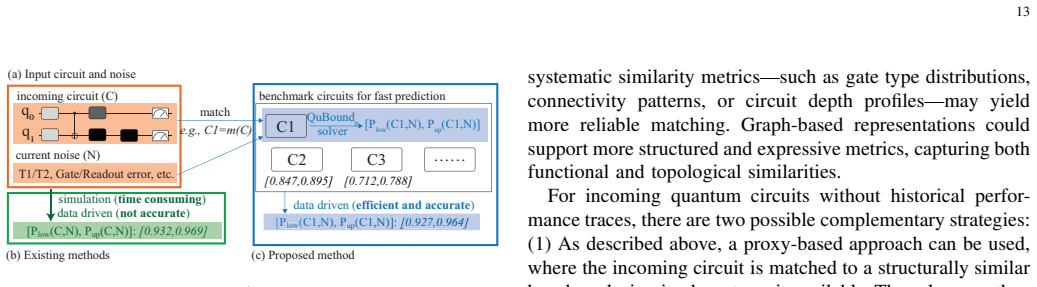
- The proxy matching currently uses simple heuristics such as qubit count and gate count, and a graph-based similarity metric over circuit structure would likely improve the transfer of bounds to unseen circuits.
- If the method is adopted in production scheduling, the delayed-job case in the paper suggests that bounds should carry an expiry timestamp or be rechecked when a job's execution is postponed past a calibration event.
Editorial analysis
A structured set of objections, weighed in public.
Referee Report
Summary. This paper presents QuBound, a data-driven framework for predicting interval bounds on the execution performance (fidelity, probability, or observable expectation) of quantum circuits under time-varying device noise. The framework has two components: QuDECOM, which decomposes a historical performance trace into a trend (used as training labels) and residuals (used to compute a bound range [L,U]), and QuPRED, which encodes quantum circuit gates together with noise parameters (T1, T2, gate errors, readout errors) and feeds the sequence into an LSTM to predict the trend. At inference, the predicted trend is shifted by [L,U] to produce lower and upper performance bounds. The paper defines the QuBoundp problem and a Bound-Compliance Rate (BCR) metric, then evaluates the method against noisy simulation, the analytical nisqReliability approach, and the ML-based QUEST predictor, on GHZ, RB, HS, VQE, and QAOA circuits with 3–15 qubits, using both noisy simulation and real IBM backends. Reported results include microsecond-level inference, BCR values close to the requested confidence level on same-distribution test data, and bound ranges narrower than nisqReliability by an order of magnitude.
Significance. The proposed workflow is practically motivated and, if the coverage guarantee could be established rigorously, would be a valuable component for fidelity-aware scheduling and compilation in quantum-centric HPC. The paper's strengths include a sensible decomposition that separates device-induced drift from sampling noise, a compact circuit-noise encoding that preserves gate ordering and hardware parameters, a public dataset, and experiments on several real IBM quantum devices showing that the method can produce reasonably tight bounds at very low latency (tens of microseconds). The central statistical claim, however, rests on the construction of [L,U] in §V-B-3, where the paper derives a confidence interval for the residual mean rather than a prediction interval for individual future measurements; as written, the method cannot produce the reported BCR values. The evaluation also does not demonstrate calibration under the non-stationary noise regimes that motivate the work, and Table VI shows visible under-coverage when jobs are executed after a delay.
major comments (3)
- [Section V-B-3, Algorithm 1] The derivation of the bound range [L,U] is a confidence interval for the residual mean, not a prediction interval for an individual future residual. The text defines η = (X̄ − E(X)) / sqrt(D(X)/n) and sets L = X̄ − Z(CL)·sqrt(D(X)/n) and U = X̄ + Z(CL)·sqrt(D(X)/n), which is the standard error of the mean. For n = 2600 training residuals, the half-width is Z(CL)·σ/√2600 ≈ 0.02·Z(CL)·σ. An individual residual has standard deviation σ, so this interval covers a new residual only with probability roughly 2Φ(Z(CL)/√n) − 1, which is about 3% at CL = 95%, not the 86–100% reported in Table IV. This is inconsistent either with the stated formula or with the reported experiments. Definition 3.1 explicitly requires a single measured performance P_t to fall in the bounds, so the interval must be a prediction interval (e.g., using the residual standard deviation or empirical quantiles). Please correct Algorithm 1 and the derivation, and re-report the experiments with the corrected interval.
- [Section V-B-3, Table VI] The bound range [L,U] is computed once from the historical training trace and added unchanged to every online prediction. This assumes the residual distribution is stationary. Table VI shows that when jobs submitted on Oct 23 and Oct 24 were postponed to Oct 25, the BCR dropped to 96.25% and 88.75% at a requested confidence of 99%, i.e., 3 and 9 of 80 measurements fell outside the predicted bounds. The paper attributes this to 'inaccurate device calibration,' which is precisely a shift in the residual distribution. The central claim that QuBound provides bounds with probability close to CL under unstable noise is therefore only demonstrated for the benign case where the test noise resembles the training noise. The method needs either an adaptive interval that uses the current noise trace, or a clearly scoped claim with a validation protocol that tests calibration on held-out time periods with changed noise regimes.
- [Section V-C, Definition 3.1] The construction of the bounds does not account for the error of the LSTM trend prediction. The interval [L,U] is derived from the residual trace trR = trP − trT (sampling noise), but the online bounds are centered at predP, the LSTM output for the trend. The actual performance is P_t = trT(t) + residual, so the deviation P_t − predP includes both the residual and the trend prediction error. Unless the trend prediction error is negligible, the coverage probability will be below CL. The BCR results in Table IV are obtained on 200 samples from the same dataset used for training and validation, which likely underestimates trend error. Please report the distribution of predP − trT on held-out days and, if it is not negligible, incorporate trend prediction error into the interval.
minor comments (5)
- [Abstract] The phrase 'with over 106 speedup' should read 'with over 10^6 speedup' (the superscript is missing).
- [Table VI caption] The caption says 'confidential level' but should say 'confidence level.'
- [Section V-B-3] The sentence 'the task is to find a range ... such that the expected residual performance can be in this range' reveals the mean-vs-individual confusion; it should read 'such that a future residual performance value falls in this range with probability CL.'
- [Section VI-B-4] In the fourth subsection, 'the deviation between BCR and the confidence interval is merely 0.44' should be 'confidence level,' not 'confidence interval.'
- [Section VI-A] A code release would aid reproducibility; only the dataset URL is provided.
Circularity Check
No circularity found: QuBound is a conventional out-of-sample forecast pipeline with empirical bound calibration; the written confidence-interval formula is a correctness flaw, not an input-output circularity.
full rationale
The claimed derivation chain, in which QuDECOM decomposes a historical performance trace into a trend label and a residual-based range (Algorithm 1), QuPRED trains an LSTM on the trend labels (Algorithm 2), and the fixed range [L,U] is added to online point predictions (Fig. 5), is a standard train/calibrate/predict pipeline. The BCR values in Tables III-VI are measured on held-out samples, on testing-day noise (Sec. VI-B-2), and on real-device executions (Table VI, Fig. 12), so they are not forced by construction from the training residuals. The Dasgupta/Humble citations ([14], [21]-[24]) and other self-citations are background or baselines (e.g., nisqReliability), not the load-bearing justification for QuBound's central claim; no uniqueness theorem or ansatz is imported from prior work. Separately, the manuscript's written bound-range formula in Sec. V-B-3, L = X̄ − Z(CL)√(D(X)/n) and U = X̄ + Z(CL)√(D(X)/n), is a confidence interval for the residual mean rather than a prediction interval for an individual future residual; as written it cannot mathematically justify the reported BCR. That is a statistical-correctness issue to be weighed under correctness risk, but it is not an input-output circularity because the BCR is an empirical out-of-sample measurement and the derivation is not equivalent to its inputs by construction. The score of 2 reflects only the presence of several minor non-load-bearing self-citations.
Assumptions & free parameters
free parameters (4)
- decomposition period (dp) =
7
- confidence level (CL) =
90%, 95%, 99%
- LSTM architecture hyperparameters =
hidden 64; FC 128->64; dropout 0.2; lr 0.008; batch 64; 200 epochs
- outlier removal threshold =
Q1-1.5*IQR, Q3+1.5*IQR
assumptions (4)
- domain assumption Additive decomposition of performance into trend plus residual, with trend identified as device-noise effects and residual as sampling-noise effects.
- domain assumption Residual performance follows a normal distribution N(mu, sigma^2).
- domain assumption The residual distribution is stationary over the prediction horizon.
- domain assumption The encoder's 5-dimensional tuple (gate type, angle, T1, T2, gate error) captures the noise that determines circuit performance.
Cite this review
Pith. "Pith review of Computational Performance Bounds Prediction in Quantum Computing with Unstable Noise." pith.science (2026). https://pith.science/paper/UUNEZOEE
@misc{pith2026250717043,
  author       = {Pith},
  title        = {Pith review of: Computational Performance Bounds Prediction in Quantum Computing with Unstable Noise},
  year         = {2026},
  howpublished = {\url{https://pith.science/paper/UUNEZOEE}},
  note         = {Machine review of arXiv:2507.17043}
}
read the original abstract
Quantum computing has significantly advanced in recent years, boasting devices with hundreds of quantum bits (qubits), hinting at its potential quantum advantage over classical computing. Yet, noise in quantum devices poses significant barriers to realizing this supremacy. Understanding noise's impact is crucial for reproducibility and application reuse; moreover, the next-generation quantum-centric supercomputing essentially requires efficient and accurate noise characterization to support system management (e.g., job scheduling), where ensuring correct functional performance (i.e., fidelity) of jobs on available quantum devices can even be higher-priority than traditional objectives. However, noise fluctuates over time, even on the same quantum device, which makes predicting the computational bounds for on-the-fly noise is vital. Noisy quantum simulation can offer insights but faces efficiency and scalability issues. In this work, we propose a data-driven workflow, namely QuBound, to predict computational performance bounds. It decomposes historical performance traces to isolate noise sources and devises a novel encoder to embed circuit and noise information processed by a Long Short-Term Memory (LSTM) network. For evaluation, we compare QuBound with a state-of-the-art learning-based predictor, which only generates a single performance value instead of a bound. Experimental results show that the result of the existing approach falls outside of performance bounds, while all predictions from our QuBound with the assistance of performance decomposition better fit the bounds. Moreover, QuBound can efficiently produce practical bounds for various circuits with over 106 speedup over simulation; in addition, the range from QuBound is over 10x narrower than the state-of-the-art analytical approach.
Figures


Figures from the paper (10 more)


Reference graph
Works this paper leans on
-
[1]
Quantum-centric supercomputing: The nex t wave of computing,
J. Gambetta, “Quantum-centric supercomputing: The nex t wave of computing,” IBM Research Blog , 2022
work page 2022
-
[2]
High-performance computin g with quantum processing units,
K. A. Britt and T. S. Humble, “High-performance computin g with quantum processing units,” JETC, vol. 13, no. 3, pp. 1–13, 2017
work page 2017
-
[3]
Y . Alexeev et al. , “Quantum-centric supercomputing for materials sci- ence: A perspective on challenges and future directions,” arXiv preprint arXiv:2312.09733, 2023
arXiv 2023
-
[4]
Quantum-centric supercomputing: Ambitious plan to solve the world’s biggest problems,
A. S. George et al. , “Quantum-centric supercomputing: Ambitious plan to solve the world’s biggest problems,” Partners Universal International Research Journal, vol. 2, no. 2, pp. 68–88, 2023
work page 2023
-
[5]
The future of quantum computing with superconducting qubits,
S. Bravyi et al., “The future of quantum computing with superconducting qubits,” Journal of Applied Physics , vol. 132, no. 16, 2022
work page 2022
-
[6]
Quantum machine learning for chemistry and physics,
M. Sajjan et al., “Quantum machine learning for chemistry and physics,” Chemical Society Reviews , 2022
work page 2022
-
[7]
Evaluating the evidence for exponential quantum ad- vantage in ground-state quantum chemistry,
S. Lee et al. , “Evaluating the evidence for exponential quantum ad- vantage in ground-state quantum chemistry,” Nature communications , vol. 14, no. 1, p. 1952, 2023
work page 1952
-
[8]
H. Singh et al., “Benchmarking of different optimizers in the variational quantum algorithms for applications in quantum chemistry, ” The Journal of Chemical Physics , vol. 159, no. 4, 2023
work page 2023
Show all 45 references
-
[9]
Quantum computing for finance,
D. Herman et al. , “Quantum computing for finance,” Nature Reviews Physics, vol. 5, no. 8, pp. 450–465, 2023
2023
-
[10]
Financial risk management on a neutral atom quantum processor,
L. Leclerc et al., “Financial risk management on a neutral atom quantum processor,” Physical Review Research , vol. 5, no. 4, p. 043117, 2023
2023
-
[11]
A co-design framework of neural networks and quantum circuits towards quantum advantage,
W. Jiang et al., “A co-design framework of neural networks and quantum circuits towards quantum advantage,” Nature communications, vol. 12, no. 1, p. 579, 2021. 14
2021
-
[12]
A novel spatial-temporal variational quantum circuit to enable deep learning on nisq devices,
J. Li et al. , “A novel spatial-temporal variational quantum circuit to enable deep learning on nisq devices,” in 2023 IEEE International Conference on Quantum Computing and Engineering (QCE) , 2023, pp. 272–282
2023
-
[13]
Quapprox: A framework for ben chmarking the approximability of variational quantum circuit,
J. Li, A. Li, and W. Jiang, “Quapprox: A framework for ben chmarking the approximability of variational quantum circuit,” in ICASSP 2024- 2024 IEEE International Conference on Acoustics, Speech an d Signal Processing (ICASSP) , 2024, pp. 13 376–13 380
2024
-
[14]
Characterizing the stabi lity of nisq devices,
S. Dasgupta and T. S. Humble, “Characterizing the stabi lity of nisq devices,” in QCE, 2020, pp. 419–429
2020
-
[15]
Battle against fluctuating quantum noise: Compression- aided framework to enable robust quantum neural network,
Z. Hu et al. , “Battle against fluctuating quantum noise: Compression- aided framework to enable robust quantum neural network,” i n DAC, 2023, pp. 1–6
2023
-
[16]
Distributiona lly robust variational quantum algorithms with shifted noise,
Z. He, B. Peng, Y . Alexeev, and Z. Zhang, “Distributiona lly robust variational quantum algorithms with shifted noise,” IEEE Transactions on Quantum Engineering , 2024
2024
-
[17]
A novel diffusion model for pairwise geoscience data generation with unbalanced training dataset,
J. Y ang et al. , “A novel diffusion model for pairwise geoscience data generation with unbalanced training dataset,” in Proceedings of the AAAI Conference on Artificial Intelligence , 2025, pp. 21 965–21 973
2025
-
[18]
On-device unsupervised image segmentation,
J. Y ang, Y . Sheng et al., “On-device unsupervised image segmentation,” in 2023 60th ACM/IEEE Design Automation Conference (DAC) , 2023, pp. 1–6
2023
-
[19]
Qusplit: Achieving both high fidelity and throughput via job splitting on noisy quantum computers,
J. Li, Y . Song et al. , “Qusplit: Achieving both high fidelity and throughput via job splitting on noisy quantum computers,” arXiv preprint arXiv:2501.12492, 2025
2025 arXiv
-
[20]
Adaptive job and resource management for the growing quantum cloud,
G. S. Ravi et al. , “Adaptive job and resource management for the growing quantum cloud,” in QCE, 2021, pp. 301–312
2021
-
[21]
Reliability of noisy quan tum computing devices,
S. Dasgupta and T. S. Humble, “Reliability of noisy quan tum computing devices,” arXiv preprint arXiv:2307.06833 , 2023
2023 arXiv
-
[22]
Characterizing the repro ducibility of noisy quantum circuits,
S. Dasgupta and T. S. Humble, “Characterizing the repro ducibility of noisy quantum circuits,” Entropy, vol. 24, no. 2, p. 244, 2022
2022
-
[23]
Assessing the stability o f noisy quantum computation,
S. Dasgupta and T. S. Humble, “Assessing the stability o f noisy quantum computation,” in Quantum Communications and Quantum Imaging XX , vol. 12238. SPIE, 2022, pp. 44–49
2022
-
[24]
Stability of noisy quantu m computing devices,
S. Dasgupta and T. S. Humble, “Stability of noisy quantu m computing devices,” arXiv preprint arXiv:2105.09472 , 2021
2021 arXiv
-
[25]
Disq: Dynamic iteration skipping for variational quantum algorithms,
J. Zhang et al. , “Disq: Dynamic iteration skipping for variational quantum algorithms,” in QCE, vol. 1, 2023, pp. 1062–1073
2023
-
[26]
Dgr: Tackling drifted and correlated noise in quan- tum error correction via decoding graph re-weighting,
H. Wang et al. , “Dgr: Tackling drifted and correlated noise in quan- tum error correction via decoding graph re-weighting,” arXiv preprint arXiv:2311.16214, 2023
2023 arXiv
-
[27]
Simultaneous execution of quantum circuits on current and near-future nisq systems,
Y . Ohkura et al., “Simultaneous execution of quantum circuits on current and near-future nisq systems,” TQE, vol. 3, pp. 1–10, 2022
2022
-
[28]
How parallel circuit execu tion can be useful for nisq computing?
S. Niu and A. Todri-Sanial, “How parallel circuit execu tion can be useful for nisq computing?” in DATE, 2022, pp. 1065–1070
2022
-
[29]
Statistical methods for quantum state verification and fidelity estimation,
X.-D. Y u et al. , “Statistical methods for quantum state verification and fidelity estimation,” Advanced Quantum Technologies , vol. 5, no. 5, p. 2100126, 2022
2022
-
[30]
Reliability modeling of nisq-era qu antum comput- ers,
J. Liu and H. Zhou, “Reliability modeling of nisq-era qu antum comput- ers,” in IISWC, 2020, pp. 94–105
2020
-
[31]
Extracting success from ibm’s 20-qubit machines using error-aware compilation,
S. Nishio et al., “Extracting success from ibm’s 20-qubit machines using error-aware compilation,” JETC, vol. 16, no. 3, pp. 1–25, 2020
2020
-
[32]
Direct fidelity estimation of quantum states using machine learning,
X. Zhang et al. , “Direct fidelity estimation of quantum states using machine learning,” Physical Review Letters, vol. 127, no. 13, p. 130503, 2021
2021
-
[33]
Quantum circuit fidelity estimation using machine learning,
A. V adali et al. , “Quantum circuit fidelity estimation using machine learning,” Quantum Machine Intelligence , vol. 6, no. 1, p. 1, 2024
2024
-
[34]
Quest: Graph transformer for quantum circuit reliabilit y estimation,
H. Wang et al., “Quest: Graph transformer for quantum circuit reliabilit y estimation,” arXiv preprint arXiv:2210.16724 , 2022
2022 arXiv
-
[35]
Data-driven reliability models of quantum circuit: From traditional ml to graph neural networ k,
V . Saravanan and S. M. Saeed, “Data-driven reliability models of quantum circuit: From traditional ml to graph neural networ k,” TCAD, 2022
2022
-
[36]
Amazon braket quotas,
Amazon, “Amazon braket quotas,” https://docs.aws.am azon.com/braket/ latest/developerguide/braket-quotas.html, 2024
2024
-
[37]
Ibm quantum platform,
IBM, “Ibm quantum platform,” https://quantum.ibm.co m/services/ resources, 2024, need to login to IBM Quantum
2024
-
[38]
13 companies offering quantum cloud comput ing software services,
J. Dargan, “13 companies offering quantum cloud comput ing software services,” https://thequantuminsider.com/202 2/05/03/ 13-companies-offering-quantum-cloud-computing-servi ces-in-2022/, 2022
2022
-
[39]
Ibmq backend properties,
IBM, “Ibmq backend properties,” in https:// www.qiskit.org/ documentation/ stable/ 0.34/ stubs/ qiskit.providers.ibmq.IBMQBackend. properties.html/, 2023
2023
-
[40]
Hpc application performance prediction with machine learning on new architectures,
D. Y okelson et al. , “Hpc application performance prediction with machine learning on new architectures,” in PERMA VOST, 2023, pp. 1–8
2023
-
[41]
Pqml: Enabling the predictive reprodu cibility on nisq machines for quantum ml applications,
P . Senapati, S. Y .-C. Chen, B. Fang, T. M. Athawale, A. Li , W. Jiang, C. C. Lu, and Q. Guan, “Pqml: Enabling the predictive reprodu cibility on nisq machines for quantum ml applications,” in 2024 IEEE International Conference on Quantum Computing and Engineering (QCE) , vol...
2024
-
[42]
Nist/sematech e-handbook of statistical methods,
“Nist/sematech e-handbook of statistical methods,” h ttps://www.itl.nist. gov/div898/handbook/prc/section1/prc16.htm, 2024
2024
-
[43]
Going beyond bell’s theorem,
D. M. Greenberger, M. A. Horne, and A. Zeilinger, “Going beyond bell’s theorem,” in Bell’s theorem, quantum theory and conceptions of the universe. Springer, 1989, pp. 69–72
1989
-
[44]
Qiskit experiments: A python package to character- ize and calibrate quantum computers,
N. Kanazawa et al., “Qiskit experiments: A python package to character- ize and calibrate quantum computers,” Journal of Open Source Software , vol. 8, no. 84, p. 5329, 2023
2023
-
[45]
Supermarq: A scalable quantum benchmark suite,
T. Tomesh et al., “Supermarq: A scalable quantum benchmark suite,” in HPCA, 2022, pp. 587–603. Jinyang Li is currently a Ph.D. student in the Department of Electrical and Computer Engineering at George Mason University. He holds a bachelor’s and a master’s degree in computer s...
2022
Reviewed August 6, 2026 · model on record in the stance chip above.
Discussion (0). Sign in to comment.