REVIEW 3 major objections 5 minor 61 references
Do DeepFake Attribution Models Generalize?
T0 review · 3 major / 5 minor · reviewed 2026-08-07 · deepseek-v4-flash
Pith's one-line read Binary DeepFake detectors generalize across datasets better than multi-class attribution models.
desk verdict Useful same-manipulation protocol, but the binary-vs-multi-class conclusion rests on an unvalidated score conversion that likely biases the comparison. read the letter →
The pith
A machine-rendered reading of the paper's core claim, the machinery that carries it, and where it could break.
The reading
What carries the argument
The central object is the evaluation protocol that makes binary and multi-class models comparable: Eq. (1) collapses multi-class labels into fake-versus-real, and Eq. (2), the softmax-to-binary scoring rule, converts a multi-class model's softmax output into a single binary score for computing AUC, EER, and balanced accuracy. The paper also builds same-manipulation test pairs through Eq. (3), matching manipulation types shared between dataset pairs, and tests contrastive losses (Triplet, NT-Xent, Supervised Contrastive) to see whether representation shaping improves generalization.
What would settle it
Run the same cross-dataset experiments but replace Equation (2) with 'one minus the probability assigned to the real class' as the fake score, then check whether binary detectors still outperform multi-class detectors on CelebDF and DFDC. If the ordering flips or narrows, the reported binary advantage depends on the chosen conversion rather than on the training paradigm.
Extended reading notes
Core claim
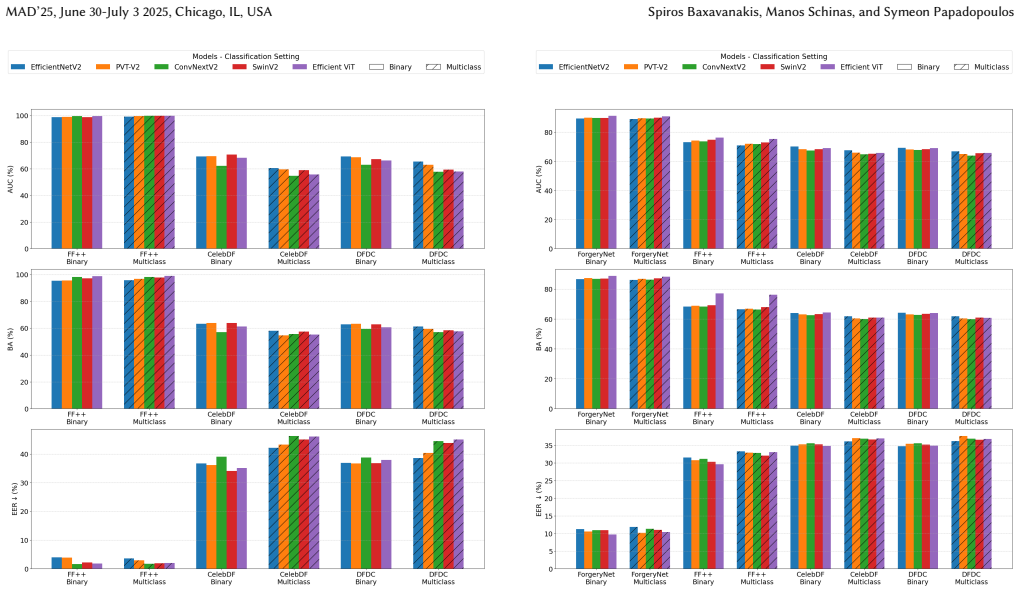
The paper reports that, across five backbones and six datasets, binary DeepFake detectors consistently show better cross-dataset generalization than multi-class attribution models. Attribution models drop sharply, often to near-zero accuracy, when tested on manipulation methods they have seen before but in datasets they have not seen, revealing a strong dataset distribution shift even for the same manipulation technique. The paper also finds that contrastive losses give only small gains on small models but larger gains on bigger transformer-based and hybrid models, and that training on newer, higher-quality datasets improves cross-dataset attribution performance.
Load-bearing premise
The whole binary-versus-attribution comparison depends on Equation (2) converting multi-class outputs into binary scores without bias; if that conversion is unfair to multi-class models, the conclusion that binary models generalize better is not established.
Editorial extensions
If this is right
- Practitioners choosing a deployment model should expect binary detectors to retain more accuracy on unseen data than attribution models trained on the same data.
- Attribution models that look reliable within a dataset cannot be trusted to recognize the same manipulation technique in a new dataset without explicit validation.
- Contrastive losses are not uniformly helpful; their benefit is concentrated in larger architectures such as SwinV2 and Efficient ViT.
- Training attribution models on newer, higher-quality datasets like DFPlatter or ForgeryNet yields better same-manipulation generalization than training on FaceForensics++.
Reading between the lines
- The paper's Eq. (2) conversion is a choice; an alternative that sums or averages fake-class probabilities could change the binary-versus-multi-class ranking, so the headline conclusion should be read as contingent on that scoring rule.
- The near-zero FaceSwap cross-dataset accuracy suggests attribution models latch onto dataset-specific background cues rather than a generic manipulation fingerprint, which points to mixed-dataset training or domain adaptation as a natural next step.
- The same-manipulation evaluation protocol could be reused as a benchmark for future attribution models; reporting per-manipulation transfer matrices would make gains actionable.
Editorial analysis
A structured set of objections, weighed in public.
Referee Report
Summary. This paper presents an empirical study of cross-dataset generalization for DeepFake attribution (multi-class) models versus binary detectors. Using five backbone models (EfficientNetV2, ConvNeXtV2, PVT-V2, SwinV2, EfficientViT) and six datasets (FF++, CelebDF, DFDC, ForgeryNet, FakeAVCeleb, DFPlatter), the authors address three research questions: RQ1 compares binary and multi-class models under cross-dataset evaluation using AUC, EER, and balanced accuracy; RQ2 measures same-manipulation accuracy when training and test datasets differ; RQ3 evaluates triplet, NT-Xent, and supervised contrastive losses for attribution training. The paper's central claims are that binary detectors generalize better across datasets than attribution models, that attribution models suffer large accuracy drops for seen manipulations from unseen datasets, and that contrastive objectives improve generalization mainly for larger models.
Significance. If the findings were established, the paper would be a valuable practical benchmark: it would tell practitioners to prefer binary detectors for cross-domain deployment and to expect attribution models to be brittle under dataset shift. The study's strengths are its breadth (5 backbones, 6 datasets, 3 loss families), the explicit formulation of RQ1-RQ3, and its aim to release code. However, the headline RQ1 comparison relies on an unvalidated and, as written, logically inconsistent softmax-to-binary conversion (Eq. 2), and all results come from single training runs. Because these issues directly affect the central claim, the paper's practical conclusions are not yet fully supported; the empirical evidence would become convincing if the conversion is ablated and the key comparisons are repeated over multiple seeds.
major comments (3)
- [§3.1, Eq. (2)] The conversion of multi-class softmax outputs to binary scores is not a valid probability aggregation and is never validated. For a sample whose argmax is the real class with p_max < 0.5, the model actually assigns more than 0.5 total probability to fake classes, yet Eq. (2) assigns p_bin = p_max (e.g., p_mc = [0.4, 0.35, 0.25] yields p_bin = 0.4 while the total fake probability is 0.6). Similarly, when j != 0, p_bin = p_max underestimates the total fake probability. Since all RQ1 AUC, EER, and balanced-accuracy comparisons in Figures 2 and 3 and Table 8 use this score, the observed superiority of binary models may be an artifact of the transformation rather than a genuine generalization difference. The standard aggregation p_bin = 1 - p_mc[0] should be reported as an ablation, or the conversion should be validated against a held-out calibration set.
- [§5, Figs. 2-3 and Tables 3-8] All experiments are single-seed runs with no variance estimates or significance tests. Many of the RQ3 comparisons are small (e.g., EfficientNetV2 B vs T-H on CelebDF: 60.56 vs 61.55 AUC) and could easily be within run-to-run noise. Without multiple seeds or a significance test, the claimed gains from contrastive methods on larger models are not established. At minimum, report mean and standard deviation over at least three seeds for the headline comparisons.
- [Table 8, PVT-V2 T-H row] The triplet hard-mining configuration collapses to random (AUC 50.80, BA 50.00, EER 50.00 on all datasets). This suggests a training failure (e.g., margin or learning-rate issue), not a meaningful performance result. The paper does not comment on this collapse, and it is included in the aggregated claims about contrastive methods. Either fix the training setup and rerun, or explicitly exclude and discuss this failed configuration.
minor comments (5)
- [§4.1] In the dataset list, "FakeA VCeleb" should be "FakeAVCeleb".
- [§3.1] There are missing spaces in expressions such as "datasetD" and "labels of this datasetD"; the notation for the manipulation set M = {m_1, ..., m_N} is also poorly spaced and should be cleaned up.
- [Eq. (5)] The summation index in the denominator of the NT-Xent loss is ambiguous; the text should state explicitly that the sum runs over the 2N augmented samples in the batch and that the indicator 1_{k≠i} excludes only the anchor.
- [§4.2 and Abstract] The abstract and Section 4.2 state that the code is available on GitHub, but no repository URL is provided anywhere in the manuscript; a link should be included.
- [Table 7] The header "Train\Test" is informal; use "Train → Test". Also clarify what the "DeepFakes" column includes in relation to the FaceShifter and FaceSwap columns.
Circularity Check
No circularity: the paper reports empirical cross-dataset measurements; the softmax-to-binary conversion in Eq. (2) is a methodological choice, not a fitted input or self-citation.
full rationale
This paper is an experimental study, not a derivation. RQ1 compares binary and multi-class detectors by converting multi-class softmax outputs to binary scores with Eq. (2). That conversion is a modeling choice made before the experiments; it is not fitted to the test data, nor is the conclusion that binary models generalize better encoded in the conversion by construction. A reader could argue that p_bin = p_max in the uncertain, argmax-real branch underestimates the total fake probability (1 - p_mc[0]), which might disadvantage multi-class models on out-of-distribution data, but that is a correctness or validity concern about the evaluation protocol, not circularity. The RQ2 tables and RQ3 contrastive-loss comparisons are direct accuracy and AUC measurements of trained models with no fitted parameter renamed as a prediction. The paper does not rely on load-bearing self-citations: the backbones, datasets, and losses are from external prior work, and no uniqueness theorem or prior ansatz by the same authors is invoked to force the conclusions. Consequently, there is no step in which a claimed result reduces by definition or by self-citation to its own inputs.
Assumptions & free parameters
free parameters (4)
- Threshold in multi-class to binary conversion =
0.5
- Triplet loss margin m
- Temperature tau in NT-Xent and SupCon
- Projection head reduction factor =
16x reduction
assumptions (5)
- domain assumption Frame-based classification with one frame per second and RetinaFace-detected faces adequately captures manipulation artifacts.
- domain assumption Manipulation labels such as FaceSwap, FaceShifter, and FSGAN denote the same underlying generation method across datasets.
- ad hoc to paper Eq. (2) provides a valid binary scoring function for multi-class outputs.
- domain assumption Backbone models pretrained on ImageNet and fine-tuned on the target datasets provide comparable baselines.
- domain assumption The chosen train/test splits, original splits applied at frame level, prevent video-level leakage.
Cite this review
Pith. "Pith review of Do DeepFake Attribution Models Generalize?." pith.science (2026). https://pith.science/paper/UVF47BLK
@misc{pith2026250521520,
  author       = {Pith},
  title        = {Pith review of: Do DeepFake Attribution Models Generalize?},
  year         = {2026},
  howpublished = {\url{https://pith.science/paper/UVF47BLK}},
  note         = {Machine review of arXiv:2505.21520}
}
read the original abstract
Recent advancements in DeepFake generation, along with the proliferation of open-source tools, have significantly lowered the barrier for creating synthetic media. This trend poses a serious threat to the integrity and authenticity of online information, undermining public trust in institutions and media. State-of-the-art research on DeepFake detection has primarily focused on binary detection models. A key limitation of these models is that they treat all manipulation techniques as equivalent, despite the fact that different methods introduce distinct artifacts and visual cues. Only a limited number of studies explore DeepFake attribution models, although such models are crucial in practical settings. By providing the specific manipulation method employed, these models could enhance both the perceived trustworthiness and explainability for end users. In this work, we leverage five state-of-the-art backbone models and conduct extensive experiments across six DeepFake datasets. First, we compare binary and multi-class models in terms of cross-dataset generalization. Second, we examine the accuracy of attribution models in detecting seen manipulation methods in unknown datasets, hence uncovering data distribution shifts on the same DeepFake manipulations. Last, we assess the effectiveness of contrastive methods in improving cross-dataset generalization performance. Our findings indicate that while binary models demonstrate better generalization abilities, larger models, contrastive methods, and higher data quality can lead to performance improvements in attribution models. The code of this work is available on GitHub.
Figures

Reference graph
Works this paper leans on
- [1]
-
[3]
Ting Chen, Simon Kornblith, Mohammad Norouzi, and Geoffrey E. Hinton. 2020. A Simple Framework for Contrastive Learning of Visual Representations. In Proceedings of the 37th International Conference on Machine Learning, ICML 2020, 13-18 July 2020, Virtual Event (Proceedings of Machine Learning Research, Vol. 119) . PMLR, 1597–1607. http://proceedings.mlr....
work page 2020
-
[4]
Sumit Chopra, Raia Hadsell, and Yann LeCun. 2005. Learning a Similarity Metric Discriminatively, with Application to Face Verification. In2005 IEEE Computer Society Conference on Computer Vision and Pattern Recognition (CVPR 2005), 20-26 June 2005, San Diego, CA, USA . IEEE Computer Society, 539–546. doi:10.1109/ CVPR.2005.202
work page 2005
-
[6]
Joon Son Chung, Arsha Nagrani, and Andrew Zisserman. 2018. VoxCeleb2: Deep Speaker Recognition. In Interspeech 2018, 19th Annual Conference of the International Speech Communication Association, Hyderabad, India, 2-6 September 2018, B. Yegnanarayana (Ed.). ISCA, 1086–1090. doi:10.21437/INTERSPEECH. 2018-1929
-
[7]
Umur Aybars Ciftci and Ilke Demir. 2019. FakeCatcher: Detection of Syn- thetic Portrait Videos using Biological Signals. CoRR abs/1901.02212 (2019). arXiv:1901.02212 http://arxiv.org/abs/1901.02212
work page Pith review arXiv 2019
-
[8]
Davide Alessandro Coccomini, Nicola Messina, Claudio Gennaro, and Fabrizio Falchi. 2022. Combining efficientnet and vision transformers for video deepfake detection. In International conference on image analysis and processing . Springer, 219–229
work page 2022
-
[9]
Jiankang Deng, Jia Guo, Evangelos Ververas, Irene Kotsia, and Stefanos Zafeiriou
-
[10]
Brian Dolhansky, Joanna Bitton, Ben Pflaum, Jikuo Lu, Russ Howes, Menglin Wang, and Cristian Canton-Ferrer. 2020. The DeepFake Detection Challenge Dataset. CoRR abs/2006.07397 (2020). arXiv:2006.07397 https://arxiv.org/abs/ 2006.07397
arXiv 2020
Show all 61 references
-
[11]
Brian Dolhansky, Russ Howes, Ben Pflaum, Nicole Baram, and Cristian Canton- Ferrer. 2019. The Deepfake Detection Challenge (DFDC) Preview Dataset. CoRR abs/1910.08854 (2019). arXiv:1910.08854 http://arxiv.org/abs/1910.08854
2019 arXiv
-
[12]
Alexey Dosovitskiy, Lucas Beyer, Alexander Kolesnikov, Dirk Weissenborn, Xi- aohua Zhai, Thomas Unterthiner, Mostafa Dehghani, Matthias Minderer, Georg Heigold, Sylvain Gelly, Jakob Uszkoreit, and Neil Houlsby. 2021. An Image is Worth 16x16 Words: Transformers for Image Recogn...
2021
-
[13]
Chao Feng, Ziyang Chen, and Andrew Owens. 2023. Self-Supervised Video Foren- sics by Audio-Visual Anomaly Detection. In IEEE/CVF Conference on Computer Vision and Pattern Recognition, CVPR 2023, Vancouver, BC, Canada, June 17-24,
2023
-
[14]
Cristian Canton Ferrer, Ben Pflaum, Jacqueline Pan, Brian Dolhansky, Joanna Bit- ton, and Jikuo Lu. 2020. Deepfake detection challenge results: An open initiative to advance AI. Meta AI, blog, June 12 (2020)
2020
-
[15]
Micah Goldblum, Hossein Souri, Renkun Ni, Manli Shu, Viraj Prabhu, Gowthami Somepalli, Prithvijit Chattopadhyay, Mark Ibrahim, Adrien Bardes, Judy Hoff- man, Rama Chellappa, Andrew Gordon Wilson, and Tom Goldstein. 2023. Battle of the Backbones: A Large-Scale Comparison of Pre...
2023
-
[20]
Dan Hendrycks, Norman Mu, Ekin Dogus Cubuk, Barret Zoph, Justin Gilmer, and Balaji Lakshminarayanan. 2020. AugMix: A Simple Data Processing Method to Improve Robustness and Uncertainty. In 8th International Conference on Learning Representations, ICLR 2020, Addis Ababa, Ethiop...
2020
-
[21]
Young-Jin Heo, Young-Ju Choi, Young-Woon Lee, and Byung-Gyu Kim. 2021. Deepfake detection scheme based on vision transformer and distillation. arXiv preprint arXiv:2104.01353 (2021)
2021 arXiv
-
[22]
Baojin Huang, Zhongyuan Wang, Jifan Yang, Jiaxin Ai, Qin Zou, Qian Wang, and Dengpan Ye. 2023. Implicit Identity Driven Deepfake Face Swapping Detection. In IEEE/CVF Conference on Computer Vision and Pattern Recognition, CVPR 2023, Vancouver, BC, Canada, June 17-24, 2023. IEEE...
2023
-
[23]
Anubhav Jain, Pavel Korshunov, and Sébastien Marcel. 2021. Improving General- ization of DeepFake Detection by Training for Attribution. In 23rd International Workshop on Multimedia Signal Processing, MMSP 2021, Tampere, Finland, October 6-8, 2021. IEEE, 1–6. doi:10.1109/MMSP5...
2021
-
[24]
Shan Jia, Xin Li, and Siwei Lyu. 2022. Model Attribution of Face-Swap DeepFake Videos. In 2022 IEEE International Conference on Image Processing, ICIP 2022, Bordeaux, France, 16-19 October 2022 . IEEE, 2356–2360. doi:10.1109/ICIP46576. 2022.9897972
2022
-
[25]
Felix Juefei-Xu, Run Wang, Yihao Huang, Qing Guo, Lei Ma, and Yang Liu. 2022. Countering Malicious DeepFakes: Survey, Battleground, and Horizon. Int. J. Comput. Vis. 130, 7 (2022), 1678–1734. doi:10.1007/S11263-022-01606-8
2022 doi
-
[26]
Hasam Khalid, Shahroz Tariq, Minha Kim, and Simon S. Woo. 2021. FakeAVCeleb: A Novel Audio-Video Multimodal Deepfake Dataset. In Proceedings of the Neural Information Processing Systems Track on Datasets and Benchmarks 1, NeurIPS Datasets and Benchmarks 2021, December 2021, vi...
2021
-
[27]
Prannay Khosla, Piotr Teterwak, Chen Wang, Aaron Sarna, Yonglong Tian, Phillip Isola, Aaron Maschinot, Ce Liu, and Dilip Krishnan. 2020. Supervised Contrastive Learning. In Advances in Neural Information Processing Systems 33: Annual Confer- ence on Neural Information Processi...
2020
-
[28]
Akash Kumar, Arnav Bhavsar, and Rajesh Verma. 2020. Detecting Deepfakes with Metric Learning. In 8th International Workshop on Biometrics and Forensics, IWBF 2020, Porto, Portugal, April 29-30, 2020 . IEEE, 1–6. doi:10.1109/IWBF49977. 2020.9107962
2020
- [29]
-
[30]
Nguyen, Junichi Yamagishi, and Isao Echizen
Trung-Nghia Le, Huy H. Nguyen, Junichi Yamagishi, and Isao Echizen. 2022. Robust Deepfake On Unrestricted Media: Generation And Detection. CoRR abs/2202.06228 (2022). arXiv:2202.06228 https://arxiv.org/abs/2202.06228
2022 arXiv
-
[31]
Lingzhi Li, Jianmin Bao, Hao Yang, Dong Chen, and Fang Wen. 2019. Faceshifter: Towards high fidelity and occlusion aware face swapping. arXiv preprint arXiv:1912.13457 (2019)
2019 arXiv
-
[33]
Xin Li, Rongrong Ni, Pengpeng Yang, Zhiqiang Fu, and Yao Zhao. 2023. Artifacts- Disentangled Adversarial Learning for DeepFake Detection. IEEE Trans. Circuits Syst. Video Technol. 33, 4 (2023), 1658–1670. doi:10.1109/TCSVT.2022.3217950
2023
-
[34]
Yuezun Li, Ming-Ching Chang, and Siwei Lyu. 2018. In Ictu Oculi: Exposing AI Created Fake Videos by Detecting Eye Blinking. In 2018 IEEE International Workshop on Information Forensics and Security, WIFS 2018, Hong Kong, China, December 11-13, 2018. IEEE, 1–7. doi:10.1109/WIFS...
2018
-
[35]
Yuezun Li, Xin Yang, Pu Sun, Honggang Qi, and Siwei Lyu. 2020. Celeb-DF: A Large-Scale Challenging Dataset for DeepFake Forensics. In 2020 IEEE/CVF Conference on Computer Vision and Pattern Recognition, CVPR 2020, Seattle, W A, USA, June 13-19, 2020 . Computer Vision Foundatio...
2020
-
[36]
Ji Lin, Richard Zhang, Frieder Ganz, Song Han, and Jun-Yan Zhu. 2021. Anycost gans for interactive image synthesis and editing. In Proceedings of the IEEE/CVF Conference on Computer Vision and Pattern Recognition . 14986–14996
2021
-
[37]
Kunlin Liu, Ivan Perov, Daiheng Gao, Nikolay Chervoniy, Wenbo Zhou, and Weiming Zhang. 2023. Deepfacelab: Integrated, flexible and extensible face- swapping framework. Pattern Recognit. 141 (2023), 109628. doi:10.1016/J.PATCOG. 2023.109628
2023
-
[38]
Ze Liu, Han Hu, Yutong Lin, Zhuliang Yao, Zhenda Xie, Yixuan Wei, Jia Ning, Yue Cao, Zheng Zhang, Li Dong, Furu Wei, and Baining Guo. 2022. Swin Transformer V2: Scaling Up Capacity and Resolution. In IEEE/CVF Conference on Computer Vision and Pattern Recognition, CVPR 2022, Ne...
2022
-
[40]
Francesco Marra, Diego Gragnaniello, Luisa Verdoliva, and Giovanni Poggi. 2019. Do GANs Leave Artificial Fingerprints?. In 2nd IEEE Conference on Multimedia Information Processing and Retrieval, MIPR 2019, San Jose, CA, USA, March 28-30,
2019
-
[41]
Trisha Mittal, Uttaran Bhattacharya, Rohan Chandra, Aniket Bera, and Dinesh Manocha. 2020. Emotions Don’t Lie: An Audio-Visual Deepfake Detection Method using Affective Cues. In MM ’20: The 28th ACM International Conference on Multimedia, Virtual Event / Seattle, W A, USA, Oct...
2020
-
[42]
Kartik Narayan, Harsh Agarwal, Kartik Thakral, Surbhi Mittal, Mayank Vatsa, and Richa Singh. 2023. DF-Platter: Multi-Face Heterogeneous Deepfake Dataset. In IEEE/CVF Conference on Computer Vision and Pattern Recognition, CVPR 2023, Vancouver, BC, Canada, June 17-24, 2023. IEEE...
2023
-
[43]
Yuval Nirkin, Yosi Keller, and Tal Hassner. 2022. FSGANv2: Improved subject agnostic face swapping and reenactment. IEEE Transactions on Pattern Analysis and Machine Intelligence 45, 1 (2022), 560–575
2022
-
[44]
Yuval Nirkin, Yosi Keller, and Tal Hassner. 2023. FSGANv2: Improved Subject Agnostic Face Swapping and Reenactment. IEEE Trans. Pattern Anal. Mach. Intell. 45, 1 (2023), 560–575. doi:10.1109/TPAMI.2022.3155571
2023
-
[46]
Andreas Rössler, Davide Cozzolino, Luisa Verdoliva, Christian Riess, Justus Thies, and Matthias Nießner. 2019. FaceForensics++: Learning to Detect Manipulated Facial Images. In 2019 IEEE/CVF International Conference on Computer Vision, ICCV 2019, Seoul, Korea (South), October ...
2019
-
[47]
Florian Schroff, Dmitry Kalenichenko, and James Philbin. 2015. FaceNet: A unified embedding for face recognition and clustering. In IEEE Conference on Computer Vision and Pattern Recognition, CVPR 2015, Boston, MA, USA, June 7-12,
2015
-
[48]
Dongyao Shen, Youjian Zhao, and Chengbin Quan. 2022. Identity-Referenced DeepFake Detection with Contrastive Learning. InIH&MMSec ’22: ACM Workshop on Information Hiding and Multimedia Security, Santa Barbara, CA, USA, June 27 - 28, 2022 , B. S. Manjunath, Jan Butora, Benedett...
2022
-
[49]
Kaede Shiohara and Toshihiko Yamasaki. 2022. Detecting Deepfakes with Self- Blended Images. In IEEE/CVF Conference on Computer Vision and Pattern Recog- nition, CVPR 2022, New Orleans, LA, USA, June 18-24, 2022 . IEEE, 18699–18708. doi:10.1109/CVPR52688.2022.01816
2022
-
[50]
Kaede Shiohara, Xingchao Yang, and Takafumi Taketomi. 2023. BlendFace: Re-designing Identity Encoders for Face-Swapping. In IEEE/CVF International Conference on Computer Vision, ICCV 2023, Paris, France, October 1-6, 2023 . IEEE, 7600–7610. doi:10.1109/ICCV51070.2023.00702
2023
-
[51]
Xiaotian Si, Weiqiang Jiang, Linghui Li, Xiaoyong Li, Kaiguo Yuan, and Zhongyuan Guo. 2023. An Efficient Active Learning based Method for Deepfake Vidoes Model Attribution. In 2023 3rd International Conference on Digital Society and Intelligent Systems (DSInS) . IEEE, 300–303
2023
-
[52]
Kihyuk Sohn. 2016. Improved Deep Metric Learning with Multi-class N-pair Loss Objective. In Advances in Neural Information Processing Systems 29: Annual Conference on Neural Information Processing Systems 2016, December 5-10, 2016, Barcelona, Spain, Daniel D. Lee, Masashi Sugi...
2016
-
[53]
Ke Sun, Taiping Yao, Shen Chen, Shouhong Ding, Jilin Li, and Rongrong Ji. 2022. Dual Contrastive Learning for General Face Forgery Detection. In Thirty-Sixth AAAI Conference on Artificial Intelligence, AAAI 2022, Thirty-Fourth Conference on Innovative Applications of Artificia...
2022 doi
-
[54]
Mingxing Tan and Quoc V. Le. 2019. EfficientNet: Rethinking Model Scaling for Convolutional Neural Networks. In Proceedings of the 36th International Conference on Machine Learning, ICML 2019, 9-15 June 2019, Long Beach, California, USA (Proceedings of Machine Learning Researc...
2019
-
[55]
Mingxing Tan and Quoc V. Le. 2021. EfficientNetV2: Smaller Models and Faster Training. In Proceedings of the 38th International Conference on Machine Learn- ing, ICML 2021, 18-24 July 2021, Virtual Event (Proceedings of Machine Learning Research, Vol. 139), Marina Meila and To...
2021
-
[56]
Suramya Tomar. 2006. Converting video formats with FFmpeg. Linux Journal 2006, 146 (2006), 10
2006
-
[57]
Aäron van den Oord, Yazhe Li, and Oriol Vinyals. 2018. Representation Learning with Contrastive Predictive Coding. CoRR abs/1807.03748 (2018). arXiv:1807.03748 http://arxiv.org/abs/1807.03748
2018 arXiv
-
[58]
Wenhai Wang, Enze Xie, Xiang Li, Deng-Ping Fan, Kaitao Song, Ding Liang, Tong Lu, Ping Luo, and Ling Shao. 2022. PVT v2: Improved baselines with Pyramid Vision Transformer. Comput. Vis. Media 8, 3 (2022), 415–424. doi:10.1007/S41095- 022-0274-8
2022 doi
-
[59]
Zhendong Wang, Jianmin Bao, Wengang Zhou, Weilun Wang, and Houqiang Li
-
[60]
Weinberger and Lawrence K
Kilian Q. Weinberger and Lawrence K. Saul. 2009. Distance Metric Learning for Large Margin Nearest Neighbor Classification. J. Mach. Learn. Res. 10 (2009), 207–244. doi:10.5555/1577069.1577078
2009
-
[61]
Sanghyun Woo, Shoubhik Debnath, Ronghang Hu, Xinlei Chen, Zhuang Liu, In So Kweon, and Saining Xie. 2023. ConvNeXt V2: Co-designing and Scaling ConvNets with Masked Autoencoders. In IEEE/CVF Conference on Computer Vision and Pattern Recognition, CVPR 2023, Vancouver, BC, Canad...
2023
-
[62]
Sanghyun Woo, Jongchan Park, Joon-Young Lee, and In So Kweon. 2018. CBAM: Convolutional Block Attention Module. In Computer Vision - ECCV 2018 - 15th European Conference, Munich, Germany, September 8-14, 2018, Proceedings, Part VII (Lecture Notes in Computer Science, Vol. 1121...
2018 doi
-
[63]
Yu, and Dahua Lin
Zhirong Wu, Yuanjun Xiong, Stella X. Yu, and Dahua Lin. 2018. Unsupervised Feature Learning via Non-Parametric Instance Discrimination. In 2018 IEEE Conference on Computer Vision and Pattern Recognition, CVPR 2018, Salt Lake City, UT, USA, June 18-22, 2018. Computer Vision Fou...
2018
-
[64]
Zhenda Xie, Zheng Zhang, Yue Cao, Yutong Lin, Jianmin Bao, Zhuliang Yao, Qi Dai, and Han Hu. 2022. Simmim: A simple framework for masked image modeling. In Proceedings of the IEEE/CVF conference on computer vision and pattern recognition. 9653–9663
2022
-
[66]
Yinglin Zheng, Jianmin Bao, Dong Chen, Ming Zeng, and Fang Wen. 2021. Ex- ploring Temporal Coherence for More General Video Face Forgery Detection. In 2021 IEEE/CVF International Conference on Computer Vision, ICCV 2021, Montreal, QC, Canada, October 10-17, 2021 . IEEE, 15024–...
2021
-
[67]
Bojia Zi, Minghao Chang, Jingjing Chen, Xingjun Ma, and Yu-Gang Jiang. 2020. WildDeepfake: A Challenging Real-World Dataset for Deepfake Detection. InMM ’20: The 28th ACM International Conference on Multimedia, Virtual Event / Seattle, W A, USA, October 12-16, 2020, Chang Wen ...
2020
-
[68]
doi:10.1109/CVPR52729.2023.01548
IEEE, 16133–16142. doi:10.1109/CVPR52729.2023.01548
2023
-
[72]
Hanqing Zhao, Wenbo Zhou, Dongdong Chen, Tianyi Wei, Weiming Zhang, and Nenghai Yu. 2021. Multi-Attentional Deepfake Detection. In IEEE Conference on Computer Vision and Pattern Recognition, CVPR 2021, virtual, June 19-25, 2021 . Computer Vision Foundation / IEEE, 2185–2194. d...
2021
-
[2015]
doi:10.1109/CVPR.2015.7298682
IEEE Computer Society, 815–823. doi:10.1109/CVPR.2015.7298682
2015
-
[2019]
doi:10.1109/MIPR.2019.00103
IEEE, 506–511. doi:10.1109/MIPR.2019.00103
2019
Reviewed August 7, 2026 · model on record in the stance chip above.
Discussion (0). Sign in to comment.