Impact of neutrino-electron scattering and an improved treatment of pair processes on binary neutron star mergers
Pith reviewed 2026-06-29 01:34 UTC · model grok-4.3
The pith
Including inelastic neutrino-electron scattering and improved pair processes reduces heavy-lepton neutrino energies and raises ejected mass by 50% in neutron star merger simulations.
A machine-rendered reading of the paper's core claim, the machinery that carries it, and where it could break.
Core claim
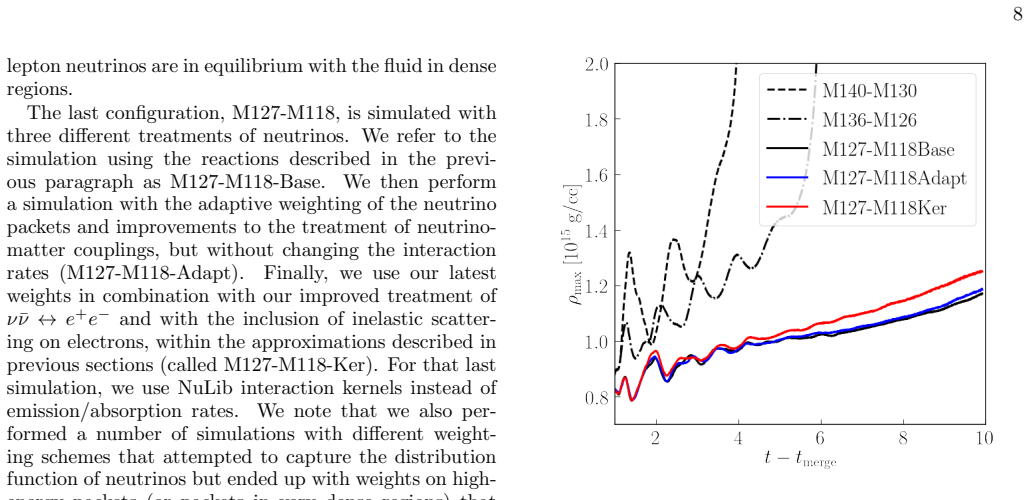
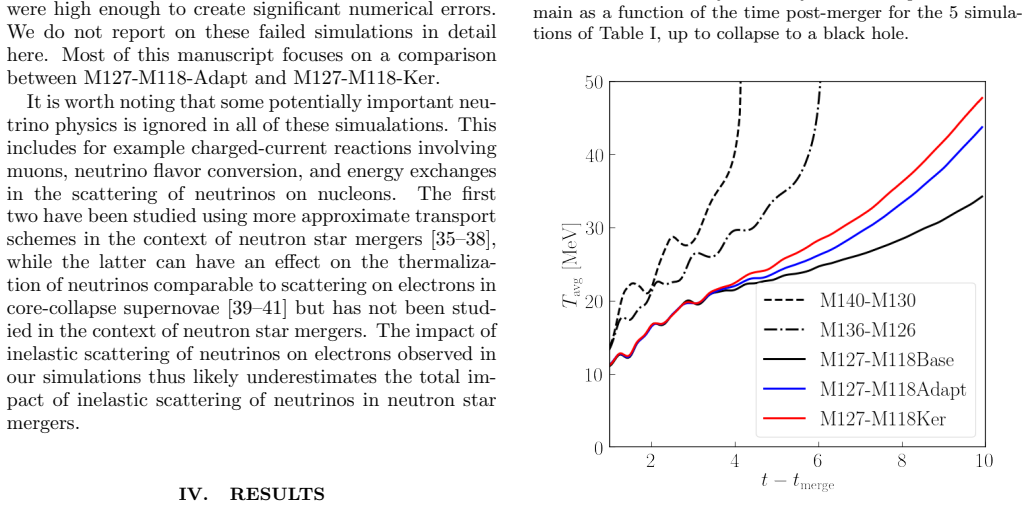
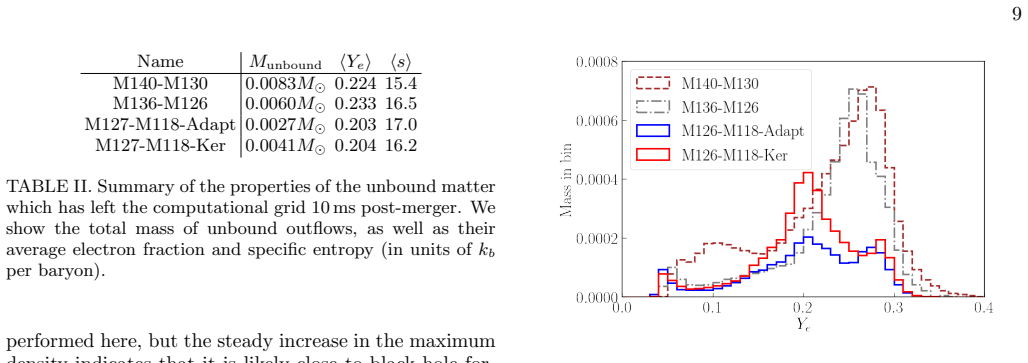
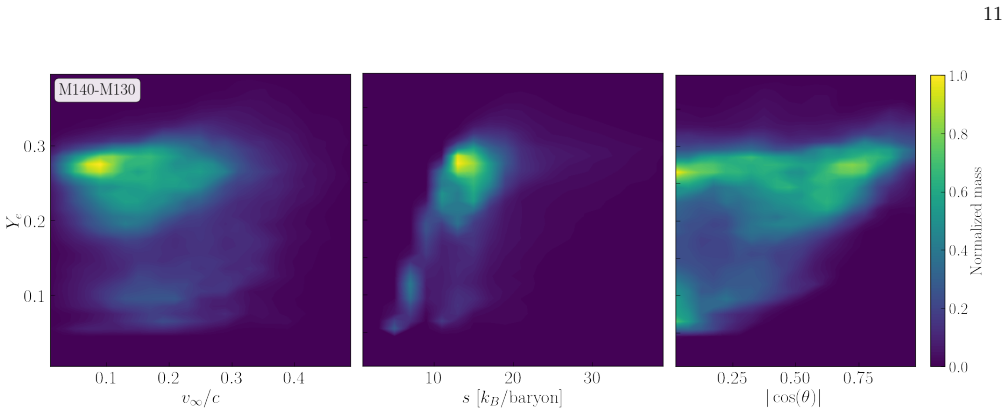
Using an advanced Monte Carlo neutrino transport scheme that incorporates inelastic neutrino-electron scattering and an improved treatment of neutrino-antineutrino pair annihilation, the simulations demonstrate a reduction in the average energy and total luminosity of heavy-lepton neutrinos, resulting in a 50% increase in the amount of ejected mass, though the total ejected mass remains below 0.005 solar masses. Separate simulations show rapid variations in ejected matter, outflow geometry, and composition with total binary mass near the prompt collapse threshold, and the scheme enables detailed study of neutrino energy spectra in the merger remnant.
What carries the argument
Improved Monte Carlo transport algorithm that calculates reaction rates on-the-fly from the simulated neutrino energy distribution, including blocking factors, while approximating angular distributions.
If this is right
- Rapid variations occur in the amount of ejected matter and in the geometry and composition of the outflows as the total mass of the binary varies near its prompt collapse threshold.
- The energy spectrum of neutrinos can be studied in more detail across the merger remnant with the advanced transport scheme.
- These neutrino physics refinements improve the reliability of models for electromagnetic signals powered by mergers.
Where Pith is reading between the lines
- The reported increase in ejected mass could revise estimates of r-process element production in merger outflows.
- Similar Monte Carlo refinements might be tested in simulations of other neutrino-dominated astrophysical events such as core-collapse supernovae.
- Higher ejected mass may produce brighter or longer-lasting kilonova signals observable in multimessenger events.
Load-bearing premise
The improved scheme still relies on approximations for the angular distribution of neutrinos while using the simulated energy distribution for reaction rates including blocking factors.
What would settle it
A high-resolution observation or simulation of a neutron star merger that shows no reduction in heavy-lepton neutrino average energy or luminosity, or no increase in ejected mass, when these processes are included would falsify the reported impact.
Figures
read the original abstract
Multimessenger observations of neutron star mergers are unique opportunities to constrain the properties of dense matter and the production site of heavy nuclei. To leverage these observations, we require reliable models of the electromagnetic signals powered by mergers. An important limitation to our ability to develop such models is the use of approximate neutrino physics in simulations. Here, we present simulations using an improved version of our Monte Carlo transport algorithm specifically designed to allow for more advanced on-the-fly calculations of reaction rates that use the simulated energy distribution of neutrinos, including in blocking factors, while still relying on approximations for the angular distribution of neutrinos. We use these new methods to include in simulations inelastic scattering of neutrinos on electrons, and to improve our treatment of neutrino-antineutrino pair annihilation. We find that, without increasing the cost of simulations, we can marginally get to the point when the addition of a single packet represents a change $\Delta f_\nu<1$ in the angle-integrated distribution function, at the cost of increased shot noise in the coupling to the fluid. With inelastic scattering and a better treatment of pair processes, we find a reduction in the average energy and total luminosity of heavy-lepton neutrinos, and an increase in the amount of mass ejected -- here by $50\%$, although on a relatively low amount of total ejected mass $<0.005M_\odot$. In a separate set of simulations varying the total mass of the binary away from its prompt collapse threshold, we find rapid variations in the amount of ejected matter and in the geometry and composition of the outflows with the total mass of the system. Finally, we use the simulations with our more advanced transport scheme to study in more detail the energy spectrum of neutrinos across the merger remnant.
Editorial analysis
A structured set of objections, weighed in public.
Referee Report
Summary. The paper presents binary neutron star merger simulations with an improved Monte Carlo neutrino transport scheme that computes reaction rates on-the-fly from the simulated energy distribution (including blocking) while retaining angular approximations. Inclusion of inelastic neutrino-electron scattering and a refined pair-annihilation treatment yields lower average energies and luminosities for heavy-lepton neutrinos and a 50% increase in ejected mass (absolute value still <0.005 M_⊙). Additional runs show rapid changes in ejecta mass, geometry, and composition with binary total mass, and the spectra of neutrinos throughout the remnant are examined.
Significance. If the central results hold, the work demonstrates that more accurate inclusion of inelastic scattering and pair processes can alter neutrino properties and outflow mass at the level relevant for r-process yields and kilonova modeling. The on-the-fly energy-dependent rates constitute a methodological advance over prior approximations. The reported sensitivity of ejecta to binary mass is also of interest for population studies. The small absolute ejecta mass and absence of quantified uncertainties, however, limit the immediate quantitative impact on multimessenger predictions.
major comments (2)
- [Abstract] Abstract: the 50% increase in ejected mass is stated without error bars, convergence tests, or direct side-by-side comparison data, even though the text explicitly notes increased shot noise in the fluid coupling. Because the headline claim attributes this change to the new microphysical processes, the lack of quantitative assessment of numerical robustness is load-bearing.
- [Abstract] Abstract (transport scheme description): reaction rates for inelastic nu-e scattering and pair annihilation are computed from the simulated energy distribution but still employ an approximated angular distribution. Both kernels depend explicitly on angular factors; any systematic deviation of the closure from the true distribution could therefore bias the net energy/momentum exchange and the resulting 50% ejecta change. A sensitivity test with alternate angular treatments is required to support the attribution.
minor comments (1)
- [Abstract] The statement that the scheme 'marginally' reaches Δf_ν < 1 per packet is presented without elaboration on how this threshold was chosen or its effect on the reported spectra and ejecta properties.
Simulated Author's Rebuttal
We thank the referee for their careful reading of the manuscript and for highlighting these important points regarding the robustness of our results. We address each major comment below.
read point-by-point responses
-
Referee: [Abstract] Abstract: the 50% increase in ejected mass is stated without error bars, convergence tests, or direct side-by-side comparison data, even though the text explicitly notes increased shot noise in the fluid coupling. Because the headline claim attributes this change to the new microphysical processes, the lack of quantitative assessment of numerical robustness is load-bearing.
Authors: We agree that the abstract would benefit from a clearer indication of the numerical uncertainties. The manuscript already notes the increased shot noise associated with the higher packet number required for the on-the-fly rates. In the revised version we will add a direct side-by-side comparison of ejecta mass between the two transport schemes (with and without the new microphysics) together with an estimate of the shot-noise contribution to the uncertainty. This will allow readers to assess whether the reported 50% change exceeds the numerical variation. revision: yes
-
Referee: [Abstract] Abstract (transport scheme description): reaction rates for inelastic nu-e scattering and pair annihilation are computed from the simulated energy distribution but still employ an approximated angular distribution. Both kernels depend explicitly on angular factors; any systematic deviation of the closure from the true distribution could therefore bias the net energy/momentum exchange and the resulting 50% ejecta change. A sensitivity test with alternate angular treatments is required to support the attribution.
Authors: The transport scheme does retain an angular approximation, as stated in the text. While the energy-dependent rates constitute the primary methodological advance, we acknowledge that angular factors enter the kernels. A dedicated sensitivity study varying the angular closure would require substantial additional code development and computational resources that are outside the scope of the present work. revision: partial
- A sensitivity test with alternate angular treatments cannot be performed within the current study due to computational and development cost.
Circularity Check
Minor self-citation to prior Monte Carlo algorithm; central results from explicit addition of new processes
full rationale
The paper's claims derive from adding inelastic neutrino-electron scattering and an improved pair-annihilation treatment to an existing Monte Carlo transport scheme. These additions use the simulated energy distribution (including blocking) to compute rates on-the-fly, producing reported changes in heavy-lepton neutrino energy, luminosity, and ejecta mass. The only self-reference is to the authors' prior transport algorithm, which is not load-bearing for the new microphysical effects. No equations reduce by construction to fitted inputs, no uniqueness theorems are imported from self-citations, and no ansatzes or known results are renamed as novel derivations. The angular-distribution approximation is a methodological limitation but does not create circularity in the reported differences.
Axiom & Free-Parameter Ledger
Reference graph
Works this paper leans on
-
[1]
In our simulations, ∆f ν = ξs∆f0 with ∆f 0 = 10 −3 andξ s = 1 initially but grow- ing over time to keep the total number of packets per species below∼10 8
Neutrino packet weights and accuracy of the distribution function Before a more detailed analysis of neutrinos in our sim- ulations, it is worth noting that an objective of these simulations is to try to use packets that each represent a change ∆f ν <1 in the distribution functionf ν of neutrinos, after integration over the direction of prop- agation of t...
-
[2]
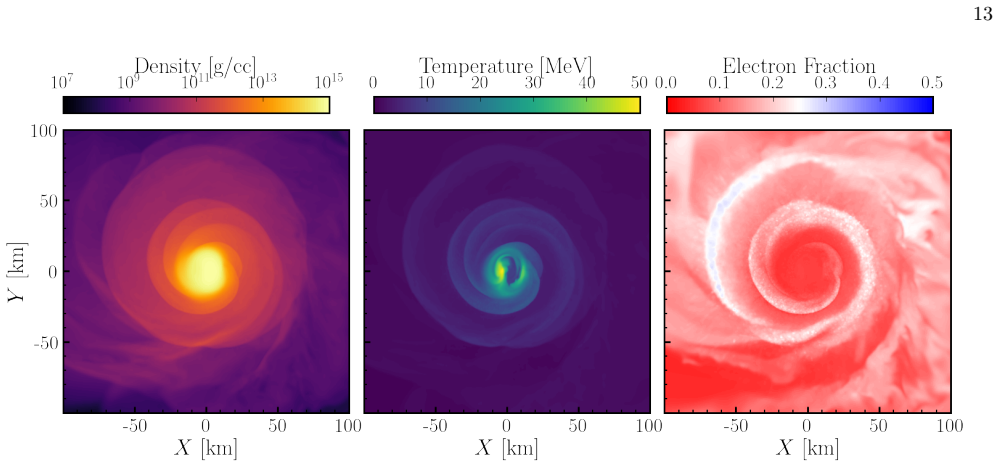
The density, temperature and electron fraction of the system are visualized in two orthogonal slices in Figs 8-9
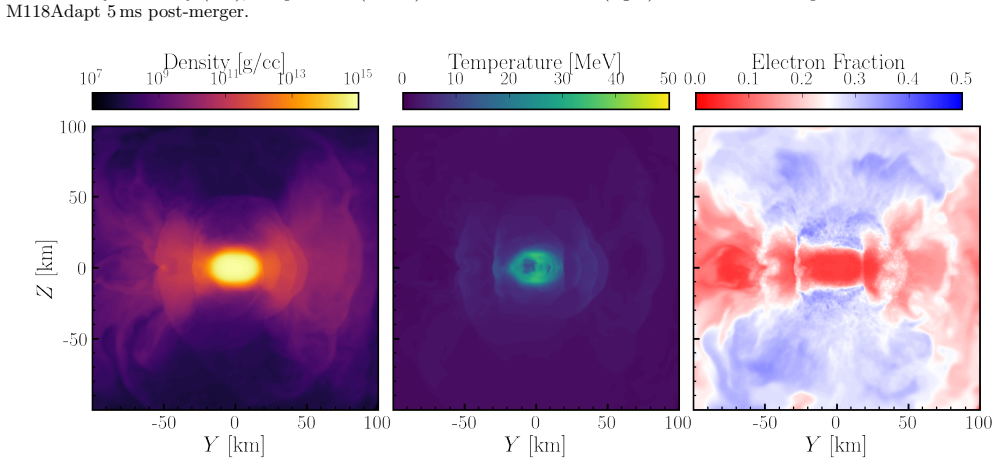
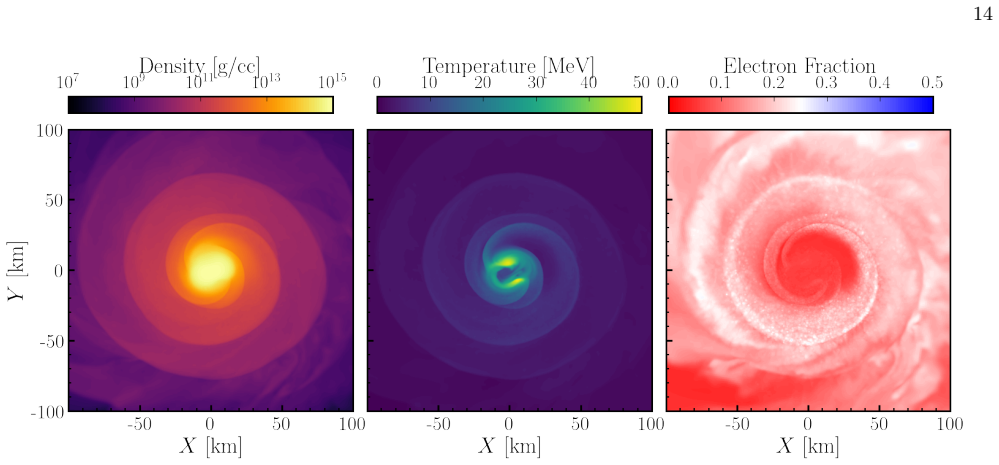
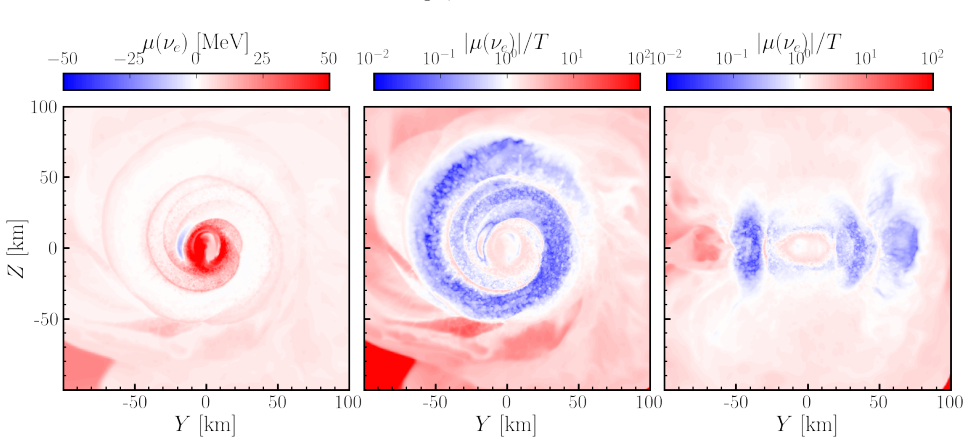
Representative simulation snapshot We start our disucussion of neutrinos and neutrino- matter interactions by analyzing a snapshot of simula- tions M127-M118Adapt and M127-M118Ker, 5 ms after merger. The density, temperature and electron fraction of the system are visualized in two orthogonal slices in Figs 8-9. We see the dense, neutron rich remnant with...
-
[3]
We divide the computational domain into 50×50 bins based on the fluid density and tem- perature
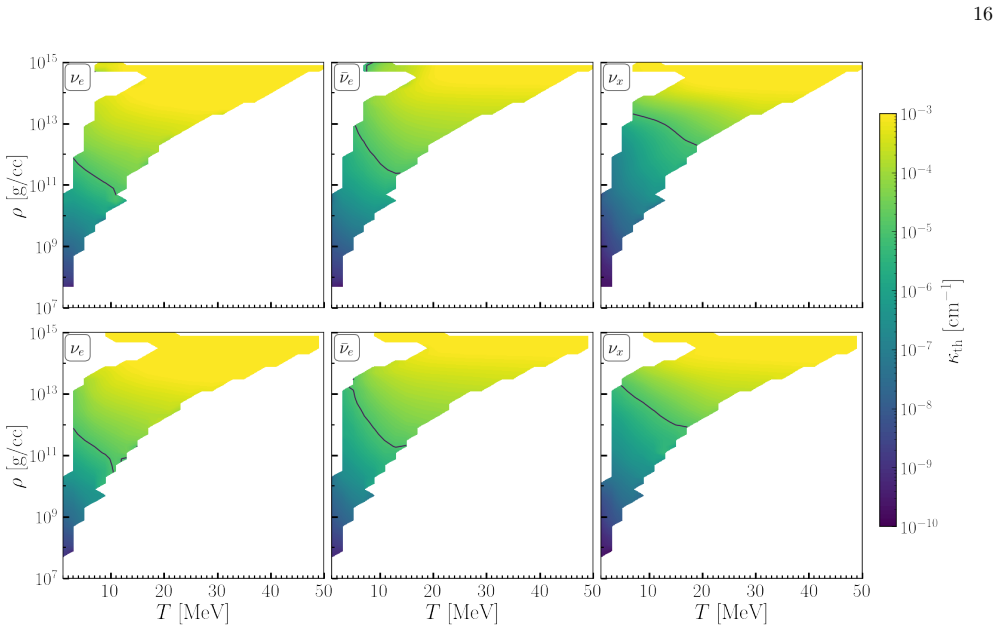
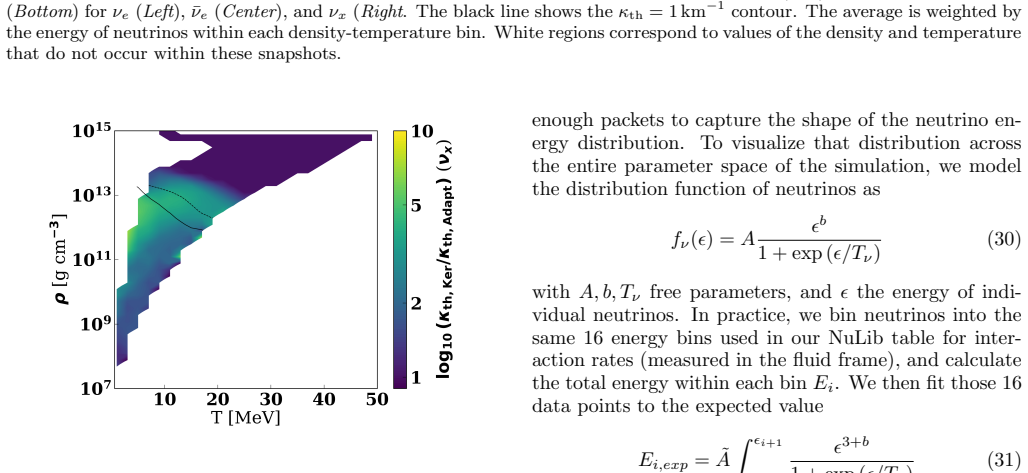
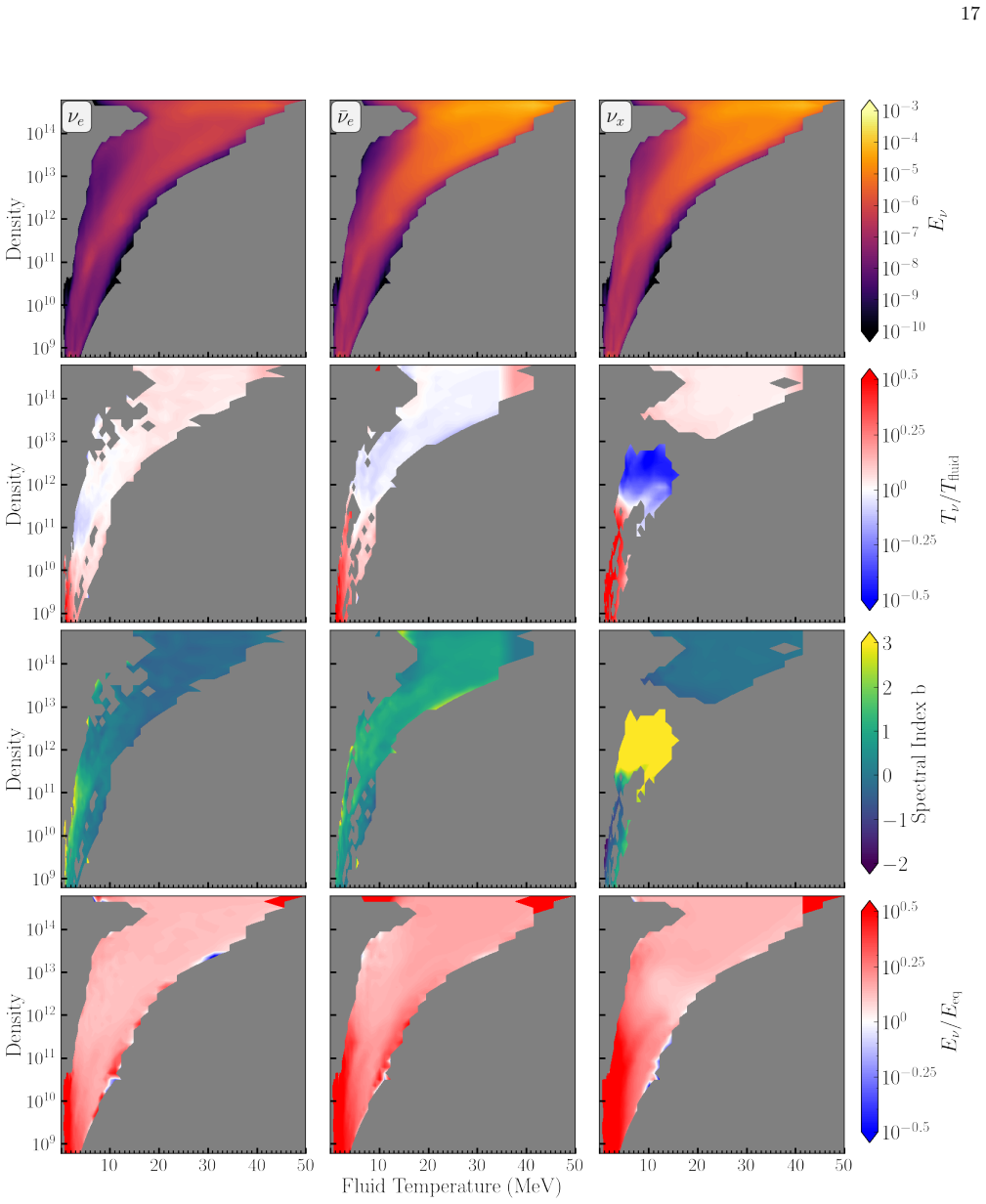
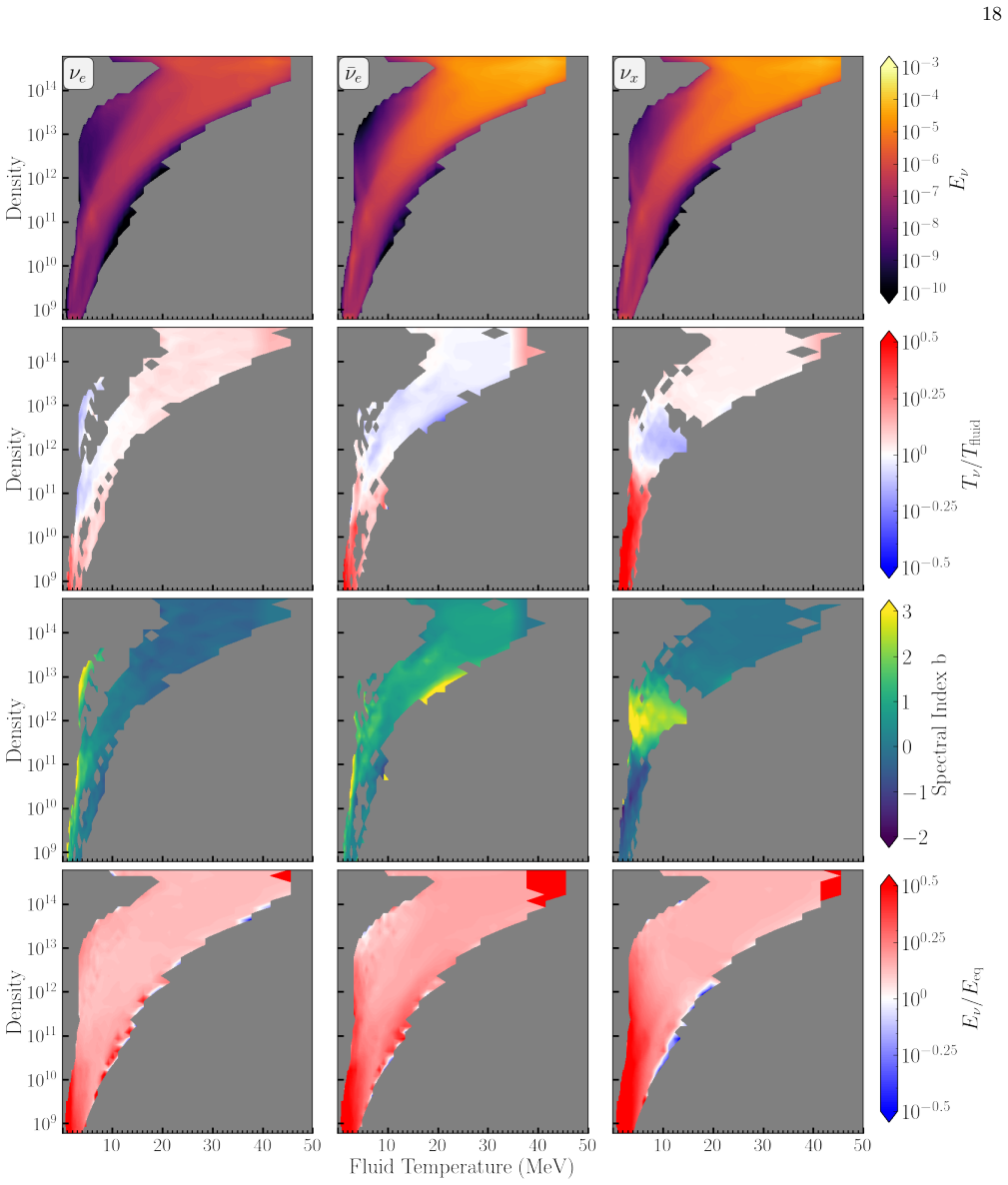
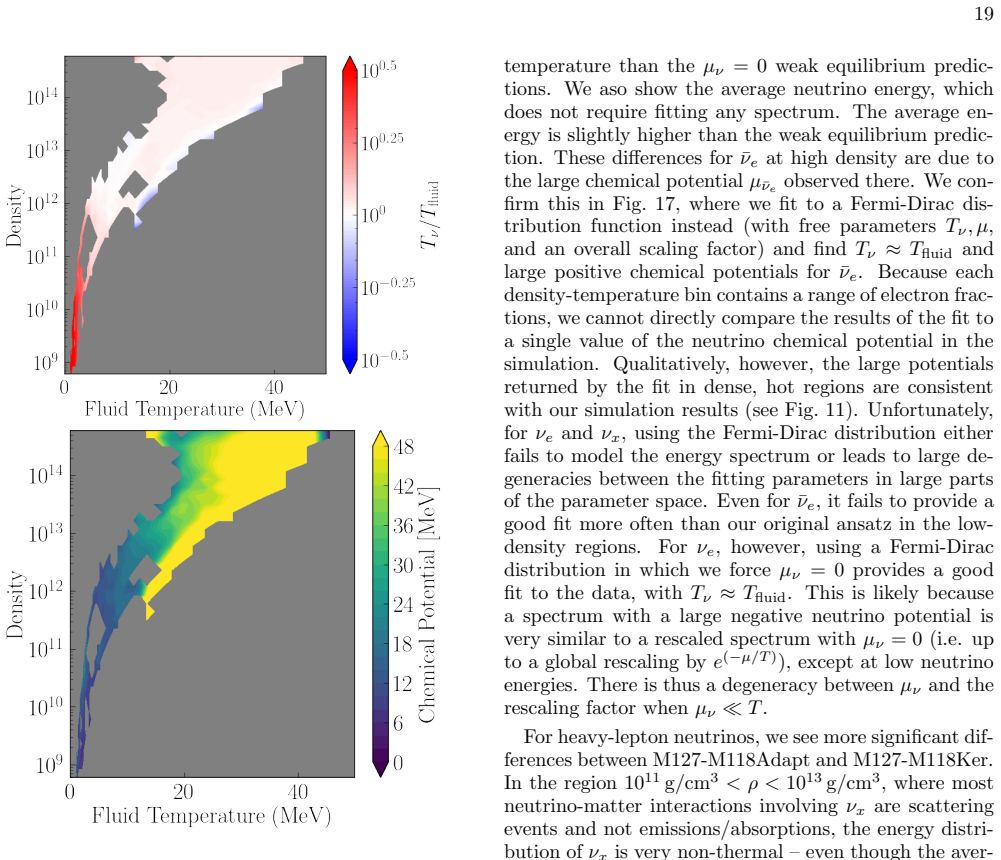
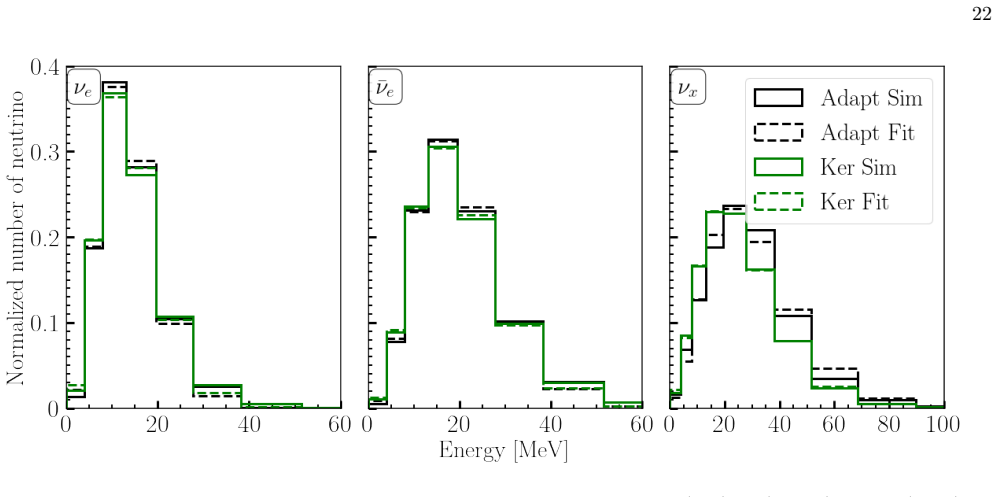
Opacities and energy distribution of neutrinos To visualize more easily changes to the opacity and energy distribution of neutrinos under different thermo- dynamical conditions, we now consider a different set of visualizations. We divide the computational domain into 50×50 bins based on the fluid density and tem- perature. The density bins are logarithmi...
-
[4]
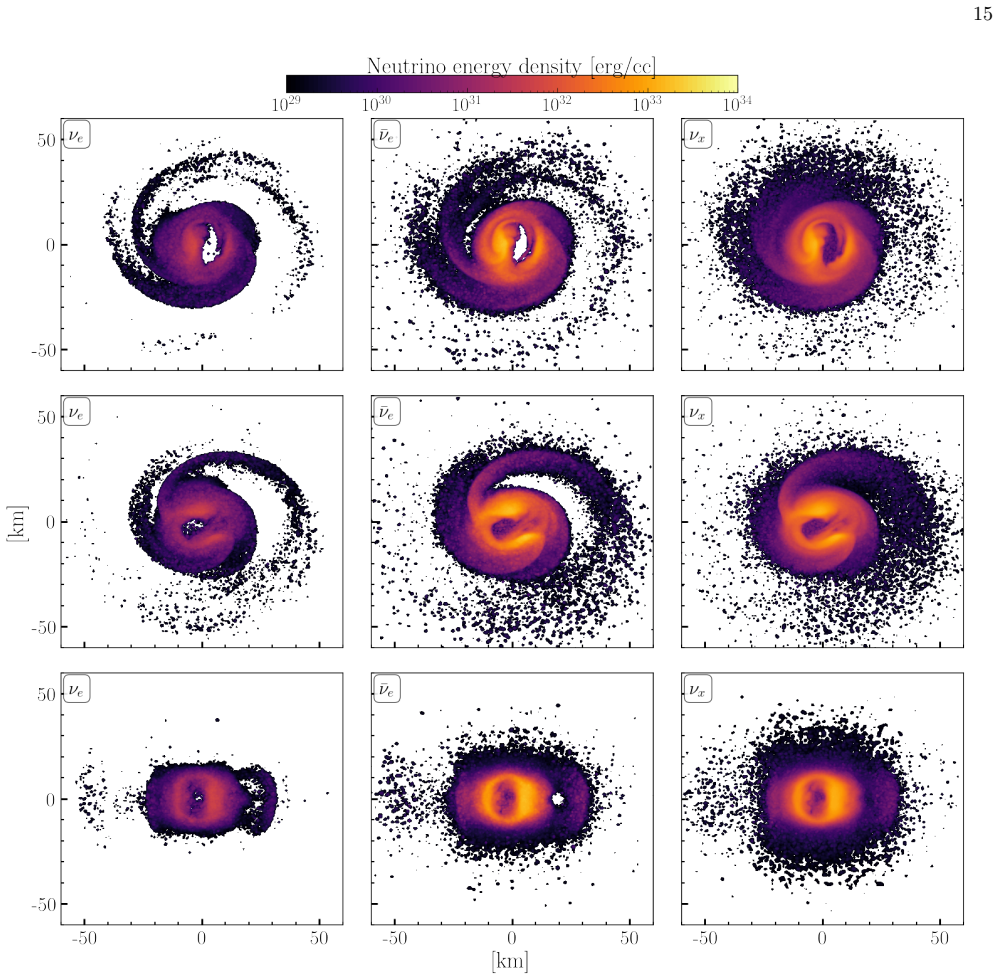
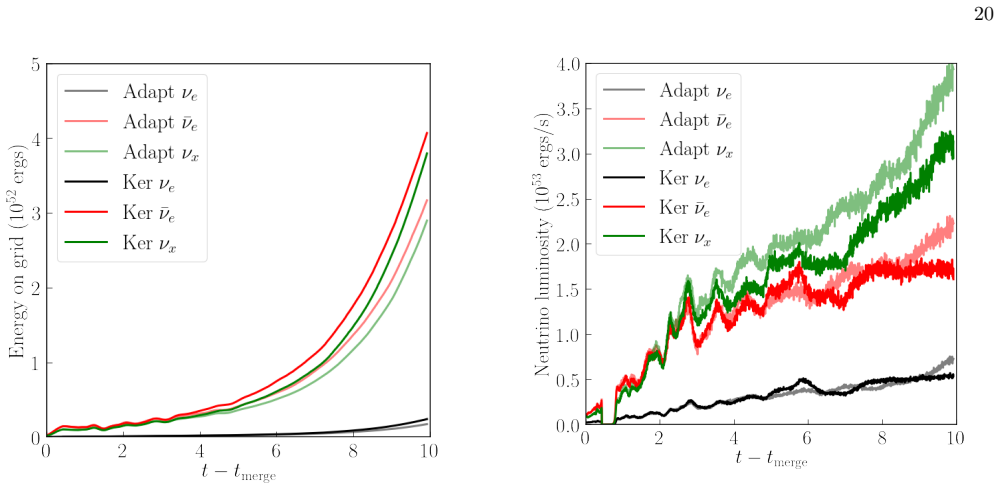
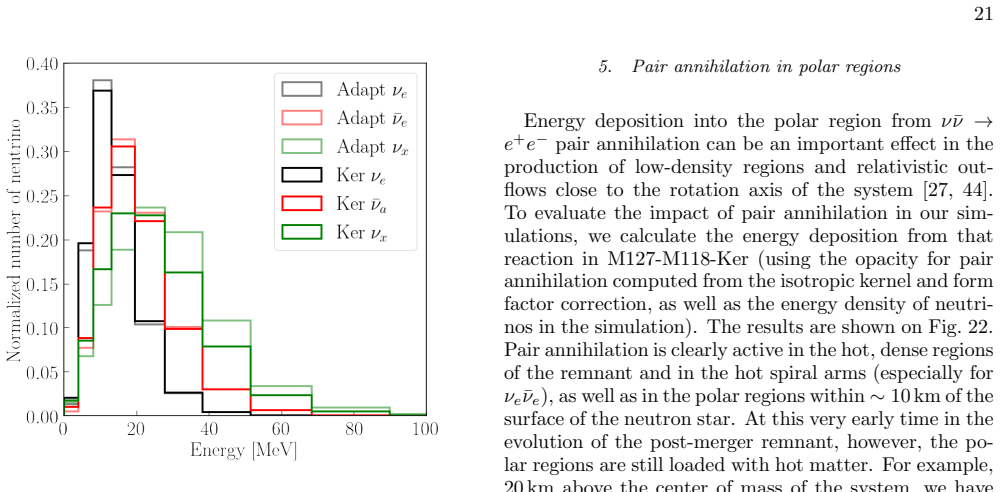
Neutrino luminosities and spectra We now turn to more global properties of the neu- trinos, still focusing on our comparison between M127- M118Adapt and M127-M118Ker. Fig. 18 shows the to- tal energy of the neutrinos on the grid. We see that the energy budget is about equally divided between ¯ν e and νx. The energy inν e is more than an order of magni- tu...
-
[5]
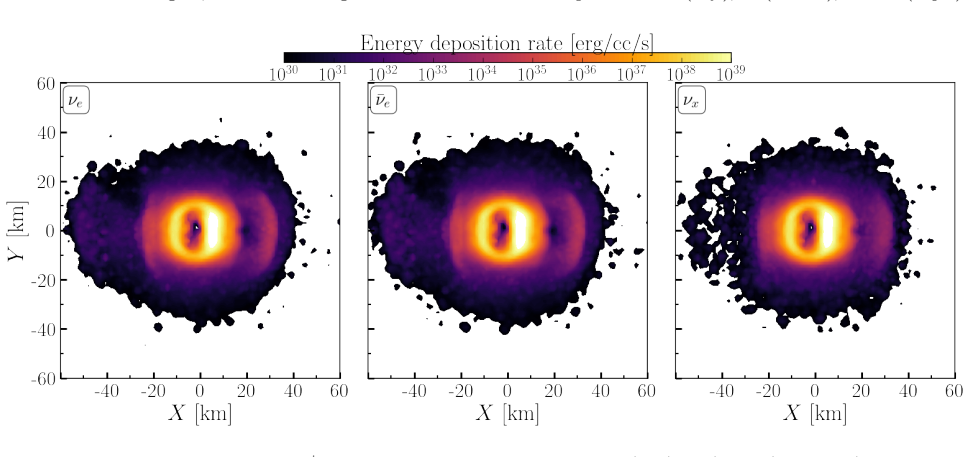
Pair annihilation in polar regions Energy deposition into the polar region fromν¯ν→ e+e− pair annihilation can be an important effect in the production of low-density regions and relativistic out- flows close to the rotation axis of the system [27, 44]. To evaluate the impact of pair annihilation in our sim- ulations, we calculate the energy deposition fr...
-
[6]
B. Abbottet al.(LIGO Scientific, Virgo), GW170817: Measurements of neutron star radii and equation of state, Phys. Rev. Lett.121, 161101 (2018), arXiv:1805.11581 24 [gr-qc]
Pith/arXiv arXiv 2018
-
[7]
D. Radice, A. Perego, F. Zappa, and S. Bernuzzi, Gw170817: Joint constraint on the neutron star equation of state from multimessenger observations, The Astrophysical Journal Letters852, L29 (2018), arXiv:1711.03647 [astro-ph.HE]
Pith/arXiv arXiv 2018
-
[8]
D. Kasen, B. Metzger, J. Barnes, E. Quataert, and E. Ramirez-Ruiz, Origin of the heavy elements in binary neutron-star mergers from a gravitational-wave event, Nature551, 80 (2017), arXiv:1710.05463 [astro-ph.HE]
Pith/arXiv arXiv 2017
-
[9]
J. C. Rastinejad, W. Fong, C. D. Kilpatrick, M. Nicholl, and B. D. Metzger, Uniform Modeling of Observed Kilo- novae: Implications for Diversity and the Progenitors of Merger-driven Long Gamma-Ray Bursts, Astrophys. J. 979, 190 (2025), arXiv:2409.02158 [astro-ph.HE]
arXiv 2025
-
[10]
B. Abbottet al.(LIGO Scientific, Virgo), GW190425: Observation of a Compact Binary Coalescence with To- tal Mass∼3.4M ⊙, Astrophys. J. Lett.892, L3 (2020), arXiv:2001.01761 [astro-ph.HE]
arXiv 2020
-
[11]
J. Barnes and D. Kasen, Effect of a High Opacity on the Light Curves of Radioactively Powered Transients from Compact Object Mergers, Astrophys. J.775, 18 (2013), arXiv:1303.5787 [astro-ph.HE]
Pith/arXiv arXiv 2013
- [12]
-
[13]
K. Kiuchi, A. Reboul-Salze, Y. Sekiguchi, and M. Shi- bata, A magnetar formation in binary neutron star merger, arXiv (2026), arXiv:2606.11299 [astro-ph.HE]
Pith/arXiv arXiv 2026
-
[14]
Foucart, Neutrino transport in general relativistic neu- tron star merger simulations, Liv
F. Foucart, Neutrino transport in general relativistic neu- tron star merger simulations, Liv. Rev. Comput. Astro- phys.9, 1 (2023), arXiv:2209.02538 [astro-ph.HE]
arXiv 2023
-
[15]
K. S. Thorne, Relativistic radiative transfer - Moment formalisms, Mon. Not. Roy. Astr. Soc.194, 439 (1981)
1981
-
[16]
M. Shibata, K. Kiuchi, Y. Sekiguchi, and Y. Suwa, Trun- cated Moment Formalism for Radiation Hydrodynamics in Numerical Relativity, Progress of Theoretical Physics 125, 1255 (2011), arXiv:1104.3937 [astro-ph.HE]
Pith/arXiv arXiv 2011
-
[17]
F. Foucart, E. O’Connor, L. Roberts, M. D. Duez, R. Haas, L. E. Kidder, C. D. Ott, H. P. Pfeiffer, M. A. Scheel, and B. Szil´ agyi, Post-merger evolution of a neu- tron star-black hole binary with neutrino transport, Phys. Rev. D91, 124021 (2015), arXiv:1502.04146 [astro- ph.HE]
Pith/arXiv arXiv 2015
-
[18]
F. Foucart, E. O’Connor, L. Roberts, L. E. Kidder, H. P. Pfeiffer, and M. A. Scheel, Impact of an im- proved neutrino energy estimate on outflows in neutron star merger simulations, Phys. Rev.D94, 123016 (2016), arXiv:1607.07450 [astro-ph.HE]
Pith/arXiv arXiv 2016
- [19]
-
[20]
Foucart, M
F. Foucart, M. D. Duez, R. Haas, L. E. Kidder, H. P. Pfeiffer, M. A. Scheel, and E. Spira-Savett, General rel- ativistic simulations of collapsing binary neutron star mergers with monte carlo neutrino transport, Phys. Rev. D107, 103055 (2023)
2023
-
[21]
J. M. Miller, B. R. Ryan, J. C. Dolence, A. Burrows, C. J. Fontes, C. L. Fryer, O. Korobkin, J. Lippuner, M. R. Mumpower, and R. T. Wollaeger, Full Transport Model of GW170817-Like Disk Produces a Blue Kilo- nova, Phys. Rev. D100, 023008 (2019), arXiv:1905.07477 [astro-ph.HE]
Pith/arXiv arXiv 2019
-
[22]
K. Kawaguchi, S. Fujibayashi, and M. Shibata, Long- term Monte Carlo-based neutrino-radiation hydrody- namics simulations for a black hole-torus system, Phys. Rev. D111, 023015 (2025), arXiv:2410.02380 [astro- ph.HE]
arXiv 2025
-
[23]
F. Foucart, Assessing the difficulty of capturing the distribution function of neutrinos in neutron star merger simulations, Phys. Rev. D112, 023046 (2025), arXiv:2504.21822 [astro-ph.HE]
arXiv 2025
-
[24]
P. C.-K. Cheong, F. Foucart, H. H.-Y. Ng, A. Offermans, M. D. Duez, N. Muhammed, and P. Chawhan, Influence of neutrino-electron scattering and neutrino-pair annihi- lation on hypermassive neutron star, Phys. Rev. D111, 043036 (2025), arXiv:2410.20681 [astro-ph.HE]
Pith/arXiv arXiv 2025
-
[25]
S. Rath, F. Foucart, L. E. Kidder, H. P. Pfeiffer, and M. A. Scheel, Assessing the Relative Importance of Neutrino Matter Interaction Channels in Post-Merger Remnant of Binary Neutron Stars, arXiv (2026), arXiv:2605.29187 [astro-ph.HE]
Pith/arXiv arXiv 2026
-
[26]
F. Foucart, P. C.-K. Cheong, M. D. Duez, L. E. Kid- der, H. P. Pfeiffer, and M. A. Scheel, Robustness of neu- tron star merger simulations to changes in neutrino trans- port and neutrino-matter interactions, Phys. Rev. D110, 083028 (2024), arXiv:2407.15989 [astro-ph.HE]
arXiv 2024
-
[27]
F. Foucart, M. D. Duez, F. Hebert, L. E. Kidder, P. Ko- varik, H. P. Pfeiffer, and M. A. Scheel, Implementation of Monte Carlo Transport in the General Relativistic SpEC Code, Astrophys. J.920, 82 (2021), arXiv:2103.16588 [astro-ph.HE]
arXiv 2021
-
[28]
B. R. Ryan, J. C. Dolence, and C. F. Gammie, bhlight: General Relativistic Radiation Magnetohydrodynamics with Monte Carlo Transport, Astroph.J.807, 31 (2015), arXiv:1505.05119 [astro-ph.HE]
Pith/arXiv arXiv 2015
-
[29]
M. G. Alford, L. Brodie, F. Foucart, and A. Haber, Ther- malization of Neutrinos in a Neutron Star Merger Simu- lation, arXiv (2026), arXiv:2603.06788 [astro-ph.HE]
arXiv 2026
-
[30]
S. W. Bruenn, Stellar core collapse - Numerical model and infall epoch, Astroph.J.Suppl.58, 771 (1985)
1985
-
[31]
E. O’Connor, An Open-source Neutrino Radiation Hy- drodynamics Code for Core-collapse Supernovae, ApJ Suppl.219, 24 (2015), arXiv:1411.7058 [astro-ph.HE]
Pith/arXiv arXiv 2015
-
[32]
S. Fujibayashi, Y. Sekiguchi, K. Kiuchi, and M. Shi- bata, Properties of Neutrino-driven Ejecta from the Rem- nant of a Binary Neutron Star Merger: Pure Radia- tion Hydrodynamics Case, Astrophys. J.846, 114 (2017), arXiv:1703.10191 [astro-ph.HE]
Pith/arXiv arXiv 2017
-
[33]
H. P. Pfeiffer, L. E. Kidder, M. A. Scheel, and S. A. Teukolsky, A multidomain spectral method for solving elliptic equations, Comput. Phys. Commun.152, 253 (2003), gr-qc/0202096
Pith/arXiv arXiv 2003
-
[34]
F. Foucart, L. E. Kidder, H. P. Pfeiffer, and S. A. Teukol- sky, Initial data for black hole-neutron star binaries: A Flexible, high-accuracy spectral method, Phys. Rev. D 77, 124051 (2008), arXiv:0804.3787 [gr-qc]
Pith/arXiv arXiv 2008
-
[35]
A. W. Steiner, M. Hempel, and T. Fischer, Core-collapse Supernova Equations of State Based on Neutron Star Ob- servations, Astrophys. J.774, 17 (2013), arXiv:1207.2184 [astro-ph.SR]
Pith/arXiv arXiv 2013
-
[36]
Bauswein, T
A. Bauswein, T. W. Baumgarte, and H.-T. Janka, Prompt merger collapse and the maximum mass of neu- tron stars, Phys. Rev. Lett.111, 131101 (2013). 25
2013
-
[37]
L. Lindblom, M. A. Scheel, L. E. Kidder, R. Owen, and O. Rinne, A New Generalized Harmonic Evolution Sys- tem, Class. Quantum Grav.23, S447 (2006), arXiv:gr- qc/0512093v3 [gr-qc]
arXiv 2006
-
[38]
M. D. Duez, F. Foucart, L. E. Kidder, H. P. Pfeiffer, M. A. Scheel, and S. A. Teukolsky, Evolving black hole- neutron star binaries in general relativity using pseu- dospectral and finite difference methods, Phys. Rev. D 78, 104015 (2008), arXiv:0809.0002 [gr-qc]
Pith/arXiv arXiv 2008
-
[39]
F. Foucart, M. B. Deaton, M. D. Duez, L. E. Kidder, I. MacDonald, C. D. Ott, H. P. Pfeiffer, M. A. Scheel, B. Szil´ agyi, and S. A. Teukolsky, Black hole-neutron star mergers at realistic mass ratios: Equation of state and spin orientation effects, Phys. Rev. D87, 084006 (2013), arXiv:1212.4810 [gr-qc]
Pith/arXiv arXiv 2013
- [40]
-
[41]
H. H.-Y. Ng, C. Musolino, S. D. Tootle, and L. Rezzolla, Accurate Muonic Interactions in Neutron Star Mergers and Impact on Heavy-element Nucleosynthesis, Astro- phys. J. Lett.985, L36 (2025), arXiv:2411.19178 [astro- ph.HE]
arXiv 2025
-
[42]
H. Gieg, R. Jaeger, M. Ujevic, and T. Dietrich, Consis- tent Treatment of Muons in Binary Neutron Star Merg- ers, arXiv (2026), arXiv:2604.14225 [astro-ph.HE]
Pith/arXiv arXiv 2026
-
[43]
Y. Qiu, D. Radice, S. Richers, and M. Bhat- tacharyya, Neutrino Flavor Transformation in Neutron Star Mergers, Phys. Rev. Lett.135, 091401 (2025), arXiv:2503.11758 [astro-ph.HE]
arXiv 2025
-
[44]
H.-T. Janka, W. Keil, G. Raffelt, and D. Seckel, Nu- cleon spin fluctuations and the supernova emission of neutrinos and axions, Phys. Rev. Lett.76, 2621 (1996), arXiv:astro-ph/9507023
Pith/arXiv arXiv 1996
-
[45]
T. A. Thompson, A. Burrows, and J. E. Horvath,µand τneutrino thermalization and production in supernovae: Processes and time scales, Phys. Rev. C62, 035802 (2000)
2000
-
[46]
A. Burrows, D. Vartanyan, J. C. Dolence, M. A. Skin- ner, and D. Radice, Crucial Physical Dependencies of the Core-Collapse Supernova Mechanism, Space Sci. Rev. 214, 33 (2018), arXiv:1611.05859 [astro-ph.SR]
Pith/arXiv arXiv 2018
-
[47]
F. Foucart, P. Moesta, T. Ramirez, A. J. Wright, S. Darbha, and D. Kasen, Estimating outflow masses and velocities in merger simulations: Impact of r-process heating and neutrino cooling, Phys. Rev. D104, 123010 (2021), arXiv:2109.00565 [astro-ph.HE]
arXiv 2021
-
[48]
D. Radice and S. Bernuzzi, Secular Outflows from Long- Lived Neutron Star Merger Remnants, J. Phys. Conf. Ser. 2742, 012009 (2024), arXiv:2310.09934 [astro-ph.HE]
arXiv 2024
-
[49]
K. Kawaguchi, S. Fujibayashi, and M. Shibata, Neu- trino pair annihilation driven jets from black-hole torus systems, Phys. Rev. D112, 043001 (2025), arXiv:2506.01679 [astro-ph.HE]
arXiv 2025
-
[50]
F. Foucart, M. D. Duez, L. E. Kidder, R. Nguyen, H. P. Pfeiffer, and M. A. Scheel, Evaluating radiation transport errors in merger simulations using a Monte Carlo algo- rithm, Phys. Rev.D98, 063007 (2018), arXiv:1806.02349 [astro-ph.HE]
Pith/arXiv arXiv 2018
- [51]
discussion (0)
Sign in with ORCID, Apple, or X to comment. Anyone can read and Pith papers without signing in.