REVIEW 4 major objections 6 minor 34 references
When two task specs conflict, language models systematically prefer formal structure over plain language and examples.
Reviewed by Pith at T0; open to challenge. T0 means a machine referee read the full paper against a public rubric. the ladder, T0–T4 →
T0 review · grok-4.5
2026-07-31 09:06 UTC pith:UW2XZ2I7
load-bearing objection Clean measurement framework with real design care; the Formal>NL>Ex ordering is useful but still partly confounded with recoverability until single-spec baselines exist. the 4 major comments →
When Specifications Conflict: A Symmetry-Based Framework for Measuring LLM Preferences
The pith
A machine-rendered reading of the paper's core claim, the machinery that carries it, and where it could break.
Core claim
Under symmetry-counterbalanced conflicts between competing executable mappings, LLMs exhibit systematic representation preferences rather than random resolution. On the mathematical benchmark the aggregate ordering is Formal ≈ Naturalized Formal > Pure Natural Language > Input–Output Examples, with formal and naturalized-formal forms selected over pure natural language in roughly 87% of attributable responses and over examples in roughly 93%. Example influence rises with model capability and depends on function family. The same attributable measurement extends to Boolean algebra, code generation, and clinical rule conflicts, where domain-specific factors can override or reshape the math orde
What carries the argument
A symmetry-based preference-attribution framework: two conflicting executable mappings f1 and f2 that disagree on a discriminative query, expressed in competing representation types, with presentation order and type-to-mapping assignment fully counterbalanced so the model’s answer can be scored as selecting f1, f2, or neither, then aggregated as P(t) over the symmetry-complete set.
Load-bearing premise
That matching the model’s final answer to one mapping’s stored output means the model selected that specification form, rather than computing something else or reacting to confounds like length and detail that cannot be fully separated from form.
What would settle it
Rerun the same 550 math conflicts with length-, density-, and detail-matched specs across forms (or with forced equal information content) and check whether the Formal ≈ NatF > NL > Examples ordering collapses or reverses in attributable selection rates.
If this is right
- Conflict handling in LLM systems can be measured as attributable specification selection, not only as accuracy or contradiction detection.
- Preserving explicit structure in specs (formal or naturalized-formal) is a practical lever when multiple instructions may disagree.
- Example-based specs should not be assumed weak or strong a priori: their weight tracks model capability and task recoverability.
- In code settings, higher-capability models’ tilt toward tests over documentation is a measurable policy, not an automatic virtue.
- In clinical-style rules, restrictiveness bias can dominate representation form, so domain checks must accompany form checks.
Where Pith is reading between the lines
- Prompt and tool design that must merge docs, tests, and formal constraints could treat structure-preserving formats as the default “tie-breaker” layer unless domain evidence says otherwise.
- Abstention rates under an explicit “uncertain” option (higher for some models when both sides are textual/formal) suggest a second axis of conflict behavior worth reporting beside preference rankings.
- If length and information density are the real drivers, future work could orthogonalize those factors and re-estimate P(t) to isolate pure form effects.
Editorial analysis
A structured set of objections, weighed in public.
Referee Report
Summary. The paper introduces a symmetry-based experimental framework for measuring how LLMs resolve conflicts between competing task specifications. Conflicts are formalized as two executable mappings f1, f2 that disagree on a discriminative query q*; model answers are attributed by exact match to f1(q*) or f2(q*). Presentation order and representation-to-mapping assignment are 2×2 counterbalanced, and preference P(t) is estimated by aggregation over the symmetry-complete set U. On a 550-instance mathematical benchmark (11 function families), four representation types are compared pairwise, yielding the aggregate ordering Formal ≈ Naturalized Formal > Pure Natural Language > Input–Output Examples. The framework is then applied to Boolean algebra (formula vs truth table / gate netlist), code generation (documentation vs tests on MBPP-derived conflicts), and clinical rule conflicts (openFDA-derived thresholds), showing attributable but context-dependent selection patterns, including a clinical restrictiveness bias.
Significance. If the measurement is valid, the work supplies a controllable, attributable alternative to existing conflict benchmarks that mainly study source credibility or knowledge contradictions rather than specification form. Strengths include executable ground truth, systematic order/assignment counterbalancing, clustered-bootstrap CIs, low non-attributable rates outside NL-vs-Ex, released construction detail for three heterogeneous domains, and diagnostic extensions (abstention, cross-authority clinical conflicts). The code-generation capability split and clinical restrictiveness finding are independently interesting for system design. The contribution is primarily methodological and empirical rather than theoretical; its lasting value depends on whether attributed matches truly isolate representation preference rather than differential recoverability of the underlying mapping.
major comments (4)
- [Preference Attribution; Experimental Protocol; Results (Pairwise Representation Preferences)] Preference Attribution / Experimental Protocol (and Fig. 2): the central inference treats exact match of the final answer to fs(q*) under a two-spec prompt as selection of representation type s. That reading requires that both specs are, in isolation, sufficiently recoverable for each model. The manuscript never reports single-specification competence baselines (one spec + q*, no conflict) stratified by representation type, model, and function family. Pure-NL bans notation; examples require induction and exclude q*; Form/NatF expose structure. Without these baselines, the headline ordering (e.g., Form>NL 87.45%, Form>Ex 93.04% of attributable responses in Pairwise Representation Preferences) is compatible with differential mapping recoverability rather than preferential selection under dual comprehension. This is load-bearing for RQ1 and should be added, or the claim should be narrowed t
- [Mathematical Benchmark Construction; Specification Generation; Discussion] Specification Generation (Mathematical Benchmark Construction): surface forms for NL, Form, and NatF are produced by DeepSeek-V4-Pro with temperature 1 and only manual spot-checks for faithfulness—no quantified semantic-faithfulness or single-spec accuracy audit, and no control that NL/Form/NatF are matched on length, information density, or detail. The Discussion already states these factors ‘cannot be fully separated’ from representation type. For a paper whose claim is about representation preference, either (i) report length/density statistics and single-spec accuracy by form, or (ii) add a matched-length / human-written control subset. Otherwise the Form≈NatF≫NL pattern may partly reflect generator style and density rather than form per se.
- [When Do Examples Become Competitive?; Table 1; Additional Results (Fig. 10, Fig. 12)] When Do Examples Become Competitive? / Table 1: higher-capability variants select example-supported mappings more often, which is presented as evidence that example influence depends on capability. The same pattern is exactly what incomplete example-based rule induction predicts (cf. elevated ‘other’ rates in NL vs Ex, Fig. 12, especially Llama and GPT-4.1-nano). Without single-spec example-only accuracy by model and family (Fig. 10 already shows large family effects), the capability interaction cannot distinguish ‘prefers examples more’ from ‘can induce from examples more.’ Please report example-only competence and condition conflict selection on successful single-spec induction where possible.
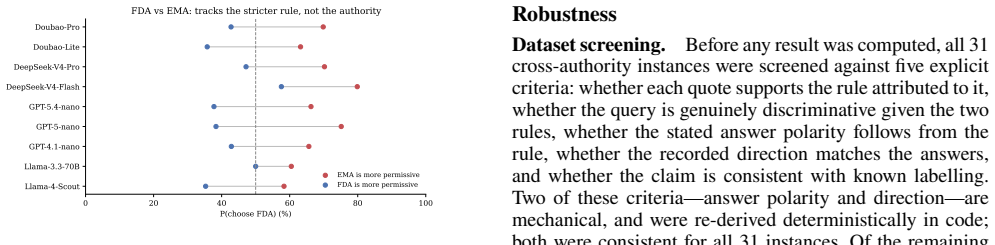
- [Heterogeneous Specification Conflicts; Abstract; Conclusion] Heterogeneous extensions are valuable but unevenly support the unified ‘representation preference’ narrative. Clinical Rule Conflicts (Fig. 7): textual forms show no stable ordering and all models prefer the more restrictive rule (52–87%), with genuine-value selection tracking restrictiveness under bidirectional perturbations—not representation. Code generation (Fig. 6): test vs documentation preference swings from ~16% to ~97% across models and is only loosely tied to an external capability index. These results show the framework measures attributable selection, but they also show that the math-benchmark ordering is not a general hierarchy of specification forms. The abstract and conclusion should state more sharply that the Form≈NatF>NL>Ex ordering is benchmark-specific, and that domain factors can dominate representation.
minor comments (6)
- [References] Several in-text citations and model cards are dated 2026 (e.g., DeepSeek-V4, GPT-5.4-nano, openFDA access dates). Ensure bibliography consistency and that all cited artifacts are citable at publication time.
- [Figure 3] Figure 3 panels for individual models are hard to read in the manuscript text layout; ensure axis labels and the pooled panel remain legible in the camera-ready figures.
- [Preference Attribution] Notation: P(t)=E_u P(select t | t, u) is clear, but ‘select t’ vs selecting mapping fi should be distinguished more explicitly when representation type and mapping identity are crossed.
- [Abstract; Introduction] Typographical issues: missing spaces in several run-on phrases in the abstract/introduction (e.g., ‘Furthermore,weextendtheframework…’) and inconsistent capitalization of Naturalized Formal / NatF.
- [Code Generation; Appendix] Code-generation construction is thorough in the appendix; a short main-text statement of the 67/200 retention rate and the single-slot semantic contract would help readers assess selection bias without reading the full appendix.
- [Robustness Checks; Figure 11] Robustness Checks: second-position rate of 67.86% for Form vs NatF is important; consider promoting a brief main-text caveat that order dominates when representation strengths are similar.
Circularity Check
No significant circularity: empirical preference measurement over executable conflicts, not a derivation that redefines its target.
full rationale
The paper’s central object is an operational measurement, not a first-principles derivation. Conflicting specifications are realized as statically defined executable mappings f1, f2 with a discriminative query q* such that f1(q*) ≠ f2(q*); model answers are attributed by exact match to those stored outputs; and preference is the aggregate P(t) = E_u P(select t | t, u) over symmetry-complete counterbalanced configurations. That construction makes selection observable; it does not force which representation wins. The reported ordering (Formal ≈ NatF > NL > Ex) and the heterogeneous extensions are empirical aggregates over trials, not fitted parameters relabeled as predictions, uniqueness theorems imported from the authors, or renamings of a known law. Specification surfaces are generated from fixed mappings and spot-checked for faithfulness; mappings, queries, and labels remain independent of the preference claim. Minor operational choices (attribution categories, one-slot code conflicts, restrictiveness splits) define the measurement protocol without making the observed selection rates true by construction. No load-bearing self-citation chain or self-definitional loop is present.
Axiom & Free-Parameter Ledger
free parameters (4)
- examples_per_mapping =
10 (4 for graph degree)
- specification_generator_sampling =
temperature=1, thinking disabled
- code_conflict_semantic_accept_thresholds =
total≥22; single-slot=5; others≥4
- clinical_subsample_sizes =
e.g., 1500 / 700 / full 7968
axioms (5)
- ad hoc to paper If the model’s normalized final answer equals fs(q*), the trial is attributed as selecting specification s (else other).
- domain assumption Schema-preserving, family-specific perturbations yield minimally different but meaningfully distinguishable executable mappings.
- domain assumption Symmetry-complete counterbalancing of order and representation-to-mapping assignment cancels non-target confounds in the aggregate preference P(t).
- domain assumption LLM API outputs under stated decoding settings are stable enough for bootstrap inference over conflict instances.
- domain assumption Exact match / hidden-test execution is an adequate oracle for code and clinical yes-no attribution after parsing/adjudication.
invented entities (2)
-
Symmetry-based conflicting-specification preference framework (P(t) over symmetry-complete U)
independent evidence
-
Naturalized formal (NatF) representation type
independent evidence
read the original abstract
Large language models (LLMs) are increasingly required to integrate multiple sources of information that may be inconsistent or conflicting. However, there is still a lack of controllable and attributable methods for analyzing how models resolve conflicts between competing specifications. We propose a controlled experimental framework for studying model preferences under conflicting specifications. By constructing specifications with explicit conflicts, the framework enables model choices between competing specifications to be directly observed and analyzed. A symmetry-based design further reduces confounding factors, allowing preferences across representation types to be compared systematically. We evaluate the framework on an executable mathematical benchmark with 550 conflict instances spanning 11 function families, comparing four representation types: pure natural language, formal language, naturalized formal language, and input--output examples. Results show systematic preference patterns rather than random behavior, with a consistent ordering: $ \text{Formal} \approx \text{Naturalized Formal} > \text{Pure Natural Language} > \text{Input--Output Examples} $. Example effects further depend on model capability and function family. We extend the framework to heterogeneous specification conflicts in Boolean algebra, code generation, and the clinical domain, demonstrating its applicability across diverse tasks and specification forms. The framework provides a unified approach for measuring how LLMs resolve conflicts between competing sources of information.
Figures




Reference graph
Works this paper leans on
-
[1]
Advances in neural information processing systems , volume=
Retrieval-augmented generation for knowledge-intensive nlp tasks , author=. Advances in neural information processing systems , volume=
-
[2]
Proceedings of the 2018 conference on empirical methods in natural language processing , pages=
HotpotQA: A dataset for diverse, explainable multi-hop question answering , author=. Proceedings of the 2018 conference on empirical methods in natural language processing , pages=
2018
-
[3]
Proceedings of the 57th Annual Meeting of the Association for Computational Linguistics , pages=
Multi-hop paragraph retrieval for open-domain question answering , author=. Proceedings of the 57th Annual Meeting of the Association for Computational Linguistics , pages=
-
[4]
Advances in Neural Information Processing Systems , volume=
Wikicontradict: A benchmark for evaluating llms on real-world knowledge conflicts from wikipedia , author=. Advances in Neural Information Processing Systems , volume=
-
[5]
npj Digital Medicine , volume=
Leveraging long context in retrieval augmented language models for medical question answering , author=. npj Digital Medicine , volume=. 2025 , publisher=
2025
-
[6]
Findings of the Association for Computational Linguistics: EMNLP , volume=
Conflicts in texts: Data, implications and challenges , author=. Findings of the Association for Computational Linguistics: EMNLP , volume=
-
[7]
arXiv preprint arXiv:2603.04464 , year=
Understanding the Dynamics of Demonstration Conflict in In-Context Learning , author=. arXiv preprint arXiv:2603.04464 , year=
-
[8]
arXiv preprint arXiv:2511.06668 , year=
When Evidence Contradicts: Toward Safer Retrieval-Augmented Generation in Healthcare , author=. arXiv preprint arXiv:2511.06668 , year=
-
[9]
arXiv preprint arXiv:2505.17762 , year=
Resolving conflicting evidence in automated fact-checking: A study on retrieval-augmented llms , author=. arXiv preprint arXiv:2505.17762 , year=
-
[10]
Proceedings of the 34th ACM International Conference on Information and Knowledge Management , pages=
BordaRAG: Resolving Knowledge Conflict in Retrieval-Augmented Generation via Borda Voting Process , author=. Proceedings of the 34th ACM International Conference on Information and Knowledge Management , pages=
-
[11]
Towards knowledge checking in retrieval-augmented generation: A representation perspective , author=. Proceedings of the 2025 Conference of the Nations of the Americas Chapter of the Association for Computational Linguistics: Human Language Technologies (Volume 1: Long Papers) , pages=
2025
-
[12]
Proceedings of the 2025 Conference on Empirical Methods in Natural Language Processing , pages=
Conflicting needles in a haystack: How LLMs behave when faced with contradictory information , author=. Proceedings of the 2025 Conference on Empirical Methods in Natural Language Processing , pages=
2025
-
[13]
2025 , publisher =
Lee, Jungyeon and Kangmin, Lee and Kim, Taeuk , booktitle =. 2025 , publisher =
2025
-
[14]
Whose Facts Win? LLM Source Preferences under Knowledge Conflicts
Schuster, Jakob and Gautam, Vagrant and Markert, Katja. Whose Facts Win? LLM Source Preferences under Knowledge Conflicts. Proceedings of the 64th Annual Meeting of the A ssociation for C omputational L inguistics (Volume 1: Long Papers). 2026. doi:10.18653/v1/2026.acl-long.1357
-
[15]
Proceedings of the 2nd Workshop on Uncertainty-Aware NLP (UncertaiNLP 2025) , pages=
Consensus or conflict? fine-grained evaluation of conflicting answers in question-answering , author=. Proceedings of the 2nd Workshop on Uncertainty-Aware NLP (UncertaiNLP 2025) , pages=
2025
-
[16]
Proceedings of the 2024 Conference on Empirical Methods in Natural Language Processing , pages=
Knowledge conflicts for llms: A survey , author=. Proceedings of the 2024 Conference on Empirical Methods in Natural Language Processing , pages=
2024
-
[17]
Advances in Neural Information Processing Systems , volume=
Conflictbank: A benchmark for evaluating the influence of knowledge conflicts in llm , author=. Advances in Neural Information Processing Systems , volume=
-
[18]
Proceedings of the 62nd Annual Meeting of the Association for Computational Linguistics (Volume 1: Long Papers) , pages=
What evidence do language models find convincing? , author=. Proceedings of the 62nd Annual Meeting of the Association for Computational Linguistics (Volume 1: Long Papers) , pages=
-
[19]
arXiv preprint arXiv:2407.13048 , year=
Establishing Knowledge Preference in Language Models , author=. arXiv preprint arXiv:2407.13048 , year=
-
[20]
The Twelfth International Conference on Learning Representations , year=
Quantifying Language Models' Sensitivity to Spurious Features in Prompt Design or: How I learned to start worrying about prompt formatting , author=. The Twelfth International Conference on Learning Representations , year=
-
[21]
2023 , eprint=
Larger language models do in-context learning differently , author=. 2023 , eprint=
2023
-
[22]
2021 , eprint=
Program Synthesis with Large Language Models , author=. 2021 , eprint=
2021
-
[23]
Artificial Analysis Intelligence Benchmarking Methodology , year =
-
[24]
2026 , note =
Comparison of. 2026 , note =
2026
-
[25]
arXiv preprint arXiv:2307.03172 , year=
Lost in the middle: How language models use long contexts , author=. arXiv preprint arXiv:2307.03172 , year=
-
[26]
arXiv preprint arXiv:2404.05520 , year=
The fact selection problem in llm-based program repair , author=. arXiv preprint arXiv:2404.05520 , year=
-
[27]
2026 , eprint=
DeepSeek-V4: Towards Highly Efficient Million-Token Context Intelligence , author=. 2026 , eprint=
2026
-
[28]
2024 , eprint=
The Llama 3 Herd of Models , author=. 2024 , eprint=
2024
-
[29]
2026 , eprint=
The Llama 4 Herd: Architecture, Training, Evaluation, and Deployment Notes , author=. 2026 , eprint=
2026
-
[30]
Introducing GPT-4.1 in the API , year =
-
[31]
2025 , howpublished =
2025
-
[32]
Introducing GPT-5.4 Mini and Nano , year =
-
[33]
arXiv preprint arXiv:2503.19786 , year=
Gemma 3 Technical Report , author=. arXiv preprint arXiv:2503.19786 , year=
-
[34]
2026 , eprint=
Kimi K3: Open Frontier Intelligence , author=. 2026 , eprint=
2026
discussion (0)
Sign in with ORCID, Apple, or X to comment. Anyone can read and Pith papers without signing in.