REVIEW 4 major objections 6 minor 1 cited by
Evolvable Conditional Diffusion
T0 review · 4 major / 6 minor · reviewed 2026-08-15 · deepseek-v4-flash
Pith's one-line read This paper derives a derivative-free guidance update for diffusion models that matches gradient-based guidance in the small-covariance limit, enabling black-box fitness functions to steer generation.
desk verdict Clean NES-based derivation for diffusion guidance, but the experiments validate with the same surrogate that evaluates noised intermediate samples — so the black-box claim isn't actually shown. read the letter →
The pith
A machine-rendered reading of the paper's core claim, the machinery that carries it, and where it could break.
The reading
What carries the argument
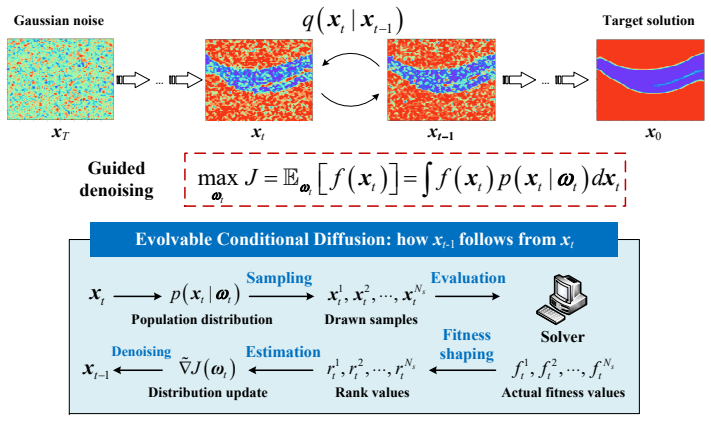
The load-bearing identity is the natural-gradient expression for expected fitness under a Gaussian population model: with $p(x_t|\omega)=\mathcal{N}(x_t;\mu_\theta,\Sigma_\theta)$, the Fisher information matrix for $\mu_\theta$ is $\Sigma_\theta^{-1}$, so $\tilde{\nabla}_{\mu_\theta}J(\omega)=\Sigma_\theta \nabla_{\mu_\theta}\mathbb{E}_\omega[f(x_t)]$. The log-likelihood trick rewrites the gradient of the expectation as an expectation involving $\nabla_{\mu_\theta}\log p(x_t|\omega)$, leading to the sample estimate $\frac{1}{N_s}\sum_i r(x_t^i)(x_t^i-\mu_\theta)$. Rank-based fitness shaping, replacing raw fitness $f$ with $r(x_t)=a+b\,\mathrm{rank}(f(x_t))$, makes the estimate invariant to order-preserving transformations of the objective and reduces sensitivity to extreme values.
What would settle it
On a task with a known fitness function, compute the correlation between $f(x_t)$ at the guidance steps used by the algorithm and $f(x_0)$ for samples from the unconditional model; if the correlation is near zero or negative while the method still reports improvement, the improvement must come from something other than the claimed evolutionary objective, and if the correlation is low the method should fail when guidance is restricted to early, high-noise steps.
Extended reading notes
Core claim
The central claim is that guidance in a diffusion model can be reformulated as an evolutionary optimization problem over the parameters $\omega=(\mu_\theta,\Sigma_\theta)$ of the denoising Gaussian, with objective $J(\omega)=\mathbb{E}_\omega[f(x_t)]$. Maximizing $J$ by a natural-gradient step yields the update $\mu_\theta^c=\mu_\theta+\alpha\tilde{\nabla}_{\mu_\theta}J(\omega)$, and when $\|\Sigma_\theta\|\to 0$ the natural gradient equals $\Sigma_\theta\nabla_{x_t}f(x_t)$, exactly the gradient-guidance update used in classifier-guided diffusion. The derivative-free version replaces the gradient with a Monte Carlo estimate $\frac{1}{N_s}\sum_i r(x_t^i)(x_t^i-\mu_\theta)$ obtained from samples drawn from the denoising distribution and their rank-shaped fitness values, so no differentiation of $f$ is ever needed. The paper demonstrates on fluidic topology and meta-surface tasks that this update lowers the target objective across all paired test samples.
Load-bearing premise
The load-bearing assumption is that evaluating the fitness function on partially denoised intermediate samples $x_t$ gives signal about the fitness of the final design $x_0$; if a solver or regressor trained only on final designs loses that signal as noise increases, the guidance update will not optimize the stated objective.
Editorial extensions
If this is right
- Pre-trained diffusion models can be steered by any evaluator, including CFD solvers, electromagnetic simulators, or laboratory measurements, without training a differentiable surrogate or computing finite differences.
- The number of solver calls per denoising step, $N_s$, and the scaling factor $\alpha$ become direct controls over the trade-off between guidance strength and computational cost.
- Because the update uses ranks rather than raw fitness values, the method is invariant to monotone rescaling of the objective, so users do not need to normalize different physics metrics before guiding generation.
- The formal correspondence to gradient guidance means insights about $\alpha$ scheduling and step-wise guidance transfer from classifier-guided diffusion to this derivative-free setting.
- Guidance strength can be applied for only a fraction of the denoising steps; the paper shows meaningful objective improvement even with guidance restricted to the last ten of one hundred steps.
Reading between the lines
- Beyond the paper: the same evolution-strategy update could be applied in latent or score-based diffusion variants, provided the transition distribution is approximately Gaussian and samples can be drawn from it.
- Beyond the paper: the method's apparent success on high-dimensional inputs suggests that the effective number of informative dimensions, not the pixel count, sets the sample complexity; this could be tested by perturbing only a subset of coordinates during guidance.
- Beyond the paper: the weakest link is whether fitness at intermediate noising levels predicts fitness of the final design; a natural extension is to anneal $N_s$ or restrict guidance to late denoising steps where samples are close to valid designs.
Signed reviews
Editorial analysis
A structured set of objections, weighed in public.
Referee Report
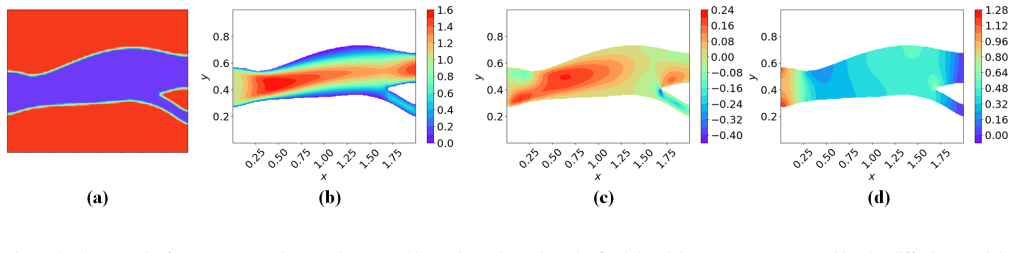
Summary. The paper proposes 'evolvable conditional diffusion,' a derivative-free guidance method for pre-trained diffusion models. The authors formulate guided denoising as maximizing an expected fitness under the Gaussian denoising distribution, derive a natural-evolution-strategy update for the denoising mean, and show that in a small-covariance limit this update resembles the standard classifier-guidance update. They validate the method on two AI-for-Science tasks: fluidic channel topology design and frequency-selective meta-surface design, using a learned regressor as a stand-in for the black-box fitness evaluator. The central claimed contribution is that black-box, non-differentiable physics solvers can guide diffusion generation without computing gradients.
Significance. If the central claim were established, the method would be a useful addition to guided diffusion: it would let pre-trained diffusion models be steered by arbitrary black-box fitness functions, which is relevant for scientific design problems where solvers are non-differentiable. The paper's derivation of the natural-gradient update is standard NES machinery and is internally consistent up to the Monte Carlo estimator; the authors also correctly note that the update itself never requires derivatives of the fitness function. However, the experimental protocol does not establish the claimed capability: fitness is evaluated on intermediate noisy samples even though the design objective is defined on final designs, and the reported success metric is computed by the same learned regressor that provides the guidance signal. These issues are load-bearing for the paper's main claim, so the current evidence is not convincing.
major comments (4)
- [Sec. 3.3, Algorithm 1, lines 4-5; Sec. 4.1 Implementation Details] Algorithm 1 evaluates the fitness f on samples drawn from N(µθ(xt), Σθ(xt)), which are intermediate denoising candidates, but the design objective f is defined only on final designs x0 (e.g., Δp obtained from CFD). The regressor used in the experiments was trained on paired (x0, Δp) data, so its outputs on partially noised images are out-of-distribution extrapolations. The paper provides no argument, theoretical or empirical, that these intermediate fitness values are meaningful for the final-design objective. Consequently, Eq. (13d) is not an estimator of the gradient of E[f(x0)] with respect to the denoising distribution, and the guidance updates in Algorithm 1 may be optimizing an objective that is different from, and unvalidated against, the stated design goal.
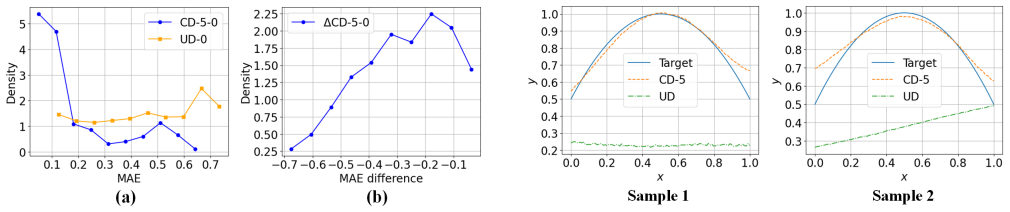
- [Sec. 4.1 and Sec. 4.2, Results] The reported performance metrics (histograms of Δp and MAE, and the per-step curves in Figures 3, 5, 6, 8, 9) are computed with the same learned regressor that supplies the guidance signal. There is no independent validation against the true CFD solver (Eq. 16) or a full-wave electromagnetic simulator on the generated designs. Because the regressor is evaluated on partially denoised, out-of-distribution inputs during the guidance process, the empirical results may reflect artifacts of the regressor rather than genuine improvement in the physical design objective. The claim that the method works with black-box non-differentiable solvers is therefore not established by the current experiments; at minimum, a subset of generated designs should be re-evaluated with the actual solver.
- [Sec. 3.1, Eq. (4); Sec. 3.3, Algorithm 1] The theoretical objective J(ω) = Eω[f(xt)] does not specify which random variable xt denotes. In Algorithm 1, the samples x_i_t are drawn from the denoising distribution for the next state xt−1, while the fitness f is ultimately a function of the final state x0. The paper never defines a time-dependent fitness, a noise-aware surrogate, or an aggregation over the remaining denoising trajectory. Without such a definition, the sequence of updates in Algorithm 1 is not a consistent optimization of the final-design objective. This is a second, theory-level manifestation of the mismatch identified above and should be resolved in the formulation itself, not only in the implementation.
- [Sec. 3.1, Proposition 1] The claimed equivalence between the derived update and the gradient-based guidance update Eq. (3) is shown in the limit ||Σθ|| → 0, but the natural-gradient formula (10) uses F^{-1} = Σθ, and the Dirac-delta step leading from Eq. (11a) to Eq. (11b) is not made rigorous. More importantly, in the actual algorithm Σθ is the learned covariance of the denoising step and is not small, so Proposition 1 does not justify the finite-covariance update as an approximation to classifier guidance. The update is a legitimate NES step, but the paper's central 'analogous to gradient-based guidance' claim requires a different argument or a precise asymptotic statement with explicit error bounds.
minor comments (6)
- [Sec. 3.3, Algorithm 1] The notation x_i_t is confusing: samples drawn from N(µθ(xt), Σθ(xt)) are candidates for xt−1, not for xt. Please rename them (e.g., x_{t-1}^{(i)}) and align the notation in Eq. (13) and Figure 1.
- [Sec. 3.2, Eq. (14)] The rank-based fitness shaping replaces f by r, which depends on the whole population of samples. The Monte Carlo estimate in Eq. (13d) is therefore not the natural gradient of J(ω) = Eω[f(xt)] as derived; the paper should state explicitly that the objective is changed to a rank-transformed fitness and discuss the consequences for the equivalence in Proposition 1.
- [Sec. 4.1, Figure 6] The label 'CD-50-0' in Figure 6 denotes α = 50 with 10-step guidance, while Figure 3 uses 'CD-5-0' for α = 5 with 50-step guidance. The naming convention is easy to confuse; a table or consistent naming scheme would help.
- [Sec. 4.1, Figure 3 caption] The phrase 'Δp is normalized by ln Δp/5' is unclear. Please specify the exact normalization formula and the reason for it.
- [Sec. 5, Discussion] The claim that the method 'eliminate[s] the need for any a priori surrogate model' is in direct tension with the experimental setup, which trains a regressor to provide the fitness evaluations. This tension should be reconciled in the text.
- [Sec. 4.2, Figure 10] The caption refers to 'predicted transmission profiles.' Please clarify whether these are regressor outputs or full-wave solver outputs; if they are regressor outputs, this limitation should be stated explicitly.
Circularity Check
Central derivation is self-contained (standard natural-evolution-strategy update); only the surrogate-based experimental validation is self-referential, with the same regressor providing both guidance and the reported metric.
-
fitted input called prediction
[Section 4.1 Implementation Details and Results; Algorithm 1 lines 4-10]
"As a proof-of-concept, a regressor was trained to provide the black-box fitness evaluation using a paired dataset comprising topology designs and their corresponding Δp."
The same regressor supplies f(·) in Algorithm 1 (line 5 evaluates f on samples from the denoising Gaussian; line 10 builds the update from those scores) and is also the source of the reported Δp histograms in the Results. The guidance update is therefore optimizing the exact function used as the evaluation metric, so the reported reduction in Δp is partly by construction. No independent CFD solver check is reported for the final designs, leaving the actual physics-based objective unvalidated. This is a validation circularity; the mathematical derivation of the update itself is independent of this self-referential evaluation.
full rationale
The paper's derivation is not circular. Eq. (4) defines J(ω)=Eω[f(xt)]; Proposition 1 computes the natural gradient for a Gaussian denoising distribution and shows the ||Σ||→0 limit recovers Σ∇xt f(xt), matching standard classifier guidance. The Monte Carlo estimator in Eq. (13) is a textbook natural-evolution-strategy / REINFORCE-type update and depends only on external, standard references (Wierstra et al. 2014; Ollivier et al. 2017; Salimans et al. 2017), not on a self-citation chain. The algorithm is not fitted to the reported results: α is user-set and the update is a maximum-likelihood-style ES step. The only load-bearing weakness is experimental: the same learned regressor is used both as the fitness function inside Algorithm 1 and as the metric in Figures 3, 6, 8-10, with no external solver verification, so the empirical improvement is partly self-fulfilling. This is a validation gap rather than a reduction of the derivation to its inputs; the central gradient-free update has independent mathematical content.
Assumptions & free parameters
free parameters (3)
- alpha (gradient scaling factor) =
1, 5, 50 in experiments
- N_s (number of samples per step) =
30
- Fitness shaping constants a and b =
not specified
assumptions (3)
- domain assumption Denoising distribution p_theta(x_{t-1} | x_t) is Gaussian with mean mu_theta and covariance Sigma_theta
- ad hoc to paper Fitness f defined on final x_0 can be evaluated on intermediate denoising samples
- standard math Rank-based Monte Carlo samples provide a valid estimate of the natural gradient
Cite this review
Pith. "Pith review of Evolvable Conditional Diffusion." pith.science (2026). https://pith.science/paper/UWZMYPV6
@misc{pith2026250613834,
  author       = {Pith},
  title        = {Pith review of: Evolvable Conditional Diffusion},
  year         = {2026},
  howpublished = {\url{https://pith.science/paper/UWZMYPV6}},
  note         = {Machine review of arXiv:2506.13834}
}
read the original abstract
This paper presents an evolvable conditional diffusion method such that black-box, non-differentiable multi-physics models, as are common in domains like computational fluid dynamics and electromagnetics, can be effectively used for guiding the generative process to facilitate autonomous scientific discovery. We formulate the guidance as an optimization problem where one optimizes for a desired fitness function through updates to the descriptive statistic for the denoising distribution, and derive an evolution-guided approach from first principles through the lens of probabilistic evolution. Interestingly, the final derived update algorithm is analogous to the update as per common gradient-based guided diffusion models, but without ever having to compute any derivatives. We validate our proposed evolvable diffusion algorithm in two AI for Science scenarios: the automated design of fluidic topology and meta-surface. Results demonstrate that this method effectively generates designs that better satisfy specific optimization objectives without reliance on differentiable proxies, providing an effective means of guidance-based diffusion that can capitalize on the wealth of black-box, non-differentiable multi-physics numerical models common across Science.
Figures

Figures from the paper (5 more)



Forward citations
Cited by 1 Pith paper
-
A Plug-and-Play Multi-Criteria Guidance for Diverse In-Betweening Human Motion Generation
MCG-IMM uses evolutionary multi-criteria optimization during sampling to increase the intra-batch diversity of in-betweening human motions generated by any pretrained model.
Reference graph
Works this paper leans on
-
[1]
D irichlet diffusion score model for biological sequence generation
Pavel Avdeyev, Chenlai Shi, Yuhao Tan, Kseniia Dudnyk, and Jian Zhou. D irichlet diffusion score model for biological sequence generation. In Proceedings of the International Conference on Machine Learning , pages 1276--1301. PMLR, 2023
work page 2023
-
[2]
Cognizant multitasking in multiobjective multifactorial evolution: MO-MFEA-II
Kavitesh Kumar Bali, Abhishek Gupta, Yew-Soon Ong, and Puay Siew Tan. Cognizant multitasking in multiobjective multifactorial evolution: MO-MFEA-II . IEEE Transactions on Cybernetics , 51(4):1784--1796, 2020
work page 2020
-
[3]
Universal guidance for diffusion models
Arpit Bansal, Hong-Min Chu, Avi Schwarzschild, Soumyadip Sengupta, Micah Goldblum, Jonas Geiping, and Tom Goldstein. Universal guidance for diffusion models. In Proceedings of the IEEE/CVF Conference on Computer Vision and Pattern Recognition , pages 843--852, 2023
work page 2023
-
[4]
An overview of diffusion models: Applications, guided generation, statistical rates and optimization
Minshuo Chen, Song Mei, Jianqing Fan, and Mengdi Wang. An overview of diffusion models: Applications, guided generation, statistical rates and optimization. arXiv preprint arXiv:2404.07771 , 2024
arXiv 2024
-
[5]
Diffusion models in vision: A survey
Florinel-Alin Croitoru, Vlad Hondru, Radu Tudor Ionescu, and Mubarak Shah. Diffusion models in vision: A survey. IEEE Transactions on Pattern Analysis and Machine Intelligence , 45(9):10850--10869, 2023
work page 2023
-
[6]
Diffusion models beat GANs on image synthesis
Prafulla Dhariwal and Alexander Nichol. Diffusion models beat GANs on image synthesis. Advances in Neural Information Processing Systems , 34:8780--8794, 2021
2021
-
[7]
Deciphering interaction fingerprints from protein molecular surfaces using geometric deep learning
Pablo Gainza, Freyr Sverrisson, Frederico Monti, Emanuele Rodola, Davide Boscaini, Michael M Bronstein, and Bruno E Correia. Deciphering interaction fingerprints from protein molecular surfaces using geometric deep learning. Nature Methods , 17(2):184--192, 2020
work page 2020
-
[8]
Big data of materials science: Critical role of the descriptor
Luca M Ghiringhelli, Jan Vybiral, Sergey V Levchenko, Claudia Draxl, and Matthias Scheffler. Big data of materials science: Critical role of the descriptor. Physical Review Letters , 114(10):105503, 2015
work page 2015
Show all 43 references
-
[9]
Half a dozen real-world applications of evolutionary multitasking, and more
Abhishek Gupta, Lei Zhou, Yew-Soon Ong, Zefeng Chen, and Yaqing Hou. Half a dozen real-world applications of evolutionary multitasking, and more. IEEE Computational Intelligence Magazine , 17(2):49--66, 2022
2022
-
[10]
Denoising diffusion probabilistic models
Jonathan Ho, Ajay Jain, and Pieter Abbeel. Denoising diffusion probabilistic models. Advances in Neural Information Processing Systems , 33:6840--6851, 2020
2020
-
[11]
Equivariant 3d-conditional diffusion model for molecular linker design
Ilia Igashov, Hannes St \"a rk, Cl \'e ment Vignac, Arne Schneuing, Victor Garcia Satorras, Pascal Frossard, Max Welling, Michael Bronstein, and Bruno Correia. Equivariant 3d-conditional diffusion model for molecular linker design. Nature Machine Intelligence , 6:417–427, 2024
2024
-
[12]
Guided- TTS : A diffusion model for text-to-speech via classifier guidance
Heeseung Kim, Sungwon Kim, and Sungroh Yoon. Guided- TTS : A diffusion model for text-to-speech via classifier guidance. In International Conference on Machine Learning , pages 11119--11133. PMLR, 2022
2022
-
[13]
Diffwave: A versatile diffusion model for audio synthesis
Zhifeng Kong, Wei Ping, Jiaji Huang, Kexin Zhao, and Bryan Catanzaro. Diffwave: A versatile diffusion model for audio synthesis. In International Conference on Learning Representations , 2021
2021
-
[14]
Evolution by adapting surrogates
Minh Nghia Le, Yew Soon Ong, Stefan Menzel, Yaochu Jin, and Bernhard Sendhoff. Evolution by adapting surrogates. Evolutionary Computation , 21(2):313--340, 2013
2013
-
[15]
The surprising creativity of digital evolution: A collection of anecdotes from the evolutionary computation and artificial life research communities
Joel Lehman, Jeff Clune, Dusan Misevic, Christoph Adami, Lee Altenberg, Julie Beaulieu, Peter J Bentley, Samuel Bernard, Guillaume Beslon, David M Bryson, et al. The surprising creativity of digital evolution: A collection of anecdotes from the evolutionary computation and art...
2020
-
[16]
Diffusion- LM improves controllable text generation
Xiang Li, John Thickstun, Ishaan Gulrajani, Percy S Liang, and Tatsunori B Hashimoto. Diffusion- LM improves controllable text generation. Advances in Neural Information Processing Systems , 35:4328--4343, 2022
2022
-
[17]
Derivative-free guidance in continuous and discrete diffusion models with soft value-based decoding
Xiner Li, Yulai Zhao, Chenyu Wang, Gabriele Scalia, Gokcen Eraslan, Surag Nair, Tommaso Biancalani, Shuiwang Ji, Aviv Regev, Sergey Levine, et al. Derivative-free guidance in continuous and discrete diffusion models with soft value-based decoding. arXiv preprint arXiv:2408.082...
2024 arXiv
-
[18]
Uncertainty-aware surrogate models for airfoil flow simulations with denoising diffusion probabilistic models
Qiang Liu and Nils Thuerey. Uncertainty-aware surrogate models for airfoil flow simulations with denoising diffusion probabilistic models. AIAA Journal , 62(8):2912--2933, 2024
2024
-
[19]
Covariance-adaptive sequential black-box optimization for diffusion targeted generation
Yueming Lyu, Kim Yong Tan, Yew Soon Ong, and Ivor Tsang. Covariance-adaptive sequential black-box optimization for diffusion targeted generation. arXiv preprint arXiv:2406.00812 , 2024
2024 arXiv
-
[20]
Diffusion models beat GANs on topology optimization
Fran c ois Maz \'e and Faez Ahmed. Diffusion models beat GANs on topology optimization. In Proceedings of the AAAI Conference on Artificial Intelligence , volume 37, pages 9108--9116, 2023
2023
-
[21]
A biological perspective on evolutionary computation
Risto Miikkulainen and Stephanie Forrest. A biological perspective on evolutionary computation. Nature Machine Intelligence , 3(1):9--15, 2021
2021
-
[22]
Information-geometric optimization algorithms: A unifying picture via invariance principles
Yann Ollivier, Ludovic Arnold, Anne Auger, and Nikolaus Hansen. Information-geometric optimization algorithms: A unifying picture via invariance principles. Journal of Machine Learning Research , 18(18):1--65, 2017
2017
-
[23]
High-resolution image synthesis with latent diffusion models
Robin Rombach, Andreas Blattmann, Dominik Lorenz, Patrick Esser, and Bj \"o rn Ommer. High-resolution image synthesis with latent diffusion models. In Proceedings of the IEEE/CVF Conference on Computer Vision and Pattern Recognition , pages 10684--10695, 2022
2022
-
[24]
Evolution strategies as a scalable alternative to reinforcement learning
Tim Salimans, Jonathan Ho, Xi Chen, Szymon Sidor, and Ilya Sutskever. Evolution strategies as a scalable alternative to reinforcement learning. arXiv preprint arXiv:1703.03864 , 2017
2017 arXiv
-
[25]
Chemistry-inspired diffusion with non-differentiable guidance
Yuchen Shen, Chenhao Zhang, Sijie Fu, Chenghui Zhou, Newell Washburn, and Barnabas Poczos. Chemistry-inspired diffusion with non-differentiable guidance. In The Thirteenth International Conference on Learning Representations , 2025
2025
-
[26]
Generative modeling by estimating gradients of the data distribution
Yang Song and Stefano Ermon. Generative modeling by estimating gradients of the data distribution. Advances in Neural Information Processing Systems , 32, 2019
2019
-
[27]
Improved techniques for training score-based generative models
Yang Song and Stefano Ermon. Improved techniques for training score-based generative models. Advances in Neural Information Processing Systems , 33:12438--12448, 2020
2020
-
[28]
Score-based generative modeling through stochastic differential equations
Yang Song, Jascha Sohl-Dickstein, Diederik P Kingma, Abhishek Kumar, Stefano Ermon, and Ben Poole. Score-based generative modeling through stochastic differential equations. arXiv preprint arXiv:2011.13456 , 2020
2011 arXiv
-
[29]
Maximum likelihood training of score-based diffusion models
Yang Song, Conor Durkan, Iain Murray, and Stefano Ermon. Maximum likelihood training of score-based diffusion models. Advances in Neural Information Processing Systems , 34:1415--1428, 2021
2021
-
[30]
Neuroevolution of physics-informed neural nets: Benchmark problems and comparative results
Nicholas Sung, Jian Cheng Wong, Chin Chun Ooi, Abhishek Gupta, Pao-Hsiung Chiu, and Yew-Soon Ong. Neuroevolution of physics-informed neural nets: Benchmark problems and comparative results. In Proceedings of the Companion Conference on Genetic and Evolutionary Computation , pa...
2023
-
[31]
An autonomous laboratory for the accelerated synthesis of novel materials
Nathan J Szymanski, Bernardus Rendy, Yuxing Fei, Rishi E Kumar, Tanjin He, David Milsted, Matthew J McDermott, Max Gallant, Ekin Dogus Cubuk, Amil Merchant, et al. An autonomous laboratory for the accelerated synthesis of novel materials. Nature , 624(7990):86--91, 2023
2023
-
[32]
Fast direct: Query-efficient online black-box guidance for diffusion-model target generation
Kim Yong Tan, Yueming Lyu, Ivor Tsang, and Yew-Soon Ong. Fast direct: Query-efficient online black-box guidance for diffusion-model target generation. In International Conference on Learning Representations , 2025
2025
-
[33]
Evolvability
Leslie G Valiant. Evolvability. Journal of the ACM , 56(1):1--21, 2009
2009
-
[34]
End-to-end diffusion latent optimization improves classifier guidance
Bram Wallace, Akash Gokul, Stefano Ermon, and Nikhil Naik. End-to-end diffusion latent optimization improves classifier guidance. In Proceedings of the IEEE/CVF International Conference on Computer Vision , pages 7280--7290, 2023
2023
-
[35]
How to select physics-informed neural networks in the absence of ground truth: A pareto front-based strategy
Zhao Wei, Jian Cheng Wong, Nicholas Sung, Abhishek Gupta, Chin Chun Ooi, Pao-Hsiung Chiu, My Ha Dao, and Yew-Soon Ong. How to select physics-informed neural networks in the absence of ground truth: A pareto front-based strategy. In 1st Workshop on the Synergy of Scientific and...
2023
-
[36]
Natural evolution strategies
Daan Wierstra, Tom Schaul, Tobias Glasmachers, Yi Sun, Jan Peters, and J \"u rgen Schmidhuber. Natural evolution strategies. The Journal of Machine Learning Research , 15(1):949--980, 2014
2014
-
[37]
LLM2FEA : Discover novel designs with generative evolutionary multitasking
Melvin Wong, Jiao Liu, Thiago Rios, Stefan Menzel, and Yew Soon Ong. LLM2FEA : Discover novel designs with generative evolutionary multitasking. arXiv preprint arXiv:2406.14917 , 2024
2024
-
[38]
Looks great, functions better: Physics compliance text-to-3 D shape generation
Qingshan Xu, Jiao Liu, Melvin Wong, Caishun Chen, and Yew-Soon Ong. Looks great, functions better: Physics compliance text-to-3 D shape generation. In International Joint Conference on Neural Networks , 2025
2025
-
[39]
Physics compliance as a metric for neural network uncertainty
Zhong Liang Ou Yang, Yang Jiang, Jian Cheng Wong, Pao-Hsiung Chiu, Weijiang Zhao, My Ha Dao, and Chin Chun Ooi. Physics compliance as a metric for neural network uncertainty. In IEEE Symposium Series on Computational Intelligence , pages 1--7, 2022
2022
-
[40]
Diffusion models: A comprehensive survey of methods and applications
Ling Yang, Zhilong Zhang, Yang Song, Shenda Hong, Runsheng Xu, Yue Zhao, Wentao Zhang, Bin Cui, and Ming-Hsuan Yang. Diffusion models: A comprehensive survey of methods and applications. ACM Computing Surveys , 56(4):1--39, 2023
2023
-
[41]
PhysDiff : Physics-guided human motion diffusion model
Ye Yuan, Jiaming Song, Umar Iqbal, Arash Vahdat, and Jan Kautz. PhysDiff : Physics-guided human motion diffusion model. In Proceedings of the IEEE/CVF International Conference on Computer Vision , pages 16010--16021, 2023
2023
-
[42]
A generative model for inorganic materials design
Claudio Zeni, Robert Pinsler, Daniel Z \"u gner, Andrew Fowler, Matthew Horton, Xiang Fu, Zilong Wang, Aliaksandra Shysheya, Jonathan Crabb \'e , Shoko Ueda, et al. A generative model for inorganic materials design. Nature , pages 1--3, 2025
2025
-
[43]
write newline
" write newline "" before.all 'output.state := FUNCTION fin.entry add.period write newline FUNCTION new.block output.state before.all = 'skip after.block 'output.state := if FUNCTION new.sentence output.state after.block = 'skip output.state before.all = 'skip after.sentence '...
Reviewed August 15, 2026 · model on record in the stance chip above.
Discussion (0). Continue with ORCID to comment.