REVIEW 4 major objections 6 minor 80 references
SEASONED: Semantic-Enhanced Self-Counterfactual Explainable Detection of Adversarial Exploiter Contracts
T0 review · 4 major / 6 minor · reviewed 2026-08-05 · deepseek-v4-flash
Pith's one-line read Operating only on compiled bytecode, SEASONED classifies adversarial DeFi exploit contracts with F1 above 0.99 and generates counterfactual explanations that isolate the core attack logic.
desk verdict Promising method and dataset, but the theoretical guarantee is unproven and the F1=0.9988 needs error bars. read the letter →
The pith
A machine-rendered reading of the paper's core claim, the machinery that carries it, and where it could break.
The reading
What carries the argument
The load-bearing object is the Semantic Relation Graph (SRG), an instruction-level graph with three edge types—control flow, data flow, and effect flow—built from bytecode via a register-transfer intermediate representation. The learning machinery is SCFED, a graph neural network with a learnable edge assignment that partitions the SRG into factual and counterfactual subgraphs, trained with four losses: a classification loss, a counterfactual loss, a sparsity loss, and a mutual-information loss following the Graph Information Bottleneck. The mutual-information term is what purportedly forces the factual subgraph embedding to carry label-relevant, implementation-invariant information.
What would settle it
Train SEASONED with and without the mutual-information term on the released dataset, then run the paper's own GIA, LFA, and PRBCD attacks plus a held-out set of new AECs; if the full model does not beat the ablated model on all three, the intrinsic-enhancement claim is falsified. Alternatively, construct a synthetic distribution where I(Z_S;Z_G) < I(Z_S;Z_G|Y) and show maximizing Eq. (22) decreases the ideal objective.
Extended reading notes
Core claim
SEASONED claims to be the first self-explainable detector for adversarial exploiter contracts. It converts compiled bytecode into a Semantic Relation Graph whose edges encode control flow, data flow, and effect flow among instructions, then uses a Self-Counterfactual Explainable Detector (SCFED) to jointly classify the graph and split it into a factual subgraph (the attack-relevant core) and a counterfactual subgraph (the benign remainder). The theoretical anchor is the Graph Information Bottleneck: SCFED trains to maximize the label-relevant mutual information of the merged graph/subgraph embedding while minimizing the mutual information between the full graph and the factual subgraph. The
Load-bearing premise
The paper's promised link between explanation training and better detection rests on an unproven inequality about how the two learned representations share information; if that condition fails, the mutual-information loss need not improve robustness, generalization, or data efficiency the way the theory claims.
Editorial extensions
If this is right
- AEC detection can move into the pending-transaction phase: contracts are flagged before deployment, when they can still be prevented from ever executing.
- Security analysts receive factual and counterfactual subgraphs per flagged contract, so review effort focuses on the attack-relevant instructions rather than thousands of bytecode nodes.
- Detectors trained this way degrade gracefully under label noise, node-injection obfuscation, and structural perturbations, addressing the main evasion strategies available to attackers.
- With roughly 50 labeled samples, the framework reaches F1 comparable to training on the full set, lowering the labeling bottleneck for new detection deployments.
- The released dataset of 359 real-world AECs gives the community a common benchmark for explainable AEC detection.
Reading between the lines
- Because SRG construction depends only on bytecode and the GIB-based training is task-agnostic, the same self-counterfactual recipe is a plausible template for other binary-only malicious-code detection problems, though the paper does not test this.
- The reported invariance to random code injection suggests SEASONED could serve as an anomaly filter that highlights which inserted code is ignored; an attacker who deliberately spreads attack logic across many interdependent contracts might defeat the single-contract graph assumption.
- A direct, untested way to sharpen the data-efficiency claim is to measure performance on AECs from attack types held out entirely (e.g., train only on reentrancy, test on oracle manipulation); the paper's Old-K% split is temporal, not attack-type-based.
Editorial analysis
A structured set of objections, weighed in public.
Referee Report
Summary. The paper proposes SEASONED, a framework for detecting Adversarial Exploiter Contracts (AECs) from compiled bytecode only. It constructs a Semantic Relation Graph (SRG) with control, data, and effect edges, and uses a Self-Counterfactual Explainable Detector (SCFED) to jointly classify the graph and produce factual/counterfactual subgraph explanations. The authors claim that, guided by the Graph Information Bottleneck (GIB), the explanation mechanism improves detection robustness, generalizability, and data efficiency. They report an F1 of 0.9988 on a new dataset of 359 AECs, compare against AECD baselines, GNN variants, and post-hoc explainers, and provide ablations, robustness tests, and a case study.
Significance. If the claims hold, the work makes a useful practical contribution: it is the first self-explaining detector specifically for AECs, operates pre-deployment on bytecode, and releases a dataset and code. The SRG representation and the coupling of explanations with training are promising ideas for interpretable DeFi security. The paper's strengths are its concrete experimental design, multiple baseline categories, ablations, and a public artifact. However, the central theoretical justification is flawed, and the near-perfect empirical results need stronger statistical support before the headline claims can be accepted.
major comments (4)
- [Section IV-B3, Theorem 1 and Eq. (25)] The proof of Theorem 1 is invalid as stated. The step from I(Z_G;Y)+I(Z_S;Y|Z_G)-I(Z_S;Z_G) to I(Z_G;Y)+I(Z_S;Y|Z_G)-I(Z_S;Z_G|Y) in Eq. (25) uses the inequality I(Z_S;Z_G) >= I(Z_S;Z_G|Y). This condition is not stated, does not follow from linearity of ψ, and fails in general; for example, if Z_S and Z_G are independent Bernoulli(1/2) and Y = Z_S XOR Z_G, then I(Z_S;Z_G)=0 while I(Z_S;Z_G|Y)=1. Even if Eq. (22) were a lower bound of Eq. (21), maximizing a lower bound does not imply maximizing the original objective. Since the paper's claim that explanation-based training 'intrinsically improves' robustness, generalizability, and data efficiency rests on this theorem, the theoretical foundation is not established. The authors should either prove Eq. (25) under explicit and plausible conditions, or substantially weaken the theoretical claim to a heuristic/empirical statement.
- [Section V-A and V-B, Table I] The headline F1 of 0.9988 is reported from 10-fold cross-validation on a small dataset of 359 AECs and 1196 benign contracts, with no confidence intervals, no per-fold standard deviation, and no mention of de-duplication. Given the very small positive class and the near-perfect scores, the result may be inflated by duplicate or near-duplicate contracts (e.g., multiple AECs derived from the same exploit template) or by leakage between folds. Please report per-fold metrics with confidence intervals, verify that no bytecode-identical or near-identical contracts appear in both training and test folds, and provide a statistical significance test comparing SEASONED with RGCN+SRG (F1 0.9901 vs 0.9988). Without this, the claimed state-of-the-art advantage is not conclusively established.
- [Section V-F/b, Table VII] The causal claim that 'extracting representative information from explanations' improves robustness, generalizability, and data efficiency is not uniquely identified by the current ablations. SEASONED differs from RGCN not only in using the factual subgraph S, but also in the additional losses L_CF, L_SP, L_MI and in the merged representation Z_M = ψ(Z_G, Z_S). Removing L_MI changes the representation learning objective independently of explanation generation. To support the attribution, add a control experiment that uses the same total loss but replaces S with a random or constant subgraph, or otherwise isolates the information contributed by the explanation mechanism. The current comparison to RGCN is confounded.
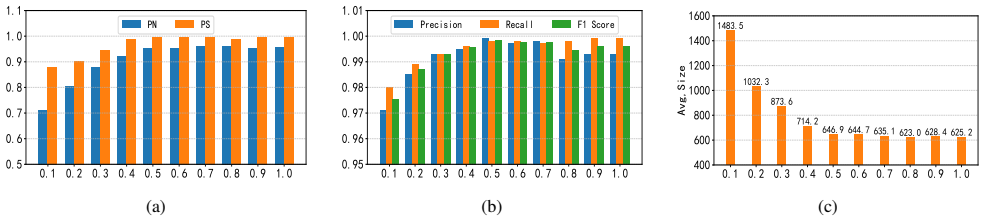
- [Section V-B/b, explanation evaluation] The PN/PS metrics are computed using the model's own predictions, so they measure self-consistency of the explanation mechanism rather than whether the explanations correspond to actual attack logic. The only external validation is the single Harvest Finance proof-of-concept case study. For the claim that SCFED 'highlights the core attack logic,' please add an evaluation against ground-truth attack-relevant code segments for a larger sample of AECs, or a human study, to rule out that explanations are merely internally coherent but semantically incorrect.
minor comments (6)
- [Eq. (8)] The sampling distribution described is a Gumbel-Softmax / Concrete relaxation, not the Gumbel-Max trick. The terminology should be corrected.
- [Eq. (27)] The text uses 'I(h_M;Y)' but h_M is not defined; it should be I(Z_M;Y).
- [Table II] The row for CF2 is difficult to parse: '0.961.0571.8' should be formatted as separate columns. Also, the table caption says 'SEASONED w/oL CF' missing a space.
- [Fig. 5] The y-axis label contains a typo: 'percision' should be 'precision'.
- [Fig. 8] The axis labels in Fig. 8 contain garbled Unicode artifacts (e.g., '/uni00000013/...'), making the figure unreadable in the submitted version.
- [References [69] and Section II-B] The claim that 'a recent study [69] documented 149 attack incidents... $1.42 billion in 2024' is attributed to OWASP, but the reference appears to be the OWASP Top 10 for smart contracts. Please verify this citation and source for the statistic.
Circularity Check
Explanation-quality PN/PS partly reduce to the L_CF training objective; detection and generalization results are external, and the GIB theorem has a non-circular proof gap.
-
fitted input called prediction
[Sec. IV-B1, Eq. (13); Sec. V-B, Table II]
"According to the property of counterfactual explanation, the counterfactual loss L_CF is: LCF = (1−y) log(1+PS +PR)−ylog (1 + PS −P R) 2 .(13) The first term of L_CF ensures the predictions of both S and R are benign when the ground truth is benign (i.e., y = 0). The second term ensures the prediction of S is malicious while the prediction of R is benign when y = 1."
Table II reports SEASONED's PN/PS (1.0 / 0.96) as evidence of explanation quality. But PN/PS are computed from the same model's outputs P_S and P_R, and Eq. (13) directly optimizes exactly those quantities: for y=1 it maximizes P_S−P_R, and for y=0 it drives both P_S and P_R toward 0. Thus the near-perfect PN/PS values are partly a measure of how well the model was fitted to L_CF, not an independent confirmation that the factual subgraph isolates attack logic. The manual case study in Sec. V-G provides external validation and mitigates this, so the circularity is partial.
full rationale
SEASONED's headline detection claim (F1>0.99) is evaluated against an external, independently labeled set of real AECs drawn from DefiLlama, rekt, SlowMist, Neptune Mutual, and ChainSec, with temporal splits and perturbation attacks; that part is not circular. The main circularity concern is the explanation-quality evaluation: PN/PS are computed from SCFED's own P_S/P_R, and Eq. (13) trains exactly those quantities to satisfy the counterfactual property being measured. Table II's near-perfect PN/PS is therefore partly a measure of fit to L_CF. This is mitigated by the manual Harvest case study, which shows factual-subgraph coverage of 1,016 manually labeled attack nodes, so the explanation claim is not wholly by construction. I also flag a non-circular but load-bearing proof gap: in Sec. IV-B3, Eq. (25), the proof of Theorem 1 silently assumes I(Z_S;Z_G) >= I(Z_S;Z_G|Y), which is not generally true (e.g., Y = Z_S xor Z_G gives 0 >= 1); hence the claimed equivalence between Eq. (22) and Eq. (21) is not established, and the theoretical basis for 'intrinsic' robustness/generalizability/data-efficiency enhancement is incomplete. No self-citation chain or imported uniqueness theorem is present. Overall score 4: one evaluation claim is partially self-referential, while the core detection and generalization/robustness results retain independent external content.
Assumptions & free parameters
free parameters (2)
- Loss weights α, β, γ and sampling threshold ρ =
α=0.5, β=0.5, γ=0.1, ρ=0.5
- Gumbel temperature τ (Eq. 8) =
not specified
assumptions (4)
- domain assumption EVM bytecode is faithfully converted to RTL by Vandal, and the control/data/effect relations fully capture the semantics relevant to AEC behavior.
- domain assumption The dataset labels from DefiLlama, rekt, SlowMist, Neptune Mutual, and ChainSec are correct, and the Forta benign set contains no AECs.
- ad hoc to paper I(Z_S;Z_G) >= I(Z_S;Z_G|Y) holds for the learned embeddings.
- standard math The chain rule and data-processing inequality for mutual information apply to the learned representations.
invented entities (1)
-
Semantic Relation Graph (SRG) with control, data, and effect edges
Cite this review
Pith. "Pith review of SEASONED: Semantic-Enhanced Self-Counterfactual Explainable Detection of Adversarial Exploiter Contracts." pith.science (2026). https://pith.science/paper/UXOQFXQX
@misc{pith2026250905681,
  author       = {Pith},
  title        = {Pith review of: SEASONED: Semantic-Enhanced Self-Counterfactual Explainable Detection of Adversarial Exploiter Contracts},
  year         = {2026},
  howpublished = {\url{https://pith.science/paper/UXOQFXQX}},
  note         = {Machine review of arXiv:2509.05681}
}
read the original abstract
Decentralized Finance (DeFi) attacks have resulted in significant losses, often orchestrated through Adversarial Exploiter Contracts (AECs) that exploit vulnerabilities in victim smart contracts. To proactively identify such threats, this paper targets the explainable detection of AECs. Existing detection methods struggle to capture semantic dependencies and lack interpretability, limiting their effectiveness and leaving critical knowledge gaps in AEC analysis. To address these challenges, we introduce SEASONED, an effective, self-explanatory, and robust framework for AEC detection. SEASONED extracts semantic information from contract bytecode to construct a semantic relation graph (SRG), and employs a self-counterfactual explainable detector (SCFED) to classify SRGs and generate explanations that highlight the core attack logic. SCFED further enhances robustness, generalizability, and data efficiency by extracting representative information from these explanations. Both theoretical analysis and experimental results demonstrate the effectiveness of SEASONED, which showcases outstanding detection performance, robustness, generalizability, and data efficiency learning ability. To support further research, we also release a new dataset of 359 AECs.
Figures


Figures from the paper (5 more)


Reference graph
Works this paper leans on
-
[1]
Complexity results for nonmonotonic logics,
G. Gottlob, “Complexity results for nonmonotonic logics,”Journal of Logic and Computation, vol. 2, no. 3, pp. 397–425, June 1992
work page 1992
-
[2]
Modeling relational data with graph convolutional networks,
M. Schlichtkrull, T. N. Kipf, P. Bloem, R. Van Den Berg, I. Titov, and M. Welling, “Modeling relational data with graph convolutional networks,” inThe semantic web: 15th international conference, ESWC 2018, Heraklion, Crete, Greece, June 3–7, 2018, proceedings 15. Springer, 2018, pp. 593–607
work page 2018
-
[3]
Smart Contract and DeFi Security Tools: Do They Meet the Needs of Practitioners?
S. Chaliasos, M. A. Charalambous, L. Zhou, R. Galanopoulou, A. Gervais, D. Mitropoulos, and B. Livshits, “Smart Contract and DeFi Security Tools: Do They Meet the Needs of Practitioners?” inProceedings of the 46th IEEE/ACM International Conference on Software Engineering, ser. ICSE ’24. New York, NY , USA: Association for Computing Machinery, Feb. 2024, p...
-
[4]
SoK: Decentralized Finance (DeFi) Attacks,
L. Zhou, X. Xiong, J. Ernstberger, S. Chaliasos, Z. Wang, Y . Wang, K. Qin, R. Wattenhofer, D. Song, and A. Gervais, “SoK: Decentralized Finance (DeFi) Attacks,” in2023 IEEE Symposium on Security and Privacy (SP), May 2023, pp. 2444–2461, iSSN: 2375-1207. [Online]. Available: https://ieeexplore.ieee.org/abstract/document/10179435
-
[5]
Gigahorse: Thorough, Declarative Decompilation of Smart Contracts,
N. Grech, L. Brent, B. Scholz, and Y . Smaragdakis, “Gigahorse: Thorough, Declarative Decompilation of Smart Contracts,” in2019 IEEE/ACM 41st International Conference on Software Engineering (ICSE). Montreal, QC, Canada: IEEE, May 2019, pp. 1176–1186. [Online]. Available: https://ieeexplore.ieee.org/document/8811905/
-
[6]
Smart contract vulnerabilities: Vulnera- ble does not imply exploited,
D. Perez and B. Livshits, “Smart contract vulnerabilities: Vulnera- ble does not imply exploited,” in30th USENIX Security Symposium (USENIX Security 21), 2021, pp. 1325–1341
work page 2021
-
[7]
MANDO-HGT: Heterogeneous Graph Transformers for Smart Contract Vulnerability Detection,
H. H. Nguyen, N.-M. Nguyen, C. Xie, Z. Ahmadi, D. Kudendo, T.-N. Doan, and L. Jiang, “MANDO-HGT: Heterogeneous Graph Transformers for Smart Contract Vulnerability Detection,” in2023 IEEE/ACM 20th International Conference on Mining Software Repositories (MSR), May 2023, pp. 334–346, iSSN: 2574-3864. [Online]. Available: https://ieeexplore.ieee.org/document...
-
[8]
Vandal: A Scalable Security Analysis Framework for Smart Contracts,
L. Brent, A. Jurisevic, M. Kong, E. Liu, F. Gauthier, V . Gramoli, R. Holz, and B. Scholz, “Vandal: A Scalable Security Analysis Framework for Smart Contracts,” Sep. 2018, arXiv:1809.03981 [cs]. [Online]. Available: http://arxiv.org/abs/1809.03981
arXiv 2018
Show all 80 references
-
[9]
Phishing scam detec- tion on ethereum: Towards financial security for blockchain ecosystem
W. Chen, X. Guo, Z. Chen, Z. Zheng, and Y . Lu, “Phishing scam detec- tion on ethereum: Towards financial security for blockchain ecosystem.” inIJCAI, vol. 7, 2020, pp. 4456–4462
2020
-
[10]
Siege: Self-supervised in- cremental deep graph learning for ethereum phishing scam detection,
S. Li, R. Wang, H. Wu, S. Zhong, and F. Xu, “Siege: Self-supervised in- cremental deep graph learning for ethereum phishing scam detection,” in Proceedings of the 31st ACM International Conference on Multimedia, 2023, pp. 8881–8890
2023
-
[11]
Forsage: Anatomy of a smart-contract pyramid scheme,
T. Kell, H. Yousaf, S. Allen, S. Meiklejohn, and A. Juels, “Forsage: Anatomy of a smart-contract pyramid scheme,” inInternational Confer- ence on Financial Cryptography and Data Security. Springer, 2023, pp. 241–258
2023
-
[12]
The art of the scam: Demystifying honeypots in ethereum smart contracts,
C. F. Torres, M. Steichenet al., “The art of the scam: Demystifying honeypots in ethereum smart contracts,” in28th USENIX Security Symposium (USENIX Security 19), 2019, pp. 1591–1607
2019
-
[13]
Towards understanding crypto-asset risks on ethereum caused by key leakage on the internet,
Y . Zhou, J. Chen, Y . Wang, Y . Tang, and G. Gu, “Towards understanding crypto-asset risks on ethereum caused by key leakage on the internet,” inCompanion Proceedings of the ACM on Web Conference 2024, 2024, pp. 875–878
2024
-
[14]
How forta’s predictive ml models de- tect attacks before exploitation,
Forta, “How forta’s predictive ml models de- tect attacks before exploitation,” 2023, accessed: [Jan 17, 2025]. [Online]. Available: https://www.forta.org/blog/ how-fortas-predictive-ml-models-detect-attacks-before-exploitation
2023
-
[15]
Lookahead: Preventing defi attacks via unveiling adversarial contracts,
S. Ren, L. He, T. Tu, D. Wu, J. Liu, K. Ren, and C. Chen, “Lookahead: Preventing defi attacks via unveiling adversarial contracts,” 2024. [Online]. Available: https://arxiv.org/abs/2401.07261
2024 arXiv
-
[16]
Skyeye: Detecting imminent attacks via analyzing adversarial smart contracts,
H. Wang, Y . Hu, H. Wu, D. Liu, C. Peng, Y . Wu, M. Fan, and T. Liu, “Skyeye: Detecting imminent attacks via analyzing adversarial smart contracts,” inProceedings of the 39th IEEE/ACM International Conference on Automated Software Engineering (ASE), 2024, pp. 1570– 1582
2024
-
[17]
Uncover the premeditated attacks: Detecting exploitable reentrancy vulnerabilities by identifying attacker contracts,
S. Yang, J. Chen, M. Huang, Z. Zheng, and Y . Huang, “Uncover the premeditated attacks: Detecting exploitable reentrancy vulnerabilities by identifying attacker contracts,” inProceedings of the IEEE/ACM 46th International Conference on Software Engineering, 2024, pp. 1–12
2024
-
[18]
Smart contract vulnerability detection using graph neural networks,
Y . Zhuang, Z. Liu, P. Qian, Q. Liu, X. Wang, and Q. He, “Smart contract vulnerability detection using graph neural networks,” inProceedings of the Twenty-Ninth International Joint Conferences on Artificial Intelli- gence (IJCAI), 2020, pp. 3283–3290
2020
-
[19]
Smart contract vulnerability detection: from pure neural network to interpretable graph feature and expert pattern fusion,
Z. Liu, P. Qian, X. Wang, L. Zhu, Q. He, and S. Ji, “Smart contract vulnerability detection: from pure neural network to interpretable graph feature and expert pattern fusion,” inProceedings of the Thirtieth International Joint Conference on Artificial Intelligence (IJCAI), 2021
2021
-
[20]
Eth2vec: learn- ing contract-wide code representations for vulnerability detection on ethereum smart contracts,
N. Ashizawa, N. Yanai, J. P. Cruz, and S. Okamura, “Eth2vec: learn- ing contract-wide code representations for vulnerability detection on ethereum smart contracts,” inProceedings of the 3rd ACM international symposium on blockchain and secure critical infrastructure, 2021, pp. 47–59
2021
-
[21]
Smartinv: Multimodal learning for smart contract invariant inference,
S. J. Wang, K. Pei, and J. Yang, “Smartinv: Multimodal learning for smart contract invariant inference,” in2024 IEEE Symposium on Security and Privacy (SP). IEEE Computer Society, 2024, pp. 126–126
2024
-
[22]
Sailfish: Vetting smart contract state-inconsistency bugs in seconds,
P. Bose, D. Das, Y . Chen, Y . Feng, C. Kruegel, and G. Vigna, “Sailfish: Vetting smart contract state-inconsistency bugs in seconds,” in2022 IEEE Symposium on Security and Privacy (SP). IEEE, 2022, pp. 161– 178
2022
-
[23]
Smartian: Enhancing smart contract fuzzing with static and dynamic data-flow analyses,
J. Choi, D. Kim, S. Kim, G. Grieco, A. Groce, and S. K. Cha, “Smartian: Enhancing smart contract fuzzing with static and dynamic data-flow analyses,” in2021 36th IEEE/ACM International Conference on Automated Software Engineering (ASE). IEEE, 2021, pp. 227–239
2021
-
[24]
Smartpulse: automated checking of temporal properties in smart contracts,
J. Stephens, K. Ferles, B. Mariano, S. Lahiri, and I. Dillig, “Smartpulse: automated checking of temporal properties in smart contracts,” in2021 IEEE Symposium on Security and Privacy (SP). IEEE, 2021, pp. 555– 571
2021
-
[25]
Pomabuster: Detecting price oracle manipulation attacks in decentralized finance,
R. Xi, Z. Wang, and K. Pattabiraman, “Pomabuster: Detecting price oracle manipulation attacks in decentralized finance,” in2024 IEEE Symposium on Security and Privacy (SP). IEEE Computer Society, 2024, pp. 240–240
2024
-
[26]
Bitcoin: A peer-to-peer electronic cash system,
S. Nakamoto, “Bitcoin: A peer-to-peer electronic cash system,”Satoshi Nakamoto, 2008
2008
-
[27]
Crypto losses reach $3 billion in 2024: Peckshield,
Peckshield, “Crypto losses reach $3 billion in 2024: Peckshield,” 2024, accessed: [Jan 18, 2025. [Online]. Available: https://decrypt.co/300204/ crypto-losses-3-billion-2024-peckshield
2024
-
[28]
Defillama hack database,
DefiLlama, “Defillama hack database,” 2023. [Online]. Available: https://defillama.com/hacks
2023
-
[29]
rekt news,
J. Bouteloup, “rekt news,” 2023. [Online]. Available: https://rekt.news/
2023
-
[30]
Slowmist hack database,
SlowMist, “Slowmist hack database,” 2023. [Online]. Available: https://hacked.slowmist.io/
2023
-
[31]
Defi and cryptocurrency hacks,
M. Neptune, “Defi and cryptocurrency hacks,” 2023. [Online]. Available: https://neptunemutual.com/hack-database/
2023
-
[32]
Documented timeline of defi exploits,
ChainSec, “Documented timeline of defi exploits,” 2023. [Online]. Available: https://chainsec.io/defi-hacks/
2023
-
[33]
Defi hack analysis poc,
A. Sami, “Defi hack analysis poc,” https://github.com/abdulsamijay/ Defi-Hack-Analysis-POC, 2023
2023
-
[34]
The dao,
Wikipedia, “The dao,” https://en.wikipedia.org/wiki/The DAO, 2016
2016
-
[35]
Explained: The inverse finance hack (june 2022),
R. Behnke, “Explained: The inverse finance hack (june 2022),” https://www.halborn.com/blog/post/ explained-the-inverse-finance-hack-june-2022, June 2022
2022
-
[36]
Harvest finance rekt,
R. News, “Harvest finance rekt,” https://rekt.news/harvest-finance-rekt/, 2023
2023
-
[37]
How was abracadabra money exploited?
M. Neptune, “How was abracadabra money exploited?” https: //neptunemutual.com/blog/how-was-abracadabra-money-exploited/, 2023
2023
-
[38]
Explained: The xcarnival hack ((june 2022)),
R. Behnke, “Explained: The xcarnival hack ((june 2022)),” https: //www.halborn.com/blog/post/explained-the-xcarnival-hack-june-2022, June 2022
2022
-
[39]
Making smart contracts smarter,
L. Luu, D.-H. Chu, H. Olickel, P. Saxena, and A. Hobor, “Making smart contracts smarter,” inProceedings of the 2016 ACM SIGSAC Conference on Computer and Communications Security (CCS). ACM, 2016, pp. 254–269
2016
-
[40]
Securify: Practical security analysis of smart contracts,
P. Tsankov, A. Dan, D. Drachsler-Cohen, A. Gervais, F. Buenzli, and M. Vechev, “Securify: Practical security analysis of smart contracts,” in Proceedings of the 2018 ACM SIGSAC Conference on Computer and Communications Security (CCS). ACM, 2018, pp. 67–82
2018
-
[41]
Cross-contract static analysis for detecting practical reentrancy vulnerabilities in smart con- tracts,
Y . Xue, M. Ma, Y . Lin, Y . Sui, J. Ye, and T. Peng, “Cross-contract static analysis for detecting practical reentrancy vulnerabilities in smart con- tracts,” inProceedings of the 35th IEEE/ACM International Conference on Automated Software Engineering (ASE), 2020, pp. 1029–1040
2020
-
[42]
Smartest: Effectively hunting vulnerable transaction sequences in smart contracts through language model-guided symbolic execution,
S. So, S. Hong, and H. Oh, “Smartest: Effectively hunting vulnerable transaction sequences in smart contracts through language model-guided symbolic execution,” inProceedings of the 30th USENIX Conference on Security Symposium, 2021, pp. 1361–1378
2021
-
[43]
Park: Accelerating smart contract vulnerability detection via parallel-fork symbolic execution,
P. Zheng, Z. Zheng, and X. Luo, “Park: Accelerating smart contract vulnerability detection via parallel-fork symbolic execution,” inProceed- ings of the 31st ACM SIGSOFT International Symposium on Software Testing and Analysis (ISSTA), 2022, pp. 740–751
2022
-
[44]
Contractfuzzer: Fuzzing smart con- tracts for vulnerability detection,
B. Jiang, Y . Liu, and W. K. Chan, “Contractfuzzer: Fuzzing smart con- tracts for vulnerability detection,” inProceedings of the 33rd ACM/IEEE International Conference on Automated Software Engineering (ASE), 2018, pp. 259–269
2018
-
[45]
Echidna: Effective, usable, and fast fuzzing for smart contracts,
G. Grieco, W. Song, A. Cygan, J. Feist, and A. Groce, “Echidna: Effective, usable, and fast fuzzing for smart contracts,” inProceedings of the 29th ACM SIGSOFT International Symposium on Software Testing and Analysis (ISSTA), 2020, pp. 557–560
2020
-
[46]
sfuzz: An efficient adaptive fuzzer for solidity smart contracts,
T. D. Nguyen, L. H. Pham, J. Sun, Y . Lin, and Q. T. Minh, “sfuzz: An efficient adaptive fuzzer for solidity smart contracts,” inProceedings of the ACM/IEEE 42nd International Conference on Software Engineering (ICSE), 2020, pp. 778–788
2020
-
[47]
An ever-evolving game: Evaluation of real-world attacks and defenses in ethereum ecosystem,
S. Zhou, Z. Yang, J. Xiang, Y . Cao, M. Yang, and Y . Zhang, “An ever-evolving game: Evaluation of real-world attacks and defenses in ethereum ecosystem,” inProceedings of the 29th USENIX Conference on Security Symposium, 2020, pp. 2793–2809
2020
-
[48]
Soda: A generic online detection framework for smart contracts,
T. Chen, R. Cao, T. Li, X. Luo, G. Gu, Y . Zhang, Z. Liao, H. Zhu, G. Chen, Z. Heet al., “Soda: A generic online detection framework for smart contracts,” inNetwork and Distributed System Security Symposium (NDSS), 2020, pp. 1–17
2020
-
[49]
Txspector: Uncovering attacks in ethereum from transactions,
M. Zhang, X. Zhang, Y . Zhang, and Z. Lin, “Txspector: Uncovering attacks in ethereum from transactions,” inProceedings of the 29th USENIX Conference on Security Symposium, 2020, pp. 2775–2792
2020
-
[50]
Evil under the sun: Understanding and discovering attacks on ethereum decentralized applications,
L. Su, X. Shen, X. Du, X. Liao, X. Wang, L. Xing, and B. Liu, “Evil under the sun: Understanding and discovering attacks on ethereum decentralized applications,” inProceedings of the 30th USENIX Confer- ence on Security Symposium, 2021, pp. 1307–1324
2021
-
[51]
The eye of horus: Spotting and analyzing attacks on ethereum smart contracts,
C. Ferreira Torres, A. K. Iannillo, A. Gervais, and R. State, “The eye of horus: Spotting and analyzing attacks on ethereum smart contracts,” in25th International Conference on Financial Cryptography and Data Security (FC), 2021, pp. 33–52
2021
-
[52]
Time-travel investigation: Toward building a scalable attack detection framework on ethereum,
S. Wu, L. Wu, Y . Zhou, R. Li, Z. Wang, X. Luo, C. Wang, and K. Ren, “Time-travel investigation: Toward building a scalable attack detection framework on ethereum,”ACM Transactions on Software Engineering and Methodology (TOSEM), vol. 31, no. 3, pp. 1–33, 2022
2022
-
[53]
Reentrancy vulnerability detection and localization: A deep learning based two-phase approach,
Z. Zhang, Y . Lei, M. Yan, Y . Yu, J. Chen, S. Wang, and X. Mao, “Reentrancy vulnerability detection and localization: A deep learning based two-phase approach,” in37th IEEE/ACM International Conference on Automated Software Engineering (ASE), 2022, pp. 1–13
2022
-
[54]
Smarter contracts: Detecting vulnerabilities in smart contracts with deep transfer learning,
C. Sendner, H. Chen, H. Fereidooni, L. Petzi, J. K ¨onig, J. Stang, A. Dmitrienko, A.-R. Sadeghi, and F. Koushanfar, “Smarter contracts: Detecting vulnerabilities in smart contracts with deep transfer learning,” inNetwork and Distributed System Security Symposium (NDSS), 2023,...
2023
-
[55]
Gptscan: Detecting logic vulnerabilities in smart contracts by combining gpt with program analysis,
Y . Sun, D. Wu, Y . Xue, H. Liu, H. Wang, Z. Xu, X. Xie, and Y . Liu, “Gptscan: Detecting logic vulnerabilities in smart contracts by combining gpt with program analysis,” in2024 IEEE/ACM 46th International Conference on Software Engineering (ICSE). IEEE, 2024
2024
-
[56]
Learning to fuzz from symbolic execution with application to smart contracts,
J. He, M. Balunovi ´c, N. Ambroladze, P. Tsankov, and M. Vechev, “Learning to fuzz from symbolic execution with application to smart contracts,” inProceedings of the 2019 ACM SIGSAC Conference on Computer and Communications Security (CCS). ACM, 2019, pp. 531– 548
2019
-
[57]
Code is not natural language: Unlock the power of semantics- oriented graph representation for binary code similarity detection,
H. He, X. Lin, Z. Weng, R. Zhao, S. Gan, L. Chen, Y . Ji, J. Wang, and Z. Xue, “Code is not natural language: Unlock the power of semantics- oriented graph representation for binary code similarity detection,” in 33rd USENIX Security Symposium (USENIX Security 24), PHILADEL- P...
2024
-
[58]
Mutual information neural estimation
B. Mohamed, Ishmael, B. Aristide, R. Sai, O. Sherjil, B. Yoshua, H. R., Devon, and C. Aaron, C., “Mutual information neural estimation.” in Proceedings of International Conference on Machine Learning, vol. 80, 2018, p. 530–539
2018
-
[59]
Rethinking the impact of noisy labels in graph classification: A utility and privacy perspective,
X. Li, Z. Gan, Q. Li, B. Qu, J. Wanget al., “Rethinking the impact of noisy labels in graph classification: A utility and privacy perspective,” Neural Networks, vol. 182, p. 106919, 2025
2025
-
[60]
Omg: Towards effective graph classification against label noise,
N. Yin, L. Shen, M. Wang, X. Luo, Z. Luo, and D. Tao, “Omg: Towards effective graph classification against label noise,”IEEE Transactions on Knowledge and Data Engineering, vol. 35, no. 12, pp. 12 873–12 886, 2023
2023
-
[61]
Robustness of graph neural networks at scale,
S. Geisler, T. Schmidt, H. S ¸irin, D. Z ¨ugner, A. Bojchevski, and S. G ¨unnemann, “Robustness of graph neural networks at scale,”Ad- vances in Neural Information Processing Systems, vol. 34, pp. 7637– 7649, 2021
2021
-
[62]
Learning and evaluating graph neural network explanations based on counterfactual and factual reasoning,
J. Tan, S. Geng, Z. Fu, Y . Ge, S. Xu, Y . Li, and Y . Zhang, “Learning and evaluating graph neural network explanations based on counterfactual and factual reasoning,” inProceedings of the ACM web conference 2022, 2022, pp. 1018–1027
2022
-
[63]
On the probability of necessity and sufficiency of explaining graph neural networks: A lower bound optimization approach,
R. Cai, Y . Zhu, X. Chen, Y . Fang, M. Wu, J. Qiao, and Z. Hao, “On the probability of necessity and sufficiency of explaining graph neural networks: A lower bound optimization approach,”Neural Networks, vol. 184, p. 107065, 2025
2025
-
[64]
Gnnex- plainer: Generating explanations for graph neural networks,
Z. Ying, D. Bourgeois, J. You, M. Zitnik, and J. Leskovec, “Gnnex- plainer: Generating explanations for graph neural networks,”Advances in neural information processing systems, vol. 32, 2019
2019
-
[65]
Parameterized explainer for graph neural network,
D. Luo, W. Cheng, D. Xu, W. Yu, B. Zong, H. Chen, and X. Zhang, “Parameterized explainer for graph neural network,”Advances in neural information processing systems, vol. 33, pp. 19 620–19 631, 2020
2020
-
[66]
Semi-supervised classification with graph convolutional networks,
T. N. Kipf and M. Welling, “Semi-supervised classification with graph convolutional networks,”International Conference on Learning Repre- sentations (ICLR), 2017
2017
-
[67]
Graph attention networks,
P. Velickovic, G. Cucurull, A. Casanova, A. Romero, P. Lio, and Y . Bengio, “Graph attention networks,”stat, vol. 1050, p. 20, 2017
2017
-
[68]
How powerful are graph neural networks?
K. Xu, W. Hu, J. Leskovec, and S. Jegelka, “How powerful are graph neural networks?” inInternational Conference on Learning Represen- tations, 2018
2018
-
[69]
Owasp top 10 2025 for smart con- tracts,
OW ASP, “Owasp top 10 2025 for smart con- tracts,” 2025. [Online]. Available: https://cybersecuritynews.com/ owasp-top-10-2025-smart-contract/#google vignette
2025
-
[70]
Graph information bottle- neck,
T. Wu, H. Ren, P. Li, and J. Leskovec, “Graph information bottle- neck,”Advances in Neural Information Processing Systems, vol. 33, pp. 20 437–20 448, 2020
2020
-
[71]
Adversarial graph augmen- tation to improve graph contrastive learning,
S. Suresh, P. Li, C. Hao, and J. Neville, “Adversarial graph augmen- tation to improve graph contrastive learning,” inAdvances in Neural Information Processing Systems, 2021
2021
-
[72]
The concrete distribution: A continuous relaxation of discrete random variables,
C. J. Maddison, A. Mnih, and Y . W. Teh, “The concrete distribution: A continuous relaxation of discrete random variables,” inInternational Conference on Learning Representations, 2017
2017
-
[73]
Categorical reparametrization with gumble-softmax,
E. Jang, S. Gu, and B. Poole, “Categorical reparametrization with gumble-softmax,” inInternational Conference on Learning Represen- tations (ICLR 2017). OpenReview. net, 2017
2017
-
[74]
Reinforcement learning enhanced explainer for graph neural networks,
C. Shan, Y . Shen, Y . Zhang, X. Li, and D. Li, “Reinforcement learning enhanced explainer for graph neural networks,”Advances in Neural Information Processing Systems, vol. 34, pp. 22 523–22 533, 2021
2021
-
[75]
Towards self-explainable graph neural network,
E. Dai and S. Wang, “Towards self-explainable graph neural network,” inProceedings of the 30th ACM international conference on information & knowledge management, 2021, pp. 302–311
2021
-
[76]
Protgnn: Towards self-explaining graph neural networks,
Z. Zhang, Q. Liu, H. Wang, C. Lu, and C. Lee, “Protgnn: Towards self-explaining graph neural networks,” inProceedings of the AAAI conference on artificial intelligence, vol. 36, 2022, pp. 9127–9135
2022
-
[77]
Self-interpretable graph learning with sufficient and necessary explanations,
J. Deng and Y . Shen, “Self-interpretable graph learning with sufficient and necessary explanations,” inProceedings of the AAAI Conference on Artificial Intelligence, vol. 38, 2024, pp. 11 749–11 756
2024
-
[78]
Cost-sensitive gnn-based imbalanced learning for mobile social network fraud detection,
X. Hu, H. Chen, H. Chen, S. Liu, X. Li, S. Zhang, Y . Wang, and X. Xue, “Cost-sensitive gnn-based imbalanced learning for mobile social network fraud detection,”IEEE Transactions on Computational Social Systems, 2023
2023
-
[79]
Hi-gnn: hierarchical interactive graph neural networks for auxiliary information-enhanced recommendation,
X. Zhang and M. Gan, “Hi-gnn: hierarchical interactive graph neural networks for auxiliary information-enhanced recommendation,”Knowl- edge and Information Systems, vol. 66, no. 1, pp. 115–145, 2024
2024
-
[80]
Muse-gnn: Learning unified gene representation from multimodal biological graph data,
T. Liu, Y . Wang, R. Ying, and H. Zhao, “Muse-gnn: Learning unified gene representation from multimodal biological graph data,” inAdvances in Neural Information Processing Systems, A. Oh, T. Neumann, A. Globerson, K. Saenko, M. Hardt, and S. Levine, Eds., vol. 36. Curran Assoc...
2023
Reviewed August 5, 2026 · model on record in the stance chip above.
Discussion (0). Continue with ORCID to comment.